




Chronic sciatica: why does the pain persist and what can be done?
A sciatica lasting three months or more deserves reevaluation. Persistence does not necessarily mean that the nerve is still severely compressed, but it should not be attributed solely to stress or poor posture either.
A herniated disc, stenosis, long-lasting nerve root irritation, a loss of physical capacity, disturbed sleep, and heightened sensitivity of the nervous system can all combine. The goal is to identify what sustains the symptoms, measure function, and select the next useful step.
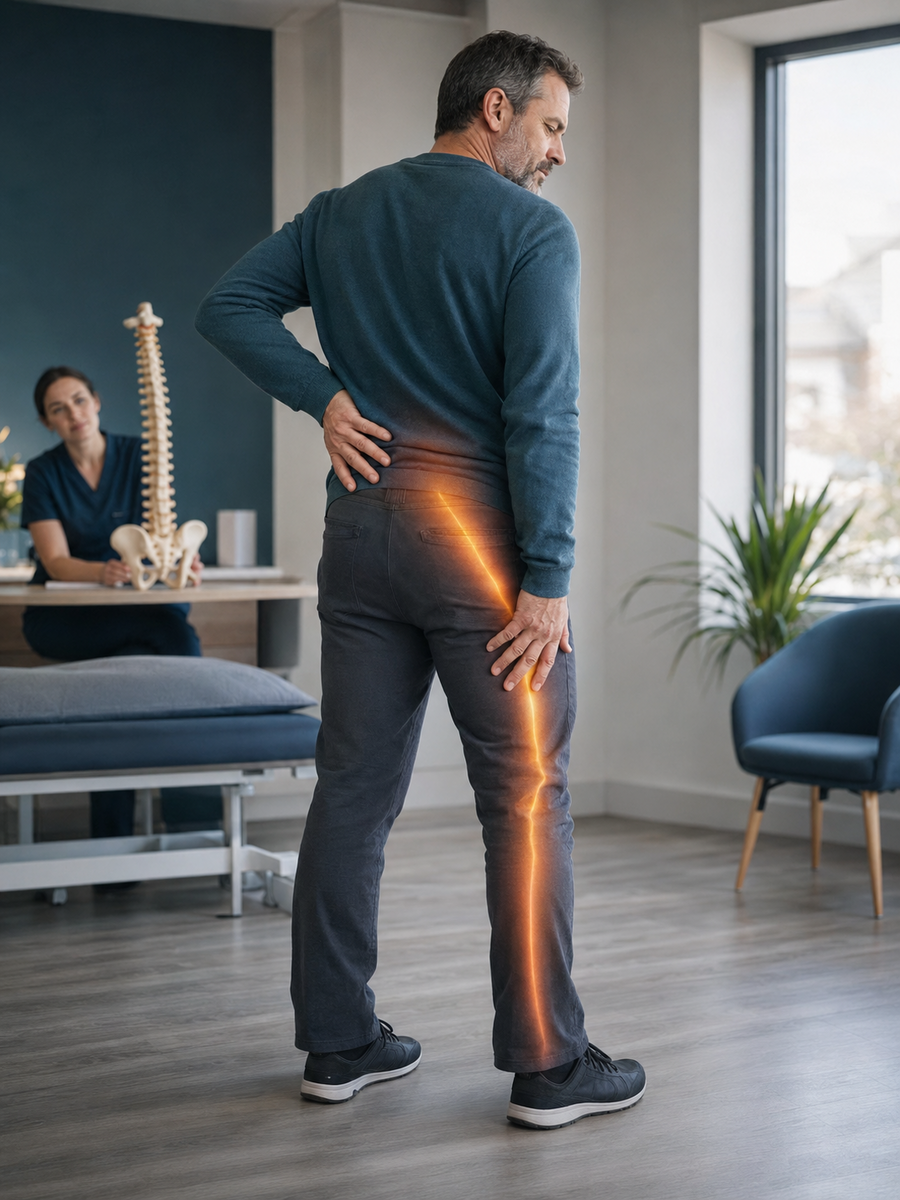
When do we talk about chronic sciatica?
The International Association for the Study of Pain defines chronic pain as pain that persists or recurs for more than three months. NICE also uses a duration of three months or more to qualify pain as chronic. In this page, ‘chronic sciatica‘ refers to a painful pathway compatible with radicular involvement that lasts or recurs beyond this time frame.
The term sciatica describes a set of symptoms rather than a single cause. Pain in the buttock, hip, sacroiliac joints, or small peripheral nerves can sometimes mimic sciatica. Persistent pain is a reason to verify again whether the pathway, neurological examination, and any imaging provide the same story.
Radicular Pain
Burning, shooting, or pain radiating down an area consistent with a lumbar root.
Radiculopathy
Nerve function impairment with weakness, loss of sensation, or changes in reflexes.
Referred Pain
Pain felt in the leg without sufficient evidence of nerve root involvement.
Why can sciatica persist?
Multiple mechanisms can coexist. A useful explanation does not artificially choose between “structure” and “nervous system”: it seeks the contribution of each, their alignment with symptoms, and modifiable factors.
Persistent compression
A herniated disc, foraminal stenosis, a narrow lumbar canal, or spondylolisthesis can continue to reduce the space of a nerve root.
Inflammation or nerve injury
A root may remain irritable or recover slowly, even if the initial compression has decreased.
Mechanical recurrences
Repeated loads, positions, or tasks can trigger flare-ups before tolerance is rebuilt.
Loss of capacity
Prolonged rest, fear of movement, and cessation of activities can reduce endurance, strength, and confidence.
Sleep and stress
Fragmented sleep, significant distress, or a difficult context can amplify pain without making it any less real.
Sensitization
The nociceptive system can become more reactive; pain that is easier to trigger does not necessarily imply new damage.
What the evolution of symptoms may suggest
| Observation | Question to explore | Possible next step |
|---|---|---|
| Pain that descends further or new territory | Is the root more irritated or has another cause appeared? | Rapid clinical reassessment, especially if sensitivity or strength changes. |
| Weakness of the foot or calf | Is there progressive motor radiculopathy? | Quick medical advice; imaging or specialized consultation may become a priority. |
| Pain especially while walking, relieved by sitting | Is lumbar stenosis or neurogenic claudication plausible? | Compare examination, walking distance, and imaging if it changes management. |
| Variable pain without progressive deficit | Does load, sleep, conditioning, or sensitivity contribute? | Gradual plan with functional measures and regular adjustments. |
| No improvement after several treatments | Were the diagnosis, treatment dose, and goals appropriate? | Take a break, reassess the hypothesis, and avoid stacking care. |
What signs should never be attributed to chronicity?
The fact that sciatica is old does not protect against a new complication. A significant change in profile requires a new decision, even if an MRI has already been done.
Possible cauda equina
New retention or incontinence, loss of saddle sensation, new sexual dysfunction, or significant symptoms in both legs.
Neurological deficit
Foot drop, rapidly progressive weakness, repeated falls, or new inability to walk on heels or toes.
Possible Serious Cause
Fever, recent infection, known cancer, immunosuppression, unexplained weight loss, trauma, or unusual night pain.
What should be reassessed after three months?
A useful reassessment is not limited to asking whether the pain is still present. It compares the current symptoms to the beginning of the episode and measures what has changed in neurological function and daily life.
- Exact path, side, intensity, numbness, and aggravating factors.
- Strength of the big toe, foot, calf, and knee.
- Sensitivity, reflexes, balance, walking, and exercise tolerance.
- Tolerated time sitting, standing, and driving; walking distance.
- Quality of sleep, ability to work, and activities abandoned.
- Treatments tried, actual dose, duration, benefits, and side effects.
- Correspondence between imaging, affected side, and suspected root.

Is an MRI or electromyogram necessary?
Imaging is not automatic for all lower back pain or sciatica. NICE recommends considering it in a specialized context only when the outcome is likely to change management. The American College of Radiology generally considers a lumbar MRI without contrast appropriate for a person eligible for intervention or surgery whose symptoms persist or progress after about six weeks of optimal management.
Lumbar MRI
It can clarify a herniation, stenosis, or another structural issue when this information changes the decision.
Electromyogram
It can sometimes help if the diagnosis remains uncertain, if peripheral neuropathy is possible, or if the examination and MRI do not match.
New imaging
It is not necessary at fixed intervals. However, a new deficit, trauma, or significant change may alter the clinical question.

A graduated action plan to regain function
The plan should be tailored to the probable cause, any deficits, important activities, and the response after each step. A brief and tolerable increase does not always indicate harm, but pain that worsens, increasing numbness, or loss of strength necessitates an adjustment.
- Clarify safety. Rule out signs of urgency and assess strength and sensitivity.
- Choose two functional goals. For example, walking for ten minutes and sleeping with fewer awakenings.
- Reduce load peaks. Break tasks into smaller parts and alternate positions without avoiding any movement.
- Resume gradually. Increase one variable at a time: duration, distance, repetitions, or resistance.
- Review at fixed intervals. Continue what improves a significant measure and change what provides no benefit.
NICE encourages the continuation of normal activities as much as possible and recommends exercise considering individuals’ needs and capabilities. For persistent pain with significant barriers to recovery or previous failures, a program combining physical and psychological elements may be considered.
What treatments can be discussed?
A chronic sciatic condition is not treated by simply stacking techniques. The choice depends on clinical consistency, neurological progression, risks, preferences, and goals. International recommendations do not replace a personalized medical decision.
| Option | What it can aim for | Limits and caution |
|---|---|---|
| Education and graded activity | Reduce avoidance, rebuild tolerance, and regain useful activities. | Must be adapted to the neurological profile; ‘moving more’ without dosage is not a plan. |
| Rehabilitation and exercise | Work on mobility, endurance, strength, walking, and confidence according to abilities. | TAGMED Clinic does not offer physiotherapy; external referral may be relevant. |
| Manual therapy | Provide temporary relief and support movement in certain individuals. | NICE considers it only within a set including exercise, with or without a psychological approach. |
| Medications | Modulate pain while a functional plan is being established. | Benefits may be limited and risks should be reviewed with the prescriber. |
| Epidural injection | Modestly and temporarily reduce pain or disability in certain radiculopathies. | The effect is variable; the American Academy of Neurology mainly describes limited short-term benefits. |
| Surgical advice | Decompress a root when symptoms, function, and imaging are consistent. | NICE suggests considering it if non-surgical treatment does not improve pain or function and if imaging is consistent. |
Which medications deserve a review?
NICE recommends not offering gabapentinoids, other antiepileptics, oral corticosteroids, or benzodiazepines for sciatica, due to an overall lack of benefit and risks. It also recommends not offering opioids for chronic sciatica. Non-steroidal anti-inflammatory drugs present risks and limited evidence of benefit.
A medication review should check the concrete benefit, side effects, interactions, duration of use, and purpose. A two-point drop in pain without improvement in sleep, walking, or function may not represent sufficient benefit for some patients.
Neurovertebral decompression and chronic sciatica
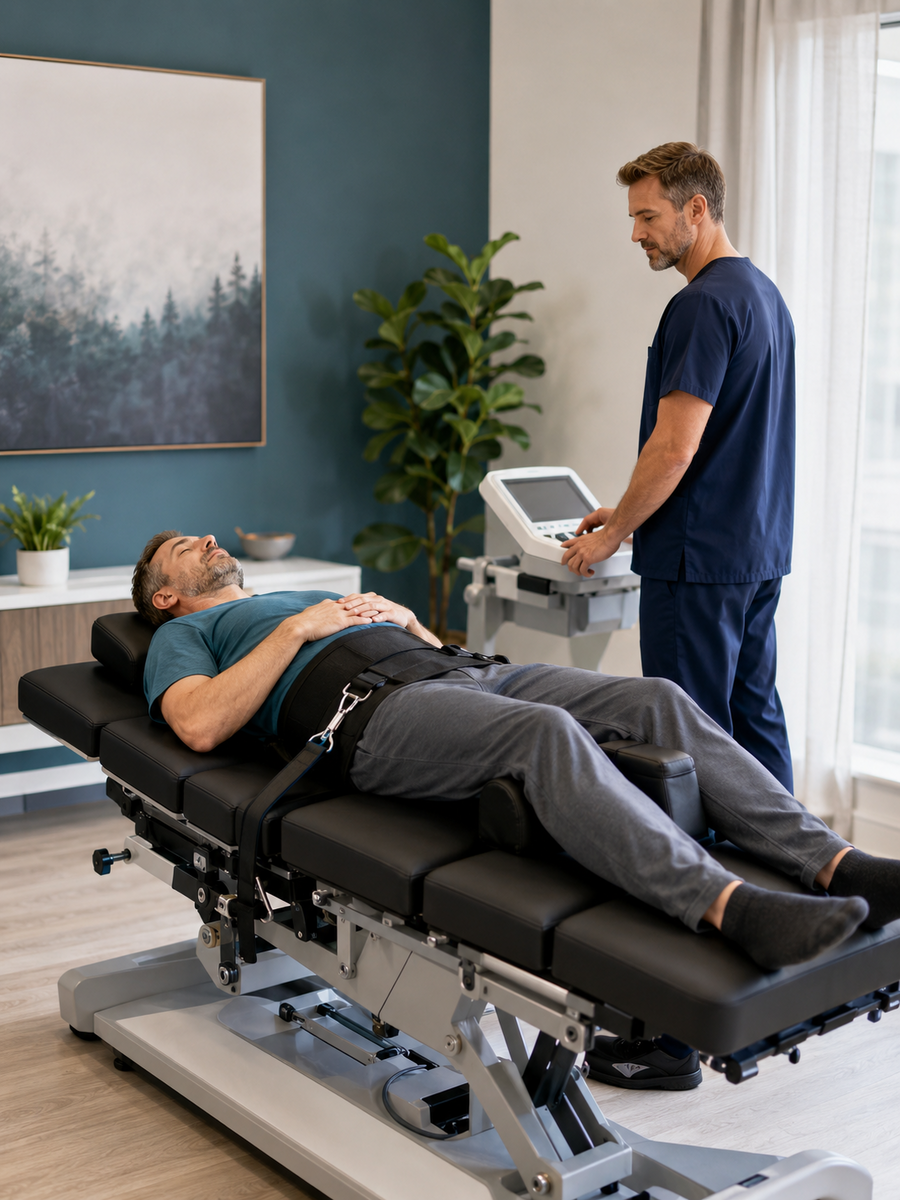
The spinal decompression therapy is a non-surgical approach that applies controlled traction to the lumbar region. It differs from surgical decompression. It can be considered as an individualized trial in certain mechanical or disc profiles, after checking for contraindications and without delaying necessary medical referral.
The evidence does not allow it to be presented as a routine treatment or as a guarantee. NICE recommends against offering traction for low back pain with or without sciatica. This reservation must be clearly explained before any decision.
- Define a measurable goal before the first trial.
- Check that the symptoms and any imaging are consistent.
- Monitor the pathway, numbness, strength, and tolerance after each session.
- Stop or redirect if the pain radiates down further, if any deficit progresses, or if no functional benefit is observed.
Six traps that sometimes maintain the deadlock
Waiting without a deadline
“Let’s see if it works” is no longer sufficient when the function has been stagnant for months.
Repeating an ineffective treatment
A method should be linked to a goal and reviewed after a defined period.
Only chasing the pain
Walking, sleeping, working, and strength are essential outcomes.
Avoiding all movement
Total protection can decrease capacity; however, recovery must be graded.
Treating only the MRI
A structural anomaly never replaces clinical concordance.
Ignoring a change
A new deficit or new territory requires reassessment, even after several months.
Assessment of chronic sciatica at TAGMED Clinic
The TAGMED Clinic can offer an osteopathic assessment of low back pain or a path consistent with sciatica. The goal is to document the profile, function, signs that necessitate medical referral, and the potential relevance of a non-surgical approach.
This assessment does not replace a medical diagnosis, a prescription, an MRI, an injection, a supervised rehabilitation, or a surgical opinion. Referral to a doctor, pharmacist, physiotherapist, or specialist may be recommended when the situation exceeds the practice scope of osteopathy.
TAGMED Clinic Terrebonne
1150 Lévis Street, Suite 200
Terrebonne, QC, J6W 5S6
Phone: 450-704-4447
Days: Monday, Wednesday, and Friday
TAGMED Clinic Montreal / Mont-Royal
1140 Beaumont Avenue
Mont-Royal, QC, H3P 3E5
Phone: 1-877-672-9060
Days: Tuesday and Thursday
Frequently Asked Questions about Chronic Sciatica
How long does it take for sciatica to become chronic?
Pain is generally classified as chronic when it persists or recurs for more than three months. This timeframe warrants a reevaluation but does not, by itself, predict the prognosis.
Can chronic sciatica still heal?
Improvement remains possible. The outcome depends particularly on the cause, neurological deficit, duration, general health, and the ability to establish an adapted plan. No method can guarantee healing.
Why does the pain persist if the hernia has decreased?
A root may recover slowly after irritation. Loss of capacity, sleep, mechanical pushes, and increased sensitivity can also contribute. A new evaluation helps distinguish these possibilities.
Do we need to repeat an MRI?
Not automatically. A new MRI becomes more relevant if the result changes the management, if a deficit appears or progresses, or if an intervention is considered.
Is an electromyogram always necessary?
No. It can help when the diagnosis is uncertain, when the MRI does not correspond to the examination, or when distinguishing between a root injury and a peripheral neuropathy is required.
Should one continue walking despite the pain?
A measured walk can support recovery if it does not cause a progression of the journey, numbness, or weakness. The duration and breaks should be adapted to the profile.
What medications are recommended?
The choice belongs to the doctor or pharmacist. NICE particularly advises against gabapentinoids, oral corticosteroids, benzodiazepines, and chronic opioids for sciatica. A medication already taken should not be stopped abruptly.
Can an epidural injection help?
It can provide modest short-term benefit in certain radiculopathies. It does not work for everyone, is not offered at the TAGMED Clinic, and requires a medical decision.
When should you seek a surgical opinion?
An opinion may be appropriate if a significant deficit appears or if pain and disability persist despite appropriate non-surgical treatment and imaging shows a target.
Is neurovertebral decompression proven for chronic sciatica?
The evidence does not support recommending it as a routine treatment, and NICE advises against traction. Any potential trial should be individualized, cautious, measured, and never delay indicated medical advice.
Sources and References
- International Association for the Study of Pain — Definitions of Chronic Pain Syndromes.
- NICE NG59 — Low back pain and sciatica: assessment and management.
- American College of Radiology — Appropriateness Criteria: Low Back Pain.
- American Academy of Neurology — Epidural Steroids for Radicular Pain and Spinal Stenosis, 2025.
TAGMED guides by city
Choose a condition and city to view the corresponding TAGMED treatment guide.
SOS Sciatique and TAGMED Clinic are part of the same website portfolio.
Your sciatica persists despite several attempts?
A re-evaluation can help clarify what has changed, the functional goals, and the next useful direction. When the situation is compatible with the field of practice, a cautious non-surgical approach can be discussed without delaying necessary examinations or medical care.
Sylvain Desforges, B.Sc., D.O., N.D., Doctor of Osteopathy
Editorial information, sources and limitations
This content is intended to inform patients about sciatica, possible causes, warning signs, and care options. It does not replace an individualized assessment.
Reference sources
References are selected according to the subject of the page: guidelines, systematic reviews, then institutional resources.
- NICE NG59 – Low back pain and sciatica in over 16s — National guideline
- HAS – Management of patients with common low back pain — French national guideline
- Cochrane – Corticosteroid injections for treatment of sciatica — Systematic review
- NCBI Bookshelf – Sciatica — Clinical institutional resource
Complementary resources from the TAGMED network
These internal resources complement the clinical information and thematic linking. They do not replace national guidelines or systematic reviews.
Editorial note on decompression
Clinical resource from the TAGMED network; it does not replace national guidelines. Some guidelines use the term “traction” and recommend caution for low back pain with or without sciatica. Any decompression option should therefore be presented as an individualized clinical approach, with limitations, indications, and contraindications clearly explained.
Limitations of this information
The information on this page is general. It does not constitute a diagnosis, prescription, or guarantee of results. Pain radiating into the leg may have several causes; assessment should consider clinical history, examination findings, symptom progression, and, when appropriate, complementary tests.
When to seek urgent medical care
Seek urgent medical care if you experience loss of bladder or bowel control, saddle anesthesia, major or progressive leg weakness, unexplained fever, pain after significant trauma, or severe pain that rapidly worsens.
