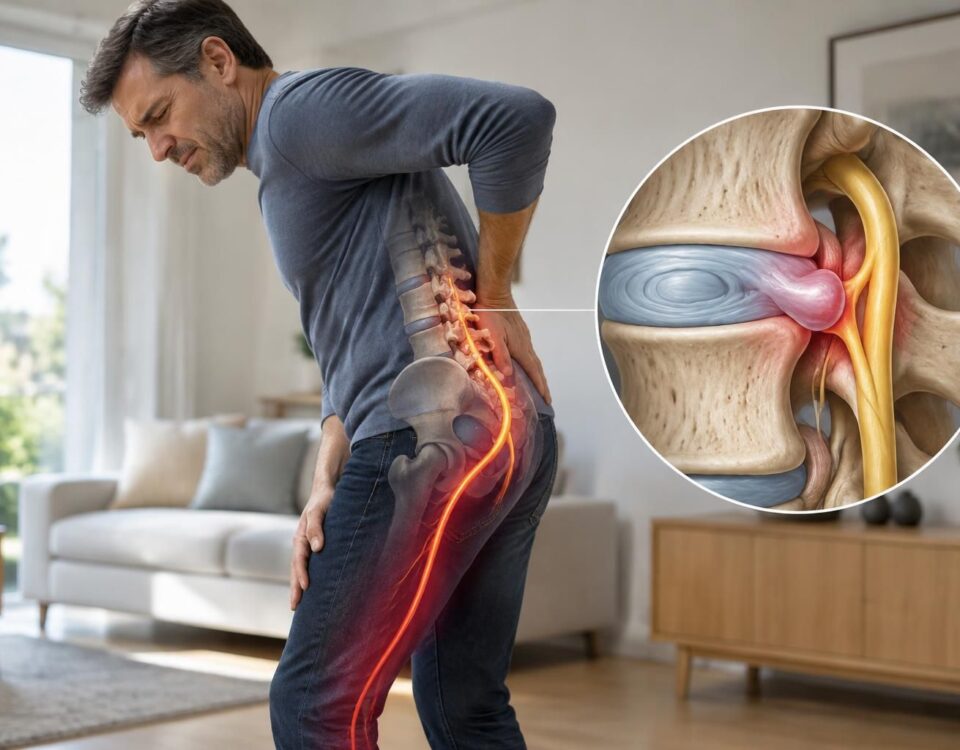
Sciatica in Terrebonne: pain in the buttock without back pain
27/09/2026
Sciatica and limping: sign to evaluate
27/09/2026
IN BRIEF
| In brief, lumbar disc herniation can cause sciatica even with a small protrusion: the pain follows the irritated nerve root, descending into the buttock, thigh, calf, or foot. This involves a worn intervertebral disc that can compress a root; it is the most common cause of radiating pain. The advantages of current treatment: avoid surgery in most cases, and recover through a conservative protocol that combines adapted activity, pain management, physiotherapy, and reduction of pressure on the disc. The diagnosis is primarily clinical; imaging is reserved if symptoms persist or in case of doubt. The approach: gentle movement and strengthening of the deep trunk muscles are prioritized, with options like injections in case of resistant pain, and surgery remains rare and reserved for very specific cases. |
The disc herniation occurs when the nucleus of the intervertebral disc protrudes through the fibrous ring and can compress a nerve root. Even a small protrusion can lead to painful sciatica that runs down the leg, depending on the path of the affected root. The diagnosis is mostly clinical; MRI is useful for confirming and planning treatment if necessary. The initial treatment is conservative: adapted activity, analgesics, anti-inflammatories, physiotherapy, and possibly an injection. Surgery remains rare and is reserved for significant neurological deficit or treatment failure after about 6 to 8 weeks. Most patients improve within a few weeks by staying active and managing pain.
This professional summary explains why a small disc protrusion can cause severe sciatica. It describes the mechanism, diagnosis, and non-surgical management options when possible. The goal is to quickly relieve pain, preserve mobility, and avoid invasive interventions as long as signs allow. For patients seeking support at TAGMED clinic, specialized methods may be proposed based on the evaluation.
Understanding the link between protrusion and pain
The intervertebral disc acts as a cushion between the vertebrae. With wear or repeated stress, the fibrous envelope can crack, allowing part of the nucleus to escape. This is referred to as a protrusion or disc herniation, depending on the extent of the detachment. Even a minimal protrusion can irritate or compress a nerve root. This irritation triggers pain that follows the path of the nerve and can manifest far from the back, notably in the buttock, thigh, or leg. Pain is not always proportional to the radiological appearance, highlighting the importance of a thorough clinical examination.
Typical signs and symptoms
Classic symptoms often associate low back pain with pain that radiates down the limb. Burning sensations, electrical shocks, or tingling along the path of the sciatic nerve are commonly described. Signs such as numbness or progressive severe weakness in one leg may accompany the episode. Pain may worsen with prolonged sitting, coughing, sneezing, or strenuous effort, which increases pressure on the disc.
Alerts should lead to prompt consultation. Loss of sensitivity in the perineal-anal area, urinary or sphincter loss, severe progressive weakness in one leg, or intense pain that persists despite treatment are signs requiring urgent medical evaluation.
Diagnosis and imaging
The initial diagnosis is based on the interview and clinical examination. The pain pathway and neurological tests guide the evaluation. MRI is the reference examination when the doctor seeks to specify the exact position of the protrusion and the extent of nerve compression. Imaging may be useful when pain persists, worsens, or before an intervention or injection. X-rays do not show the discs and have little interest in this context.
In some cases, online resources and specialized articles explain warning signs and possible MRI results. For further reading, you will find relevant resources on Disc herniation and what the MRI can show and other analyses on pain that prevents sitting.
Treatment options and management
Most cases evolve favorably without surgery. Treatment aims to reduce pain, preserve mobility, and decrease pressure on the disc.
Conservative treatment and management at TAGMED clinic: it may include motorized neurovertebral decompression, a specific osteopathy, or the use of a precision impactor, based on individual assessment. These approaches are offered at the TAGMED Clinic in Montreal or Terrebonne.
Complementary options exist when pain persists. Local injections may be considered to target inflammation around the nerve root and facilitate the resumption of activity. Surgery remains rare and is generally reserved in cases of treatment failure, refractory pain, or severe neurological deficit. Modern interventions may be minimally invasive and performed with appropriate rehabilitation follow-up.
For those looking to explore the links between pain and treatment, resources available on pain that prevents driving for long or sciatica and slow walking may offer complementary perspectives.
Preventing recurrences and preserving the back
Prevention involves simple and regular measures. Maintaining a healthy weight and promoting adapted physical activity support the spine. It is important to avoid movements that impose sudden twisting or excessive rounding of the back when lifting a load. Active breaks and a neutral posture during long sitting sessions help reduce pressure on the disc.
Note that most episodes improve in the weeks that follow, especially if the treatment is applied quickly and if severe symptoms remain absent. To learn more about mechanisms and treatments, you can check information resources about pain and prolonged sitting and about slow walking and tolerance.
Frequently Asked Questions
Can a protrusion resolve on its own? Yes. The body can reabsorb the protrusion, and the inflammation around the nerve can decrease. The majority of cases progress without surgery within a few weeks if one stays active and follows an appropriate protocol.
Is surgery mandatory in case of a protrusion? No. Surgery is the exception and occurs after a failure of conservative treatment, uncontrollable pain, or significant neurological deficit.
Is the diagnosis based solely on imaging? No. The clinical examination and the pain trajectory largely guide management. Imaging confirms the presence of a protrusion and specifies its relation to the nerve roots.
Is sports possible during an episode? Movement is generally recommended, but activities should be adapted and performed without straining. Consult your specialist for a safe approach tailored to your situation.
Useful Links and Professional Resources
For additional information on clinical approaches and treatment options available nearby, visit the TAGMED Clinic and the associated resources:
TAGMED Clinic: cliniquetagmed.com
Neurovertebral decompression pathways and options: decompressionneurovertebrale.com
General resources on protrusion and sciatica: sosherniediscale.com and sosherniateddisc.com
Information elements on carpal tunnel related to radicular pain: sostunnelcarpien.com
For more general context, educational references on the links between disc pain, protrusion, and radicular symptoms can be consulted through public resources from sciatica in Montreal and pain that prevents sitting.
To understand the clinical implications, you can also explore additional informational resources on Doctissimo.
You can also consult articles about progression and warning signs on MedecinIndirect.
For questions related to education and information on sciatic pain, specialized online resources can be consulted at Sciatica and walking.
Warning: this article does not constitute individual medical advice. Any significant pain requires personalized medical consultation.
Medical Disclaimer: The information and advice provided on this site do not replace the opinion, diagnosis, or treatment of a healthcare professional. Please note that Dr. Sylvain Desforges, osteopath, is neither a medical doctor nor a specialist in a medical specialty as defined by the Collège des médecins du Québec. Manual medicine, functional medicine, and sports medicine as described on this site exclude any treatment or medical diagnosis made by a doctor or medical specialist. Always consult your physician for any medical questions. For more details, please read our full Legal Notice.
- Context minor protrusion but marked pain.
- Definition worn disc, nucleus pushing against a nerve root.
- Why pain persists nerve inflammation and residual pressure.
- Typical signs radiating pain, paresthesia, possible localized weakness.
- Quick diagnosis clinical evaluation and painful trajectory for localization.
- Aim of treatment relieve without surgery and restore movement.
- Non-surgical options adapted activity, physiotherapy, analgesics/anti-inflammatories, injections if needed.
- When to operate neurological deficit, rebellious pain after 6–8 weeks.

This article explains why a disc protrusion can cause significant pain in sciatica even when imaging shows a small bulge. Pain depends more on the irritation or compression of a nerve root than on the exact size of the protrusion. You will see how to quickly assess the situation, prioritize a conservative treatment, and incorporate exercises and good posture to promote recovery, while knowing when a specialized consultation is necessary.
Understanding the relationship between protrusion and pain
A disc protrusion occurs when the nucleus of the disc pushes against the envelope, potentially irritating a nerve root and triggering pain that travels down the nerve, often to the foot. This pain is termed radiating pain and can coexist with tingling or burning sensations. The precise location of the pain trajectory helps pinpoint the involved root and determines whether the pain is more sciatic or femoral. It sometimes happens that small protrusions cause intense pain because they touch sensitive areas of the spinal canal.
Diagnosis and Follow-up
The diagnosis is based on clinical examination and evaluation of the pain pathway, reflexes, and muscle strength. In the majority of cases, no imaging is necessary at the start, and treatment can be initiated quickly. An MRI or CT scan becomes useful if the pain persists, if neurological signs appear, or if an injection or surgery is considered. Warning signs justifying urgent consultation include loss of urinary control, progressive weakness of one leg, extremely intense pain not relieved by treatment, or associated fever.
When imaging is useful
Used as a complement, imaging allows visualization of the disc, potential compression, and nerve structures. It helps adapt the treatment plan and exclude other painful causes. Keep in mind that visible protrusions on an MRI do not always produce symptoms, and the absence of major abnormalities does not mean the absence of pain.
Conservative treatment plan
In most cases, conservative treatment is sufficient: tailored activity, pain relief, and inflammation reduction. Strict rest is rarely necessary; prioritize light and progressive activity. Anti-inflammatories and analgesics may be prescribed according to medical evaluation, with gradual reduction of medication over the weeks. Physical therapy and targeted exercises help restore mobility, strengthen supporting muscles, and improve postural patterns to limit recurrences. If pain persists despite these measures, local injections may be considered to reduce inflammation around the nerve root.
Avoid risky movements and promote movement
Avoid sudden twists and lifting heavy loads; prioritize walking and gentle exercises following a professional’s advice. Maintaining moderate daily activities helps reduce pressure on the lumbar discs and accelerates recovery. An appropriate sitting posture and regular active breaks are also beneficial in limiting pain worsening during long periods of sitting.
Exercises and posture
Simple and progressive exercises strengthen the deep core muscles and improve stability, which can bring pain under control. Start with pain-free movements, then increase intensity under supervision if necessary. Adapting posture during daily activities, especially when lifting, helps protect the back and prevent recurrences. If radiating pain frequently returns or is accompanied by persistent tingling, quickly reassess the situation with a professional.
Preventing recurrences
Prevention relies on regular physical activity, strengthening the back and hip muscles, weight control, and proper lifting techniques. Planning active breaks during long sitting periods and integrating mobility exercises can help maintain a resilient spine and reduce the risk of recurrence, even after initial improvement.
| Definition | Small disc protrusion that may compress a nerve root and cause significant radiating pain in the leg |
| Common location | Lower lumbar, typically between L4-L5 or L5-S1 |
| Key symptoms | Radiating pain in the buttock and leg, sometimes with paresthesias; pain often stronger than back pain |
| Warning signs | Motor deficit, loss of urinary/bowel control, very intense or progressive pain requiring urgent care |
| Initial diagnosis | Clinical evaluation; MRI useful if persistence or to plan an injection or procedure |
| Evolution without surgery | Approximately 80% improve within weeks with appropriate movement and treatment |
| Initial management | Tailored activity, analgesics/anti-inflammatories, and physical therapy |
| Advanced options | Injection in case of persistent pain; surgery reserved for treatment failure or significant neurological deficit |
| Prevention and recovery | Regular physical activity, strengthening the core, and safe lifting techniques to limit recurrences |
Patient testimonials: significant pain despite a small protrusion
My name is Sophie, 38 years old. I was diagnosed with a herniated disc with a small protrusion, yet the sciatica that went down to my foot was so intense that sleeping became impossible. Even though the imaging showed modest protrusion, the pain was daily debilitating. Thanks to a personalized plan focused on movement, posture, and physical therapy, I gradually regained a sense of lightness and the ability to carry out my usual tasks within weeks.
My name is Thomas, 46 years old. A herniated disc with a small protrusion caused a sciatica radiating from the buttock to the calf, and the pain remained very strong despite what appeared on the imaging. With targeted exercises and posture advice, the pain significantly improved, and I was able to return to work without fearing every step.
Marie, 34 years old, recounts: after the diagnosis of herniated disc and a small protrusion, the pain was still very sharp during flare-ups. Physical therapy, breathing techniques, and stretching exercises allowed me to reduce inflammation around the nerve and improve my mobility. Today, the sciatica is much more tolerable, and my days have become fluid again.
Alexandre, 29 years old, an athlete, discovered a lumbar herniated disc with a small protrusion that triggered a disabling sciatica during training. The gradual approach and sessions of physical therapy allowed me to safely return to sports, with core strengthening exercises and adapted posture advice, and the pain has decreased.
Claire, 43 years old, an executive, suffered from a herniated disc with a small protrusion and sciatica that regularly recurred and disturbed her professional life. After a management focused on movement and reducing pressure on the disc, combining tailored physical activity and posture work, the pain became sporadic, and my ability to sit for long periods improved.
Herniated disc and sciatica: significant pain despite a small protrusion
Dr Sylvain Desforges, osteopath, specialist in chronic pain and manual care, offers an integrated approach for patients suffering from a herniated disc and sciatica. An expert in osteopathy, naturopathy, and manual medicine, he has dedicated his career to health innovation and improving care pathways. Founder and president of the TAGMED clinics and the ACMA association, he emphasizes evidence-based treatments tailored to each patient to optimize their health and well-being. His approach revolves around total body management, combining manual techniques and recent technologies to treat lower back and radicular pain.
A herniated disc occurs when the gel-like nucleus of the intervertebral disc pushes through the fibrous ring, which can lead to nerve compression and pain that travels along the nerve’s path—the sciatica. This phenomenon can manifest even when the disc protrusion is relatively small and the symptoms appear disproportionate compared to the radiological image. Dr. Desforges points out that pain is not solely related to the protrusion itself, but mainly to irritation or compression of a nerve root in the spinal canal, which explains why a small protrusion can cause intense and debilitating pain.
A central part of the practitioner’s work involves distinguishing painful pathways and areas affected by radiculopathy. Pain can follow the path of the sciatic nerve, from the buttock to the foot, or target areas like the front of the thigh in cases of femoral nerve pain. The intensity and location vary depending on the affected level (e.g., L4–L5 or L5–S1 for sciatica). This understanding guides a targeted approach: identifying movements and postures that worsen the pain and proposing strategies to reduce pressure on the disc while maintaining activity, which is key to rapid recovery.
In his practice, Dr. Desforges prioritizes tailored education and a progressive treatment plan. The diagnosis mainly relies on a clinical examination, with imaging only when pain persists despite initial treatment or in the presence of neurological signs. Conservative treatment is the cornerstone: adapted activity, postural advice, physiotherapy to strengthen supporting muscles, and measures to reduce pain and inflammation. Complementary options, such as injections targeting inflammation near the nerve root, can be discussed depending on the severity and duration of symptoms. Surgery remains the exception, reserved for rare cases where neurological deficits worsen or persist despite optimized treatment over several weeks.
Dr. Desforges’ philosophy is based on an evidence-based approach, which combines effective manual techniques with modern technologies. Among them, he integrates spinal decompression methods, laser therapies, and shockwave therapies when relevant, to promote recovery and prevent recurrences. His goal is to enable each patient to regain functional mobility and a sustainable quality of life, without unnecessary sacrifice of their daily activities.
For individuals facing significant pain related to even a subtle disc protrusion, support from Dr. Desforges offers a clear and personalized path: precise diagnosis, progressive treatment plan, and regular follow-ups to assess progress and adjust interventions based on evolution. His human and structured approach encourages rapid and proactive management to effectively and safely restore comfort and mobility.
This text explains why significant pain may persist even with a small disc protrusion, how this can be understood, how it can be evaluated and treated without surgery, and what situations require prompt management. It also recalls the mechanisms underlying radiated pain, the indications for examinations, and the principles of a progressive and tailored management approach to limit recurrences.
Understanding the mechanism: why a small protrusion can cause marked pain
A herniated disc occurs when the gel-like nucleus of a disc protrudes outside its envelope, possibly irritating or compressing a nerve root that exits the spine. Pain is not merely a function of the size of the protrusion: it is often the interaction between the protrusion and the nerve root that determines the intensity and pathway of the pain, notably in the lower limb. This is why an apparently modest protrusion can trigger strong sciatic pain, with burning sensations, tingling, or muscle weakness along the nerve’s path.
Diagnosis and therapeutic orientation: when imaging is useful and how to act in practice
In most cases, the diagnosis initially relies on clinical examination and history-taking, based on the pain’s trajectory and any neurological signs present. MRI is generally indicated only when pain persists despite treatment, is accompanied by neurological deficits, or when an invasive procedure is considered. Alert signs require urgent evaluation: loss of bladder control, bowel dysfunction, rapid weakness in a leg, rapidly worsening pain, or associated fever. For cases without major deficits, active monitoring and conservative approaches are prioritized, as most lumbar protrusions heal within a few weeks as inflammation and pain diminish.
Therapeutic approach and progressive management: prioritizing conservative treatment
The initial treatment aims to relieve pain while allowing for activity. This involves measures such as analgesics and, if appropriate, anti-inflammatories for a limited duration, a temporary reorganization of activities, and a gradual return to movement. Physiotherapy plays a central role: targeted exercises and postural advice to strengthen the deep trunk muscles, improve spinal stability, and prevent recurrences. In cases where pain persists despite optimal management, local injection may be discussed to target inflammation around the nerve root. Surgery is only considered in rare situations: failure of conservative treatment after 6 to 8 weeks, disabling resistant pain, or major neurological deficit.
Prevention and practical daily advice to limit recurrences
After the acute episode, prevention involves adapted physical activity, strengthening the supporting muscles, and proper management of daily postures and movements. Simple measures such as avoiding long periods of sitting without breaks, adopting a sitting position with lumbar support, bending the knees to lift, and gradually progressing in sports contribute to reducing pressure on the discs and limiting recurrences. Lifestyle habits such as weight control and improving hip mobility complement an effective long-term approach.
To delve deeper into the mentioned points and access additional resources, please consult these helpful links:
Sciatica and walking on icy sidewalks: tension and muscle protection,
Sciatica in Terrebonne: pain that prevents sitting,
Sciatica in Montreal: calf pain that feels like a cramp,
Herniated disc and sciatica: link,
Sciatica in Terrebonne: burning pain behind the thigh,
Herniated disc and sciatica: mechanical cause,
Doctissimo – Herniated disc,
Lumbar herniated disc L4-L5,
Herniated and protruding discs,
Herniated disc: symptoms, treatment, and surgery.

L5-S1 protrusion and sciatic pain: pathway to the foot
IN BRIEF A L5-S1 disc protrusion is a disc that slightly bulges between the lumbar and sacral vertebrae. If it irritates a nerve root, pain may radiate from the lower back or buttock down the back of the leg to…

L4-L5 protrusion and sciatic pain: possible signs
IN BRIEF A L4-L5 disc protrusion is a bulging of the disc between two lumbar vertebrae. If it irritates the L5 nerve root, it can cause sciatica radiating from the buttock to the side of the leg and the top…
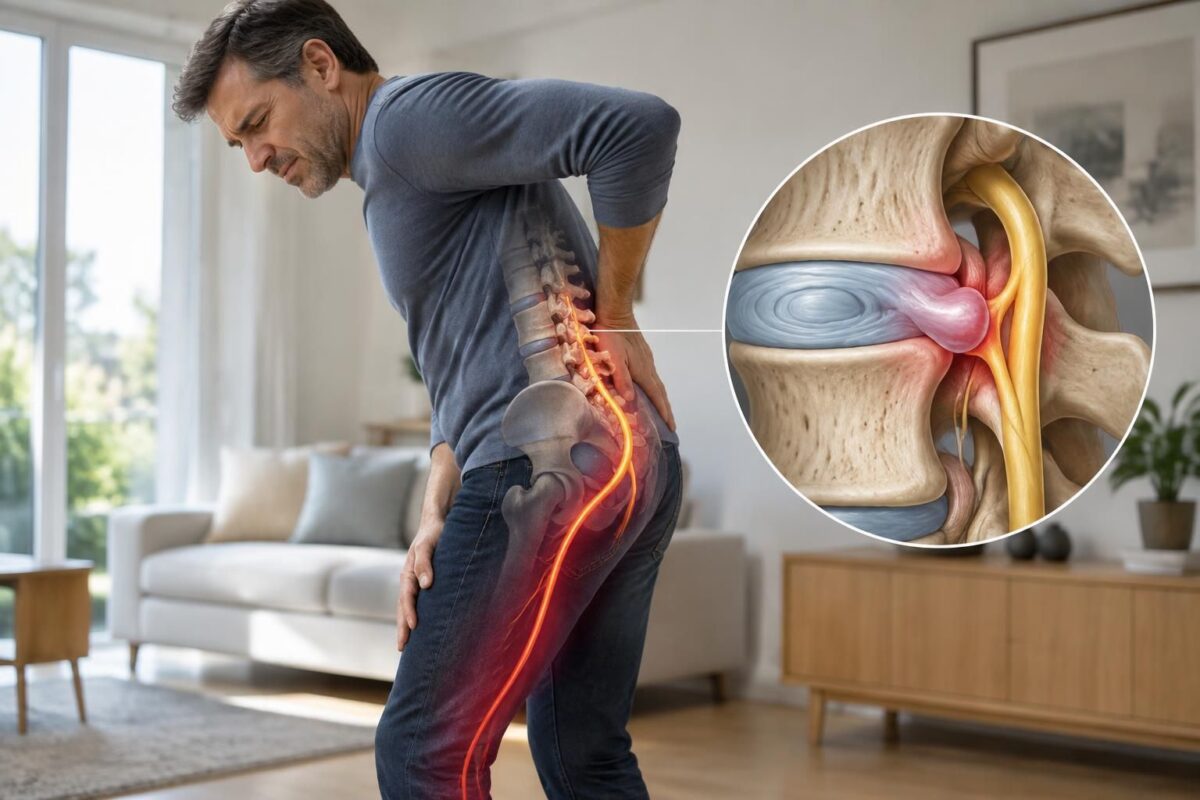
Disc protrusion and sciatica: when the disc touches a nerve root
IN BRIEF A disc protrusion is a disc that extends beyond its usual contour. If it irritates a nerve root, it can contribute to sciatica, with pain radiating into the buttock or leg, sometimes accompanied by tingling or weakness. An…

Herniated disc and sciatica: morning pain and lumbar stiffness
IN BRIEF A herniated disc can irritate a nerve root and cause sciatica, with lower back pain radiating down the leg. However, morning pain and lower back stiffness alone are not sufficient to confirm this diagnosis. An assessment helps guide…

Herniated disc and sciatica: night pain and factors to watch out for
IN BRIEF A herniated disc can irritate a nerve root and cause sciatica, sometimes more bothersome at night. Night pain alone is not enough to determine the cause: its variation according to positions, neurological examination and, if necessary, imaging help…

Herniated disc and sciatica: why the leg can be numb
IN BRIEF A sciatica is pain related to the irritation of a nerve root, sometimes caused by a <strongherniated disc. Pressure on the nerve can cause tingling, loss of sensation, or weakness in the leg. A healthcare professional can assess…

Herniated disc and sciatica: causes of recurring pain
IN BRIEF A herniated disc can irritate or compress a nerve root and cause sciatica, with pain radiating from the lower back to the buttock or leg and possibly returning. Symptoms and their causes are not always the same: an…
Herniated disc and sciatica: when to reassess symptoms
IN BRIEF A herniated disc can irritate a nerve root and cause sciatica, with pain that radiates down the leg. Reevaluating symptoms helps to track their evolution and determine if medical advice or tests are necessary, without assuming that surgery…

Dr Sylvain Desforges, B.Sc., D.O., N.D., osteopath, is the founding president of TAGMED and of the ACMA association. He dedicates his practice to chronic spinal pain, low back pain and symptoms compatible with sciatica, particularly when pain radiates toward the buttock, leg, calf, foot or toes.
Through SOS Sciatique, he publishes educational content on sciatica symptoms, possible causes such as disc herniation, disc narrowing, foraminal stenosis or irritation of a lumbar nerve root, as well as non-surgical approaches that may be considered according to the evaluation. At Clinique TAGMED, care may include, depending on the case, motorized neurovertebral decompression, specific osteopathic care or precision percussion.
For an evaluation related to sciatica treatment in Montreal / Mount Royal or sciatica treatment in Terrebonne, please consult the services available at Clinique TAGMED.
Medical disclaimer
The information published on SOS Sciatique is provided for educational purposes only and does not replace a consultation, diagnosis, opinion or treatment provided by a physician or another authorized healthcare professional. The author of this article is neither a medical doctor nor a specialist in a medical specialty recognized by the Collège des médecins du Québec. The osteopathic, manual medicine or functional support approaches described on this site do not constitute medical acts and are not intended to replace medical follow-up.
Consult a physician or emergency service in cases of loss of bladder or bowel control, anesthesia in the saddle area, significant or progressive weakness in the leg or foot, fever, recent trauma, severe pain or rapid worsening of symptoms. For more details, please read our Legal Notice.