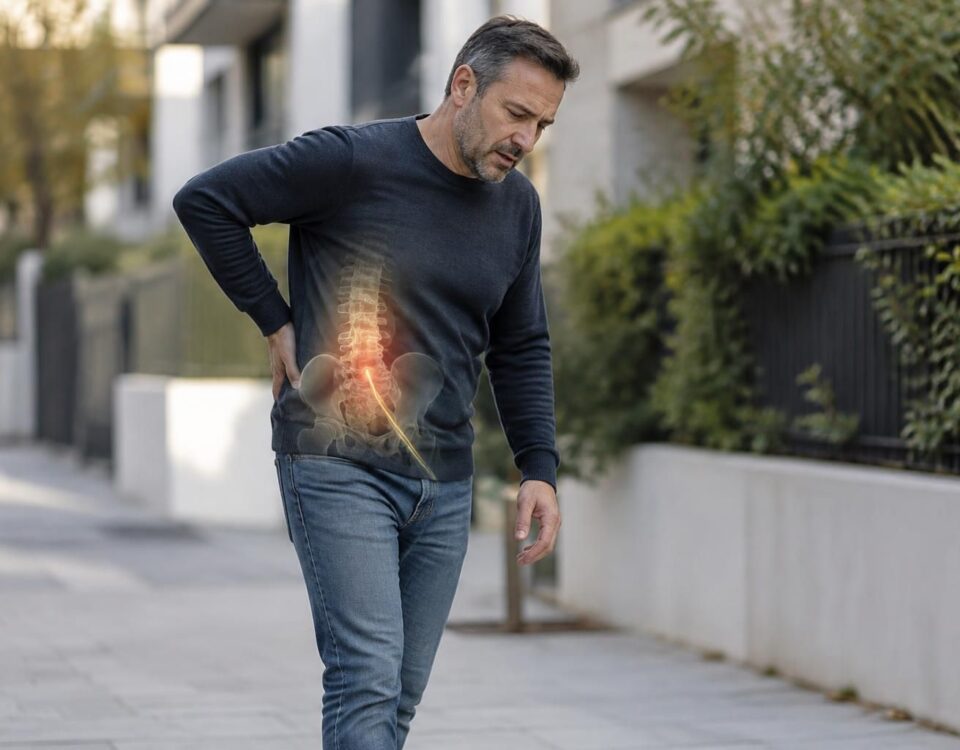
Sciatica and numbness in the leg: neurological sign
16/08/2026
Foot weakness and sciatica in Montreal: when to seek quick consultation?
17/08/2026
IN BRIEF
| In brief, a herniated disc with foot weakness is a protrusion of an intervertebral disc that can compress a nerve root, causing lower back pain and foot weakness, often associated with radiating pain in the leg. Treatment aims for pain relief and inflammation, most often without surgery, through non-surgical approaches and rehabilitation. Osteopathic support and lifestyle advice help prevent recurrences and chronic pain. In Montreal, this service is particularly recommended for individuals with foot weakness associated with radiating pain, to quickly restore mobility and function. |
The herniated disc occurs when the nucleus of an intervertebral disc pushes through a tear in the fibrous ring and can compress a nerve root. If this compression affects the nerves that control the foot, it can lead to foot weakness, sometimes associated with numbness or tingling in the top of the foot or leg.
Warning signs: increasing foot weakness and foot flexion/dorsiflexion impairment, pain worsening in a sitting position or during exertion, or pain radiating towards the leg. In the presence of these signs, prompt medical evaluation is recommended. Most hernias respond well to non-surgical treatment, but follow-up is essential.
Quick summary: a herniated disc can compress the nerve root that controls the foot muscles. This compression can lead to foot weakness and a risk of progression if left unchecked. This article outlines possible causes, signs to monitor, assessment methods, and non-surgical management options, particularly at TAGMED Clinic, with neurovertebral decompression options when indicated.
What is foot weakness related to a herniated disc?
Foot weakness can result from the impairment of a nerve root that controls the foot and ankle muscles. It may present as difficulty in lifting the foot (weakness of dorsiflexion) or bending certain toes. This weakness can be a sign of an irritated or compressed nerve and warrants prompt evaluation by a healthcare professional.
Causes and mechanisms
A herniated disc occurs when the nucleus pulposus of an intervertebral disc pushes against the fibrous covering and can compress a nerve root exiting the spinal cord. When the root supplying the foot is affected, the muscles responsible for dorsiflexion or plantar flexion may show weakness. Lumbar levels, particularly L5 and S1, play a key role in these symptoms, but manifestations at the thoracic or cervical level remain possible in other contexts.
Signs and symptoms to monitor
In addition to foot weakness, patients may experience:
– Pain in the lower back and/or leg
– Numbness, tingling, or burning sensation in the foot or toes
– Pain worsening in a seated position, when bending, or during coughing/sneezing
– Pain or weakness that worsens or persists
Assessment and monitoring
A medical assessment differentiates between a protrusion, a bulging disc, or an extruded herniated disc, and determines whether warning signs require rapid management. Imaging may be considered when symptoms evolve or present red flags, notably progressive motor weakness, associated lower back pain, or loss of urinary/perineal bowel control. For cases requiring specialized care, prioritize facilities dedicated to neurovertebral decompression and specialized osteopathy.
To access relevant information and resources, you can consult the resources dedicated to spine pathologies on the websites sossciatique.com and sosherniediscale.com.
Treatment options and management
Treatment aims for pain relief and inflammation. Surgery is rarely necessary and is only considered after thorough evaluation and failure of non-surgical measures. At TAGMED Clinic, available approaches include, depending on the case, specific osteopathy and motorized neurovertebral decompression, accompanied by functional support in line with clinical assessment. Intervention may be considered when symptoms evolve or when nerve function preservation demands it.
To learn more about non-surgical treatment proposals and options in Montreal or Terrebonne, consult Clinique TAGMED.
Additional information and insights on mechanisms and non-surgical options can be consulted on the following resources: sossciatique.com and sosherniediscale.com.
To understand the links between examinations and decompression options, you can explore resources on neurovertebral decompression.
General information and risk factors associated with herniated discs and lower back pain are also discussed on sosherniateddisc.com.
For questions related to osteopathic practice and training, note that relevant institutions in osteopathy include NUMSS, NAO, National University of Medical Sciences, and National Academy of Osteopathy. Relevant professional associations include ACMA, College of Canadian Osteopaths, and the Canadian College of Osteopaths.
As part of the treatments offered at TAGMED Clinic and neurovertebral decompression options, it is recommended to avoid exercises or stretches without supervision when the clinical context advises so, and to prioritize an evaluated approach guided by your specialist.
For additional information related to neurovertebral decompression and associated options, see neurovertebral decompression and sciatica and lumbar pain without pain.
Medical disclaimer: The information and advice provided on this site do not replace the opinion, diagnosis, or treatment from a health professional. Please note that Sylvain Desforges, B.Sc., D.O., N.D., Doctor of Osteopathy, is neither a medical doctor nor a physician, and is not specialized in any medical specialty as defined by the Collège des médecins du Québec. Manual medicine, functional medicine, and sports medicine as described on this site exclude any treatment or medical diagnosis made by a physician or specialist physician. Always consult your doctor for any medical questions. For more details, please read our full Legal Notice.
- Lumbar disc herniation possibly compressing a nerve root.
- Repeated pressure on the discs (heavy loads, frequent twists).
- Trunk instability and weakness of the abdominal muscles.
- Poor posture and lack of physical activity.
- Aggravating factors: overweight, smoking, general muscle weakness.
- Foot weakness (reduced dorsiflexion) to monitor.
- Radiating pain along the leg to the foot.
- Abnormal sensations (tingling/burning) in the foot.
- Emergency signs: loss of urinary or bowel control, marked progressive weakness, severe pain.
- Actions to take: consult a specialist quickly; avoid prolonged rest; stay active as tolerated.

This sheet presents the links between a disc herniation and a foot weakness, the causes to watch for, and practical measures to limit risks and promote recovery without surgery. You will discover why weakness may reflect nerve damage and how to act quickly to prevent aggravation.
What is a disc herniation with foot weakness?
A disc herniation occurs when the outer layer of an intervertebral disc cracks and its nucleus partially protrudes, potentially compressing a nerve root that extends to the foot. When this compression affects the nerves that control the foot, a foot weakness may appear, typically with difficulties in raising the foot (dorsiflexion) or extending the toes. This manifestation may be accompanied by pain in the lower back or along the leg, and it can indicate an acute episode or persist as chronic nerve damage. Generally, these situations primarily concern the lumbar region, with a clear predominance of symptoms in the leg and foot.
Causes and mechanisms to watch for
Origin and mechanisms
The intervertebral disc, composed of a pulpy nucleus and a fibrous envelope, can rupture due to repeated pressures or significant effort, resulting in a protrusion that compresses a nerve root. This compression is responsible for pain and, depending on the affected nerve pathway, may manifest as foot weakness or gait disorders.
The location is frequently in the lower back, as lumbar discs bear significant loads. A lumbar injury may then manifest as pain from the buttock to the ankle, accompanied by motor deficits such as difficulty in lifting the foot. In some cases, a cervical herniation may cause symptoms in the shoulder and arm, but this text focuses on the foot and leg.
Signs to watch for and risk factors
In addition to pain, signs to watch for include numbness, tingling, and especially a foot weakness that may manifest during walking or when lifting the toes. If this symptom appears or worsens, prompt medical evaluation should be considered, as nerve compression may progress.
Several factors increase the risk of disc herniation and associated weakness: repetitive activities involving the spine, sedentary lifestyle associated with trunk muscle weakness, poor posture, overweight, smoking, and family history. In some individuals, acute episodes alternate with periods of respite, and the evolution may become more chronic if management is insufficient.
When to consult and prevention strategies
Consult quickly if a foot weakness occurs with lower back pain, especially if accompanied by the inability to dorsiflex the foot or move the toes, or if neurological signs progress. In case of loss of urinary control or severe associated neurological pain, heading to emergency services is indicated.
To prevent recurrences and improve the prognosis without surgery, an active approach is recommended: maintaining suitable activity, strengthening core and lower limb stabilizing muscles, postural and ergonomic work, and supervised rehabilitation that combines mobility, strengthening, and posture advice. An assessment by a healthcare professional allows for the adjustment of the action plan, avoiding prolonged rest, and encouraging a gradual and safe return to activities.
| Element | What to watch for |
|---|---|
| Main cause | Compression of a nerve root by a herniated disc resulting in foot weakness. |
| Typical signs | Lower back pain radiating to the foot, numbness, and difficulty lifting the front of the foot. |
| Emergency | Loss of urinary or anal control, rapid and severe pain → seek immediate medical attention. |
| Diagnosis | Clinical examination and, if necessary, imaging (MRI or CT scan) to confirm the herniated disc. |
| Initial treatment | Pain and inflammation management, suitable activity, and rehabilitation; surgery is rare. |
| Risk factors | Repetitive work, sedentariness, overweight, smoking, poor posture. |
| Episodes and progression | Often acute and transient; can become chronic if untreated or recurrent. |
| When to seek advice | Consult as soon as a foot weakness or progressive symptom appears. |
Testimonials on herniated disc with foot weakness: signs to watch for
Marie, 44, initially experienced lower back pain followed by a foot weakness that disrupted her walking. She describes irradiation that concerned her because the weakness returned when the pain increased. After an evaluation and a non-surgical treatment plan, she regained stability, and her foot regained its coordination. She emphasizes the importance of monitoring any new signs and not delaying consultation if weakness persists.
Jean, 52, faced foot weakness after an episode of lower back pain linked to a herniated disc. The journey involved targeted rehabilitation and postural adjustments that restored foot strength and avoided surgery. He stresses that the progression or persistence of weakness should be taken seriously and evaluated quickly.
Sophie, 36, experienced tingling and foot weakness that mainly occurred while walking. Under supervision and through targeted exercises and manual therapy, she regained better sensitivity and a more stable walk. She advises staying vigilant: any worsening deserves a prompt consultation to adjust treatment.
Marc, 60, became aware of his posture and lifestyle, as a herniated disc is sometimes associated with foot weakness when it compresses a nerve root. After lifestyle changes and a tailored program, he noticed a reduction in symptoms and regained foot responsiveness. He emphasizes that monitoring signs and acting early can prevent progression.
Claire, 33, noticed that her foot weakness appeared mainly while walking, in connection with lower back pain. With progressive support and targeted exercises, she regained balance and stability in her foot. She highlights the importance of early evaluation at the first signs.
Thierry, 45, perceived a foot weakness that could be a sign of a progressive herniated disc. His follow-up focused on motor control and muscle strengthening helped prevent progression and limit pain without resorting to surgery. He emphasizes the importance of not minimizing these signs and consulting quickly.
Alice, 29, experienced a painful flare-up associated with foot weakness, prompting her to seek specialized evaluation. She found comfort in the non-surgical approach and the adaptation of her lifestyle, which helped her progress and prevent recurrences.
Important note: these testimonials illustrate lived experiences and do not replace medical consultation. If you experience foot weakness or other signs of a possible herniated disc, contact a healthcare professional quickly for a personalized evaluation and an appropriate treatment plan.
Herniated disc with foot weakness: causes to watch for
A herniated disc can manifest as lower back pain accompanied by a painful reflex spreading down the leg. When it reaches the nerve roots serving the lower limb, it can lead to foot weakness or difficulty lifting the front of the foot, often referred to as “dorsiflexion weakness” or, in advanced cases, true “sciatic nerve pain” with loss of strength. This weakness is a sign of nerve damage and must be evaluated quickly to avoid progression to more disabling symptoms.
Anatomically, intervertebral discs act as shock absorbers between the vertebrae. The pulpy nucleus contained within the disc is maintained by a fibrous sheath called the annulus. A tear in the annulus can allow part of the nucleus to leak out, causing a disc bulge that may compress an adjacent nerve root. If this compression affects the nerves that innervate the leg, it can result in motor, sensory, and painful symptoms in the foot and ankle.
The causes of these episodes are not limited to a single incident: most hernias develop from repeated acts or factors over time, such as improperly lifting heavy loads, repeated twisting movements, or muscular imbalances. Risk factors like obesity, inadequate posture, lack of exercise, and smoking can accelerate disc wear and promote the appearance of a disc protrusion. In demanding work involving heavy loads or prolonged positions, monitoring precursor signs becomes essential to prevent repercussions on the foot.
Typical symptoms associated with a lumbar herniated disc that may affect the foot include lower back pain radiating into the back of the leg, paresthesias or burning sensations, and especially targeted muscle weakness in the foot or ankle. Foot weakness may manifest as difficulty lifting the toes or maintaining the foot in dorsiflexion, which can impair walking and balance. Diagnosis is typically confirmed by a thorough clinical examination and, when necessary, by medical imaging to assess the extent of the bulge and nerve compression.
Monitoring alarm signals is fundamental. A pain accompanied by progressive weakness of the foot, persistent numbness, urinary or bowel control deficit, or marked walking weakness requires urgent medical attention. Early consultations help guide management towards appropriate non-surgical approaches while preventing potential complications.
Most cases of disc herniation benefit from non-surgical treatment focused on pain relief, inflammation reduction, and strengthening the trunk stabilizing muscles. Programs may include exercises targeting the back and lower limbs, manual therapy techniques, and progressive physical activity strategies. The goal is to preserve mobility, restore foot functionality, and prevent recurrences, while avoiding prolonged rest and unnecessary limitations.
To reduce long-term risks and improve recovery chances, a comprehensive approach focused on appropriate physical activity, a correct daily posture, and healthy lifestyle habits is essential. Controlling weight, quitting smoking, and incorporating trunk and leg muscle strengthening exercises help stabilize the spine and limit future episodes of disc herniation, especially when signs of foot weakness appear.
If in doubt about the evolution of symptoms or if foot weakness persists and worsens, it is recommended to quickly consult a specialist who can assess the opportunity for personalized treatment suited to your situation, in order to prevent progression to chronic pain and lasting functional limitations.
Quick summary: this conclusion details the key points of a disc herniation with foot weakness, the signals to monitor, potential mechanisms, and non-surgical management options, in order to guide an effective preventive and therapeutic approach.
A disc herniation occurs when the pulpy nucleus of an intervertebral disc breaches its casing and can compress a nerve root. When this compression manifests as foot weakness, it may reflect a specific radicular injury and deserves prompt evaluation to guide treatment towards conservative measures and targeted rehabilitation. To understand the mechanisms and signs, consult specialized sources like the MSD Manuals guide on disc herniation.
Causes involving foot weakness can result from a tear in the disc’s envelope associated with repeated pressures or microtraumas. The symptom may be low back pain associated with weakness or sensory disturbances in the foot, which can evolve into radiculopathy if compression persists. Weak foot may be a major indicator of nerve disorder and requires careful monitoring, including imaging and thorough clinical evaluation. To better understand the mechanisms and connections with pain radiating down the leg, see dedicated resources.
Alert signs and actions to take: progressive foot weakness, numbness, loss of strength, or any alteration of motor function requires prompt consultation and possible imaging (MRI). In case of sudden onset of fever, anesthesia around the saddle area, or incontinence, emergency medical services should be mobilized immediately. For explanations on situations where pain may increase while sitting or driving, refer to specialized resources on these aspects.
Non-surgical management options and prevention: the goal is to relieve pain and inflammation while strengthening the back and stabilizing muscles. Regular and appropriate physical activity is favored over prolonged rest. Approaches like neurovertebral decompression may be considered in certain recurring cases to promote recovery after a recurrent disc herniation.
When to consider surgical intervention? In most cases, surgery is not necessary, and rehabilitation with conservative measures suffices. However, an intervention may be discussed if foot weakness progresses, if pain remains severe despite treatment, or if significant neurological signs appear. To delve into alarming signs and surgical indications, consult dedicated specialized resources.
To broaden knowledge and options, here are some useful resources: MSD Manuals, Disc herniation and sciatica – why does pain radiate down the leg, and resources explaining the links between symptoms and nerve damage, such as sciatica, herniation, stenosis, or nerve irritation. For information related to pain and driving, see Sciatica and driving and Pain that increases while sitting. You will also find advice on Medecindirect and, more broadly, on health and prevention resources related to the foot and spine on Health Insurance.

Disc bulge and pain after exertion
IN BRIEF A disc bulge is a disc that slightly protrudes between two vertebrae; after exertion, it may be associated with low back pain, sometimes radiating into the leg. An imaging result alone is not enough to explain the pain…

Disc bulge and tingling in the foot
IN SHORT A disc bulge refers to a disc that bulges beyond its boundary; if it irritates a nerve root, it can contribute to tingling in the foot, numbness, or pain in the leg. However, MRI alone is not sufficient…

Disc bulge and intermittent numbness
IN SHORT A bulging disc associated with intermittent numbness may sometimes indicate nerve irritation, but an MRI alone does not allow determining the cause. Connecting the symptoms’ path, sensitivity, and strength helps guide the evaluation and next steps. New or…

IN BRIEF A disc bulge is a diffuse protrusion of the disc and does not always cause symptoms. A buttock pain may sometimes be associated with nerve irritation, but the bulge visible on imaging is not enough to establish the…
Disc herniation and lumbar stiffness
IN BRIEF The disc bulge is a protrusion of the disc between the vertebrae, without a necessary tear, and does not always indicate a herniation or a cause of pain. It can accompany lumbar stiffness, but the link must be…
Disc herniation and pain while walking
IN BRIEF A disc bulge is a protrusion of the disc between the vertebrae, which can sometimes be accompanied by pain while walking or radiating down the leg. A gentle and progressive walk helps maintain activity if symptoms remain stable,…

Disc bulge and pain in sitting position
IN BRIEF A disk bulge is a protrusion of a disk between the vertebrae; it does not always cause symptoms. Prolonged sitting can accentuate lower back pain and sometimes pain that radiates into the buttock or leg. Varying positions, moving…

Disc herniation and fluctuating symptoms
IN BRIEF A disc bulge is a protrusion of the disc between the vertebrae, which may not necessarily cause symptoms. When pain fluctuates, its intensity can vary based on movements, activities, and other factors; the bulge visible on MRI does…

Sylvain Desforges, B.Sc., D.O., N.D., docteur en ostéopathie
Dr Sylvain Desforges, B.Sc., D.O., N.D., osteopath, is the founding president of TAGMED and of the ACMA association. He dedicates his practice to chronic spinal pain, low back pain and symptoms compatible with sciatica, particularly when pain radiates toward the buttock, leg, calf, foot or toes.
Through SOS Sciatique, he publishes educational content on sciatica symptoms, possible causes such as disc herniation, disc narrowing, foraminal stenosis or irritation of a lumbar nerve root, as well as non-surgical approaches that may be considered according to the evaluation. At Clinique TAGMED, care may include, depending on the case, motorized neurovertebral decompression, specific osteopathic care or precision percussion.
For an evaluation related to sciatica treatment in Montreal / Mount Royal or sciatica treatment in Terrebonne, please consult the services available at Clinique TAGMED.
Medical disclaimer
The information published on SOS Sciatique is provided for educational purposes only and does not replace a consultation, diagnosis, opinion or treatment provided by a physician or another authorized healthcare professional. The author of this article is neither a medical doctor nor a specialist in a medical specialty recognized by the Collège des médecins du Québec. The osteopathic, manual medicine or functional support approaches described on this site do not constitute medical acts and are not intended to replace medical follow-up.
Consult a physician or emergency service in cases of loss of bladder or bowel control, anesthesia in the saddle area, significant or progressive weakness in the leg or foot, fever, recent trauma, severe pain or rapid worsening of symptoms. For more details, please read our Legal Notice.