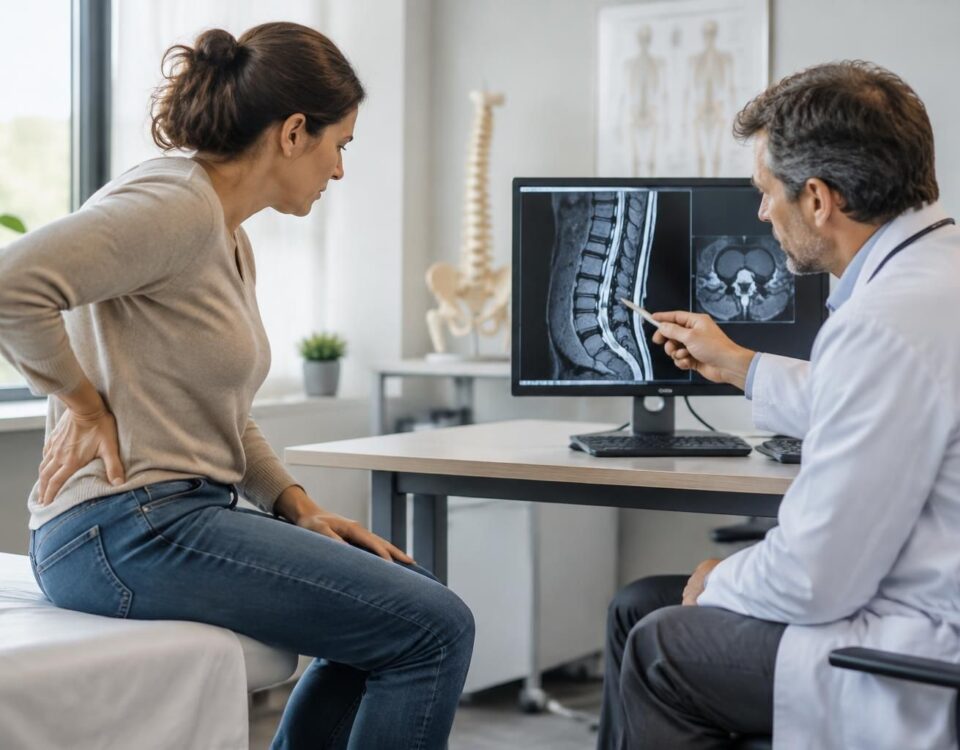
Sciatica and pain when getting out of bed
17/10/2026
Sciatica and lunges: leg pain to watch out for
17/10/2026
IN BRIEF
| A disc protrusion is a bulging of the disc that can contribute to pain after a back twist, but it alone does not confirm the cause. The pain can remain in the lower back or radiate to the buttock and leg if a nerve is irritated. Gradually resuming movements is generally preferable to prolonged rest. Seek prompt consultation in case of significant weakness or urinary or bowel issues. |
After a back twist, pain may appear or worsen, but this does not necessarily mean that the disc protrusion visible on imaging is the cause: it may also be present without symptoms. A protrusion is a bulging of the disc with its outer envelope remaining intact. Gradually resume tolerated movements and seek professional advice if the pain persists or radiates into a leg. In case of significant weakness, numbness in the saddle area, or urinary or bowel issues, seek emergency care.
Pain that appears after a back twist can arise from a muscle, a joint, or an intervertebral disc. A disc protrusion may be present, but the image alone does not explain the pain. Most often, a clinical evaluation helps determine the course of action. Recovery typically occurs gradually, without surgery, but certain signs necessitate urgent consultation.
What does a disc protrusion mean after a twist?
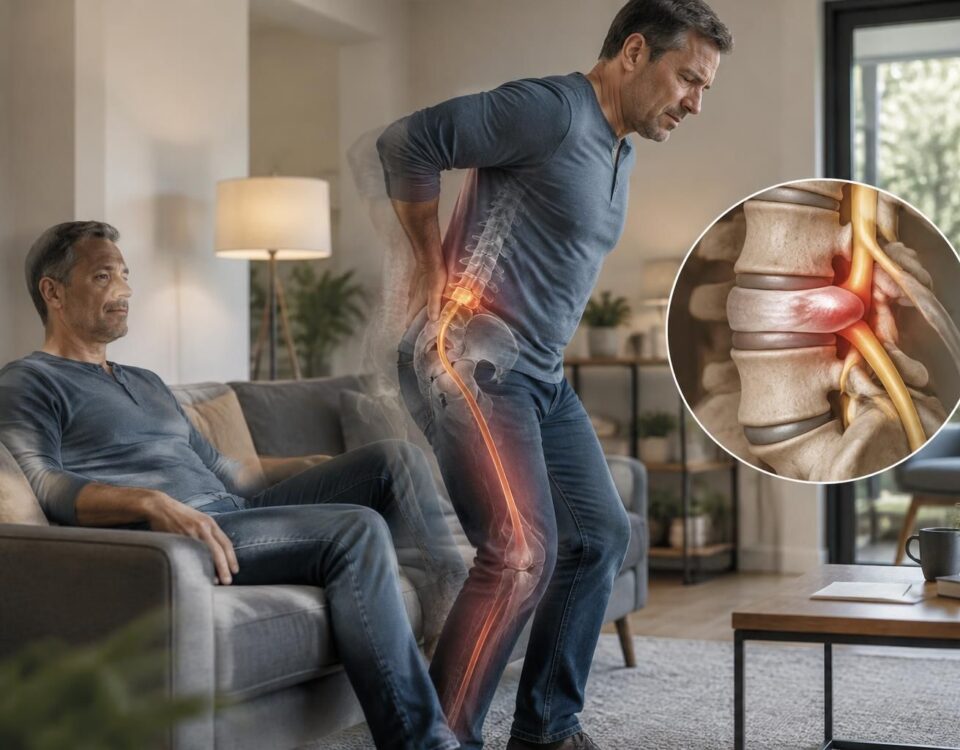
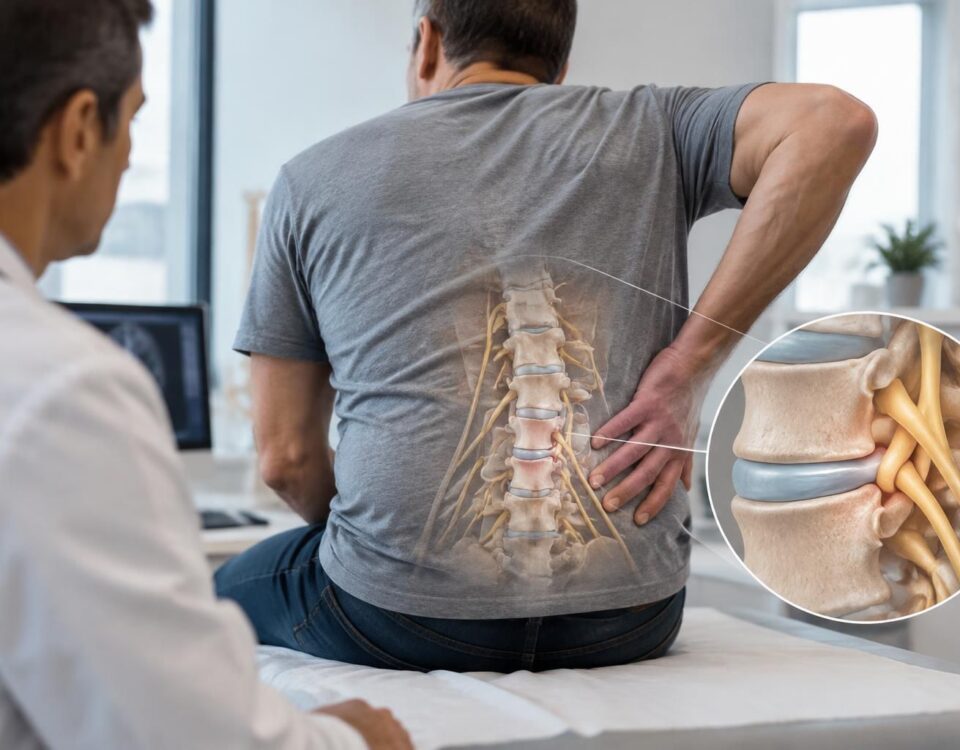
An intervertebral disc is located between the vertebrae. It cushions part of the stress placed on the spine. A protrusion corresponds to a bulging of the disc: its outer envelope deforms but does not rupture. A twist can trigger pain if it stresses the back, but it does not prove that the disc is the exact cause of the symptom.
A protrusion may also be visible on imaging in a person who has no pain. Therefore, the result of an MRI must be interpreted alongside the symptoms and the examination performed by a healthcare professional. To better understand the role of imaging, consult this article on what an MRI can show in the case of disc herniation and sciatica and that on the absence of pain despite a visible abnormality.
Disc protrusion and disc herniation: an important difference
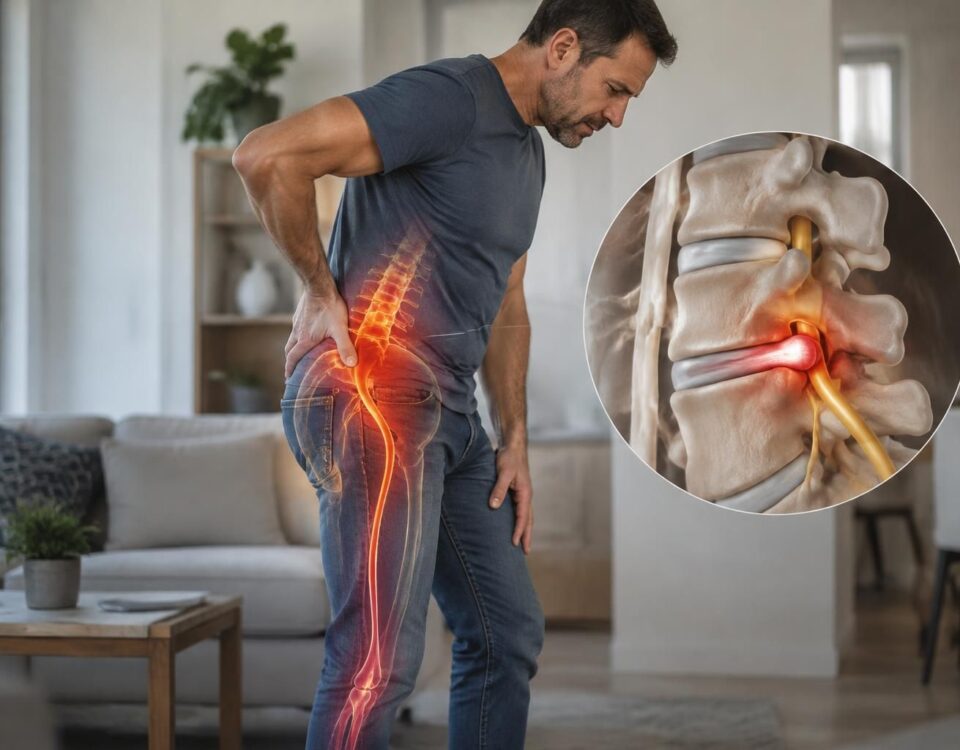
In a protrusion, the envelope of the disc remains intact and forms a bulge. In a disc herniation, this envelope is fissured or ruptured, and part of the disc’s contents may escape. The two terms describe different aspects of the disc, but neither allows for assessing pain or the severity of the situation alone.
Further explanation on disc protrusion and its characteristics can help understand the vocabulary used in a report. You can also read this overview of symptoms associated with disc protrusion.
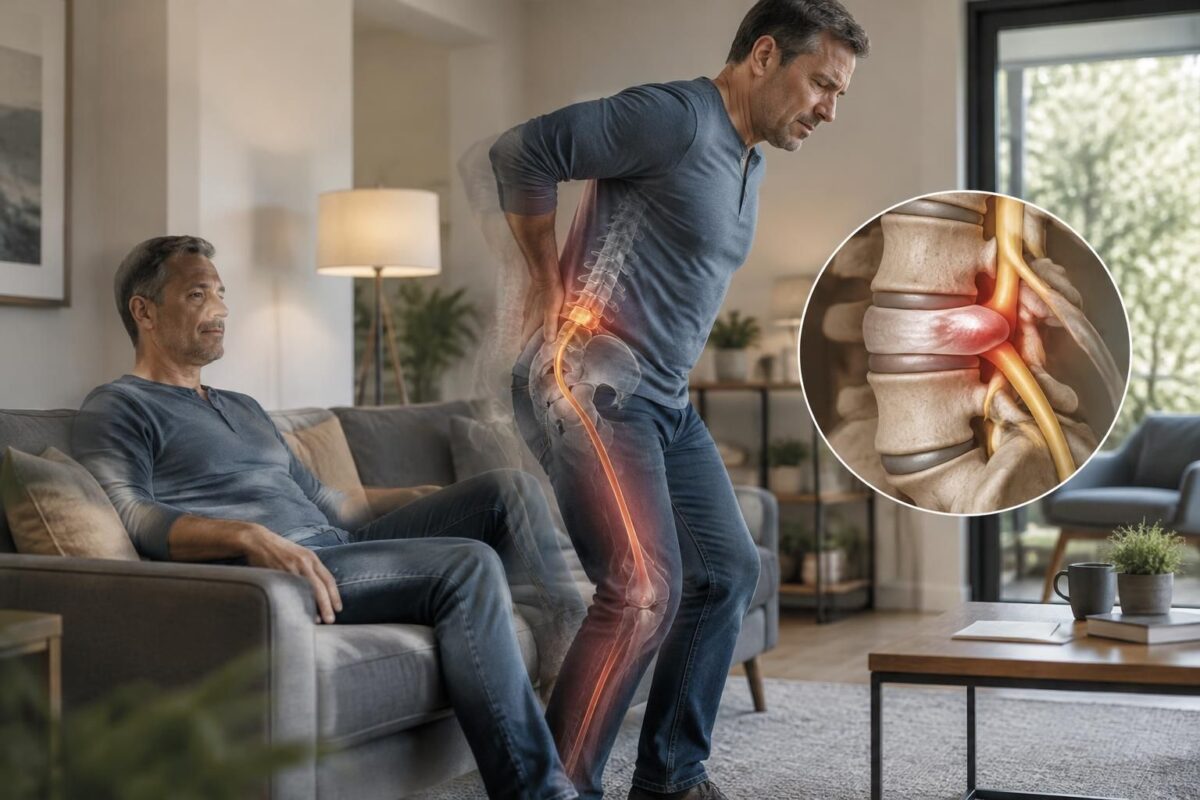
Disc herniation and fluctuating symptoms
IN BRIEF A disc bulge is a protrusion of the disc between the vertebrae, which may not necessarily cause symptoms. When pain fluctuates, its intensity can vary based on movements, activities, and other factors; the bulge visible on MRI does…
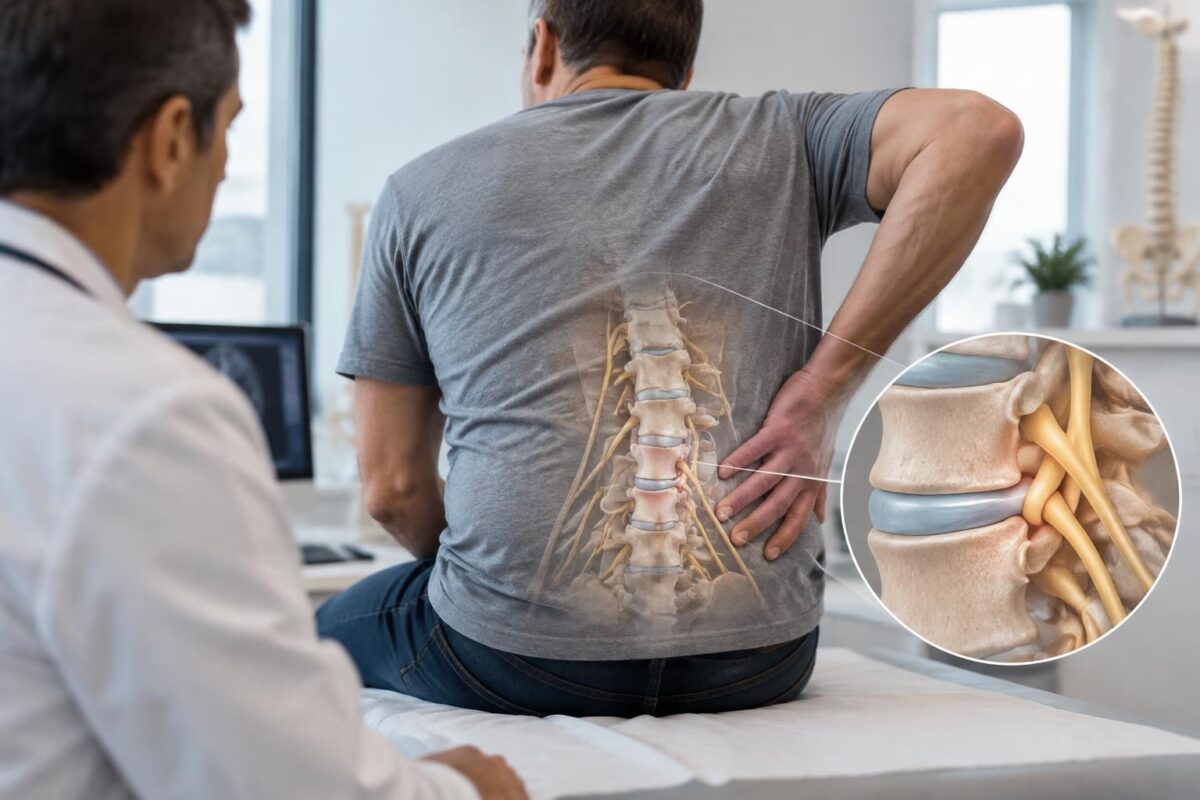
Disc bulge and mild nerve compression
IN BRIEF A disc bulge with mild nerve compression occurs when a disc slightly protrudes and may irritate a nerve, sometimes causing pain, tingling, or numbness. Symptoms and imaging do not always align: the assessment takes into account your movements…
Why can a twist trigger pain?
A rapid rotation of the trunk, especially when combined with effort or moving a load, can stress several structures in the back. Pain may originate from the muscles, ligaments, joints, or a disc that is already sensitive. It can also appear without significant injury. Therefore, it is not possible to conclude a protrusion based solely on the movement that triggered the pain.
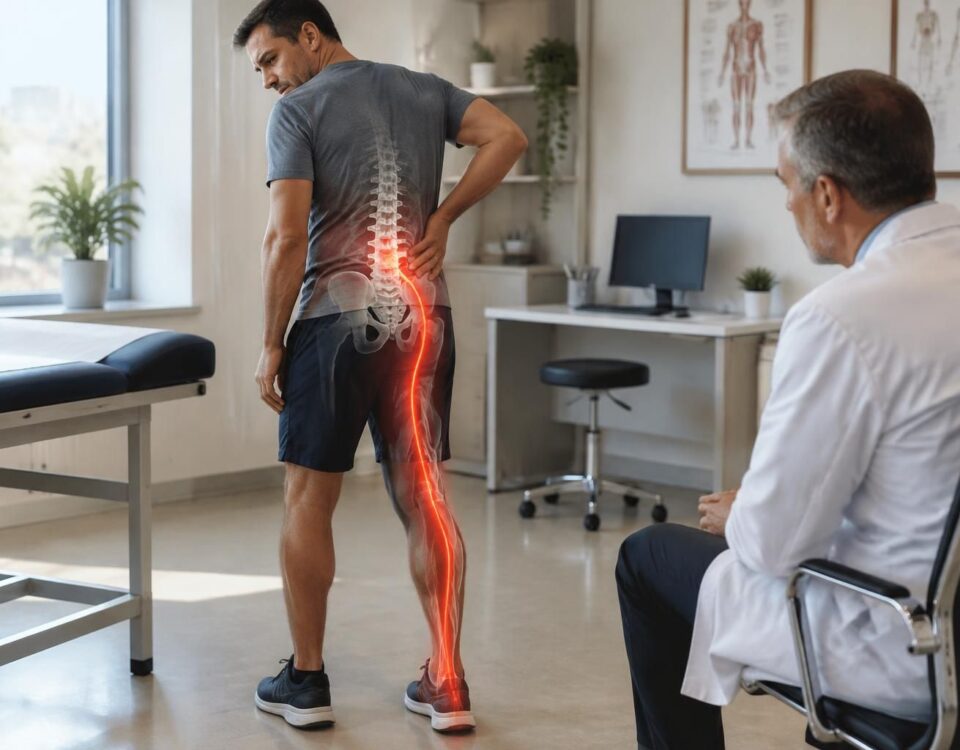
The pain may be localized in the lower back or spread to a buttock and a leg. Irritation of a nerve root can cause burning sensations, tingling, or pain that follows a specific pathway. However, lower back pain after a twist may have other causes. A healthcare professional can evaluate the symptoms and determine if tests are necessary.
Pain that increases in a sitting position or during coughing
The sitting position may exacerbate pain in some individuals, especially if it lasts a long time. This reaction does not confirm a disc protrusion. To learn more, check the information on disc protrusion and pain that increases in a seated position.
Coughing or sneezing can also intensify an already present pain by briefly altering the pressure in the trunk. This sign alone is insufficient to establish a diagnosis. The article on painful coughing and nerve irritation explains this phenomenon in more detail.
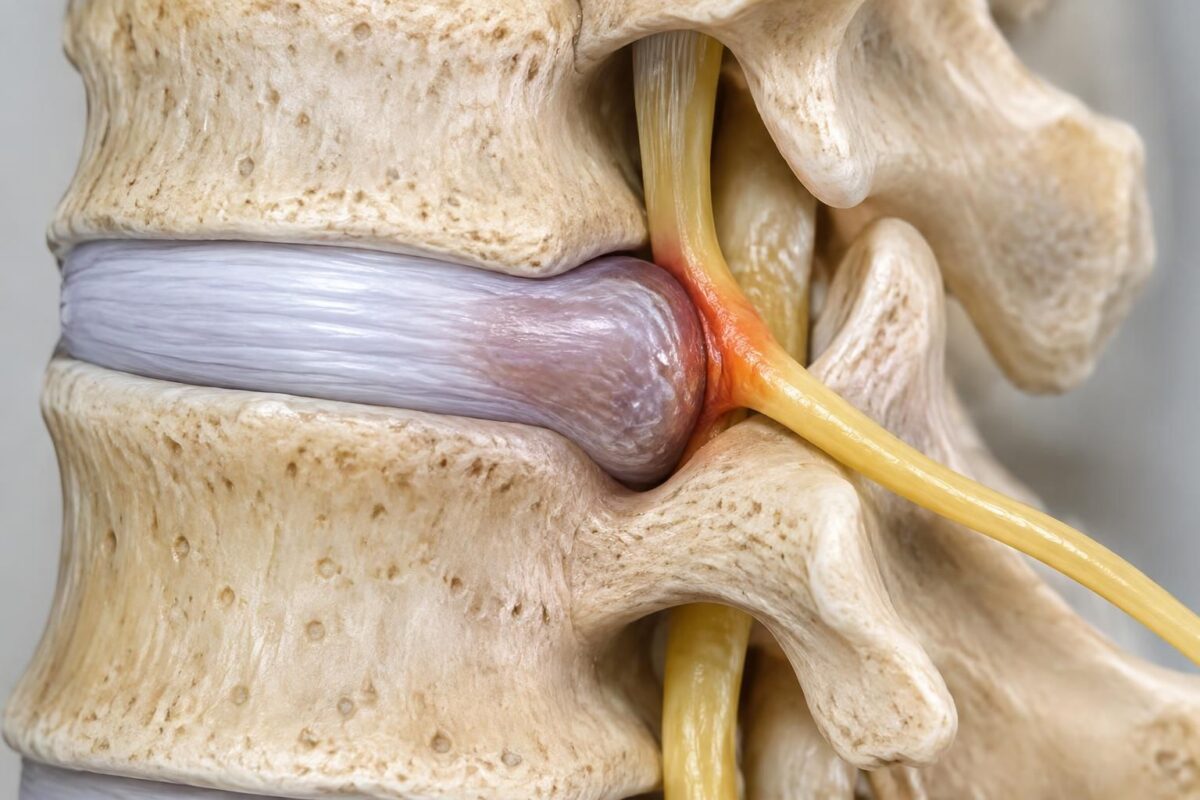
Disc herniation and foraminal irritation
IN BRIEF A disc bulge can reduce the space of the foramen, the opening through which a nerve exits, and contribute to its irritation. This can cause lower back pain radiating into the buttock or leg, tingling, or numbness. An…
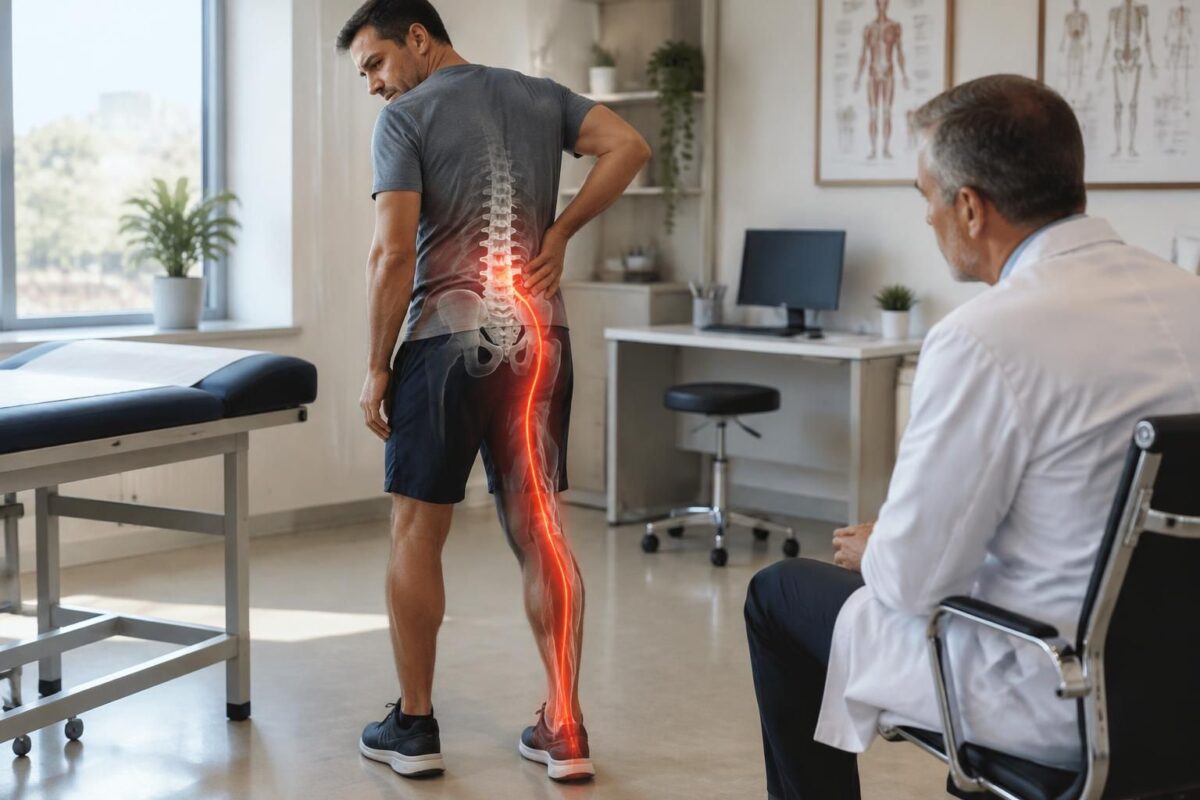
Disc bulge L5-S1 and pain toward the foot
IN SHORT A L5-S1 disc bulge corresponds to a disc that slightly overruns between the last lumbar vertebra and the sacrum. It can irritate a nerve root and cause pain resembling sciatica down to the foot, but this anomaly visible…
What symptoms can accompany a disc protrusion?
Many protrusions cause no symptoms. When pain arises, its location depends on the affected region and irritated structures. A lumbar protrusion may be accompanied by pain in the lower back. If a nerve is irritated, the pain may descend into the buttock or leg. A cervical protrusion may instead cause pain in the neck or towards the shoulder and arm.
An issue located between the last lumbar vertebrae and the sacrum may sometimes be accompanied by pain that radiates towards the foot. The pathway varies from person to person. Consult the page dedicated to L5-S1 protrusion and sciatica pain towards the foot for general guidelines.
Additional information on the causes and symptoms of a disc protrusion and on the bulging of the disc may also be helpful. These resources do not replace an individual assessment.
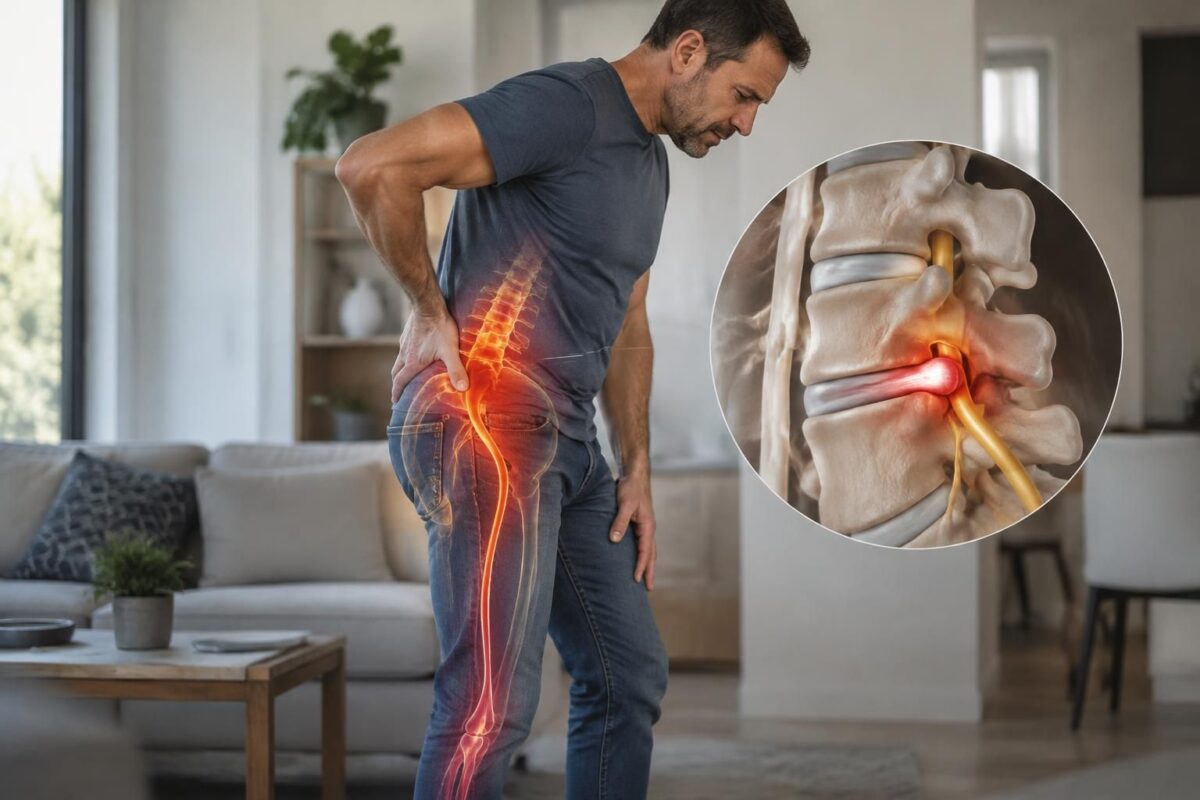
Disc herniation L4-L5 and leg pain
IN BRIEF A L4-L5 disc bulge is a protrusion of the lumbar disc that can contribute to pain in the buttock or leg if a nerve root is irritated. An MRI in a neutral position does not always show what…
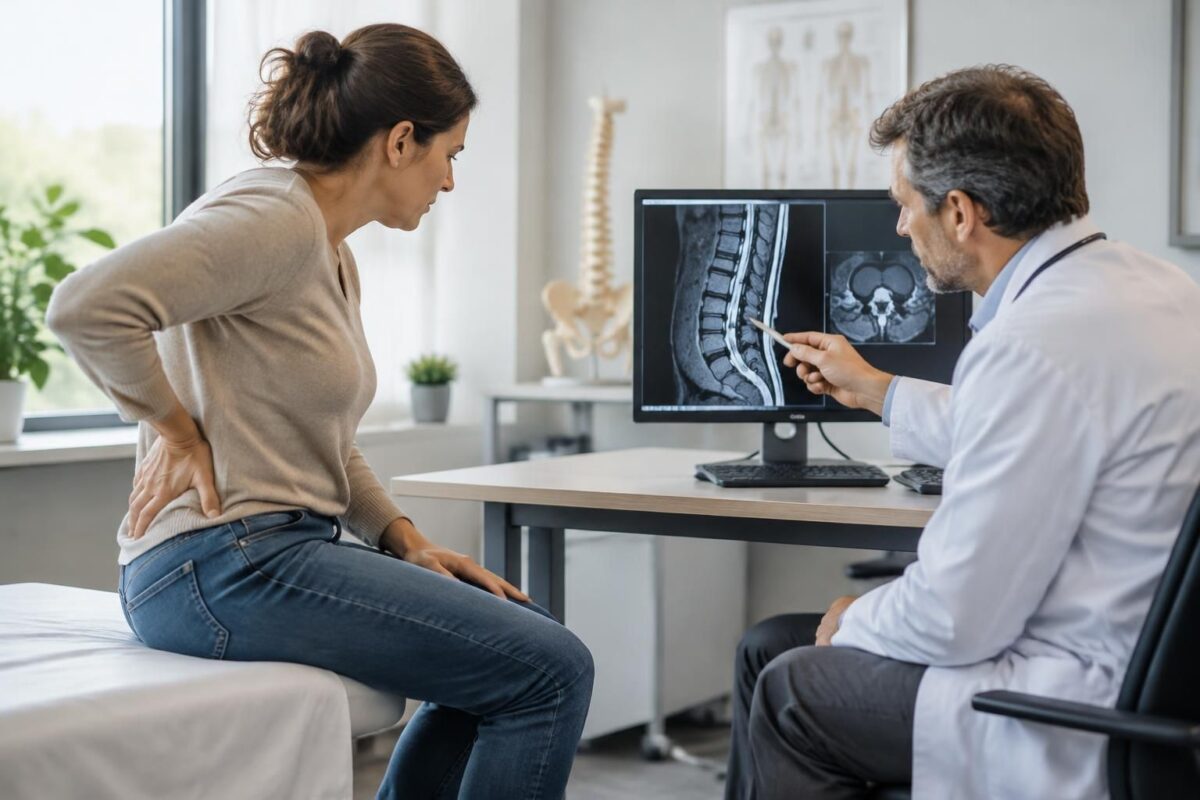
Disc bulge and sciatica: possible cause or simple discovery?
IN SHORT A disc bulge is a diffuse protrusion of a disc, sometimes associated with sciatica, but often discovered incidentally on imaging. To determine if it explains symptoms, one must compare the image to their path, the neurological examination, and…
When should you seek urgent medical assistance?
Pain after a back twist is generally not an emergency in the absence of serious signs. However, certain symptoms require immediate evaluation. Go to the emergency room or contact emergency services if you experience:
- a loss of sensation around the perineum or the area between the legs;
- new difficulty urinating, loss of control of the bladder or bowels;
- significant or progressive weakness of a leg or foot;
- marked difficulty walking or weakness affecting both legs;
- severe pain accompanied by fever, or rapid deterioration.
These signs may indicate a nerve injury requiring urgent care. They should not be managed solely in the office. Persistent pain, numbness, or radiation into the leg also warrant a consultation with a healthcare professional.
How does the evaluation proceed?
The professional begins by clarifying when the pain started, the triggering movement, its path, and its evolution. They may also assess mobility, sensitivity, and strength. These elements help in choosing the next steps of the assessment and identifying signs that require prompt medical advice.
Imaging is not necessary in all cases. A doctor may request it based on the symptoms, their duration, and the examination results. The image must be related to the clinical situation: a visible protrusion does not automatically mean it is responsible for the pain.
What to do after a back twist?
After a twist, avoid movements that significantly worsen the pain and resume your activities cautiously, according to your tolerance. Strict and prolonged rest may increase stiffness and delay the return to normal activities. However, it is important to seek advice if the pain is intense, if it runs down the leg, or if it does not improve.
Do not attempt to correct a protrusion on your own and avoid sudden manipulations of the back without prior assessment. A professional can help you determine the precautions suitable for your symptoms. Treatments depend on the examination, the pain, and any potential nerve irritation. No care should be presented as a guarantee to eliminate the disc bulge.
Evaluation and complementary care
At TAGMED Clinic, in Montreal and Terrebonne, the evaluation can guide towards different approaches, based on the situation and the individual’s needs. Options may include specific osteopathy or motorized neurovertebral decompression, when deemed appropriate. These approaches aim for comfort and function; they do not replace a medical diagnosis or consultation with a doctor.
The recovery time varies according to the cause of the pain, its intensity, and the demands of work or daily activities. For general guidelines, consult this resource on healing time and management options for a disc bulge.
Frequently asked questions about disc bulge after a twist
Can a twist create a disc bulge?
A twist can trigger pain or make a previously weakened area symptomatic. It does not confirm if a bulge appeared at that moment. Only an evaluation, sometimes supplemented by imaging prescribed by a doctor, can clarify the situation.
Is a disc bulge always painful?
No. Some bulges are discovered incidentally and cause no symptoms. Pain depends on several factors, including potential irritation of a nerve and other structures in the back.
How long can the pain last?
The duration varies according to the cause and intensity of the symptoms. Many back pains improve gradually over weeks, but some persist longer. Consult a professional if the pain worsens, severely limits your activities, or is accompanied by numbness or weakness.
Does a disc bulge mean surgery is necessary?
No. The presence of a bulge on an image does not mean surgery is necessary. Management depends on the symptoms, the examination, and their evolution. A medical evaluation is important if neurological signs appear.
About the author
Sylvain Desforges, B.Sc., D.O., N.D., osteopath and naturopath, is the founding president of TAGMED and the ACMA association. He dedicates his practice to chronic spinal pain, lower back pain, and pain compatible with sciatica, particularly when the pain radiates to the hip, leg, calf, foot, or toes.
Through SOS Sciatica, he publishes educational content on sciatica symptoms, possible causes such as herniated disc, disc pinching, foraminal stenosis, or irritation of a lumbar nerve root, as well as on non-surgical approaches that may be considered based on evaluation. At TAGMED Clinic, care may include, depending on the case, motorized neurovertebral decompression, specific osteopathy, or precision impactor.
For an evaluation related to sciatica treatment in Montreal / Mont-Royal or sciatica treatment in Terrebonne, consult the services available at TAGMED Clinic.
Medical disclaimer
Medical disclaimer: The information and advice provided on this site do not replace the opinion, diagnosis, or treatment of a healthcare professional. Please note that Sylvain Desforges, B.Sc., D.O., N.D., Doctor of Osteopathy, is neither a medical doctor nor a physician, and is not specialized in a medical specialty as defined by the Collège des médecins du Québec. Manual therapy, functional medicine, and sports medicine as described on this site exclude any treatment or medical diagnosis made by a physician or specialist doctor. Always consult your physician for any medical questions. For more details, please read our complete legal disclaimer.
After the twist: understanding pain
- A twist can irritate the back without creating a disc bulge.
- A visible bulge on imaging may be old and not directly related to the pain.
- Pain toward the hip or leg may signal nerve irritation.
Good reflexes
- Gradually resume movements and walking according to tolerance.
- Avoid prolonged strict rest and painful twists in the beginning.
- Consult if the pain persists or is accompanied by weakness.
- Emergency in case of urinary or bowel issues, or numbness in the saddle area.

After a back twist, pain may appear even if a disc protrusion was already present without causing symptoms. Pain does not necessarily mean that the disc has worsened: one must consider the examination, the evolution of symptoms, and their impact on your activities. Here are cautious recommendations to promote a gradual recovery and recognize situations that require prompt consultation.
Understanding Pain After a Twist
A disc protrusion is a bulging of the disc between the vertebrae, without rupture of its outer envelope. It can be discovered incidentally on an MRI and may not be the direct cause of pain. After a twist, the muscles, ligaments, or joints in the back can also be irritated. Pain that radiates into the buttock or leg may sometimes suggest nerve irritation, but symptoms alone cannot confirm the diagnosis.
Avoid concluding that the twist has necessarily transformed the protrusion into a herniation. If the pain is significant, persists, or is accompanied by tingling or numbness, a healthcare professional can evaluate your situation and determine if any tests are useful.
What to Do in the First Few Days?
Stay Active Without Straining
Strict bed rest is generally discouraged beyond a short period, as immobility can maintain stiffness. Instead, make short movements and gradually resume tolerated gestures. Gentle walking may be suitable if it does not significantly increase your symptoms. For now, limit sudden movements, repeated twists, and carrying heavy loads.
Change positions regularly, especially if you need to sit. Stand up at regular intervals and adjust your workstation to avoid keeping your back bent for long periods. To lift an object, bring it close to your body and avoid pivoting while carrying it.
Gradually Resume Activities
Resumption should be based on your pain and daily tasks. Gradually increase the duration of walking and usual activities, without trying to test your back with intense efforts. If an activity causes lasting worsening or a more pronounced radiation into the leg, reduce the effort and seek advice from a professional.
When to Request an Evaluation?
Consult a doctor if the pain is severe, does not improve, recurs frequently, or significantly limits your activities. An evaluation is also indicated in cases of weakness, persistent numbness, or pain radiating down the leg. Medications, physiotherapy, or other options should be discussed with a healthcare professional, depending on your history and symptoms.
A manual approach may sometimes be considered as a complement to improve comfort and mobility, after appropriate evaluation. It does not reposition the disc and does not replace medical follow-up. In the presence of acute pain after a twist, avoid forced manipulations of the spine without prior advice.
Signs of Emergency Not to Ignore
Go to the emergency room if you experience a loss of control over the bladder or bowels, difficulty urinating, loss of sensitivity around the perineum, or significant and progressive weakness in one or both legs. Fever associated with back pain, recent trauma, or rapid worsening also requires medical evaluation without delay.
| Indicator | Disc Protrusion and Pain After Back Twist |
|---|---|
| Possible link | A twist can trigger pain, without proving that a protrusion is the cause. |
| Protrusion | Bulging of the disc without rupture of its envelope. |
| Pain After Twist | May originate from the muscles, joints, or an irritated disc. |
| Possible Signs | Lower back pain, stiffness, or radiation towards the buttock and leg. |
| Diagnosis | The clinical examination evaluates the symptoms; MRI is considered based on the context. |
| Initial Actions | Favor tolerated movements and avoid prolonged strict rest. |
| Evolution | Many pains improve gradually over a few weeks. |
| Emergency | Consult without delay in case of progressive weakness or urinary or bowel issues. |
Illustrative Testimonials: Disc Protrusion and Pain After a Back Twist
Note: the stories below are fictional examples, written for educational purposes. They do not represent accounts from real patients and do not allow for a diagnosis. Pain that appears after a twist can have several causes; a protrusion visible on imaging is not necessarily the source of symptoms.
“The pain appeared when I turned”
While lifting a bag, Marc turned quickly and felt pain in his lower back. In the first few days, he was afraid he had aggravated his condition by moving. After an evaluation by a healthcare professional, he gradually resumed walking and adjusted his activities. His MRI report mentioned a lumbar protrusion, but he was told that the image should be interpreted along with his symptoms and clinical examination.
“The MRI report worried me”
After a back twist, Nadia experienced pain that sometimes radiated to her buttock. Imaging described a disc protrusion. She learned that this finding did not automatically mean that a nerve was compressed or that surgery would be necessary. Appropriate follow-up and a gradual return to movements helped her manage her daily life better.
“Staying still didn’t help me”
After a sudden movement, Julien limited almost all his activities for fear of aggravating his pain. With the advice of his professional, he began walking for short periods and regularly changing positions at work. The discomfort gradually decreased. His experience reminds us that prolonged strict rest is generally not recommended, unless specifically advised by a professional.
“I had to modify my tasks at work”
After a twist while handling equipment, Sophie felt increased lower back pain exacerbated by long sitting periods and carrying loads. She discussed her limitations with a health professional and temporarily adapted some tasks. The return to her activities was gradual, depending on the evolution of her symptoms, rather than an immediate return to her usual pace.
Takeaway: a twist can trigger or exacerbate pain, but it does not alone prove that a disc protrusion is the cause. The evaluation takes into account the location of the pain, its radiation, strength and sensitivity, as well as imaging results when indicated.
Consult a healthcare professional promptly if the pain persists, worsens, or is accompanied by numbness or weakness. A loss of bladder or bowel control, insensitivity in the saddle area, or significant and progressive weakness requires urgent evaluation.
About the author
Sylvain Desforges, B.Sc., D.O., N.D., osteopath and naturopath, is the founding president of TAGMED and the ACMA association. He focuses his practice on chronic spinal pain, lower back pain, and pain consistent with sciatica. Manual or functional approaches may be considered based on evaluation; they do not replace medical follow-up.
Medical Warning
This information is provided for educational purposes and does not replace a consultation, diagnosis, or treatment by a licensed healthcare professional. The author is neither a physician nor a specialist in a medical specialty recognized by the Collège des médecins du Québec. Consult a doctor or an emergency service in case of loss of bladder or bowel control, anesthesia in the saddle area, significant or progressive weakness, fever, recent trauma, severe pain, or rapid worsening.
Disc Protrusion and Pain after a Back Twist: Understanding What to Do
Pain that appears after suddenly twisting the back can be concerning, especially if imaging has already revealed a disc protrusion. However, coincidence does not necessarily mean that the disc has worsened or is the sole cause of the pain. A twist can also stress the muscles, ligaments, and small joints of the spine. The severity of the symptoms and their evolution matter more than just the term noted on a report.
What is a disc protrusion?
Between the vertebrae, intervertebral discs help distribute stress and cushion movements. A protrusion refers to a bulging of the disc beyond its usual contour, without a complete rupture of its outer envelope. It is distinguished from certain disc hernias, where part of the disc’s contents crosses a tear in this envelope.
A protrusion may be visible on an MRI without causing pain. The changes observed on imaging are common and should be interpreted alongside symptoms and clinical examination. It is therefore best not to conclude that pain after twisting necessarily comes from the disc, nor that the protrusion has transformed into a hernia without proper evaluation.
Why can a twist trigger pain?
During a twisting movement, particularly if it is quick, performed while carrying a load or associated with bending, several structures in the back are stressed. Pain may arise from local mechanical irritation, a muscle spasm, or existing sensitivity around the spine. If a nerve root is irritated, the pain may also radiate to the buttock or leg, sometimes with tingling or numbness.
Discomfort limited to the lower back does not carry the same significance as pain radiating down the leg or muscle weakness. Note when the pain began, the movements that worsen it, its pathway, and changes in sensitivity. This information will help the health professional determine if a medical examination or further investigations are necessary.
Initial Actions and Resuming Activities
In the absence of warning signs, prolonged immobility is generally not recommended. It is often better to maintain gentle movements and gradually resume tolerated activities, without forcing in a direction that clearly triggers pain. Short walks and regular position changes can help limit stiffness. An appropriate return is usually more beneficial than a sudden return to intense efforts.
Temporarily avoid gestures that combine twisting and carrying loads. At work, alternate positions and take breaks if you remain seated for long periods. Rehabilitation and strengthening exercises may be considered based on evaluation and tolerance. Manual support can contribute to comfort and mobility but does not guarantee a change in the structure of the disc and does not replace medical advice.
When to Seek Prompt Consultation
Request an evaluation if the pain persists, worsens, or is accompanied by pain radiating into the leg, numbness, or decreased strength. A significant or progressive weakness, loss of sensation in the saddle area, or new urinary or bowel problems require urgent consultation. Fever, recent trauma, or rapid deterioration also justify seeking medical advice without delay.
Sylvain Desforges, B.Sc., D.O., N.D., is an osteopath and naturopath, founding president of TAGMED clinics and the ACMA association. His practice focuses notably on chronic spinal pain and functional support. The information presented here is educational and does not replace a consultation, diagnosis, or treatment by a licensed healthcare professional.
After a back twist, pain may come from muscle or joint irritation, but it may also coincide with an already present disc protrusion. Pain, even if intense, does not alone determine the origin of the problem: the evaluation takes into account its evolution, pathway, and associated signs. A protrusion on imaging does not necessarily explain the symptoms and does not automatically mean that intervention is necessary.
Pain after a Back Twist: Understanding the Situation
A sudden rotational movement, especially when accompanied by bending or carrying a load, can cause a painful thrust. This may be a low back pain without nerve involvement, or pain that radiates to the hip and leg if a nerve root is irritated. The difference between a protrusion and a disc herniation primarily concerns the deformation of the disc and the state of its envelope; an overview is provided by this article on protrusion and disc herniation.
The location helps to describe the symptoms, but is not sufficient to make a diagnosis. For example, a lumbar issue at the L4-L5 level may be accompanied by pain in the lower back and sometimes radiating into the leg. To better understand this location, check the information on L4-L5 disc protrusion. Pain behind the thigh, numbness, or tingling should also be described to the professional evaluating you: they can guide the examination, but do not alone prove nerve compression.
The intensity of the pain does not always correspond to the size of the protrusion observed on imaging. A small anomaly may be associated with significant discomfort, while a more pronounced protrusion may cause no symptoms. Articles addressing significant pain despite a small protrusion and pain behind the thigh discuss these situations. Interpretation should always correlate imaging with clinical examination and your history.
What actions should be prioritized in the first few days?
In the absence of warning signs, prolonged immobility is generally not the best strategy. Gradually resume tolerated activities, for example with short walks, and alternate positions rather than staying seated or standing for long periods without moving. Temporarily avoid movements that clearly trigger pain, especially twisting under load, but do not attempt to force a painful posture or exercise.
If your work involves long periods of sitting, repetitive movements, or carrying loads, temporarily adjust your organization and take regular breaks. Advice on workplace adjustments and physical constraints is available from an ergonomics consultant. Returning to work depends on your symptoms, tasks, and the possibility of accommodations; it should be gradual when necessary.
Recovery varies based on the cause of the pain and the individual. A healthcare professional can determine if a clinical examination, imaging, or further management is indicated. Rehabilitation and exercises should be tailored to your situation: information on healing time and rehabilitation can serve as general guidelines, but do not replace an individualized assessment. For additional resources on causes and symptoms, you can also check this dossier on disc protrusion.
When to seek a prompt evaluation?
Consult a professional if the pain persists, worsens, frequently recurs, or is accompanied by radiation, numbness, or decreased strength. A pain that changes over days also merits re-evaluation: its centralization or extension can be a factor to describe, but does not alone determine the evolution of a hernia. To dive deeper into this topic, see the information on centralizing pain and numbness associated with nerve irritation.
Significant or progressive weakness, loss of sensation in the saddle region, or new issues with urinary or bowel control require immediate consultation. Do not attempt to treat these signs with manipulations or by waiting for spontaneous improvement. A sequestrated disc herniation and its symptoms must also be medically evaluated; further details are presented in this article on the necessity of evaluation.
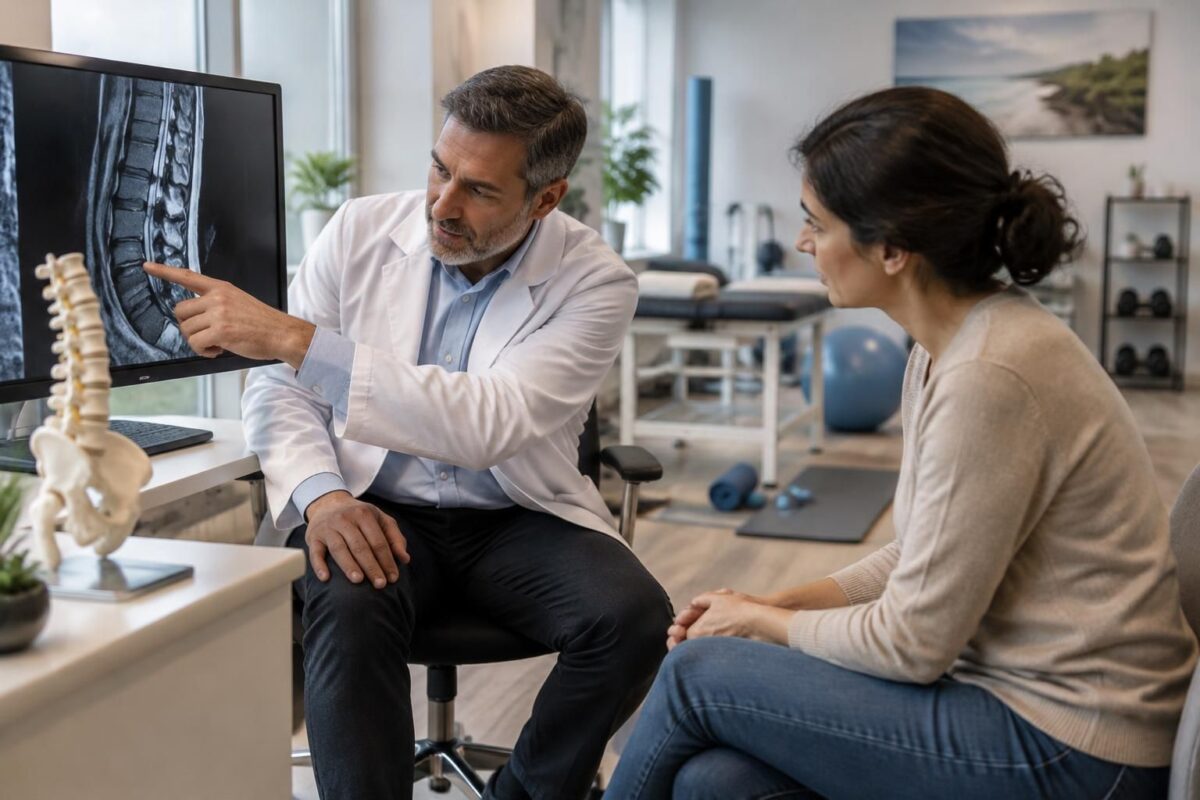
Lumbar Disc Protrusion and the Choice of a Non-Surgical Approach
IN SHORT A disc protrusion is a bulging of a disc between the vertebrae; it often does not cause any symptoms. If it is accompanied by pain, a non-surgical approach may include appropriate activity, prescribed medications, and progressive rehabilitation. It…
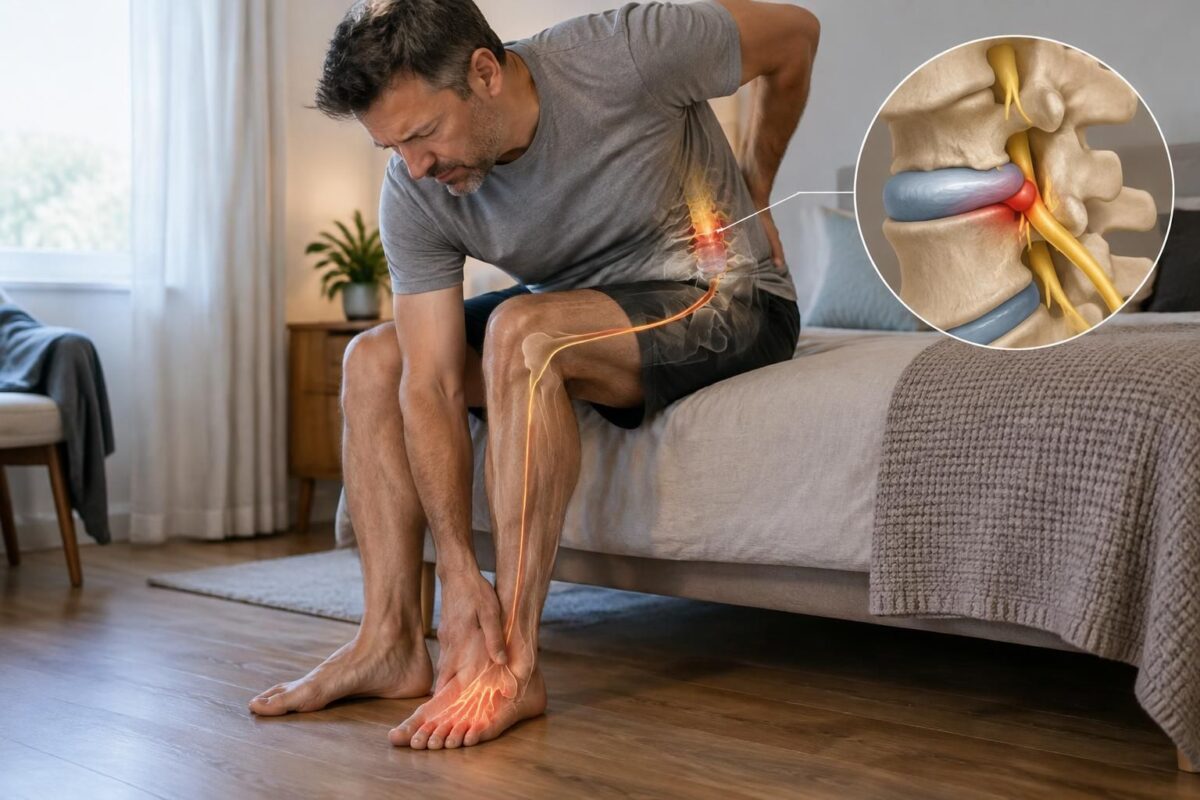
Disc herniation and pain on the top of the foot
IN BRIEF A disc protrusion is an intervertebral disc that bulges without necessarily rupturing. Pain on the top of the foot may sometimes be related to irritation of a lumbar nerve, but it does not alone confirm disc involvement. An…

Sylvain Desforges, B.Sc., D.O., N.D., docteur en ostéopathie
Dr Sylvain Desforges, B.Sc., D.O., N.D., osteopath, is the founding president of TAGMED and of the ACMA association. He dedicates his practice to chronic spinal pain, low back pain and symptoms compatible with sciatica, particularly when pain radiates toward the buttock, leg, calf, foot or toes.
Through SOS Sciatique, he publishes educational content on sciatica symptoms, possible causes such as disc herniation, disc narrowing, foraminal stenosis or irritation of a lumbar nerve root, as well as non-surgical approaches that may be considered according to the evaluation. At Clinique TAGMED, care may include, depending on the case, motorized neurovertebral decompression, specific osteopathic care or precision percussion.
For an evaluation related to sciatica treatment in Montreal / Mount Royal or sciatica treatment in Terrebonne, please consult the services available at Clinique TAGMED.
Medical disclaimer
The information published on SOS Sciatique is provided for educational purposes only and does not replace a consultation, diagnosis, opinion or treatment provided by a physician or another authorized healthcare professional. The author of this article is neither a medical doctor nor a specialist in a medical specialty recognized by the Collège des médecins du Québec. The osteopathic, manual medicine or functional support approaches described on this site do not constitute medical acts and are not intended to replace medical follow-up.
Consult a physician or emergency service in cases of loss of bladder or bowel control, anesthesia in the saddle area, significant or progressive weakness in the leg or foot, fever, recent trauma, severe pain or rapid worsening of symptoms. For more details, please read our Legal Notice.