Sciatica and pain after driving
09/10/2026
Sciatica and running: when to stay cautious
09/10/2026
IN BRIEF
| A disc protrusion is a bulging of a spinal disc, often without symptoms. A pain behind the thigh can be muscular or, if it originates from the back and is accompanied by tingling or numbness, related to nerve irritation like sciatica. Evaluation by a professional helps to identify the cause and guide appropriate care. Significant or progressive weakness, or urinary or bowel issues, requires urgent consultation. |
A disc protrusion is a bulging of a vertebral disc; it often has no symptoms. If it irritates a lumbar nerve root, it can contribute to pain starting from the lower back or buttock and radiating behind the thigh, sometimes with tingling, numbness, or weakness. However, pain behind the thigh can also originate from muscles or tendons: the protrusion is therefore not automatically the cause.
Evaluation by a healthcare professional helps to distinguish these origins and determine if further examinations are necessary. Consult promptly in the case of significant or progressive weakness, loss of urinary or bowel control, or numbness in the saddle area.
About the Author
Sylvain Desforges, B.Sc., D.O., N.D., Doctor of Osteopathy, is the founding president of the TAGMED Clinic and the ACMA association. His practice focuses particularly on chronic pain of the spine and pain compatible with sciatica.
Medical Disclaimer
This content is provided for educational purposes and does not replace a consultation, diagnosis, or treatment by a licensed healthcare professional. The author is neither a physician nor a specialist in a medical specialty recognized by the Collège des médecins du Québec. In the case of concerning symptoms or rapid deterioration, consult a physician or an emergency service.
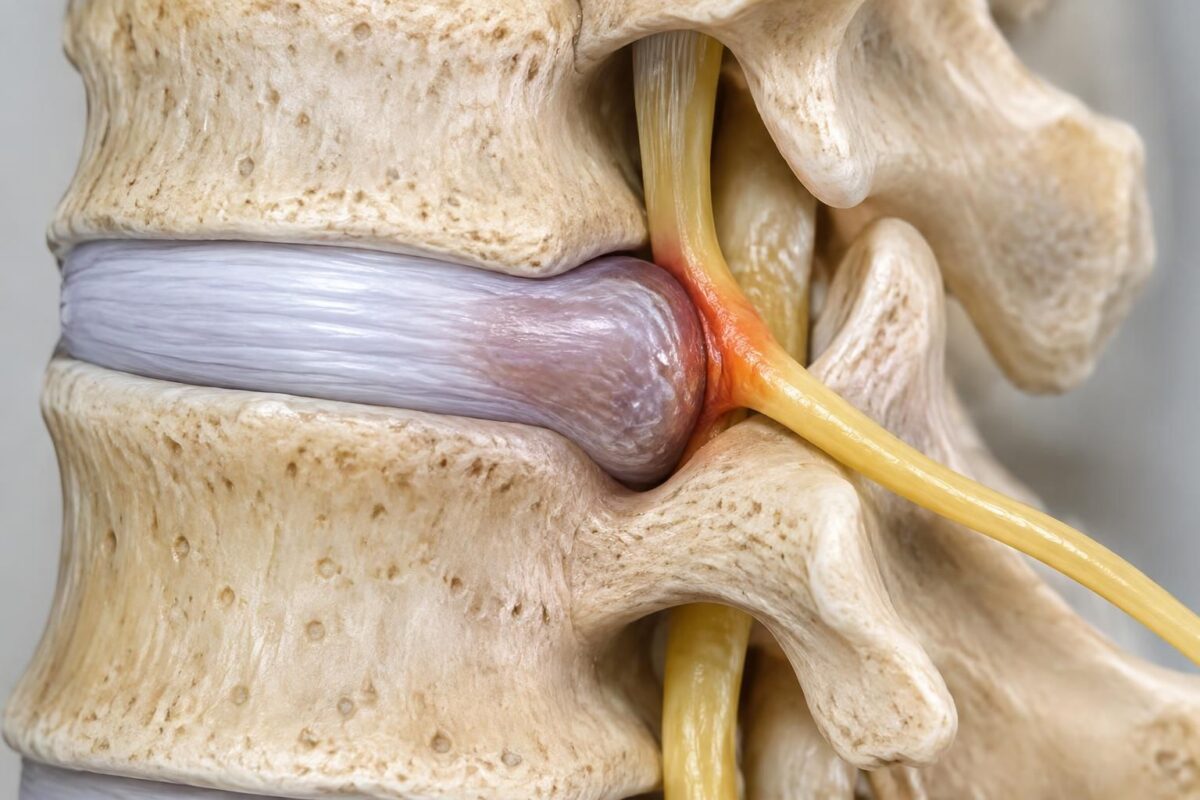
A disc protrusion can sometimes irritate a nerve root and cause pain that radiates behind the thigh. However, a protrusion seen on imaging does not always cause symptoms, and pain at the back of the thigh can also come from a muscle, tendon, hip, or a circulatory problem. The evaluation must therefore link the symptoms to the clinical examination and, if necessary, to imaging results. A spinal disc is located between two vertebrae. It helps distribute loads and allows for movements of the spine. Over time, the disc may lose some of its water and flexibility. Its contour may then slightly exceed the usual boundaries: this is referred to as a disc protrusion or disc bulge. The protrusion is not automatically a painful herniation. It can remain asymptomatic and be discovered incidentally on imaging. Pain primarily appears when a sensitive structure, such as a nerve root, is irritated or compressed. To learn more about the difference between a protrusion and other disc abnormalities, consult this presentation on disc protrusion on MRI. A lumbar protrusion can irritate a nerve root that contributes to the sciatic nerve. The pain can then start in the lower back or buttock and radiate behind the thigh. It may sometimes extend down to the calf, foot, or toes. Some individuals describe a burning sensation, electric shocks, tingling, or numbness. The location depends on the affected nerve root. Damage at a specific lumbar level can produce different symptoms than damage located lower. The pages on protrusion L4-L5 and possible sciatica signs, pain radiating towards the heel or foot, and pain towards the calf and the external border of the foot describe these possible profiles. However, symptoms alone do not confirm the affected level. Pain localized at the back of the thigh can have several causes. A hamstring injury often occurs after exertion and can be associated with sharp pain during contraction or stretching. A tendinopathy may instead appear gradually, near the buttock fold or behind the knee. Nerve pain may be accompanied by tingling or numbness, but these signs alone are not sufficient to establish a diagnosis. The hip, the tissues around the buttock, and, more rarely, circulation issues can also explain the symptoms. Sudden pain with swelling and warmth in one leg requires urgent medical evaluation. For further insights into possible causes, see resources on pain behind the thigh and its causes, the various possible causes, as well as information from Nootralis and the Cabinet Renaissance. The healthcare professional seeks to understand where the pain began, how it has evolved, and whether it radiates below the knee. They also ask if certain movements, coughing, or prolonged sitting change the symptoms. Pain that originates from the back or buttock and follows the leg, with electric sensations or sensory disturbances, may suggest nerve irritation. However, this does not prove that a protrusion is the cause. Pain that appeared after a sprint, a fall, or unusual exertion may indicate a muscular or tendinous injury. Hip stiffness or difficulty walking can also guide the examination. The professional evaluates sensitivity, strength, and movements, then determines if additional examinations are necessary. The evaluation begins with an interview and a physical examination. The professional examines mobility, strength, and sensitivity, and checks if the signs correspond to nerve irritation or another cause. Imaging is not necessary in all cases. An MRI or another examination may be considered depending on the symptoms, their duration, and the results of the clinical examination. An image cannot replace an examination. Protrusions and other disc changes may be present without pain. The result must therefore be interpreted in relation to symptoms and clinical evaluation. An overview of the signs associated with a protrusion is presented in this resource on L4-L5 protrusion. Management depends on the cause, intensity of pain, and the presence or absence of neurological signs. A doctor or other authorized professional may recommend an appropriate approach and check if medical treatment is necessary. Do not start a medication or treatment without considering your health status and other prescriptions. When symptoms align with nerve pain, assessment can help determine if non-surgical management is appropriate. At TAGMED Clinic, the options offered may include, depending on the case, specific osteopathy, precision percussion, or motorized neurovertebral decompression. These approaches are not suitable for everyone and do not replace a medical diagnosis. An evaluation at TAGMED Clinic allows for discussion of the services available in Montreal or Terrebonne. Tolerance for walking varies from person to person. In the case of sciatic symptoms, guidance should respect pain levels and recommendations received. For more information on this topic, refer to the page dedicated to daily walking and symptom tolerance. If pain appears after a day of sitting, this resource also addresses pain after a day of work sitting. Consult a healthcare professional quickly if the pain becomes significant, worsens, or is accompanied by new weakness in the leg or foot. A loss of bladder or bowel control, loss of sensation around the genitals or anus, or marked weakness requires urgent assessment. These signs may indicate serious nerve damage. A suddenly swollen, warm, and painful leg also requires urgent medical attention, as a vascular problem must be ruled out. Fever, recent trauma, or rapid worsening also warrant immediate medical advice. Sylvain Desforges, B.Sc., D.O., N.D., Doctor of Osteopathy, is the founding president of TAGMED and the ACMA association. His practice focuses on chronic spinal pain, low back pain, and pain consistent with sciatica, particularly when the pain radiates to the buttock, leg, calf, foot, or toes. Through SOS Sciatique, he publishes educational content on sciatic symptoms, possible causes like herniated discs, disc pinching, foraminal stenosis, or irritation of a lumbar nerve root, as well as on non-surgical approaches that may be considered after evaluation. At TAGMED Clinic, care may include, depending on the case, motorized neurovertebral decompression, specific osteopathy, or precision percussion. For an evaluation related to sciatica treatment in Montreal or Mont-Royal, or sciatica treatment in Terrebonne, consult the services available at TAGMED Clinic. The information published on SOS Sciatique is provided for educational purposes. It does not replace a consultation, diagnosis, advice, or treatment provided by a doctor or other authorized healthcare professional. The author of this article is neither a physician nor a specialist in a medical specialty recognized by the Collège des médecins du Québec. The approaches of osteopathy, manual medicine, or functional support described on this site do not constitute medical acts and are not intended to replace medical follow-up. Consult a physician or emergency service in the event of loss of bowel or bladder control, anesthesia in the saddle area, significant or progressive weakness of the leg or foot, fever, recent trauma, severe pain, or rapid worsening. For more details, please read our Legal Notice. “Medical disclaimer: The information and advice provided on this site do not replace the advice, diagnosis, or treatment of a healthcare professional. Please note that Sylvain Desforges, B.Sc., D.O., N.D., Doctor of Osteopathy, is neither a doctor of medicine nor a physician, and is not a specialist in a medical specialty as defined by the Collège des médecins du Québec. Manual medicine, functional medicine, and sports medicine as described on this site exclude any treatment or medical diagnosis made by a physician or specialist. Always consult your doctor for any medical questions. For more details, please read our complete Legal Notice.”What is a disc protrusion?
Why can a protrusion cause pain behind the thigh?
Pain behind the thigh is not always sciatica
What signs can guide the evaluation?
How to confirm the cause of the pain?
What steps can help relieve symptoms?
When to consult quickly?
About the author
Medical disclaimer
When a disc protrusion may be involved
- Pain radiating from the lower back or buttock.
- Radiation behind the thigh, sometimes to the foot.
- Tingling, numbness, or associated weakness.
- Pain alone is not sufficient to confirm a disc origin.
What to keep in mind
- A protrusion visible on imaging is often asymptomatic.
- Local pain after exertion may instead come from the hamstrings.
- A professional evaluates symptoms and decides if imaging is needed.
- Urgency in cases of progressive weakness, loss of bladder or bowel control, or numbness in the saddle area.

Disc protrusion and pain behind the thigh: what to do?
A pain behind the thigh may come from a muscle or tendon, but sometimes also from nerve irritation related to the lower back. A disc protrusion visible on imaging does not automatically mean it is responsible for your symptoms: it may be present without pain. To better guide you, observe the course of the pain, its evolution, and associated signs, then have the situation assessed if it persists or limits your activities.
IN BRIEF A disc bulge is a diffuse protrusion of the disc and does not always cause symptoms. A buttock pain may sometimes be associated with nerve irritation, but the bulge visible on imaging is not enough to establish the…
Understanding the possible link with a disc protrusion
A disc protrusion corresponds to a bulge of the disc between two vertebrae. It is often related to the natural progression of the disc and does not necessarily cause symptoms. Pain mainly occurs if sensitive structures, such as a nerve root, are irritated or compressed.
When lumbar nerve irritation is involved, pain can start from the lower back or buttock and radiate down the back of the thigh. Tingling, numbness, or weakness may also be present. However, pain limited to the back of the thigh may also be related to the hamstrings, a tendon, the hip, or other causes. Symptoms alone do not always provide a definitive diagnosis.
Disc herniation and lumbar stiffness
IN BRIEF The disc bulge is a protrusion of the disc between the vertebrae, without a necessary tear, and does not always indicate a herniation or a cause of pain. It can accompany lumbar stiffness, but the link must be…
Recommendations for the first few days
Stay active without overdoing it
In the absence of urgent signs, generally avoid prolonged immobility. Favor gentle movements and tolerable activities, temporarily reducing gestures that significantly increase pain. Running, heavy lifting, or intense stretching can wait if these efforts worsen symptoms. Gradually resume them according to your comfort and the recommendations of a professional.
Adapt your position and pace
If sitting for long periods exacerbates discomfort, stand up regularly and change position. You can try a short walk or a more comfortable posture. Avoid keeping your back in a position that systematically triggers radiating pain. Heat or cold can provide temporary relief to some individuals, without necessarily treating the cause.
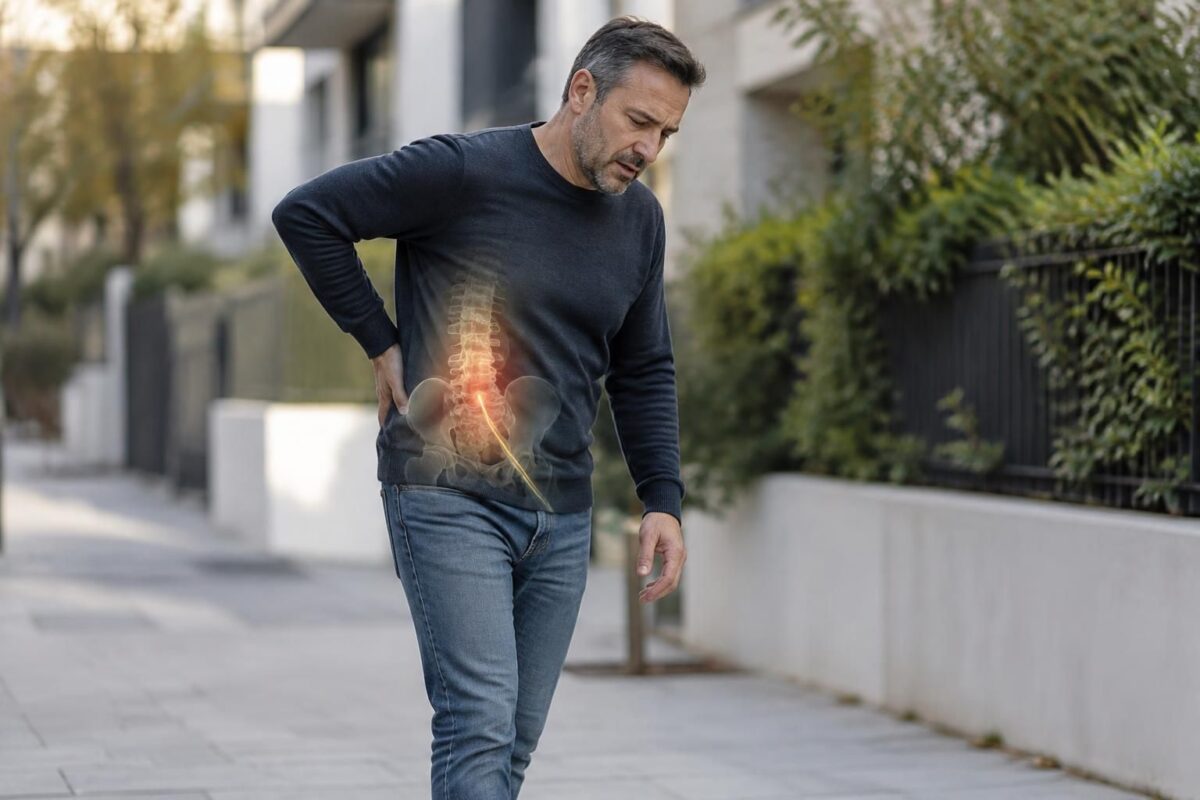
Disc herniation and pain while walking
IN BRIEF A disc bulge is a protrusion of the disc between the vertebrae, which can sometimes be accompanied by pain while walking or radiating down the leg. A gentle and progressive walk helps maintain activity if symptoms remain stable,…
When to seek an evaluation?
Consult a healthcare professional if the pain persists, frequently returns, intensifies, or is accompanied by symptoms in the leg. The evaluation may include questions about the onset of the pain, an examination of the back and hip, as well as tests of strength, sensitivity, and mobility. Imaging, such as an MRI, is not routine: its usefulness depends on clinical signs and their evolution.
Treatment depends on the identified cause. It may include advice for maintaining appropriate activity, progressive exercises, or support in physiotherapy. Medications should be discussed with a professional, especially in the presence of other health issues or ongoing treatments. An image showing a protrusion alone is not sufficient to determine a specific treatment.
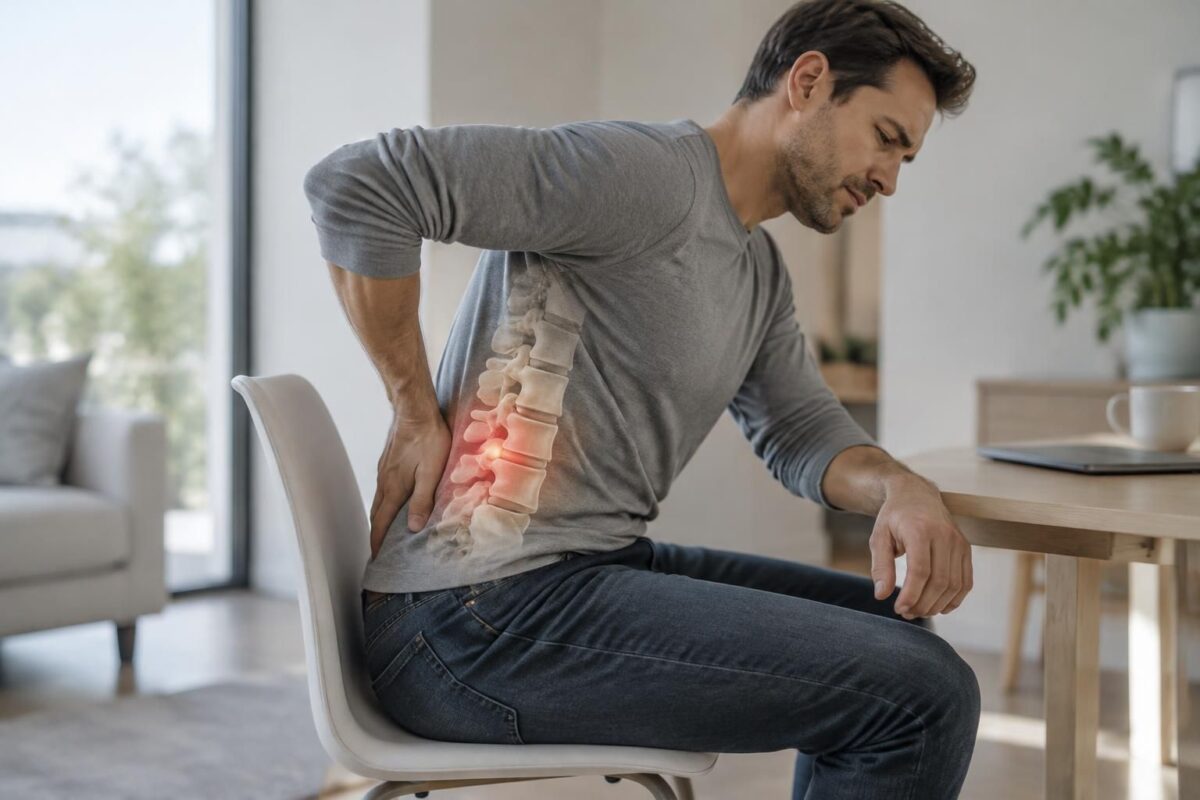
Disc bulge and pain in sitting position
IN BRIEF A disk bulge is a protrusion of a disk between the vertebrae; it does not always cause symptoms. Prolonged sitting can accentuate lower back pain and sometimes pain that radiates into the buttock or leg. Varying positions, moving…
Signs that require prompt assistance
Seek urgent medical evaluation in cases of significant or progressive weakness in the leg or foot, loss of control of the bladder or bowels, or numbness in the saddle area. Pain accompanied by fever, recent trauma, or rapid deterioration also warrants prompt medical attention. Sudden and marked swelling in one leg, especially with heat or redness, should also be evaluated quickly.
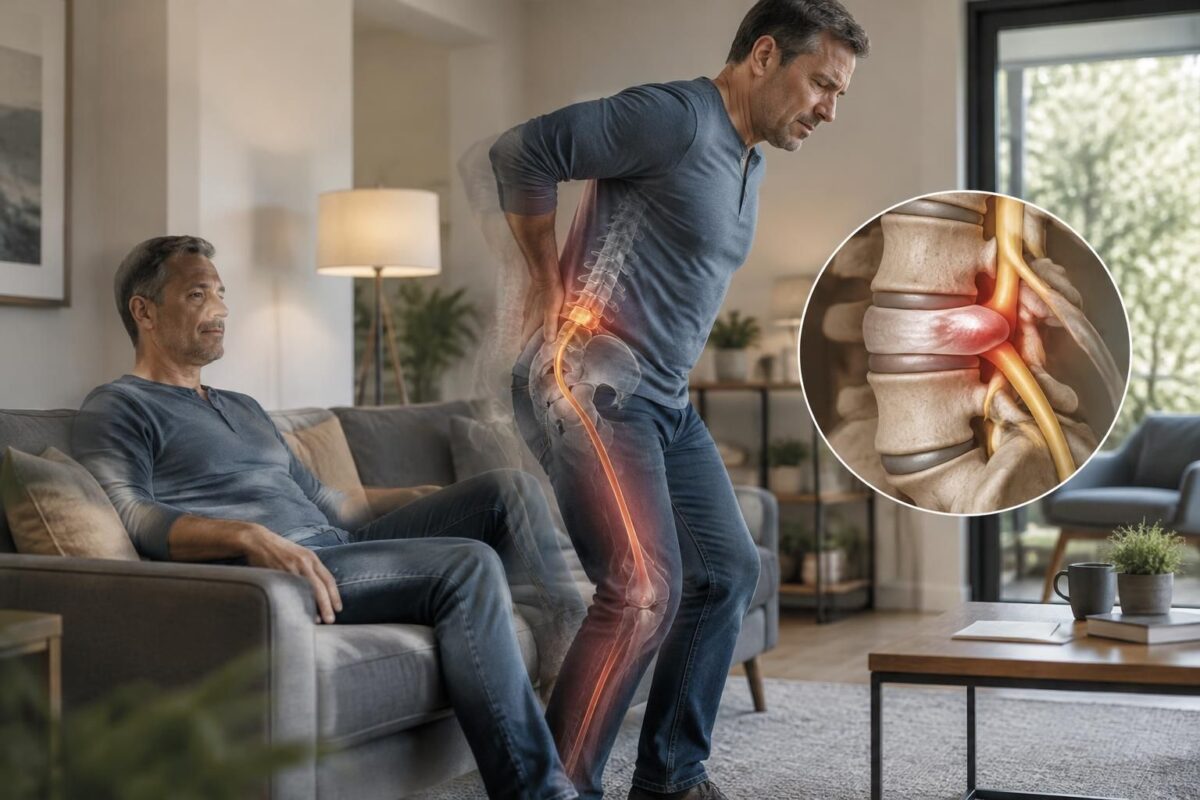
Disc herniation and fluctuating symptoms
IN BRIEF A disc bulge is a protrusion of the disc between the vertebrae, which may not necessarily cause symptoms. When pain fluctuates, its intensity can vary based on movements, activities, and other factors; the bulge visible on MRI does…
About the author
Sylvain Desforges, B.Sc., D.O., N.D., Doctor of Osteopathy, is the founding president of TAGMED and the ACMA association. His practice particularly focuses on chronic spinal pain, lower back pain, and symptoms compatible with sciatica.
Through SOS Sciatique, he publishes educational content on symptoms, their possible causes, and non-surgical approaches that may be considered based on the evaluation. At TAGMED Clinic, care may include, depending on the case, motorized neurovertebral decompression, specific osteopathy, or precision percussion.
For an evaluation related to sciatica treatment in Montreal / Mont-Royal or sciatica treatment in Terrebonne, consult the services available at TAGMED Clinic.
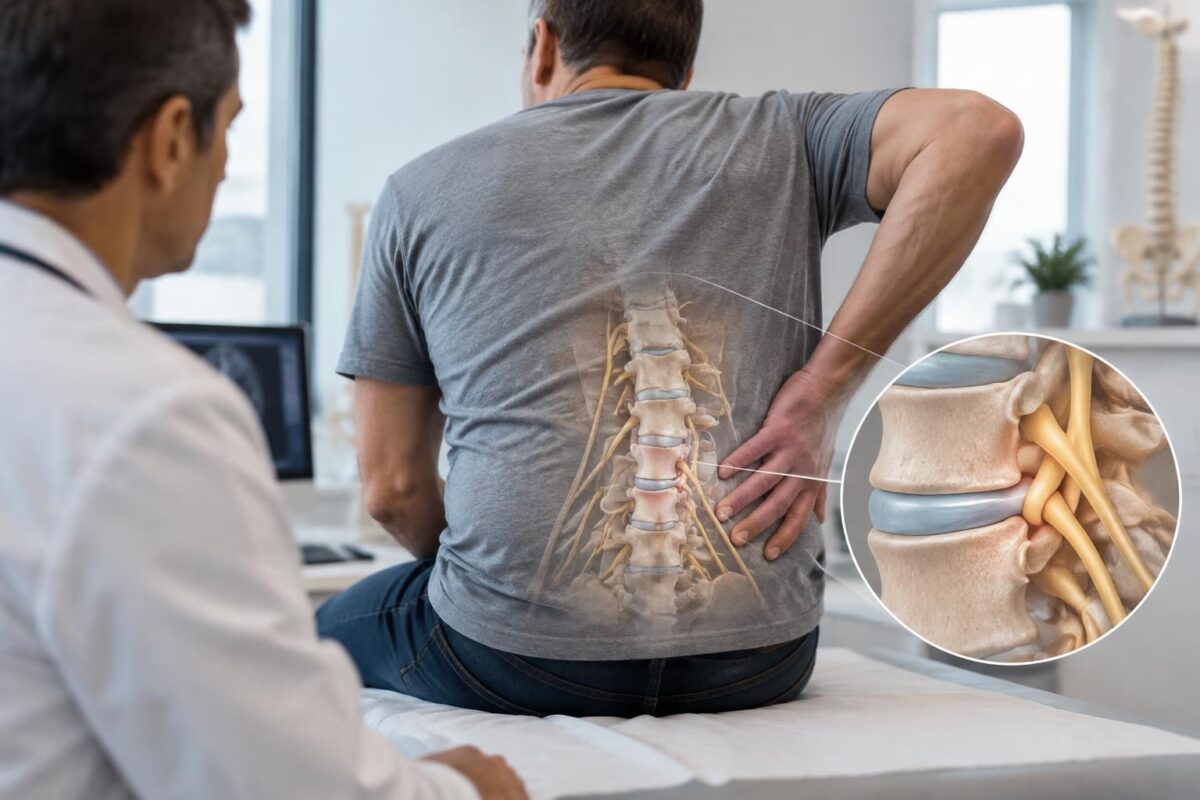
Disc bulge and mild nerve compression
IN BRIEF A disc bulge with mild nerve compression occurs when a disc slightly protrudes and may irritate a nerve, sometimes causing pain, tingling, or numbness. Symptoms and imaging do not always align: the assessment takes into account your movements…
Medical disclaimer
This information is provided for educational purposes and does not replace a consultation, diagnosis, or treatment by a physician or another licensed healthcare professional. The author is neither a doctor nor a specialist in a medical specialty recognized by the Collège des médecins du Québec. Osteopathy, manual medicine, or functional support approaches do not constitute medical acts and do not replace medical follow-up.
Consult a doctor or an emergency service in case of loss of bladder or bowel control, anesthesia in the saddle area, significant or progressive weakness in the leg or foot, fever, recent trauma, severe pain, or rapid deterioration. For more details, please read the legal notice.
| Comparison point | To remember |
|---|---|
| Possible link | A lumbar protrusion can irritate a nerve root and cause pain behind the thigh. |
| Nerve profile | Pain can start from the lower back or buttock and be accompanied by tingling or numbness. |
| Other causes | A hamstring injury or a hip issue may also be at play. |
| Muscle indicator | Localized pain triggered by exertion or contraction suggests a muscular origin. |
| Imaging protrusion | It may be present without causing pain; imaging alone does not confirm the cause. |
| Evaluation | Clinical examination helps guide the diagnosis; an MRI is considered based on symptoms and their evolution. |
| Urgency | Progressive weakness, loss of bladder or bowel control, or saddle numbness: consult without delay. |
Disc herniation and foraminal irritation
IN BRIEF A disc bulge can reduce the space of the foramen, the opening through which a nerve exits, and contribute to its irritation. This can cause lower back pain radiating into the buttock or leg, tingling, or numbness. An…
Testimonials on disc protrusion and pain behind the thigh
Note: the testimonials below are fictional examples written for illustrative purposes. They do not describe real patients and do not allow for a diagnosis. A disc protrusion visible on imaging is not necessarily the cause of pain.
Camille, 48 years old — “I initially thought it was a muscle pain”
After a long period of sitting, I felt discomfort behind my thigh, with pain sometimes present in the lower back. Since I was also doing sports, I thought I had injured my hamstrings. The evaluation allowed for examining several avenues, without immediately assuming that the disc protrusion seen on imaging explained all my symptoms.
Marc, 56 years old — “The tingling prompted me to seek help”
The pain started in my lower back and went down into my buttock, then behind my thigh. I also had tingling at times. These signs led me to seek professional advice. I understood that pain radiating down the leg could be compatible with nerve irritation, but that a clinical exam is necessary to search for the origin.
Élise, 39 years old — “The pain was mostly related to effort”
My pain behind my thigh appeared after a sprint during a run. It intensified when I contracted my leg and remained quite localized. A disc protrusion had already been mentioned in an old report, but that alone was not enough to automatically link the two problems. The examination helped consider a muscular cause.
David, 62 years old — “The imaging didn’t tell the whole story”
A disc protrusion was spotted during an exam, while my symptoms were limited and variable. I learned that this type of finding can exist without causing pain. To understand my discomfort behind the thigh, it was also important to consider its evolution, my movements, and the results of the clinical examination.
Nadia, 51 years old — “The consultation helped me describe my symptoms better”
I felt pain behind my thigh after sitting for a long time. In consultation, I specified when it appeared, whether it went below the knee, and if I had any numbness or weakness. These factors helped guide the assessment between a muscular, joint, or nerve origin, without concluding solely from an image.
Important note: pain behind the thigh can have various causes, including muscular, tendinous, nerve, or vascular. Significant or progressive weakness, loss of control over the bladder or bowels, or numbness in the saddle area requires urgent medical evaluation. These examples do not replace the advice of a healthcare professional.
Disc bulge L5-S1 and pain toward the foot
IN SHORT A L5-S1 disc bulge corresponds to a disc that slightly overruns between the last lumbar vertebra and the sacrum. It can irritate a nerve root and cause pain resembling sciatica down to the foot, but this anomaly visible…
Disc protrusion and pain behind the thigh: understanding the possible links
Pain at the back of the thigh can hinder walking, sleeping, and daily activities. It is sometimes associated with a lumbar disc protrusion, but this explanation does not apply to all cases. The hamstrings, their tendons, the hip joint, or other nerve structures may also be involved. Therefore, the origin should be assessed based on symptoms and context, rather than presumed.
Intervertebral discs sit between vertebrae and contribute to mobility and shock absorption. Over time, they can lose some of their flexibility and become deformed. A disc protrusion refers to an overflow of the disc, usually more spread out than a disc herniation. This change can be visible on imaging without causing pain. Its presence on an MRI does not, therefore, suffice, on its own, to establish that it explains thigh pain.
When can the pain be of nerve origin?
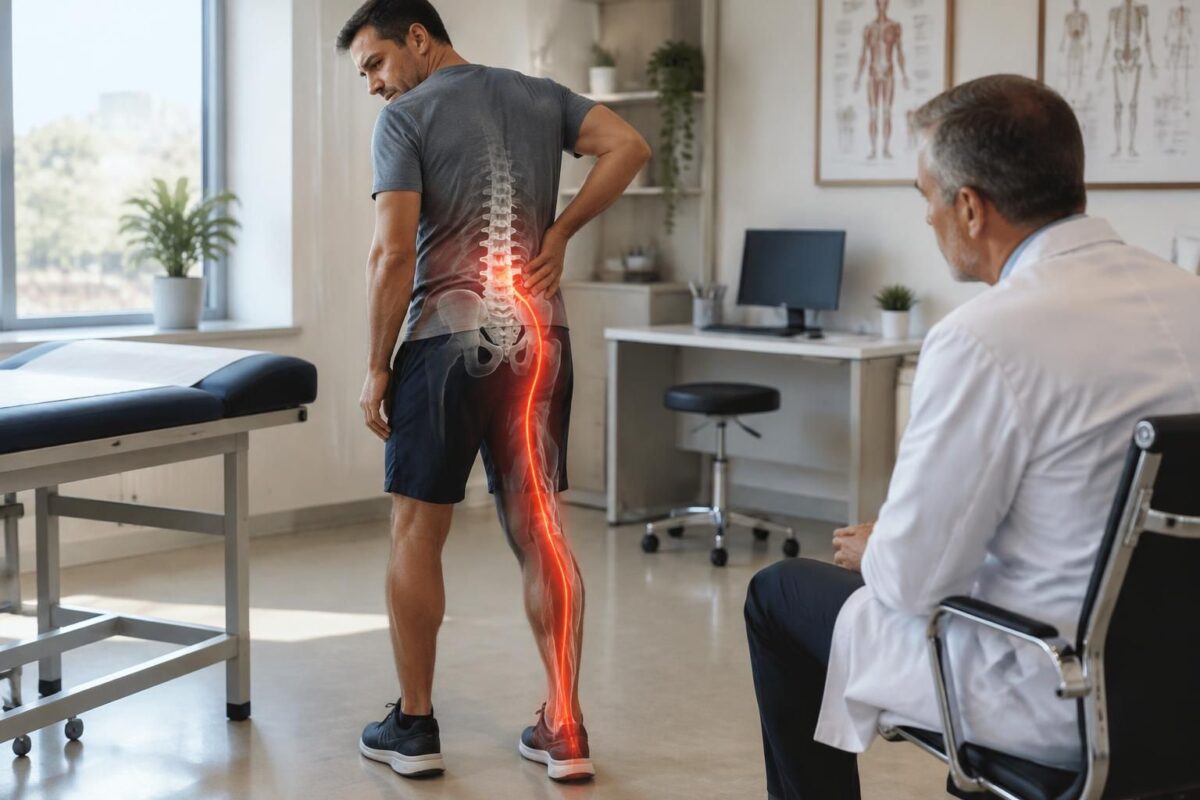
If a protrusion affects or irritates a lumbar nerve root, the pain can follow the path of the nerve into the buttock and back of the thigh. It can sometimes radiate down to the calf or foot. Burning sensations, electric shocks, tingling, or numbness may accompany this irradiation. Weakness in the leg or foot deserves particular attention. However, isolated pain behind the thigh is not necessarily sciatica.
An injury to the hamstrings is more likely when the pain appears after exertion, remains localized, and worsens when contracting or stretching the muscle. A tendinopathy may develop gradually, especially after repeated movements. The time spent sitting, sports activities, the circumstances of onset, and movements that worsen or relieve the pain are useful information to convey to the healthcare professional.
Assessment and management
The assessment may include an interview about symptoms and history, as well as an examination of mobility, strength, sensitivity, and movements that reproduce the pain. Imaging is not systematic: a healthcare professional may deem it relevant based on evolution, clinical examination, and the presence of particular signs. The result must always be interpreted with consideration of the symptoms, as disc abnormalities are sometimes discovered incidentally.
Management depends on the identified cause and the situation of each person. It may include advice to temporarily adjust activities, maintaining tolerated activity, and gradual rehabilitation. Exercises aimed at mobility and strengthening may be suggested by a qualified professional. Medications, specific tests, or treatments should be discussed with a doctor or another authorized professional. It is best to avoid exercises that significantly increase pain and not to prolong immobility without appropriate advice.
Seek medical assistance promptly in cases of loss of bladder or bowel control, numbness in the saddle area, significant or progressive weakness, fever, recent trauma, or rapid aggravation. These signs do not allow for a remote diagnosis and require immediate evaluation.
About the author
Sylvain Desforges, B.Sc., D.O., N.D., Doctor of Osteopathy, is the founding president of TAGMED and the ACMA association. His practice focuses particularly on chronic spinal pain, lower back pain, and symptoms compatible with sciatica. Care offered at the TAGMED Clinic may include, based on evaluation and situation, motorized neurovertebral decompression, specific osteopathy, or precision percussor. His approach focuses on managing pain and integrating technologies, including decompression, laser, and shock waves.
Medical disclaimer: this content is provided for educational purposes and does not replace consultation, diagnosis, or treatment by a licensed healthcare professional. The author is neither a physician nor a specialist in a medical specialty recognized by the Collège des médecins du Québec. Osteopathy, manual medicine, or functional support approaches do not replace medical follow-up.
A pain behind the thigh can be related to the hamstrings, a tendon, irritation of the sciatic nerve, or, more rarely, a circulation problem. A disc protrusion may contribute to the pain if it irritates a nerve root, but it is often discovered through imaging without causing symptoms. The onset of pain, its path, and associated signs help guide the assessment but do not replace a professional examination.
Essential points
Disc protrusion corresponds to a bulging of the intervertebral disc. It does not necessarily mean that a nerve is compressed or that it explains pain in the thigh. To understand the difference between protrusion and disc herniation, as well as the characteristics of these changes, refer to the resources from Doctissimo and Consultant ergonome. The possible symptoms and the causes and management options vary from person to person.
A pain that starts in the lower back or buttock and descends behind the thigh may be compatible with nerve irritation, especially if accompanied by tingling, numbness, or weakness. The affected area may depend on the involved nerve root, as explained in this resource on the differences between L4-L5 and L5-S1. Numbness in the leg and difficulty walking on the heels merit evaluation; you can learn more about numbness associated with disc herniation and sciatica and difficulty walking on the heels.
Conversely, a localized pain that occurs after exertion and worsens when the hamstrings contract may suggest a muscle or tendon injury. Discomfort related to prolonged sitting may also have different origins. Accurately describing the onset, path, aggravating factors, and associated signs helps the professional choose the useful checks; this guide can assist you in describing your symptoms during a consultation.
Management depends on the established cause. When symptoms related to a disc are present, maintaining an appropriate activity level and individualized rehabilitation may be considered with a healthcare professional; recovery times vary based on the situation and the person. Consult the information on healing time and rehabilitation. Persistent or worsening nighttime pain should also be discussed with a professional, particularly to examine the factors to watch out for in sciatica.
Significant or progressive weakness in the leg or foot, loss of bladder or bowel control, or numbness in the saddle region requires urgent medical evaluation. This information is educational and does not alone allow for a diagnosis or determine whether a disc protrusion is responsible for the pain.

Sylvain Desforges, B.Sc., D.O., N.D., docteur en ostéopathie
Dr Sylvain Desforges, B.Sc., D.O., N.D., osteopath, is the founding president of TAGMED and of the ACMA association. He dedicates his practice to chronic spinal pain, low back pain and symptoms compatible with sciatica, particularly when pain radiates toward the buttock, leg, calf, foot or toes.
Through SOS Sciatique, he publishes educational content on sciatica symptoms, possible causes such as disc herniation, disc narrowing, foraminal stenosis or irritation of a lumbar nerve root, as well as non-surgical approaches that may be considered according to the evaluation. At Clinique TAGMED, care may include, depending on the case, motorized neurovertebral decompression, specific osteopathic care or precision percussion.
For an evaluation related to sciatica treatment in Montreal / Mount Royal or sciatica treatment in Terrebonne, please consult the services available at Clinique TAGMED.
Medical disclaimer
The information published on SOS Sciatique is provided for educational purposes only and does not replace a consultation, diagnosis, opinion or treatment provided by a physician or another authorized healthcare professional. The author of this article is neither a medical doctor nor a specialist in a medical specialty recognized by the Collège des médecins du Québec. The osteopathic, manual medicine or functional support approaches described on this site do not constitute medical acts and are not intended to replace medical follow-up.
Consult a physician or emergency service in cases of loss of bladder or bowel control, anesthesia in the saddle area, significant or progressive weakness in the leg or foot, fever, recent trauma, severe pain or rapid worsening of symptoms. For more details, please read our Legal Notice.