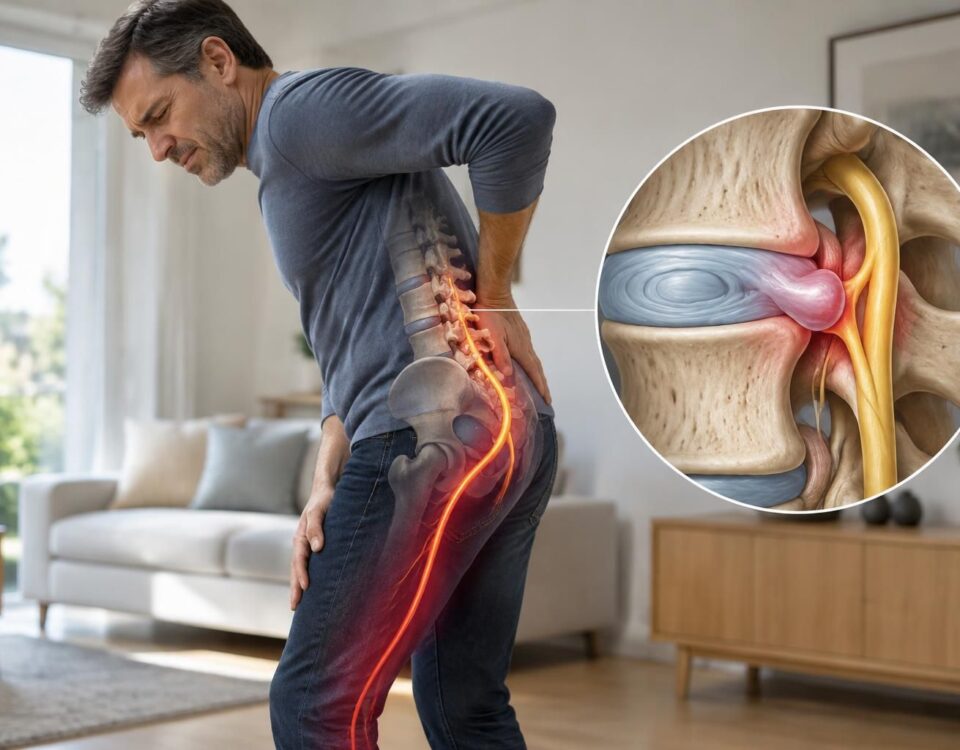
Sciatica and pain after lifting a load
28/09/2026
Sciatica and altered gait: why this can perpetuate pain
28/09/2026
IN BRIEF A herniated disc visible on MRI may not cause pain or sciatica. The image alone is therefore not sufficient to explain the symptoms: it must be interpreted alongside the clinical examination. This distinction helps avoid unnecessary concerns and treatments, while guiding management based on pain, function, and neurological signs. |
Herniated Disc and Sciatica: An Image Visible Without Pain
A herniated disc detected on MRI does not always cause pain or sciatica. Some individuals have no symptoms, while lower back pain or leg pain may have other causes. The image must therefore be interpreted with the symptoms and clinical examination: it is not enough, on its own, to establish the source of the pain.
In the absence of symptoms, a visible herniated disc does not necessarily require treatment. Consult a healthcare professional if pain arises or persists. Significant or progressive weakness in the leg, loss of bowel or bladder control, or numbness in the saddle area warrant urgent evaluation.
An MRI can show a herniated disc while the person feels no pain. This image alone does not prove that the disc is causing a problem or that treatment is necessary. To understand the situation, a healthcare professional correlates the symptoms, clinical examination, and imaging results. An intervertebral disc is located between two vertebrae and helps distribute stress. A part of the disc may bulge or move: this is referred to as protrusion or herniation. This change can appear on imaging without irritating a nerve and without causing pain. Imaging examinations sometimes reveal changes in discs among people who experience no symptoms. The presence of an abnormality does not automatically mean it explains pain or requires treatment. To explore the difference between an image and symptoms, consult this article on herniated discs without back pain. You can also read this page on herniated discs and sciatica without lower back pain. The MRI allows visualization of the discs and structures near the nerves. It can specify the level of the herniation and show if a nerve root appears compressed. However, it does not directly measure pain and does not, on its own, establish the cause of each symptom. A report mentioning a herniation must therefore be interpreted in context. The professional checks if the observed side and level correspond to the path of the pain, changes in sensitivity, and muscle strength. An image that does not align with clinical signs may be a finding unrelated to the symptoms. The terms in the report can also be confusing. A disc protrusion and a herniated disc do not always describe the same form of change. The professional can explain the meaning of the words used in your report. A herniation can contribute to sciatica if it irritates or compresses a nerve root. The pain may start in the lower back or the buttock, then radiate down the thigh and leg. Some individuals may also experience tingling, numbness, or weakness. Lower back pain is not always present. A person may have pain radiating down the leg without experiencing back pain. Conversely, a visible herniation may not cause any sciatica. To better differentiate the possible mechanisms, consult this resource on low back pain and sciatica. A lesion of a lumbar nerve root can produce symptoms in a specific area of the leg. However, the pain or unusual sensations may vary from person to person. For example, heel pain alone is not sufficient to confirm an S1 nerve root injury. Other causes are possible, as highlighted on this page about heel pain and the S1 root. Coughing or sneezing can sometimes worsen pain radiating down the leg. This sign merits evaluation, but it does not confirm the presence of a herniation on its own. For more information, see the details on sciatic pain aggravated by coughing. An evaluation takes several factors into account: where the pain starts, its path, sensations in the leg, muscle strength, and reflexes. The professional compares these observations to the level indicated on the MRI. This approach helps determine if the image and symptoms appear related. An MRI is not necessary in every situation of recent pain. The physician assesses whether the examination could change management, particularly based on the duration of symptoms, their progression, and the presence of neurological signs. An X-ray does not show discs and nerves in the same way as an MRI. A resource dedicated to herniated discs, MRI, and warning signs also presents the points to consider during evaluation. For an explanation of the differences between herniation, sciatica, and femoral neuralgia, consult this page on herniated discs, sciatica, and femoral neuralgia. In the absence of symptoms, a visible herniation does not automatically warrant treatment. The professional can place the result in the context of your health and address your questions. It is useful to keep the report and avoid drawing conclusions solely from a medical term or an image. If pain arises later, a new evaluation can check if it corresponds to the area seen on the MRI. Care should then consider function, symptoms, and their progression, rather than focusing solely on a radiological abnormality. Management depends on the evaluation and the individual situation. It may include self-management advice and non-surgical care tailored to the symptoms. A manual or functional approach does not replace a medical diagnosis and cannot confirm, on its own, that a herniation is the cause of the pain. At the TAGMED Clinic, an assessment can help clarify the available care options. Depending on the case, services may include specific osteopathy or motorized neurovertebral decompression. These approaches are not suitable for everyone and require a prior assessment. To understand some misconceptions about this approach, refer to the article on myths about neurovertebral decompression. Quickly consult a doctor if there is significant or progressive weakness in a leg or foot, or if you notice worsening loss of sensation. New difficulty in controlling the bladder or intestines, or loss of sensitivity in the saddle area, requires urgent evaluation. Severe pain, fever, or rapid deterioration also warrant medical advice. Dr. Sylvain Desforges, B.Sc., D.O., N.D., osteopath, is the founding president of TAGMED and of the ACMA association. His practice focuses particularly on chronic pain in the spine, lumbar pain, and pain associated with sciatica, including when the pain radiates to the buttock, leg, calf, foot, or toes. Through SOS Sciatique, he publishes educational content on sciatica symptoms, possible causes such as disc herniation or irritation of a lumbar nerve root, and non-surgical approaches that may be considered after an assessment. At the TAGMED Clinic, care may include, depending on the situation, motorized neurovertebral decompression, specific osteopathy, or precision percussion. For an evaluation related to sciatica treatment in Montreal or Mont-Royal, sciatica treatment in Terrebonne, or services from the TAGMED Clinic, check the available options. Medical disclaimer: The information and advice provided on this site do not replace the opinion, diagnosis, or treatment of a healthcare professional. Please note that Dr. Sylvain Desforges, osteopath, is neither a medical doctor nor a physician, and is not a specialist in any medical specialty as defined by the Collège des médecins du Québec. Manual medicine, functional medicine, and sports medicine as described on this site exclude any medical treatment or diagnosis made by a physician or medical specialist. Always consult your doctor for any medical questions. For more details, please read our complete legal notice.A Herniated Disc Can Remain Asymptomatic
What the MRI Can Show — and What It Cannot Conclude
When Can a Herniated Disc Cause Sciatica?
The Path of Symptoms Depends on the Affected Nerve
How to Interpret Results with the Symptoms
What to Do if the MRI Shows a Herniation but There Is No Pain?
What Approaches Can Be Considered?
When to seek medical advice quickly?
About the author
Medical disclaimer

L5-S1 protrusion and sciatic pain: pathway to the foot
IN BRIEF A L5-S1 disc protrusion is a disc that slightly bulges between the lumbar and sacral vertebrae. If it irritates a nerve root, pain may radiate from the lower back or buttock down the back of the leg to…
Visible disc herniation, but no pain: distinguishing image from symptoms
What the MRI shows
- A disc herniation may be present without causing pain.
- The image describes a structure: it does not confirm, by itself, the cause of the symptoms.
- Disc abnormalities may also be observed in people without pain.
What to evaluate
- The presence and pathway of pain to the buttock or leg.
- Changes in sensitivity, strength, or reflexes.
- The concordance between symptoms, clinical examination, and imaging.

A visible disc herniation on imaging does not necessarily mean it is causing pain or sciatica. Disk abnormalities can exist without symptoms; thus, the interpretation should take into account what you feel, your mobility, and the clinical examination. If you are not in pain and your functioning is normal, an image alone typically does not justify treatment.

L4-L5 protrusion and sciatic pain: possible signs
IN BRIEF A L4-L5 disc protrusion is a bulging of the disc between two lumbar vertebrae. If it irritates the L5 nerve root, it can cause sciatica radiating from the buttock to the side of the leg and the top…
An image does not tell the whole story
The MRI allows observation of the discs and surrounding structures, but it does not directly measure pain. A herniation may appear without irritating a nerve root. Conversely, lower back pain or pain radiating down the leg may have other causes, even if the imaging does not show significant herniation.
The link between a herniation and sciatica becomes more plausible when several elements align: symptom pathway, examination of sensitivity and strength, reflexes, and level of the herniation observed on MRI. For example, some L4-L5 or L5-S1 lesions may irritate nerve roots associated with distinct areas of the leg. However, the imaging report must be interpreted by a professional, not in isolation.
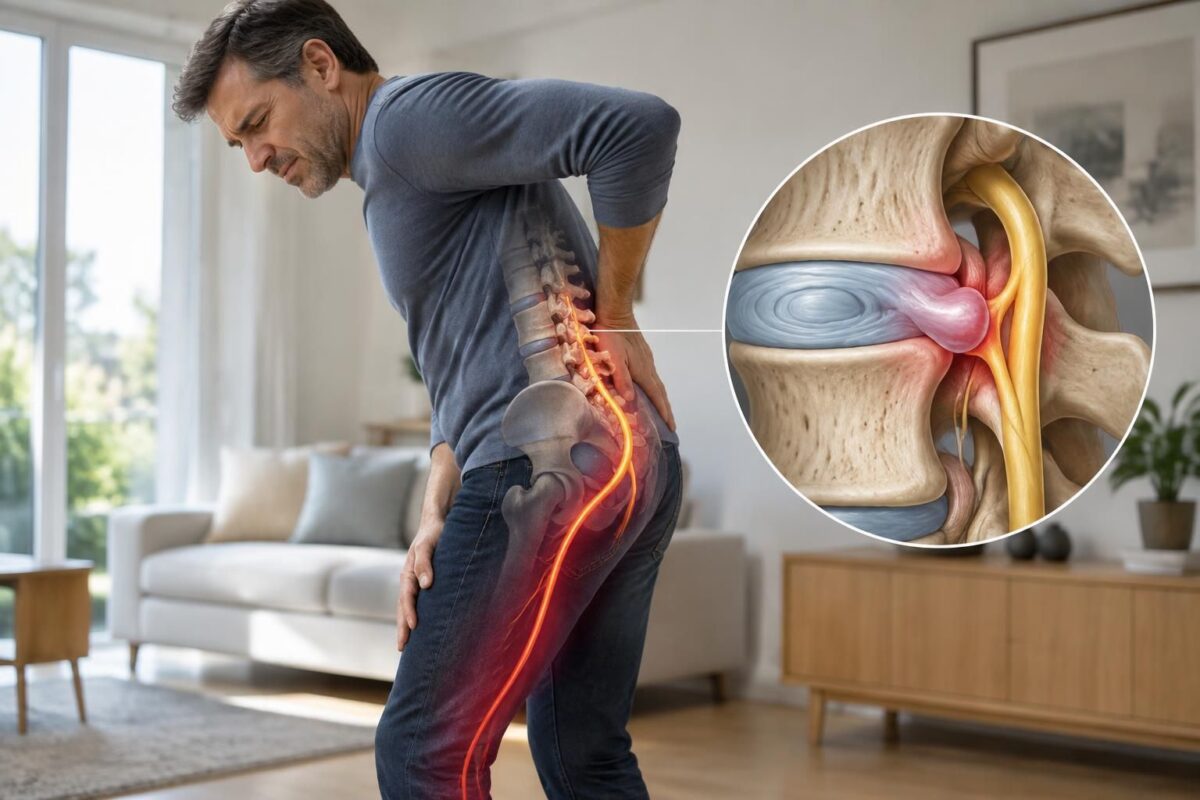
Disc protrusion and sciatica: when the disc touches a nerve root
IN BRIEF A disc protrusion is a disc that extends beyond its usual contour. If it irritates a nerve root, it can contribute to sciatica, with pain radiating into the buttock or leg, sometimes accompanied by tingling or weakness. An…
What to do if you have no symptoms?
If a herniation is discovered incidentally and you have no pain, numbness, or weakness, avoid panicking. It is generally unnecessary to seek to “correct” the image or request treatment just to make it go away. Discuss it with the professional who prescribed the exam to understand the result and check if it requires particular follow-up.
You can continue your usual activities according to your tolerance. Stay active, vary positions, and gradually resume efforts after a period of inactivity. It is not necessary to systematically avoid sports, lifting objects, or back movements in the absence of symptoms. If an activity causes new or persistent pain, temporarily reduce its intensity and seek advice.

Herniated disc and sciatica: morning pain and lumbar stiffness
IN BRIEF A herniated disc can irritate a nerve root and cause sciatica, with lower back pain radiating down the leg. However, morning pain and lower back stiffness alone are not sufficient to confirm this diagnosis. An assessment helps guide…
If sciatica occurs
A pain that starts from the lower back or buttock and radiates down the leg deserves evaluation, especially if accompanied by tingling or diminished sensitivity. Note when it occurs, how far it descends, and which movements aggravate or alleviate it. This information helps the professional compare your symptoms with the imaging results.
In the absence of serious signs, care is often gradual and non-surgical: advice to maintain appropriate activity, pain management strategies, and individualized exercises based on the assessment. Osteopathy or other functional approaches may be considered on a case-by-case basis, without replacing medical follow-up. An intervention is not decided based solely on the presence of a herniation on MRI.
When to seek urgent help
Quickly consult a doctor or an emergency service in case of loss of urinary or bowel control, numbness in the saddle area, significant or progressive weakness of the leg or foot, fever after back pain, or rapid worsening. These signs require immediate evaluation.

Herniated disc and sciatica: night pain and factors to watch out for
IN BRIEF A herniated disc can irritate a nerve root and cause sciatica, sometimes more bothersome at night. Night pain alone is not enough to determine the cause: its variation according to positions, neurological examination and, if necessary, imaging help…
About the Author
Dr Sylvain Desforges, B.Sc., D.O., N.D., osteopath, is the founding president of TAGMED and the ACMA association. His practice focuses, among other things, on chronic spinal pain, lower back pain, and symptoms compatible with sciatica. The approaches offered at the TAGMED Clinic may include, depending on the assessment, specific osteopathy, motorized neurovertebral decompression, or precision impactor.
Medical Warning
This content is provided for educational purposes and does not replace a consultation, diagnosis, or treatment by a doctor or another authorized healthcare professional. The author is neither a doctor nor a specialist in a medical specialty recognized by the Collège des médecins du Québec. The approaches of osteopathy, manual medicine, and functional support do not replace medical follow-up.
| What the MRI Shows | How to Interpret It |
|---|---|
| Visible disc herniation, without pain | It may be asymptomatic and does not automatically require treatment. |
| Lower back pain without sciatica | The image alone does not attribute the pain to the herniation. |
| Pain that radiates down the leg | The path and clinical examination help verify possible nerve irritation. |
| Herniation and symptoms on the same side | The correlation between the MRI and symptoms makes the link more plausible, without confirming it on its own. |
| Tingling or numbness | To be assessed with sensitivity, strength, and reflexes. |
| Pain despite an MRI without herniation | Other causes may be considered during the evaluation. |
| Treatment decision | It depends on the symptoms, function, and examination, not just the image. |
| Progressive weakness or urinary or bowel issues | Quickly consult a healthcare professional or an emergency service. |

Herniated disc and sciatica: why the leg can be numb
IN BRIEF A sciatica is pain related to the irritation of a nerve root, sometimes caused by a <strongherniated disc. Pressure on the nerve can cause tingling, loss of sensation, or weakness in the leg. A healthcare professional can assess…
Illustrative Testimonials: Disc Herniation and Sciatica without Pain
Important Note: The testimonials below are fictional and are intended solely to illustrate possible situations. They do not come from identifiable patients and do not allow for predicting the progress of an individual. A visible herniation on the MRI is not necessarily the cause of pain: imaging results must be interpreted alongside symptoms and clinical examination.
Camille, 42 — An Unexpected Discovery
“I had an MRI for another reason, and the report mentioned a lumbar disc herniation. Since I had neither back pain nor leg pain, I was initially worried that the problem might worsen. After discussing it with a healthcare professional, I understood that the image alone was not sufficient to conclude that I was sick or needed treatment.”
Marc, 51 — A Daily Life without Symptoms
The imaging report described a disc protrusion, but I could walk, work, and do my usual activities without pain. I realized that a visible anomaly can be present without causing symptoms. I continued to move normally, remaining attentive to the potential appearance of new signs.”
Élise, 36 — An Image that Did Not Match Her Sensations
“I sometimes had stiffness in my lower back, but no pain radiating into my buttock or leg. The MRI revealed a herniation, and I wondered if it explained everything. The clinical examination and discussion about my symptoms helped me avoid making conclusions based solely on the report.”
Rachid, 47 — The Importance of Overall Evaluation
“My imaging showed a disc herniation, but I had no sciatica or loss of strength. I was told that the diagnosis also depends on the location of the pain, sensitivity, strength, and reflexes. This context reassured me and helped me better understand the results.”
Julie, 58 — Avoiding Assumptions
“I thought that a herniation spotted on the MRI automatically meant a serious injury. Since I had no pain, I learned that there was no reason to presume it required treatment. I instead emphasized the importance of seeking an interpretation suited to my situation.”
These examples illustrate an essential point: a disc herniation can be present without pain, while lower back pain or sciatica may have other origins. An MRI does not, by itself, constitute a diagnosis of the cause of symptoms. The evaluation takes into account, among other factors, the path of the pain, strength, sensitivity, reflexes, and changes over time.
In the absence of symptoms, a herniation found incidentally does not automatically mean that intervention is necessary. If pain appears, persists, or is accompanied by symptoms in the leg, consult an authorized healthcare professional to determine the appropriate course of action. Do not modify a treatment or start new exercises solely based on an imaging result.
Quickly consult a doctor or an emergency service in case of loss of urinary or bowel control, numbness in the saddle area, or significant or progressive weakness in one leg or foot.
About the Author
Dr Sylvain Desforges, B.Sc., D.O., N.D., osteopath, is the founding president of TAGMED and the ACMA association. He dedicates his practice to chronic pain in the spine, lower back pain, and pain compatible with sciatica, particularly when the pain radiates toward the buttock, leg, calf, foot, or toes.
Through SOS Sciatique, he publishes educational content on sciatica symptoms, possible causes such as disc herniation, disc pinching, foraminal stenosis, or irritation of a lumbar nerve root, as well as non-surgical approaches that may be considered depending on the assessment. At the TAGMED Clinic, care may include, as appropriate, motorized neurovertebral decompression, specific osteopathy, or precision impactor.
Medical Warning
The information published on SOS Sciatique is provided for educational purposes and does not replace a consultation, diagnosis, opinion, or treatment performed by a physician or another authorized health professional. The author of this article is neither a doctor nor a specialist in a medical specialty recognized by the Collège des médecins du Québec. The osteopathy, manual medicine, or functional support approaches described on this site do not constitute medical acts and are not intended to replace medical follow-up.

Herniated disc and sciatica: causes of recurring pain
IN BRIEF A herniated disc can irritate or compress a nerve root and cause sciatica, with pain radiating from the lower back to the buttock or leg and possibly returning. Symptoms and their causes are not always the same: an…
Herniated disc and sciatica: why a visible image may not cause any pain
A herniated disc discovered through imaging can cause many worries, especially when associated with sciatica. However, the presence of a hernia on an MRI does not automatically mean it is painful, that it compresses a nerve, or that it requires treatment. Some people have a visible disc anomaly without experiencing any symptoms and continue their usual activities without knowing it exists.
The intervertebral discs are the soft structures located between the vertebrae. They help distribute the stresses related to movements and loads. A hernia occurs when part of the disc protrudes or migrates beyond its usual position. Depending on its size and location, it may be close to a nerve root, touch it, or compress it. But this anatomical finding alone does not allow for the determination of the cause of pain.
Sciatica generally refers to pain related to irritation of a lumbar nerve root. It can start from the lower back or buttock and travel down the leg, sometimes reaching the foot or toes. Tingling, numbness, or weakness may also be present. A hernia can contribute to these symptoms when they coincide with the level and side observed on imaging. Conversely, a visible hernia without pain radiating into the leg may be an incidental finding.
This difference between the image and symptoms is important. An MRI shows structures, but it does not directly measure pain and does not always reveal why a person is suffering. Disc anomalies may appear in individuals who feel no back pain. Similarly, low back pain may have multiple factors: tissue sensitivity, physical stress, disrupted sleep, stress, decreased activity, or other musculoskeletal causes. It is, therefore, preferable to interpret the results alongside the clinical history and physical examination.
A professional evaluation focuses on the trajectory of the pain, its evolution, the movements that modify it, as well as the strength, sensitivity, and reflexes of the legs. The professional can compare these elements to the imaging report. The goal is to establish whether the hernia is genuinely compatible with the symptoms and whether further examination or specific management could alter care decisions. An abnormal image does not justify intervention on its own.
When there is no pain or loss of function, a hernia observed incidentally generally does not require specific treatment. If symptoms are present, a progressive approach may be considered based on the evaluation: appropriate maintenance of activities, gradual resumption of movement, self-management advice, and support from authorized professionals. The choice of care depends on each individual’s situation; manipulations or exercises may not be suitable for everyone. It is also important to avoid prolonged immobility and efforts that significantly worsen symptoms.
A prompt medical consultation is necessary in the presence of significant or progressive weakness in the leg or foot, loss of urinary or bowel control, or numbness in the saddle area. These signs require urgent evaluation, regardless of what the MRI shows.
Dr. Sylvain Desforges, B.Sc., D.O., N.D., osteopath, is the founding president of TAGMED clinics and the ACMA association. His practice notably focuses on chronic spinal pain, low back pain, and symptoms compatible with sciatica. He is interested in functional evaluation and non-surgical approaches tailored to the situation, which may include specific osteopathy or motorized neurovertebral decompression. However, educational information does not replace a consultation, diagnosis, or medical follow-up.
A visible herniated disc on MRI does not necessarily mean it causes pain or sciatica. Some hernias remain silent, while low back pain or leg pain may have other origins. To understand what the imaging reveals, it must be related to the symptoms, clinical examination, and the individual’s evolution, rather than drawing conclusions based solely on the image.

Herniated disc and sciatica: when to reassess symptoms
IN BRIEF A herniated disc can irritate a nerve root and cause sciatica, with pain that radiates down the leg. Reevaluating symptoms helps to track their evolution and determine if medical advice or tests are necessary, without assuming that surgery…
Visible herniated disc on MRI: what the image allows us to conclude
An MRI can show the shape and location of a disc, a protrusion or hernia, as well as their proximity to a nerve root. It describes structures but does not, on its own, establish that the anomaly is the cause of pain. Imaging observations in symptom-free individuals illustrate this distinction between a present hernia and a truly symptomatic hernia. To expand on this point, consult this article on herniated disc without pain.
The affected level can help interpret symptoms when they exist. For example, an L4-L5 hernia may be associated with irritation of the L5 root, while an L5-S1 involvement may concern the S1 root. However, pain, changes in sensitivity, and movement difficulties are not the same from one person to another. A detailed presentation of L4-L5 characteristics is available in this article on lumbar herniated disc L4-L5. General information on sciatica related to a hernia can also be found in this information document.
Linking symptoms, clinical examination, and imaging
The evaluation focuses on the trajectory of the pain, tingling or numbness, the strength of the leg and foot, as well as reflexes. An image may show an anomaly without corresponding to the side or area of the symptoms. Conversely, a person may suffer even if the MRI does not clearly show a responsible hernia. It is, therefore, essential to interpret the results in context and to distinguish between an MRI image and the certain cause of sciatica.
The presence of an annular fissure or discopathy does not, by itself, explain pain. These terms refer to changes that must be related to clinical manifestations. You can find explanations on the annular fissure and possible pain as well as on the differences between disc herniation and discopathy.
A loss of sensitivity, weakness, or difficulty lifting the foot deserves professional evaluation, even if the pain is mild or absent. The significance of these signs depends on their intensity, duration, and progression. To better understand why these changes need to be evaluated, consult the page dedicated to sensitivity loss associated with a disc herniation.
Choosing Appropriate Management for the Situation
When a hernia is visible but does not cause any symptoms, the image alone generally does not justify treatment. In the presence of pain, management depends more on the intensity of the symptoms, their impact on activities, and the results of the examination. A non-surgical approach can be considered based on the evaluation; surgery is discussed in certain particular situations, especially in cases of significant neurological deficit or persistent, disabling symptoms despite appropriate management. Additional information on symptoms and treatment options is provided in this article about disc herniation, its symptoms, and treatments.
X-rays and MRIs do not show the same structures: X-rays mainly provide information about bones, while MRIs allow visualization of the discs and other soft tissues. Even when an MRI shows a hernia, the result must be compared to the clinical examination. To learn more about image interpretation and its limitations, consult the resources on what an MRI can show and on sciatica and its possible causes.
Quickly consult a doctor or emergency service if you experience loss of urinary or bowel control, numbness in the saddle area, significant or progressive weakness of the leg or foot, fever, recent trauma, or rapid deterioration. These signs cannot be evaluated based on an image alone.
About the Author
Dr Sylvain Desforges, B.Sc., D.O., N.D., osteopath, is the founding president of TAGMED and the ACMA association. He dedicates his practice to chronic spinal pain, lower back pain, and pain compatible with sciatica, especially when the pain radiates to the buttock, leg, calf, foot, or toes.
Through SOS Sciatique, he publishes educational content on sciatica symptoms, possible causes such as disc herniation, disc compression, foraminal stenosis, or irritation of a lumbar nerve root, as well as non-surgical approaches that may be considered based on evaluation. At TAGMED Clinic, care may include, depending on the case, motorized neurovertebral decompression, specific osteopathy, or precision impactor.
For an evaluation related to sciatica treatment in Montreal / Mont-Royal or sciatica treatment in Terrebonne, consult the available services at TAGMED Clinic.
Medical Disclaimer
The information published on SOS Sciatique is provided for educational purposes and does not replace a consultation, diagnosis, opinion, or treatment by a doctor or another licensed healthcare professional. The author of this article is neither a physician nor a specialist in a medical specialty recognized by the Collège des médecins du Québec. The approaches of osteopathy, manual therapy, or functional support described on this site do not constitute medical acts and are not intended to replace medical follow-up.
Consult a doctor or emergency service in case of loss of urinary or bowel control, numbness in the saddle area, significant or progressive weakness of the leg or foot, fever, recent trauma, severe pain, or rapid deterioration. For more details, please read our Legal notice.

Dr Sylvain Desforges, B.Sc., D.O., N.D., osteopath, is the founding president of TAGMED and of the ACMA association. He dedicates his practice to chronic spinal pain, low back pain and symptoms compatible with sciatica, particularly when pain radiates toward the buttock, leg, calf, foot or toes.
Through SOS Sciatique, he publishes educational content on sciatica symptoms, possible causes such as disc herniation, disc narrowing, foraminal stenosis or irritation of a lumbar nerve root, as well as non-surgical approaches that may be considered according to the evaluation. At Clinique TAGMED, care may include, depending on the case, motorized neurovertebral decompression, specific osteopathic care or precision percussion.
For an evaluation related to sciatica treatment in Montreal / Mount Royal or sciatica treatment in Terrebonne, please consult the services available at Clinique TAGMED.
Medical disclaimer
The information published on SOS Sciatique is provided for educational purposes only and does not replace a consultation, diagnosis, opinion or treatment provided by a physician or another authorized healthcare professional. The author of this article is neither a medical doctor nor a specialist in a medical specialty recognized by the Collège des médecins du Québec. The osteopathic, manual medicine or functional support approaches described on this site do not constitute medical acts and are not intended to replace medical follow-up.
Consult a physician or emergency service in cases of loss of bladder or bowel control, anesthesia in the saddle area, significant or progressive weakness in the leg or foot, fever, recent trauma, severe pain or rapid worsening of symptoms. For more details, please read our Legal Notice.