Sciatica and pain after cycling
04/10/2026
Sciatica and daily walking: how to respect tolerance
04/10/2026
IN BRIEF
| A herniated disc can irritate a nerve root and cause sciatica, with lower back pain radiating down the leg. However, morning pain and lower back stiffness alone are not sufficient to confirm this diagnosis. An assessment helps guide the management, which is often progressive and non-surgical. Consult quickly if there is significant or progressive weakness, or urinary or bowel disturbances. |
A lower back pain upon waking accompanied by stiffness may have several causes and does not automatically mean it is a herniated disc. If a nerve root is irritated, the pain may radiate into the buttock and leg — sometimes all the way to the foot — with tingling or numbness. A professional examination helps clarify the origin of the symptoms and determine the appropriate management.
Consult a doctor quickly if significant or progressive weakness appears, if you have difficulty walking, or if you notice a loss of urinary or bowel control or numbness in the anal region.
About the author
Sylvain Desforges, B.Sc., D.O., N.D., Doctor of Osteopathy, is the founding president of TAGMED and the ACMA association. His practice focuses, in particular, on chronic pain of the spine and pain compatible with sciatica.
Medical disclaimer
This content is educational and does not replace a consultation, diagnosis, or treatment by a licensed health professional. The author is neither a doctor nor a specialist in a medical specialty recognized by the Collège des médecins du Québec.
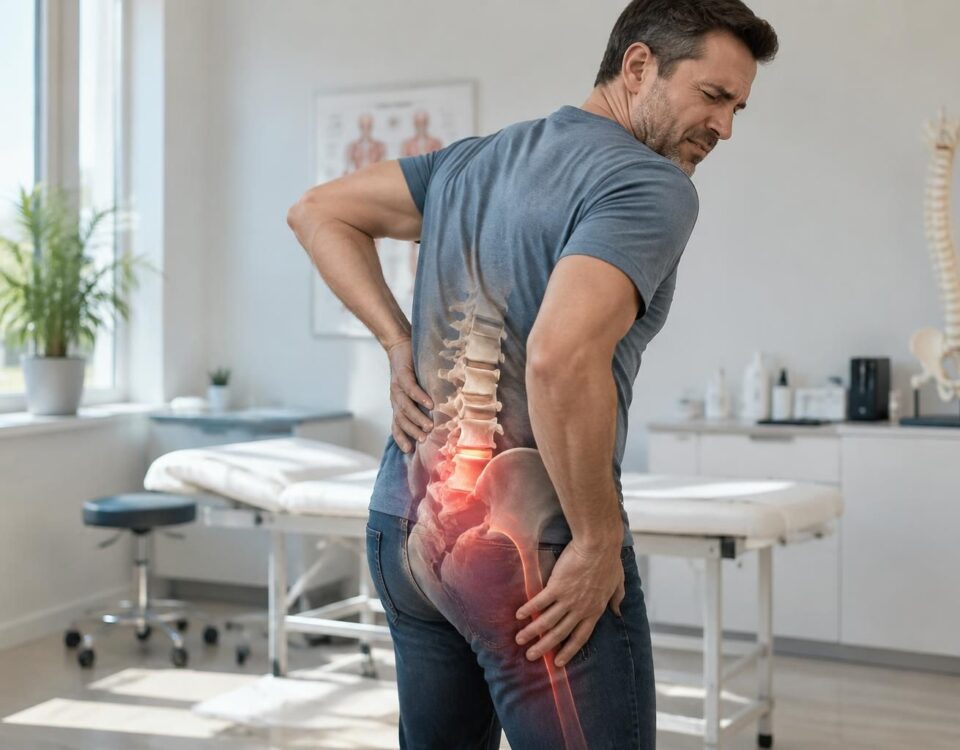
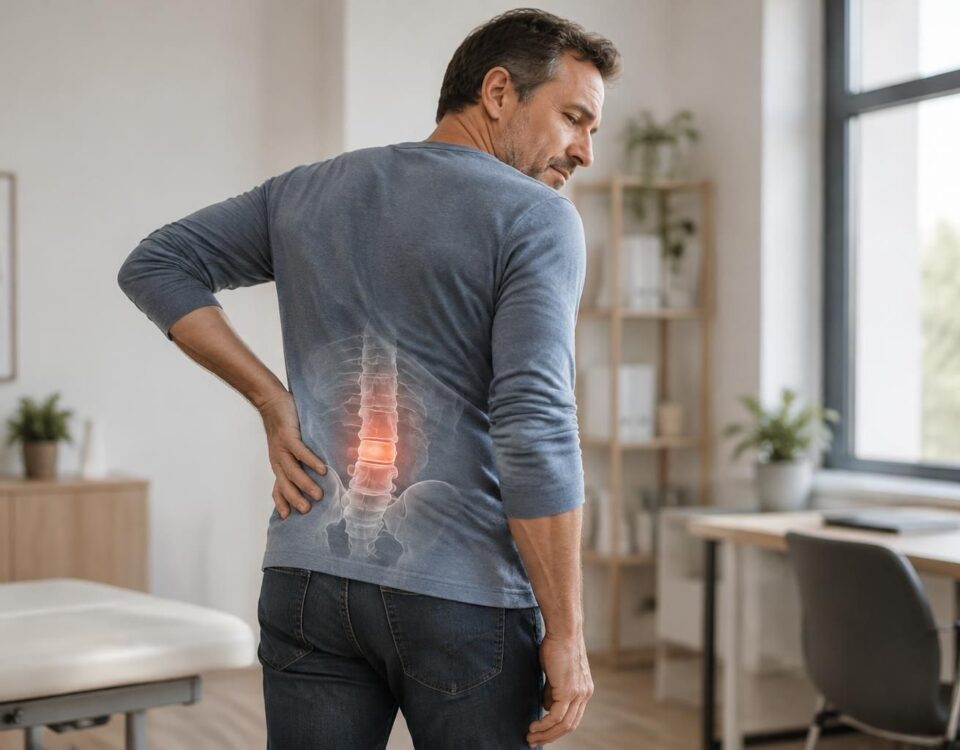
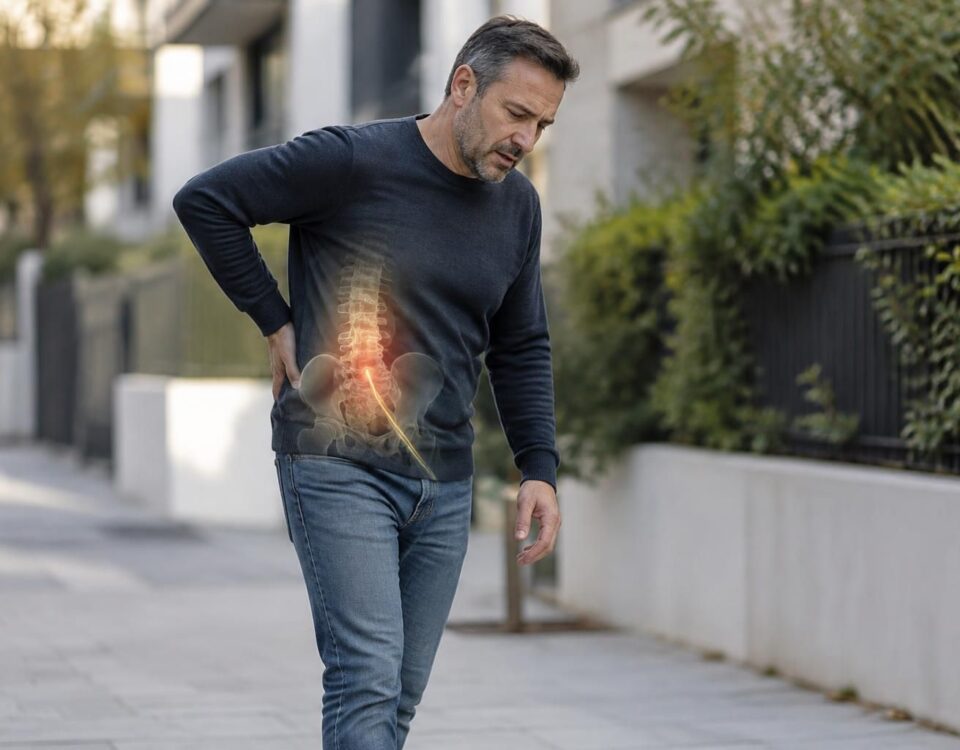
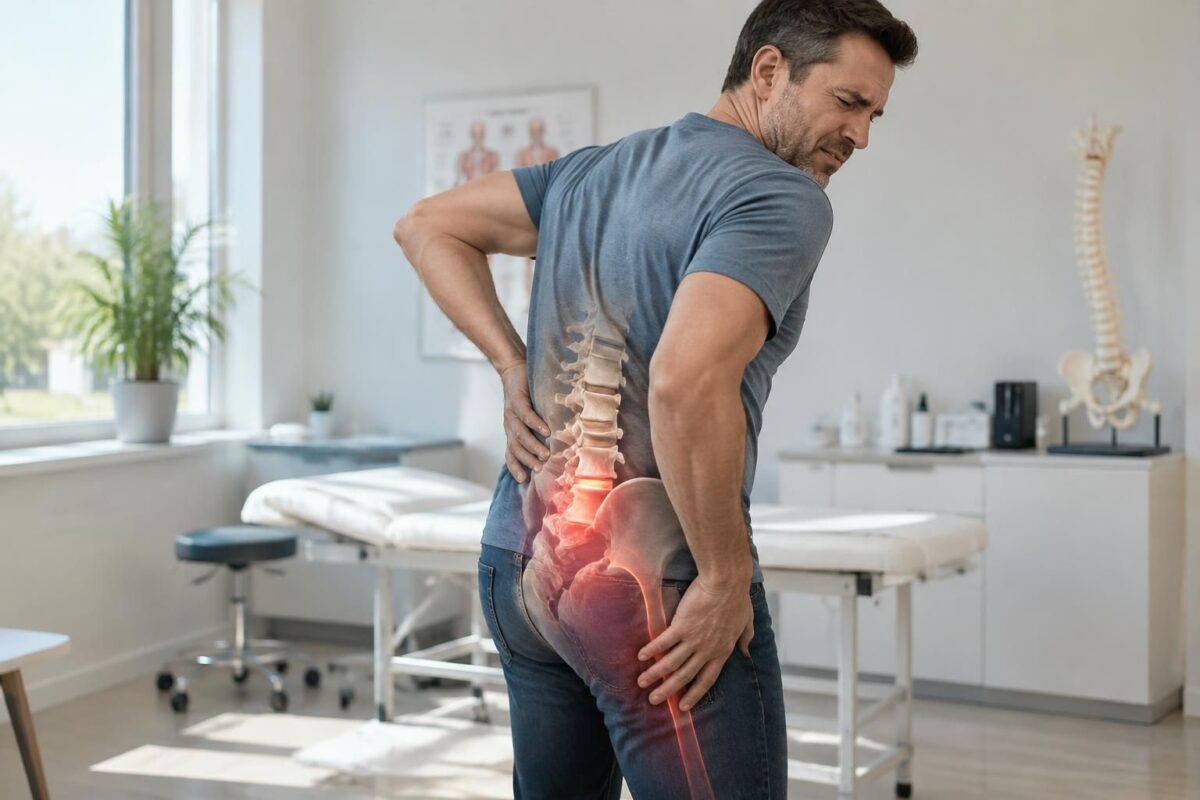
A morning pain in the lower back, accompanied by stiffness and pain radiating down the buttock or leg, may be compatible with irritation of a nerve root, sometimes linked to a lumbar herniated disc. However, these symptoms alone do not confirm the cause. Their evolution, clinical examination, and, in some cases, imaging help determine the course of action.
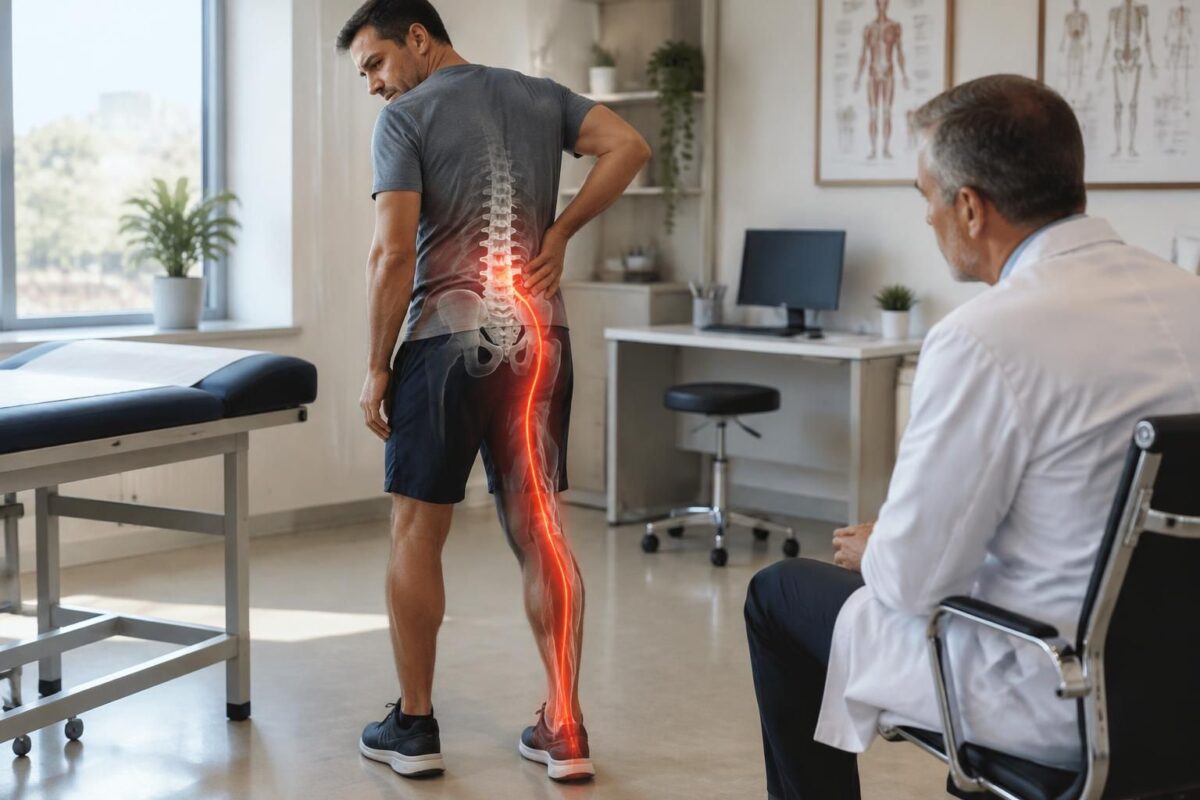
After a night in bed, some people experience a stiff back or increased pain upon rising. The stiffness may decrease when the person changes position and begins their activities. Pain that radiates into the buttock, thigh, or further down the leg may also indicate sciatica.
Morning pain does not prove that a herniated disc is the cause. Sleep position, prolonged periods without moving, joint or muscle irritation, and other back issues can also contribute to the symptoms. A health professional must interpret these signs in the context of your entire history and examination.
Why a herniated disc may irritate the sciatic nerve
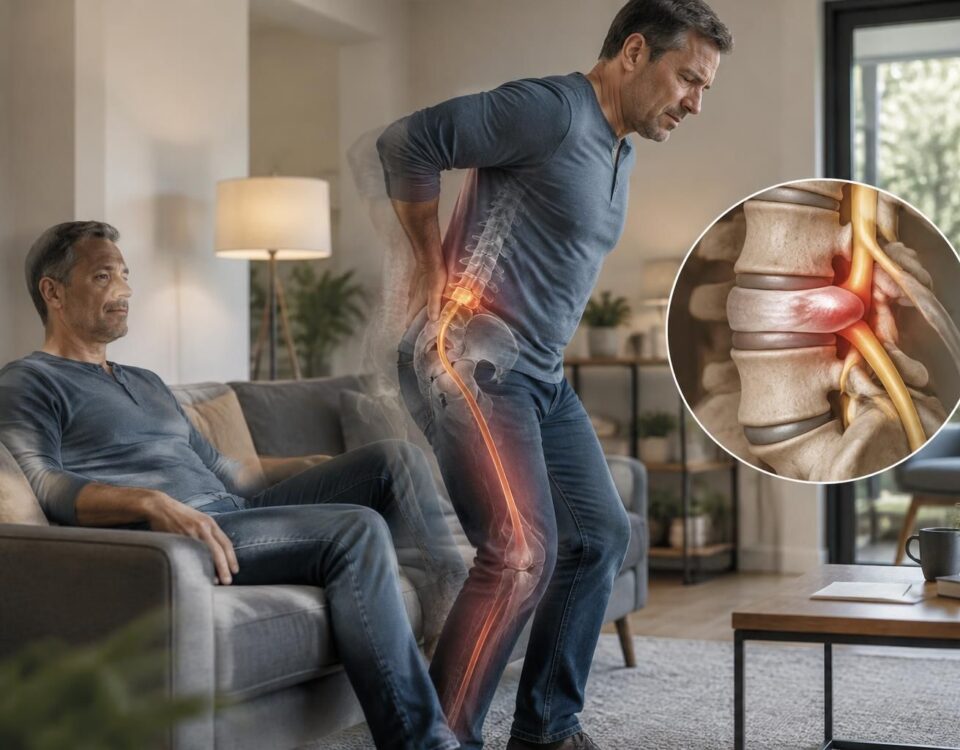
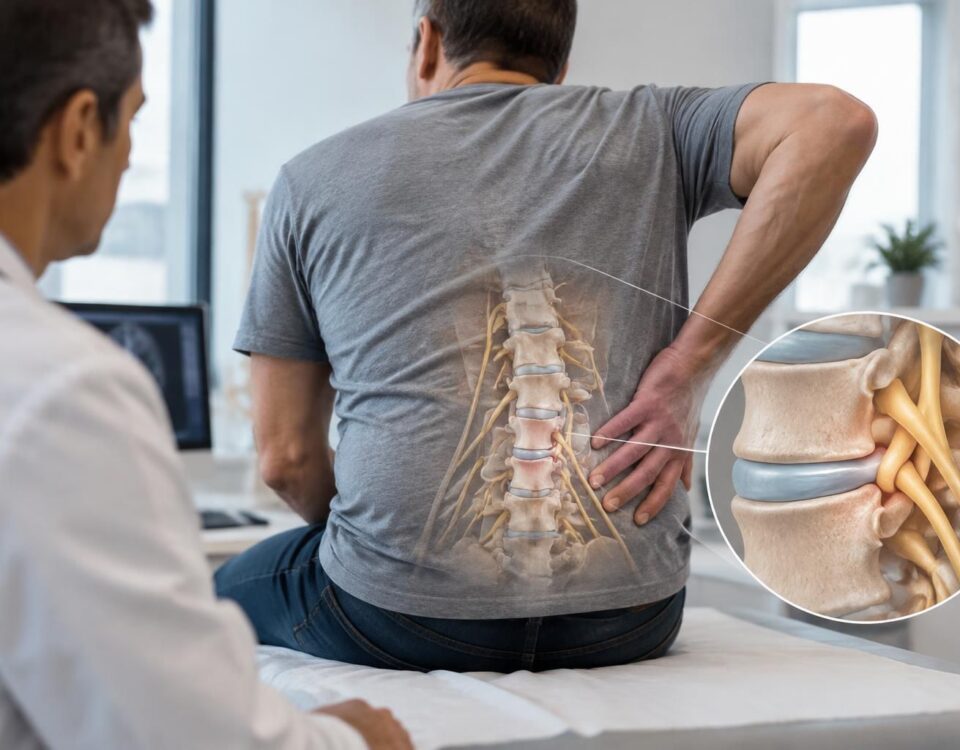
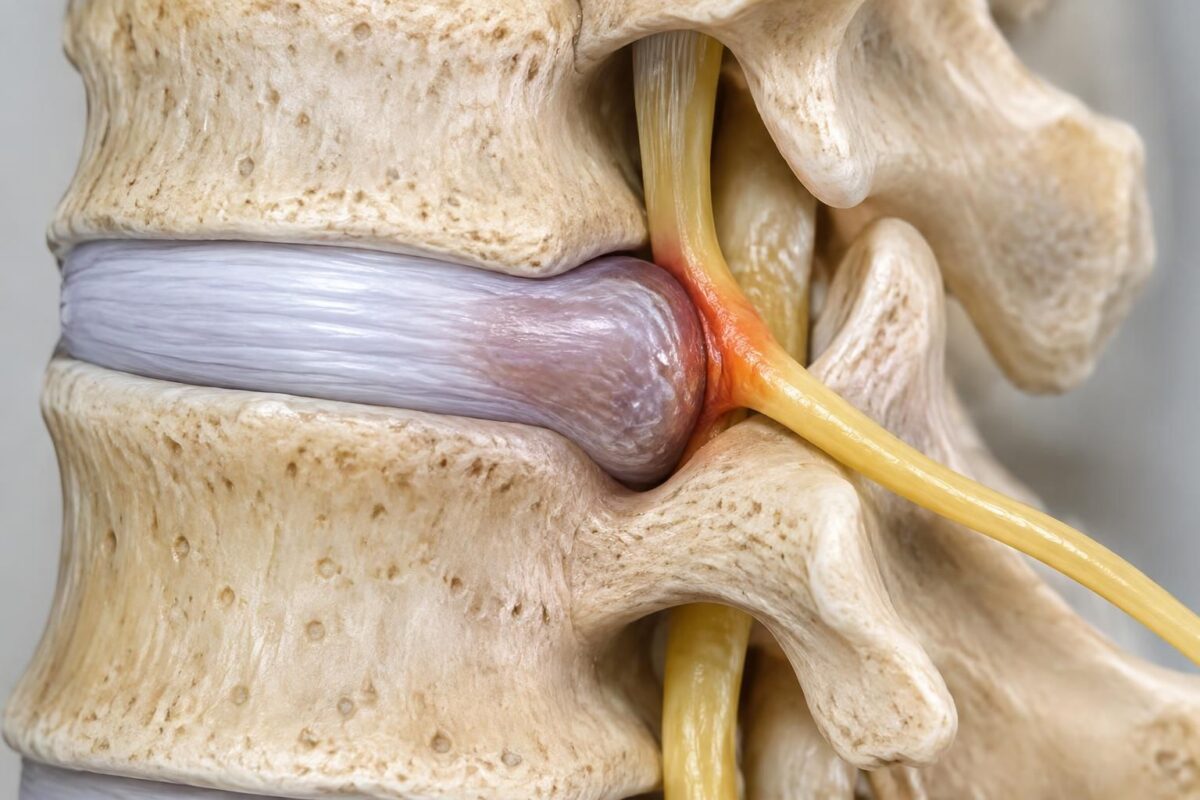
The intervertebral discs are located between the vertebrae and help distribute stress. A part of the disc may protrude and, in certain situations, irritate a nerve root. In the lower back, this irritation may produce pain that follows the path of the nerve into the buttock and leg.
The pain may be accompanied by tingling, numbness, or a feeling of weakness. Its path varies depending on the affected nerve root. For example, pain that reaches the big toe may sometimes correspond to irritation of the L5 root, but this sign alone is not enough to make a diagnosis. You can learn more about big toe pain and the L5 root.
IN BRIEF A disc bulge is a diffuse protrusion of the disc and does not always cause symptoms. A buttock pain may sometimes be associated with nerve irritation, but the bulge visible on imaging is not enough to establish the…
What morning stiffness may indicate
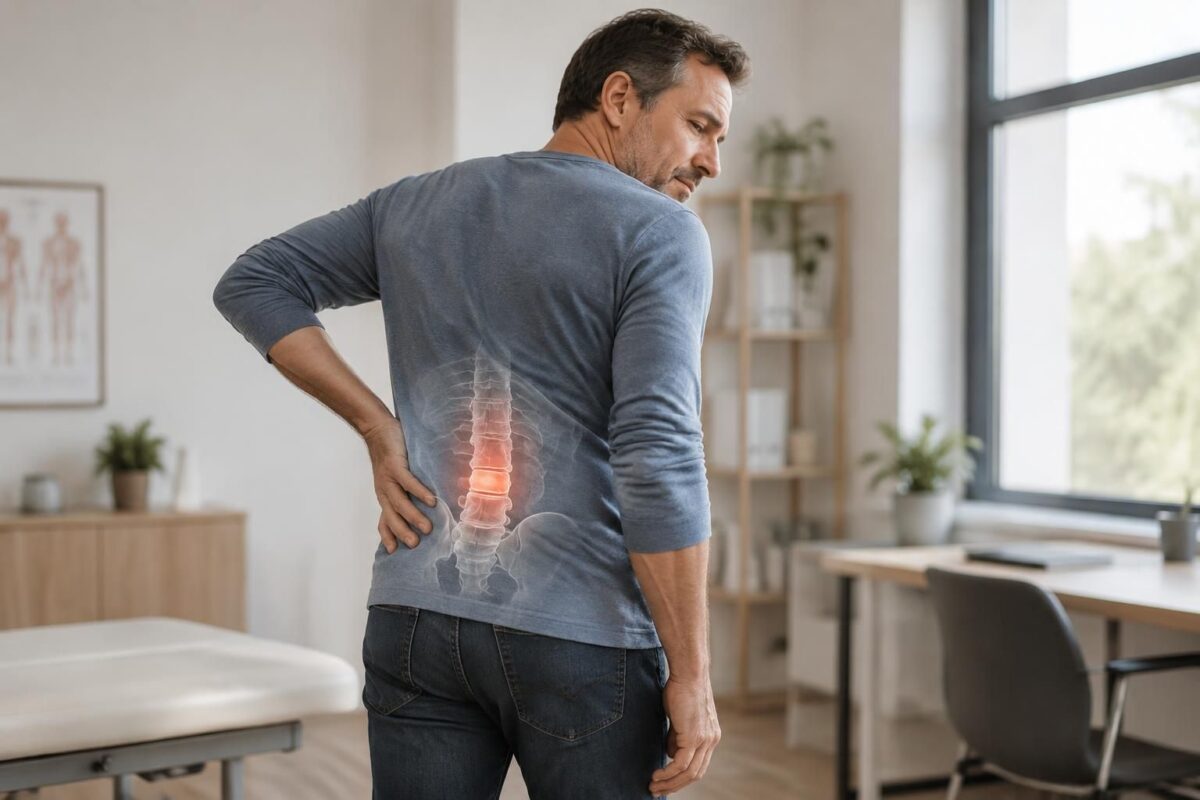
Stiffness upon waking is a symptom, not a diagnosis. It may appear after a night spent in a position that increases discomfort or after a period of pain where movements became more limited. Note its duration, intensity, and the activities that worsen or relieve it. These elements can help the consulted professional guide their assessment.
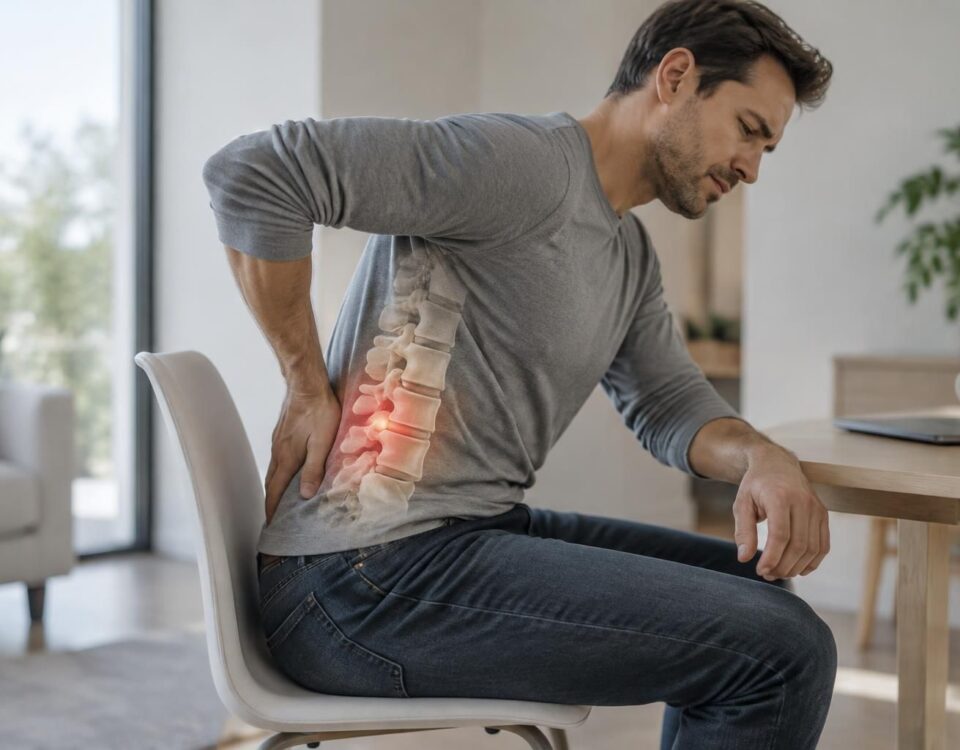
The pain may increase in prolonged sitting, during certain movements, or while coughing and sneezing. However, reactions vary from person to person. Avoid concluding that a specific movement is the cause of the hernia or is suitable for your situation. Some movements may aggravate symptoms in some people; this topic is explained in this article on movements that may be poorly tolerated.
Disc herniation and lumbar stiffness
IN BRIEF The disc bulge is a protrusion of the disc between the vertebrae, without a necessary tear, and does not always indicate a herniation or a cause of pain. It can accompany lumbar stiffness, but the link must be…
The size of the hernia does not alone explain the pain
An MRI image alone does not measure the intensity of the pain. A small protrusion may be accompanied by marked symptoms if it irritates a nerve root. Conversely, a visible anomaly may not correspond to the symptoms experienced. The professional must therefore compare the imaging with the pain pathway and the examination results. To better understand this point, consult the article on significant sciatica pain despite a small protrusion.
A discopathy describes a deterioration of a disc. A hernia refers to a protrusion of disc material. These terms do not describe exactly the same thing and do not automatically prove that the disc is the source of the pain. To distinguish these notions, read the article on the difference between herniated disc and discopathy.
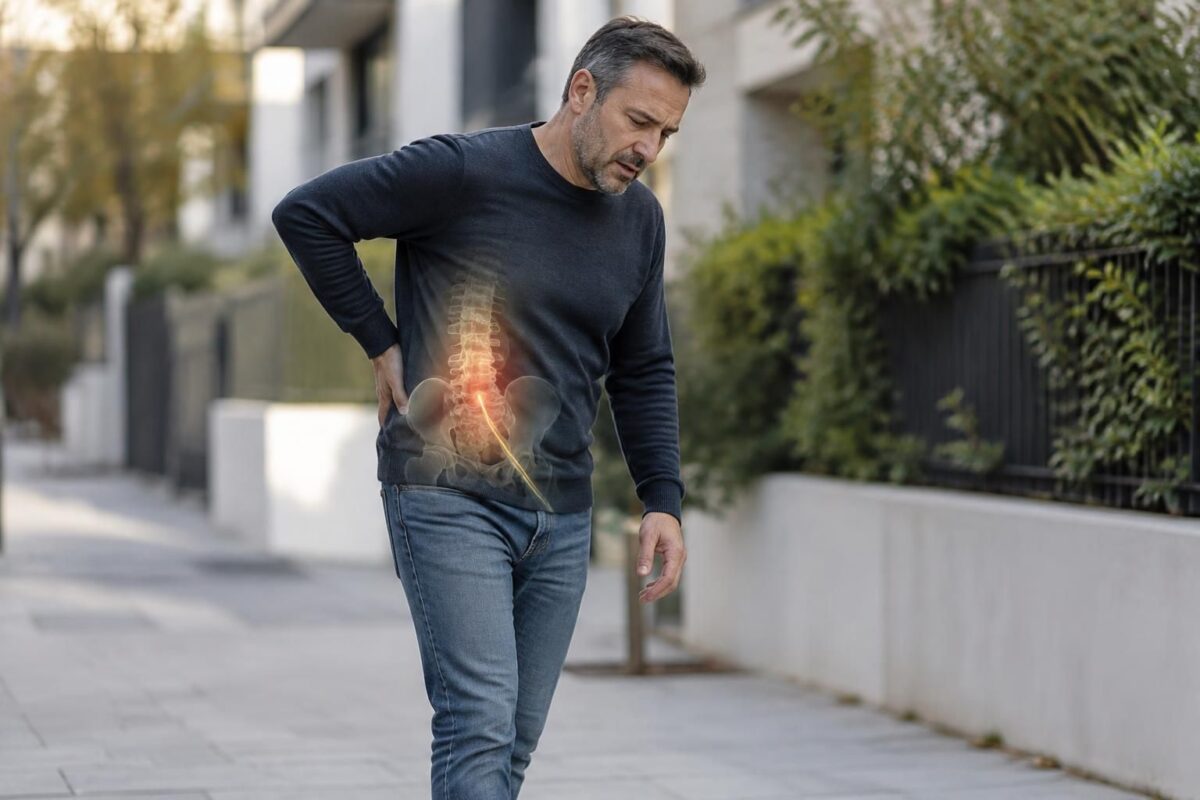
Disc herniation and pain while walking
IN BRIEF A disc bulge is a protrusion of the disc between the vertebrae, which can sometimes be accompanied by pain while walking or radiating down the leg. A gentle and progressive walk helps maintain activity if symptoms remain stable,…
How to determine the cause of the symptoms
The evaluation generally starts with questions about the pain, its pathway, its duration, and the actions that modify it. The professional may also check sensitivity, reflexes, strength, and certain movements. A strength test helps identify a possible motor deficit; it must be interpreted in the context of the examination. To learn more, consult the page on muscle strength in case of a herniated disc.
An MRI or CT scan is not necessary for every recent pain. A doctor may consider imaging if the symptoms persist, worsen, do not respond to initial measures, or if a medical procedure is being considered. The examination then serves to verify if the images align with the symptoms and to guide the management.
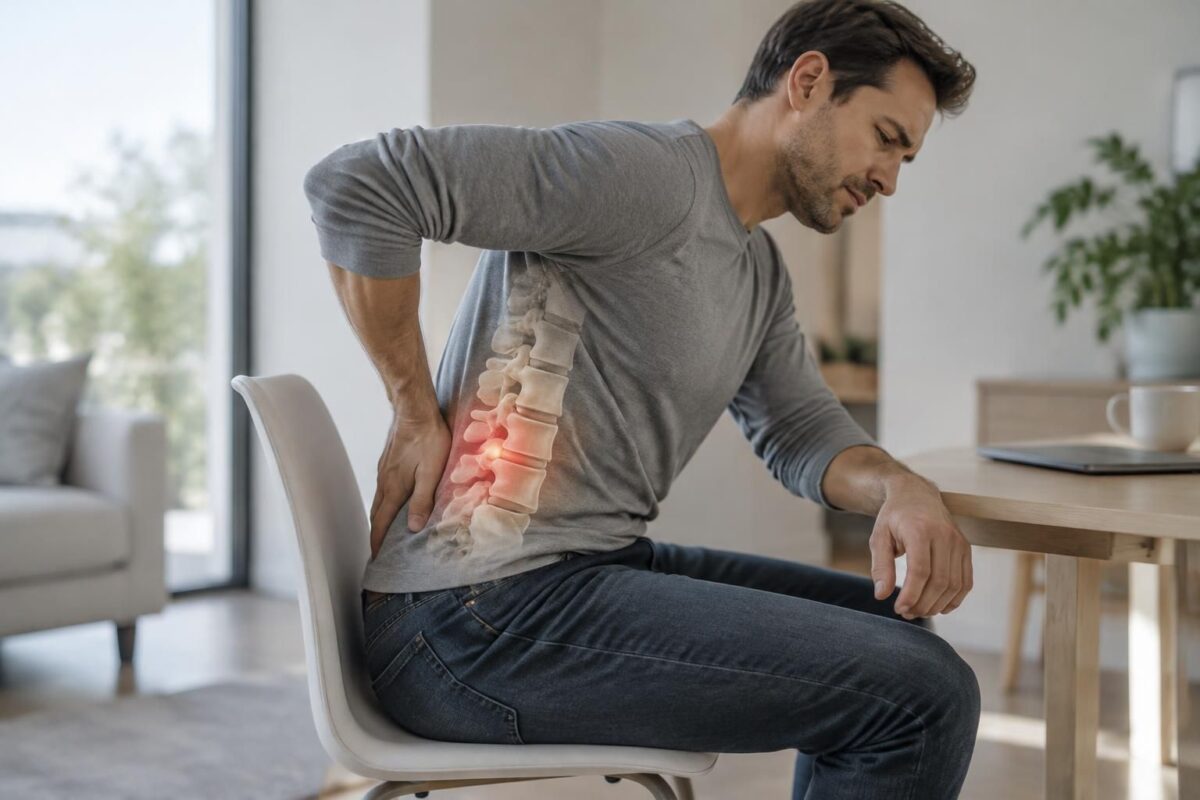
Disc bulge and pain in sitting position
IN BRIEF A disk bulge is a protrusion of a disk between the vertebrae; it does not always cause symptoms. Prolonged sitting can accentuate lower back pain and sometimes pain that radiates into the buttock or leg. Varying positions, moving…
When to seek medical help quickly
Consult a doctor or an emergency service without delay in case of loss of bladder or bowel control, difficulty urinating, numbness in the saddle region, or significant or progressive weakness in a leg or foot. A new difficulty in walking or intense pain that worsens rapidly also requires prompt medical evaluation.
A decrease in pain does not always guarantee that the problem is improving if weakness appears at the same time. Report any change in strength, any loss of sensation that progresses, and any difficulty performing usual activities. The article on warning signs and imaging presents other elements to watch for.
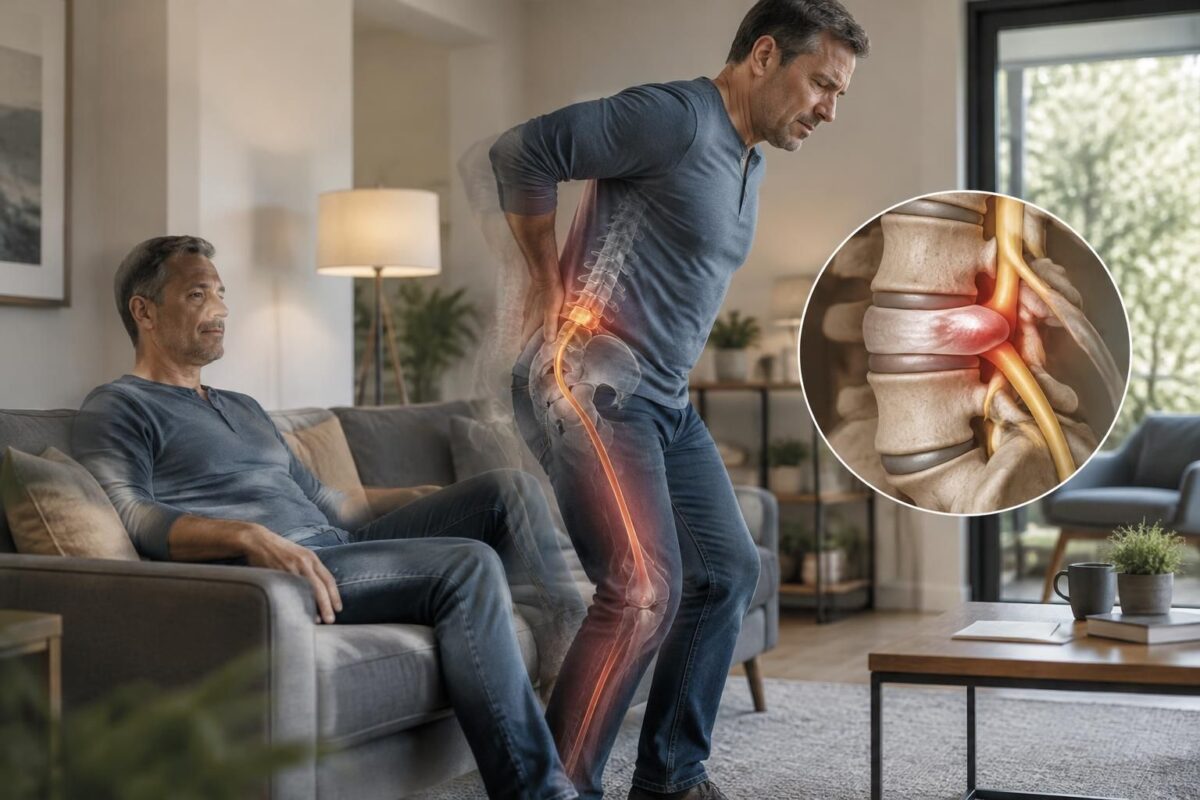
Disc herniation and fluctuating symptoms
IN BRIEF A disc bulge is a protrusion of the disc between the vertebrae, which may not necessarily cause symptoms. When pain fluctuates, its intensity can vary based on movements, activities, and other factors; the bulge visible on MRI does…
What management options to discuss
Management depends on the evaluation and severity of the signs. A doctor may discuss medications or other medical options based on your health condition. Surgery involves certain situations, particularly severe compression, concerning weakness, or persistent and highly disabling symptoms despite appropriate management. It is not automatic when a herniation appears on imaging.
At the TAGMED Clinic, an osteopathy assessment can examine symptoms and their evolution. Depending on the case, services may include specific osteopathy or motorized neurovertebral decompression. These approaches do not replace a medical diagnosis and are not suitable for all situations.
To learn about services related to sciatica in Montreal and Mont-Royal or in Terrebonne, check the relevant pages or contact the TAGMED Clinic.
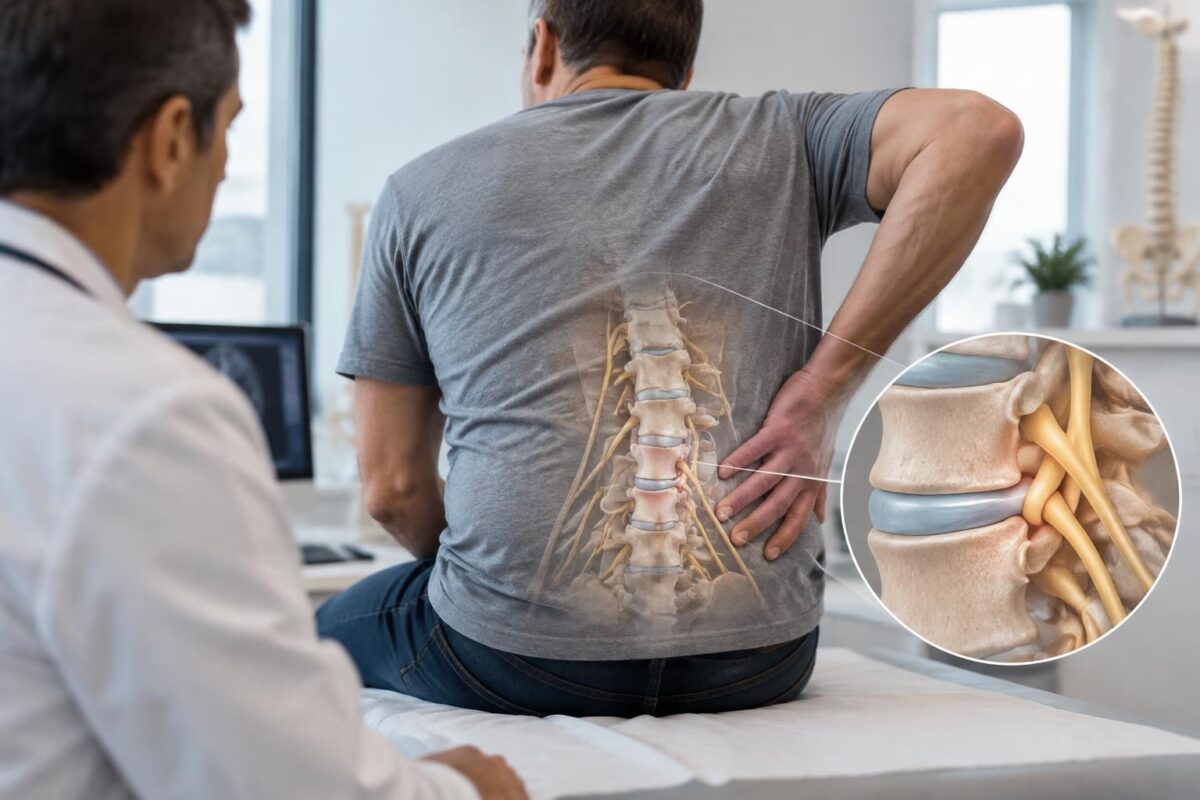
Disc bulge and mild nerve compression
IN BRIEF A disc bulge with mild nerve compression occurs when a disc slightly protrudes and may irritate a nerve, sometimes causing pain, tingling, or numbness. Symptoms and imaging do not always align: the assessment takes into account your movements…
About the author
Sylvain Desforges, B.Sc., D.O., N.D., Doctor of Osteopathy, is the founding president of TAGMED and the ACMA association. His practice focuses on chronic spinal pain, lower back pain, and pain associated with sciatica, particularly when it radiates down to the buttock, leg, calf, foot, or toes.
Through SOS Sciatique, he publishes educational content on symptoms of sciatica, possible causes — including herniated disc, disc pinching, foraminal stenosis, or irritation of a lumbar nerve root — and non-surgical approaches that may be considered after evaluation. At the TAGMED Clinic, care may include, depending on the case, motorized neurovertebral decompression, specific osteopathy, or precision impactor.
Disc herniation and foraminal irritation
IN BRIEF A disc bulge can reduce the space of the foramen, the opening through which a nerve exits, and contribute to its irritation. This can cause lower back pain radiating into the buttock or leg, tingling, or numbness. An…
Medical disclaimer
Medical disclaimer: The information and advice provided on this site do not substitute for the opinion, diagnosis, or treatment of a healthcare professional. Please note that Sylvain Desforges, B.Sc., D.O., N.D., Doctor of Osteopathy, is neither a medical doctor nor a physician, and is not a specialist in a medical field as defined by the Quebec College of Physicians. Manual medicine, functional medicine, and sports medicine as described on this site exclude any treatment or medical diagnosis made by a doctor or specialist. Always consult your doctor for any medical questions. For more details, please read our full legal notice.
Disc bulge L5-S1 and pain toward the foot
IN SHORT A L5-S1 disc bulge corresponds to a disc that slightly overruns between the last lumbar vertebra and the sacrum. It can irritate a nerve root and cause pain resembling sciatica down to the foot, but this anomaly visible…
Herniated disc and sciatica: understanding morning pain
What stiffness may indicate
- Lumbar stiffness upon waking: sometimes related to overnight immobility.
- Pain radiating to the buttock or leg: possible irritation of a nerve root.
- These signs alone are not sufficient to confirm a herniated disc.
Movements and signs to watch for
- Gradually resume movements, avoiding forcing through pain.
- Consult if symptoms persist, worsen, or are accompanied by weakness.
- Emergency in the case of urinary or intestinal disturbances, or numbness in the saddle region.

A morning pain accompanied by lumbar stiffness may occur with a herniated disc and sciatica, but these symptoms alone are not sufficient to confirm their origin. A few cautious measures can facilitate the first movements of the day: mobilize gradually, avoid sudden efforts, and resume activities according to tolerance. However, worsening pain, weakness, or urinary disturbances require prompt medical evaluation.
Why might the back be stiffer upon waking?
After several hours in the same position, the joints and tissues in the lower back may seem less mobile. If a nerve root is irritated, pain can also radiate to the buttock or leg, sometimes down to the foot. A herniated disc may be involved, but other issues can cause similar signs. Only a qualified professional can evaluate the symptoms and determine appropriate examinations or care.
Start the day with gentle movements
Before getting up, take a moment to move your ankles and knees, then change position smoothly. To get out of bed, turn onto your side, bring your legs close to the edge, and push with your arms to sit up. Once standing, walk gently for a few minutes if it remains tolerable. The goal is not to force stretching or “unlock” the back, but to gradually regain movement.
Adapt activities without becoming immobilized
Prolonged strict rest is generally not a strategy to adopt without medical advice. Instead, try to continue daily activities that are compatible with your condition, temporarily limiting those that significantly increase radiating pain. Alternate positions and take short breaks if you remain seated for long periods. To lift an object, bring it close to your body and avoid twisting the trunk abruptly under load.
Observe the evolution of symptoms
Note, if it helps, the moments when the pain appears, its trajectory, and the movements that modify it. Tingling or numbness may accompany nerve irritation. A new or progressive weakness, difficulty walking or loss of dexterity deserves prompt consultation. Avoid relying solely on the intensity of the pain: an apparent improvement does not always rule out a problem requiring examination.
When to seek an evaluation?
If stiffness and pain persist, recur frequently, or limit your activities, consult a physician or another licensed healthcare professional. Clinical examination helps verify strength, sensitivity, and reflexes. An MRI or other imaging exam is not routine at the beginning; its usefulness depends in particular on the evolution, observed signs, and planned treatments. Management options should be tailored to your situation.
Recognizing emergency signs
Seek emergency services immediately in case of loss of control of the bladder or intestines, sudden difficulty urinating, numbness in the area between the legs, or significant or progressive weakness in a leg or foot. Uncontrollable pain, fever, or rapid deterioration also warrants prompt medical advice. These signs should not be managed solely through exercises or manual therapy.
The information above is educational and does not replace a consultation, diagnosis, or treatment by a licensed healthcare professional.
| Marker | Herniated disc and sciatica |
|---|---|
| Morning stiffness | May accompany lower back pain, but does not alone confirm a herniated disc. |
| Radiating pain | Pain that descends into the buttock or leg may indicate nerve irritation. |
| Possible triggers | Coughing, sneezing, or certain movements may exacerbate symptoms. |
| Morning evolution | Stiffness may decrease with gentle movement, without helping to identify the cause. |
| Tingling or numbness | These signs in the leg or foot warrant evaluation, especially if they persist or progress. |
| When to consult urgently | Progressive weakness, difficulty walking, or urinary or bowel problems require quick medical help. |
Testimonials on herniated disc and sciatica: morning pain and lumbar stiffness
Transparency note: The accounts below are fictional examples created for educational purposes. They do not correspond to verified patient testimonials and do not allow for a diagnosis.
“Upon waking, my lower back was very stiff. The first steps were difficult, and on some mornings, pain would radiate into my buttock and then down my leg. I initially thought it was just a bad sleeping position. As the episodes recurred, I consulted to have my symptoms assessed and to understand if the pain could be related to nerve irritation.”
“My lower back pain was especially present in the morning, with a sensation of blockage that eased a bit after I got up and moved gently. I also had tingling in my calf. The clinical examination helped me to describe the trajectory of the pain accurately and discuss the next steps with a healthcare professional.”
“After a period of sitting for a long time, I would wake up with a stiff back and pain pulling toward my leg. I feared I might have to be operated on as soon as herniated disc was mentioned. I was explained that imaging and treatments depend on the evolution of the symptoms and the examination, and that surgery is not necessary in all cases.”
“Morning stiffness was not always the same: some days it would ease with gentle movement; other times, the radiating pain would persist more. I began to note the moments when it appeared, the movements that exacerbated it, and any accompanying numbness. These details made my consultation more useful.”
Lower back pain accompanied by radiation into the buttock or leg can have several causes. A herniated disc can irritate a nerve root, but the symptoms alone are not sufficient to confirm this diagnosis. A professional evaluation allows for the verification of strength, sensitivity, and reflexes, and then determines if further examinations are relevant.
Consult a physician or emergency service promptly in case of significant or progressive weakness in a leg or foot, difficulty walking, loss of bowel or urinary control, or numbness in the saddle area. Severe or rapidly worsening pain also deserves medical advice.
About the author
Sylvain Desforges, B.Sc., D.O., N.D., Doctor of Osteopathy, is the founding president of TAGMED and the ACMA association. His practice focuses particularly on chronic spinal pain, lower back pain, and pain consistent with sciatica. The proposed approaches depend on the evaluation and do not replace medical follow-up.
Medical disclaimer
This information is provided for educational purposes and does not replace a consultation, diagnosis, or treatment by a physician or another licensed healthcare professional. The author is neither a physician nor a specialist in a medical specialty recognized by the Collège des médecins du Québec. Osteopathy, manual medicine, and functional support approaches do not constitute medical acts and do not replace medical follow-up.
Herniated disc and sciatica: understanding morning pain and lumbar stiffness
Waking up with a stiff lower back or pain radiating into the buttock and leg can be concerning. A herniated disc is among the possible causes, but these symptoms alone do not allow for a diagnosis. Morning stiffness may also be related to prolonged sleeping position, muscle sensitivity, or other lumbar issues. The evolution of symptoms and their association with nerve signs help determine if an evaluation is necessary.
Intervertebral discs are structures located between the vertebrae. They help distribute stress and facilitate movement of the spine. A herniation occurs when a part of the disc bulges through its outer layer. If this bulge irritates a nerve root, it can cause pain radiating down the leg, sometimes accompanied by tingling, numbness, or a feeling of weakness. Pain following the pathway of the sciatic nerve is often referred to as sciatica, but only a clinical evaluation can clarify the cause.
Upon waking, the transition from immobility to activity can make symptoms more noticeable. Some people describe difficulty sitting up, putting on their shoes, or walking during the first few minutes. Discomfort may then ease with gentle movement or, conversely, worsen with certain movements, coughing, or sneezing. However, morning pain does not necessarily indicate that the hernia is worsening: its intensity, duration, and development over the days must be considered.
To start the day, it may be helpful to change positions gradually and resume movements within a comfortable range, without forcing despite sharp pain. Prolonged bed rest is generally not a strategy to be maintained for several days without professional advice. Temporarily adapting activities that severely trigger symptoms and then gradually resuming movement according to tolerance may promote the maintenance of function. The choice of exercises and treatments should take into account the examination and situation of each individual.
A consultation allows for examining mobility, strength, sensitivity, and reflexes, then verifying if the pain pathway corresponds to nerve irritation. An MRI or another imaging exam is not automatically required from the outset. A healthcare professional may recommend it if symptoms persist, worsen, resist initial measures, or if an intervention is considered. Imaging should be interpreted alongside symptoms, as a visible disc anomaly does not always mean it is the source of pain.
Consult quickly in cases of significant or progressive weakness in a leg, new difficulty walking, or loss of sensitivity in the area between the legs. Issues with bladder or bowel control require urgent evaluation. Severe pain, rapid worsening, fever, or recent trauma also justify prompt medical advice.
About the author
Sylvain Desforges, B.Sc., D.O., N.D., Doctor of Osteopathy, is the founding president of TAGMED and the ACMA association. His practice focuses mainly on chronic spinal pain, lower back pain, and pain compatible with sciatica. At the TAGMED Clinic, support options may include, depending on the evaluation, specific osteopathy, motorized neurovertebral decompression, or precision impact therapy.
Medical disclaimer
This content is provided for educational purposes and does not replace a consultation, diagnosis, or treatment by a physician or other authorized healthcare professional. The author is neither a doctor nor a specialist in a medical specialty recognized by the Collège des médecins du Québec. The osteopathy and manual medicine approaches described do not replace medical follow-up.
A morning pain accompanied by lower back stiffness may occur with a herniated disc, but it does not, on its own, confirm this diagnosis. When pain radiates down to the buttock or leg, sometimes to the foot, irritation of the sciatic nerve is possible. The progression of symptoms, clinical examination, and the possible presence of neurological signs help determine the appropriate course of action.
Morning pain and lower back stiffness
After several hours in the same position, the lower back may feel stiff upon rising. The pain may gradually ease with movement, or conversely, be exacerbated by certain actions, coughing, or sneezing. A herniated disc may contribute to these symptoms if it irritates a nerve root, but other causes are possible. Therefore, morning stiffness alone is insufficient to establish a direct link between an imaging finding of a hernia and the pain experienced.
In cases of sciatica, the pain can follow a pathway in the buttock, thigh, and leg, sometimes with tingling, numbness, or a sensation of weakness. The location of symptoms provides indications but does not alone identify the underlying structure. To better understand this relationship, consult the explanations on the clinical correlation between herniated disc and sciatica as well as general information on the symptoms and complications of a herniated disc.
A hernia is a change in a disc located between two vertebrae. Some hernias visible on imaging do not cause pain, while nerve irritation can generate symptoms away from the back. The presentation from MSD Manual on herniated discs and these resources on herniated discs and symptoms to recognize provide additional reference points. An annular tear may also be mentioned in certain cases, but its significance must be interpreted with the symptoms and examination: see the information on the annular tear and possible pain.
When pains return, change pathways, or persist despite initial measures, a reassessment may be helpful. A herniated disc can coexist with other changes in the spine, including lumbar osteoarthritis, and symptoms cannot always be attributed to a single cause. Resources on recurring pain, situations where it is necessary to reassess the symptoms, and the relationship between herniated discs and lumbar osteoarthritis can help prepare for a discussion with a healthcare professional. General information on sciatica may also serve as a reference, without replacing individual evaluation.
In the absence of warning signs, relative rest and a gradual resumption of tolerated movements are often preferable to prolonged immobility. It may be helpful to change positions regularly, gradually resume activities, and seek advice before starting exercises or treatments, especially if pain radiates down the leg. An MRI or CT scan is not routinely done from the outset: a professional may consider them if symptoms persist, worsen, or if their results are likely to alter management.
An urgent consultation is necessary in cases of significant or progressive weakness in a leg or foot, new difficulty walking, loss of bladder or bowel control, or numbness in the saddle region. Very intense pain or pain that worsens rapidly also justifies prompt medical advice.
About the author
Sylvain Desforges, B.Sc., D.O., N.D., Doctor of Osteopathy is the founding president of TAGMED and the ACMA association. He dedicates his practice to chronic spinal pain, lower back pain, and pain compatible with sciatica, especially when the pain radiates down to the buttock, leg, calf, foot, or toes.
Through SOS Sciatique, he publishes educational content about the symptoms of sciatica, possible causes such as herniated disc, disc compression, foraminal stenosis, or irritation of a lumbar nerve root, as well as non-surgical approaches that may be considered based on the assessment. At TAGMED Clinic, care may include, depending on the case, motorized neurovertebral decompression, specific osteopathy, or precision percussion.
For an evaluation related to sciatica treatment in Montreal / Mont-Royal or sciatica treatment in Terrebonne, check the services available at TAGMED Clinic.
Medical Disclaimer
The information published on SOS Sciatique is provided for educational purposes and does not replace a consultation, diagnosis, opinion, or treatment performed by a physician or another authorized health professional. The author of this article is neither a physician nor a specialist in a medical specialty recognized by the Collège des médecins du Québec. The approaches of osteopathy, manual medicine, or functional support described on this site do not constitute medical acts and are not intended to replace medical follow-up.
Consult a physician or an emergency service in case of loss of bladder or bowel control, anesthesia in the saddle area, significant or progressive weakness of the leg or foot, fever, recent trauma, severe pain, or rapid deterioration. For more details, please read our Legal Notice.

Sylvain Desforges, B.Sc., D.O., N.D., docteur en ostéopathie
Dr Sylvain Desforges, B.Sc., D.O., N.D., osteopath, is the founding president of TAGMED and of the ACMA association. He dedicates his practice to chronic spinal pain, low back pain and symptoms compatible with sciatica, particularly when pain radiates toward the buttock, leg, calf, foot or toes.
Through SOS Sciatique, he publishes educational content on sciatica symptoms, possible causes such as disc herniation, disc narrowing, foraminal stenosis or irritation of a lumbar nerve root, as well as non-surgical approaches that may be considered according to the evaluation. At Clinique TAGMED, care may include, depending on the case, motorized neurovertebral decompression, specific osteopathic care or precision percussion.
For an evaluation related to sciatica treatment in Montreal / Mount Royal or sciatica treatment in Terrebonne, please consult the services available at Clinique TAGMED.
Medical disclaimer
The information published on SOS Sciatique is provided for educational purposes only and does not replace a consultation, diagnosis, opinion or treatment provided by a physician or another authorized healthcare professional. The author of this article is neither a medical doctor nor a specialist in a medical specialty recognized by the Collège des médecins du Québec. The osteopathic, manual medicine or functional support approaches described on this site do not constitute medical acts and are not intended to replace medical follow-up.
Consult a physician or emergency service in cases of loss of bladder or bowel control, anesthesia in the saddle area, significant or progressive weakness in the leg or foot, fever, recent trauma, severe pain or rapid worsening of symptoms. For more details, please read our Legal Notice.