Sciatica and pain after running
03/10/2026
Sciatica and Gradual Resumption of Walking After an Attack
03/10/2026
IN BRIEF
| A herniated disc can irritate a nerve root and cause sciatica, sometimes more bothersome at night. Night pain alone is not enough to determine the cause: its variation according to positions, neurological examination and, if necessary, imaging help guide treatment. In Montreal or Mont-Royal, an assessment can clarify symptoms and signs to watch for. Consult quickly in case of progressive weakness, foot drop, or urinary or bowel issues. |
Herniated Disc and Sciatica: Night Pain and Signs to Watch For
A herniated disc can irritate a nerve root and cause pain that travels down the buttock or leg, sometimes more bothersome at night. Certain positions or immobility can exacerbate it; changing position or supporting the knees may help some individuals. However, a visible herniation on imaging does not automatically explain the symptoms: the pain path, strength, sensitivity, and function must be evaluated together.
Consult quickly in case of new or progressive weakness, foot drop, or difficulty walking. Urinary or bowel issues, numbness in the perineal region, fever or general deterioration require urgent evaluation. Persistent night pain accompanied by general signs also deserves medical advice.
A herniated disc can irritate a nerve root and cause pain that travels down the buttock or leg. The pain may disrupt sleep, but it does not automatically mean that the herniation is worsening. Position, nerve irritability, and lack of sleep can play a role. The evaluation should connect symptoms, strength, sensitivity, function, and imaging while identifying signs that necessitate a quick consultation. Sciatica refers to pain that follows the path of a nerve root or the sciatic nerve. It can start from the lower back or buttock and travel down the thigh, calf, or foot. A lumbar disc herniation may be involved if it irritates a nerve root, but the presence of a herniation on imaging alone does not establish that link. Night pain therefore deserves interpretation according to the overall picture. Pain that changes with position may correspond to a mechanical component. Persistent pain associated with fever, unexplained weight loss, or general deterioration requires medical evaluation. The context and associated signs are just as important as the time the pain occurs. At night, some people stay in the same position for a long time. This relative immobility may increase discomfort or make a position less tolerated. The sensitivity of the irritated nerve, difficulty finding a comfortable posture, and repeated awakenings can also contribute to the pain. Lack of sleep can then amplify sensitivity to pain and make recovery more difficult. This does not prove that the herniation is increasing in size. To learn more about factors that can disrupt sleep, visit our page on herniated disc and sciatica at night. There is no universal position for sleeping with sciatica. Some people feel more comfortable on their side with a pillow between their knees. Others prefer to sleep on their back with support under their knees. You can try changing position if it improves comfort, without forcing a movement that significantly increases pain. Night pain alone does not determine whether an MRI is necessary. The healthcare professional considers the duration of symptoms, their evolution, neurological signs, and elements of the examination. An imaging study may show a protrusion or herniation in a person who does not have pain. To estimate if the abnormality is related to sciatica, one must compare the level and side indicated on the image with the pain path and examination results. The evaluation can check painful or numb areas, certain movements, strength, walking, sensitivity, and reflexes. The professional also examines the evolution of symptoms and their effect on daily activities. MRI or CT scanning may be useful when their results are likely to change management; they are not routine for every night pain. To better understand the limits of image-only interpretation, read our article on herniated disc and what MRI cannot decide alone. The mechanical nature of symptoms can also be examined on our page about sciatica possibly related to a mechanical cause. The tendency of symptoms helps choose the next steps. Note if the pain changes, if it travels further down the leg, if numbness extends, or if weakness appears. Also observe if walking, sleeping, or usual tasks become more difficult. Maintaining ordinary activities, with adaptations according to tolerance, is generally preferable to prolonged immobilization. NICE recommendations encourage self-management and maintaining activities as much as possible. They do not recommend traction for low back pain with or without sciatica. The motorized neurovertebral decompression should not be presented as a standard or guaranteed treatment: the data remain uncertain and options should be discussed without promises of outcome. Some neurological or general signs require rapid evaluation. They should not wait for a routine appointment: In the presence of new urinary or bowel issues, numbness in the saddle area, or severe weakness, go to the emergency room or contact emergency services. Rapid evaluation is also indicated if strength loss worsens. Care depends on the presumed cause, the intensity of the pain, neurological signs, and function. A physician can assess the factors that require medical treatment, request imaging if it may change decisions, and discuss options suited to the situation. Medications or an injection fall under an evaluation and medical decision. A consultation in osteopathy can help examine mobility, tolerance to positions, and functional repercussions, within the limits of this practice. It does not replace a medical diagnosis or an urgent evaluation when warning signs are present. At TAGMED Clinic, the options provided are discussed after evaluation, with clear information on their limits and the uncertainty of results. For an evaluation in Montreal or Mont-Royal, consult information on the sciatica treatment in Montreal and Mont-Royal. The TAGMED Clinic also receives patients in Terrebonne. Sustainable improvement in function and the ability to perform daily activities is a useful indicator, beyond a single measure of pain. Not necessarily. Prolonged position, nerve irritability, and sleep quality can influence pain. However, worsening accompanied by weakness or other neurological signs requires rapid evaluation. No. But constant pain, especially if accompanied by fever, unexplained weight loss, or general deterioration, should be evaluated by a healthcare professional. Not automatically. The decision depends on the examination, progression, associated signs, and the possibility that the result may change management. No. The term describes a form of hernia on imaging. The decision also depends on symptoms, neurological examination, function, and progression. Consult our article on the clinical significance of an extruded disc herniation. A recurrence can have several factors. Have symptoms re-evaluated, especially if the pattern changes, if numbness increases, or if weakness appears. For more information, consult our page on the recurrence of sciatica and its possible factors. Dr. Sylvain Desforges, B.Sc., D.O., N.D., osteopath, is the founding president of TAGMED and of the ACMA association. He dedicates his practice to chronic pain of the spine, lower back pain, and pain consistent with sciatica, especially when pain radiates to the buttock, leg, calf, foot, or toes. Through SOS Sciatique, he publishes educational content on the symptoms of sciatica, possible causes such as disc herniation, disc compression, foraminal stenosis, or irritation of a lumbar nerve root, as well as non-surgical approaches that may be considered based on evaluation. At TAGMED Clinic, care may include, depending on the case, motorized neurovertebral decompression, specific osteopathy, or a precision impactor. For an evaluation related to the sciatica treatment in Montreal / Mont-Royal or to the sciatica treatment in Terrebonne, consult the available services at the TAGMED Clinic. Medical Disclaimer: The information and advice provided on this site do not replace the opinion, diagnosis, or treatment of a healthcare professional. Please note that Dr. Sylvain Desforges, osteopath, is neither a doctor of medicine nor a physician, and is not specialized in a medical specialty as defined by the Collège des médecins du Québec. Manual medicine, functional medicine, and sports medicine as described on this site exclude any treatment or medical diagnosis made by a physician or specialist. Always consult your doctor for any medical questions. For more details, please read our full legal notice. The information published on SOS Sciatique is provided for educational purposes and does not replace a consultation, diagnosis, advice, or treatment carried out by a doctor or other authorized healthcare professional. The author of this article is neither a doctor nor a specialist in a medical specialty recognized by the Collège des médecins du Québec. Osteopathy, manual medicine, or functional support approaches described on this site do not constitute medical acts and are not intended to replace medical follow-up. Consult a doctor or emergency service in case of loss of bladder or bowel control, numbness in the saddle area, significant or progressive weakness of the leg or foot, fever, recent trauma, severe pain, or rapid deterioration.Why Can a Herniated Disc Hurt at Night?
Positions That May Be Better Tolerated
A Herniation Visible on MRI Does Not Always Explain Symptoms
Factors to Monitor Over the Days
When to Consult Quickly?
What Management Options to Discuss?
Frequently Asked Questions about Night Pain and Sciatica
Does night pain mean the hernia is worsening?
Is pain that wakes you up at night always serious?
Do you need an MRI because the pain occurs at night?
Does an extruded hernia always mean surgery is necessary?
What to do if sciatica returns?
About the Author
Medical Disclaimer
Night Pain: Possible Factors
- Prolonged position or movement that irritates the leg.
- Try a better-tolerated position: on your side with a pillow between your knees, or on your back with knees supported.
- Insufficient sleep, which may increase sensitivity to pain.
- Pain alone does not confirm that a hernia is involved.
Signs to Watch For
- New or progressive weakness, foot drop, or worsening walk.
- Loss of bladder or bowel control, or numbness in the saddle area: medical emergency.
- Constant pain with fever, trauma, or general deterioration: quick medical advice.
- An MRI is not automatic: it depends on symptoms, examination, and its usefulness for management.

A disc herniation associated with sciatica can make nights difficult, but nighttime pain does not automatically indicate that the situation is serious. Position, immobility, and lack of sleep can influence symptoms. To decide on the next steps, the pain’s pathway, strength, sensitivity, function, and, when indicated, imaging must be correlated.

L5-S1 protrusion and sciatic pain: pathway to the foot
IN BRIEF A L5-S1 disc protrusion is a disc that slightly bulges between the lumbar and sacral vertebrae. If it irritates a nerve root, pain may radiate from the lower back or buttock down the back of the leg to…
Why can sciatica be more bothersome at night?
After a day of activity, certain prolonged positions or remaining still can increase discomfort. Nerve irritation can also make the pain more sensitive to movements in bed or certain postures. Additionally, insufficient sleep can amplify the perception of pain and make recovery more difficult.
There is no ideal position for everyone. Some people tolerate sleeping on their side with a pillow between their knees better; others prefer to be on their back with support under their knees. Try one position at a time and adjust it according to your comfort, without forcing a posture that significantly intensifies symptoms.

L4-L5 protrusion and sciatic pain: possible signs
IN BRIEF A L4-L5 disc protrusion is a bulging of the disc between two lumbar vertebrae. If it irritates the L5 nerve root, it can cause sciatica radiating from the buttock to the side of the leg and the top…
Herniation on MRI: checking for concordance
A herniation visible on an MRI does not prove, by itself, that it is causing the pain. Disc abnormalities may also be observed in individuals without symptoms. The assessment therefore seeks a concordance between the side and level of the herniation, the pathway of the pain, and neurological signs.
Elements to examine
The healthcare professional may specify where the pain, tingling, and numbness occur, then assess strength, sensitivity, reflexes, and gait. The progression of symptoms also matters: stable pain does not have the same degree of urgency as new or progressive weakness.
Imaging is not necessary simply because the pain occurs at night. Recommendations advocate considering it in a specialized context when the result could modify management. However, constant pain accompanied by fever, general deterioration, or other unusual signs warrants medical evaluation.
Disc protrusion and sciatica: when the disc touches a nerve root
IN BRIEF A disc protrusion is a disc that extends beyond its usual contour. If it irritates a nerve root, it can contribute to sciatica, with pain radiating into the buttock or leg, sometimes accompanied by tingling or weakness. An…
Staying active and adapting activities
When symptoms allow, maintaining adapted daily activities is generally preferable to prolonged immobility. Temporarily reduce movements that significantly worsen pain, change positions regularly, and gradually resume activities according to your tolerance. A lasting change in function is a useful indicator beyond a single measure of pain.
Traction is not recommended by NICE for low back pain with or without sciatica. Therefore, motorized decompression should not be presented as a standard or guaranteed treatment: its benefits remain uncertain, and any option should be explained transparently.

Herniated disc and sciatica: morning pain and lumbar stiffness
IN BRIEF A herniated disc can irritate a nerve root and cause sciatica, with lower back pain radiating down the leg. However, morning pain and lower back stiffness alone are not sufficient to confirm this diagnosis. An assessment helps guide…
When to seek an evaluation quickly?
Do not hesitate to consult in case of new, significant, or progressive weakness, foot drop, deteriorating gait, numbness in the saddle area, or new urinary or intestinal issues. Marked symptoms in both legs, fever, significant trauma, or general deterioration also require prompt attention. These signs should not wait for a routine appointment.

Herniated disc and sciatica: why the leg can be numb
IN BRIEF A sciatica is pain related to the irritation of a nerve root, sometimes caused by a <strongherniated disc. Pressure on the nerve can cause tingling, loss of sensation, or weakness in the leg. A healthcare professional can assess…
An evaluation in Montreal / Mont-Royal
If sciatica potentially related to a herniation disrupts your sleep, an evaluation at the TAGMED Clinic, in Montreal / Mont-Royal, can help clarify symptoms, function, and support options. It does not replace a medical diagnosis; in the presence of urgent signs, contact a physician or emergency service.

Herniated disc and sciatica: causes of recurring pain
IN BRIEF A herniated disc can irritate or compress a nerve root and cause sciatica, with pain radiating from the lower back to the buttock or leg and possibly returning. Symptoms and their causes are not always the same: an…
About the author
Dr. Sylvain Desforges, B.Sc., D.O., N.D., osteopath, is the founding president of TAGMED and the ACMA association. His practice focuses on chronic spinal pain, low back pain, and symptoms compatible with sciatica. The care provided at TAGMED Clinic may include, depending on the assessment, specific osteopathy, precision impactor, or motorized neurovertebral decompression.

Herniated disc and sciatica: when to reassess symptoms
IN BRIEF A herniated disc can irritate a nerve root and cause sciatica, with pain that radiates down the leg. Reevaluating symptoms helps to track their evolution and determine if medical advice or tests are necessary, without assuming that surgery…
Medical warning
This content is educational and does not replace a consultation, diagnosis, or treatment by a physician or other licensed health professional. The author is neither a physician nor a specialist of a medical specialty recognized by the Collège des médecins du Québec. The approaches described do not constitute medical acts and do not replace medical follow-up. In case of loss of bowel or bladder control, saddle anesthesia, progressive weakness, fever, recent trauma, or rapid deterioration, consult a physician or emergency service without delay.
| Observed marker | To remember |
|---|---|
| Pain that varies with position | May be influenced by immobility or nighttime posture. |
| Relief when changing position | A pillow under the knees or between the legs can improve comfort. |
| Pain radiating down the leg | Compare its pathway with sensory, motor, and functional signs. |
| Herniation visible on MRI | It does not necessarily explain symptoms without clinical concordance. |
| Disturbed sleep | Lack of sleep can enhance sensitivity to pain. |
| Constant pain with fever or general deterioration | Seek medical advice quickly. |
| Progressive weakness or foot drop | An urgent medical evaluation is needed. |
| Urinary or intestinal issues, saddle numbness | Consult emergency services without delay. |
Transparency note: the narratives below are composite examples for educational purposes. They do not correspond to verified patient testimonies and do not allow for a diagnosis.
“The pain woke me up as soon as I stayed in the same position for too long.” This type of situation can occur when pain compatible with sciatica is accompanied by a disc herniation. Prolonged immobility or certain positions can make symptoms more difficult to tolerate. A person may try to gently change position or, if it relieves them, sleep on their side with a pillow between their knees or on their back with support under their knees. However, there is no ideal position for everyone.
“I was afraid that nighttime pain necessarily meant that my herniation was getting worse.” Pain at night does not, by itself, indicate that the situation is serious. It can vary with posture, nerve irritability, and sleep quality. However, persistent pain that does not change with positions, especially if accompanied by fever, unexplained weight loss, or general deterioration, deserves medical evaluation.
“After several difficult nights, I found myself more sensitive to pain during the day.” Lack of sleep can contribute to increased pain sensitivity and make daily activities more burdensome. It is helpful to observe the evolution of sleep, pain, and movement ability, without automatically attributing every worsening to the herniated disc.
“My MRI showed a hernia, but I wanted to know if it really explained my leg pain.” A disc abnormality on imaging does not prove, by itself, that it is the cause of the symptoms. The evaluation seeks a match between the side and path of the pain, areas of numbness or tingling, muscle strength, reflexes, and function. The results of the MRI should be interpreted with the symptoms and examination, rather than in isolation.
“I didn’t know whether to rest or continue my activities.” In the absence of warning signs, maintaining ordinary activities adjusted to tolerance is generally preferable to prolonged immobility. Temporarily reducing movements that strongly trigger pain, regularly changing position, and gradually resuming activities can help preserve function. If imaging is being considered, its usefulness particularly depends on the possibility that its results will change the management.
Factors to monitor include the progression of pain, the appearance or worsening of numbness, loss of strength, less stable walking, and changes in usual activities. An improvement in function and ability to move over time is an important benchmark, beyond a single measure of pain.
See a doctor promptly or urgently in case of new, significant, or rapidly progressive weakness, recent foot drop, worsening walking, new urinary or bowel issues, or numbness in the perineal region. Significant symptoms in both legs, fever, major trauma, or general deterioration also require immediate evaluation without waiting for a routine appointment.
A consultation at the TAGMED Clinic, in Montreal / Mont-Royal, can help examine the match between the path of symptoms, function, and available imaging results, as well as clarify the signs to monitor and possible options. The proposed approaches depend on the evaluation; motorized decompression is not a standard or guaranteed treatment for sciatica, and uncertainties regarding the data must be explained.
About the author
Dr. Sylvain Desforges, B.Sc., D.O., N.D., osteopath, is the founding president of TAGMED and the ACMA association. His practice notably focuses on chronic spinal pain, lower back pain, and pain consistent with sciatica.
Medical disclaimer
This information is provided for educational purposes and does not replace a consultation, diagnosis, or treatment by a physician or other licensed healthcare professional. The author is neither a doctor nor a specialist in a medical specialty recognized by the Collège des médecins du Québec. Osteopathic, manual medicine, or functional support approaches do not constitute medical acts and do not replace medical follow-up.
Pain that wakes you at night can be particularly distressing when it accompanies a herniated disc and sciatica. However, it does not automatically mean that the situation is worsening. A position held for a long time, irritation of the nerve root, or insufficient sleep can contribute to increased discomfort. The overall context and evolution of symptoms are as important as the intensity of the pain.
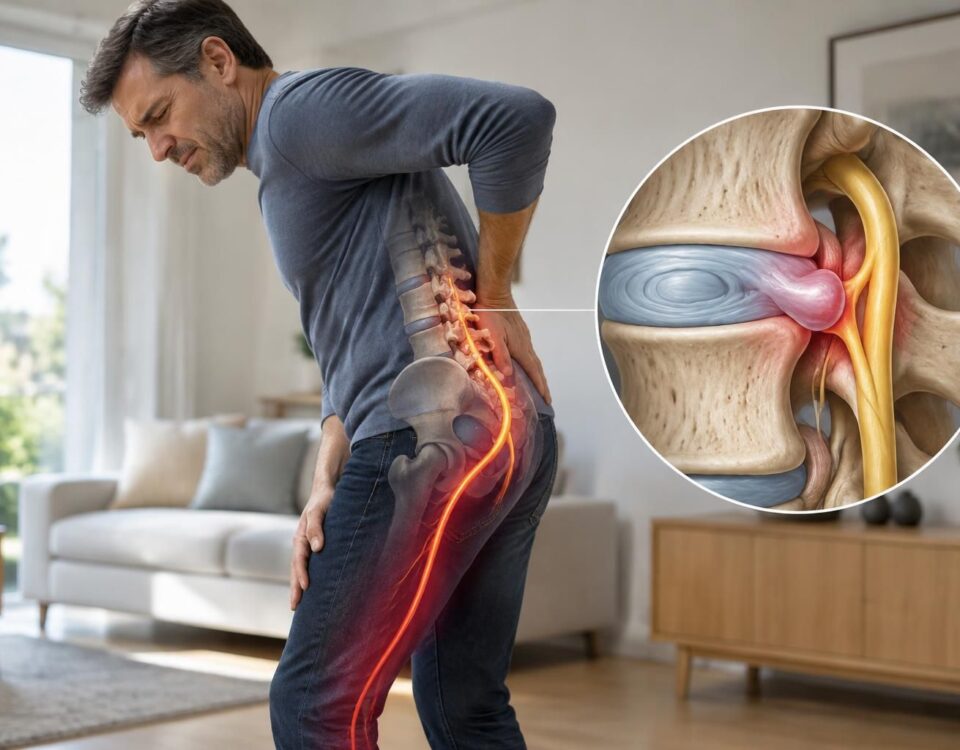
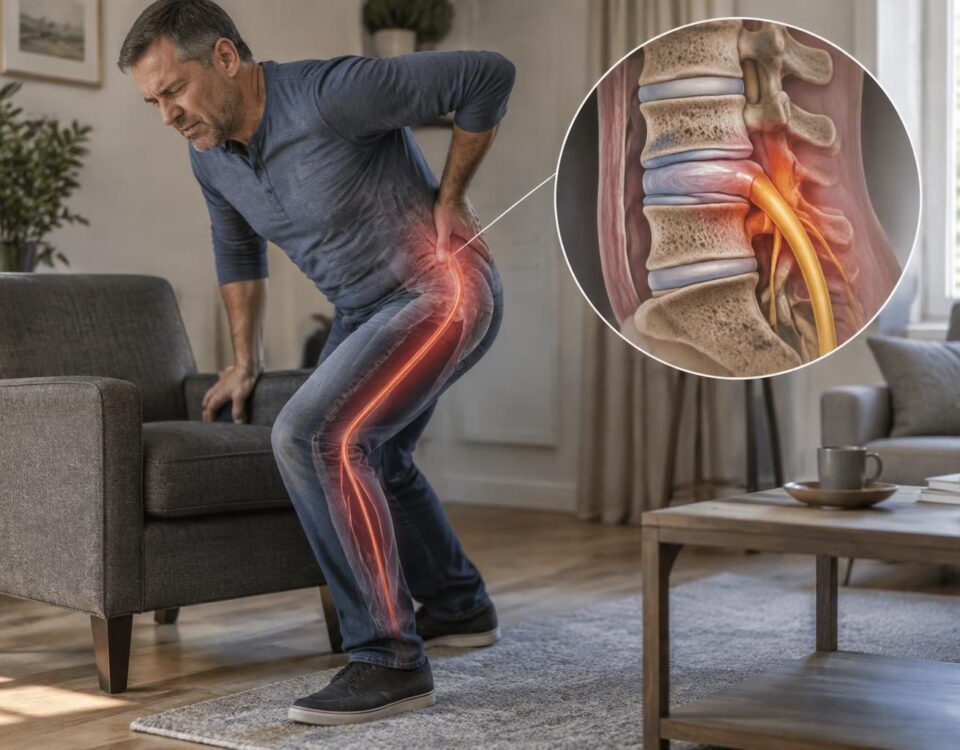
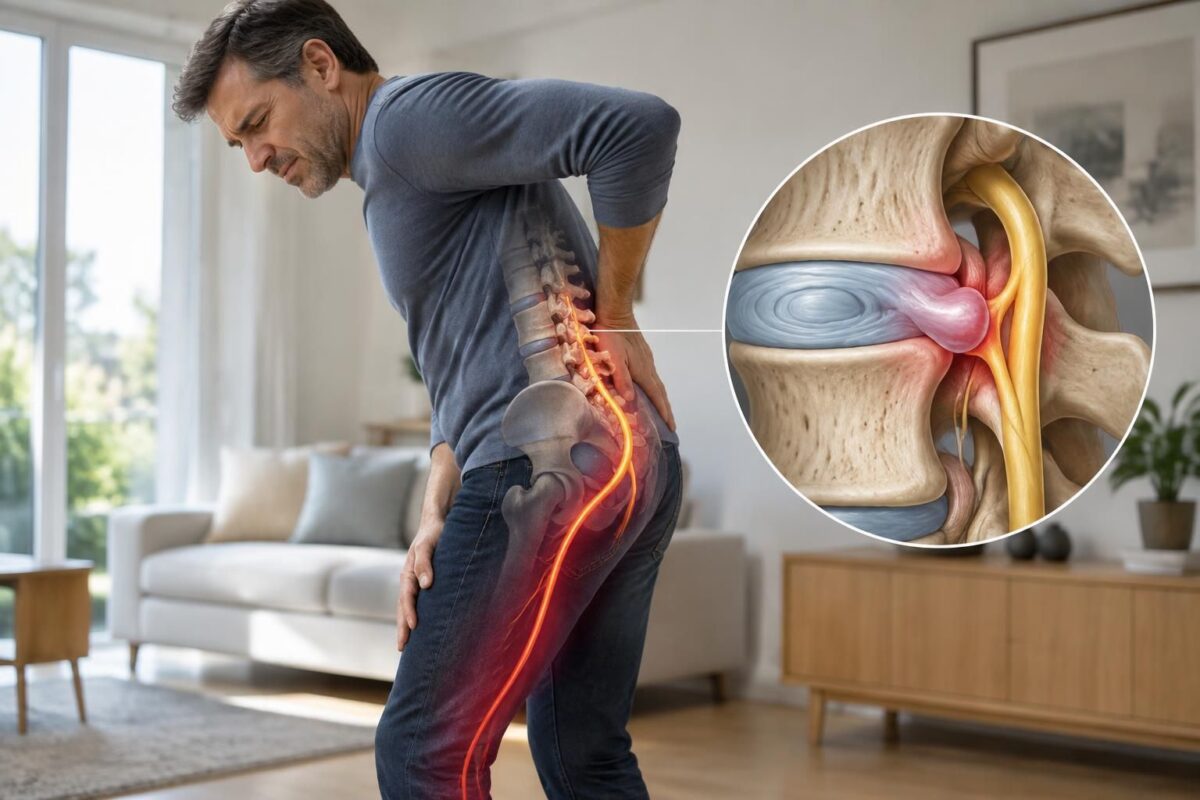
An intervertebral disc acts as a cushion between vertebrae. When part of the disc bulges, it can irritate a nerve root. In the lower back, this irritation can cause pain that radiates into the buttock and leg, sometimes to the foot or toes. Tingling, numbness, or weakness may also occur. However, the presence of a herniation on imaging does not solely prove that it explains the symptoms: it is necessary to check that its level and side correspond with the pain and observed signs.
At night, some people tolerate one position better than others. Lying on the side with a pillow between the knees or on the back with support under the knees can provide comfort, although this is not a universal solution. Gently changing position can also help when immobility increases discomfort. During the day, maintaining usual activities adjusted to tolerance is generally preferable to prolonged immobility. Lack of sleep can heighten pain sensitivity and make recovery more difficult.
Pain that varies with movement or position may be compatible with a mechanical component. In contrast, constant pain accompanied by fever, general deterioration, or other unusual signs warrants medical attention. Isolated nighttime pain does not automatically justify an MRI. Imaging is particularly relevant when it can change management decisions based on examination and evolution.
The evaluation aims to connect the path of pain to nerve functions and daily activities. It may include observing walking, comparing strength, examining sensitivity and reflexes, as well as analyzing functional difficulties. If imaging already exists, its interpretation benefits from being related to these elements rather than considered separately.
Some signs change the priority: a new or progressive weakness, foot drop, worsening walking, significant symptoms in both legs, or new urinary or bowel issues. Numbness in the saddle region or perineum also requires urgent evaluation. These manifestations should not wait for a routine appointment.
Dr. Sylvain Desforges, B.Sc., D.O., N.D., is an osteopath and founding president of TAGMED and the ACMA association. His practice notably focuses on chronic spinal pain and symptoms consistent with sciatica. At the TAGMED Clinic, options may include specific osteopathy or, depending on the evaluation, technologies such as motorized neurovertebral decompression. Since traction is not recommended as a standard treatment for low back pain with or without sciatica by NICE guidelines, any decompression approach must be presented transparently regarding the uncertainties of the data and without guarantee of results.
Medical disclaimer: this information is educational and does not replace a consultation or diagnosis. The author is not a doctor, and the manual or functional approaches described do not replace medical follow-up. Consult a physician or emergency service if any of the warning signs mentioned are present, or if symptoms rapidly worsen.
A herniated disc associated with sciatica can disrupt sleep, but nighttime pain alone does not determine the cause or severity. Prolonged positions, irritation of a nerve root, and lack of sleep can influence symptoms. The evaluation should correlate the pain pathway, strength, sensitivity, function, and, when it can alter management, imaging results.
Night Pain and Factors to Monitor
Pain can vary depending on position and the duration spent immobile. Some people cope better at night by switching sides or placing a pillow between their knees; others prefer to sleep on their back with support under their knees. There is no universal position: the goal is to find a comfortable support without stressing the back. During the day, staying active according to tolerance and breaking periods of sitting can help avoid prolonged immobility. Pain that increases when transitioning from sitting to standing is addressed in this article on sitting-standing transitions with sciatica.
A hernia visible on MRI does not automatically explain the symptoms: its level and side must correspond to the painful pathway and the findings of the examination. The warning signs and the link between hernia, sciatica, and MRI deserve special attention, as do the details about the possible link between herniated disc and sciatica. Pain, tingling, or numbness should be interpreted alongside muscle strength, sensitivity, reflexes, and functional abilities, not from an isolated imaging report. To better understand the common causes of a marked episode, also consult this page on herniated discs and acute sciatica.
Pay particular attention to any new or worsening weakness, recent difficulty walking on heels or toes, as well as a deteriorating gait. Resources explain the difficulty walking on heels, the difficulty walking on toes, and why a modified gait can perpetuate pain. These changes do not substitute for an examination: if they are new, significant, or progressive, seek medical advice promptly.
Consult immediately if you experience new urinary or intestinal disturbances, numbness in the saddle area or perineum, rapidly progressive weakness, significant symptoms in both legs, fever, major trauma, or overall deterioration. Persistent nighttime pain accompanied by concerning general signs, such as fever or unexplained weight loss, should also be evaluated. Recommendations regarding sciatica management can clarify possible steps, but they do not replace an evaluation appropriate to your situation.
Imaging is not automatically necessary because pain occurs at night. It is generally considered when the clinical context justifies it and its result could change management decisions. Options should be discussed with a healthcare professional; no approach guarantees a given outcome. For more general information on herniated discs, their symptoms, treatments, and the possibility of surgery, keep in mind that the choice depends especially on the progression, function, and neurological signs.
This information is educational and does not replace a consultation, diagnosis, or treatment by a licensed healthcare professional. Improvement in function and changes in symptoms are useful markers to monitor; in the presence of a sign of urgency, do not delay evaluation for a routine appointment.

Herniated disc and sciatica: understanding the clinical correlation
IN BRIEF A herniated disc can irritate a nerve root and cause sciatica, with pain, numbness, or weakness in the leg. Their connection is verified by comparing the symptom pathway, neurological examination, and, if necessary, imaging: a visible hernia alone…

Dr Sylvain Desforges, B.Sc., D.O., N.D., osteopath, is the founding president of TAGMED and of the ACMA association. He dedicates his practice to chronic spinal pain, low back pain and symptoms compatible with sciatica, particularly when pain radiates toward the buttock, leg, calf, foot or toes.
Through SOS Sciatique, he publishes educational content on sciatica symptoms, possible causes such as disc herniation, disc narrowing, foraminal stenosis or irritation of a lumbar nerve root, as well as non-surgical approaches that may be considered according to the evaluation. At Clinique TAGMED, care may include, depending on the case, motorized neurovertebral decompression, specific osteopathic care or precision percussion.
For an evaluation related to sciatica treatment in Montreal / Mount Royal or sciatica treatment in Terrebonne, please consult the services available at Clinique TAGMED.
Medical disclaimer
The information published on SOS Sciatique is provided for educational purposes only and does not replace a consultation, diagnosis, opinion or treatment provided by a physician or another authorized healthcare professional. The author of this article is neither a medical doctor nor a specialist in a medical specialty recognized by the Collège des médecins du Québec. The osteopathic, manual medicine or functional support approaches described on this site do not constitute medical acts and are not intended to replace medical follow-up.
Consult a physician or emergency service in cases of loss of bladder or bowel control, anesthesia in the saddle area, significant or progressive weakness in the leg or foot, fever, recent trauma, severe pain or rapid worsening of symptoms. For more details, please read our Legal Notice.