




Sciatica after surgery: why does the pain persist or come back?
The pain in the leg hasn’t completely disappeared, it returns after improvement or new symptoms appear? Pain after a discectomy, laminectomy, or lumbar decompression should be interpreted according to the time frame, neurological evolution, wound, and the surgeon’s instructions.
This page helps you distinguish between a recovery that is still ongoing and a situation that requires a prompt call to the surgical team. It also outlines the minimum conditions before considering a conservative approach.
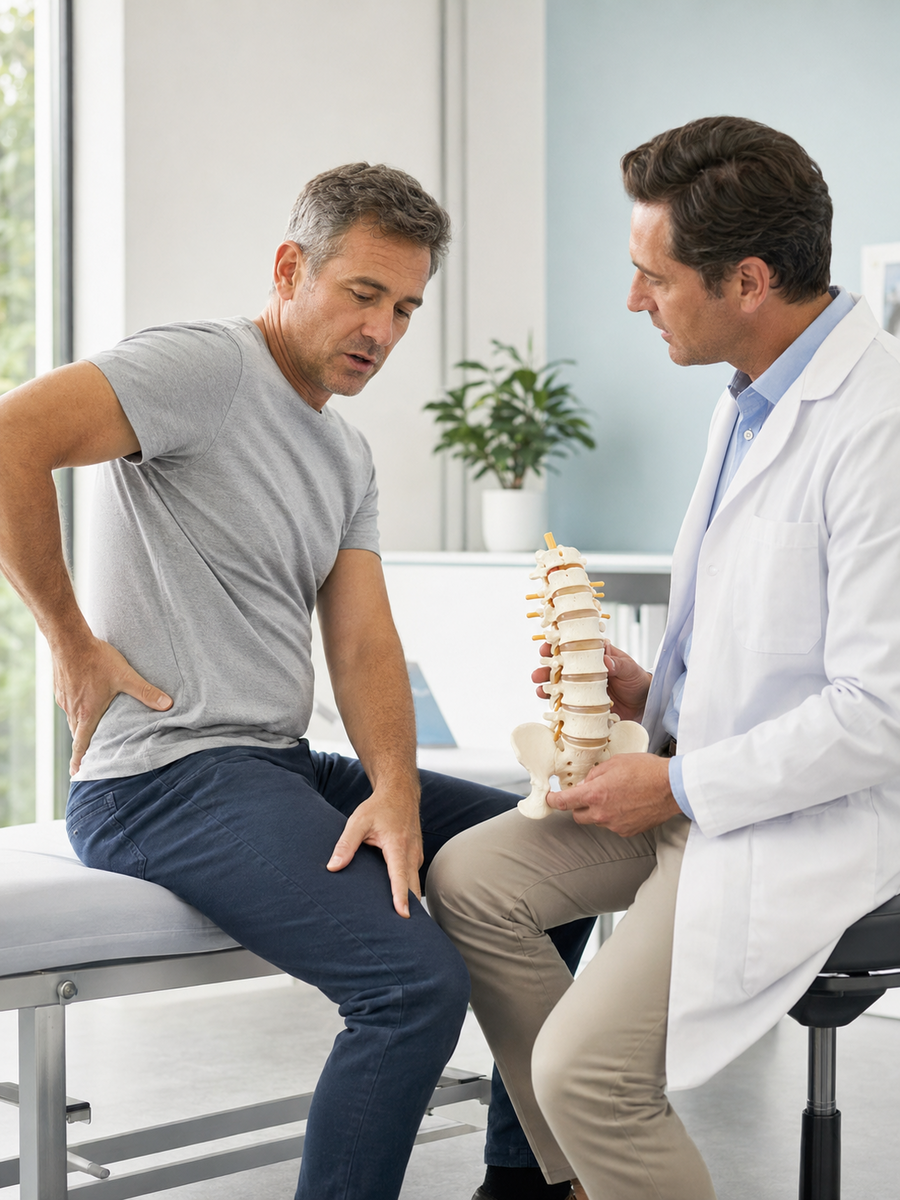
Short answer: postoperative pain does not have a single cause
Nerve recovery
A long-compressed nerve root may gradually recover. Pain, numbness, and weakness do not always follow the same timeline.
Local inflammation
The tissues operated on and the nerve root may remain sensitive during the initial period, even when the compression has been relieved.
Persistent or new cause
Residual compression, recurrence of hernia, stenosis at another level, or instability may be discussed as applicable.
Complication
Infection, hematoma, cerebrospinal fluid leakage, or neurological impairment are less common but require prompt evaluation.
When to contact the surgeon or emergency services urgently?
The instructions provided by your hospital take precedence over any general information. After spinal surgery, any new or rapidly progressive symptom should not be treated with massage, manipulation, improvised exercise, or traction before a medical evaluation.
| Situation | Prudent Action | Why |
|---|---|---|
| New or worsening weakness | Contact the surgical team or emergency services immediately. | A postoperative neurological deficit must be examined promptly. |
| Urinary retention, incontinence, loss of sensation in the saddle area | Immediate emergency. | These signs may suggest severe nerve root injury. |
| Fever, chills, red, warm, or draining wound | Call the surgical team that same day; emergency if general condition deteriorates. | An infection or wound issue must be ruled out. |
| Clear fluid discharge with significant headache | Urgent evaluation according to hospital instructions. | A cerebrospinal fluid leak is a postoperative possibility. |
| Severe, new, or rapidly increasing pain | Request prompt medical advice. | The change in profile is more important than an isolated pain score. |
| Shortness of breath, chest pain, or swollen calf | Immediate emergency. | A thromboembolic complication must be ruled out. |

How long can pain last after surgery?
The timeline depends on the type of procedure, the duration of nerve compression before the surgery, preoperative strength, complications, age, general condition, and given restrictions. Wound pain or initial stiffness does not have the same significance as a return of the sciatic path from before the surgery.
Specialized hospitals indicate that general pain and fatigue can take several weeks to subside. Pain in the leg and walking distance can continue to improve over the first months, sometimes longer. However, these indicators do not replace the personalized timeline from the surgeon.
- First days: wound pain, fatigue, and sensitivity are common; the hospital specifies what to expect.
- First weeks: activity is gradually increased while respecting load, bending, and twisting restrictions.
- First months: function, walking, sleep, strength, and nerve pathway are reevaluated.
- After a clear improvement: the return of the same sciatic path warrants a call to the doctor, especially if it intensifies.
Why can sciatica persist or return after surgery?
Several mechanisms can produce similar symptoms. The goal is not to choose a cause yourself but to provide the care team with an accurate timeline.
Still Irritable Root
Relieving compression does not instantly normalize a root that has been inflamed or compressed. Pain may fluctuate during recovery.
Residual Compression
A part of the stenosis or hernia may continue to correspond to the path, depending on the procedure performed and the anatomy.
Recurrent Disc Herniation
A new fragment may compress a root again at the surgical site. Improvement followed by a return of radicular pain is a profile to note.
Epidural Scar
Fibrosis may surround the operated tissues. Its presence on imaging alone does not prove it causes pain.
Another Level or Another Diagnosis
Hip, sacroiliac joint, peripheral neuropathy, neighboring stenosis, or other conditions can mimic sciatica.
Deconditioning and Sensitivity
After a period of pain and reduced activity, capacity, sleep, and sensitivity of the nervous system can influence function.
A systematic review accompanied by a prospective study reported varying rates of recurrent low back pain, new hernias, and reoperations after discectomy. These figures vary depending on the definition, duration of follow-up, and patients; they do not predict individual cases.
How does the doctor reassess postoperative pain?
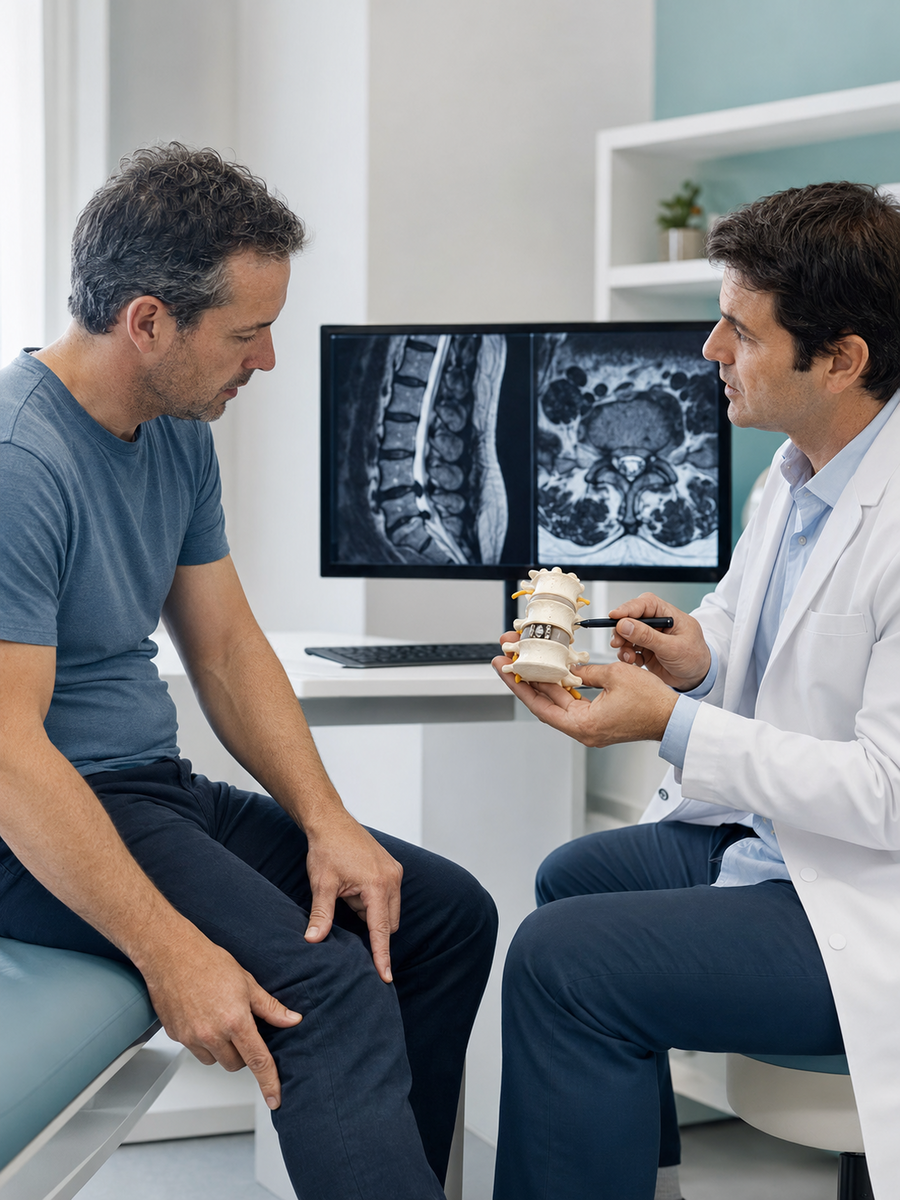
The timeline is central. The professional distinguishes between pain that has never improved, pain that has partially improved, recurrence after a pain-free period, and new pain. He then checks strength, sensitivity, reflexes, walking, the wound, and urinary and bowel functions.
Surgical report
Type of procedure, level, side, decompressed structures, implants, and intraoperative incidents.
Measurable evolution
Pain in the leg, walking circumference, sleep, sitting position, strength, and medications.
Neurological examination
Strength, sensitivity, reflexes, and signs of nerve tension interpreted in the postoperative context.
Targeted imaging
MRI or other examination only when the doctor deems the result may alter management.
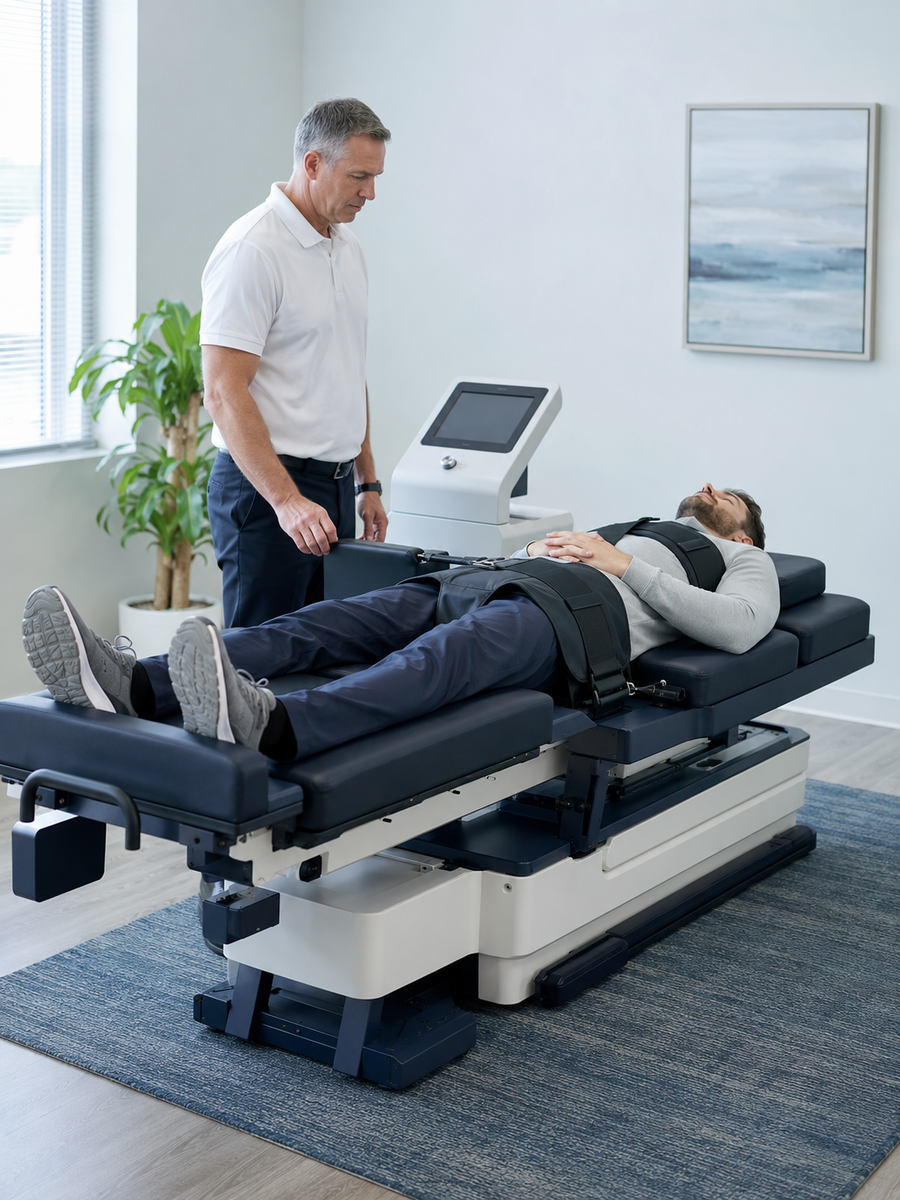
Is neurovertebral decompression possible after surgery?
There is no universal timeline applicable to all surgeries. A fusion with implants, a microdiscectomy, a simple decompression, and a postoperative complication present very different constraints. The surgeon must specify the healing, stability, restrictions, and the moment when a pulling force may be considered, if permitted.
The motorized decompression is a form of controlled traction. It does not remove a recurrence of a hernia, does not correct an implant, does not treat an infection, and does not replace an indicated reoperation. NICE recommends against providing routine traction for low back pain with or without sciatica; data specific to people who have already undergone surgery is limited.
- The wound must be completely healed and show no signs of infection.
- The surgical report and restrictions must be known.
- An explicit medical authorization is required when the surgery is recent, complex, or involves fusion or implants.
- No new or progressive deficit should be present.
- The plan must have measurable objectives and a threshold for stopping or redirecting.
Prepare a TAGMED assessment after lumbar surgery
TAGMED does not perform surgery and does not provide postoperative follow-up. When the situation is stable and the medical team allows conservative management, an osteopathic assessment can document function and determine if a cautious trial of motorized decompression can be discussed.
Surgical documents
Bring the surgical report, date, level, side, implants, and restrictions.
Imaging and reports
Bring the reports before and after the operation as well as the written recommendations from the surgeon.
Symptom Timeline
Note the initial improvement, return of pain, trajectory, strength, walking, and medications.
TAGMED Clinic Montreal / Mont-Royal
1140 Beaumont Avenue
Mont-Royal, QC, H3P 3E5
Phone: 1 877 672-9060
Days: Tuesday and Thursday
TAGMED Clinic Terrebonne
1150 Lévis Street, Suite 200
Terrebonne, QC, J6W 5S6
Phone: 450 704-4447
Days: Monday, Wednesday, and Friday
Frequently Asked Questions about Sciatica after Surgery
Is it normal to still have sciatica pain after surgery?
Residual or fluctuating pain may occur during recovery, especially if a nerve root was compressed for a long time. However, pain that never improves, worsens, or is accompanied by new weakness should be reported to the surgical team.
Why does the pain come back after a few weeks or months?
Possible explanations include a still-sensitive nerve root, recurrent herniation, residual compression, adjacent stenosis, scarring, or another diagnosis. The timeline, examination, and sometimes imaging help distinguish them.
Does returning pain mean the surgery failed?
No. The outcome is assessed by leg pain, strength, walking, function, and progression. A flare-up does not automatically negate improvements, but it should be assessed if it persists, worsens, or strongly replicates the initial symptoms.
When should an MRI be redone?
Not automatically. The surgeon may request imaging if symptoms change, if a deficit appears, if a recurrence is suspected, or if the results would alter treatment. A postoperative MRI should be interpreted alongside the report and the time elapsed since surgery.
Does a recurrence of hernia always require another surgery?
No. The decision depends on the deficit, pain, function, size, and agreement of the recurrence, as well as the response to non-surgical options. Significant or progressive weakness may accelerate the surgical advice.
Can one walk after lumbar surgery?
Gradual walking is often encouraged, but the distance, frequency, and restrictions depend on the procedure. Follow the program provided by the hospital and reduce effort if symptoms worsen persistently.
What exercises should be done after surgery?
Only use exercises authorized by the surgical team or the rehabilitation professional. The type of surgery, healing, and restrictions make a generic online program dangerous.
When can one receive manual therapy after surgery?
There is no single timeline. The wound, stability, implants, type of surgery, and surgeon’s instructions must be verified. No care should be applied on a possible complication or before the required authorization.
Can neurovertebral decompression avoid a second surgery?
No promise of this kind is justified. In a stable and permitted situation, a cautious trial may sometimes be discussed, but it does not address an emergency, does not replace indicated surgery, and its effectiveness after an operation remains uncertain.
What documents should be brought to TAGMED?
Bring the surgical report, restrictions, imaging reports, medication list, pain timeline, and any medical authorization. These documents also help decide if a return to the surgeon is preferable.
Sources and clinical landmarks
- NHS — Lumbar decompression surgery: recovery and possible complications.
- Cambridge University Hospitals — Post-operative recovery following lumbar decompression surgery.
- University College London Hospitals — Multi-level lumbar decompression: recovery and warning signs.
- Parker et al. — Incidence of Low Back Pain After Lumbar Discectomy and Patient-reported Outcomes.
- Floris et al. — MRI after successful lumbar discectomy.
- NICE NG59 — Low back pain and sciatica in over 16s: assessment and management.
Your situation is stable, but the pain persists after the operation?
After surgical follow-up, healing, and appropriate authorization, a TAGMED assessment can help document function, the course, and mechanical factors. Motorized decompression is only discussed if the profile seems compatible, without guarantees and without delaying necessary medical re-evaluation.
Sylvain Desforges, B.Sc., D.O., N.D., Doctor of Osteopathy
Editorial information, sources and limitations
This content is intended to inform patients about sciatica, possible causes, warning signs, and care options. It does not replace an individualized assessment.
Reference sources
References are selected according to the subject of the page: guidelines, systematic reviews, then institutional resources.
- NICE NG59 – Low back pain and sciatica in over 16s — National guideline
- HAS – Management of patients with common low back pain — French national guideline
- Cochrane – Corticosteroid injections for treatment of sciatica — Systematic review
- NCBI Bookshelf – Sciatica — Clinical institutional resource
Complementary resources from the TAGMED network
These internal resources complement the clinical information and thematic linking. They do not replace national guidelines or systematic reviews.
Editorial note on decompression
Clinical resource from the TAGMED network; it does not replace national guidelines. Some guidelines use the term “traction” and recommend caution for low back pain with or without sciatica. Any decompression option should therefore be presented as an individualized clinical approach, with limitations, indications, and contraindications clearly explained.
Limitations of this information
The information on this page is general. It does not constitute a diagnosis, prescription, or guarantee of results. Pain radiating into the leg may have several causes; assessment should consider clinical history, examination findings, symptom progression, and, when appropriate, complementary tests.
When to seek urgent medical care
Seek urgent medical care if you experience loss of bladder or bowel control, saddle anesthesia, major or progressive leg weakness, unexplained fever, pain after significant trauma, or severe pain that rapidly worsens.
