


Herniated disc and sciatica: understanding the clinical correlation
29/09/2026
Sciatica in Montreal: radiation in the leg after physical effort
30/09/2026
IN SHORT
| Sciatica irritates the sciatic nerve and can cause pain that radiates down the leg, sometimes to the point of making walking difficult or causing limping. Walk for short periods if the pain remains bearable, without trying to push through it: moving helps avoid inactivity and maintain mobility. If walking straight becomes impossible, if the pain worsens, or if weakness appears, seek medical advice promptly. |
A sciatica can cause pain that radiates from the lower back down to the leg, sometimes accompanied by tingling or weakness. The pain can then interfere with walking, cause limping, or make it difficult to walk straight.
If the pain remains bearable, try walking for short periods and gradually increase based on your tolerance. If it intensifies, prevents you from walking normally, or does not improve, consult a healthcare professional.
A sciatica can cause pain in the lower back, buttock, and back of the leg. This pain can make walking difficult, cause limping, or prevent you from standing straight. The course of action depends on the intensity of the symptoms: walk only if it remains tolerable, avoid forcing it and consult a healthcare professional if the pain worsens or if your leg becomes weak. The sciatic nerve starts from the lower back and descends into the leg. When a nerve root is irritated or compressed, the pain can affect the buttock, thigh, calf, or foot. Tingling, numbness, or weakness may also appear. To avoid pain, some people lean their torso, shorten their steps, or limp. This posture can be a reaction to pain. It does not, by itself, identify the cause of the problem. Pain in the buttock without back pain may also be present: discover the elements described in this article about pain in the buttock associated with sciatica. Pain that increases after a long period sitting or driving can also limit movement. To better understand this case, refer to this information on sciatica and difficulty driving for long periods. Walking is not suitable for all phases of sciatica. If you can walk without limping heavily and without a significant increase in pain, you can try short periods of walking. Start with a few minutes, stay close to home, and take a break as soon as symptoms increase. If every step sharply increases the pain or if you are unable to walk normally, do not push it. Temporarily reduce your movements and seek advice from a healthcare professional. A guide on sciatica preventing walking can complement this advice, but does not replace a medical evaluation. Advice on walking varies depending on symptoms and individual circumstances. You can read these resources on walking with sciatica, the decision to walk or not, and precautions to take while walking. Choose flat and stable ground. Avoid long distances, heavy loads, and movements that trigger sharp pain. Stairs can exacerbate symptoms in some people: proceed carefully and consult the advice on sciatica on stairs. Uneven terrain requires more balance and can make walking less safe. Familiarize yourself with the precautions suggested for walking on uneven ground. If your pain increases throughout the day, this information on symptoms that worsen at the end of the day may also help you identify your triggers. Make an appointment with a doctor if the pain persists, frequently returns, or limits your activities. Consult promptly if you are unable to move, if leg weakness increases, or if your foot starts dragging. The recommendations from the Assurance Maladie also specify what to do in the event of sciatica and when to consult. Seek urgent medical assistance if you lose control of your bladder or bowels, if you have a loss of sensation in the perineum, or if significant weakness appears rapidly. These signs require immediate evaluation. Adopt a position that reduces pain and change posture regularly if you can. Avoid staying in bed for a long time, but do not force yourself to walk when the pain becomes intense. Do not use medication without checking with a healthcare professional that it is suitable for your situation, especially if you have a medical condition or are already undergoing treatment. Note where the pain starts, how far it descends, and what aggravates it. Indicate whether you have tingling, numbness, or weakness. These details will help the healthcare professional assess your symptoms and decide on appropriate care. Medical disclaimer: The information and advice provided on this site do not replace the opinion, diagnosis, or treatment of a healthcare professional. Please note that Dr. Sylvain Desforges, osteopath, is neither a medical doctor nor a physician and is not a specialist in a medical specialty as defined by the Collège des médecins du Québec. Manual medicine, functional medicine, and sports medicine, as described on this site, exclude any medical treatment or diagnosis made by a doctor or medical specialist. Always consult your doctor for any medical questions. For more details, please read our full Legal Notice.Why can sciatica prevent walking straight?
Should you walk when having trouble standing straight?
Adapt your movements to the pain
When does difficulty in walking require a consultation?
What to do while waiting for medical advice?
What this may indicate
- A sciatic pain that hinders support or movement.
- Tingling, numbness, or weakness in the leg.
- Limping when the pain increases while walking.
How to react
- Do not push yourself if walking significantly increases the pain.
- If it remains bearable, try short walks with breaks.
- Consult a doctor if the difficulty persists or intensifies.

A sciatica can make walking difficult and give you the feeling that you can no longer walk straight, especially when the pain radiates down into the buttock and leg. The appropriate action depends on your symptoms: move gently if the pain remains bearable, without forcing or limping further. In case of significant weakness, worsening, or unusual symptoms, seek medical advice promptly.
Why can sciatica hinder walking?
Sciatica corresponds to irritation or compression of a root of the sciatic nerve, which originates from the lower back and extends down the back of the leg. It can cause pain, tingling, numbness, or a feeling of weakness in the buttock, thigh, calf, or foot. A lumbar disc herniation is a common cause.
To avoid pain, you can modify your posture, shorten your steps, or lean your torso forward. This may give the impression of walking crookedly. Pain alone can disrupt your gait, but a real loss of strength in a leg or foot requires special attention.

Sciatica and return to activity: why to progress slowly
IN BRIEF Returning to activity after sciatica involves gradually regaining movement without exacerbating pain. It helps maintain mobility while minimizing the risk of relapse. Start with walking, then alternate between walking and running for short intervals, increasing effort step by…

Sciatica and physical activity: how to avoid mistakes
IN BRIEF Sciatica is pain that follows the path of the sciatic nerve, from the lower back to the leg. Appropriate physical activity helps to stay mobile without maintaining irritation: favor gentle walking, cycling in an upright position, or swimming,…
Should you walk or rest?
Adapt your walking to your pain
Prolonged bed rest is generally not recommended. If you can walk without heavily limping and the pain remains tolerable, prefer short periods of walking, for example, 5 to 10 minutes several times a day. Start at home or on a nearby route, then gradually increase the duration if your symptoms do not worsen.
Stop and take a break if the pain markedly increases or if your gait becomes more difficult. Avoid trying to cover long distances to “unblock” the nerve: forcing yourself to walk can worsen symptoms. When the pain is intense, temporarily limit your movements and seek advice from a healthcare professional on how to resume activity.
Gradually resume your activities
Alternate positions and avoid staying still for long periods. When the crisis subsides, a gradual resumption of walking and adapted exercises can help maintain your mobility. A doctor or physiotherapist can advise you on which movements to favor and which ones trigger your pain. Do not resume sports if you cannot walk normally or if the activity significantly increases your symptoms.
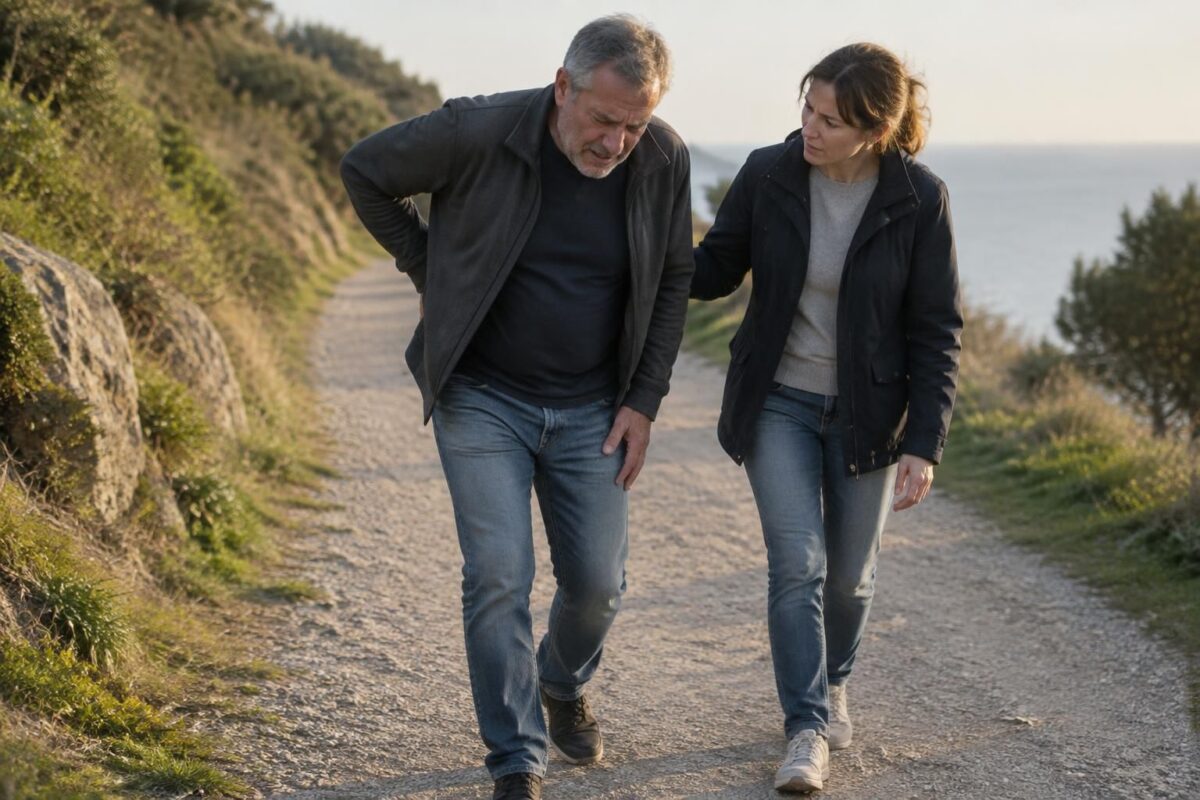
Sciatica and forced walking: risk of worsening
IN BRIEF Sciatica can make walking painful, but pushing yourself may worsen the symptoms. Walk for short periods, at your own pace, only if the pain remains tolerable and does not intensify over time. If you are limping, if the…

Sciatica and daily walking: how to respect tolerance
IN BRIEF Sciatica is pain related to the irritation of a nerve, which can extend from the lower back down to the leg. Walking with sciatica is often possible and helps to maintain mobility, provided you move slowly, take short…
When to consult quickly?
Make an appointment with your doctor if you have difficulty walking straight, if limping persists, if the pain does not improve, or if you are unsure whether your gait is due to pain or weakness. An examination will assess your strength, sensitivity, and reflexes, and then choose the appropriate management. Only use pain or anti-inflammatory medications according to the advice of a healthcare professional.
Consult urgently if significant weakness appears or worsens, if you find it difficult to lift your foot, if you lose sensitivity around the perineum, or if you experience new difficulties urinating or controlling your bowel movements. These signs should not be attributed to simple sciatica without examination.
| Situation | Key point to remember |
|---|---|
| Pain hinders walking | Sciatica can cause difficulty walking straight or limping. |
| Light pain, normal walking | Walk for short periods and stop if the pain increases. |
| Moderate pain | Reduce the duration and distance, without forcing. |
| Intense pain or worsened by walking | Rest temporarily and seek advice from a healthcare professional. |
| Resuming walking | Start with 5 to 10 minutes, then gradually increase based on your symptoms. |
| Unable to stand or walk | Consult your doctor promptly. |

Sciatica and Gradual Resumption of Walking After an Attack
IN BRIEF Sciatica is pain related to irritation or compression of the sciatic nerve. After an episode, gradually resuming walking can help maintain mobility and limit stiffness without straining. Start with short walks on flat terrain, wear comfortable shoes, and…

Sciatica and walking after sitting: why the pain increases at the start
IN BRIEF Sciatica can hurt more during the first steps after sitting for a long time: a sensitized nerve may tolerate maintained posture and the restart of movement less well. Gradually standing up, walking for a few minutes, and varying…
Testimonials: sciatica and difficulty walking straight
The testimonials below are fictional examples inspired by possible situations. Symptoms and their progression vary from person to person.
“I was walking leaning to the side” — Sophie, 42
During my episode, the pain started from my lower back and radiated down behind my leg. I had trouble standing up straight and began limping after a few steps. I avoided forcing it, then resumed short walks in the house when the pain became more bearable. My doctor helped me adapt my activities.
“Every step made me fear a jolt” — Karim, 51
I felt like my leg would give out, and I shifted to find a less painful position. At first, I could almost not walk straight. I took frequent breaks and gradually increased my walking time without trying to push through the pain.
“I mainly limped after sitting for a while” — Émilie, 36
When getting up, I felt a sharp pain in my buttock and leg. The first steps were difficult, and I couldn’t maintain a normal gait. I regularly stood up and resumed walking for short periods, stopping when symptoms worsened.
“I had to slow down and seek advice” — Marc, 60
My pain increased as soon as I walked for a few minutes, and I began to limp. I stopped long outings and made an appointment with my doctor to evaluate the situation. With his recommendations, I was able to gradually resume movements that remained bearable.
“The pain made me lean forward” — Nadia, 47
I couldn’t walk straight and was constantly looking for a position that relieved my leg. I started with a few minutes of walking inside, several times a day. I gradually increased the duration while staying attentive to the evolution of the pain.
If the pain is very intense, worsens, or prevents you from moving, seek advice from a healthcare professional promptly. Significant weakness in the leg or new urinary or bowel troubles require urgent medical evaluation.

Sciatica and difficulty walking on tiptoes
IN BRIEF The difficulties in walking on tiptoes with sciatica may indicate muscle weakness related to nerve damage. This test helps identify a deficit but is not sufficient to establish a diagnosis. If the weakness is new, worsens, or is…

Sciatica and difficulty walking on heels
IN BRIEF The difficulty in walking on heels with sciatica may be related to weakness in the muscles that lift the foot, sometimes caused by nerve irritation or compression. This sign alone does not determine the cause: have it assessed…
Sciatica and difficulty walking straight: understanding the symptoms and acting
Sciatica refers to pain related to the irritation or compression of a root of the sciatic nerve, which originates from the lower back and descends into the buttock and then along the back of the leg. It can manifest as pain, tingling, numbness, or a feeling of weakness. Depending on its intensity and trajectory, it can make walking difficult and give the impression that one can no longer walk straight.
This discomfort can lead to limping, shortening steps, or tilting the torso to avoid certain pains. These adaptations are sometimes instinctive: the person seeks a position that seems less painful. However, difficulty walking straight does not, by itself, confirm sciatica. Other issues with the back, hip, or nerves can cause similar symptoms. A health professional can evaluate their origin.
The most common cause of sciatica is a lumbar disc herniation that irritates a nerve root. The pain can vary throughout the day and be worsened by certain positions, exertion, or prolonged walking. It is therefore important to adapt activity to symptoms: forcing through a pain that increases markedly risks making movement more difficult, while strict and prolonged rest is generally not favored when pain allows movement.
When walking remains possible without significant worsening, it can be helpful to start with short periods, for example a few minutes, and then take a break if symptoms increase. Duration and distance can be gradually increased according to tolerance. Conversely, if each step significantly worsens the pain, it’s better to stop the effort and seek advice from a doctor or another qualified professional before continuing. A cane or crutches may sometimes be considered upon professional recommendation.
Difficulty walking straight deserves particular attention if it is accompanied by marked weakness in the leg or foot, significant loss of sensitivity, or if it worsens rapidly. An urgent consultation is necessary if there is loss of control over the bladder or bowels, or numbness in the area between the legs. These signs should not be attributed to simple sciatica without evaluation.
Dr. Sylvain Desforges is presented as a specialist in osteopathy, naturopathy, and manual medicine. He is the founding president of TAGMED clinics and the ACMA association. His career is dedicated to innovation in health and the management of chronic pain. His approach emphasizes care based on available data and the integration of technologies such as spinal decompression, laser, and shock waves. For someone who experiences difficulties walking straight, evaluating the cause of symptoms remains essential before considering specific care.
The treatment of sciatica depends on clinical examination, symptoms, and their evolution. A doctor can recommend appropriate measures, prescribe pain relief if necessary, and refer to exercises or physical therapy. The goal is to progressively regain comfortable mobility, without ignoring intensifying pain or attempting to correct one’s posture by forcing.
A sciatica can make walking difficult and give the impression of being unable to move straight. Pain, tingling, or weakness in the leg can alter your posture and way of walking. The intensity of symptoms helps determine whether it is better to continue moving gently or to stop activity and seek medical advice.
Sciatica corresponds to the irritation of a nerve root that contributes to the formation of the sciatic nerve. The pain can start from the lower back or buttock, then descend into the thigh, calf, or foot. To avoid pain, some people tilt their torso, shorten their steps, or limp. This protective gait can be uncomfortable without by itself indicating a serious injury.
Discomfort while walking can also occur during specific movements, such as climbing stairs or standing up after sitting. You can consult these resources on leg pain when climbing stairs and pain when standing up from a chair. Walking on a slope can also differently strain the back and legs: observe the symptoms to watch for when walking on a slope.
When the pain remains bearable and you can walk without limping further, gentle and spaced activity is often preferable to prolonged immobility. Start with a few minutes on flat ground, near your home, then take a break if symptoms increase. Practical advice is available in this guide on walking with sciatica, as well as in these recommendations for resuming walking cautiously.
It is not necessary to force yourself to walk straight despite intense pain. Reduce the duration or stop walking if your gait worsens, if the pain spreads further into the leg, or if you can no longer bear weight normally. To better understand possible manifestations and relief options, consult this guide on sciatica symptoms and causes and these tips focused on walking with sciatica.
A burning pain or unusual sensations in the foot may accompany nerve irritation. Their presence should be monitored, especially if they worsen or are accompanied by a loss of strength. To learn more about possible nerve compression, read this article on burning in the foot and sciatica. A herniated disc may sometimes be involved, but only a health professional can evaluate your situation: discover the explanations regarding the relationship between herniated disc and sciatica.
If walking is possible without clear worsening, gradually increase the duration rather than the speed or distance. However, seek medical advice quickly if pain prevents you from walking, if leg weakness increases, or if you notice significant loss of sensitivity. Additional indicators are provided in this file on the benefits and precautions of walking with sciatica.

Dr Sylvain Desforges, B.Sc., D.O., N.D., osteopath, is the founding president of TAGMED and of the ACMA association. He dedicates his practice to chronic spinal pain, low back pain and symptoms compatible with sciatica, particularly when pain radiates toward the buttock, leg, calf, foot or toes.
Through SOS Sciatique, he publishes educational content on sciatica symptoms, possible causes such as disc herniation, disc narrowing, foraminal stenosis or irritation of a lumbar nerve root, as well as non-surgical approaches that may be considered according to the evaluation. At Clinique TAGMED, care may include, depending on the case, motorized neurovertebral decompression, specific osteopathic care or precision percussion.
For an evaluation related to sciatica treatment in Montreal / Mount Royal or sciatica treatment in Terrebonne, please consult the services available at Clinique TAGMED.
Medical disclaimer
The information published on SOS Sciatique is provided for educational purposes only and does not replace a consultation, diagnosis, opinion or treatment provided by a physician or another authorized healthcare professional. The author of this article is neither a medical doctor nor a specialist in a medical specialty recognized by the Collège des médecins du Québec. The osteopathic, manual medicine or functional support approaches described on this site do not constitute medical acts and are not intended to replace medical follow-up.
Consult a physician or emergency service in cases of loss of bladder or bowel control, anesthesia in the saddle area, significant or progressive weakness in the leg or foot, fever, recent trauma, severe pain or rapid worsening of symptoms. For more details, please read our Legal Notice.


