Sciatica and constant pain: why evaluate it?
06/08/2026
Sciatica and pain during sitting-standing transitions
06/08/2026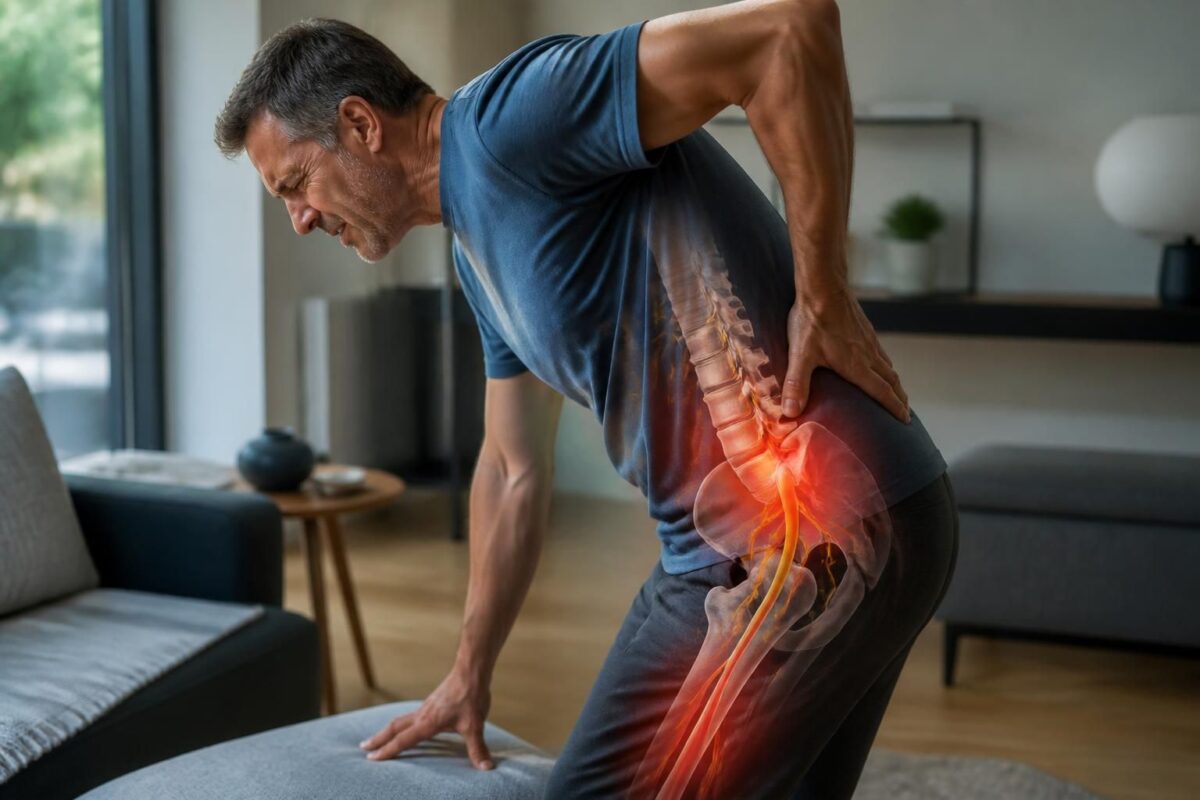
IN BRIEF
| In brief, sciatica and lumbar disc herniation describe the link between a disc protrusion and pain that follows the path of the sciatic nerve. It is the main cause of lower back pain radiating to the buttock and leg. Understanding this link allows for identifying the source and opting for effective non-surgical solutions, promoting mobility and the resumption of activities. Available in Montreal and its surroundings, this framework allows for rapid improvement of lower back pain and sciatica while preserving quality of life. |
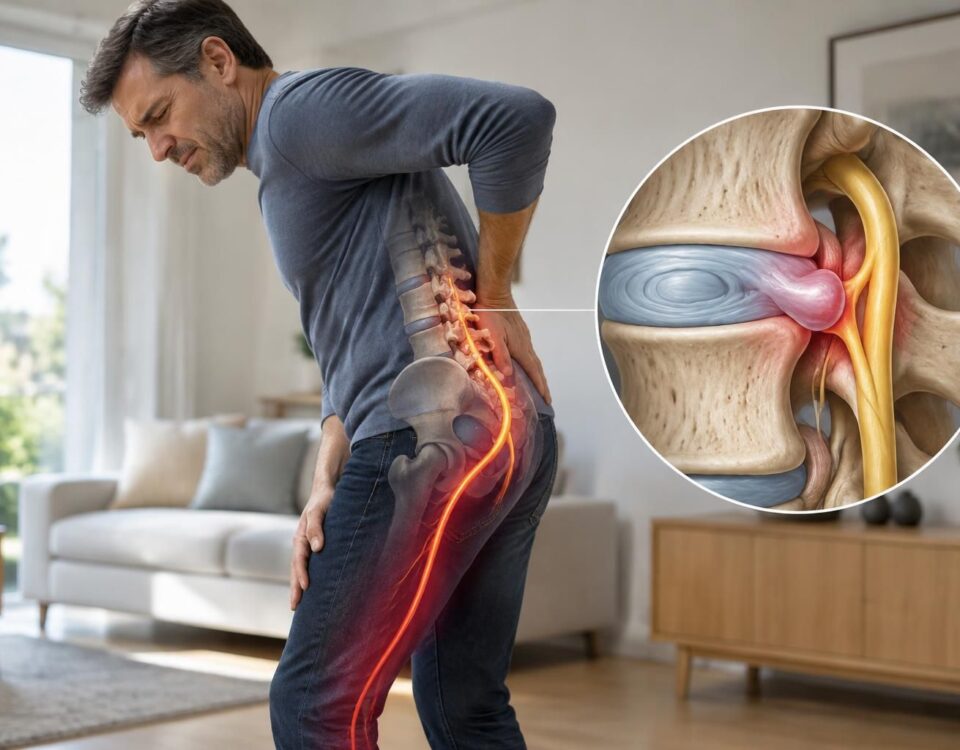
The link between sciatica and lumbar disc herniation lies in the fact that a disc herniation can irritate or compress the sciatic nerve.
The intervertebral disc can crack and bulge into the spinal canal, causing lower back pain and pain radiating down the leg.
This pain follows the path of the sciatic nerve, the longest in the body, and may be accompanied by tingling, weakness, or difficulties walking.
It is often unilateral and can be triggered by movements, prolonged sitting, or exertion.
Treatment generally combines pain-relieving and anti-inflammatory measures, rehabilitation, and muscle strengthening; in some cases, non-surgical approaches may suffice, whereas surgery is considered if warning signs appear.
Maintaining appropriate activity and adopting good postures can help relieve pain and prevent recurrences.
This text explains the link between sciatica and lumbar disc herniation, how a disc herniation can irritate the sciatic nerve and trigger pain that descends down the leg. It describes simple mechanisms, clinical signs, and non-surgical management options offered in our clinics, as well as situations that require urgent medical attention. No exercise recommendations are provided here; emphasis is placed on evaluation and non-invasive choices whenever possible.
The disc herniation is a protrusion of the intervertebral disc that can irritate a nerve root. This irritation can cause sciatic nerve pain, that is, sciatica, when the affected nerve is involved. Among the possible causes, other spinal conditions can be found, but the disc herniation remains the primary culprit in many cases.
What is a disc herniation?
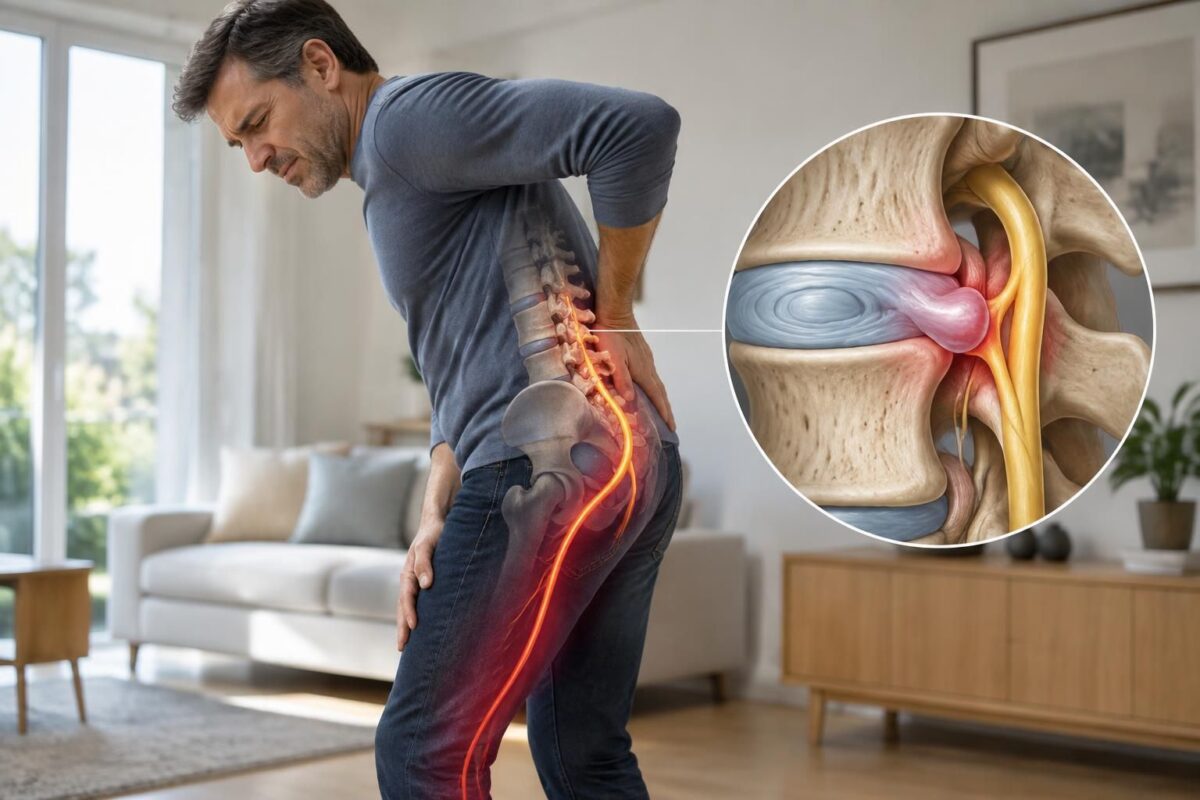
The intervertebral disc can crack and deform. When a bulge occurs, it can compress or irritate the nerve roots passing nearby. This compression or irritation triggers pain that can radiate down the body, primarily at the lumbar and buttock levels.
How does a disc herniation form?
The spine is made up of vertebrae separated by discs. When the disc weakens, it can crack. The bulge can then press on a nerve root that traverses the vertebral canal. This pressure and irritation cause pain signals that follow the path of the nerve.
The path of the sciatic nerve and signs
The sciatic nerve is the longest in the body. It originates in the lower back and descends along each leg. A disc herniation affecting a lumbar root can trigger pain radiating from the buttock to the foot. Tingling and muscle weakness can accompany the pain.
Differentiating L5 and S1 impairments
The pain follows a precise path. Irritation at the L5 level may descend on the outer side of the thigh, cross the ankle, and reach the big toe. An S1 impairment may follow the back of the leg to the heel and little toe. Tracking the nerve’s pathway to the foot helps locate the disc-root origin.
Typical signs
Pain that starts in the buttock or lower back and sometimes radiates upward, then descends into the leg. Tingling, burning sensations, or muscle weakness may occur. The pain is often unilateral and may be aggravated by certain sitting positions or exertion.

L5-S1 protrusion and sciatic pain: pathway to the foot
IN BRIEF A L5-S1 disc protrusion is a disc that slightly bulges between the lumbar and sacral vertebrae. If it irritates a nerve root, pain may radiate from the lower back or buttock down the back of the leg to…
Management options and care pathways
Management depends on clinical and radiological evaluation. Non-surgical approaches exist and may be considered depending on the case. In our TAGMED clinics, non-invasive care may include neurovertebral decompression techniques, targeted osteopathy, or the use of precision percussors when appropriate. For more information on non-surgical options, consult the associated resources.
For situations where specific decompression is necessary, it is important to discuss indications, risks, and alternatives with the healthcare professional. In some cases, surgery is not the first option, and non-surgical approaches can allow for recovery of mobility and reduction of pain without immediate surgical intervention.
Useful resources to understand the links between sciatica and disc herniation and to compare available approaches can be reviewed on the following pages:
Sciatica and lumbar disc herniation,
Non-surgical treatment of sciatica,
Disc herniation and non-surgical management,
Information on disc herniation,
TAGMED Clinic,
Neurovertebral decompression.
It is also possible to consult resources on the links between disc pressure, pain, and mobility, without formulating specific exercises within this subject.

L4-L5 protrusion and sciatic pain: possible signs
IN BRIEF A L4-L5 disc protrusion is a bulging of the disc between two lumbar vertebrae. If it irritates the L5 nerve root, it can cause sciatica radiating from the buttock to the side of the leg and the top…
Prevention and practical advice
Prevention involves a good lifestyle and an appropriate posture. Maintaining a healthy weight, moving regularly, and adopting work positions compatible with the lower back help reduce the risk of recurrence. In case of persistent or worsening pain, a medical evaluation is necessary to determine if neurovertebral decompression or another approach is indicated.
To learn more about the mechanisms and non-surgical options, you can consult the following resources:
Pain that worsens when standing,
Pain when walking,
Lumbar disc herniation L4-L5.
For general information on the link between disc herniation and sciatica and the nerve pathways, you can consult the following resources:
Link between disc herniation and sciatica.
For specific questions about non-surgical solutions and care pathways, the following pages may be useful:
Sciatica and lumbar disc herniation,
Pain, strength, and reflex evaluation.
Disc protrusion and sciatica: when the disc touches a nerve root
IN BRIEF A disc protrusion is a disc that extends beyond its usual contour. If it irritates a nerve root, it can contribute to sciatica, with pain radiating into the buttock or leg, sometimes accompanied by tingling or weakness. An…
Medical Disclaimer
Medical disclaimer: The information and advice provided on this site do not replace the opinion, diagnosis, or treatment of a healthcare professional. Please note that Dr. Sylvain Desforges, osteopath, is neither a doctor of medicine nor a physician, and is not specialized in a medical specialty as defined by the Collège des médecins du Québec. Manual medicine, functional medicine, and sports medicine as described on this site exclude any treatment or medical diagnosis made by a doctor or medical specialist. Always consult your physician for any medical questions. For more details, please read our full Legal Notice.
.cols { display: grid; grid-template-columns: 1fr 1fr; gap: 20px; } .col { list-style: none; padding: 0; margin: 0; } .col li { margin-bottom: 12px; } strong { font-weight: bold; }
- Lumbar disc herniation can cause sciatica by compressing or irritating a nerve root.
- The sciatic nerve is the longest; pain follows its pathway from the lower back to the foot.
- The mechanism is mechanical (compression) and inflammatory (irritating proteins).
- The painful pathway varies depending on the L5 and S1 roots, sometimes affecting the buttock, thigh, calf, and foot.
- Prevent and relieve: prioritize movement and rehabilitation over strict rest.
- Basic treatments: analgesics, anti-inflammatories; injections if needed.
- Strengthening the core and good postures to limit recurrences and support the lumbar spine.
- Warning signs: loss of urinary control, marked weakness, rapidly progressive pain; consult quickly.

This guide provides a clear insight into the link between Sciatica and lumbar disc herniation, explaining what a hernia is, how it can cause pain radiating down the leg, and what management and prevention strategies to prioritize to regain mobility and limit recurrences.

Herniated disc and sciatica: morning pain and lumbar stiffness
IN BRIEF A herniated disc can irritate a nerve root and cause sciatica, with lower back pain radiating down the leg. However, morning pain and lower back stiffness alone are not sufficient to confirm this diagnosis. An assessment helps guide…
Understanding the link between Sciatica and lumbar disc herniation
The sciatic nerve can be irritated or compressed when the intervertebral disc shifts or ruptures. This situation is the main cause of sciatica, although other conditions can also produce this symptom. Pain follows the pathway of the nerve, starting from the lower back and descending into the buttock and leg.
The causal link
In a disc herniation, a bulging disc can irritate the nerve root exiting at the lumbar level, triggering pain that follows the nerve pathway down to the foot. The process is primarily disc-related, but symptoms can vary depending on the affected root.
When pain becomes sciatica
Pain that runs down one leg, sometimes associated with tingling or weakness, indicates inflammation or nerve compression related to disc involvement. The location of the symptoms allows, with the help of a professional, to identify the affected root and the involved disc level.

Herniated disc and sciatica: night pain and factors to watch out for
IN BRIEF A herniated disc can irritate a nerve root and cause sciatica, sometimes more bothersome at night. Night pain alone is not enough to determine the cause: its variation according to positions, neurological examination and, if necessary, imaging help…
What is a disc herniation and how does it form?
A disc herniation is a tear or protrusion of the intervertebral disc that can compress a nerve root. It often occurs when the discs dry out and weaken, and the nucleus of the disc pushes through a weakened area.
Formation and mechanism
The discs act as shock absorbers between the vertebrae. When they get injured, fissures form, and the outer part can protrude into the spinal canal, potentially affecting nerve roots and triggering pain and inflammation.

Herniated disc and sciatica: why the leg can be numb
IN BRIEF A sciatica is pain related to the irritation of a nerve root, sometimes caused by a <strongherniated disc. Pressure on the nerve can cause tingling, loss of sensation, or weakness in the leg. A healthcare professional can assess…
Sciatica: symptoms and nerve pathway
The sciatic nerve is the longest in the body, and its irritation typically produces pain in a “leg pathway” starting from the buttock, then towards the calf and sometimes down to the foot. Tingling, a burning sensation, or muscle weakness in the leg can also be felt.
Differentiation L5 and S1
Depending on the location of the involvement, the pain can follow a different pathway: L5 radiates externally from the thigh to the big toe; S1 spreads down the back of the leg to the heel and little toe. This mapping helps target evaluation and treatment.

Herniated disc and sciatica: causes of recurring pain
IN BRIEF A herniated disc can irritate or compress a nerve root and cause sciatica, with pain radiating from the lower back to the buttock or leg and possibly returning. Symptoms and their causes are not always the same: an…
Management and practical recommendations
The initial treatment often combines analgesics and anti-inflammatories, sometimes with targeted infiltrations. In parallel, rehabilitation and gradual movement encourage healing and prevent recurrences. In some cases, the use of a brace can support the back and improve posture during the acute phase. In some cases, the use of a brace, such as the Daum brace, can support the back and improve posture during the acute phase.
Rehabilitation and exercises
A physiotherapy program focused on maintaining movement and strengthening deep muscles helps restore lumbar mobility and reduce tension on the nerve roots. Working on stabilization and neuro-meningeal mobility is particularly beneficial.
When to consider advanced options
If improvement is not observed after 6 to 8 weeks, a reevaluation is recommended to discuss other therapeutic options or, in some cases, specialized intervention depending on the evolution and symptoms.
Prevention and lifestyle habits
Adopting good postural habits and appropriate physical activity helps prevent recurrences. Maintaining a healthy weight, engaging in regular activity, and learning the right techniques for lifting or carrying loads reduce tension on the back and discs.
Posture and office work
At work, make sure to keep your feet flat, your back straight, and your forearms supported; alternate positions and practice stretching periodically to limit stiffness and pressure on the lumbar discs.
When to consult and warning signs
If you experience lower back pain associated with significant loss of strength, progressive weakness in the leg, pain that reaches the saddle area, or signs of infection, contact a healthcare professional promptly. A consultation is indicated in case of doubt or rapid worsening to assess the need for appropriate treatment.
| Axis | Concise text |
|---|---|
| Definition of the link | A disc herniation can cause sciatica by irritating a nerve root; understanding this link helps guide treatment. |
| Location of pain | Pain that starts in the buttock and follows the path of the sciatic nerve down to the foot, a key diagnostic indicator. |
| Mechanism | The intervertebral disc tears and compresses a nerve root, causing pain and inflammation. |
| Typical symptoms | Radiated pain, paresthesias, and possible weakness along the nerve’s path. |
| Diagnosis | Clinical examination + imaging MRI or CT to locate the hernia and level. |
| Non-surgical treatments | Analgesics, anti-inflammatories, physiotherapy, and rehabilitation; infiltrations based on evaluation. |
| Prevention and posture | Regular physical activity, healthy weight, and appropriate postures at work and during exertions. |
| Emergencies and signs to watch for | Loss of control over urination/defecation, rapid pain, and weakness; consult immediately to avoid late decompression. |
Understanding the link between sciatica and lumbar disc herniation — testimonials
Marie, 42 years old: “I had pain in my buttock and leg for months. I was told it was related to a lumbar disc herniation irritating the sciatic nerve. After an evaluation, I understood the mechanism and followed a rehabilitation and postural adaptation program that allowed me to return to my activities without pain.”
David, 55 years old: “The pain prevented me from walking and disrupted my daily life. Thanks to a clear explanation of the link between lumbar disc herniation and sciatica, I accepted a non-surgical plan and started targeted exercises and posture advice. Today, I am gradually regaining my mobility and confidence.”
Sophie, 35 years old: “I sit at my desk all day and thought it was just lower back pain. Understanding that sciatica could be caused by a disc herniation prompted me to correct my positions and move regularly. My pain decreased and my energy returned.”
Lucas, 50 years old: “I was shown that the inflammation around the sciatic nerve, rather than just pressure, was the cause of my pain. With a progressive approach, strengthening exercises, and movement advice, I regained better mobility and fewer crises.”
Camille, 29 years old: “After the evaluation, I understood that my lumbar disc herniation was irritating the sciatic nerve, which explained my pain radiating down to the foot. A safe and personalized program allowed me to resume my activities, with support and tailored exercises.”
This biography presents a multidisciplinary expert in osteopathy, naturopathy, and manual medicine, whose work is dedicated to illuminating the complex link between sciatica and lumbar disc herniation. Founder of clinics and engaged in professional networks, he embodies an approach centered on innovation and evidence in care. His background is distinguished by an integrated vision of lower back pain and pathologies that radiate down the leg, with particular attention to the inflammatory and radicular mechanisms responsible for pain that speaks from a distance from the damaged disc.
The work described here explores how a disc herniation can manifest as painful sciatica and how this interrelation fits into the broader context of spinal disorders. The author reminds that when the intervertebral disc tears or shifts, it can compress or irritate nerve roots and trigger pain that follows a precise path down to the lower limb. This mapping of the nerve roots, particularly the pathways associated with L5 and S1, allows for distinguishing symptoms and quickly guiding therapeutic assessment. In his practice, vigilance focuses as much on clinical signs as on aggravating factors and triggers to provide personalized and safe management.
Methodologically, the author emphasizes a rigorous diagnostic approach, combining detailed clinical examinations and appropriate imaging choices, when necessary, to detect the discal-radicular origin and assess the degree of nerve irritation. This approach aims to avoid uniform treatments and to favor therapeutic pathways that take into account the nerve’s trajectory and the individual characteristics of each patient. In parallel, the insights provided by manual and natural sciences enrich the understanding of the inflammatory mechanisms that fuel pain and guide the development of a progressive rehabilitation program.
The core of their practice relies on a multidisciplinary and evidence-based approach, integrating advanced technologies to support patients in their journey. Among these are motorized lumbar decompression, the use of laser, and shockwave therapy. These tools aim to reduce nerve irritation, restore mobility, and promote durable functional recovery, all while involving an active program of physiotherapy and targeted exercises. The goal is to relieve pain, improve function, and prevent recurrences through tailored and progressive rehabilitation.
Apart from direct care, the author promotes patient education and preventive strategies that help limit the onset and recurrence of symptoms. Particular attention is given to lifestyle hygiene, regular physical activity, weight management, and daily postures and movements that protect the spine. This proactive vision translates into a care offer that combines listening, precise diagnosis, and personalized support to restore autonomy and quality of life. Their mission remains to provide evidence-based care to optimize the health and well-being of patients.
To deepen their approach and discover the services offered, TAGMED clinics provide a structured and tailored management, focusing on understanding the link between sciatica and lumbar disc herniation and on concrete solutions for resuming movement safely.
This conclusion summarizes the link between lumbar disc herniation and sciatica, explaining how a disc protrusion can irritate or compress a nerve root and trigger pain that follows the trajectory of the sciatic nerve. It explores the inflammatory mechanisms, non-surgical treatment options, and situations where intervention may be considered, while highlighting preventive aspects and the role of rehabilitation.
The relationship between lumbar disc herniation and sciatica primarily lies in the protrusion of the intervertebral disc that can compress or irritate a nerve root of the sciatic nerve, causing pain and inflammation along the nerve’s course. This pain often radiates from the lower back to the buttock and leg and may be accompanied by tingling or muscle weakness. Understanding this mechanism is essential for guiding the care pathway and prioritizing non-surgical approaches when appropriate.
The trajectory of the sciatic nerve and the distinction between L5 and S1 lesions allow for precise identification of the origin of symptoms and adaptation of exercises, posture, and rehabilitation. Irritation or compression can descend from the lumbar canal to the foot depending on the nerve’s path, guiding diagnosis and therapeutic planning.
Conservative approaches constitute the first pillar of treatment: analgesics and anti-inflammatories, supplemented by targeted interventions when necessary. Movement and rehabilitation play a central role in reducing inflammation, restoring mobility, and preventing recurrences. In some cases, the use of a brace or other aids may be considered as temporary support, often with satisfactory results during the recovery process.
Prevention relies on an adapted lifestyle, regular physical activity, and ergonomic postures suited to work and daily tasks. Strengthening the deep muscles of the back, core stability, and a progressive approach contribute to reducing pressure on the spine and lowering the risk of recurrence, especially for individuals exposed to heavy loads or prolonged periods of sitting.
Warning signs require prompt management: loss of urinary or bowel control, significant or progressive weakness in the leg, refractory severe pain, or cauda equina syndrome. In these cases, urgent medical evaluation is necessary and may lead to surgical intervention if the medical criteria justify it, followed by tailored rehabilitation to strengthen the lumbar area and support a return to normal activities.
For further exploration, you can consult these resources:
sciatica and constant pain: why evaluate,
location of pain and significance,
path of the nerve and healing,
radicular pain or referred pain,
ergonomic chair and sciatica,
Doctissimo,
Tremplin Santé,
Kiné-Sport Versailles,
disco-radicular conflict,
radicular pain or referred pain.
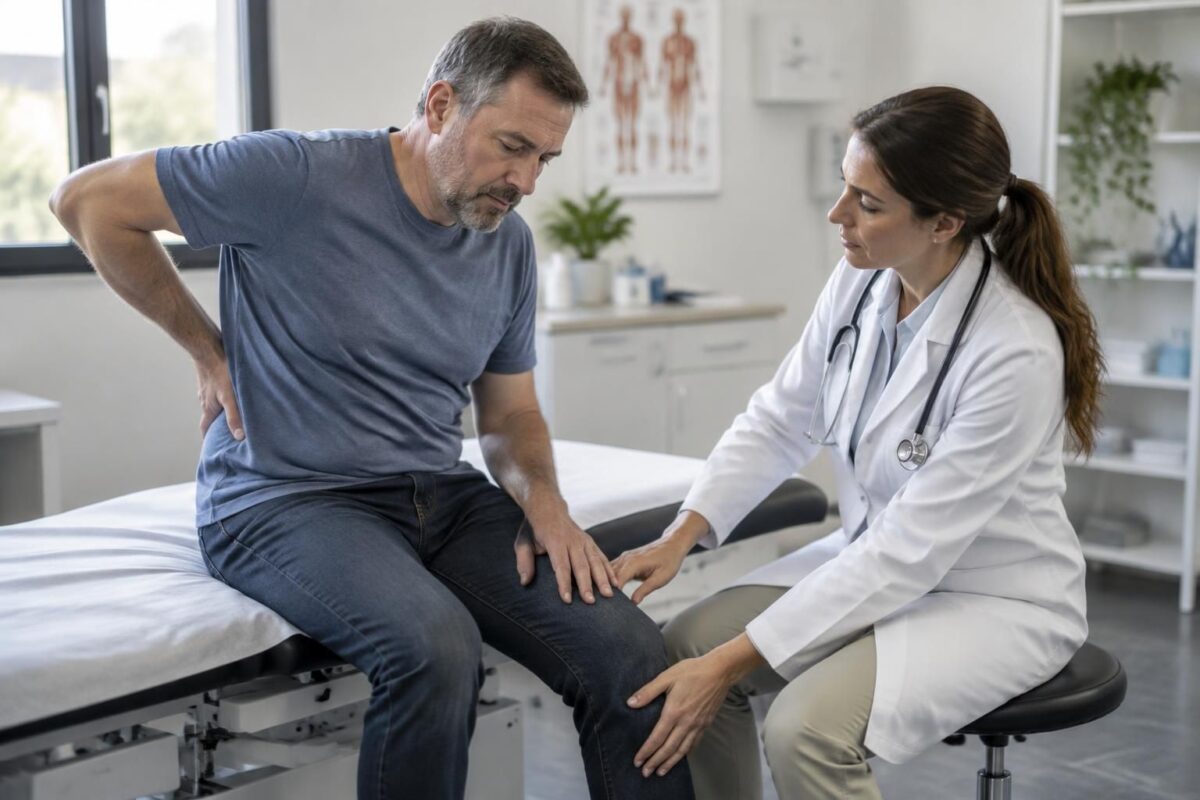
Herniated disc and sciatica: when to reassess symptoms
IN BRIEF A herniated disc can irritate a nerve root and cause sciatica, with pain that radiates down the leg. Reevaluating symptoms helps to track their evolution and determine if medical advice or tests are necessary, without assuming that surgery…

Dr Sylvain Desforges, B.Sc., D.O., N.D., osteopath, is the founding president of TAGMED and of the ACMA association. He dedicates his practice to chronic spinal pain, low back pain and symptoms compatible with sciatica, particularly when pain radiates toward the buttock, leg, calf, foot or toes.
Through SOS Sciatique, he publishes educational content on sciatica symptoms, possible causes such as disc herniation, disc narrowing, foraminal stenosis or irritation of a lumbar nerve root, as well as non-surgical approaches that may be considered according to the evaluation. At Clinique TAGMED, care may include, depending on the case, motorized neurovertebral decompression, specific osteopathic care or precision percussion.
For an evaluation related to sciatica treatment in Montreal / Mount Royal or sciatica treatment in Terrebonne, please consult the services available at Clinique TAGMED.
Medical disclaimer
The information published on SOS Sciatique is provided for educational purposes only and does not replace a consultation, diagnosis, opinion or treatment provided by a physician or another authorized healthcare professional. The author of this article is neither a medical doctor nor a specialist in a medical specialty recognized by the Collège des médecins du Québec. The osteopathic, manual medicine or functional support approaches described on this site do not constitute medical acts and are not intended to replace medical follow-up.
Consult a physician or emergency service in cases of loss of bladder or bowel control, anesthesia in the saddle area, significant or progressive weakness in the leg or foot, fever, recent trauma, severe pain or rapid worsening of symptoms. For more details, please read our Legal Notice.