Sciatica in Terrebonne: difference between L4-L5 and L5-S1
09/10/2026
Disc herniation and pain behind the thigh
09/10/2026
IN BRIEF Sciatica after driving is pain that can radiate from the lower back down into the leg and can worsen after a journey. Prolonged sitting, vibrations, and an improperly adjusted seat can contribute to discomfort. Adjusting your seat, maintaining back support, and taking breaks to walk can help make travel more comfortable. Consult a healthcare professional if the pain persists, worsens, or is accompanied by weakness. |
Prolonged sitting, road vibrations, and an improperly adjusted seat can exacerbate pain related to sciatica after driving. Adjust the seat to support the lower back, keep your legs slightly bent, and take a break to walk every one to two hours during a long trip. If the pain limits your use of the pedals, or is accompanied by significant weakness or numbness, seek medical advice promptly and avoid driving if your safety is compromised.
Sciatic-type pain can appear or intensify after a car ride. Prolonged sitting, an improperly adjusted seat, and vibrations can contribute to discomfort in the lower back, buttock, or leg. Adjusting your position, taking breaks, and monitoring symptoms can help make travel more bearable, but cannot replace an evaluation by a healthcare professional.
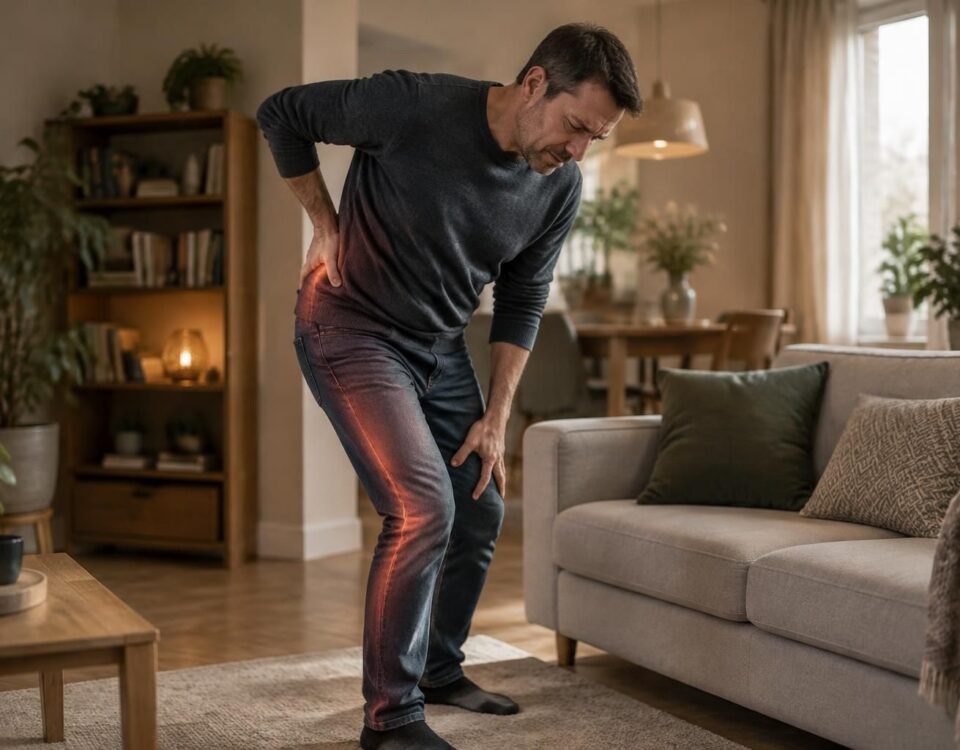
Sciatica refers to pain that follows the path of the sciatic nerve, usually from the lower back to the buttock and leg. It can be accompanied by burning sensations, tingling, or numbness. Pain felt after driving can also originate from other structures in the back or leg. Only a healthcare professional can determine the cause.
Irritation of a lumbar nerve root, sometimes associated with a herniated disc or another spinal issue, may contribute to the symptoms. However, driving does not prove that a disc is affected. To learn more, check our article on pain that travels down after movement in the case of a herniated disc.
Why might the pain increase after a trip?
In a seated position, the pelvis and lower back often remain still for an extended period. The backrest, seat height, and distance from the steering wheel influence posture. Road vibrations and jolts can also make the position less comfortable.
Pain may start during the journey or manifest upon exiting the car. Some people feel lower back stiffness, pain in the buttock, or symptoms radiating down into the thigh, calf, or foot. The duration of the trip and intensity of the symptoms vary from person to person.
An overly reclined backrest may alter pelvis position and increase discomfort in some individuals. You can read our page on the effects of an excessively inclined car backrest.
What symptoms may appear after driving?
Possible symptoms include pain in the lower back or buttock, shooting pain in the leg, tingling, and a sensation of numbness. Pain that radiates down the leg does not confirm sciatica on its own.
Tingling that occurs while sitting can have multiple causes. Visit our page on tingling while sitting to better understand potential causes. If the sensations affect the foot, other causes apart from sciatica may also be involved: see our article on tingling in the foot, sciatica, and neuropathy.
Numbness in the foot while driving warrants particular attention, especially if it occurs frequently or is accompanied by a loss of strength. You can find additional information on numbness in the foot while driving.

Sciatica and pain that descends slowly
IN BRIEF Sciatica is a pain that often starts in the lower back or buttock and gradually descends into the leg, sometimes reaching the foot, when a nerve root is irritated. It may be accompanied by tingling or numbness and…
How to adjust your position while driving?
Before starting, take the time to adjust the seat and steering wheel. Position the pelvis at the back of the seat and keep the back supported against the backrest. Adjust the distance to reach the pedals without fully extending your legs and to hold the steering wheel without leaning forward.
Avoid slumping in a seat that is too soft. If the seat does not comfortably support the lower back, appropriate support can help some people maintain a more stable position. A cushion is not a one-size-fits-all solution: it should enhance your comfort without hindering access to the pedals or compromising driving safety.
Vibrations and driving position can influence comfort, but they do not explain all pain after a trip. For other advice on these topics, you can read the pages of SOS Sciatique dedicated to sciatica and driving.

Disabling sciatica: what to do when the leg limits activities?
IN BRIEF A debilitating sciatica causes pain that travels down the leg and can limit walking, sleeping, or daily activities. If your leg is holding you back, have the cause evaluated and adjust your activities without straining: non-surgical approaches may…
When to take a break and when to avoid driving?
During a long trip, plan for regular breaks, often every one to two hours. Get out of the vehicle and walk for a few minutes if this does not worsen the symptoms. For daily trips, avoid remaining still for long periods after arriving whenever possible.
Do not drive if pain prevents you from moving quickly or if you have difficulty using the pedals. Some pain or muscle spasm medications may reduce alertness. Check the medication instructions and consult a doctor or pharmacist if in doubt.
A medical evaluation is indicated if the pain persists, worsens, or is accompanied by sensory disturbances or weakness. A consultation can help examine symptoms and determine next steps. To learn more about evaluation services related to sciatica, check out the TAGMED Clinic.

Moderate sciatica: when to consult?
IN BRIEF A moderate sciatica is pain that starts from the lower back and radiates down into the buttock or leg, sometimes accompanied by tingling. If it limits your activities, persists, or worsens, consult a healthcare professional to assess the…
What signs require urgent medical help?
Consult a doctor or emergency service promptly in case of loss of bladder or bowel control, numbness in the saddle region, significant or progressive weakness in the leg or foot, fever, recent trauma, or severe pain that worsens rapidly.
A loss of strength that affects the use of the pedals can make driving dangerous. Pull over to a safe place and seek help. Do not attempt to continue the journey if you cannot safely control the vehicle.

Mild sciatica: should we still keep an eye on it?
IN BRIEF A mild sciatica causes moderate pain that can radiate from the lower back to the buttock and leg. While it often improves over time, monitor its progress, avoid prolonged rest, and maintain gentle activity according to your tolerance.…
About the author
Sylvain Desforges, B.Sc., D.O., N.D., Doctor of Osteopathy is the founding president of TAGMED and the ACMA association. His practice focuses on chronic pain of the spine, lower back pain, and pain compatible with sciatica, especially when the pain radiates down to the buttock or leg.
Through SOS Sciatique, he publishes educational content on sciatica symptoms, their possible causes, and non-surgical approaches that can be considered after an evaluation. At TAGMED Clinic, care may include, depending on the case, motorized neurovertebral decompression, specific osteopathy, or a precision impactor.
For an assessment related to sciatica treatment in Montreal or Mont-Royal, or sciatica treatment in Terrebonne, consult the services available at TAGMED Clinic.

Severe sciatica: what signs warrant an evaluation?
IN BRIEF A severe sciatica is pain that radiates from the lower back or buttock down the leg and may be accompanied by nerve signs. A significant or progressive weakness, difficulties urinating or controlling bowel movements, or numbness in the…
Medical Disclaimer
The information published on SOS Sciatique is provided for educational purposes. It does not replace a consultation, diagnosis, advice, or treatment performed by a physician or another licensed healthcare professional. The author of this article is neither a physician nor a specialist in a medical specialty recognized by the Collège des médecins du Québec. The osteopathy, manual medicine, or functional support approaches described on this site do not constitute medical acts and do not replace medical follow-up. Consult a doctor or an emergency service in case of loss of bowel or bladder control, anesthesia in the saddle area, significant or progressive weakness of the leg or foot, fever, recent trauma, severe pain, or rapid deterioration. For more details, please read our Legal Notice.
Medical disclaimer: The information and advice provided on this site do not replace the opinion, diagnosis, or treatment of a healthcare professional. Please note that Sylvain Desforges, Osteopath, is neither a medical doctor nor a physician, and is not a specialist in a medical specialty as defined by the Collège des médecins du Québec. Manual medicine, functional medicine, and sports medicine as described on this site exclude any treatment or medical diagnosis done by a physician or medical specialist. Always consult your doctor for any medical questions. For more details, please read our complete Legal Notice.
During the Trip
- Adjust the seat to keep the back supported and the knees slightly bent.
- Avoid sitting still for too long: take a break every one to two hours.
- An ergonomic cushion can help reduce pressure on the pelvis and coccyx.
If Pain Occurs
- Pull over to a safe place and walk for a few minutes.
- Do not drive if the pain affects your pedal control or if a treatment reduces your alertness.
- Seek immediate consultation in case of significant weakness, urinary issues, or loss of sensation in the groin area.

A sciatica can cause or worsen pain after driving, especially when sitting for a prolonged period and the seat does not adequately support the lower back. To make trips more tolerable, adjust your seating, take regular breaks, and avoid driving if the pain or a treatment compromises your ability to use the pedals safely.

Recurrent sciatica: symptoms that often come back
IN BRIEF Recurrent sciatica refers to the return of pain that starts from the lower back or buttock and radiates down one leg, sometimes all the way to the foot. Tingling or numbness may also reappear. A herniated disc or…
Why Can Pain Appear After a Trip?
Sciatica refers to pain that follows the path of the nerve, from the lower back to the buttock and sometimes to the leg or foot. Possible causes include a herniated disc or other lumbar disorders. Sitting for long periods can increase discomfort in some people, while road vibrations and repetitive leg movements can contribute to stiffness or irritation of symptoms.
Pain can manifest during the trip or when getting out of the car: a shooting pain in the buttock, a burning sensation, tingling, or numbness. These symptoms vary from person to person. Their appearance after driving does not, on its own, help identify their cause.

Chronic sciatica: symptoms to watch for
IN BRIEF Chronic sciatica is a persistent pain that starts from the lower back or buttock and radiates down the leg, sometimes to the foot. Burning, tingling, numbness, or weakness may also occur. Identifying these symptoms helps obtain an evaluation…
How to Better Position Yourself While Driving?
Adjusting the Seat and Distance to the Pedals
Before starting, take a few minutes to adjust the seat. Keep your back supported against the backrest and have a slight bend in your knees when you operate the pedals. Move the seat closer if you have to stretch your legs or lean toward the steering wheel. Avoid a slouched position or a sharply inclined backrest, which can make it more difficult to maintain trunk support.
Try Suitable Support
If the seat lacks support, an ergonomic cushion or lumbar support can help find a more comfortable posture. Choose a stable model that does not place you too high and does not obstruct access to the pedals. Some seat cushions have a cutout designed to reduce pressure on the coccyx; however, they may not be suitable for everyone. Test cautiously and stop using it if it increases pain.

Subacute sciatica: persistent symptoms
IN SHORT Subacute sciatica refers to pain that follows the path of the sciatic nerve and persists for several weeks, often between 4 and 12 weeks. It may be accompanied by tingling, numbness, or pain in the buttock and leg.…
What to Do During and After the Trip?
Plan for Breaks
On a long trip, stop regularly, ideally every one to two hours, or sooner if symptoms arise. When stopped, walk for a few minutes and gently move your legs. Do not perform exercises that require you to divert your attention while the vehicle is moving.
Assess Your Ability to Drive
Do not drive if pain limits your movement, if you have difficulty controlling a pedal, or if you feel weakness in your leg. Some pain medications can cause drowsiness or slow reflexes: check the treatment instructions and consult a healthcare professional. After the trip, change positions gently and prefer light walking if comfortable.
When to seek medical advice?
Consult a healthcare professional if the pain persists, worsens, or is accompanied by numbness or weakness. Loss of bowel or bladder control, numbness in the saddle area, or significant and progressive weakness require urgent evaluation. If in doubt about your ability to drive, seek medical advice before getting back on the road.
About the author
Sylvain Desforges, B.Sc., D.O., N.D., Doctor of Osteopathy, is the founding president of TAGMED and the ACMA association. His practice focuses particularly on chronic spinal pain and pain compatible with sciatica.
Medical warning
This information is provided for educational purposes and does not replace a consultation, diagnosis, or treatment by a licensed healthcare professional. The author is neither a doctor nor a specialist in a medical specialty recognized by the Collège des médecins du Québec. Osteopathy and manual medicine approaches do not replace medical follow-up.
| Situation after driving | Helpful hint |
|---|---|
| Lower back pain or pain in the buttock | Prolonged sitting can worsen discomfort. |
| Pain radiating down the leg | It may follow the path of the sciatic nerve. |
| Tingling or numbness | Take a break and monitor the progression of symptoms. |
| Stiffness after the trip | Walk for a few minutes and gently change positions. |
| Pain during the trip | Adjust the seat and plan for breaks every one to two hours. |
| Weakness or difficulty using the pedals | Do not drive and seek medical advice promptly. |
| Urinary issues or significant loss of sensitivity | Consult an emergency service immediately. |
Testimonials about sciatica and pain after a car ride
Note: The accounts below are fictional examples, written for information purposes. They do not correspond to verified patient testimonials and do not predict the progression of sciatica.
“The pain appeared after about thirty minutes”
“I felt pain in my lower back that radiated into my buttock and thigh after some time driving. When getting out of the car, I needed to walk for a few minutes before feeling less stiff. I adjusted the seat and now plan for breaks on long trips.”
“Traffic made the drive more difficult”
“Frequent stops and staying seated without moving heightened my burning sensations in the leg. I try to keep my back against the seatback and avoid driving when my pain prevents me from moving comfortably.”
“The vibrations from the road increased my discomfort”
“On uneven roads, I felt more jolts in my lower back. A better seat adjustment made my posture more stable, but it didn’t eliminate the pain. I discussed it with a healthcare professional to better understand my symptoms.”
“I had to adjust my long trips”
“During my longer journeys, the pain ended up radiating toward my calf. I now plan regular stops to walk gently and change positions. If the symptoms increase, I prefer to stop the journey rather than push through.”
Key point: Pain that occurs after driving may be influenced by the duration in a seated position, the seat adjustment, and vibrations. A suitable cushion may improve comfort for some people, but it does not treat the cause of sciatica. Take a break as soon as possible if you have difficulty using the pedals or driving safely.
Seek prompt medical advice if the pain worsens, is accompanied by significant or progressive weakness in the leg, or disrupts your activities. Loss of bowel or bladder control or numbness in the saddle area warrants urgent evaluation.
Sciatica and pain after driving: understanding and better managing discomfort
Sciatica refers to pain that follows the path of the sciatic nerve, from the lower back or buttock down into the thigh, calf, and sometimes the foot. It may be accompanied by tingling, numbness, or a sensation of electrical shock. Several causes are possible, including irritation of a lumbar nerve root, a herniated disc, foraminal stenosis, or other spinal issues. Only a healthcare professional can evaluate symptoms and determine the cause.
After a car ride, pain may become more noticeable or intense. Prolonged sitting alters the stresses on the lower back and pelvis. Immobility may also contribute to stiffness, while vibrations and repeated jolts from the road can sometimes add to discomfort. An improperly adjusted seat that is too soft or tilted can encourage a slouched posture and increase tension in the lumbar region.
Adjusting your position while driving
Before starting, take the time to adjust the seat. The backrest should support your back without forcing you to lean forward. Position the seat close enough to the steering wheel to keep your arms relaxed and your knees slightly bent while using the pedals. If the lower back lacks support, a lumbar support may help some individuals maintain a more comfortable position. An appropriately designed seat cushion may also be considered if it improves pelvic stability or reduces pressure felt in a seated position.
However, these accessories do not treat the cause of sciatica, and their effectiveness varies from person to person. The best choice depends on the shape of the seat, the duration of travel, and the symptoms. Prioritize stable support that does not place you too high or too close to the steering wheel. If a position significantly increases pain or causes numbness, adjust it and seek advice from a healthcare professional.
Reducing discomfort during travel
During a long trip, plan for regular breaks, ideally after one to two hours, or sooner if symptoms appear. When stopped, walk for a few minutes and gently move your legs. Avoid stretching or performing movements that trigger or worsen the pain. While driving, keep your back supported and avoid leaning forward. Slow breathing and relaxed shoulders can also help limit tensions associated with driving.
Driving is not always safe when pain is significant. Weakness in the leg, difficulty controlling the pedals, reduced sensitivity, or medication that decreases alertness can compromise driving. In these situations, avoid getting behind the wheel and seek medical advice. Consult quickly in case of significant or progressive weakness, urinary or bowel issues, or numbness in the saddle area.
The journey of Sylvain Desforges
Sylvain Desforges, B.Sc., D.O., N.D., is an osteopath and founding president of TAGMED and the ACMA association. He dedicates his practice to supporting individuals living with chronic spinal pain, lower back pain, and symptoms consistent with sciatica. His approach focuses on functional limitations and factors that may influence daily comfort, including during travel.
At TAGMED Clinic, support options may include, depending on the assessment and situation of the person, specific osteopathy, motorized neurovertebral decompression, or precision percussion. These approaches do not replace a medical diagnosis or the care recommended by a doctor. The information presented here is educational and does not constitute personalized advice. In case of persistent pain, worsening, or neurological symptoms, seek the advice of a licensed healthcare professional.
After prolonged driving, sciatica may manifest as pain in the lower back or buttock, which sometimes radiates down the thigh, calf, or foot. Sitting position, vibrations, and an ill-adjusted seat can contribute to increased discomfort. Breaks, proper adjustment of the driving position, and a gradual return to movement can help make journeys more bearable, without replacing an assessment when symptoms persist.
After the trip: actions to remember
Once stopped, exit the vehicle carefully and take a few minutes to walk at your own pace. If it remains comfortable, you can gently move your legs and feet. Avoid imposing sudden or painful stretches: movements should remain tolerable and can be adjusted according to your symptoms. To limit recurrences, also consider interrupting long periods of sitting outside of trips.
Before your next trip, check your setup: keep your back against the seatback, bring the seat close enough to the steering wheel so that your legs are not extended, and maintain slightly flexed knees. A cushion may improve comfort for some people, but it is not necessarily suitable for everyone. The seat tilt and pelvic position can also matter; you can learn more in this article on sciatica and the tilt of the car seat.
For a long trip, plan regular breaks, ideally before the pain becomes difficult to manage. If you are driving, only do the exercises or movements once the vehicle is safely parked. Also avoid driving if the pain prevents you from properly using the pedals, if your mobility is significantly reduced, or if medication decreases your alertness. Additional advice on driving and back care is offered by Medinfo Lyon and Groupe Santé pour Tous.
Pain radiating down the leg can have various causes, including irritation of a nerve root. A herniated disc is one possibility, but it cannot be confirmed based on symptoms alone. To better understand possible causes and evaluation options, consult the information on sciatica associated with a hernia, stenosis, or nerve irritation and on persistent pain related to a herniated disc and sciatica.
Seek medical advice if the pain persists, intensifies, recurs frequently, or is accompanied by numbness or weakness. New or progressive weakness of the foot deserves particular attention; guidelines are presented in this article on herniated disc accompanied by foot weakness. In case of loss of urinary or bowel control, numbness in the saddle region, or significant and sudden weakness, contact emergency services without delay.
You can also consult the advice dedicated to driving and the possible aggravation of sciatica pain, as well as that of Ergotech on driving with sciatica. For an evaluation, the services available at the TAGMED Clinic in Terrebonne can be consulted.
Medical warning: this information is provided for educational purposes and does not replace a consultation, diagnosis, or treatment by a licensed healthcare professional. The author is neither a doctor nor a specialist in a medical specialty recognized by the Collège des médecins du Québec. Osteopathy, manual medicine, or functional support approaches do not replace medical follow-up.
About the author
Sylvain Desforges, B.Sc., D.O., N.D., Doctor of Osteopathy, is the founding president of TAGMED and the ACMA association. His practice focuses on chronic spinal pain, lower back pain, and pain consistent with sciatica.

Sylvain Desforges, B.Sc., D.O., N.D., docteur en ostéopathie
Dr Sylvain Desforges, B.Sc., D.O., N.D., osteopath, is the founding president of TAGMED and of the ACMA association. He dedicates his practice to chronic spinal pain, low back pain and symptoms compatible with sciatica, particularly when pain radiates toward the buttock, leg, calf, foot or toes.
Through SOS Sciatique, he publishes educational content on sciatica symptoms, possible causes such as disc herniation, disc narrowing, foraminal stenosis or irritation of a lumbar nerve root, as well as non-surgical approaches that may be considered according to the evaluation. At Clinique TAGMED, care may include, depending on the case, motorized neurovertebral decompression, specific osteopathic care or precision percussion.
For an evaluation related to sciatica treatment in Montreal / Mount Royal or sciatica treatment in Terrebonne, please consult the services available at Clinique TAGMED.
Medical disclaimer
The information published on SOS Sciatique is provided for educational purposes only and does not replace a consultation, diagnosis, opinion or treatment provided by a physician or another authorized healthcare professional. The author of this article is neither a medical doctor nor a specialist in a medical specialty recognized by the Collège des médecins du Québec. The osteopathic, manual medicine or functional support approaches described on this site do not constitute medical acts and are not intended to replace medical follow-up.
Consult a physician or emergency service in cases of loss of bladder or bowel control, anesthesia in the saddle area, significant or progressive weakness in the leg or foot, fever, recent trauma, severe pain or rapid worsening of symptoms. For more details, please read our Legal Notice.