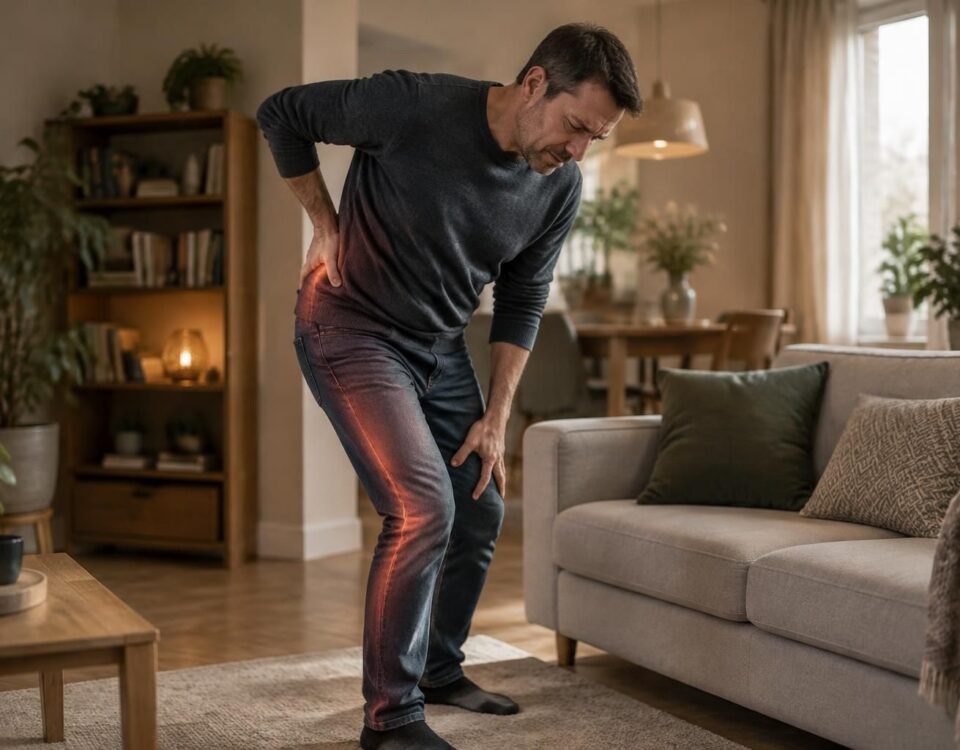
Sciatica L5 in Terrebonne: pain towards the big toe
07/10/2026
L5-S1 protrusion and sciatic pain: pathway to the foot
07/10/2026
IN BRIEF
| Sciatica is pain related to irritation of a nerve root, which can radiate from the lower back to the buttock and leg. Prolonged and immobile standing can promote or worsen symptoms, although it is not always the cause. Alternating postures, moving regularly, and adapting the workplace help reduce strain. In cases of progressive weakness, loss of sensitivity, or urinary or intestinal issues, consult a healthcare professional promptly. |
Sciatica and Pain After Prolonged Standing
Standing still for long periods can tire the lower back and legs and contribute to the onset or worsening of sciatica in some people. The pain can start from the back or buttock and travel down to the thigh, calf, or foot, sometimes accompanied by tingling or a burning sensation. Its causes are multiple: posture, repetitive movements, stress, and lack of sleep can also play a role.
To reduce strain, adapt the workstation, alternate positions, and take regular short steps or ankle movements. Persistent pain, loss of sensitivity, or weakness warrant a medical consultation. Urinary or intestinal issues, or significant or progressive weakness in the leg, require urgent evaluation.
Pain that appears after several hours of standing can affect the lower back, buttock, or leg. It may sometimes mimic sciatica, but pain in the leg is not always caused by irritation of the sciatic nerve. Posture, lack of movement, and circulatory disorders can also contribute to the symptoms. Here’s how to recognize possible signs, know when to seek medical advice, and reduce the strain associated with standing work. Prolonged standing can fatigue the back and leg muscles. It can also exacerbate pre-existing pain. The risk increases when a person remains immobile, keeps the trunk bent, or works in an uncomfortable posture for prolonged periods. Standing does not necessarily cause sciatica. However, this posture can reveal or worsen symptoms related to lumbar nerve irritation, muscle pain, or another cause. To understand the factors related to standing work, check out this article on sciatica and standing work. The term sciatica refers to pain associated with irritation of one or more nerve roots in the lower back, often those contributing to the sciatic nerve. The painful pathway can start from the lumbar region and pass through the buttock before descending into the thigh, calf, or foot. Some people experience pain only in part of this pathway. The pain may be accompanied by tingling, numbness, burning sensations, or electric shocks. These signs do not alone determine the cause or severity of the problem. To better understand the possible forms of this pain, check the page on sciatic pain. The affected area may provide clues about the irritated nerve roots, but it does not confirm a diagnosis. Pain that descends toward the heel or foot may particularly be addressed in this article on L5-S1 sciatica and pain towards the heel or foot. Pain directed toward the big toe is presented in the page on L5 sciatica and pain toward the big toe. The body generally tolerates postures that can be varied better. When a person stands still, certain muscles work continuously to maintain balance. Fatigue can set in the lower back, hips, or legs. Leaning forward, frequently turning, or shifting all weight onto one leg can add strain. The relationship between posture and pain depends on each individual. The same posture may hinder one worker and be well-tolerated by another. For suggestions on workstation setup and the lower back, consult this guide on standing work and back pain. A sensation of heaviness, swelling, or burning in the legs after a long period of standing may also be related to venous return, shoes, the floor, or muscle fatigue. These symptoms may sometimes differ from nerve pain originating in the back or buttock that follows a path in the leg. An article on leg pain while standing presents other possible factors. You can also consult this resource on leg pain after standing. These links provide general information and do not replace a medical evaluation if symptoms persist or worsen. Pain may depend on several elements: the condition of the back, repetitive movements, loads carried, health history, sleep, and stress. A herniated disc may sometimes irritate a nerve root, but its presence on imaging does not always mean it causes symptoms. Pain after exertion may also have several explanations. To learn more, check out resources on sciatica after weightlifting and sciatica after gardening. A well-adjusted workstation can limit uncomfortable positions. The height of the work surface should allow for a relaxed posture without the need to bend or extend the arms repeatedly. Proper shoes and a less hard floor can also improve comfort. An anti-fatigue mat may be considered depending on the tasks and safety regulations of the workplace. Setup should consider the actual position, tasks, loads handled, and the needs of the individuals. A professional assessment can help identify repetitive constraints throughout the day. Alternating between standing, walking, or sitting, when work permits, can reduce time spent in a static posture. Changes in tasks and short active breaks can also help limit fatigue. The goal is not to maintain a perfect posture but to avoid staying in the same position for too long. Needs vary depending on symptoms and the type of job. A temporary adjustment of the workstation may be useful during a painful period. If the pain increases or descends further in the leg, consult a healthcare professional rather than continuing an activity that clearly aggravates the symptoms. Consult a doctor if the pain persists, frequently returns, or is accompanied by a loss of sensation or strength. Difficulty walking or progressive weakness also requires prompt evaluation. Do not wait to consult an emergency service in case of loss of control of the bladder or bowels, or numbness in the saddle region. A leg that suddenly becomes very swollen, red, or warm also requires quick medical advice. These signs do not conclude to sciatica and may signal another health issue. The choice of support depends on the evaluation, symptoms, and results of a medical examination when necessary. At TAGMED Clinic, services may include assessment and non-surgical approaches, depending on the situation. Check the information on sciatica associated with standing, as well as the services of TAGMED Clinic in Montreal and Terrebonne. The motorized neurovertebral decompression may be considered in some cases after appropriate evaluation. It is not suitable for everyone and does not replace a diagnosis or medical follow-up. The professional must explain the options, their limits, and the signs that require medical consultation. About the author Sylvain Desforges, B.Sc., D.O., N.D., Doctor of Osteopathy, is the founding president of TAGMED and the ACMA association. He dedicates his practice to chronic pain of the spine, low back pain, and pain consistent with sciatica, especially when pain radiates down to the buttock, leg, calf, foot, or toes. Through SOS Sciatique, he publishes educational content on the symptoms of sciatica, possible causes such as disc herniation, disc pinching, foraminal stenosis, or irritation of a lumbar nerve root, as well as non-surgical approaches that may be considered depending on the evaluation. At TAGMED Clinic, care may include, depending on the case, motorized neurovertebral decompression, specific osteopathy, or precision percussion therapy. For an evaluation related to sciatica treatment in Montreal / Mont-Royal or sciatica treatment in Terrebonne, check the services available at TAGMED Clinic. Medical Disclaimer: The information and advice provided on this site do not replace the opinion, diagnosis, or treatment of a health professional. Please note that Sylvain Desforges, B.Sc., D.O., N.D., Doctor of Osteopathy, is neither a medical doctor nor a physician and is not a specialist in a medical specialty as defined by the Collège des médecins du Québec. Manual medicine, functional medicine, and sports medicine as described on this site exclude any medical treatment or diagnosis made by a doctor or specialist. Always consult your doctor for any medical questions. For more details, please read our Complete Legal Notice. Medical Warning The information published on SOS Sciatique is provided for educational purposes and does not replace a consultation, diagnosis, advice, or treatment performed by a physician or other licensed health professional. The author of this article is neither a doctor nor a specialist in a medical specialty recognized by the Collège des médecins du Québec. The approaches of osteopathy, manual medicine, or functional support described on this site do not constitute medical acts and are not intended to replace medical follow-up. Consult a doctor or emergency service in case of loss of urinary or bowel control, numbness in the saddle area, significant or progressive weakness of the leg or foot, fever, recent trauma, severe pain, or rapid deterioration. For more details, please read our Legal Notice.What is Sciatica?
Why Does Pain Increase After Standing?
An Immobile Posture Can Fatigue the Back
Pain in the Legs Is Not Always Sciatica
Multiple Factors Can Combine
How to Reduce Strain Related to Standing Work
Adjust the Workstation
Vary Positions and Tasks
When to Consult?
What assessment and support options should be considered?
Sciatica
- Pain radiating from the lower back or buttock down the leg.
- Sometimes accompanied by tingling, burning, or electrical shocks.
- Alternate positions and remain active according to tolerance.
- Consult promptly if pain persists or is accompanied by a loss of strength or sensation.
Pain after prolonged standing
- Heavy, tired, or swollen legs after being still.
- Static posture can also promote tension in the lower back.
- Walk for a few minutes, move the ankles, and vary weight distribution regularly.
- Adapt shoes and the workstation to limit strain.
Emergency: difficulty urinating, loss of urinary or bowel control, numbness in the saddle area, or significant weakness of the leg require immediate medical evaluation.

Prolonged standing can promote low back pain and contribute to the appearance or maintenance of symptoms consistent with sciatica, especially when accompanied by immobility, repetitive movements, or carrying loads. To reduce strain at work, it is useful to adjust the workstation, vary positions, and encourage movement breaks. However, pain radiating into the buttock or leg should be evaluated based on the symptoms of each individual.

Sciatica and pain that descends slowly
IN BRIEF Sciatica is a pain that often starts in the lower back or buttock and gradually descends into the leg, sometimes reaching the foot, when a nerve root is irritated. It may be accompanied by tingling or numbness and…

Disabling sciatica: what to do when the leg limits activities?
IN BRIEF A debilitating sciatica causes pain that travels down the leg and can limit walking, sleeping, or daily activities. If your leg is holding you back, have the cause evaluated and adjust your activities without straining: non-surgical approaches may…
Understanding the link between standing and sciatica
A static posture that can fatigue the back
Standing for long periods without the ability to move is a postural constraint. Maintaining the same position can fatigue the muscles of the back and legs, especially if the person works hunched over, frequently turns, or leans on one leg. These constraints can aggravate low back pain and, in some individuals, be associated with pain radiating to the buttock, thigh, calf, or foot.
Pain in the leg does not always indicate compression of the sciatic nerve. Possible causes are varied and may include nerve irritation, disc problems, muscle tension, or other factors. Stress, lack of sleep, health history, and work organization can also influence the experience of pain.

Moderate sciatica: when to consult?
IN BRIEF A moderate sciatica is pain that starts from the lower back and radiates down into the buttock or leg, sometimes accompanied by tingling. If it limits your activities, persists, or worsens, consult a healthcare professional to assess the…

Mild sciatica: should we still keep an eye on it?
IN BRIEF A mild sciatica causes moderate pain that can radiate from the lower back to the buttock and leg. While it often improves over time, monitor its progress, avoid prolonged rest, and maintain gentle activity according to your tolerance.…
Three recommendations to reduce risks
1. Arrange the workstation
Check that the height of the work surface prevents leaning or stretching the arms repeatedly. When the context allows, an anti-fatigue mat, comfortable shoes, and enough space to change support can enhance comfort. It’s also important to examine the tasks associated with the position: handling, repetitive movements, vibrations, and frequent bending of the back. An ergonomic assessment can help tailor solutions to the actual needs of the team.
2. Allow for position variation
Alternating standing periods with walking or sitting helps avoid prolonged immobility. Offer, when possible, a seat suitable for the position, task rotations, and short active breaks. Even a few steps, changes in support, or gentle ankle movements can help reduce fatigue. The goal is not to impose an ideal posture, but to offer several options and avoid staying still for too long.
3. Raise awareness of signs and good reflexes
Encourage employees to report persistent pain early and to identify tasks that aggravate it. Regular physical activity, quality sleep, and stress management can support overall well-being, without replacing a professional assessment. In case of symptoms, maintaining appropriate activity is often preferable to complete inactivity, but exercises should respect the individual’s capacities and the advice of a healthcare professional.

Severe sciatica: what signs warrant an evaluation?
IN BRIEF A severe sciatica is pain that radiates from the lower back or buttock down the leg and may be accompanied by nerve signs. A significant or progressive weakness, difficulties urinating or controlling bowel movements, or numbness in the…

Recurrent sciatica: symptoms that often come back
IN BRIEF Recurrent sciatica refers to the return of pain that starts from the lower back or buttock and radiates down one leg, sometimes all the way to the foot. Tingling or numbness may also reappear. A herniated disc or…
When to request a medical evaluation?
A persistent pain, loss of sensitivity, or weakness in the leg justifies a medical consultation. Significant or progressive difficulty in walking also requires prompt evaluation. Consult emergency services immediately in case of loss of bladder or bowel control, or numbness in the saddle area. These general recommendations do not replace a diagnosis or appropriate follow-up.
About the author
Sylvain Desforges, B.Sc., D.O., N.D., Doctor of Osteopathy, is the founding president of TAGMED and the ACMA association. His practice focuses notably on chronic spinal pain, lower back pain, and symptoms compatible with sciatica.
Medical disclaimer
This information is provided for educational purposes and does not replace a consultation, diagnosis, or treatment by a licensed healthcare professional. The author is neither a physician nor a specialist in a medical specialty recognized by the Collège des médecins du Québec. Osteopathy and manual medicine approaches do not replace medical follow-up.
| Sciatica | Pain after prolonged standing |
|---|---|
| Frequent area | Lower back, buttock, and sometimes leg or foot. |
| Possible sensation | Shocks, burning, tingling, or numbness. |
| Link with posture | Can vary according to movements and positions. |
| After a long period standing | Heavy, tired, or swollen legs, often relieved by movement. |
| Role of movement | Staying still can promote discomfort; walking activates the calf muscles. |
| To monitor | Progressive weakness, loss of sensitivity, or urinary issues: urgent medical advice. |
Chronic sciatica: symptoms to watch for
IN BRIEF Chronic sciatica is a persistent pain that starts from the lower back or buttock and radiates down the leg, sometimes to the foot. Burning, tingling, numbness, or weakness may also occur. Identifying these symptoms helps obtain an evaluation…

Subacute sciatica: persistent symptoms
IN SHORT Subacute sciatica refers to pain that follows the path of the sciatic nerve and persists for several weeks, often between 4 and 12 weeks. It may be accompanied by tingling, numbness, or pain in the buttock and leg.…
Illustrative testimonials: sciatica and pain after prolonged standing
Note: the testimonials below are fictional examples designed for informational purposes. They do not correspond to identifiable patients and do not allow for a diagnosis. Pain that radiates down the leg can have different causes.
“After several hours at the counter, the pain radiated down to my calf”
I work standing up, and after very busy days, I would feel pain in my lower back that spread to my buttock and sometimes down to my calf. I noticed that staying still seemed more difficult than being able to walk for a few minutes. I spoke to a healthcare professional to evaluate my symptoms.
“I thought it was just fatigue”
At the end of my shift, I often had tension in one leg and tingling in my foot. Initially, I thought it was just my shoes. As the sensations kept returning regularly, I sought advice rather than assuming it was necessarily sciatica.
“The days without posture changes were the hardest”
My job required me to stand almost in the same spot for long periods. Lower back discomfort developed, sometimes radiating to the buttock. We then discussed ways to vary tasks, walk briefly, and make the position more comfortable.
“I learned not to ignore pain that spreads”
After a day standing, the pain was no longer limited to my back: it radiated down my thigh and was sometimes accompanied by tingling. I made an appointment to understand what might be causing these symptoms and to determine which activities to maintain or adapt.
“Short movement breaks helped me not to stay too still”
I thought I just had to hold on until the end of my shift. With my team, we started integrating posture changes and short movements when work allowed it. This does not replace an assessment if the pain persists, but this organization made long periods of standing less static.
To remember: lower back pain or leg pain after prolonged standing does not necessarily mean it is sciatica. If the pain persists, is accompanied by loss of sensitivity or strength, or worsens, consult a healthcare professional. Loss of bladder or bowel control, numbness in the saddle area, or significant or progressive weakness requires urgent evaluation.
Sciatica and pain after prolonged standing
Standing for long periods can lead to pain in the lower back, buttocks, or legs. In some individuals, these symptoms suggest sciatica, but any pain felt in a leg is not necessarily related to the sciatic nerve. Posture, lack of movement, muscle fatigue, and circulation problems can also contribute to discomfort. Distinguishing these causes helps in better choosing the measures to take.
Sciatica generally refers to pain associated with irritation of a lumbar nerve root that contributes to the formation of the sciatic nerve. It can start in the lower back or buttock and then travel down the thigh and sometimes as far as the calf or foot. Symptoms such as tingling, burning, numbness, or electrical shocks may also occur. The path and intensity vary from person to person; they alone do not determine the exact cause of the problem.
Standing still for an extended period can strain the muscles of the back and legs, especially when the position requires a fixed posture, an asymmetric support, or repetitive movements. The body generally tolerates positions that can be modified better than those that are held continuously. Standing does not automatically lead to sciatica, but it can trigger or exacerbate symptoms in someone who is already sensitive. Carrying loads, repeated bending, vibrations, stress, and insufficient sleep can also contribute to the overall strain.
It is also useful to distinguish nerve pain from heavy legs. A sensation of swelling, warmth, or fatigue after several hours of standing may be related to circulation and lack of activity in the calf muscles, without corresponding to sciatica. Conversely, pain that descends from the buttock, accompanied by tingling or altered sensitivity, deserves appropriate evaluation. Symptoms can have multiple origins; a healthcare professional can examine their distribution, evolution, and triggering factors.
To limit strains at work, it is relevant to regularly vary postures rather than seeking to maintain a perfect and immobile position. When possible, alternate between standing, walking, and sitting; taking a few steps or mobilizing the ankles helps interrupt immobility. The layout of the workspace also matters: appropriate working height, sufficient space to move, comfortable shoes, and, if suitable for the activity, anti-fatigue mats or supports that allow for weight redistribution. Breaks and adjustments should align with tasks and the needs of the team.
If symptoms persist, or if there is a loss of sensitivity or decrease in strength, it is recommended to consult a doctor. Significant or progressive weakness, difficulty walking, loss of bladder or bowel control, or numbness around the saddle area require urgent medical attention. Sciatic pains evolve differently depending on their origin; therefore, diagnosis and advice for resuming activity must be individualized.
About the author: Sylvain Desforges, B.Sc., D.O., N.D., is an osteopath and founding president of TAGMED clinics and the ACMA association. His practice particularly focuses on chronic spinal pain and non-surgical approaches, including neurovertebral decompression, based on assessed needs. The information presented is educational and does not replace a diagnosis or consultation with a licensed healthcare professional.
A pain that appears after several hours of standing can have various origins: muscle fatigue, postural constraints, venous circulation, or nerve irritation. Immobile standing can contribute to lumbar tension and, in some individuals, participate in the onset or persistence of sciatica-type pain. Adjustments to the workspace and regular opportunities to move can help reduce these strains.
Key Takeaways
Sciatica refers to pain related to the irritation of a nerve root in the lower back. It can manifest in the buttock and descend into the thigh, calf, or foot. Its path varies from person to person: pain that only runs along part of the leg does not exclude a nerve origin. To better understand these variations, consult the information on the incomplete path of sciatic pain and on the pain that descends to the foot.
Remaining standing for long periods without changing support can fatigue the muscles of the back and legs. Limited movement also reduces the activation of the calf muscle pump, which can promote a sensation of heavy or swollen legs. These symptoms do not necessarily mean it is sciatica: leg pain after prolonged standing can also relate to circulatory factors, footwear, or supports. Additional resources address leg pain related to standing and painful legs while standing.
At work, it is helpful to limit periods of immobility and allow for alternating postures. Brief walking, regularly changing support, and adapting the height of the work surface, shoes, and flooring are options to consider based on the activity. Recommendations regarding sciatica and standing work may complement this reflection. An individualized assessment helps distinguish professional constraints from other possible factors.
If the pain persists, is accompanied by a loss of sensitivity or strength, or limits walking, evaluation by a healthcare professional is indicated. A neurological examination can contribute to assessing sensitivity, strength, and reflexes; consult the guidelines on the role of neurological evaluation and on when to seek a personalized evaluation. Pain that extends to the foot may also warrant special attention, as explained in this resource on sciatica pain reaching the foot.
Significant or progressive weakness, loss of bladder or bowel control, or loss of sensitivity in the saddle area require urgent medical care. In the presence of marked swelling in one leg, redness, or localized warmth, seek medical advice promptly. For other leads regarding leg pain while standing, also check the explanations from Marine Naturopathe.

Sylvain Desforges, B.Sc., D.O., N.D., docteur en ostéopathie
Dr Sylvain Desforges, B.Sc., D.O., N.D., osteopath, is the founding president of TAGMED and of the ACMA association. He dedicates his practice to chronic spinal pain, low back pain and symptoms compatible with sciatica, particularly when pain radiates toward the buttock, leg, calf, foot or toes.
Through SOS Sciatique, he publishes educational content on sciatica symptoms, possible causes such as disc herniation, disc narrowing, foraminal stenosis or irritation of a lumbar nerve root, as well as non-surgical approaches that may be considered according to the evaluation. At Clinique TAGMED, care may include, depending on the case, motorized neurovertebral decompression, specific osteopathic care or precision percussion.
For an evaluation related to sciatica treatment in Montreal / Mount Royal or sciatica treatment in Terrebonne, please consult the services available at Clinique TAGMED.
Medical disclaimer
The information published on SOS Sciatique is provided for educational purposes only and does not replace a consultation, diagnosis, opinion or treatment provided by a physician or another authorized healthcare professional. The author of this article is neither a medical doctor nor a specialist in a medical specialty recognized by the Collège des médecins du Québec. The osteopathic, manual medicine or functional support approaches described on this site do not constitute medical acts and are not intended to replace medical follow-up.
Consult a physician or emergency service in cases of loss of bladder or bowel control, anesthesia in the saddle area, significant or progressive weakness in the leg or foot, fever, recent trauma, severe pain or rapid worsening of symptoms. For more details, please read our Legal Notice.