
Sciatica in Terrebonne: S1 and difficulty standing on tiptoe
22/10/2026
Disc herniation and associated foraminal stenosis
22/10/2026
IN SUMMARY Sciatica is pain that radiates from the lower back or buttock down to the leg, sometimes all the way to the foot. If it decreases with walking, a gentle and regular walk can help limit stiffness and maintain mobility. Start with short distances, without overexerting: stop if the pain increases or moves further down the leg. Progressive weakness, significant numbness, or urinary or bowel problems require prompt medical evaluation. |
A sciatica-like pain that improves with gentle walking may be less bothersome with movement than with prolonged sitting. Start with short walks at your own pace, and reduce effort if the pain moves further down the leg or intensifies.
Consult a healthcare professional promptly if the pain persists or is accompanied by progressive weakness, loss of sensation, urinary or bowel issues, or numbness in the perineal area.
Pain that starts in the lower back or buttock and decreases while walking may be compatible with irritation of the sciatic nerve, but this sign alone is not enough to make a diagnosis. The response varies depending on the cause and the individual. Gentle walking can sometimes reduce stiffness and improve comfort. However, you should slow down or stop if the pain intensifies, moves further down the leg, or is accompanied by numbness or weakness.
Why can sciatica pain improve with walking?
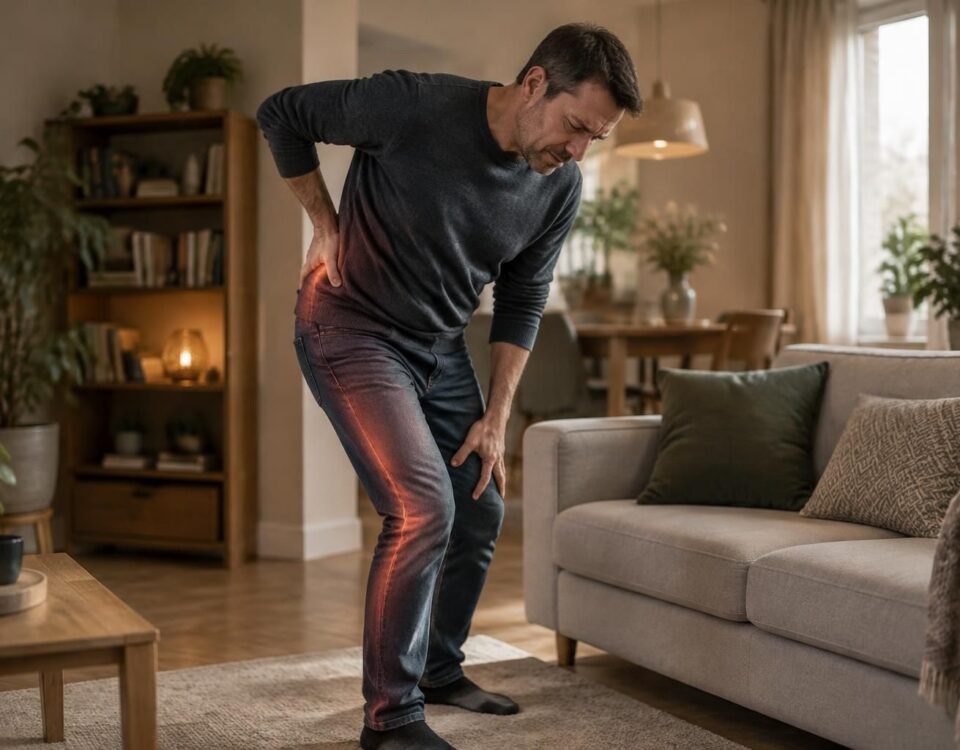
Sciatica refers to pain that often follows the path of a lumbar nerve root towards the buttock and leg. It can be related, among other things, to a disc herniation or nerve irritation. Walking can decrease the sensation of stiffness in some people, especially after a period of sitting or being still. Movement can also help gradually resume everyday activities.
This improvement does not necessarily mean that the nerve is “unblocked” or that the cause has disappeared. Symptoms can fluctuate throughout the day. They can also vary depending on posture, walking duration, and level of irritation. Therefore, pain that decreases with walking should be interpreted alongside other signs and the context.
Can walking help distinguish sciatica from low back pain?
No, not by itself. Low back pain primarily affects the lower back. Sciatica pain may start in the back or buttock and follow down the leg, sometimes to the calf or foot. Both types of pain can be present simultaneously. To better understand the potential signs, consult our page on sciatica in Montreal and this guide on sciatica.

Sciatica and pain that descends slowly
IN BRIEF Sciatica is a pain that often starts in the lower back or buttock and gradually descends into the leg, sometimes reaching the foot, when a nerve root is irritated. It may be accompanied by tingling or numbness and…

Disabling sciatica: what to do when the leg limits activities?
IN BRIEF A debilitating sciatica causes pain that travels down the leg and can limit walking, sleeping, or daily activities. If your leg is holding you back, have the cause evaluated and adjust your activities without straining: non-surgical approaches may…
What improvement while walking might mean
If the pain decreases after a few steps, immobility or prolonged position may be contributing to your discomfort. A slow, short walk may then be better tolerated than complete rest. However, walking does not suit everyone in the same way. Some people experience worsening symptoms from standing or walking, especially when their condition involves a narrowing of the space around the nerves.
The location of the pain can also provide clues, without confirming the cause. Irritation of different nerve roots can produce symptoms in various areas of the leg. You can learn more about possible pathways with our articles on L4-L5 and pain on the top of the foot, root L5-S1 and symptoms in the calf, as well as sciatica S1 and pain towards the calf and the outer edge of the foot.
The pain can also be influenced by posture and daily movements. Another overview of the causes and symptoms is available in this guide on sciatic pain. To better understand the link between symptoms and lumbar levels visible in imaging, also consult our article on lumbar levels on an MRI and the one explaining why the affected root may change the pain pathway.

Moderate sciatica: when to consult?
IN BRIEF A moderate sciatica is pain that starts from the lower back and radiates down into the buttock or leg, sometimes accompanied by tingling. If it limits your activities, persists, or worsens, consult a healthcare professional to assess the…

Mild sciatica: should we still keep an eye on it?
IN BRIEF A mild sciatica causes moderate pain that can radiate from the lower back to the buttock and leg. While it often improves over time, monitor its progress, avoid prolonged rest, and maintain gentle activity according to your tolerance.…
How to walk when the pain improves?
Start with a short duration and a comfortable pace. Choose a regular surface and avoid trying to cover a specific distance. If the pain remains stable or decreases, you can continue without forcing. Gradually increase the duration in small steps, according to your tolerance during the walk and in the hours that follow.
Take a break if the pain becomes sharper, moves lower in the leg, or remains aggravated after the activity. The goal is not to walk despite increasing symptoms. It is better to resume more gently and seek advice from a professional if you cannot find a tolerable activity.
What to watch for during and after walking?
Monitor the intensity of the pain, its trajectory, and sensations in the leg. Pain that moves further towards the buttock or back may be experienced differently from pain that progresses towards the calf or foot. Also note any tingling, numbness, and any difficulty controlling the foot. These observations can help a professional assess your situation.
Avoid long periods of standing or sitting if they exacerbate your symptoms. Regular position changes may sometimes be more comfortable. Lumbar support can provide temporary relief for some people, but it does not replace an assessment or professional advice.

Severe sciatica: what signs warrant an evaluation?
IN BRIEF A severe sciatica is pain that radiates from the lower back or buttock down the leg and may be accompanied by nerve signs. A significant or progressive weakness, difficulties urinating or controlling bowel movements, or numbness in the…

Recurrent sciatica: symptoms that often come back
IN BRIEF Recurrent sciatica refers to the return of pain that starts from the lower back or buttock and radiates down one leg, sometimes all the way to the foot. Tingling or numbness may also reappear. A herniated disc or…
When walking does not relieve sciatica
Pain that increases while walking does not, by itself, identify the cause. It may indicate that duration, pace, or posture are not suitable for you, or that professional advice is needed. Do not push through if walking triggers significant pain, weakness, or loss of sensation.
A medical opinion is indicated if the pain persists, worsens, recurs frequently, or disrupts sleep and daily activities. The professional can investigate the cause and determine if further examination is useful. Additional resources on sciatica are available in this guide dedicated to symptoms and possible causes and in this content on sciatica pain and suitable activities.
At TAGMED Clinic, an assessment can help determine if a non-surgical approach, such as specific osteopathy or motorized neurovertebral decompression, can be considered based on your situation. These approaches do not replace a medical diagnosis. To learn more, consult the guide on sciatica symptoms and relief.
Signs that require prompt attention
Consult a doctor quickly if you notice new or progressive weakness in a leg, increasing difficulty lifting your foot or walking, or significant loss of sensation. These signs may indicate nerve damage that requires evaluation.
Loss of bladder or bowel control, numbness in the perineal region, fever, recent trauma, or very intense pain that worsens rapidly require urgent medical evaluation. Do not wait to see if walking improves these symptoms.
About the author
Sylvain Desforges, B.Sc., D.O., N.D., osteopath and naturopath, is the founding president of TAGMED and the ACMA association. He dedicates his practice to chronic pain of the spine, lower back pain, and pain compatible with sciatica, especially when the pain radiates to the buttock, leg, calf, foot, or toes.
Through SOS Sciatique, he publishes educational content on sciatica symptoms, possible causes such as herniated discs, disc pinching, foraminal stenosis, or irritation of a lumbar nerve root, as well as non-surgical approaches that may be considered based on the evaluation. At TAGMED Clinic, care may include, depending on the case, motorized neurovertebral decompression, specific osteopathy, or precision percussion.
For an evaluation related to sciatica treatment in Montreal / Mont-Royal or sciatica treatment in Terrebonne, check the services available at TAGMED Clinic.
Medical warning
The information published on SOS Sciatique is provided for educational purposes and does not replace a consultation, diagnosis, opinion, or treatment performed by a physician or another licensed healthcare professional. The author of this article is neither a doctor nor a specialist in a medical specialty recognized by the Collège des médecins du Québec. The approaches of osteopathy, manual medicine, or functional support described on this site do not constitute medical acts and are not intended to replace medical follow-up.
Consult a doctor or emergency service in case of loss of bladder or bowel control, numbness in the saddle area, significant or progressive weakness of the leg or foot, fever, recent trauma, severe pain, or rapid worsening. For more details, please read our Legal Notice.
Medical disclaimer: The information and advice provided on this site do not replace the advice, diagnosis, or treatment of a healthcare professional. Please note that Sylvain Desforges, B.Sc., D.O., N.D., Doctor of Osteopathy, is neither a doctor in medicine nor a physician, and is not a specialist in a medical specialty as defined by the Collège des médecins du Québec. Manual medicine, functional medicine, and sports medicine as described on this site exclude any medical treatment or diagnosis made by a physician or a medical specialist. Always consult your doctor for any medical questions. For more details, please read our Complete Legal Notice.
Sciatica: when the pain improves with walking
- A gentle walk can reduce stiffness and improve comfort.
- Start with a few minutes at a comfortable pace.
- Gradually increase if symptoms remain stable.
- Stop if the pain radiates further down the leg or intensifies significantly.
- Avoid overexertion: improvement with walking does not mean the cause is resolved.
- Consult promptly in case of progressive weakness, perineal numbness, or urinary or bowel disorders.

When pain compatible with sciatica improves with walking, a gentle activity may be better tolerated than prolonged immobility. Proceed gradually, observe your leg’s response during and after walking, and do not push if the pain intensifies or unusual signs appear. However, relief from walking alone does not allow for the identification of the pain’s cause.
Why can walking provide relief?
Sciatica pain can originate from the lower back or buttock and follow the path down the leg. It is sometimes accompanied by burning sensations, jolts, tingling, or numbness. For some individuals, changing positions and moving gently reduces stiffness or discomfort associated with prolonged posture.
Walking engages the body moderately and can help maintain mobility. If your symptoms decrease while walking, it indicates that this movement seems better tolerated at that moment — not proof that the nerve is “unblocked” or that the cause has disappeared. Lower back pain radiating into the leg can have various origins and deserves evaluation if it persists or returns regularly.
How to resume walking without worsening symptoms?
Start with short periods
Choose an easy route and start with a few minutes at a gentle pace. If the pain remains stable or decreases, you can repeat short walks throughout the day. Gradually increase the duration according to your tolerance, rather than trying to reach a specific distance right away.
Pay attention to pain evolution
While walking, especially monitor if the pain increases and spreads further down the leg, or if new tingling or numbness occurs. Slow down, take a break, or stop if the symptoms sharply intensify. Also check how you feel in the hours that follow: persistent worsening indicates that the effort may have been too much.
Choose comfortable shoes and even terrain. A natural posture is generally preferable to a stiff or forced position. If sitting for long periods exacerbates your pain, switch positions and get up regularly, without turning every movement into a workout.
What complementary actions can help?
Test a comfortable resting position after walking, for example on your back with your legs supported or on your side with a cushion between your knees. Heat or cold can provide temporary comfort: choose the option that relieves you, while protecting the skin. Stretching is not essential and should remain gentle; stop any movement that increases radiation into the leg.
Do not impose strict bed rest without medical advice. Conversely, a lumbar belt or medication may not be suitable for everyone: consult a healthcare professional, especially if you have other health issues or are already taking medications.
When to seek medical advice?
Consult if the pain persists, worsens, recurs frequently, or limits your activities despite appropriate walking. A new or progressive weakness in the leg or foot requires prompt evaluation. In case of loss of urinary or bowel control, numbness in the saddle area, fever, recent trauma, or severe pain that worsens rapidly, contact a medical service or emergency immediately.
About the author
Sylvain Desforges, B.Sc., D.O., N.D., osteopath and naturopath, is the founding president of TAGMED and the ACMA association. His practice focuses particularly on chronic spinal pain and lower back pain compatible with sciatica.
Medical Warning
This information is educational and does not replace a consultation, diagnosis, or treatment by a licensed healthcare professional. The author is neither a doctor nor a specialist in a medical specialty recognized by the Collège des médecins du Québec. Manual or functional approaches do not replace medical follow-up.
| Marker | To remember |
|---|---|
| Pain that decreases while walking | A gentle walk may be well tolerated. |
| Duration of walking | Start with a few minutes, according to your comfort. |
| Progression | Gradually increase if symptoms remain stable. |
| Pain that extends further down the leg | Slow down or stop and reassess your tolerance. |
| Worsening weakness or numbness | Seek medical advice promptly. |
Testimonials: when walking helps to better live with sciatica
Fictitious examples for illustrative purposes: each sciatica is different. Walking can provide comfort for some people, but it can also exacerbate symptoms in others.
“My pain started from my buttock and went down behind my thigh. I thought I had to lie down, but immobility made me stiff. I tried to walk for a few minutes at a gentle pace. As long as I didn’t overexert, it helped me regain some mobility.” — Claire, 46 years old
“At first, I only did short walks in the house. I stopped as soon as the pain increased. Little by little, I was able to walk a little longer, without trying to break a record. It mainly helped me regain confidence in my movements.” — Marc, 53 years old
“Sitting for long periods worsened my leg pain. I regularly got up to take a few steps, then resumed my activities. Walking didn’t make my sciatica disappear overnight, but these active breaks were more comfortable for me.” — Nadia, 39 years old
“I tried a short, slow walk, staying attentive to my sensations. Some days, it felt good; other days, I had to cut it short. I realized that it was better to adjust the duration rather than continue despite pain radiating further down my leg.” — Jean, 61 years old
If you are trying to walk with sciatica pain, start with a duration that feels comfortable and gradually increase only if symptoms remain stable. Reduce effort or stop if pain intensifies sharply, if numbness appears, or if weakness increases. In cases of significant or progressive weakness, loss of urinary or bowel control, or numbness in the saddle area, consult urgently.
Sciatica and pain that improves with walking: understanding this signal
Pain that starts from the lower back or buttock and radiates down the leg may suggest sciatica, which means pain related to irritation of a nerve root or the sciatic nerve. In some people, it decreases during a gentle walk. This change may seem reassuring, but it does not alone identify the cause or confirm a diagnosis. Symptoms and their evolution vary from person to person.
The sciatic nerve originates in the lumbar region, crosses the buttock, and extends down the back of the thigh, before branching off in the leg and foot. When nearby structures irritate a nerve root, the pain can manifest far from the lower back: burning, stabbing, pulling, or electric shock sensations may occur. Tingling or numbness may also appear.
Why can walking provide comfort? A light activity gradually moves the back and legs and can limit stiffness associated with prolonged sitting. For some people, a few minutes of gentle walking are better tolerated than sitting for long periods or staying in bed. However, this reaction is not universal: others may feel worse when walking, especially if the pain becomes sharper or travels further down the leg.
If walking seems to relieve pain, start with a short duration, on even ground and at a comfortable pace. Gradually increase only if the symptoms remain stable during and after the activity. There is no need to aim for a particular distance or pace. Favor natural steps, avoid carrying heavy loads, and take a break if pain significantly increases, if tingling intensifies, or if weakness appears.
Pay close attention to how the pain evolves: does it stay in the buttock, or does it extend towards the calf and foot? Pain that moves upwards towards the back and away from the leg can be seen as a favorable change, but this sign does not replace a professional evaluation. The cause may be related to a herniated disc, narrowing of the spaces around the nerves, or another condition. An examination helps determine the appropriate course of action.
It is generally not helpful to remain immobile for several days without medical indication. Rest can be occasional when the pain is significant, but returning to daily movements should remain gradual and adapted to tolerance. Stretching or nerve mobilization exercises may not be suitable for everyone: stop them if they exacerbate radiation, cause loss of sensation, or trigger sharp pain. For medications, consult a health professional, especially if you are already receiving treatment or have contraindications.
Consult a doctor quickly if the pain persists, frequently returns, or severely limits your activities. Significant or progressive weakness in the leg or foot, loss of urinary or bowel control, numbness in the perineal area, fever, or pain after trauma require urgent evaluation.
About the author: Sylvain Desforges, B.Sc., D.O., N.D., is an osteopath and naturopath, founding president of TAGMED clinics and the ACMA association. His background focuses on managing chronic pain and integrating technologies like neurovertebral decompression, laser, and shockwaves. His approach aims to provide individualized support, based on evaluation and available data. The information presented here is educational and does not replace a consultation, diagnosis, or treatment by a licensed health professional.
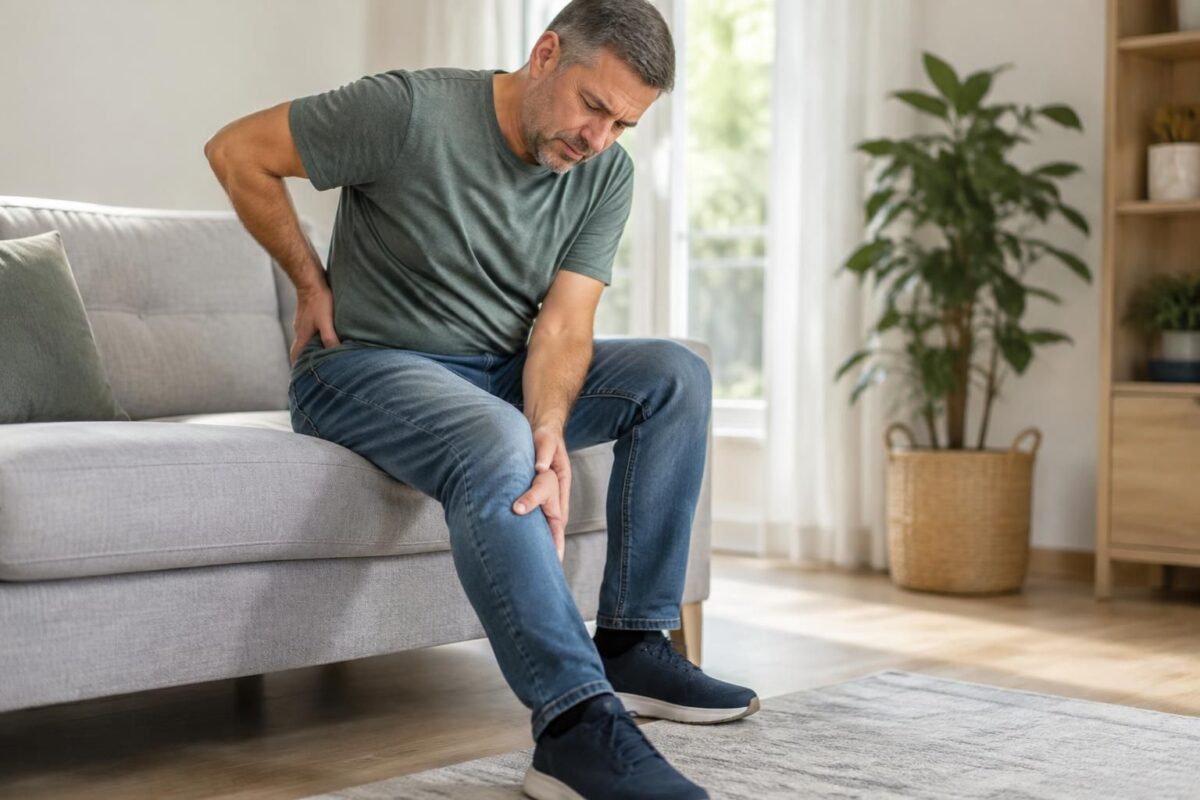
Radicular pain that eases while walking may indicate that gentle movement is better tolerated than immobility or prolonged position. However, this improvement alone is not sufficient to identify the cause of the pain or to rule out nerve irritation. The essential thing is to remain active without straining and to monitor the evolution of symptoms.
Why can walking improve pain?
Slow walking over a short distance gradually mobilizes the back and legs. For some people, this reduces stiffness felt after sitting or lying down and helps regain confidence in movement. The recommendations from the Health Insurance generally encourage suitable activity rather than prolonged bed rest, unless otherwise advised by a doctor.
Start at your own pace: a few minutes may be enough. If the pain remains stable or decreases, you can gradually increase the duration, without aiming for a set target. Practical advice is also provided in this article on walking in case of sciatica.
An improvement while walking does not mean you should push on
Observe how your body reacts while walking and in the hours that follow. If the pain becomes sharper, travels further towards the calf or foot, or is accompanied by new tingling or numbness, slow down or stop the activity. Resume only when symptoms allow and avoid movements that cause a significant aggravation.
Tolerance to movement can also vary according to circumstances. Pain that appears after a long period of sitting, such as during driving, deserves particular attention: you can check our references on sciatica after driving and end-of-day pain. Stationary biking is not necessarily suitable for everyone; its effect depends on posture and symptom response, as explained in this article on sciatica and stationary biking.
The pathway of pain and signs to monitor
Pain that starts from the lower back or buttock and descends into the leg may correspond to irritation of a nerve root, but other causes can produce similar symptoms. The pathway varies according to the affected root: see explanations on the roots L4, L5, and S1 in Montreal as well as those regarding sciatica pain in Terrebonne.
To better understand the causes, symptoms, and management options, you can consult the resources from MédecinDirect and Tout pour ma santé. Comfort measures are also presented in this guide to relieve sciatica, without replacing an evaluation suited to your situation.
Consult a health professional quickly if the pain persists, worsens, or frequently returns. Significant or progressive weakness in the leg or foot requires prompt evaluation. In case of loss of urinary or bowel control, numbness in the saddle area, fever, recent trauma, or rapid worsening, seek emergency care.
Chronic sciatica: symptoms to watch for
IN BRIEF Chronic sciatica is a persistent pain that starts from the lower back or buttock and radiates down the leg, sometimes to the foot. Burning, tingling, numbness, or weakness may also occur. Identifying these symptoms helps obtain an evaluation…

Subacute sciatica: persistent symptoms
IN SHORT Subacute sciatica refers to pain that follows the path of the sciatic nerve and persists for several weeks, often between 4 and 12 weeks. It may be accompanied by tingling, numbness, or pain in the buttock and leg.…

Sylvain Desforges, B.Sc., D.O., N.D., docteur en ostéopathie
Dr Sylvain Desforges, B.Sc., D.O., N.D., osteopath, is the founding president of TAGMED and of the ACMA association. He dedicates his practice to chronic spinal pain, low back pain and symptoms compatible with sciatica, particularly when pain radiates toward the buttock, leg, calf, foot or toes.
Through SOS Sciatique, he publishes educational content on sciatica symptoms, possible causes such as disc herniation, disc narrowing, foraminal stenosis or irritation of a lumbar nerve root, as well as non-surgical approaches that may be considered according to the evaluation. At Clinique TAGMED, care may include, depending on the case, motorized neurovertebral decompression, specific osteopathic care or precision percussion.
For an evaluation related to sciatica treatment in Montreal / Mount Royal or sciatica treatment in Terrebonne, please consult the services available at Clinique TAGMED.
Medical disclaimer
The information published on SOS Sciatique is provided for educational purposes only and does not replace a consultation, diagnosis, opinion or treatment provided by a physician or another authorized healthcare professional. The author of this article is neither a medical doctor nor a specialist in a medical specialty recognized by the Collège des médecins du Québec. The osteopathic, manual medicine or functional support approaches described on this site do not constitute medical acts and are not intended to replace medical follow-up.
Consult a physician or emergency service in cases of loss of bladder or bowel control, anesthesia in the saddle area, significant or progressive weakness in the leg or foot, fever, recent trauma, severe pain or rapid worsening of symptoms. For more details, please read our Legal Notice.