Sciatica in Terrebonne: burning pain behind the thigh
19/09/2026
Herniated disc and muscle strength: why to test it
19/09/2026
IN BRIEF
In brief, sciatica and pain during position change is pain radiating along the sciatic nerve triggered or worsened by postural changes and prolonged postures. Benefits: identifying positions to avoid and adopting ergonomic adjustments helps reduce pain, improve comfort, and prevent flare-ups; functioning: combine good ergonomics (sitting, sleeping, lifting), gentle exercises, and regular walking to decrease pressure on the nerve and promote recovery. In Montreal, this approach is particularly useful for professionals and active individuals looking to maintain their activity while managing pain. |
The sciatica is a pain that follows the path of the sciatic nerve and can radiate from the lower back to the legs. The intensity level varies according to the adopted positions and postural changes.
Changing positions can either trigger or relieve pain. A few simple ergonomic principles can help limit pain spikes: prioritize position alternation, avoid positions that compress the nerve, and ensure a proper weight distribution.
- Sitting: avoid prolonged sitting; take breaks every 30–45 minutes with a straight back and lumbar support.
- Leg position: avoid crossed or tucked legs; prefer flat feet.
- Sleeping position: sleep on your side with a pillow between your knees or on your back with a pillow under your knees.
- Lifting weights: bend the knees and keep the back straight, the load close to the body.
- Walking: gentle and regular activity to promote recovery.
Adopting these gestures can help reduce pain during position changes and prevent relapses.
This article, written by a health professional, explains how sciatica reacts to position change. It describes postures to avoid, useful ergonomic adjustments, and daily actions to reduce pain. It also provides guidelines on when to consult and what resources to look up online.
The pain related to sciatica is often influenced by how you stand, sit, and rise. Prolonged or inappropriate positions can worsen pain and delay recovery. A good understanding of the mechanisms and simple gestures can limit triggers and promote progress toward better mobility.
Understanding the link between position and pain
The sciatic nerve can become irritated or compressed by repeated pressures in certain positions. Maintaining a static or unbalanced posture increases the risk of pain and can trigger recurrent episodes. An approach focused on protective postures and gradual movements helps reduce the load on the nerve and limit flare-ups.
Positions to avoid during position change
Sitting too long
Prolonged sitting can compress lumbar structures and the sciatic nerve. Prefer active breaks and postural changes every 30 to 45 minutes.
Crossed or tucked legs
This configuration shifts the pelvis and can increase lumbar twisting. Avoid this position, even for short periods.
Rounded back without lumbar support
A back without support puts more strain on the disc and can intensify pain. Use lumbar support or an appropriate cushion.
Sleeping on your stomach
This posture can twist the lower back and stretch the sciatic nerve. Prefer other more neutral sleeping positions.
Bending with a flexed back and rotation
Bending forward with a flexed back and rotation increases pressure on the lumbar spine. Carry a load close to the body and avoid sudden movements.
Driving and prolonged trips
Vibrations and a fixed posture can worsen nerve irritation. Alternate positions and take breaks whenever possible.

Sciatica and pain after a day of sitting at work
IN BRIEF Sciatica after a day of sitting refers to pain that starts in the lower back or buttock and may radiate down the leg. Prolonged posture can accentuate discomfort. Regular breaks, a few minutes of walking, and an adequately…
Good postures and ergonomic alternatives
For sitting
Keep both feet flat, back straight, and pelvis pushed back into the seat. Choose a chair with lumbar support or add an ergonomic cushion. Hips should be slightly higher than the knees. Take active breaks every 30 to 45 minutes (walking or small movements).
For sleeping
Prefer a side position with slightly bent knees and a pillow between the legs, or on your back with a pillow under your knees. Use a mattress suitable for your body type and an ergonomic pillow.
For lifting a load
Bend your knees, keep your back straight, and bring the load close to your body. Do not bend over while rounding your back.
During walking and movement
Wear comfortable shoes and walk at a suitable pace. Regular and gradual outings support recovery and reduce stiffness.
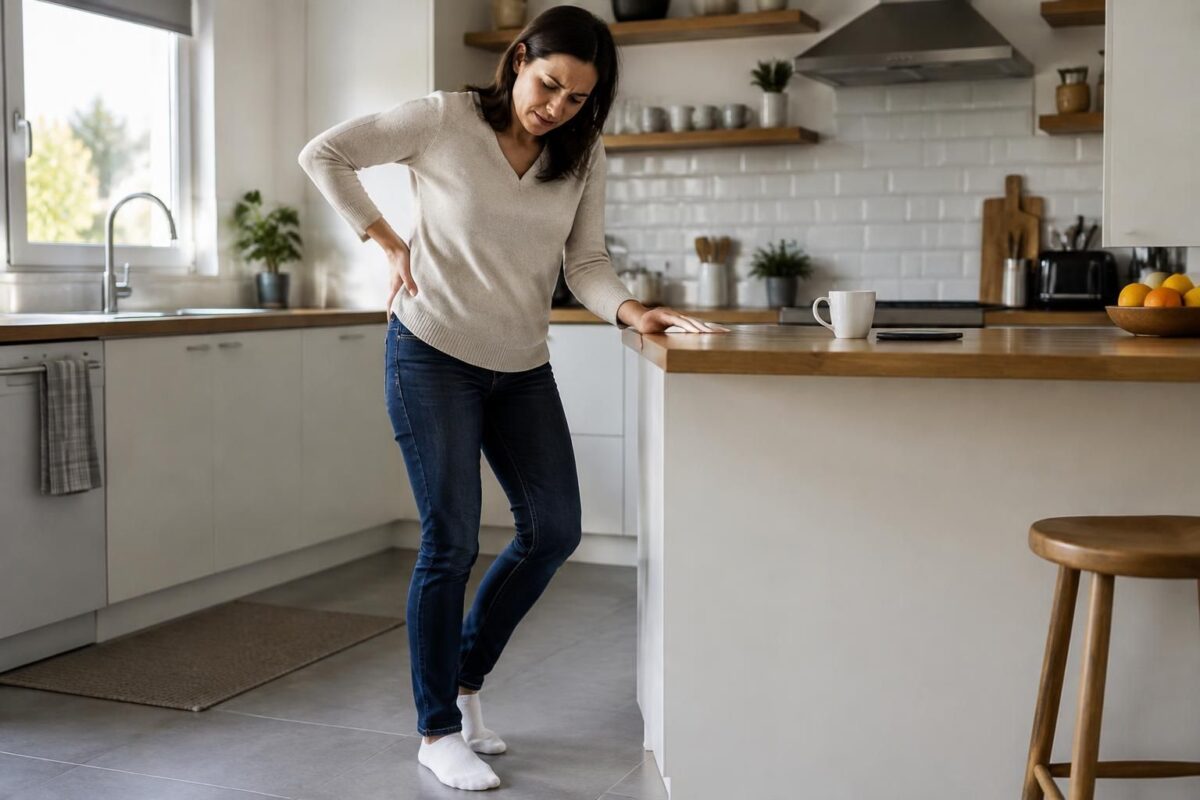
Sciatica and pain after prolonged standing
IN BRIEF Sciatica is pain related to irritation of a nerve root, which can radiate from the lower back to the buttock and leg. Prolonged and immobile standing can promote or worsen symptoms, although it is not always the cause.…
The circadian rhythm can influence pain, with morning or late-day peaks. Alternate light activity and rest during these times to limit pain spikes.

Sciatica and pain after long walk
IN BRIEF sciatica after a long walk manifests as pain in the lower back or buttock that radiates down the leg, sometimes accompanied by tingling or numbness. Temporarily reduce the distance, take breaks, and resume walking gradually, without staying in…
When to consult a professional
Consult quickly if pain persists after 48 to 72 hours without improvement, if there is a loss of strength in one leg, incontinence, fever, or recent trauma. Serious medical history or alarming signs require prompt clinical evaluation. An assessment allows for ruling out other causes and considering options suitable for your situation.

Sciatica and pain after weight training
IN BRIEF Sciatica after weight training refers to pain that starts from the lower back or buttock and radiates down the leg, sometimes after a workout. Weight training is not always the cause or necessarily prohibited: a gradual return, a…
Resources and useful links
To deepen your understanding of positions to avoid and ergonomics, you can consult online resources; they complement clinical advice and help to establish simple daily gestures. For example, guides and articles accessible on positions to avoid for daily pain and Sciatica and positions to avoid allow you to identify simple guidelines. Additional testimonies and advice can be found on Sciatica in Montreal and Sciatica in Terrebonne. For clinical advice and services, discover TAGMED Clinic.
For additional perspectives on postures and ergonomics, refer particularly to the following resources: Position to relieve Sciatica, Position to avoid, or persistent pain in the heel.
For complementary information, you can also consult resources dedicated to neurovertebral decompression and the associated management on Neurovertebral Decompression and therapeutic comparisons on SOS Sciatica.
Care options to consider within a specialized clinic focus on ergonomics, mobility, and progressive strengthening. Measures tailored to your case can be discussed during a consultation at TAGMED Clinic, in Montreal or Terrebonne.
For more information and a personalized assessment, consult TAGMED Clinic.
Medical disclaimer: The information and advice provided on this site do not replace the opinion, diagnosis, or treatment of a health professional. Please note that Dr. Sylvain Desforges, osteopath, is neither a doctor of medicine nor a physician and is not a specialist in any medical specialty as defined by the Collège des médecins du Québec. Manual medicine, functional medicine, and sports medicine as described on this site exclude any treatment or medical diagnosis made by a doctor or medical specialist. Always consult your physician for any medical questions. For more details, please read our complete Legal Notice.

Sciatica can be directly influenced by how you position and move yourself daily. This article provides you with clear recommendations to identify risky positions, adopt suitable ergonomics, and practice simple gestures that alleviate pain when you change positions, in order to prevent episodes and promote recovery.

Sciatica and pain after cycling
IN BRIEF Sciatica and pain after biking may be related to nerve irritation or an uncomfortable position. Biking is sometimes possible if the pain is mild and stable: reduce the duration, pedal without forcing, and adjust your posture. Stop if…
Understanding the link between position and sciatic pain
Sciatic pain often results from irritation or compression of the nerve roots along the sciatic nerve. Certain positions increase pressure on the lumbar spine and intervertebral discs, triggering or amplifying pain in the buttock, thigh, or leg. In practice, patient feedback shows that prolonged maintenance of the same posture, especially at the end of the day, can exacerbate symptoms and hinder recovery. Adopting a proactive approach to daily movements helps limit these painful peaks and improve tolerance for usual activities.

Sciatica and pain after running
IN BRIEF Sciatica after running is pain that can radiate from the lower back or buttock down the leg, sometimes all the way to the foot. The impacts of running can exacerbate symptoms: reduce or temporarily suspend outings that worsen…
Positions to avoid and why
Positions to temporarily avoid
Avoid prolonged sitting and rounded back that compress the sciatic nerve and imbalance load distribution on the back. Avoid crossed legs that misalign the pelvis and cause lumbar twisting. Avoid sleeping on the stomach, which causes rotation of the spine and tension on the nerve. Avoid bending forward with a rounded back, especially when lifting loads. Avoid long car rides or prolonged transport without breaks to limit vibrations and tension on the nerve. Finally, avoid repetitive gestures that combine bending and twisting of the trunk.

Sciatica and pain after sports
IN SHORT Sciatica pain after sports can be a temporary reaction to effort, especially after a too-quick or intense return. It does not necessarily mean that sports are off-limits: reducing intensity, progressing gradually, and favoring well-tolerated movements can help keep…
Ergonomics and alternatives for sitting, sleeping, and moving
When sitting, prefer a position with both feet flat, straight back, and effective lumbar support. The height of the hips should be slightly above that of the knees, and active breaks every 30 to 45 minutes facilitate recovery. For sleeping, prefer the side position with a pillow between the knees or the back position with a pillow under the knees; choose a suitable mattress and an ergonomic pillow to maintain spine alignment. To lift a load, bend the knees and keep the back straight and the load close to the body. During walking, prefer small relaxed steps and a regular stride. Ergonomics at work and in the vehicle should also be reconsidered to limit constraints on the spine and the nerve.

Sciatica and pain after moving
IN BRIEF Sciatica after a move is pain that starts in the lower back or buttock and radiates down the leg, sometimes after lifting or moving heavy objects. It may be accompanied by tingling or numbness. Identifying the symptoms and…
Exercises and daily gestures to relieve
Core exercises should remain gentle and progressive. Incorporate piriformis and hamstring stretches, deep breathing exercises, and gentle core stability to stabilize the spine. Moderate walking for 20 to 30 minutes a day can reduce the risk of chronicity. Active breaks every 30 to 60 minutes at the office help to break fixed positions. The goal is to gradually increase mobility and activity tolerance without causing a sudden worsening.
When to consult and severity factors
Consult if the pain persists beyond 48 to 72 hours without improvement, or in case of loss of strength in the leg, sphincter abnormalities, fever, or signs of nighttime worsening. A medical assessment allows for evaluation of the causes and consideration of appropriate management (physiotherapy, occupational therapy advice, possible injections). In the event of intense pain or significant neurological signs, a quick assessment is recommended. The aim is to prevent relapses and maintain suitable activity throughout the resumption of daily tasks.
| Element to Modify | Impact and Concise Advice |
|---|---|
| Prolonged Sitting | Increases pressure on the sciatic nerve; prefer breaks every 30-45 minutes and a neutral posture. |
| Crossed Legs | Tilts the pelvis and increases lumbar twisting; avoid and keep feet flat. |
| Rounded Back | Stresses the disc and may compress the nerve; correct with lumbar support and straight back. |
| Sleeping on the Stomach | Twists the spine and puts tension on the nerve; prefer sleeping on the side or back with pillows. |
| Leaning Forward with Load | Increases pressure on the lumbar discs; bend the knees and keep the back straight when lifting. |
| Long Driving | Vibrations and fixed position worsen irritation; take breaks and adjust the seat. |
| Quick Stand-Sit Transition | Sudden movements increase pain; prefer a slow rise and turn with the knees. |
| Nocturnal Position Change | Sleep: prefer positions that relieve, like on the side with a pillow between the knees or on the back with a pillow under the knees. |
| Walking After Prolonged Rest | Walking is beneficial; start with short distances and increase gradually. |
Testimonials on Sciatica and Pain Related to Position Change
“Before, every position change would wake me up with a throbbing pain in my leg. At work, sciatica returned after 45 minutes of sitting. By adopting an ergonomic chair and taking active breaks every 30 to 45 minutes, the pain has decreased and I can focus again.”
“During long drives, sciatica worsened over the hours. After adjusting my posture and taking short mobility breaks, the pain remained stable, and I was able to finish my drive without fear.”
“Sleeping on my stomach made my sciatica worse. By switching to back sleeping with a pillow under my knees, and using an ergonomic pillow, I wake up without tightness and am relearning to sleep through the night.”
“Carrying loads at work triggered painful episodes when I leaned without bending my knees. By learning to keep my back straight, bring the object close to my body, and bend my knees, the pain quickly subsided.”
“I now take a light walk of 20 to 30 minutes each day and do gentle stretches. This routine has diminished nerve shocks and helped me maintain activity without fear of painful flare-ups.”
“After following advice from an osteopath on ergonomics and simple exercises, I have seen a reduction in episodes and better tolerance for daily movements.”
Detailed Biography: Sciatica and Pain from Position Change
Dr. Sylvain Desforges, osteopath and naturopath, is the founding president of TAGMED clinics and the ACMA association. With a career dedicated to innovation in healthcare, he specializes in managing chronic back pain and, more specifically, sciatica and pain related to position change. His approach is based on evidence and functional assessment of postures and daily movements that trigger or worsen pain. This approach fits within a holistic vision of well-being, where mobility and quality of life become possible again.
His actions are fueled by a strong conviction: understanding how posture changes affect pain allows for the development of concrete prevention and remission strategies. He analyzes the mechanisms by which an inadequate posture increases pressure on the sciatic nerve and triggers painful manifestations, such as shooting pains in the buttock or leg. In his practice, ergonomics plays a central role: prolonged sitting, sleeping, and movement are accompanied by personalized support to limit acute episodes and promote recovery.
Therapeutically, Dr. Desforges is a pioneer in integrating advanced technologies into the non-surgical management of sciatica. He uses motorized neurovertebral decompression, specific osteopathy, and the precision percussor as complementary tools to restore alignment and reduce nerve irritation during activities or position changes. When relevant, he combines interventions such as laser and shock waves to optimize therapeutic response, always guided by rigorous patient assessment and solid clinical outcomes.
Outside of techniques, Dr. Desforges places great importance on patient education and autonomy. He offers clear advice on ergonomics of the workstation, bedding arrangements, and daily gestures that minimize pressure on the spine and promote pain control when changing positions. His programs include gentle exercises, progressive stretching routines, and practical advice sessions on walking, standing up, and carrying loads to avoid sudden movements that trigger pain.
His mission remains to provide evidence-based care and to optimize the health and well-being of his patients. By combining clinical expertise, advanced technologies, and an educational approach, he is committed to helping everyone navigate more serenely through daily life marked by sciatica and position changes, without losing sight of functional and lasting recovery.
Quick summary: pain from sciatica is heavily influenced by position changes and inappropriate postures. By understanding the mechanisms that irritate the sciatic nerve, it is possible to act daily with simple ergonomic measures, safe movements, and appropriate exercises to limit pain and prevent recurrences.
Identifying positions that aggravate pain during position changes
Sciatic pain often occurs when the nerve is compressed or irritated by a maintained or repeated posture. Positions that excessively stress the intervertebral disc or cause twisting of the spine can trigger or amplify symptoms. This includes, in particular, the sudden transition from sitting to standing, movements that accentuate the flexion or rotation of the trunk, and postures that lead to poor weight distribution on the pelvis.
Certain common situations exacerbate pain during position changes: sitting for long periods without altering position, crossing legs, or adopting a back position without lumbar support during simple movements like standing up or picking up an object. Maintaining a rounded back or an unbalanced pelvis can multiply nerve irritation and increase symptoms.
Recent studies and clinical experience indicate that pain can also be sensitive to the rhythm of activities and alternating between sitting and standing. Adapting the pace of movements and favoring gentle transitions can significantly reduce the magnitude of flare-ups.
Postures to avoid and ergonomic alternatives to prioritize
To limit triggers during position changes, prioritizing alternatives that are more respectful of the sciatic nerve is key. Positions that impose repeated bending of the back or trunk rotation without support should be used cautiously and ideally avoided temporarily during acute flare-ups.
In office work, favoring a seat with lumbar support and taking active breaks every 30 to 45 minutes can greatly help limit pain. During travel, prolonged driving or travel can cause irritation if the position remains fixed or if vibrations worsen symptoms.
For sleep and domestic activities, it is recommended to adopt positions that reduce pressure on the lumbar discs and allow for a neutral alignment of the pelvis. For example, sleeping on the side with a cushion between the knees or on the back with supports under the knees can decrease nerve irradiation.
External resources offer practical approaches and ergonomic guides to avoid problematic postures. You can consult guides dedicated to the prevention of lumbar pain and workstations, especially those that describe positions to avoid and ergonomic arrangements to implement daily.
Practical strategies and daily gestures
When sitting, keep the feet flat, back straight, and pelvis well positioned at the back of the seat with lumbar support and hips slightly higher than the knees. Take active breaks every 30 to 45 minutes: short walks, gentle stretches, self-lengthening.
For sleeping, favor a position that does not compress the nerve: sleep on the side with a cushion between the knees or on the back with a cushion under the knees. A mattress that suits one’s morphology and an ergonomic pillow help maintain spinal alignment.
To lift a load, bend the knees and keep the back straight, with the load close to the body. Avoid bending by rounding the back and avoid sudden movements when carrying heavy loads.
While walking, choose shock-absorbing shoes and adopt a regular pace with controlled steps. Moderate walking can promote nerve recovery and limit stiffness.
The circadian rhythm often influences pain: painful peaks may occur early in the morning or late in the day. Adapting one’s routine by alternating light physical activity and rest periods can help alleviate these peaks.
Exercises and daily gestures during a flare-up
Gentle stretches of the piriformis and hamstrings, combined with deep breathing and gentle core stabilization, can help reduce lumbar tension and improve mobility. Daily walking and local activities remain important elements to prevent the chronicization of pain.
It is crucial to adapt exercises to the phase and presumed cause. If a movement significantly increases pain in the leg, it should be interrupted and re-evaluated by a professional.
When to consult and safety
Certain situations require prompt consultation: pain that persists beyond 48 to 72 hours despite measures, significant loss of strength in a leg, major numbness, persistent night pain, fever, or concerning neurological signs. Assessment allows for the exclusion of an underlying pathology and orientation towards appropriate solutions (physiotherapy, osteopathy, or imaging if necessary).
For older adults, particular vigilance is recommended to prevent falls and functional losses associated with nerve pain. An active and progressive approach remains the best prevention against recurrences.
Additional resources
To deepen advice on positions to avoid and related ergonomics, you can consult these practical guides and resources:
Sciatica: positions to avoid – ergonomic guide
Sciatica and frequent breaks while walking
Sciatica in Terrebonne: pain and numbness after walking
Sciatica and difficulty standing
Positions to avoid to relieve pain
Sciatica in Montreal: heavy or painful leg
Sciatica in Montreal: pain and numbness after walking

Dr Sylvain Desforges, B.Sc., D.O., N.D., osteopath, is the founding president of TAGMED and of the ACMA association. He dedicates his practice to chronic spinal pain, low back pain and symptoms compatible with sciatica, particularly when pain radiates toward the buttock, leg, calf, foot or toes.
Through SOS Sciatique, he publishes educational content on sciatica symptoms, possible causes such as disc herniation, disc narrowing, foraminal stenosis or irritation of a lumbar nerve root, as well as non-surgical approaches that may be considered according to the evaluation. At Clinique TAGMED, care may include, depending on the case, motorized neurovertebral decompression, specific osteopathic care or precision percussion.
For an evaluation related to sciatica treatment in Montreal / Mount Royal or sciatica treatment in Terrebonne, please consult the services available at Clinique TAGMED.
Medical disclaimer
The information published on SOS Sciatique is provided for educational purposes only and does not replace a consultation, diagnosis, opinion or treatment provided by a physician or another authorized healthcare professional. The author of this article is neither a medical doctor nor a specialist in a medical specialty recognized by the Collège des médecins du Québec. The osteopathic, manual medicine or functional support approaches described on this site do not constitute medical acts and are not intended to replace medical follow-up.
Consult a physician or emergency service in cases of loss of bladder or bowel control, anesthesia in the saddle area, significant or progressive weakness in the leg or foot, fever, recent trauma, severe pain or rapid worsening of symptoms. For more details, please read our Legal Notice.