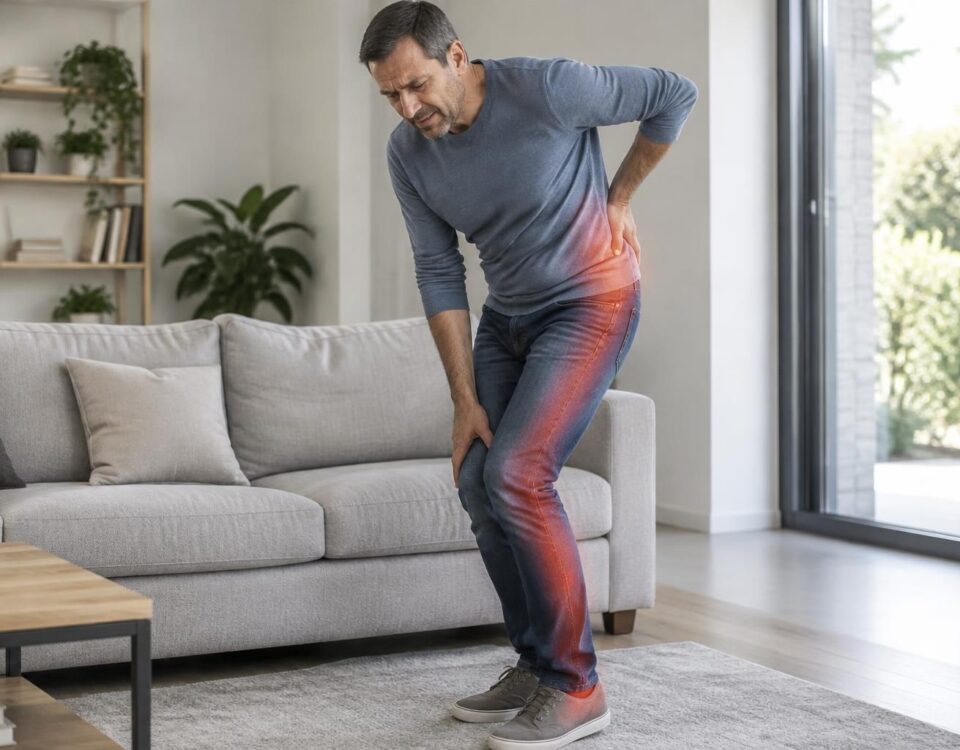


Sciatica in Terrebonne: why the affected root changes the pain path
17/10/2026
Disc protrusion and pain after twisting the back
17/10/2026
IN BRIEF
| Sciatica upon getting out of bed is pain that radiates from the lower back to the buttock or leg and can be more pronounced after the night. Gradually rising, moving gently, and finding a comfortable sleeping position can help reduce discomfort. Significant weakness or urinary or bowel disturbances require urgent evaluation. |
Sciatica may be more painful upon waking after several hours of immobility. Stiffness and nerve sensitivity can make initial movements uncomfortable, but this does not necessarily mean a worsening condition.
To get out of bed more gently, turn onto your side, use your arms to help yourself up, and then rise gradually. A few slow steps may help if walking remains tolerable. Avoid straining to stretch or making movements that significantly increase pain in the leg.
Significant or progressive weakness, loss of sensation in the perineum, or urinary or bowel disturbances require urgent medical evaluation.
Sciatica more painful upon waking can make the first steps difficult. The pain may be related to nighttime immobility, an uncomfortable sleeping position, or too quick a transition from bed to standing. A gradual rise and gentle movements may improve comfort. However, significant weakness, urinary disturbances, or loss of sensation in the perineum require urgent medical evaluation. Sciatica refers to pain that follows the path of a nerve root from the lower back to the buttock and leg. It may be accompanied by burning sensations, electric shocks, tingling, or numbness. The pain can extend down to the foot or toes. For more information on its symptoms, please see this overview of sciatica. At night, the body often remains in similar positions for several hours. Upon waking, the back and tissues around the lumbar region may feel stiff. The first changes in position then put stress on an already sensitive area. This morning stiffness does not automatically indicate that the nerve was further damaged during the night. After a period of rest, some people feel their symptoms more acutely when they turn or sit up. The pain may decrease as the body gradually resumes movement. This profile is common, but it alone does not determine the cause of sciatica nor confirm that it is benign. Explanations for sciatic pain upon waking vary from person to person. You can check out this article on the heightened morning sciatica pain and this page dedicated to sciatica upon waking. This general information does not replace an evaluation tailored to your situation. A position maintained for a long time can increase discomfort for some people. Sleeping twisted, lying on the stomach, or lacking support can make waking more difficult, even though these positions may not necessarily be problematic for everyone. There is no ideal sleeping posture for every person with sciatica. A sudden rise can also trigger pain. Sitting up quickly or twisting while getting up places a sudden strain on the back. A more gradual transition to a standing position may be better tolerated. When you wake up, take a few moments before standing up. You can breathe calmly and gently move your legs through a comfortable range. Avoid testing your pain or forcing a movement that triggers a jolt in the leg. To get out of bed, first turn onto your side if this position is comfortable. Then bring your legs closer to the edge of the bed, and let them drop while using your arms for support to sit up. Once seated, wait a few seconds before standing. Adjust this method if it increases your symptoms. After getting up, a short walk in a safe place may be considered if it remains tolerable. Start slowly and take a break if the pain increases sharply. The goal is not to walk despite intense pain, but to avoid prolonged immobility when movement is possible. It is not necessary to do intense stretching right upon waking. If a stretch causes more pain to travel down the leg or triggers shocks, do not push it. When the cause of the pain is unclear or when a disc injury is suspected, seek professional health advice before adding stretches or exercises to your routine. Online resources present movements to do in bed, such as this article on stretches for sciatica or this page on morning mobilization. These suggestions may not be suitable for every situation. Do not reproduce a movement that increases your symptoms, and do not replace a medical evaluation with online content. Choose the position in which you sleep best without significant increase in pain in the leg. Sleeping on your back, placing one or more pillows under your knees may be comfortable. On your side, a pillow between the knees may help some people maintain a more stable position. You can try these options without forcing yourself to keep a posture that causes you pain. It is not mandatory to sleep on the opposite side of the pain. Some people prefer this side, while others feel better on the painful side or on their back. Real comfort and the evolution of symptoms should guide your choice. A mattress or pillow does not treat the cause of sciatica, even though more comfortable support may facilitate sleep. Not necessarily. Increased pain upon waking may reflect heightened sensitivity after several hours of immobilization. It does not alone imply that the disc herniation or nerve has worsened. Similarly, pain that improves after a few minutes does not confirm alone that the situation is benign. The pathway of pain and other symptoms can help healthcare professionals guide their assessment. Irritation of the L5 nerve root may particularly cause symptoms on the outside of the leg and the top of the foot, whereas S1 involvement may manifest more at the back of the leg or under the foot. These pathways vary from person to person. Refer to the pages on L5-S1 protrusion and pain towards the foot, irritation of the L5 root, and pain pathways based on the L4, L5, and S1 roots. To describe your situation during a consultation, note where the pain starts, how far it descends, what exacerbates it, and any presence of tingling or weakness. This guide can help you describe your sciatica symptoms. A loss of sensitivity or new weakness should not be dismissed. Request an evaluation if the pain persists, returns frequently, disrupts your sleep, or limits your activities. Consult also if numbness progresses, if your foot drags on the ground, or if you notice a decrease in strength. A professional can assess your symptoms and determine if a medical examination or imaging is necessary. The consultation also allows for a review of the medications you are taking. Some pain medications have contraindications or interactions. Do not exceed the indicated doses and do not combine multiple products without checking their compatibility with a doctor or pharmacist. Consult an emergency service immediately if you experience loss of bladder or bowel control, new difficulty urinating, numbness around the perineum or genital organs, or significant and progressive weakness in the leg or foot. Severe pain that worsens quickly, fever, or pain following recent trauma also requires prompt medical attention. Management depends on your symptoms, their duration, your health condition, and the results of the examination. Prolonged bed rest is generally not recommended for uncomplicated sciatica. It is often better to gradually resume tolerated activities, without forcing a position or movement that clearly exacerbates the pain. At the TAGMED Clinic, an evaluation may discuss non-surgical approaches suited to the case, including specific osteopathy, precision percussion, or motorized neurovertebral decompression when appropriate. These treatments do not replace a medical diagnosis and may not be suitable for everyone. To know the services offered in Montreal / Mount Royal or Terrebonne, consult the TAGMED Clinic. Sylvain Desforges, B.Sc., D.O., N.D., osteopath and naturopath, is the founding president of TAGMED and the ACMA association. His practice focuses notably on chronic pain of the spine, lower back pain, and pain compatible with sciatica, including those radiating down towards the buttock, leg, calf, foot, or toes. Through SOS Sciatique, he publishes educational content on sciatica symptoms, its possible causes — such as disc herniation, disc pinching, foraminal stenosis, or irritation of a lumbar nerve root — and non-surgical approaches that may be considered after an evaluation. At the TAGMED Clinic, treatments may include, depending on the case, motorized neurovertebral decompression, specific osteopathy, or precision percussion. The information published on SOS Sciatique is provided for educational purposes. It does not replace a consultation, diagnosis, advice, or treatment performed by a physician or another licensed healthcare professional. The author of this article is neither a doctor nor a specialist in a medical specialty recognized by the Collège des médecins du Québec. The approaches of osteopathy, manual medicine, or functional support described on this site do not constitute medical acts and are not intended to replace medical follow-up. Medical disclaimer: The information and advice provided on this site do not replace the advice, diagnosis, or treatment of a healthcare professional. Please note that Sylvain Desforges, B.Sc., D.O., N.D., Doctor of Osteopathy, is neither a medical doctor nor a physician, and is not a specialist in a medical specialty as defined by the Collège des médecins du Québec. Manual medicine, functional medicine, and sports medicine as described on this site exclude any medical treatment or diagnosis made by a doctor or medical specialist. Always consult your physician for any medical questions. For more details, please read our Full Legal Notice.Why does sciatica hurt more upon waking?
Nighttime immobility and stiffness
Sleeping position and getting up
How to get out of bed when you have sciatica?
A gradual getting up method
Should you stretch as soon as you get out of bed?
What sleeping position to choose with sciatica?
Does morning pain mean sciatica is worsening?
When should you consult for pain upon getting up?
Signs that require urgent care
What management options can be evaluated?
About the author
Medical disclaimer
Before getting out of bed
- Do some gentle leg movements.
- Roll onto your side before sitting up.
- Avoid sharp stretches upon waking.
To stand up
- Lower your legs to the edge of the bed and support yourself with your arms.
- Get up gradually, without forced movement.
- Start with a short walk if tolerable.
Consult urgently in case of significant loss of strength, numbness of the perineum, or urinary or bowel issues.

A more painful sciatica upon waking can make the first movements difficult, without necessarily indicating that the situation is worsening. Night-time immobility, stiffness, and a too-quick transition to standing can contribute to discomfort. Gradual movements, a comfortable sleeping position, and appropriate activity can help start the day better.
Why can sciatica hurt more upon waking?
Sciatica corresponds to pain that follows the pathway of a nerve root from the lower back to the buttock and leg. It may be accompanied by burning, electric shocks, tingling, or numbness. Upon waking, the discomfort may be more pronounced after spending several hours in the same position, or when the back and legs are stiff.
The way you sleep and get up can also influence symptoms. A position that increases pain, or a rapid adjustment, can make the initial movements less comfortable. However, this alone does not help identify the cause of sciatica or assess the condition of a disk or nerve.
How to get out of bed with less discomfort
Gently prepare the movement
Before getting up, take a few moments to breathe calmly and gently move your legs without straining. If a movement significantly increases or decreases the pain in your leg, stop it and choose a more comfortable range. Intense stretching upon waking is not necessary and may be poorly tolerated during a flare-up.
Gradually transition to a standing position
Turn onto your side, move closer to the edge of the bed, then let your legs drop while pushing with your arms to straighten your torso. Sit for a few seconds before standing up. This method avoids a sudden adjustment and allows you to observe how your body reacts.
Once standing, start with a few slow steps if walking remains tolerable. It is better to resume activities in stages than to remain immobilized for too long or try to “test” the pain with forced movements.
Adjusting sleep and morning activities
There is no ideal sleeping position for everyone. On your back, placing a pillow under your knees can improve comfort. On your side, a pillow between your knees may be helpful. Maintain the position that allows you to sleep without significantly worsening symptoms; do not force yourself to sleep on a specific side.
If pain increases while sitting, avoid long periods of immobility during breakfast or while traveling. Alternate positions and get up regularly. Gentle heat can provide temporary relief; protect your skin and be particularly careful if an area is numb.
When to seek medical advice
Consult a healthcare professional if the pain persists, worsens, severely limits your activities, or is accompanied by progressing numbness. Significant or new weakness, such as difficulty lifting your foot, requires quick evaluation.
A loss of sensation in the perineal area, difficulty urinating, urinary leakage, or loss of bowel control are emergency signs. In these situations, go to an emergency room immediately. These recommendations are informative and do not replace a personalized medical evaluation.
| Marker | Sciatica and pain upon rising |
|---|---|
| Upon waking | Pain and stiffness may be more pronounced after nighttime immobility. |
| Possible route | From the lower back or buttock to the thigh, calf, or foot. |
| Evolution | Discomfort that gradually decreases with movement may occur. |
| Getting out of bed | Turn onto your side, support yourself with your arms, and gently straighten up. |
| First movements | Favor gentle movements; avoid forced stretches if pain increases. |
| Activity | Gradually resume walking if it remains tolerable; avoid prolonged rest in bed. |
| Emergency signs | Significant weakness, numb perineum, or urinary or bowel issues: seek emergency assistance. |
Illustrative testimonials: sciatica and pain upon getting out of bed
Note: the stories below are fictional examples written for educational purposes. They do not represent verified testimonials or guaranteed results. Each case of sciatica can progress differently.
Émilie, 42 years old — “The first steps were the hardest”
Upon waking, I felt pain in my lower back that radiated into my buttock and the back of my thigh. I took my time to turn onto my side, then used my arms to help me sit up. The first few minutes remained uncomfortable, so I adapted my getting up routine and gradually resumed my movements. I sought professional advice on how to manage the symptoms.
Marc, 56 years old — “Sitting seemed to worsen my pain”
My sciatica was particularly bothersome after a night of immobility and when I sat for a long time. Instead of looking for a perfect position, I tried to alternate postures and take short walks when it remained tolerable. The pain did not disappear overnight, but these adjustments helped me organize my days better.
Nadia, 63 years old — “I was afraid to move upon waking”
Every morning, I dreaded the first movement, especially when the pain radiated down to my calf. I started by gently moving my legs before getting up, and then I straightened up slowly. Since I also had persistent tingling, I spoke to a healthcare professional rather than relying solely on general advice.
Luc, 49 years old — “I stopped forcing stretches”
I thought I needed to stretch my leg hard upon waking. However, some movements exacerbated the shocks down to my foot. I stopped forcing and chose gentler movements while staying attentive to the evolution of the symptoms. An exercise that significantly amplifies pain in the leg should be interrupted or adjusted with a professional.
Increased pain upon rising may be related to nighttime immobility or sensitivity in the back and leg, but it cannot, alone, identify its cause. There is no ideal sleeping position for everyone: lying on your side with a pillow between your knees or on your back with your knees slightly supported, the choice mainly depends on the comfort achieved.
Some measures can help make getting up more gradual: turning onto your side, supporting yourself with your arms, sitting for a moment before standing up, and starting with a short walk if it is tolerable. Occasional rest may be necessary, but prolonged immobility in bed is generally discouraged without medical indication.
Seek assistance quickly in case of significant or progressive weakness in the leg or foot. A loss of sensation in the perineal area, difficulty urinating, or loss of bowel control require urgent management.
About the author
Sylvain Desforges, B.Sc., D.O., N.D., is an osteopath and naturopath. His practice focuses notably on chronic spinal pain, lower back pain, and symptoms compatible with sciatica.
Medical warning
These information are provided for educational purposes and do not replace a consultation, diagnosis, or treatment by a licensed healthcare professional.
Sciatica and pain when getting out of bed: understanding and better managing symptoms
Pain that starts in the lower back and radiates down to the buttock or leg can make the early moments of the day particularly difficult. Some people describe a feeling of stiffness, burning, shooting pains, or electric shocks when sitting up. Tingling or numbness may also be present. These signs may correspond to a sciatica, but only a healthcare professional can assess their origin and determine if other causes should be considered.
Sciatica refers to pain related to the irritation or compression of a nerve root involved in the sciatic nerve. It can extend to the back or side of the thigh, into the calf, and down to the foot or toes. A herniated disc is a possible cause, but changes related to osteoarthritis or narrowing of the spaces around the nerves can also contribute to symptoms. The path of the pain alone does not confirm the cause.
A more pronounced pain upon waking is common, but it does not automatically mean that the situation worsens during the night. After several hours in the same position, the back and legs may feel stiff, and the first movements may be less comfortable. Sleep posture or a sudden transition from lying down to standing can also influence sensations. However, persistent morning pain or pain that increases warrants appropriate evaluation.
To get out of bed with more control, it may be helpful to gently roll onto your side, bring your legs close to the edge, and then push with your arms to sit up. Take a moment before standing. Gentle leg movements or a short walk, if tolerated, can help gradually resume your activities. Avoid forcing a stretch that exacerbates pain down the leg.
The most comfortable sleeping position varies from person to person. When lying on your back, a pillow under the knees can sometimes reduce discomfort. When lying on your side, a pillow between the knees can help find a more pleasant position. The essential criterion is your actual comfort: no posture is ideal for everyone. Likewise, it is generally unnecessary to stay in bed for several days. An appropriate and gradual activity is often preferable to prolonged immobility, while respecting pain limits.
Sylvain Desforges, B.Sc., D.O., N.D., is an osteopath and naturopath, founding president of TAGMED and the ACMA association. His practice particularly focuses on chronic spinal pain and lumbar pain compatible with sciatica. Depending on the assessment and situation of the person, proposed approaches may include motorized neurovertebral decompression, specific osteopathy, or precision percussion. These approaches do not replace a medical diagnosis or care indicated by a licensed professional.
An urgent evaluation is necessary in cases of significant or progressive weakness in a leg or foot, loss of sensation in the perineal area, difficulty urinating, urinary or fecal incontinence, fever, recent trauma, or rapid worsening. These signs should not be addressed solely with positioning advice or manual therapy.
Medical warning: these information are provided for educational purposes and do not replace a consultation, diagnosis, or treatment by a doctor or another licensed healthcare professional. The author is neither a physician nor a specialist in a recognized medical specialty. The approaches of osteopathy, manual medicine, and functional support do not constitute medical acts.
A sciatica more painful upon waking is common and can be explained by nighttime immobility, temporary stiffness, and nerve sensitivity during the first movements. Getting up gradually, choosing a comfortable sleeping position, and resuming walking gently can help better tolerate the start of the day. However, significant or progressive loss of strength, perineal numbness, or urinary or intestinal issues necessitate a medical evaluation urgently.
After several hours spent in the same position, the back and surrounding tissues may feel stiff. The first movements can then rekindle the lower back pain or cause it to radiate into the buttock and leg. Morning pain does not, by itself, mean that the situation is worsening: its progression and associated symptoms also matter.
Upon waking, avoid sitting up abruptly or forcing a stretch that increases electric shocks in the leg. Take a few moments to move gently, then turn onto your side and use your arms to sit up. A short walk, at a comfortable pace, can then facilitate a return to activities if it does not significantly intensify symptoms.
The most suitable sleeping position is one that allows rest without worsening pain. When lying on your side, a pillow between the knees can improve comfort; when lying on your back, support under the knees can be tried. It is unnecessary to force a particular position if it increases discomfort.
If the pain persists, worsens, or is accompanied by tingling or progressing numbness, seek advice from a healthcare professional. A significant or progressive decrease in strength, loss of sensation in the perineum, difficulties urinating, or loss of bowel control justify urgent care.

Mild sciatica: should we still keep an eye on it?
IN BRIEF A mild sciatica causes moderate pain that can radiate from the lower back to the buttock and leg. While it often improves over time, monitor its progress, avoid prolonged rest, and maintain gentle activity according to your tolerance.…

Severe sciatica: what signs warrant an evaluation?
IN BRIEF A severe sciatica is pain that radiates from the lower back or buttock down the leg and may be accompanied by nerve signs. A significant or progressive weakness, difficulties urinating or controlling bowel movements, or numbness in the…

Recurrent sciatica: symptoms that often come back
IN BRIEF Recurrent sciatica refers to the return of pain that starts from the lower back or buttock and radiates down one leg, sometimes all the way to the foot. Tingling or numbness may also reappear. A herniated disc or…

Chronic sciatica: symptoms to watch for
IN BRIEF Chronic sciatica is a persistent pain that starts from the lower back or buttock and radiates down the leg, sometimes to the foot. Burning, tingling, numbness, or weakness may also occur. Identifying these symptoms helps obtain an evaluation…

Subacute sciatica: persistent symptoms
IN SHORT Subacute sciatica refers to pain that follows the path of the sciatic nerve and persists for several weeks, often between 4 and 12 weeks. It may be accompanied by tingling, numbness, or pain in the buttock and leg.…

Acute sciatica: typical symptoms to recognize
IN BRIEF Acute sciatica is pain related to the irritation of a nerve root, often starting from the lower back and extending into one buttock and then one leg. It may be accompanied by burning, electric shocks, tingling, numbness or…

Sciatica and Chronic Pain: When to Reassess?
IN BRIEF Chronic sciatica refers to pain that persists or recurs for more than three months. It is helpful to reassess the situation if the pain worsens, limits activities, or is accompanied by numbness or weakness. A professional can review…
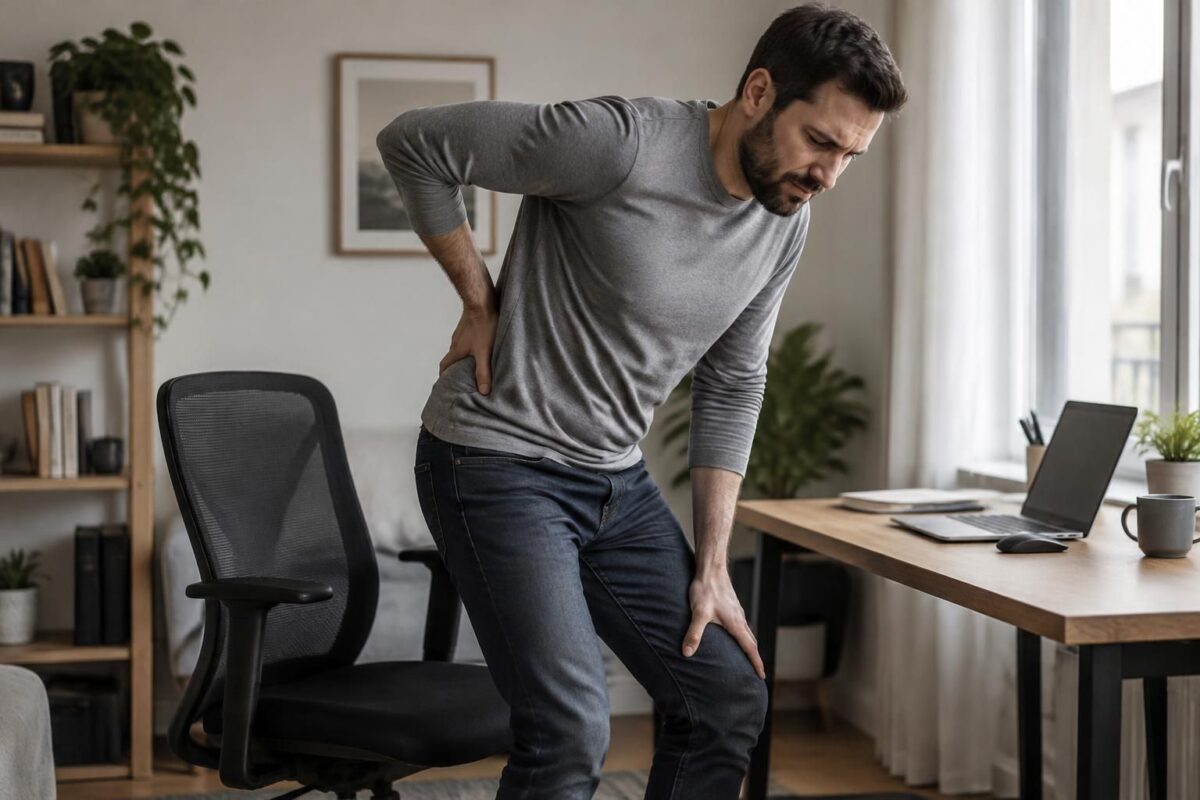
Sciatica and recurrent pain: why does it come back?
IN BRIEF Recurrent sciatica refers to pain that recurs from the lower back or buttock and may extend down the leg. It can be maintained by nerve irritation, a lumbar cause, or a too-rapid return to activities. An evaluation helps…

Sylvain Desforges, B.Sc., D.O., N.D., docteur en ostéopathie
Dr Sylvain Desforges, B.Sc., D.O., N.D., osteopath, is the founding president of TAGMED and of the ACMA association. He dedicates his practice to chronic spinal pain, low back pain and symptoms compatible with sciatica, particularly when pain radiates toward the buttock, leg, calf, foot or toes.
Through SOS Sciatique, he publishes educational content on sciatica symptoms, possible causes such as disc herniation, disc narrowing, foraminal stenosis or irritation of a lumbar nerve root, as well as non-surgical approaches that may be considered according to the evaluation. At Clinique TAGMED, care may include, depending on the case, motorized neurovertebral decompression, specific osteopathic care or precision percussion.
For an evaluation related to sciatica treatment in Montreal / Mount Royal or sciatica treatment in Terrebonne, please consult the services available at Clinique TAGMED.
Medical disclaimer
The information published on SOS Sciatique is provided for educational purposes only and does not replace a consultation, diagnosis, opinion or treatment provided by a physician or another authorized healthcare professional. The author of this article is neither a medical doctor nor a specialist in a medical specialty recognized by the Collège des médecins du Québec. The osteopathic, manual medicine or functional support approaches described on this site do not constitute medical acts and are not intended to replace medical follow-up.
Consult a physician or emergency service in cases of loss of bladder or bowel control, anesthesia in the saddle area, significant or progressive weakness in the leg or foot, fever, recent trauma, severe pain or rapid worsening of symptoms. For more details, please read our Legal Notice.