


Sciatica in Terrebonne: intermittent pain or constant pain?
20/09/2026
Herniated disc and cauda equina syndrome: warning signs
20/09/2026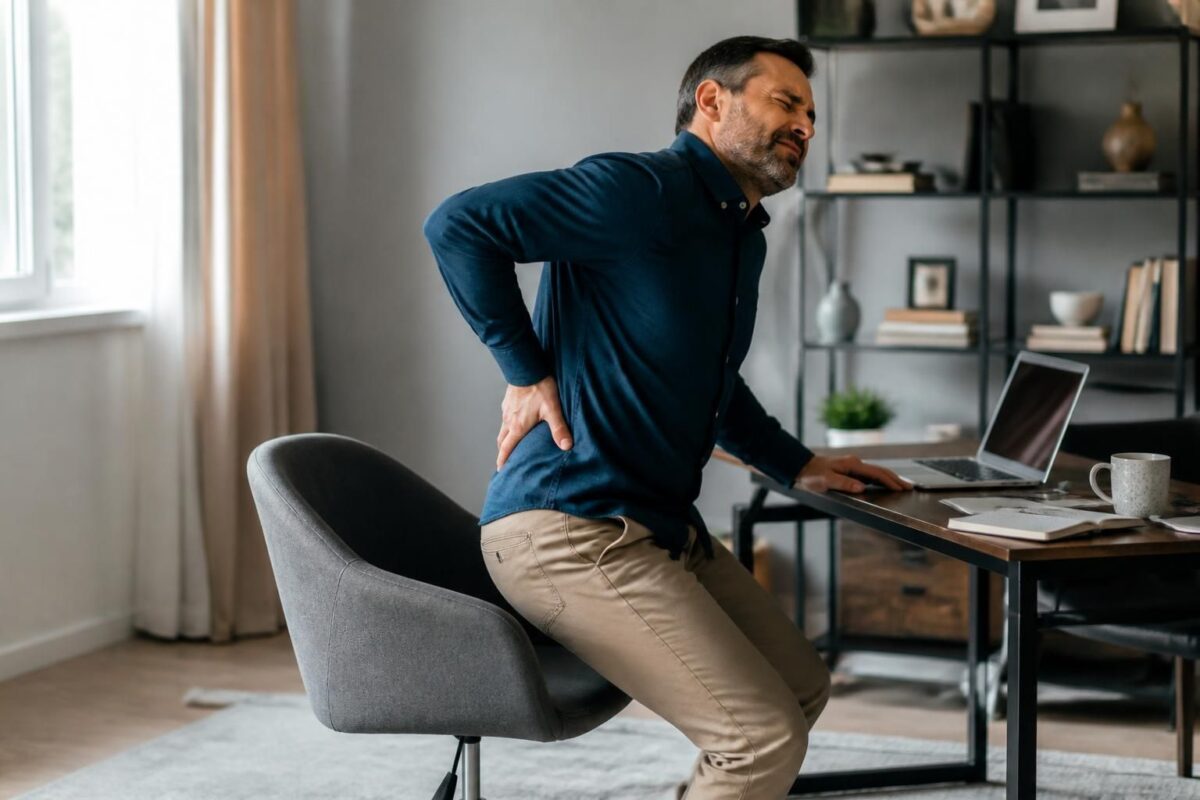
IN BRIEF In brief, sciatica and pain when getting up from a chair refer to lower back discomfort triggered by the transition from sitting to standing, often related to irritation of a lumbar nerve root or poor posture. What is it? A pain that occurs upon standing and may radiate down the leg. What are the benefits? Simple and non-invasive solutions for quick relief, improved mobility, and prevention of chronicity. How does it work? We optimize ergonomics, perform active breaks and easy stretches, and adopt coordinated breathing; if it persists, consult a professional. In Montreal, this approach is useful for professionals and anyone seeking practical steps for back pain and sciatica. |
The transition from a sitting position to standing can trigger lower back pain often associated with Sciatica. This pain frequently occurs after long periods of inactivity and results from muscle tension, inadequate posture, and strain on the lumbar discs and nerve roots.
To prevent and relieve, prioritize active breaks every 30 to 45 minutes, check and adjust your seat, and practice stretches and gentle strengthening exercises targeting the spine and hips. If symptoms persist, worsen, or radiate down the leg, consult a healthcare professional promptly.
This guide, written by a healthcare professional, explores why sciatica may occur when transitioning from a chair to standing. It describes possible mechanisms, signs to watch for, and practical tips to improve mobility and reduce pain in daily life, while indicating when to seek advice and where to find appropriate care in Montreal and Terrebonne.
Sciatica can manifest during the sitting-to-standing transition as pain that starts from the lower back and may radiate to the buttock, thigh, then calf or foot. This pain can be sharp or dull, sometimes accompanied by burning or tingling sensations. Irritation of a lumbar nerve root is often involved.
Causes and Simple Mechanisms
Prolonged sitting posture increases pressure on the lumbar spine and can lead to stiffness. Postural muscles may weaken, which can lead to tension when standing. The transition to standing requires coordination between the lumbar area and hips; poor synchronization can trigger pain radiating down the leg.
Warning Signs and When to Consult
Consult promptly if the pain is sudden or persists for more than 2 to 3 weeks despite usual measures. Seek evaluation if it is accompanied by weakness, numbness, tingling in one leg, or loss of control of the bladder or bowel. Pain that radiates down to the foot may suggest radiculopathy and requires appropriate assessment.
Simple Self-Tests and Observations
Posture test: ask someone to observe you as you stand up after getting up. Note if your back is rounded, shoulders are drooping, or pelvis is misaligned. Quickly correct your posture and observe if the pain improves after a few seconds.
Rising test: sit down, place one foot in front of the other, and stand up slowly. If pain appears in the lower back while rising, this may reveal muscle overstrain or hip limitations.
What You Can Do in the Short Term
Change positions every 30 to 45 minutes. Take a few steps, slightly twist your torso, and breathe slowly during the movement. Calm breathing can help prevent excessive contraction of the lumbar muscles and facilitate standing up.
Approach and Treatments to Consider
For an evaluation and tailored treatment plan, contact the TAGMED Clinic in Montreal or Terrebonne. Management options can be discussed based on the evaluation, including specialized approaches offered by TAGMED. Don’t hesitate to discuss the most appropriate alternatives for your case with your physician.
Training and professional resources: osteopaths and healthcare professionals are trained at institutes such as NUMSS and NAO, as well as recognized organizations like the National University of Medical Sciences and National Academy of Osteopathy.
Additional resources and readings:
Sciatica in Terrebonne — pain behind the thigh
Pain in the foot while walking
Neurovertebral decompression and other options to discuss with your physician
For additional items, also check the following resources: TAGMED Clinic and Sos Sciatica.
Institutional links and associations: the training and organizations followed by healthcare professionals include recognized associations like ACMA (Canadian Alliance of Alternative Medicine) and professional bodies such as the College of Canadian Osteopaths and the College of Canadian Osteopaths.
Useful sites: Sos Sciatica, Pain in the leg after prolonged standing, Pain while sitting with tingling.
Medical disclaimer: The information and advice provided on this site do not replace the opinion, diagnosis, or treatment of a healthcare professional. Please note that Dr. Sylvain Desforges, osteopath, is neither a doctor of medicine nor a physician, and is not a specialist in a medical specialty as defined by the Collège des médecins du Québec. Manual medicine, functional medicine, and sports medicine as described on this site exclude any medical treatment or diagnosis made by a physician or specialist. Always consult your doctor for any medical questions. For more details, please read our full Legal Notice.
- Prolonged posture and pelvic tilt
- Lumbar compression due to inactivity
- Reduced mobility of postural muscles
- Inadequate chair with insufficient back or seat support
- Muscle-ligament tensions around the disc
- Adjustment of the seat and lumbar support
- Quick warm-up: tilts and rotations
- Breathing and relaxation during getting up
- Regular active breaks and light walking
- Strengthening the back and abdominal muscles

This guide explains why sciatica can manifest when getting up from a chair and offers simple gestures, self-tests, and practical advice to relieve pain and prevent recurrences. You will find concrete methods to improve your posture, prepare for movement, and reduce tensions when standing up from sitting.
Understanding the phenomenon when getting up
The pain that occurs when getting up can arise from a combination of joint, muscle, and nerve factors. A prolonged sitting position puts stress on the lumbar spine and can promote contraction of the postural muscles, resulting in stiffness and pain that arise with movement. When sciatica is involved, irritation or compression of a nerve root can radiate to the buttock, leg, or even the calf. Understanding this mechanics allows for smoother movements and targeting areas to strengthen or relax.
Simple self-assessments
To get started, quickly perform two tests at home to identify points to correct. The first involves sitting down, placing one foot slightly in front of the other, and, keeping your back straight, slowly getting up. If pain appears in the lower back or leg at the beginning of the movement, it may indicate muscle overuse or a limitation of hip or thigh mobility. The second test involves observing your posture with a third person or using your phone’s camera: rounded back, drooping shoulders, or tilted pelvis can reveal silent muscular imbalances that exacerbate pain when transitioning from sitting to standing.
Preparing for movement and relieving immediately
Gentle warm-up before getting up
Before getting out of your chair, perform pelvic tilts (forward/backward) and trunk rotations about ten times each. This warm-up prepares the joints and muscles to move without jarring the back.
Breathing and relaxation
Adopt a slow and fluid breathing pattern during the movement. Inhale before moving, exhaling while standing up, like a long sigh. You can also practice an “explosive” breath to maintain fluid breathing and avoid blocked efforts.
Stretches and targeted movements
Integrate simple exercises: back stretch in standing position with hands touching the feet without forcing the knees; slight flexion of hamstrings; gentle trunk twists while remaining seated. These gestures relieve tension and improve the mobility of the muscle chains that support the back.
Good practices in daily life
Improve your workstation with an ergonomic chair providing lumbar support, and adjust its height so that your feet rest flat and your knees are in a natural hip opening. Take regular breaks: stand up, walk a few steps, and do some simple stretches to boost circulation and prevent stiffness. Integrate trunk strengthening exercises and gentle coordination movements to encourage lasting stability when getting up, such as floor bridges, simple planking, and pelvic lifts.
When to consult and what a professional can suggest
Consult promptly if the pain is sudden, persists for more than fifteen days despite adjustments, is accompanied by a loss of strength, significant tingling, or a failure of improvements with the measures described. The doctor may refer to a physiotherapist, osteopath, or specialist depending on the source of the pain. A personalized self-rehabilitation and strengthening plan can then be established to secure your movements and sustainably reduce episodes of pain when transitioning from sitting to standing.
Errors to avoid
Avoid forcing during stretches when pain is present, ignoring signals from your body, or persisting in a prolonged static position. Maintaining postural habits without adaptation can turn temporary discomfort into chronic pain. Instead, adopt a gradual progression and consult if necessary.
| Axis | Concise Element |
|---|---|
| Trigger | The transition from sitting → standing can trigger lower back pain and sometimes sciatica. |
| Typical Signs | Localized pain in the lower back, possible radiation, and stiffness when standing up. |
| Aggravating Factors | Prolonged posture, unsuitable chair, and lack of movement. |
| Mechanism | Flexion then lumbar extension mobilizing the muscles and joints. |
| Role of Ergonomics | An ill-fitting chair multiplies pressure points on the lower back. |
| Immediate Measures | Warm-up, active breaks, gentle stretches, controlled breathing. |
| Long-term Strategies | Strengthening deep muscles and improving ergonomics at the workstation. |
| Warning Signs | Pain worsening, loss of strength, numbness, or more extensive radiation. |
| When to Consult | If it persists >15 days or worsens despite adjustments. |
Testimonials on Sciatica and Pain while Getting Up from a Chair
“Before, every time I got up from a chair, it triggered intense pain in the lumbar region that radiated down to the sciatica. After applying some simple posture tips and doing targeted exercises, I now get up smoothly and the pain is much less present.”
“At the office, an ill-adjusted chair accentuated my painful sensations during the transition from sitting to standing. By adopting a suitable seat and taking short active breaks, my end-of-day wake-ups have become much more bearable.”
“For me, getting up has become the critical step when the pain radiates. Thanks to breathing techniques and light strengthening, my mobility has improved and I can resume my usual activities without fear.”
“I’ve noticed that targeted stretches and working on my hips have made a significant difference. Getting up is less challenging and the pain doesn’t linger as long throughout the day.”
“I’ve learned to listen to my body: a simple pelvic tilt movement followed by controlled breathing is sometimes enough to avoid pain when transitioning from sitting to standing.”
“Even in an open space, simple gestures can make all the difference: a well-adjusted chair, short breaks, and strengthening exercises have allowed me to get up without fear and without pain.”
Detailed Biography: Sciatica and Pain during the Sitting-to-Standing Transition
In the field of musculoskeletal pain, a clinician has established himself as a reference for Sciatica and the pain associated with transitioning from sitting to standing. An expert in osteopathy, naturopathy, and manual medicine, he has built a practice focused on the sustainable reduction of pain and the improvement of movement. His career has led him to direct innovative clinics and unite teams around a common goal: to provide evidence-based care tailored to patients’ daily lives.
His therapeutic approach relies on integrating advanced technologies with proven manual techniques. He prioritizes approaches such as motorized spinal decompression, laser therapy, and shockwave treatments, to optimize the treatment of lower back pain and Sciatica that manifest when getting up from a chair. This combination aims to restore alignment, relieve tension, and accelerate the recovery process while avoiding surgical solutions when possible.
The clinician explains that getting up from a chair can reveal a muscular imbalance and often underappreciated postural stresses. Prolonged sitting generates repeated pressure on the discs and stresses the nerve structures, which can amplify pain radiating into the buttock, thigh, or calf. The mechanism is rarely unique: lost posture, lack of activity, and deconditioning of stabilizing muscles, combined with inadequate workplace ergonomics.
To quickly assess the situation, he favors simple self-evaluations and functional observations. Tests can identify overuse of the lumbar muscles, limitations in hip mobility, or misalignment of the pelvis. He emphasizes the importance of observing one’s posture daily and testing tolerance to movement gently, to establish a personalized action plan.
In practice, prevention and treatment rely on concrete actions: micro-breaks every 30 to 45 minutes, targeted exercises to strengthen the pelvic floor and deep trunk muscles, and gradual stretching of the back and hamstrings. The objective is clear: to equip you to get up with less discomfort and regain ease in daily activities. Ergonomic advice on chair choice, height, and foot positioning complements the approach.
At the heart of his practice, patient education and autonomy are emphasized. Self-rehabilitation plans, adaptable at home, help maintain gains achieved during sessions and prevent the return of pain when getting up from a chair. Results show that when they engage in this program, many patients experience a noticeable improvement in their movement tolerance and a reduction in painful episodes, even after weeks of symptoms.
Continuously, the practitioner offers an integrated approach to care, based on evidence and tailored to each lifestyle. His commitment is to deliver care that allows people to get up without fear and to maintain that autonomy, day by day.
Quick summary: this conclusion reminds us that sciatica associated with pain during the sitting-to-standing transition can result from a combination of postures, deconditioned muscles, and sometimes lumbar nerve irritation. By prioritizing simple evaluations and practical actions, it is possible to provide rapid relief, prevent recurrences, and organize effective management with gradual exercises and daily adjustments.
Raising a chair places significant stress on the lower back and hip joints. When pain occurs as you transition from sitting to standing, it may reflect a sciatica or nerve irritation that can be associated with factors such as postural imbalance, weakness of supporting muscles, or accumulated muscle tension from prolonged sitting. In some cases, causes like a herniated disc or foraminal stenosis may play a role, but most situations can be managed effectively with simple adjustments and a gradual progression of movements.
To act quickly and sustainably, favor simple and accessible approaches. A brief warm-up before standing, controlled breathing during the transition, and a series of gentle stretches and targeted strengthening exercises can help restore movement tolerance and prevent painful episodes. Everyday actions, such as active breaks and modifications to your seating, can transform your work experience and reduce lower back tension.
Practical tips can significantly improve your chances of standing up without pain. Adjust your seat to support the natural curve of the back, prioritize regular breaks to walk and stretch, and gradually incorporate strengthening and core stability exercises that protect the lumbar spine. If pain persists despite these efforts, a professional evaluation is recommended to tailor the action plan and prevent worsening.
Alert signals should not be ignored. If pain occurs suddenly, persists beyond 15 days, is accompanied by loss of strength, significant numbness or radiates strongly into the leg, it is crucial to consult a doctor or specialist (physiotherapist, osteopath, or rheumatologist) quickly to identify the cause and adjust treatment. Early intervention often helps avoid prolonged periods of inactivity and sustainably improves quality of life.
To go further and enhance your understanding, you can explore additional resources on sciatica and the sitting-standing transition, including the articles and guides available on these pages: sciatica and calf pain when walking, numbness of the big toe and lower back pain, position to avoid, electric shock sensation in the calf, chair exercises, causes and solutions, leg pain when standing, pain after a long walk, causes, symptoms and definition, pain that returns after walking.

Sciatica and pain in lying position
IN SHORT sciatica in lying position refers to pain that follows the path of the sciatic nerve and can disrupt sleep. Sleeping on your back with a cushion under your knees or on your side with a cushion between your…

Sciatica and pain during sleep
IN BRIEF Sciatica during sleep is pain that follows the path of the nerve, from the lower back to the buttock and leg, and can intensify at rest. Sleeping on the side with a pillow between the knees or on…

Sciatica and pain after a long journey
IN BRIEF Sciatica after a long trip refers to pain that can radiate from the lower back to the buttock and leg, sometimes worsened by sitting and vibrations. To limit discomfort, adjust your seat, support your back, and take regular…

Sciatica and pain after driving
IN BRIEF Sciatica after driving is pain that can radiate from the lower back down into the leg and can worsen after a journey. Prolonged sitting, vibrations, and an improperly adjusted seat can contribute to discomfort. Adjusting your seat, maintaining…

Sciatica and pain after a day of sitting at work
IN BRIEF Sciatica after a day of sitting refers to pain that starts in the lower back or buttock and may radiate down the leg. Prolonged posture can accentuate discomfort. Regular breaks, a few minutes of walking, and an adequately…
Sciatica and pain after prolonged standing
IN BRIEF Sciatica is pain related to irritation of a nerve root, which can radiate from the lower back to the buttock and leg. Prolonged and immobile standing can promote or worsen symptoms, although it is not always the cause.…

Sciatica and pain after long walk
IN BRIEF sciatica after a long walk manifests as pain in the lower back or buttock that radiates down the leg, sometimes accompanied by tingling or numbness. Temporarily reduce the distance, take breaks, and resume walking gradually, without staying in…

Sciatica and pain after weight training
IN BRIEF Sciatica after weight training refers to pain that starts from the lower back or buttock and radiates down the leg, sometimes after a workout. Weight training is not always the cause or necessarily prohibited: a gradual return, a…

Dr Sylvain Desforges, B.Sc., D.O., N.D., osteopath, is the founding president of TAGMED and of the ACMA association. He dedicates his practice to chronic spinal pain, low back pain and symptoms compatible with sciatica, particularly when pain radiates toward the buttock, leg, calf, foot or toes.
Through SOS Sciatique, he publishes educational content on sciatica symptoms, possible causes such as disc herniation, disc narrowing, foraminal stenosis or irritation of a lumbar nerve root, as well as non-surgical approaches that may be considered according to the evaluation. At Clinique TAGMED, care may include, depending on the case, motorized neurovertebral decompression, specific osteopathic care or precision percussion.
For an evaluation related to sciatica treatment in Montreal / Mount Royal or sciatica treatment in Terrebonne, please consult the services available at Clinique TAGMED.
Medical disclaimer
The information published on SOS Sciatique is provided for educational purposes only and does not replace a consultation, diagnosis, opinion or treatment provided by a physician or another authorized healthcare professional. The author of this article is neither a medical doctor nor a specialist in a medical specialty recognized by the Collège des médecins du Québec. The osteopathic, manual medicine or functional support approaches described on this site do not constitute medical acts and are not intended to replace medical follow-up.
Consult a physician or emergency service in cases of loss of bladder or bowel control, anesthesia in the saddle area, significant or progressive weakness in the leg or foot, fever, recent trauma, severe pain or rapid worsening of symptoms. For more details, please read our Legal Notice.


