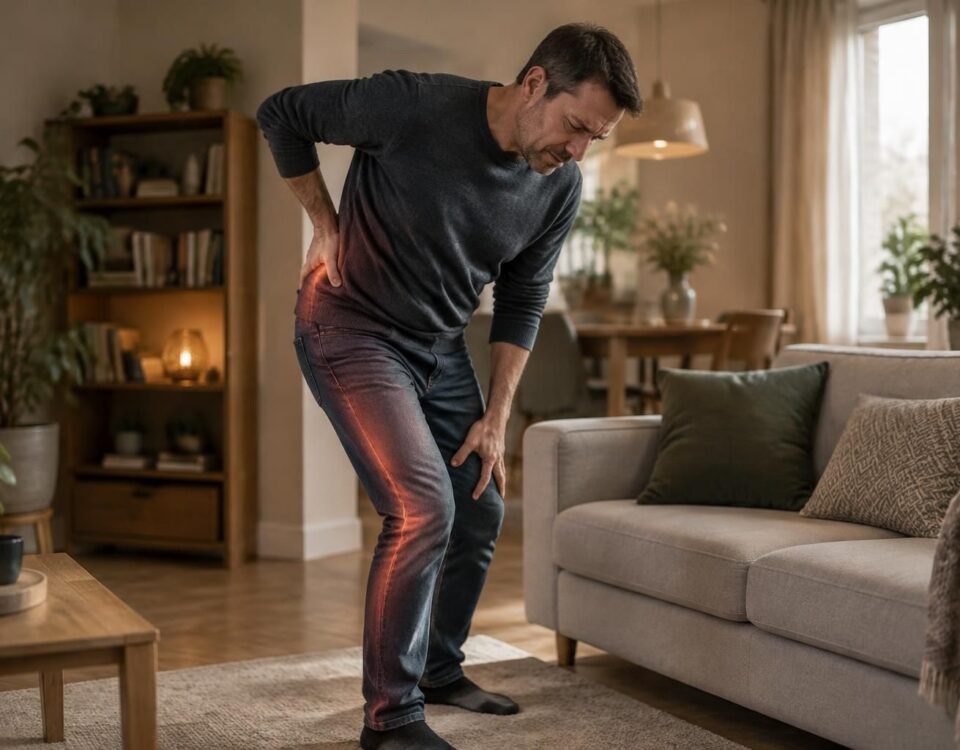
Sciatica in Terrebonne: understanding the L5-S1 foraminal compression
25/10/2026
Disc herniation and persistent pain in the leg
25/10/2026
IN BRIEF
| Sciatica aggravated in a seated position may be related to irritation of a nerve root, sometimes caused by a herniated disc. Remaining seated can exacerbate pain that radiates from the buttock down the leg, but this symptom alone is not sufficient to confirm a disc origin. Moving regularly and gradually returning to activities may help; a healthcare professional can assess the cause and appropriate options. Seek emergency consultation in case of significant or progressive weakness, or urinary or bowel disturbances. |
Sciatica and aggravated pain in a seated position: think about the disc?
A sciatica-like pain aggravated in a seated position may be consistent with irritation of a lumbar nerve root, particularly related to a herniated disc. Flexing the back and prolonged pressure can then increase discomfort. However, this sign alone is not enough to confirm disc involvement: other causes are possible and a professional assessment can help direct the management.
Avoid prolonged immobility and change positions regularly, without forcing painful movements. Consult quickly if the pain worsens or persists. Significant or progressive weakness, loss of sensation in the perineum, or urinary or bowel disturbances require urgent medical evaluation.
Educational information: this content does not replace a consultation or medical diagnosis.
A sciatic pain that increases while sitting may be related to a lumbar disc, especially a herniation or protrusion. However, this sign alone is not sufficient to establish the cause: posture, irritation of a nerve root, and other back or hip issues can also contribute to the pain. Clinical examination helps guide the assessment and determine the course of action. The seated position alters the stresses on the lower back. For some individuals, sitting for long periods intensifies lower back pain and radiates into the buttock or leg. Trunk flexion, prolonged sitting, or repeatedly transitioning from sitting to standing can also exacerbate symptoms. Aggravated pain from sitting may therefore suggest a disc origin, but does not confirm it. The type of pain, its trajectory, its evolution, and the results of the examination are as important as the position that triggers it. To better understand this link, consult this article on sciatica aggravated in a seated position and a possible disc cause. The discs are located between the vertebrae. A herniated disc occurs when a part of the disc bulges and can irritate or compress a nerve root. This irritation can cause pain that starts from the lower back or buttock and radiates down the leg. The pain may be accompanied by tingling, numbness, or, less commonly, weakness. Pain that radiates down the leg does not always mean that the disc is compressing a nerve. MRI scans may also show disc changes in people who have no symptoms. Thus, the healthcare professional correlates the symptoms, the examination, and, when indicated, imaging studies. To learn more about the pathway of pain, read why a herniated disc may cause pain to radiate down the leg. Sciatica generally corresponds to pain related to irritation of a lumbar nerve root, often L5 or S1. The pain usually affects one side and may follow a specific pathway in the buttock, thigh, calf, or foot. Coughing or sneezing may sometimes aggravate the pain. An involvement of the L5 root may lead to pain on the side of the leg and the top of the foot, sometimes down to the big toe. Weakness in lifting the foot may also occur. Involvement of the S1 root may cause pain behind the thigh and calf, down to the heel or the outer edge of the foot. These pathways vary from person to person and do not, on their own, enable a diagnosis. If you have difficulty lifting your foot, you will find additional information on L5 sciatica accompanied by difficulty lifting the foot. The article on the frequency of L5 and S1 involvement in sciatica also presents the pathways associated with these roots. A disc protrusion describes a bulging of the disc. Degeneration refers to changes that occur in the disc over time. These imaging terms do not automatically mean that a nerve is compressed or that they explain the pain. Their significance depends on their concordance with the symptoms and examination. To distinguish these concepts, consult the pages dedicated to disc protrusion and lumbar degeneration as well as the causes, symptoms, and management of sciatica. Pain related to sitting is not always disc-related sciatica. Localized pain in the lower back, irritation of other tissues, a hip problem, or prolonged sensitivity to the same posture can produce similar discomfort. The location, duration, and evolution of symptoms help to differentiate them. Discomfort that primarily appears after a long period of sitting may be influenced by posture and the work environment. These resources address seated positions in the office, in the car, or at home: prolonged sitting and sciatica, tips for sitting with sciatica, sitting position and sciatica, and positions to consider when sitting for long periods. These general tips do not replace an evaluation. The most comfortable posture varies by individual. If a position significantly increases pain or causes new symptoms, avoid maintaining it and seek advice from a healthcare professional. The assessment begins with questions about the onset of pain, its trajectory, aggravating factors, and associated symptoms. The professional then examines mobility, sensitivity, strength, and certain reflexes. They particularly look for signs that may indicate significant nerve involvement. An MRI is not necessary for all sciatica cases. The doctor may request one if the signs are concerning, if symptoms persist despite management, or if the results may change the treatment. Any anomaly visible on imaging must always be interpreted in light of the examination and the person’s history. Avoid staying in a position that significantly exacerbates symptoms for long periods. You can change positions regularly and adjust your seat to find a more comfortable sitting posture. There is no single posture that works for all sciatica cases. Also, avoid prolonged strict rest unless a professional has given you specific instructions. Do not start medication or extend self-medication without appropriate advice. Some medications have contraindications or interactions. A doctor or pharmacist can help you choose an option that takes your health status into account. At TAGMED Clinic, an assessment may enable discussion of non-surgical options suitable for the situation. Depending on the case, care may include specific osteopathy or motorized neurovertebral decompression. These approaches do not replace a medical diagnosis and are not suitable for everyone. To learn about available services, consult the TAGMED Clinic. Consult without delay in case of loss of urinary or bowel control, numbness around the perineum, or significant or progressive weakness of the leg or foot. These signs may indicate nerve impairment that requires urgent evaluation. A fever, recent trauma, very intense pain, or rapid worsening also justify a quick medical assessment. In case of an emergency, contact emergency services. Do not delay this step to try manual treatment or another approach. Sylvain Desforges, B.Sc., D.O., N.D., osteopath and naturopath, is the founding president of TAGMED and the ACMA association. His practice focuses on chronic pain of the spine, lower back pain, and pain associated with sciatica, especially when the pain radiates towards the buttock, leg, calf, foot, or toes. Through SOS Sciatique, he publishes educational content on sciatica symptoms, its possible causes—such as herniated disc, disc pinching, foraminal stenosis, or irritation of a lumbar nerve root—and the non-surgical approaches that may be considered based on the evaluation. At TAGMED Clinic, care may include, depending on the case, motorized neurovertebral decompression, specific osteopathy, or a precision impactor. For an evaluation, consult the information on sciatica treatment in Montreal or Mont-Royal and sciatica treatment in Terrebonne. Medical disclaimer: The information and advice provided on this site do not replace the advice, diagnosis, or treatment of a healthcare professional. Please note that Sylvain Desforges, B.Sc., D.O., N.D., Doctor of Osteopathy, is neither a medical doctor nor a physician, and is not a specialist in a medical specialty as defined by the College of Physicians of Quebec. Manual medicine, functional medicine, and sports medicine as described on this site exclude any treatment or medical diagnosis made by a physician or medical specialist. Always consult your doctor for any medical questions. For more details, please read our Complete Legal Notice.Why can sitting increase sciatic pain?
The possible role of the lumbar disc
What symptoms may indicate disc-related sciatica?
A protrusion or degeneration does not prove the cause
Pain while seated may have other causes
How does the professional assess sciatica?
What to do when sitting increases the pain?
When should you consult immediately?
About the author
Medical disclaimer
What sitting posture may indicate
- A pain radiating from the lower back or buttock down into the leg may correspond to sciatica.
- A worsening while sitting may be compatible with irritation of a nerve root, sometimes linked to a lumbar disc.
- This sign alone does not confirm a herniated disc: other causes are possible.
Good reflexes
- Avoid prolonged immobility and gradually resume tolerated movements progressively.
- Have a persistent, atypical pain or one accompanied by numbness or weakness evaluated.
- Consult urgently in case of urinary or bowel disturbance, numbness of the perineum, or significant weakness that is progressing.

A sciatica pain that worsens in a sitting position may be related to irritation of a nerve root, sometimes associated with a lumbar disc, but this sign alone is not sufficient to establish the cause. The pathway of the pain, its evolution, and the clinical examination help guide the next steps. In the meantime, adjust the position, move regularly, and consult quickly if alarm signs appear.

Sciatica and pain that descends slowly
IN BRIEF Sciatica is a pain that often starts in the lower back or buttock and gradually descends into the leg, sometimes reaching the foot, when a nerve root is irritated. It may be accompanied by tingling or numbness and…

Disabling sciatica: what to do when the leg limits activities?
IN BRIEF A debilitating sciatica causes pain that travels down the leg and can limit walking, sleeping, or daily activities. If your leg is holding you back, have the cause evaluated and adjust your activities without straining: non-surgical approaches may…
Why can sitting increase the pain?
Sciatica refers to pain that generally starts from the lower back or buttock and radiates down into the leg. It is often related to irritation of a lumbar nerve root. A herniated disc may be the cause: certain sitting positions or movements may then exacerbate symptoms in some individuals.
However, increased pain while sitting does not prove that a disc is affected. Muscles, joints in the back or hip, and other structures can also contribute to the pain. The piriformis syndrome, for example, can cause pain in the buttock and sometimes along the leg. Only a healthcare professional can evaluate the possible causes based on your symptoms and an examination.
Identify the pathway and triggering factors
Note if the pain radiates below the knee, down to the foot or toes, and if it is accompanied by tingling, numbness, or weakness. Also observe if it worsens while sitting, bending, coughing, or sneezing. This information is useful during a consultation but does not alone allow for a diagnosis.

Moderate sciatica: when to consult?
IN BRIEF A moderate sciatica is pain that starts from the lower back and radiates down into the buttock or leg, sometimes accompanied by tingling. If it limits your activities, persists, or worsens, consult a healthcare professional to assess the…

Mild sciatica: should we still keep an eye on it?
IN BRIEF A mild sciatica causes moderate pain that can radiate from the lower back to the buttock and leg. While it often improves over time, monitor its progress, avoid prolonged rest, and maintain gentle activity according to your tolerance.…
What to do when sitting becomes painful?
Avoid staying in a position that significantly accentuates the pain for long periods. Stand up regularly, walk for a few minutes, and change your posture according to your tolerance. There is no ideal sitting position for everyone: prioritize a comfortable posture, with your feet supported, and adjust the height of your seat if necessary.
A gentle and progressive activity is generally preferable to prolonged strict rest. Short walks may be an option if they do not significantly worsen symptoms. However, avoid forced stretching, exercises that cause sharp pain, and aggressive manipulations, especially during the acute phase. If the pain persists or limits your activities, seek advice from a health professional before resuming an exercise program.

Severe sciatica: what signs warrant an evaluation?
IN BRIEF A severe sciatica is pain that radiates from the lower back or buttock down the leg and may be accompanied by nerve signs. A significant or progressive weakness, difficulties urinating or controlling bowel movements, or numbness in the…

Recurrent sciatica: symptoms that often come back
IN BRIEF Recurrent sciatica refers to the return of pain that starts from the lower back or buttock and radiates down one leg, sometimes all the way to the foot. Tingling or numbness may also reappear. A herniated disc or…
When to seek medical evaluation?
Consult a professional if the pain is significant, worsening, recurring frequently, or not improving. The evaluation particularly focuses on strength, sensitivity, and reflexes. Imaging, such as an MRI, is not systematic: its relevance depends on the examination, the duration of symptoms, and the presence of worrying signs.
Warning signs not to overlook
Consult immediately in case of loss of bladder or bowel control, numbness in the perineum, or significant or progressive weakness in a leg or foot. A fever, recent trauma, severe pain, or rapid worsening also justify prompt medical evaluation.
Medical warning: this content is educational and does not replace a consultation, diagnosis, or treatment by a licensed health professional. Osteopathy or functional support approaches do not replace medical follow-up.
| Observed Index | What it may indicate |
|---|---|
| Pain that increases when seated | Possible lumbar irritation, sometimes related to a disc. |
| Pain starting from the lower back or buttock | A lumbar origin is possible. |
| Pain that descends below the knee to the foot | A path compatible with nerve irritation, notably sciatica. |
| Worsening when coughing or sneezing | Increased pressure may accentuate root pain. |
| Tickling or numbness in the leg | A clinical examination may clarify the affected area. |
| Isolated pain in the buttock, without irradiation | The disc is not the only possible explanation. |
| Progressive weakness, urinary issues, or numbness in the perineum | Consult immediately. |

Chronic sciatica: symptoms to watch for
IN BRIEF Chronic sciatica is a persistent pain that starts from the lower back or buttock and radiates down the leg, sometimes to the foot. Burning, tingling, numbness, or weakness may also occur. Identifying these symptoms helps obtain an evaluation…

Subacute sciatica: persistent symptoms
IN SHORT Subacute sciatica refers to pain that follows the path of the sciatic nerve and persists for several weeks, often between 4 and 12 weeks. It may be accompanied by tingling, numbness, or pain in the buttock and leg.…
Illustrative testimonies: sciatica and worsened pain in seated position — think about the disc?
Transparency note: the testimonies below are fictional examples, written for educational purposes. They do not correspond to identifiable patients and do not replace a medical evaluation. Pain that increases when seated may be compatible with irritation of a nerve root, sometimes related to a lumbar disc, but this sign alone is not sufficient to establish a diagnosis.
“After half an hour sitting at the office, the pain started from the lower back and buttock and descended behind my thigh. I thought I surely had a herniated disc. The evaluation helped me understand that the location and other signs also mattered: pain alone does not indicate what structure is involved.” — Marc, fictional testimony
“In the car, the pain became stronger, and I sometimes had tingling down to my foot. I was explained that prolonged sitting can further irritate certain lumbar pains, especially when a nerve root is sensitive. However, this did not prove that my disc was responsible.” — Sophie, fictional testimony
“I was worried because sitting was more painful than walking slowly. The professional advised me not to draw conclusions solely based on this symptom and to have my strength, sensitivity, and the path of the pain checked. This approach reassured me and helped me know better what to monitor.” — Alain, fictional testimony
When a sciatica is related to a herniated disc, the pain may start in the lumbar region or buttock and descend into the leg. Pain worsened in a seated position may occur, but it can also have other causes. The path — for instance, towards the top of the foot or towards the heel — as well as any numbness, tingling, or changes in strength help the health professional direct their evaluation.
It is useful to note what modifies the symptoms: time spent seated, walking, coughing or sneezing, and the area where the pain spreads. Avoid staying still for long if it increases discomfort, but do not force a movement that causes significant pain. A health professional can determine if a consultation or tests are indicated; imaging is not systematic for every type of sciatica-related pain.
Consult immediately in case of loss of urinary or bowel control, numbness in the saddle region, significant or progressive weakness in the leg or foot, or pain accompanied by fever or occurring after recent trauma.
About the author
Sylvain Desforges, B.Sc., D.O., N.D., is an osteopath and naturopath, founding president of TAGMED and the ACMA association. His educational content particularly addresses spinal pain and symptoms compatible with sciatica. The approaches presented may vary according to the evaluation and do not replace medical follow-up.
Medical warning
This content is provided for informational purposes and does not replace a consultation, diagnosis, or treatment by a physician or another licensed healthcare professional. The author is neither a physician nor a specialist in a medical specialty recognized by the Collège des médecins du Québec. Osteopathic, manual medicine, or functional support approaches do not constitute medical acts and do not substitute medical follow-up.
Sciatica and worsened pain in seated position: should we think about the disc?
A sciatica-type pain that increases in seated position may suggest irritation of a lumbar nerve root, sometimes related to a herniated disc. However, this sign alone does not allow for a diagnosis. Sciatica generally refers to pain that starts from the lower back or buttock and descends into the leg, sometimes reaching the foot. Its path depends on the nerve root involved.
Sitting, the lower back can be more stressed, especially when the torso leans forward or the posture is maintained for a long time. In some individuals, these positions exacerbate symptoms associated with disc or nerve irritation. Pain can then take the form of a burning sensation, an electric shock, or a sharp pain. It may also be accompanied by tingling or a feeling of numbness. However, increased discomfort while sitting can have other causes: sensitivity of the lumbar joints, muscle tension, or another condition of the back or hip.
A herniated disc occurs when a part of the disc between two vertebrae bulges and irritates a nerve root. The location of the pain and the clinical examination help the healthcare professional to assess whether this mechanism is plausible. For example, pain radiating down to the top of the foot or big toe may indicate involvement of the L5 root, while pain going towards the heel or the sole of the foot may suggest S1 involvement. These markers do not replace an individual assessment.
The diagnosis usually begins with a discussion about the symptoms, their duration, their evolution, and the activities that modify them. An examination may evaluate strength, sensitivity, reflexes, and certain movements. An MRI is not systematic upon the onset of typical pain: it is particularly considered if concerning signs are present, if symptoms persist despite appropriate management, or if an intervention is being discussed. The healthcare professional determines the relevant examinations according to the context.
While waiting for an assessment, it is generally better to avoid prolonged immobility and to gradually resume tolerated activities. Changing positions regularly, interrupting sitting periods, and walking gently can help maintain movement without forcing through significant pain. Medications should be used with the advice of a professional, taking contraindications into account. Vigorous manipulations are not indicated without prior assessment, especially when symptoms are intense or unusual.
Consult promptly if the pain is accompanied by significant or progressive weakness in the leg, a new difficulty in lifting the foot, loss of sensation in the perineal area, or urinary or intestinal disorders. Fever, recent trauma, severe pain that rapidly worsens, or altered general condition also require medical advice. These signs should not be automatically attributed to a herniated disc.
About the author
Sylvain Desforges, B.Sc., D.O., N.D., osteopath and naturopath, is the founding president of TAGMED and the ACMA association. He dedicates his practice to chronic spinal pain, lower back pain, and pain compatible with sciatica. His background focuses on health innovation and the integration of functional approaches and technologies, such as motorized decompression, laser therapy, and shockwave therapy, as appropriate after evaluation. His goal is to provide support based on available data, tailored to the needs and situation of each individual.
Medical disclaimer
This text is provided for educational purposes and does not replace a consultation, diagnosis, opinion, or treatment by a physician or another licensed healthcare professional. The author is neither a physician nor a specialist in a medical discipline recognized by the Collège des médecins du Québec. Osteopathy, manual medicine, or functional support approaches do not constitute medical acts and do not replace medical follow-up. In the presence of urgent signs, contact emergency services.
A sciatica worsened when sitting may be compatible with irritation of a lumbar nerve root, sometimes related to a hernia or disc protrusion. However, this reaction alone is not enough to confirm a disc origin: posture, duration of sitting, tissue sensitivity, and other possible causes must also be considered. The evolution of symptoms and associated signs helps determine the next steps.
Why can sitting accentuate pain?
In a sitting position, the lower back often remains flexed and the hips bent. In some people, this posture increases symptoms or makes the pain more perceptible, especially after a prolonged period without movement. Pain can start from the lower back or buttock and radiate down into the thigh, calf, or foot. A burning sensation, electric shock, or tingling may also accompany nerve irritation.
A link between symptoms and a sitting position can therefore guide the evaluation but cannot alone identify the cause. For a better understanding of possible mechanisms, consult the information on disc protrusion and disc pinching, as well as on disc protrusion and nerve inflammation.
Think about the disc, without self-diagnosing
A lumbar disc herniation can irritate or compress a nerve root and trigger pain following a recognizable path. Involvement of the L5 root may be accompanied by pain towards the top of the foot and the big toe, sometimes with difficulty lifting the foot. S1 involvement can produce pain towards the back of the calf and the outer edge or sole of the foot, sometimes accompanied by difficulty standing on tiptoe. These signs warrant evaluation, without alone confirming the level involved. To learn more, see the pages on sciatica L5 and difficulty lifting the foot and sciatica S1 and difficulty standing on tiptoe.
Other structures or issues may also contribute to pain felt while sitting. A professional examination allows for consideration of the pain trajectory, muscle strength, sensitivity, reflexes, symptom history, and their evolution. General information provided by Doctolib on sciatica and by SGCA on this condition can complement this information, without replacing a consultation.
Adjust seating and gradually resume movement
It is generally not necessary to stay in bed or avoid all movement. If sitting exacerbates the pain, try varying your postures and regularly interrupt prolonged periods by getting up or walking gently, depending on your tolerance. Adjusting the seat and comfortably supporting the lower back can also help some people. Additional advice is offered on how to sit when you have sciatica, as well as on positions to avoid for sleeping and positions that may exacerbate pain.
A gradual return to activities, tailored to symptoms and the assessment of a professional, is generally preferable to prolonged immobility. However, avoid movements or exercises that cause significant and persistent worsening. The evolution of pain associated with a herniated disc varies from person to person; factors that may modulate it are presented in this article on the factors influencing the evolution of a herniated disc and sciatica.
When to seek prompt evaluation?
Quickly consult a healthcare professional if the pain persists, intensifies, radiates down the leg, or is accompanied by numbness or weakness. Significant or progressive weakness, new difficulty lifting the foot, or walking on tiptoes deserves particular attention.
A loss of control of the bladder or bowels, difficulty urinating, numbness in the perineal area, fever, or severe pain after trauma requires urgent evaluation. These signs should not simply be attributed to sitting posture or presumed disc issues.
About the author
Sylvain Desforges, B.Sc., D.O., N.D., osteopath and naturopath, is the founding president of TAGMED and the ACMA association. He dedicates his practice to chronic spinal pain, lower back pain, and pain compatible with sciatica, particularly when the pain radiates to the buttock, leg, calf, foot, or toes.
Through SOS Sciatique, he publishes educational content on the symptoms of sciatica, possible causes such as herniated discs, disc pinch, foraminal stenosis, or irritation of a lumbar nerve root, as well as non-surgical approaches that may be considered based on assessment. At TAGMED Clinic, care may include, depending on the case, motorized neurovertebral decompression, specific osteopathy, or precision percussion.
For an evaluation related to sciatica treatment in Montreal / Mount Royal or sciatica treatment in Terrebonne, check the available services at the TAGMED Clinic.
Medical disclaimer
Information published on SOS Sciatique is provided for educational purposes and does not replace a consultation, diagnosis, opinion, or treatment done by a doctor or other licensed healthcare professional. The author of this article is neither a doctor nor a specialist in a medical specialty recognized by the Collège des médecins du Québec. The osteopathy, manual medicine, or functional support approaches described on this site do not constitute medical acts and are not intended to replace medical follow-up.
Consult a doctor or emergency service in case of loss of urinary or bowel control, anesthesia in the saddle area, significant or progressive weakness of the leg or foot, fever, recent trauma, severe pain, or rapid worsening. For more details, please read our Legal notice.

Sylvain Desforges, B.Sc., D.O., N.D., docteur en ostéopathie
Dr Sylvain Desforges, B.Sc., D.O., N.D., osteopath, is the founding president of TAGMED and of the ACMA association. He dedicates his practice to chronic spinal pain, low back pain and symptoms compatible with sciatica, particularly when pain radiates toward the buttock, leg, calf, foot or toes.
Through SOS Sciatique, he publishes educational content on sciatica symptoms, possible causes such as disc herniation, disc narrowing, foraminal stenosis or irritation of a lumbar nerve root, as well as non-surgical approaches that may be considered according to the evaluation. At Clinique TAGMED, care may include, depending on the case, motorized neurovertebral decompression, specific osteopathic care or precision percussion.
For an evaluation related to sciatica treatment in Montreal / Mount Royal or sciatica treatment in Terrebonne, please consult the services available at Clinique TAGMED.
Medical disclaimer
The information published on SOS Sciatique is provided for educational purposes only and does not replace a consultation, diagnosis, opinion or treatment provided by a physician or another authorized healthcare professional. The author of this article is neither a medical doctor nor a specialist in a medical specialty recognized by the Collège des médecins du Québec. The osteopathic, manual medicine or functional support approaches described on this site do not constitute medical acts and are not intended to replace medical follow-up.
Consult a physician or emergency service in cases of loss of bladder or bowel control, anesthesia in the saddle area, significant or progressive weakness in the leg or foot, fever, recent trauma, severe pain or rapid worsening of symptoms. For more details, please read our Legal Notice.