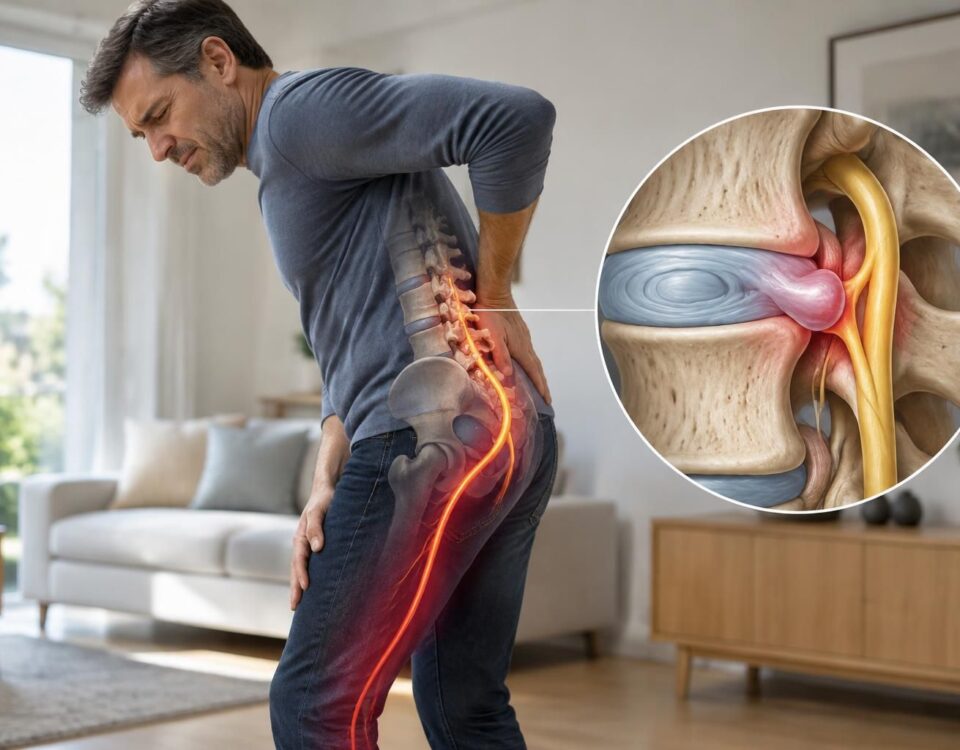
Sciatica and intermittent pain: is it reassuring?
05/08/2026
Sciatica and laptop: prolonged posture and lower back pain
05/08/2026
IN BRIEF
| In brief, sciatica is pain related to the irritation or compression of a lumbar nerve root, most often L5 or S1. The common causes include a herniated disc, arthritis, and spinal canal stenosis. This topic offers benefits: avoiding misinterpretations, understanding the path of the sciatic nerve, and guiding towards effective conservative treatments (appropriate physical activity, physiotherapy/osteopathy). How it works: pain follows the path of the sciatic nerve from the lower back down to the leg and foot; understanding this pathway helps in quicker diagnosis and prioritizes non-surgical options. Accessible and useful for preventing recurrences through a progressive and holistic approach. |
Quick summary on sciatica: common causes and misinterpretations
- What is sciatica? Pain due to the irritation or compression of the sciatic nerve, the longest nerve in the body, which starts from the lower back and descends into the leg.
- Common causes:
- Lumbar herniated disc with nerve root compression.
- Lumbar arthritis and spinal canal stenosis causing progressive nerve compression.
- Piriformis syndrome where the gluteus muscle compresses the sciatic nerve.
- Other possible but less common causes: spondylolisthesis, infection, tumor, or vertebral fracture.
- Common misinterpretations:
- Confusing localized back pain with sciatica; sciatica is characterized by radiation down the leg.
- Thinking that all leg pain originates from the back without any other possible source.
- Assuming that imaging (MRI/CT) indicates the diagnosis without clinical correlation; treatment must rely on overall evaluation.
- Believing that strict rest resolves everything; movement and appropriate rehabilitation are priorities.
- Thinking that every sciatic pain requires surgery; surgery is a last resort, after evaluation and conservative treatments.
- Confusing postural or muscular pain with a nerve pathology; it is necessary to look for associated neurological signs (weakness, loss of reflexes, decreased sensitivity).
Sciatica is pain that follows the path of the sciatic nerve. It can be concerning, as the pain can be sharp and radiate to the buttock, thigh, leg, and sometimes the foot. This article, written by a healthcare professional expert in this field, provides a clear view of common causes and frequent misinterpretations. We distinguish radiculopathy, which is related to a lesion of a lumbar nerve root, from isolated low back pain. The goal is to understand the mechanisms and open suitable management paths without jumping to hasty conclusions.
Common causes
The lumbar herniated disc is one of the most common causes of sciatica. The disc may press on a nerve root and trigger pain that follows the path of the sciatic nerve. To delve deeper into the link between disc and nerve, you can refer to dedicated resources on specialized platforms.
Foraminal stenosis or spinal stenosis can also compress the nerve at the exit of the spine. This compression often manifests with symptoms that appear when walking and subside at rest.
Lumbar arthritis and spinal canal narrowing can promote pain radiating into the leg, particularly in older individuals. The pain can be bilateral or unilateral depending on the location of the compression.
The piriformis syndrome is another possible cause. The piriformis muscle can irritate or compress the sciatic nerve when it is tense or spasmed. This situation can mimic sciatica, but its treatment varies depending on the context.
Spondylolisthesis and other vertebral anomalies can also contribute to pain radiating down the leg, especially when vertebral displacement alters the space around the nerve roots.
Less common causes exist, such as tumor elements, infections, or vertebral fractures. These situations remain rare and require careful evaluation by a professional.
To understand the mechanisms between the lumbar spine and the sciatic nerve, refer to resources that describe the nerve’s pathway and the effects of its compression. For example, dedicated articles explain how low back pain can manifest with radiation down to the foot and why some signals do not seem to be localized only in the back.
For further insights on the links between the lumbar disc and the sciatic nerve, consult specialized resources on websites dedicated to sciatica in urban or provincial contexts. These resources also discuss the differences between back pain and pain that follows the nerve.
Common misinterpretations
A common error is to believe that all pain in the leg necessarily equates to a herniated disc or an urgent surgical situation. In reality, the pain may come from other mechanisms of compression or inflammation around the nerve root or the nerve itself, without requiring surgery.
It is common to confuse low back pain with radicular pain. Sciatica is not limited to the lower back; it can present as pain that descends along the leg. This distinction is essential for guiding the evaluation and treatment.
Another mistake is to believe that strict rest is the best means of healing. On the contrary, appropriate activity and a progressive approach promote recovery and reduce the risk of recurrence.
Some patients interpret neurological signs (weakness, difficulty walking on heels or toes, decreased reflexes) as minor symptoms. These signs may indicate more significant nerve damage and require further evaluation.
Finally, confusing lumbar pain with pelvic or joint pain can delay the correct diagnosis. A targeted clinical examination and, if necessary, additional assessments can clarify the diagnosis and avoid inappropriate treatments.
Key elements for a reliable evaluation
Assess the pain pathway: does it start from the lower back and descend to the buttock, thigh, and then the leg? Observe the factors that worsen or relieve the pain, such as prolonged sitting, coughing, or exertion. Note the possible presence of tingling, numbness, or weakness.
Differentiate local signs and neurological signs. Signs such as muscle weakness or loss of strength in the leg should raise concern and guide referral for specialized evaluation.
Consult specialized resources to delve into certain mechanisms and the assessment approaches used in clinical practice. Reliable resources provide a better understanding of the links between the lumbar spine and the sciatic nerve, avoiding simplistic interpretations.
Management options and practical advice
Sciatica management is guided by clinical evaluation and can combine general measures and specific treatments tailored to each case. Manual approaches and specialized assessments may be considered depending on the context and symptoms. In some cases, services offered by specialized clinics, such as the TAGMED Clinic, can be discussed during the initial evaluation.
For individuals seeking additional information, public and professional resources provide explanations about mechanisms and available options. Online sources allow exploration of the links between lumbar pain and foot pain, possible causes, and evaluation criteria.
Specific resources on safe approaches and choice of referral based on symptoms can help guide care decisions. These resources also help understand the risks and benefits of different therapeutic pathways.
References and associated resources
For additional information on approaches and evaluation criteria, you can consult specialized resources in the following areas: Safe approaches to sciatica in Montreal, Pain extending to the foot, Causes and diagnosis, and Link between lumbar spine and foot pain. Other useful resources cover the mechanisms and signs mentioned above on the reference sites in the sciatica field.
For information on treatments offered in clinic, you can consult the pages of the TAGMED Clinic and associated resources. These resources describe the available management options within the framework of a local clinical evaluation.
For questions related to diagnosis, pain, and nerve function, the resources described above provide a framework for understanding the signs and possible outcomes, while guiding towards medical consultation when necessary.
Medical disclaimer
Medical disclaimer: The information and advice provided on this site do not replace the opinion, diagnosis, or treatment of a healthcare professional. Please note that the osteopath author is neither a doctor of medicine nor a physician, and is not a specialist in a medical specialty as defined by the Collège des médecins du Québec. Manual medicine, functional medicine, and sports medicine as described on this site exclude any treatment or medical diagnosis made by a physician or specialist. Always consult your doctor for any medical questions. For more details, please read our complete Legal Notice.
Common causes
- Lumbar disc herniation compressing a root
- Lumbar stenosis or foraminal stenosis
- Disc protrusion without major deformation
- Lumbar osteoarthritis and narrowing of the canal
- Spondylolisthesis (slipping of a vertebra)
- Piriformis syndrome and muscle strains
- Root nerve compression of mechanical origin
Interpretation errors
- Thinking that any leg pain is due to a herniation
- Confusing lumbar pain and leg pain as the same origin
- Believing that medical imaging determines surgery alone
- Assuming that no movement should be done in acute pain
- Thinking that severity is proportional to initial intensity without deficit
- Ignoring the effectiveness of appropriate physical activity and physiotherapy
- Minimizing the importance of the posture/nutrition factor in recurrence

Quick summary: this article clarifies the common causes of sciatica and the common interpretation errors, to guide a reliable evaluation and appropriate management without overinterpreting symptoms or resorting excessively to imaging or surgery.
Common causes of sciatica
Sciatica is a sign of irritation or compression of a lumbar nerve, most often at the L5 or S1 roots. Understanding the most common causes helps avoid hasty interpretations and guides conservative treatments when indicated.
Lumbar disc herniation
The lumbar disc herniation is the main cause in young to middle-aged adults. The intervertebral disc can bulge out of its allocation and compress a nerve root, triggering pain that follows the path of the sciatic nerve down to the foot. This cause is often associated with lower back pain and radiating pain in the leg.
Foraminal stenosis and narrow lumbar canal
Foraminal stenosis or narrowing of the lumbar canal mainly affects older individuals. The space around the nerve gradually reduces, causing pain that may manifest during walking or exertion, sometimes bilaterally.
Other common mechanisms
Among other common causes, there is the piriformis syndrome (compression of the sciatic nerve by the piriformis muscle), degenerative joint alterations (osteoarthritis), and, in some cases, scenario factors such as minor trauma or anatomical variations. Although less frequent, these situations can predominate in certain patients and require a targeted approach.

L5-S1 protrusion and sciatic pain: pathway to the foot
IN BRIEF A L5-S1 disc protrusion is a disc that slightly bulges between the lumbar and sacral vertebrae. If it irritates a nerve root, pain may radiate from the lower back or buttock down the back of the leg to…

L4-L5 protrusion and sciatic pain: possible signs
IN BRIEF A L4-L5 disc protrusion is a bulging of the disc between two lumbar vertebrae. If it irritates the L5 nerve root, it can cause sciatica radiating from the buttock to the side of the leg and the top…
Frequent Misinterpretations
Misinterpreting the signs of sciatica can lead to inappropriate therapeutic choices. Here are the most common pitfalls and how to avoid them.
Confusing sciatica with simple back pain
Sciatic pain is a radiation that follows the path of the sciatic nerve and may target the buttock, thigh, leg, and sometimes the foot. Isolated back pain alone is not enough to conclude a sciatica; it is necessary to assess whether the pain radiates and is accompanied by neurological signs.
Thinking that all leg pains come from a herniation
A radiation does not necessarily mean a disc herniation. Other causes such as stenosis, piriformis syndrome, or musculoskeletal injuries can produce similar symptoms. The diagnosis requires a clinical examination and, if necessary, targeted additional tests.
Overestimating imaging or considering surgery too soon
Imaging tests can confirm an anomaly but do not always demonstrate the primary cause of the symptoms. The conservative approach (appropriate activity, physical therapy, osteopathy, medical check-ups) is effective in the majority of cases and avoids unnecessary interventions. Surgery remains a last resort when non-invasive treatments fail or when significant neurological deficits arise.
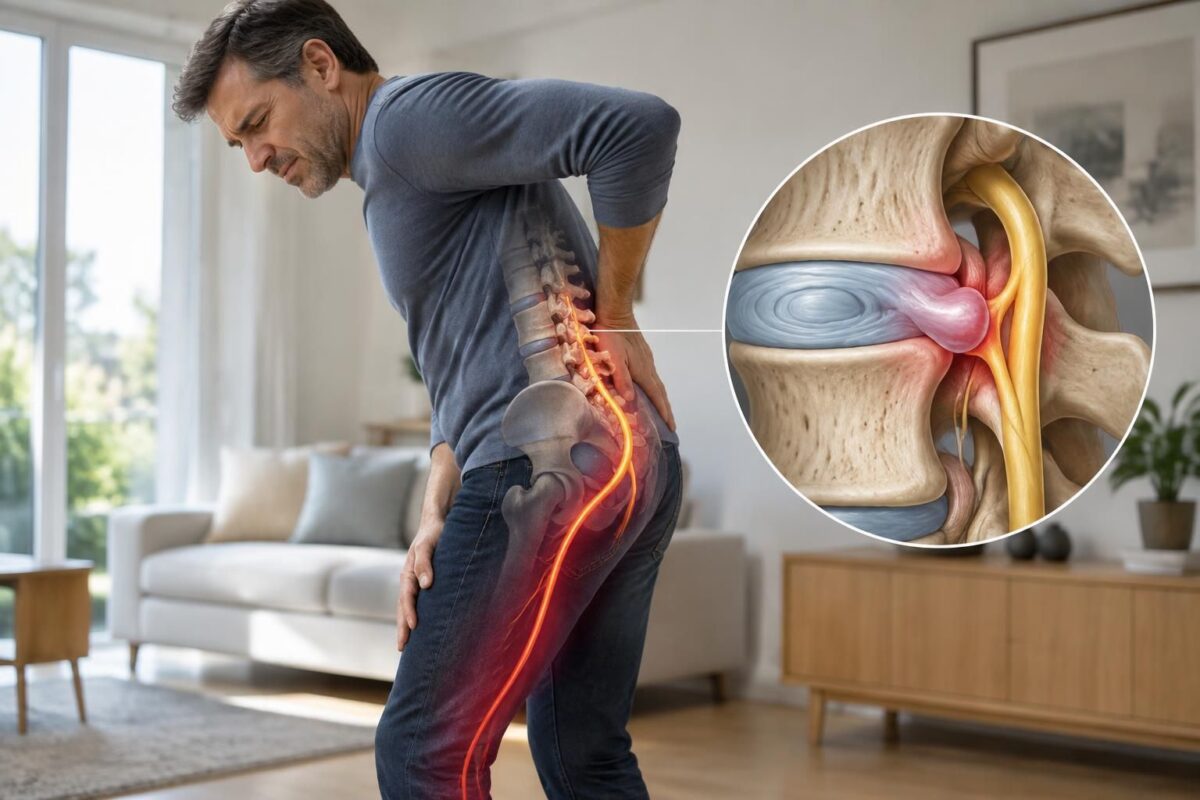
Disc protrusion and sciatica: when the disc touches a nerve root
IN BRIEF A disc protrusion is a disc that extends beyond its usual contour. If it irritates a nerve root, it can contribute to sciatica, with pain radiating into the buttock or leg, sometimes accompanied by tingling or weakness. An…

Herniated disc and sciatica: morning pain and lumbar stiffness
IN BRIEF A herniated disc can irritate a nerve root and cause sciatica, with lower back pain radiating down the leg. However, morning pain and lower back stiffness alone are not sufficient to confirm this diagnosis. An assessment helps guide…
Practical Recommendations
To act effectively, prioritize a clear evaluation and a progressive approach. Maintain appropriate physical activity, favor movements that do not worsen pain, and work with competent professionals (physiotherapist, osteopath) to correct compression mechanisms. Monitor warning signs and consult quickly in case of progressive weakness, loss of urinary control, or pain that worsens despite treatment.

Herniated disc and sciatica: night pain and factors to watch out for
IN BRIEF A herniated disc can irritate a nerve root and cause sciatica, sometimes more bothersome at night. Night pain alone is not enough to determine the cause: its variation according to positions, neurological examination and, if necessary, imaging help…

Herniated disc and sciatica: why the leg can be numb
IN BRIEF A sciatica is pain related to the irritation of a nerve root, sometimes caused by a <strongherniated disc. Pressure on the nerve can cause tingling, loss of sensation, or weakness in the leg. A healthcare professional can assess…
Common Causes and Misinterpretations of Sciatica
| Element | Concise Description |
|---|---|
| Lumbar disc herniation — Common cause | Compression of a lumbar nerve root, typically L5-S1, causing pain radiating down the leg. |
| Lumbar osteoarthritis and spinal canal stenosis — Common cause | Narrowing of the spinal canal and/or foramina → pain while walking and possible radiation. |
| Foraminal stenosis — Common cause | Narrowing of the foramina → compression of the roots; variable radiation worsened standing/walking, improved in flexion. |
| Piriformis syndrome — Common cause | Extrinsic compression of the sciatic nerve by the piriformis muscle; buttock pain sometimes radiating without demonstrated disc lesion. |
| Lumbar trauma or overuse — Common cause | Acute episode triggered by a shock or repeated effort, with radiculalgia sometimes without obvious discopathy. |
| Degenerative disc pain — Common cause | Nerve irritation related to disc wear; variable radiation depending on location and compression. |
| Misinterpretation: any lumbar pain = sciatica | Neglects precise evaluation of location and cause; can lead to incorrect treatment. |
| Misinterpretation: any leg pain = herniation | Other causes exist (piriformis, foraminal stenosis, osteoarthritis, musculoskeletal pain). |
| Misinterpretation: strict rest is the best solution | Staying active with appropriate activity and physical therapy promotes recovery. |
| Misinterpretation: quick surgery necessary | Surgery is rare and reserved for cases that do not respond to conservative treatment or present a neurological deficit. |

Herniated disc and sciatica: causes of recurring pain
IN BRIEF A herniated disc can irritate or compress a nerve root and cause sciatica, with pain radiating from the lower back to the buttock or leg and possibly returning. Symptoms and their causes are not always the same: an…

Herniated disc and sciatica: when to reassess symptoms
IN BRIEF A herniated disc can irritate a nerve root and cause sciatica, with pain that radiates down the leg. Reevaluating symptoms helps to track their evolution and determine if medical advice or tests are necessary, without assuming that surgery…
Testimonials on Sciatica: Common Causes and Misinterpretations
“At first, I thought my back pain was trivial and would go away by itself. Then the pain moved to my buttock and leg, with electric shocks. I was explained that it is often a lumbar disc herniation pinching a nerve root and triggering sciatica. Understanding this cause helped me quickly guide the treatment and not get stuck in prolonged rest.”
“I thought it all came from a tight muscle. We discovered a narrowing of the spinal canal related to lumbar osteoarthritis. This misinterpretation cost me time: the pain was radiating down the leg, and we needed to treat the source, not just the symptoms.”
“The doctor mentioned piriformis syndrome as a possible cause. I was surprised: pain that can start from the buttock without herniation. This explanation challenged the common idea that only the spine could be at fault. It is necessary to check peripheral causes and conduct the right examinations.”
“Another frequent misinterpretation is to believe that pain in the leg means that the spine is irreparably damaged. In reality, a radiculAlgo can be reversible with appropriate management and exercises, and it is important to distinguish simple back pain from sciatica for proper treatment.”
Dr. Sylvain Desforges, osteopath and expert in manual medicine, offers a clear clinical perspective on sciatica, its common causes, and the misinterpretations that fuel patients’ concerns. The radiculalgia characteristic of sciatica is pain related to the irritation or compression of a lumbar nerve root, most often L5 or S1. It typically starts in the lower back and radiates to the buttock, thigh, and leg, potentially reaching the foot. A persistent misconception remains: sciatica is seen as a unique and primary disease of the back. In reality, it is a complex symptom, evolving according to the precise path of the sciatic nerve and the structures surrounding it.
Among the common causes, the lumbar disc herniation remains the most prevalent in young and middle-aged adults: the disc cracks or protrudes from its space and compresses a nerve root, triggering pain along the nerve. Foraminal stenosis or narrowing of the lumbar canal, often associated with age, can also cause nerve compression and pain that extends to the leg. Other factors to watch for include piriformis syndrome, when the piriformis muscle compresses the sciatic nerve, and degenerative mechanisms like lumbar osteoarthritis. Although rarer, causes such as spondylolisthesis, tumors, or infections should be considered when the clinical picture suggests this.
Interpretation errors are common and can lead to inappropriate treatments. One of the most widespread is confusing an anomaly detected on imaging with a symptomatic cause: a disc herniation visible on an MRI does not necessarily explain the pain the patient feels, and some patients present with protruded discs without radicular pain. Another major point: believing that all pain radiating down the leg comes from a single lumbar mechanism, neglecting peripheral or alternative radicular causes. Moreover, there is sometimes an overestimation of the role of strict rest and an underestimation of the benefits of rehabilitation and appropriate movement. Finally, the error of segmenting the pain into “back pain” vs “leg pain” without evaluating the exact path of the nerve and motor deployment can delay the accurate diagnosis and appropriate treatment.
To avoid these traps, the assessment must combine detailed medical history, neurological examination, and, if necessary, targeted imaging studies, while remaining attentive to red flags such as alterations in urinary function, perineal sensory disturbances, or progressive weakness. Dr. Desforges emphasizes a patient-centered approach, prioritizing conservative treatments first when possible and tailored to the specific cause, with structured rehabilitation and a gradual return to physical activity.
Understanding common causes and interpretation errors helps avoid diagnostic dead ends and guides effective management. In practice, this involves combining precise anatomical knowledge with a functional approach to the patient in order to distinguish the real causes of pain and optimize long-term outcomes.
Sciatica is a pain related to irritation or compression of the roots of the sciatic nerve. This pain typically follows the path of the nerve, starting from the lower back and radiating to the buttock and leg, sometimes all the way to the foot. This detailed overview helps you distinguish the common causes from misconceptions and steer an appropriate care approach, without falling into the most common misinterpretations.
Among the common causes of sciatica, classical mechanisms rely on mechanical conflicts that irritate or compress lumbar roots, most often L5 or S1. The lumbar disc herniation is the major cause; the cracked disc can compress a root and trigger pain along the path of the sciatic nerve. Foraminal stenosis and narrowing of the lumbar canal can also cause radiating pain, especially in older individuals. The radiation can also occur when the piriformis or other structures exert pressure on the nerve. Less frequently, factors such as spondylolisthesis, a tumor, or a spinal infection may be involved. For a synthetic and practical view of the causes, you can consult the associated resources, including the MSD Manual and additional articles on Médecin Direct and Le Traumato.
Common interpretation errors often hinder assessment. A widespread idea is to confuse isolated back pain with sciatica, which can mask a different origin. Another trap: assuming that any pain in the lower body is due to a disc herniation, which can lead to inappropriate investigations or treatments. Understanding that the location of pain in the leg does not necessarily imply a lumbar origin requires a complete clinical assessment and correlation with neurological signs. To better understand the importance of location and path, refer to dedicated resources like this article on pain location and the relationship between lower back and leg.
Another point of caution: believing that surgery is invariably necessary. In most cases, conservative management – rehabilitation, adapted physical activity, and symptomatic treatments – is sufficient. Online resources and guides emphasize the importance of avoiding hasty decisions and prioritizing a progressive and coordinated approach. To enrich your understanding of non-surgical options and surgical indications, you can refer to dedicated analyses on avoiding hasty decisions and specialized reviews like spinal surgery.
For a practical and versatile approach, the following resources provide complementary perspectives on mechanisms, assessment, and conservative treatments and situations requiring intervention: Delivortho, Le Traumato, and Médecin Direct. For a general understanding of symptoms and treatments, you can also consult MSD Manual and the specialized resources mentioned above.

Dr Sylvain Desforges, B.Sc., D.O., N.D., osteopath, is the founding president of TAGMED and of the ACMA association. He dedicates his practice to chronic spinal pain, low back pain and symptoms compatible with sciatica, particularly when pain radiates toward the buttock, leg, calf, foot or toes.
Through SOS Sciatique, he publishes educational content on sciatica symptoms, possible causes such as disc herniation, disc narrowing, foraminal stenosis or irritation of a lumbar nerve root, as well as non-surgical approaches that may be considered according to the evaluation. At Clinique TAGMED, care may include, depending on the case, motorized neurovertebral decompression, specific osteopathic care or precision percussion.
For an evaluation related to sciatica treatment in Montreal / Mount Royal or sciatica treatment in Terrebonne, please consult the services available at Clinique TAGMED.
Medical disclaimer
The information published on SOS Sciatique is provided for educational purposes only and does not replace a consultation, diagnosis, opinion or treatment provided by a physician or another authorized healthcare professional. The author of this article is neither a medical doctor nor a specialist in a medical specialty recognized by the Collège des médecins du Québec. The osteopathic, manual medicine or functional support approaches described on this site do not constitute medical acts and are not intended to replace medical follow-up.
Consult a physician or emergency service in cases of loss of bladder or bowel control, anesthesia in the saddle area, significant or progressive weakness in the leg or foot, fever, recent trauma, severe pain or rapid worsening of symptoms. For more details, please read our Legal Notice.