



Sciatica and jogging: pain in the leg after effort
10/10/2026
Sciatica in Terrebonne: what does irritation of the S1 root mean?
11/10/2026
IN SHORT
| An irritation of the S1 root can cause pain of the sciatic type, often felt in the buttock, the back of the calf, or the edge of the foot, sometimes accompanied by tingling or weakness. In Montreal, an assessment clarifies the symptoms and guides non-surgical management based on each situation. Significant or progressive weakness, or loss of urinary or bowel control, requires urgent consultation. |
In Montreal, an irritation of the S1 nerve root can cause pain that starts in the lower back or buttock and travels down the back of the thigh and calf to the outer edge of the foot. Tingling, numbness, or difficulty standing on tiptoes may also occur. A herniated disc or narrowing around the nerve are among the possible causes, but only a healthcare professional can assess the situation. Consult quickly in case of significant or progressive weakness, loss of bowel or bladder control, or numbness in the saddle area.
An irritation of the S1 root can cause pain starting from the lower back or buttock and descending behind the thigh, into the calf, to the heel or outer edge of the foot. These signs can guide the evaluation, but they are not sufficient to confirm the cause. In Montreal, a healthcare professional can examine your symptoms and determine if medical advice or additional tests are necessary.
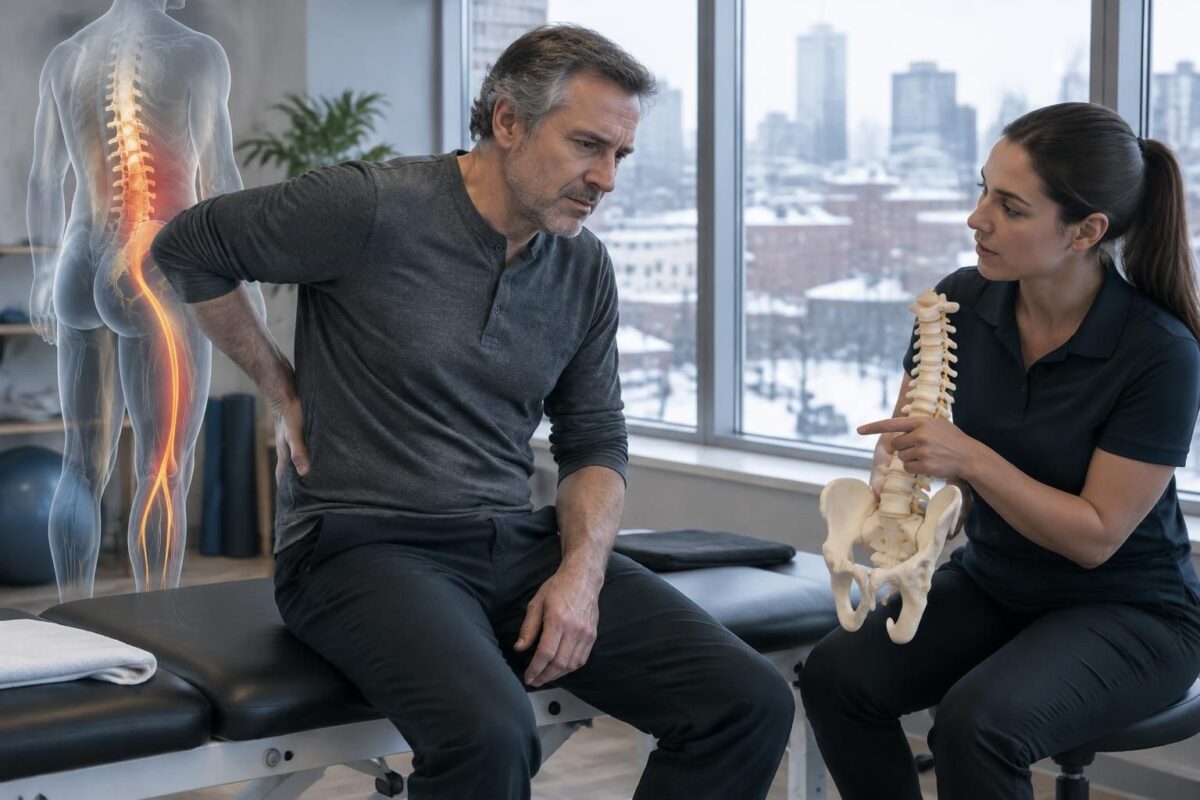
The S1 nerve root emerges from the lower part of the spine. It contributes to the sensitivity of certain areas of the leg and foot and is involved in the strength of certain foot movements. An irritation of this root can cause what is called radicular pain, often referred to as S1 sciatica.
The term “irritation” describes a possible injury to the nerve. It does not specify the cause on its own. A root can be irritated or compressed, particularly by a herniated disc or by narrowing of the space around the nerve. Only an individual evaluation can help determine the underlying cause of the symptoms. To understand the role of the lumbar nerves, see this article on lumbar nerve roots and sciatica.
What symptoms may suggest an S1 irritation?
Pain may start in the buttock and follow the back of the thigh and calf. It can reach the heel, the sole of the foot, or its outer edge. Some people also experience tingling, numbness, or a burning sensation in these areas.
An S1 irritation may sometimes be accompanied by weakness when the person pushes on the front of the foot or stands on tiptoes. The location and intensity of symptoms vary from person to person. Pain on the outer edge of the foot or at the heel may have other causes; it does not confirm an S1 injury by itself.
To learn more about pain on the outer edge of the foot, consult the page dedicated to the S1 root and pain on the outer edge of the foot. The pain in the heel and the S1 root is also discussed in a separate article.
How to distinguish S1 from L5?
The symptoms of S1 and L5 can be similar, as both roots contribute to the sensitivity and movements of the leg and foot. Pain associated with L5 often affects the outer side of the leg and the top of the foot. S1 is more commonly associated with the back of the calf and the outer edge or sole of the foot. These pointers remain indicative: symptoms do not always follow a classic path.
The page on possible irritation of the L5 root in Montreal provides additional pointers. A clinical examination allows comparison of sensitivity, strength, and reflexes, while considering the entire clinical picture.
What causes can irritate the S1 root?
A lumbar herniated disc can put pressure on or provoke inflammation near a nerve root. Narrowing of the canal or a nerve passage can also contribute to symptoms. Other issues of the spine, hip, or surrounding tissues can produce similar pain.
An MRI or X-ray image does not always explain the pain. Some people have visible changes without symptoms, while others have significant symptoms without any obvious abnormalities on an image. The professional interprets the examinations in relation to the symptoms and findings of the clinical exam.

Sciatica and disc bulge in Montreal: possible cause of nerve irritation
IN BRIEF A disc bulge can sometimes irritate a nerve root and contribute to sciatica, with pain in the buttock or leg. Evaluation helps to identify the cause of the symptoms and guide appropriate care; in Montreal, a consultation can…
How is a sciatica evaluation conducted in Montreal?
The evaluation begins with questions about the onset of the pain, its trajectory, intensity, and movements that modify it. The professional then checks, according to their field of practice, the sensitivity, strength, and certain reflexes. They also take into account medical history and signs that may require medical consultation.
An evaluation of sciatica in Montreal helps clarify the next steps. Depending on the situation, medical advice or imaging may be indicated. The presence of pain at S1 alone does not determine that decompression or another approach is appropriate.
For those wishing to learn about the services offered, the TAGMED Clinic’s page on S1 sciatica and the one on pain on the outer edge of the foot associated with S1 provide information on evaluation and options offered based on the case.

Sciatica in Montreal: disc protrusion or herniated disc?
IN BRIEF Sciatica in Montreal may be related to a disc protrusion or a herniated disc, but these terms describe different changes in the disc and are not sufficient on their own to explain the pain. An assessment helps to…
When should you consult quickly?
Consult a doctor or emergency service immediately in case of loss of bladder or bowel control, numbness in the saddle area, or significant or progressive weakness in the leg or foot. These signs may require urgent evaluation.
Seek medical advice if the pain is severe, worsens rapidly, occurs after a trauma, or is accompanied by fever. If in doubt about the cause of your symptoms, an authorized healthcare professional can guide you toward the appropriate evaluation.

Sciatica disc in Montreal: why the pain travels down the leg
IN BRIEF Disc herniated sciatica occurs when a lumbar disc irritates or compresses a nerve root, which can cause pain to radiate down to the buttock and leg. In Montreal, an evaluation helps understand the cause of the symptoms and…
About the author
Sylvain Desforges, B.Sc., D.O., N.D., Doctor of Osteopathy, is the founding president of TAGMED and the ACMA association. His practice focuses on chronic pain of the spine, lower back pain, and pain compatible with sciatica, especially when the pain radiates down to the buttock, leg, calf, foot, or toes.
Through SOS Sciatique, he publishes educational content on the symptoms of sciatica, its possible causes, and non-surgical approaches that may be considered based on the evaluation. At TAGMED Clinic, care may include, depending on the case, motorized neurovertebral decompression, specific osteopathy, or a precision impactor.
For an evaluation related to sciatica treatment in Montreal or Mount Royal, or sciatica treatment in Terrebonne, check the services available at TAGMED Clinic.

L4-L5 disc herniation and sciatica in Montreal: pain towards the foot
IN BRIEF An L4-L5 disc herniation can irritate the L5 nerve root and cause sciatica that radiates down to the top of the foot or the big toe. Burning sensations, tingling, and pain when walking may occur. In Montreal, a…
Medical Disclaimer
The information published on SOS Sciatique is provided for educational purposes. It does not replace a consultation, diagnosis, opinion, or treatment performed by a physician or another licensed healthcare professional. The author of this article is neither a doctor nor a specialist in a medical specialty recognized by the Collège des médecins du Québec. The approaches of osteopathy, manual medicine, or functional support described on this site do not constitute medical acts and are not intended to replace medical follow-up.
“Medical disclaimer: The information and advice provided on this site do not replace the opinion, diagnosis, or treatment of a healthcare professional. Please note that Sylvain Desforges, B.Sc., D.O., N.D., Doctor of Osteopathy, is neither a doctor of medicine nor a physician, and is not a specialist in a medical specialty as defined by the Collège des médecins du Québec. Manual medicine, functional medicine, and sports medicine as described on this site exclude any treatment or medical diagnosis made by a doctor or a medical specialist. Always consult your physician for any medical questions. For more details, please read our complete Legal Notice.”
For more details, please read our Legal Notice.
What irritation of S1 may indicate
- Pain from the lower back to the buttock, back of the leg, or edge of the foot.
- Tingling or numbness possible in this area.
- Sometimes, difficulty standing on tiptoes.
Things to watch for in Montreal
- These signs may suggest an issue with S1, but do not suffice to confirm the cause.
- A professional evaluation helps clarify the origin of symptoms and suitable options.
- Progressive weakness, loss of bladder or bowel control: consult immediately.

In Montreal, pain that originates from the lower back or buttock and descends behind the leg may be compatible with irritation of the S1 nerve root. This root contributes notably to the sensitivity of the outer edge of the foot and certain movements of the ankle. Symptoms vary based on their cause and intensity: a professional evaluation helps guide the next steps, without concluding a diagnosis based solely on symptoms.

Herniated Disc L5-S1 and Sciatica in Montreal: Common Symptoms
IN BRIEF A L5-S1 disc herniation is a displacement of the disc located between the last two lumbar vertebrae and the sacrum; if it irritates a nerve root, it can cause sciatica. The pain often radiates from the buttock down…
What does irritation of the S1 root mean?
Nerve roots exit the spinal column and transmit messages between the lower back, legs, and brain. An irritation of the S1 root means that a nerve located in the lumbosacral region may be sensitized or compressed. This is sometimes referred to as radicular pain or sciatica, but these terms do not indicate a specific cause by themselves.
A herniated disc, a reduction of space around the nerve, or other changes in the spine may contribute to symptoms. However, their presence on imaging does not always explain the pain. Clinical examination and the history of symptoms are essential for interpreting the situation.

Sciatica and disc herniation in Montreal: understanding the link
IN BRIEF Sciatica is a pain that radiates down the leg when a nerve root is irritated; a lumbar herniated disc can be the cause, but is not always responsible. In Montreal, an assessment helps to better understand the symptoms,…
What signs may be associated with S1?
Pain and unusual sensations
Pain may radiate from the buttock to the back of the thigh and calf, then to the outer edge or sole of the foot. Some individuals also describe tingling, numbness, or a burning sensation. The path is not always identical from one person to another, and pain in the leg alone does not allow for identifying the affected root.
Strength and function
An issue with S1 may sometimes be accompanied by difficulty pushing off the forefoot or standing on tiptoes. New or worsening weakness deserves prompt attention. Note when the symptoms began, what modifies them, and their progression: this information can facilitate the evaluation.
Sciatica in Montreal: lumbar roots and choice of a cautious treatment
IN BRIEF Sciatica is pain radiating from the buttock down the leg, often related to irritation of a lumbar root. In Montreal, a careful assessment helps to connect symptoms to function and to choose appropriate management: modified activity, rehabilitation, or…
What to do in Montreal if you have these symptoms?
If the pain is recent and there are no alarming signs, temporarily adjust activities that exacerbate it, while avoiding prolonged bed rest. Gentle movements and short walks, according to your tolerance, can help maintain your daily activities. Do not force an exercise that significantly increases the pain or causes more numbness.
A physician or authorized healthcare professional can assess your condition, check strength and sensitivity, and determine if further examinations are indicated. Depending on the evaluation, appropriate support can be discussed. Manual or functional care does not replace a medical diagnosis and may not be suitable for all situations.

Sciatica in Montreal: how to interpret pain according to the leg path
IN BRIEF Sciatica refers to pain that can follow a nerve root from the lower back to the buttock and the leg. Its path, along with tingling, numbness, or weakness, helps guide the evaluation but is not sufficient to make…
When to seek immediate consultation?
Seek immediate emergency services in case of loss of bladder or bowel control, numbness in the saddle region, or significant or progressive weakness of the leg or foot. Severe or rapidly worsening pain, fever, or recent trauma also warrant prompt medical evaluation.
Medical warning: this content is educational and does not replace consultation, diagnosis, or treatment by a licensed health professional. The author is neither a doctor nor a specialist recognized by the Collège des médecins du Québec.
| Marker | What it may mean |
|---|---|
| S1 Root | Nerve that may be irritated in the lower back. |
| Pain | May radiate from the buttock down the back of the leg. |
| Area sometimes affected | Calf, outer edge of the foot, or small toes. |
| Possible sensations | Tingling, numbness, or burning. |
| Strength | Weakness in the calf or difficulty standing on tiptoes may occur. |
| Possible origins | Herniated disc, stenosis, or other nerve irritation; evaluation is necessary. |
| In Montreal | A professional can assess symptoms and guide management. |
| Seek quickly | Progressive weakness, urinary or bowel issues, or loss of sensitivity in the saddle area. |
The stories below are fictional and educational examples: they do not correspond to identifiable patients and do not constitute authentic opinions on care. They illustrate symptoms sometimes associated with irritation of the S1 nerve root. Manifestations vary from person to person, and only a health professional can assess your situation.
Illustrative testimonial example: pain radiating down the back of the leg
“My pain started in the lower back and traveled through the buttock before descending along the back of the thigh and calf. I sometimes also felt tingling near the outer edge of my foot.”
This pathway may be consistent with irritation of the S1 root, which is involved in sensitivity and certain movements of the foot and leg. Pain that follows this route is sometimes referred to as sciatica, but its location alone is not sufficient to confirm which root is involved or why it is irritated.
Illustrative testimonial example: unusual sensations in the foot
“I experienced tingling in my foot and a feeling of weakness when I was on my tiptoes. These signs didn’t always occur at the same time as the low back pain.”
An S1 involvement may be accompanied by pain, numbness, or tingling toward the buttock, back of the leg, and foot. Difficulty pushing down with the foot or standing on tiptoes warrants a clinical evaluation, especially if it appears or worsens. These signs may also have other causes.
Illustrative testimonial example: variable symptoms depending on movements
“Certain movements seemed to exacerbate the pain in my leg, while at other times it would decrease. I wondered whether a nerve irritation necessarily meant a herniated disc.”
Not necessarily. An S1 root can be irritated or compressed in different contexts, for example, in the presence of a herniated disc, narrowing around the nerve, or other spinal changes. The term “S1 irritation” describes a hypothesis regarding a nerve; it does not, by itself, denote a precise cause. Diagnosis relies on symptoms, examination, and, if indicated, additional tests.
In Montreal, if pain radiates down the leg or if you notice tingling or weakness, consulting a health professional can help clarify the next steps. Depending on the evaluation, non-surgical approaches may be considered. At TAGMED Clinic, the options offered may include specific osteopathy or motorized neurovertebral decompression, when appropriate. Their relevance depends on each situation, and they do not replace a medical evaluation when needed.
Seek immediate medical attention in case of loss of urinary or bowel control, numbness in the saddle area, significant or progressive weakness in the leg or foot, fever, recent trauma, severe pain, or rapid worsening.
About the author
Sylvain Desforges, B.Sc., D.O., N.D., Doctor of Osteopathy, is the founding president of TAGMED and the ACMA association. His practice focuses on chronic spinal pain, low back pain, and pain associated with sciatica. He publishes educational content on symptoms, possible causes, and non-surgical approaches to consider based on the evaluation.
Medical warning: the information presented is provided for educational purposes and does not replace consultation, diagnosis, or treatment by a doctor or another licensed health professional. The author is neither a doctor nor a specialist in a medical specialty recognized by the Collège des médecins du Québec. Osteopathy, manual medicine, and functional support approaches do not constitute medical acts and do not replace medical follow-up when necessary.
Sciatica in Montreal: what does irritation of the S1 root mean?
An irritation of the S1 nerve root refers to an impairment or increased sensitivity of a nerve root that emerges from the low part of the lumbar spine. It can contribute to pain referred to as “sciatica,” but this term describes a set of symptoms and does not specify, by itself, their cause. Irritation of S1 may be associated with a herniated disc, age-related changes, or narrowing of the space through which the nerve passes. Only an appropriate evaluation can help determine what is happening in a particular case.
When S1 is involved, pain may arise from the lower back or buttock and radiate down the back of the thigh, towards the calf, and sometimes even to the outer edge or sole of the foot. Some people also describe tingling, numbness, or a burning sensation. Weakness when pushing down with the foot or on tiptoes may sometimes be observed. These manifestations vary from person to person and do not, alone, allow confirmation of which nerve root is irritated.
In Montreal, a consultation for symptoms compatible with S1 sciatica generally begins with a study of their evolution and distribution, as well as a physical examination. The professional may check mobility, sensitivity, strength, and certain reflexes, and then consider activities that worsen or relieve the pain. Imaging is not necessary in all situations: its usefulness depends on the clinical picture and the judgment of the health professional. The goal is to distinguish nerve irritation from other possible causes of back or leg pain.
Care is chosen based on the symptoms, their duration, intensity, and the results of the evaluation. It may include advice to temporarily adjust certain activities, graduated movement support, and non-surgical care when appropriate. At the TAGMED Clinic, options may include specific osteopathy, motorized neurovertebral decompression, or other modalities available depending on the case. These approaches may not necessarily suit everyone and do not replace a medical diagnosis or recommended follow-up. Expected benefits should be discussed with the professional evaluating the situation.
Sylvain Desforges, B.Sc., D.O., N.D., Doctor of Osteopathy, is the founding president of TAGMED and the ACMA association. His practice focuses on chronic spinal pain, lower back pain, and symptoms that may suggest sciatica. He is interested in integrating manual approaches and technologies, including neurovertebral decompression, into individualized care. His goal is to contribute to informed care, taking into account the evaluation, needs, and limits specific to each person.
Medical warning: this information is educational and does not replace a consultation, diagnosis, or treatment by a physician or another authorized healthcare professional. The author is neither a physician nor a specialist in a medical specialty recognized by the Collège des médecins du Québec. Consult a doctor or emergency service promptly in case of loss of bowel or bladder control, numbness in the saddle region, significant or progressive weakness, fever, recent trauma, or rapid worsening.
In Montreal, irritation of the S1 root means that the nerve exiting the lower part of the lumbar spine is sensitive or irritated. It can cause pain starting from the lower back or buttock and descending behind the thigh to the calf, sometimes to the outer edge of the foot. This path can guide the evaluation but is not sufficient alone to establish a diagnosis: symptoms, their evolution, and the clinical examination must be considered together.
What does irritation of the S1 root mean?
Spinal nerve roots emerge from the spine and contribute to the sensitivity and movements of the legs. When the S1 root becomes irritated, sensations may follow part of its territory, often from the buttock down the back of the leg, the calf, and the outer edge of the foot. The pain may be described as burning, an electric shock, tingling, or numbness. To better understand possible symptoms, check this page on sciatica S1 and pain towards the calf and outer edge of the foot.
The term “irritation” does not necessarily mean that a nerve is severely compressed. A root can be sensitized or inflamed, particularly in the presence of a disc problem, narrowing of the space where the nerve passes, or other changes in the spine. A foraminal disc herniation is, for example, a possible cause when the available space around the root is reduced. This remains a possibility to check, not a conclusion that can be drawn solely from the type of pain.
What signs may be associated with S1?
Pain that descends behind the leg and reaches the calf or the outer edge of the foot may point to the S1 territory. Some people also experience tingling, decreased sensitivity, or a sense of weakness. In some cases, movements that engage the calf, like standing on tiptoes, may seem more difficult. These signs vary from person to person and may overlap with those of other nerve roots.
An electric pain may be consistent with nerve irritation, but it alone cannot localize the affected root. You can learn more about this type of sensation in the article dedicated to sciatica with electric discharges. To distinguish possible paths, it is also useful to compare the markers associated with levels L4, L5, and S1 and those of the L5 root, sometimes associated with pain on the top of the foot.
Why evaluation is important in Montreal
The location of the pain is a clue, but several problems can cause similar symptoms. An irritation higher up in the spine, involvement of another root, or pain from another structure may sometimes be confused with S1 sciatica. Distinguishing between sciatica and cruralgia, for example, relies notably on the path of the symptoms and the results of the examination. General resources on sciatica, like this dossier dedicated to sciatica, can help familiarize oneself with the terms without replacing a personalized evaluation.
A healthcare professional can assess strength, sensitivity, reflexes, and movements that reproduce or relieve symptoms. Depending on the context, they may recommend a medical consultation or additional exams. A lumbar disc herniation is a possible cause of lumbosciatica, but its role must be interpreted based on the symptoms and examination; the resource from Physio Learning on lumbosciatica related to a disc herniation presents these concepts. For practical guides on recognizing and relieving symptoms, also refer to this guide on sciatica and neuralgia.
When to seek medical help promptly
Consult a doctor or emergency service without delay in case of loss of control of the bladder or bowels, numbness in the saddle region, significant or progressive weakness in the leg or foot, fever, recent trauma, or pain that worsens rapidly. These signs require medical evaluation; do not wait for a relief approach to take effect.
About the author
Sylvain Desforges, B.Sc., D.O., N.D., Doctor of Osteopathy is the founding president of TAGMED and the ACMA association. His practice is dedicated to chronic spinal pain, lower back pain, and pain compatible with sciatica, particularly when the pain radiates to the buttock, leg, calf, foot, or toes.
Through SOS Sciatique, he publishes educational content on the symptoms of sciatica, its possible causes, and non-surgical approaches that can be considered based on the assessment. At TAGMED Clinic, the care may include, depending on the case, motorized neurovertebral decompression, specific osteopathy, or precision impact therapy.
For an assessment related to sciatica treatment in Montreal or Mont-Royal, or to sciatica treatment in Terrebonne, please check the services available at TAGMED Clinic.
Medical Disclaimer
The information published on SOS Sciatique is provided for educational purposes and does not replace a consultation, diagnosis, advice, or treatment by a physician or other licensed healthcare professional. The author of this article is neither a doctor nor a specialist in a medical specialty recognized by the Collège des médecins du Québec. The osteopathy, manual medicine, or functional support approaches described on this site do not constitute medical acts and do not aim to replace medical follow-up. For more details, please read our Legal Notice.

Sylvain Desforges, B.Sc., D.O., N.D., docteur en ostéopathie
Dr Sylvain Desforges, B.Sc., D.O., N.D., osteopath, is the founding president of TAGMED and of the ACMA association. He dedicates his practice to chronic spinal pain, low back pain and symptoms compatible with sciatica, particularly when pain radiates toward the buttock, leg, calf, foot or toes.
Through SOS Sciatique, he publishes educational content on sciatica symptoms, possible causes such as disc herniation, disc narrowing, foraminal stenosis or irritation of a lumbar nerve root, as well as non-surgical approaches that may be considered according to the evaluation. At Clinique TAGMED, care may include, depending on the case, motorized neurovertebral decompression, specific osteopathic care or precision percussion.
For an evaluation related to sciatica treatment in Montreal / Mount Royal or sciatica treatment in Terrebonne, please consult the services available at Clinique TAGMED.
Medical disclaimer
The information published on SOS Sciatique is provided for educational purposes only and does not replace a consultation, diagnosis, opinion or treatment provided by a physician or another authorized healthcare professional. The author of this article is neither a medical doctor nor a specialist in a medical specialty recognized by the Collège des médecins du Québec. The osteopathic, manual medicine or functional support approaches described on this site do not constitute medical acts and are not intended to replace medical follow-up.
Consult a physician or emergency service in cases of loss of bladder or bowel control, anesthesia in the saddle area, significant or progressive weakness in the leg or foot, fever, recent trauma, severe pain or rapid worsening of symptoms. For more details, please read our Legal Notice.


