



Sciatica and piriformis stretching: useful or worsening depending on the case
23/10/2026
Sciatica in Terrebonne: why L5-S1 is often involved
24/10/2026
IN BRIEF
| The sciatica L5-S1 often corresponds to irritation of the S1 root, sometimes related to a herniated disc. The pain may start in the buttock and descend behind the thigh to the calf or the foot. In Montreal, understanding this pathway helps better guide the assessment and management: not all sciatica originates from L5-S1, and imaging must be interpreted alongside the symptoms. Significant or progressive weakness, or urinary or intestinal issues, requires urgent consultation. |
The sciatica in Montreal is often associated with the L5-S1 region, located between the last lumbar vertebra and the sacrum. This area bears significant strain during movements and can be affected by a herniated disc irritating the S1 nerve root. The pain may then start in the buttock and descend behind the thigh, calf, or down to the foot. However, a visible abnormality on imaging is not enough to explain the symptoms: the assessment must consider pain, strength, and sensitivity. Most episodes improve with appropriate management and a gradual return to activities. In case of significant or progressive weakness, or urinary or intestinal problems, consult a doctor quickly.
A sciatica related to L5-S1 can cause pain in the lower back, buttock, and back of the leg, sometimes down to the foot. This level is often involved because it bears significant strain. However, an image of a hernia on an MRI does not fully explain the symptoms: the clinical examination and their evolution also count.
What does L5-S1 mean?
L5-S1 refers to the disc located between the last lumbar vertebra, L5, and the first sacral vertebra, S1. This area is at the junction between the mobile part of the lumbar spine and the pelvis. It bears a significant part of the loads and participates in trunk movements.
This stress can contribute to the wear of the disc or the appearance of a hernia. It does not mean that the back is broken or that surgery will be necessary. The presence of a disc abnormality does not always cause pain.

Sciatica and disc bulge in Montreal: possible cause of nerve irritation
IN BRIEF A disc bulge can sometimes irritate a nerve root and contribute to sciatica, with pain in the buttock or leg. Evaluation helps to identify the cause of the symptoms and guide appropriate care; in Montreal, a consultation can…

Sciatica in Montreal: disc protrusion or herniated disc?
IN BRIEF Sciatica in Montreal may be related to a disc protrusion or a herniated disc, but these terms describe different changes in the disc and are not sufficient on their own to explain the pain. An assessment helps to…
How an L5-S1 injury can cause sciatica
A herniated disc at the L5-S1 level can irritate or compress a nerve root, often the S1 root. The pain may then start in the buttock and descend behind the thigh, into the calf, then towards the heel or the outer border of the foot. Tingling or a sensation of numbness may also appear.
The pathway varies from person to person. Pain that extends down to the foot can help guide the assessment, but it does not alone confirm the affected level. To learn more about this pathway, visit the page on sciatica L5-S1 in Montreal and the pain that goes down to the foot.
Difference between L5 sciatica and S1 sciatica
Irritation of the L5 root can cause pain on the side of the leg and the top of the foot, sometimes down to the big toe. An injury to the S1 root more often results in pain at the back of the leg, towards the heel or the sole of the foot. These pathways are guidelines, not a diagnosis on their own.
The symptoms and their location can help the professional guide their examination. You can read about the differences between the levels in this article on the difference between L4-L5 and L5-S1, or on the page dedicated to the L4-L5 injury and pain towards the top of the foot.

Sciatica disc in Montreal: why the pain travels down the leg
IN BRIEF Disc herniated sciatica occurs when a lumbar disc irritates or compresses a nerve root, which can cause pain to radiate down to the buttock and leg. In Montreal, an evaluation helps understand the cause of the symptoms and…

L4-L5 disc herniation and sciatica in Montreal: pain towards the foot
IN BRIEF An L4-L5 disc herniation can irritate the L5 nerve root and cause sciatica that radiates down to the top of the foot or the big toe. Burning sensations, tingling, and pain when walking may occur. In Montreal, a…
Why this level is often affected
The L5-S1 disc undergoes pressures related to movements and daily loads. Positions sustained for a long time, repeated motions, and certain efforts can also strain the lower back. However, these factors alone do not determine the cause of sciatica.
A herniated disc is a common cause, but other issues can contribute to the symptoms. Arthritis, narrowing of the space around a nerve root, or other lumbar injuries can also be evaluated. An overview of the causes and symptoms is available on our page about irritation of the S1 root in Montreal.

Herniated Disc L5-S1 and Sciatica in Montreal: Common Symptoms
IN BRIEF A L5-S1 disc herniation is a displacement of the disc located between the last two lumbar vertebrae and the sacrum; if it irritates a nerve root, it can cause sciatica. The pain often radiates from the buttock down…

Sciatica and disc herniation in Montreal: understanding the link
IN BRIEF Sciatica is a pain that radiates down the leg when a nerve root is irritated; a lumbar herniated disc can be the cause, but is not always responsible. In Montreal, an assessment helps to better understand the symptoms,…
A visible hernia on an MRI does not describe the whole situation
The MRI shows the structures of the spine, but it does not directly measure pain. Some people have a herniated disc without symptoms. The professional therefore compares the imaging to the symptoms experienced, their location, and the examination results.
An MRI is not necessary in all cases from the start. The professional may request it if the symptoms are atypical, persist despite appropriate management, or if concerning neurological signs are present. To delve into the interpretation of this diagnosis, check out our article on the management of sciatica in Montreal.
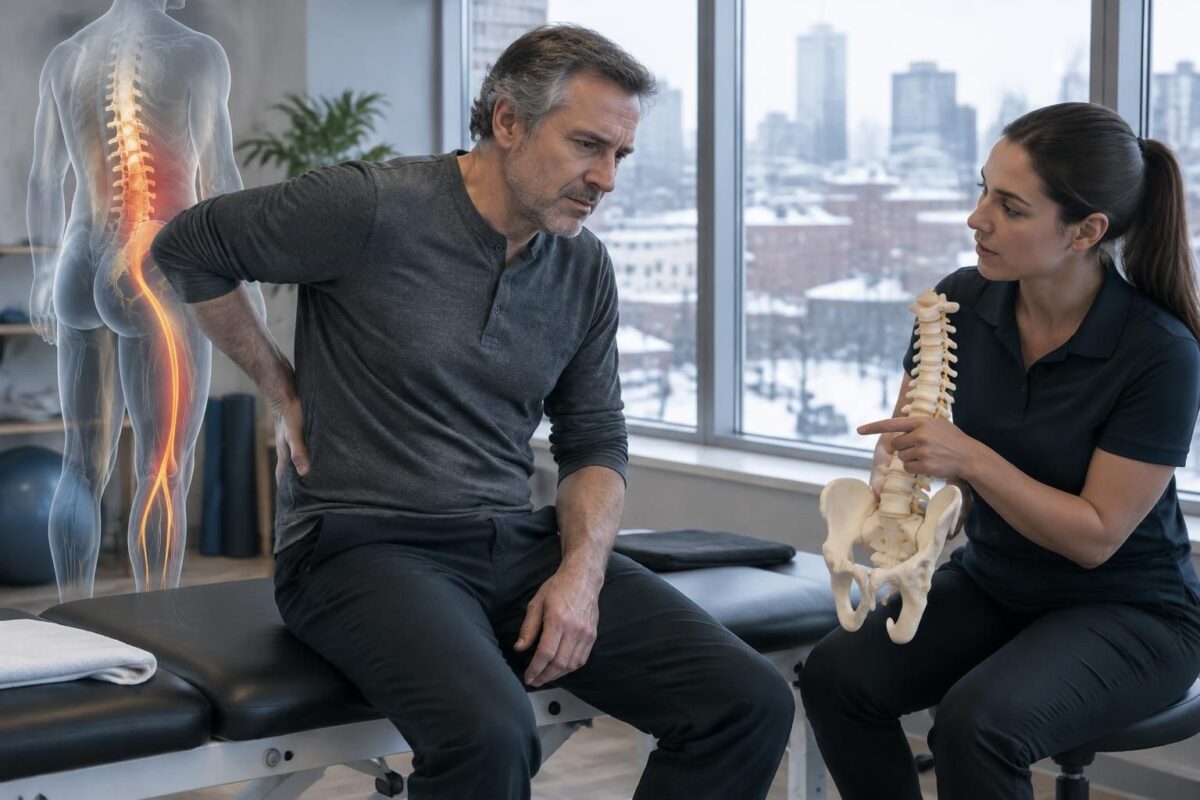
Sciatica in Montreal: lumbar roots and choice of a cautious treatment
IN BRIEF Sciatica is pain radiating from the buttock down the leg, often related to irritation of a lumbar root. In Montreal, a careful assessment helps to connect symptoms to function and to choose appropriate management: modified activity, rehabilitation, or…

Sciatica in Montreal: how to interpret pain according to the leg path
IN BRIEF Sciatica refers to pain that can follow a nerve root from the lower back to the buttock and the leg. Its path, along with tingling, numbness, or weakness, helps guide the evaluation but is not sufficient to make…
When should you seek an evaluation quickly?
A quick medical evaluation is necessary in case of significant or progressive weakness in a leg or foot, loss of control of the bladder or intestines, or numbness in the perineum area. These signs may indicate a nerve injury that requires urgent care.
Also consult quickly in case of fever, recent trauma, intense pain that worsens rapidly, or pain accompanied by a significant deterioration in overall condition. In the presence of severe or sudden symptoms, contact emergency services.
What non-surgical options can be evaluated?
The management depends on the examination, symptoms, and their evolution. It may include medical follow-up and manual or functional approaches tailored to the situation. Strict prolonged rest is generally not recommended without professional advice. In case of a herniated disc or radicular pain, avoid starting exercises or stretches without having obtained an appropriate evaluation.
At TAGMED Clinic, an evaluation can determine if treatments such as the neurovertebral decompression approach or specific osteopathic care can be considered. These options are not suitable for everyone and do not replace a medical diagnosis. The professional must take your file into account and refer you to a doctor if your situation requires it.
Frequently Asked Questions about L5-S1 Sciatica
Does an L5-S1 herniation mean I need surgery?
No. A herniation at this level does not automatically mean that surgery is necessary. This option is assessed based on symptoms, examination, progression, and the possible presence of significant neurological deficit.
Can L5-S1 sciatica extend down to the foot?
Yes. Irritation of S1 can cause pain that goes down the back of the leg to the heel or foot. However, the pathway varies from person to person and does not confirm the cause on its own.
Does a decreasing pain mean that the herniation has disappeared?
Not necessarily. Symptoms can improve even if an abnormality remains visible on imaging. Follow-up is based on your clinical condition and function, not just on the appearance of the disc.
About the Author
Sylvain Desforges, B.Sc., D.O., N.D., osteopath and naturopath, is the founding president of TAGMED and the ACMA association. He dedicates his practice to chronic pain of the spine, lower back pain, and pain compatible with sciatica, especially when pain radiates to the buttock, leg, calf, foot, or toes.
Through SOS Sciatique, he publishes educational content on the symptoms of sciatica, possible causes such as disc herniation, disc compression, foraminal stenosis, or irritation of a lumbar nerve root, as well as non-surgical approaches that can be considered based on the evaluation. At TAGMED Clinic, care may include, as appropriate, motorized neurovertebral decompression, specific osteopathy, or precision percussion.
For an evaluation related to sciatica treatment in Montreal / Mont-Royal or sciatica treatment in Terrebonne, check the services available at TAGMED Clinic.
Medical Disclaimer
The information published on SOS Sciatique is provided for educational purposes and does not replace consultation, diagnosis, opinion, or treatment by a physician or other licensed healthcare professional. The author of this article is neither a physician nor a specialist in a medical specialty recognized by the Collège des médecins du Québec. The osteopathy, manual medicine, or functional support approaches described on this site do not constitute medical acts and are not intended to replace medical follow-up.
Consult a physician or emergency service in case of loss of urinary or bowel control, anesthesia in the saddle region, significant or progressive weakness of the leg or foot, fever, recent trauma, severe pain, or rapid worsening. For more details, please read our Legal notice.
Medical Disclaimer: The information and advice provided on this site do not replace the opinion, diagnosis, or treatment of a healthcare professional. Please note that Sylvain Desforges, B.Sc., D.O., N.D., Doctor of Osteopathy, is neither a doctor of medicine nor a physician and is not a specialist in a medical specialty as defined by the Collège des médecins du Québec. Manual medicine, functional medicine, and sports medicine, as described on this site, exclude any treatment or medical diagnosis made by a physician or specialist. Always consult your doctor for any medical questions. For more details, please read our complete Legal Notice.
Why L5-S1 is Often Involved
- Transition zone between the movable lumbar vertebrae and the sacrum.
- Repeated stresses related to bending, exertion, and prolonged sitting, especially during commutes.
- Possible disc herniation that may irritate the S1 nerve root and trigger sciatica pain.
What This Means for Sciatica
- The S1 pain may radiate from the buttock down the back of the thigh and calf, sometimes down to the foot.
- An MRI image alone is not enough to explain symptoms: evaluation must consider pain, strength, and sensitivity.
- Most cases improve without surgery; a progressive weakness or urinary issues require urgent advice.

Pain that starts from the lower back or buttock and radiates down the leg can correspond to sciatica, but its cause varies from person to person. The L5-S1 region, located between the last lumbar vertebra and the sacrum, is often involved because it bears significant stresses during movement and effort. However, this does not mean that an abnormality at this level always explains the pain, nor that surgery will be necessary: evaluation of symptoms and function guides recommendations.
Why is the L5-S1 Area Frequently Involved?
The L5-S1 junction connects the mobile part of the lumbar spine to the pelvis. It participates in flexion, rotation, and load transmission. Prolonged sitting, repeated bending, or carrying loads can stress this area, without necessarily proving that they caused a specific injury.
On this floor, a lumbar disc can sometimes protrude and irritate a nerve root, particularly S1. The pain can then travel through the buttock, the back of the thigh and calf, up to the heel or the outer edge of the foot. An L5 injury may instead be accompanied by symptoms on the side of the leg and the top of the foot. These pathways provide clues but are not sufficient to make a diagnosis on their own.
What to do in case of sciatica pain in Montreal?
Stay active without overexerting
In the absence of emergency signs, prioritize a gradual return to movement. Short walks and regular position changes are often preferable to several days in bed. Adapt the activity to your tolerance: temporarily reduce movements that significantly trigger pain, then gradually resume them. Avoid stretching or exercises that clearly worsen symptoms in the leg.
Have the symptoms evaluated
A consultation with a healthcare professional can help assess strength, sensitivity, reflexes, and the progression of symptoms. Imaging, such as an MRI, is not automatically necessary at the onset of uncomplicated sciatica; its usefulness depends particularly on the examination, duration, and observed signs. A disc image should be interpreted in relation to the individual: it does not by itself demonstrate the source of the pain.
Choose a progressive approach
Management may include activity advice, tailored exercises, and, based on the evaluation, physiotherapy or other conservative care. The goal is to support function and a gradual return to activities, without promising to “put the disc back”. If you consult in Montreal or Mont-Royal, request an individualized assessment and report any numbness or changes in strength. Manual treatments do not replace a medical examination when indicated.
When to seek urgent help
Quickly consult an emergency service in case of loss of urinary or bowel control, numbness in the perineal region, significant or worsening weakness in the leg or foot, or pain associated with fever or recent trauma. These signs require immediate medical evaluation.
About the author
Sylvain Desforges, B.Sc., D.O., N.D., osteopath and naturopath, is the founding president of TAGMED and the ACMA association. His practice focuses particularly on chronic spinal pain, lower back pain, and pain compatible with sciatica.
Medical disclaimer
This content is provided for educational purposes and does not replace a consultation, diagnosis, or treatment by a licensed healthcare professional. The author is neither a doctor nor a specialist in a medical specialty recognized by the Collège des médecins du Québec. Osteopathy and manual medicine approaches do not replace medical follow-up when indicated.
| Factor | Why L5-S1 is often involved |
|---|---|
| Transition zone | It connects the lower back to the sacrum. |
| Mechanical stress | It supports a significant share of loads and movements. |
| Disc under strain | The L5-S1 disc can protrude and irritate a nerve root. |
| S1 involvement | Irritation can cause pain toward the buttock, calf, or foot. |
| Variable symptoms | A hernia visible on imaging does not always mean it causes pain. |
| Evaluation needed | The pathway of the symptoms and clinical examination help guide management in Montreal. |
Sciatica in Montreal: illustrative testimonies on the frequent involvement of L5-S1
Note: the stories below are fictional and composite examples. They do not correspond to real testimonies and do not allow for diagnosis. Pain that travels down the leg can have several causes, and a hernia visible on imaging does not always explain the symptoms.
“The pain started from the lower back and went down to the heel.”
Marc, 46 years old — fictional example
After several weeks of lower back pain and discomfort in the buttock, Marc felt pain at the back of the thigh and calf. This pathway may be compatible with irritation of the S1 root, often associated with the L5-S1 area. However, a clinical examination is necessary to determine if this area is truly involved.
“My report mentioned an L5-S1 hernia, and I immediately thought of surgery.”
Isabelle, 39 years old — fictional example
The discovery of a hernia can be concerning, but the image alone does not determine the intensity of pain or the necessary treatment. The decision also depends on symptoms, progression, and neurological examination. Many sciatic conditions improve with suitable conservative management, without surgery.
“Sitting for long periods made the pain harder to bear.”
David, 52 years old — fictional example
A prolonged position can exacerbate symptoms in some individuals but does not, by itself, identify the cause. L5-S1 is a transition area between the lower back and the sacrum, subjected to stress during movements and daily activities. This helps explain why the discs in this region are frequently affected, without necessarily meaning they are damaged or fragile.
Why is L5-S1 often involved? This segment is located between the last lumbar vertebra and the sacrum. It contributes to the mobility of the lower back and supports significant loads. A hernia at this level can irritate a nerve root, particularly S1, and cause pain that radiates from the buttock to the back of the leg, sometimes as far as the foot. However, the pathway varies from person to person and does not suffice to confirm the diagnosis.
In Montreal as elsewhere, the evaluation should consider the overall picture: location of pain, strength of the leg and foot, sensitivity, reflexes, and progression of symptoms. An MRI is not systematically required from the outset; a healthcare professional can determine if it is indicated based on the situation.
In the absence of emergency signs, prolonged strict bed rest is generally discouraged. A gradual return to tolerated activities and suitable support can be discussed with a healthcare professional. Manual therapy or osteopathy may sometimes be considered as complementary approaches after evaluation; they do not replace a medical diagnosis or prescribed treatments.
Quickly consult a doctor or emergency service in case of loss of urinary or bowel control, numbness in the saddle area, significant or progressive weakness in the leg or foot, fever, recent trauma, or rapid worsening.
About the author
Sylvain Desforges, B.Sc., D.O., N.D., osteopath and naturopath, is the founding president of TAGMED and the ACMA association. He dedicates his practice to chronic spinal pain, lower back pain, and pain associated with sciatica. The published information is educational and does not replace a consultation, diagnosis, or treatment by a licensed healthcare professional. The author is neither a physician nor a specialist in a medical specialty recognized by the Collège des médecins du Québec.
Sylvain Desforges is an osteopath and naturopath. His background is dedicated to managing chronic pain, particularly those related to the spine and lower back. In Montreal and the surrounding areas, many people seek consultation for lower back pain that radiates to the buttock, thigh, or foot. When this pain follows the path of the sciatic nerve, one of the levels often examined is L5-S1, the junction between the last lumbar vertebra and the sacrum.
This area is an important transition between the mobile part of the spine and the pelvis. It supports the weight of the upper body and is involved in daily activities such as bending, standing up, walking, or sitting. These stresses do not mean that L5-S1 is “fragile” or necessarily damaged: they help explain why this segment is frequently affected by disc changes and lower back pain.
Between the vertebrae are discs that allow the spine to absorb and distribute some of the loads. At L5-S1, a herniated disc can sometimes irritate a nerve root, particularly the S1 root, causing pain that descends from the buttock down the back of the thigh and calf, sometimes reaching the heel or foot. Tingling or a sensation of numbness may also occur. However, a herniation visible on imaging does not always produce symptoms, and not all sciatica necessarily originates from L5-S1.
The pain pathway, muscle strength, sensitivity, and reflexes help the healthcare professional guide the assessment. Pain descending toward the big toe may suggest involvement of the L5 root, while pain toward the heel or little toe may be compatible with S1 involvement. These indicators alone do not confirm a diagnosis: they must be interpreted in the context of all symptoms and clinical examination.
Dr. Desforges’ role is to accompany the functional assessment and present options tailored to each person’s situation. Depending on the case, management may include specific osteopathy, advice for gradually resuming activities, and at the TAGMED Clinic, technologies such as motorized neurovertebral decompression. These approaches do not replace a medical diagnosis, and their relevance depends on an individualized assessment. The goal is to avoid promises of universal healing and to prioritize a gradual approach that aligns with the patient’s needs and limitations.
In most cases, sciatica improves with conservative management. Prolonged strict rest is generally to be avoided: it is often better to maintain tolerated movements and resume activities gradually, following the recommendations of a professional. Imaging is not systematic; it may be considered based on current symptoms, progression, or response to care.
An urgent medical evaluation is necessary in cases of loss of bowel or bladder control, numbness in the saddle area, significant or progressive weakness in the leg or foot, fever, recent trauma, or rapid worsening. These signs should not be automatically attributed to a herniated disc.
About the author
Sylvain Desforges, B.Sc., D.O., N.D., osteopath and naturopath, is the founding president of TAGMED and the ACMA association. His practice focuses, in particular, on chronic spinal pain, lower back pain, and pain compatible with sciatica. The care offered at the TAGMED Clinic may include, based on the evaluation, motorized neurovertebral decompression, specific osteopathy, or precision percussion therapy.
Medical Warning
This content is provided for educational purposes and does not replace a consultation, diagnosis, or treatment provided by a physician or other licensed healthcare professional. The author is neither a physician nor a specialist in a medical specialty recognized by the Collège des médecins du Québec. In the presence of warning signs or severe pain, quickly consult a healthcare professional or an emergency service.
In Montreal, pain that starts from the lower back or buttock and descends into the leg may be compatible with sciatica, but its pathway alone cannot confirm its origin. The level L5-S1 is frequently involved due to the mechanical stresses exerted at the junction between the lumbar spine and the sacrum. However, the cause and the affected nerve root must be evaluated based on symptoms and clinical examination.
Why L5-S1 is Often Involved
The segment L5-S1 connects the last lumbar vertebra and the sacrum. This transitional area participates in torso movements and transmits a significant portion of the loads between the upper body and the pelvis. Repeated bends, certain prolonged positions, and exertion can stress the structures of this region. This helps explain why the lower lumbar discs, particularly the one located between L5 and S1, are often affected by changes or a herniated disc.
When a herniation at this level irritates a nerve root, it can specifically affect S1 and cause pain that descends from the buttock down the back of the thigh and calf, sometimes reaching the heel, sole of the foot, or little toe. An involvement of L5 may instead cause pain that radiates to the side of the leg, the top of the foot, and the big toe. However, the level of the herniation and the irritated root are not always interchangeable: an L5 involvement may, for example, be related to a problem located at the L4-L5 level. To better understand this difference, consult the explanations on the differences between L4-L5 and L5-S1 and how the affected root can alter the pain pathway.
Pain in the big toe may suggest irritation of the L5 root, but it is not sufficient to establish a diagnosis. Other causes may produce similar symptoms. The articles on big toe pain and the L5 root and on other possible causes of this pain can help identify questions to ask during an assessment.
It is also important not to confuse a radiological image with a complete explanation of the symptoms. An MRI can show a protrusion or a herniated disc, but the result must be correlated with the examination, the location of the pain, and neurological signs. Consult this guide to better understand the lumbar levels on an MRI, as well as the guide on sciatica and herniated discs.
Management depends on the evolution and possible presence of warning signs. Many cases of sciatica improve progressively with a suitable approach, which may include a gradual return to activities and follow-up by appropriate health professionals. To delve into the mechanisms of lumbosciatica related to a herniated disc, you can consult the resources from Physio Learning and Caducee.
In Montreal, an evaluation allows for perspective on the course of the pain, mobility, and any changes in strength or sensitivity. Information on sciatica assessment in Montreal is also available. However, significant or progressive weakness, loss of sensation in the saddle area, or urinary or intestinal disturbances require urgent medical consultation.

Sylvain Desforges, B.Sc., D.O., N.D., docteur en ostéopathie
Dr Sylvain Desforges, B.Sc., D.O., N.D., osteopath, is the founding president of TAGMED and of the ACMA association. He dedicates his practice to chronic spinal pain, low back pain and symptoms compatible with sciatica, particularly when pain radiates toward the buttock, leg, calf, foot or toes.
Through SOS Sciatique, he publishes educational content on sciatica symptoms, possible causes such as disc herniation, disc narrowing, foraminal stenosis or irritation of a lumbar nerve root, as well as non-surgical approaches that may be considered according to the evaluation. At Clinique TAGMED, care may include, depending on the case, motorized neurovertebral decompression, specific osteopathic care or precision percussion.
For an evaluation related to sciatica treatment in Montreal / Mount Royal or sciatica treatment in Terrebonne, please consult the services available at Clinique TAGMED.
Medical disclaimer
The information published on SOS Sciatique is provided for educational purposes only and does not replace a consultation, diagnosis, opinion or treatment provided by a physician or another authorized healthcare professional. The author of this article is neither a medical doctor nor a specialist in a medical specialty recognized by the Collège des médecins du Québec. The osteopathic, manual medicine or functional support approaches described on this site do not constitute medical acts and are not intended to replace medical follow-up.
Consult a physician or emergency service in cases of loss of bladder or bowel control, anesthesia in the saddle area, significant or progressive weakness in the leg or foot, fever, recent trauma, severe pain or rapid worsening of symptoms. For more details, please read our Legal Notice.


