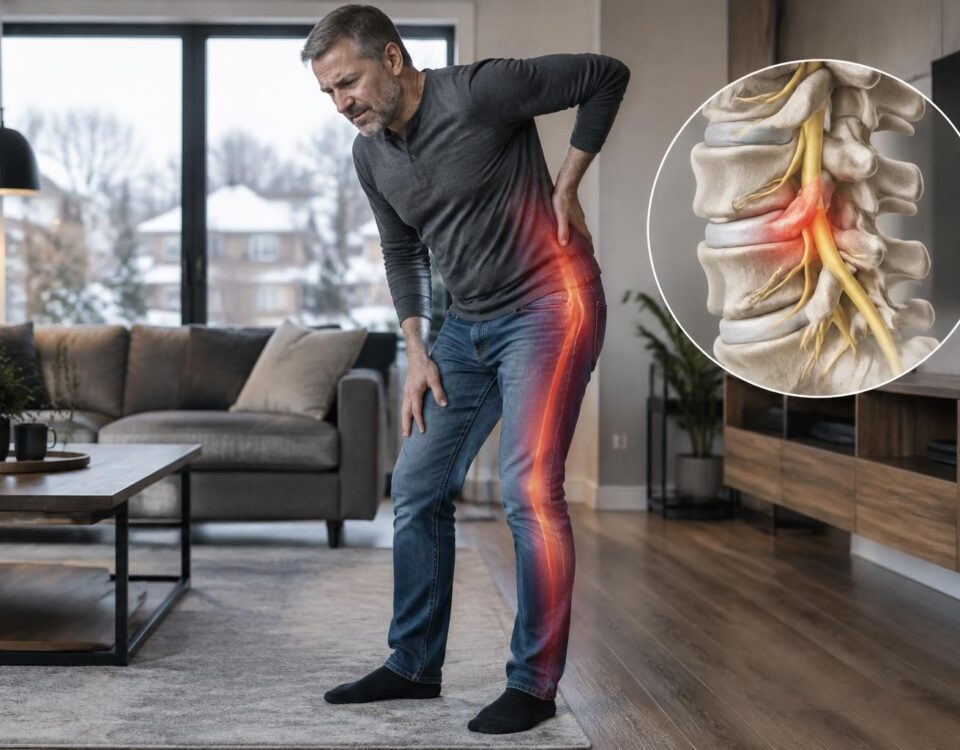
Sciatica in Montreal: burning pain behind the thigh
19/09/2026
Sciatica and Pain with Position Change
19/09/2026
IN BRIEF
| In brief, sciatica in Terrebonne, pain described as a burning sensation behind the thigh, is a nerve irradiation due to irritation or compression of a lumbar root that follows the pathway of the sciatic nerve. Benefits: precise local assessment, personalized non-surgical management plan, improvement in mobility and pain, gradual return to activities. Instructions: evaluate the symptom pathway, neurological signs, and function to identify possible causes and propose adapted conservative options (rehabilitation, exercises, postural advice) without surgery, with follow-up and measurable objectives. |
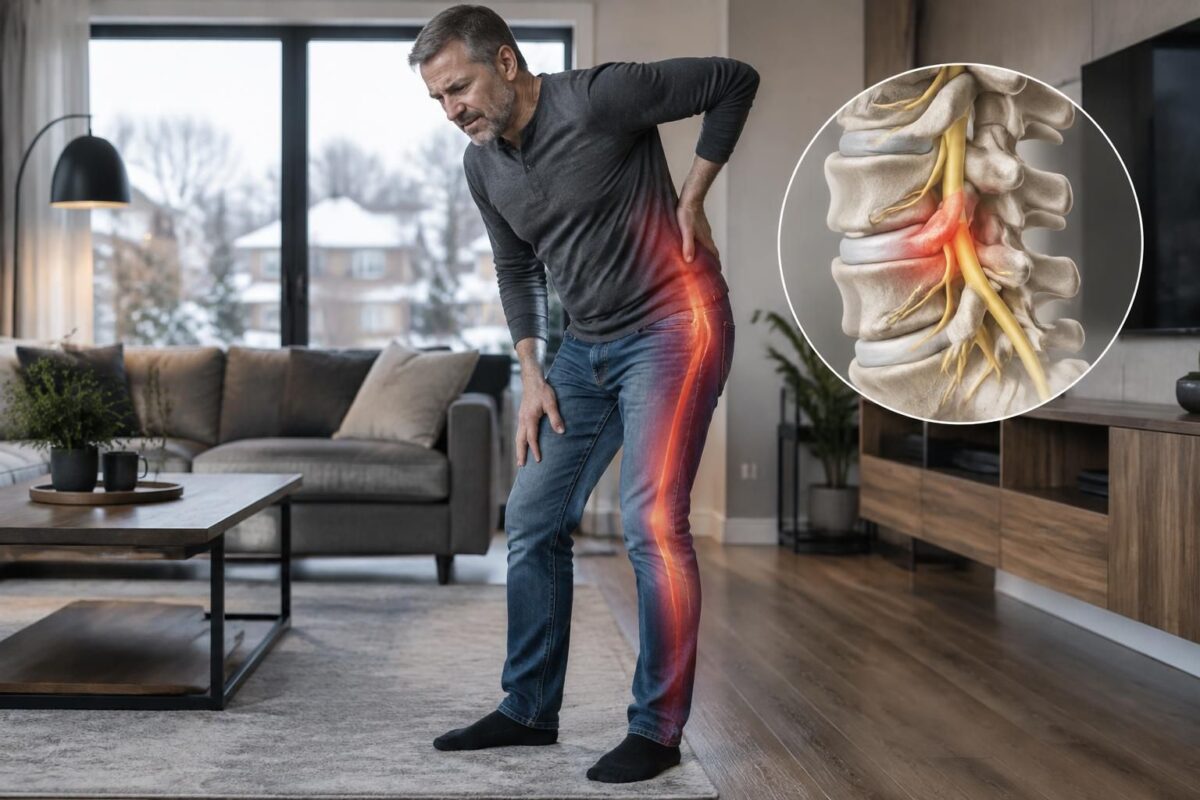
In Terrebonne, sciatica may manifest as a burning pain behind the thigh, reflecting irritation or compression of a lumbar nerve root.
At Clinique TAGMED Terrebonne, the assessment aims to trace the symptom pathway, evaluate sensitivity and strength, and relate clinical signs to possible causes (herniated disc, protrusion, foraminal stenosis, etc.).
A personalized and non-surgical management plan can be discussed, including adapted exercises, manual approaches, and activity advice, with complementary options if necessary.
For an assessment in Terrebonne, make an appointment at 1150 rue Lévis, suite 200, Terrebonne, QC J6W 5S6.
Quick summary: this article explains the possible causes of sciatica presenting a burning pain behind the thigh, the key assessment elements, and the non-surgical management options available at Clinique TAGMED in Terrebonne. It emphasizes the symptom pathway, neurological signs, and the criteria guiding medical orientation. The goal is to help determine when a consultation is indicated and what approaches can be discussed within a care process.
Pain that starts from the lower back or buttock and radiates down the thigh, calf, or foot can be described as a burning pain and may correspond to lumbar radiculopathy. At Clinique TAGMED in Terrebonne, the goal of the first consultation is to clarify the symptom pathway, identify signs requiring medical orientation, and determine what conservative options may reasonably be discussed. The consultation is offered at 1150 rue Lévis, suite 200, Terrebonne, QC J6W 5S6.
Symptom Pathway and Neurological Signs
The pathway of pain often indicates the structure or root that may be involved. Pain that radiates or extends to the back of the thigh may involve lumbar roots such as L4, L5, or S1. Neurological signs such as numbness, tingling, loss of sensitivity, weakness, or changes in reflexes increase the importance of neurological assessment. The precise location in the buttock, thigh, calf, ankle, or foot helps guide the analysis.
Pain may also be associated with decreased function: walking, time spent sitting or standing, quality of sleep, work tolerance, and daily efforts. The assessment should be interpreted in correlation with available imaging exams when relevant.
Imaging and the Role of Supplemental Diagnostics
An MRI or other exams may be correlated with the clinical assessment. Imaging may reveal a herniated disc, a protrusion, or foraminal stenosis in patients whose symptoms partially arise from another mechanism. The doctor interprets the imaging considering the side, level, clinical examination, and function.
Typical Clinical Profile by Roots
L4 Profile: symptoms may affect the front of the thigh, the knee, or the inner thigh. L5 Profile: pain radiated to the side of the leg, the top of the foot, or the big toe; possible weakness of the foot dorsiflexor may be present. S1 Profile: pain or numbness that follows the back of the calf, the heel, or the outer edge of the foot. See the complete guide on roots L4, L5, and S1 for details.
Key Takeaways
The territories L4, L5, and S1 provide useful markers, but no dermatome, myotome, or reflex confirms the diagnosis alone. A radiating pain may be associated with paresthesias and weakness that justify a thorough clinical evaluation. The presence of night pain or other alarming signs requires prompt management.
Management Options and Conservative Approach
Initial Evaluation and Personalized Treatment Plan
The first visit connects the history, the symptom pathway, neurological signs, and available exams. The doctor proposes a clear plan with measurable objectives and the criteria for reevaluation or referral.
Conservative Approaches and Clinical Practices
Depending on the profile, manual or instrumental approaches may be integrated into a comprehensive strategy and reevaluated according to function. At TAGMED, some non-surgical options may be discussed based on the assessment, with a referral to care in Terrebonne or Montreal according to the care plan.
Neurovertebral Decompression and Other Options
Neurovertebral decompression is a non-surgical mechanical approach that can be discussed when the evaluation suggests discal or foraminal involvement. This option is considered only after a thorough evaluation and according to specific criteria. It should not be presented as a method that “puts the disc back in place” and fits into a personalized approach.
When to Consult and Warning Signals
Consult promptly in case of new urinary or bowel issues, saddle anesthesia, significant or rapid weakness of the leg, foot drop, or fever and recent trauma. Significant bilateral symptoms, general deterioration, or rapidly worsening pain require urgent medical evaluation.

Sciatica S1 in Terrebonne: pain towards the calf and the outer edge of the foot
IN BRIEF S1 sciatica is pain related to irritation of a lumbar nerve root, which may radiate down to the buttock, back of the calf, and the outer edge of the foot. Tingling or weakness may also occur. In Terrebonne,…

Sciatica L5 in Terrebonne: pain towards the big toe
IN SHORT L5 sciatica can cause pain or numbness that radiates to the big toe, sometimes with difficulty lifting the foot. This pathway is a clue, not a diagnosis: the examination compares strength, sensitivity, and gait, as the nerve territories…

Sciatica L5-S1 in Terrebonne: pain radiating to the heel or foot
IN BRIEF A L5-S1 sciatica often corresponds to irritation of the S1 root, which can cause pain that radiates from the buttock down to the calf, heel, or outer edge of the foot. Identifying the pathway of symptoms and changes…
Sciatica L4-L5 in Terrebonne: understand the possible symptoms
IN BRIEF The L4-L5 sciatica often corresponds to irritation of the L5 nerve root, sometimes related to a disc herniation. It can cause pain from the lower back to the buttock, the side of the leg, and the top of…
Resources and Additional Information
To delve deeper, here are useful resources regarding non-surgical management and information on sciatica provided by professionals:
Sciatica and foot pain while walking
Treatment of sciatica in Terrebonne
Sciatica in Terrebonne – pain while sitting
Sciatica Montreal burning pain behind the thigh
Sciatica and difficulty sitting
Sciatica and frequent breaks while walking
SCIATICA and foot pain while walking
Sciatica in Terrebonne – pain while sitting with tingling in the foot
Sciatica Montreal burning pain behind the thigh
For neurovertebral decompression and other non-surgical approaches, you can also consult specialized resources on the following areas: Neurovertebral decompression, and related information on discs and lower back pain in resources associated with reference areas.
Links and authorized areas mentioned above: sossciatique.com, cliniquetagmed.com, decompressionneurovertebrale.com, sosherniediscale.com, sosherniateddisc.com, sostunnelcarpien.com, sossciatique.com.
Additional help and frequently asked questions available on the pages associated with TAGMED and SOS Sciatique can clarify other points such as causes, symptoms, and non-surgical treatment options based on clinical details.
Medical disclaimer: The information and advice provided on this site do not replace the opinion, diagnosis, or treatment of a healthcare professional. Please note that Dr. Sylvain Desforges, osteopath, is neither a doctor of medicine nor a physician, and is not a specialist in a medical specialty as defined by the Collège des médecins du Québec. Manual medicine, functional medicine, and sports medicine as described on this site exclude any medical treatment or diagnosis made by a physician or medical specialist. Always consult your doctor for any medical questions. For more details, please read our complete Legal Notice.
Sciatica in Terrebonne: burning pain behind the thigh
- Location and pathway: Burning pain behind the thigh, possibly radiating to the buttock or calf.
- Neurological signs: Numbness, tingling, paresthesia, and sometimes, weakness.
- Aggravating factors: prolonged sitting, coughing/sneezing that amplifies the pain.
- Probable causes: herniated disc, protrusion, foraminal stenosis, radicular irritation.
- Urgency to monitor: loss of bladder control, saddle anesthesia, major progressive weakness, foot drop.
- Imaging and diagnosis: MRI or imaging depending on progression and clinical examination.
- Conservative approaches: tailored activity, targeted exercises, manual therapies according to tolerance.
- Management plan: assessment in Terrebonne and personalized plan with measurable objectives.

Quick summary: a burning pain behind the thigh, sometimes radiating to the calf, requires targeted evaluation of the painful pathway, neurological signs, and impact on walking and resting. In Terrebonne, the TAGMED Clinic offers a structured initial consultation to clarify the possible radicular origin and establish a personalized management plan, prioritizing conservative and functional approaches with clear and measurable goals.
Initial assessment and objectives of the first visit
Pathway and location: accurately identifying the affected area (buttock, thigh, behind the thigh to the lower leg) helps orient the potentially involved root and the relevant foramen.
Neurological signs: the evaluation focuses on numbness, tingling, possible weakness, or reflex changes, indicating the importance of a thorough neurological examination.
Functional impact: the ability to walk, sit, or stand, sleep, and work activities guide the understanding of the real impact of the symptoms.
Imaging and clinical correlations: if previous examinations exist (MRI or others), they will be recognized and interpreted in relation to the pain pathway and clinical signs to avoid any isolated interpretation.
Possible causes and irritation profiles
The burning pain behind the thigh may reflect a lumbar radiculopathy related to a herniated disc, a protrusion, or foraminal stenosis, but other mechanisms may play a role (muscle tissues, hip joint, peripheral neuropathy). The clinician will assess levels L4, L5, or S1 and consider the typical clinical profiles, which guide the treatment strategy.
The exact path of the pain, neurological symptoms, and function allow for distinguishing causes and identifying whether additional imaging is necessary to guide non-surgical options.
Management Plan in Terrebonne
Conservative approaches: a combination of tailored exercises, postural education, and manual or instrumental therapies may be proposed based on the profile. The goal is to enhance mobility, reduce nerve irritation, and restore function without resorting to surgery.
Activity and rehabilitation: an individualized program is implemented to maintain tolerated activities and progressively advance, with targeted exercises for the lumbar spine and supporting muscles.
Role of neurovertebral decompression and other interventions: based on the assessment, options like motorized neurovertebral decompression or other targeted techniques may be discussed as part of a comprehensive plan, with regular reevaluation of outcomes and goals.
When to consider intervention: if symptoms evolve with marked weakness, significant functional limitation, or progression despite conservative treatment, specialized referral and surgical options may be discussed after thorough evaluation.
Warning Signs and When to Seek Emergency Care
Medical emergency: loss of bladder or bowel control, saddle anesthesia, progressive or significant weakness of a foot or leg, fever, or recent trauma require prompt consultation.
Dangerous evolution: pain that worsens rapidly, bilateral with neurological deficits, or any systemic sign should be evaluated without delay.
Practical Information in Terrebonne
For an assessment of sciatic pain in Terrebonne, the TAGMED Clinic welcomes you at 1150 Lévis St, Suite 200. You can make an appointment online or by phone to receive a personalized care plan tailored to your situation and focused on returning to your activities.
Sciatica in Terrebonne: burning pain behind the thigh
| Element | Description |
|---|---|
| Pain path and location | Burning pain starting from the lower back or buttock and radiating into the thigh, potentially reaching the calf or foot. |
| Type of pain | Burning or stinging, a typical sign of nerve irritation. |
| Neurological signs | Paresthesias, numbness, or weakness indicating nerve involvement. |
| Functional impact | Effect on walking, sleep, and daily activities; prioritize tolerable positions and gradual resumption. |
| Probable causes | Herniated disc, protrusion, or foraminal stenosis possible; other lumbar causes remain conceivable. |
| Recommended examination | Neurological evaluation and mobility tests; correlation with available imaging. |
| Useful imaging | MRI and relevant examinations help guide diagnosis based on pain path and level. |
| Conservative approaches | Tailored activity, rehabilitation, and postural corrections; regular reevaluation. |
| Emergency / Warning signs | Medical emergency in case of loss of bowel/bladder control, rapid weakness, or pain that progresses rapidly. |
| Next steps and consulting location | Personalized plan after evaluation; appointment possible in Terrebonne at 1150 Lévis St, Suite 200. |
Testimonials about Sciatica in Terrebonne: burning pain behind the thigh
Testimonial 1 – Marie, Terrebonne: I had a burning pain behind my thigh that radiated to my buttock and prevented me from sleeping. After a comprehensive evaluation at the TAGMED Clinic in Terrebonne, the symptom path was clarified, and a personalized management plan was proposed. Since then, the pain has significantly improved, and I am returning to my daily activities without fear of walking long distances.
Testimonial 2 – Pierre, Terrebonne: The burning pain along my thigh and calf limited me greatly at work. The TAGMED team took the time to explain the symptom path and correlate neurological signs with available examinations, then adapted a conservative treatment plan that suited my professional reality. A few weeks later, outings and movements became possible again without intense pain.
Testimonial 3 – Sophie, Terrebonne: We were discussing sciatica, and I was afraid the progression would be severe. The evaluation performed at the TAGMED Clinic highlighted neurological signs and directed towards targeted exercises and a gradual return to activities. The pain became less burning, and my nights improved.
Testimonial 4 – Jean, Terrebonne: By consulting at the TAGMED Clinic located at 1150 Lévis St, Suite 200, Terrebonne, I received a precise evaluation of my burning pain behind the thigh. The diagnosis was swift, and the personalized management plan allowed me to resume my activities with caution and progression. I recommend this approach to anyone suffering from sciatica and looking for a tailored solution without surgery.
Professional Biography around Sciatica in Terrebonne: burning pain behind the thigh
In the field of lumbar and radicular pain, burning pain behind the thigh may signal radicular involvement that sometimes extends up to the lower back. This presentation, common around lumbar nerves L4, L5, and S1, can radiate from the buttock to the back of the thigh and sometimes extend down to the calf or foot. In Terrebonne, this symptomatology is managed with an approach focused on the precise identification of the painful path, associated neurological signs, and underlying lumbar mechanisms, in order to offer an appropriate non-surgical management when possible.
The TAGMED Clinic in Terrebonne, located at 1150 Lévis Street, Suite 200, is a center of expertise dedicated to the structured assessment of sciatic and radicular pain. The goal is clear: to specify the symptoms’ trajectory, identify signs that require medical referral, and discuss reasonable conservative options based on each profile. This approach relies on a comprehensive assessment that links clinical information to available imaging when relevant, in order to avoid isolated interpretations and establish a personalized plan.
The assessment framework is based on four axes. First, the history and trajectory of the symptoms, examining the onset, duration, affected side, and distribution in the leg, as well as the impact on sleep, walking, and work. Next, the functional and neurological examination, focusing on mobility, strength, sensitivity, and reflexes, in order to measure the impact of symptoms on daily life. Then, the correlation with available imaging, notably MRI or other tests, to integrate clinical results into the radiological context. Finally, the decision and objectives: the proposed plan specifies the options, limits, and reassessment criteria or referral to specialists if necessary.
In this context, the preferred diagnoses include disc herniation, protrusion, disc pinch, foraminal stenosis, and lumbar stenosis, but other causes such as musculoskeletal disorders, hip issues, or peripheral neuropathies may also be considered. Clinical indicators remain complementary and do not undermine the central role of the clinical examination and function in localizing the problem.
The care plan favors conservative approaches tailored to the patient’s profile. Activity and rehabilitation are central, with exercise programs and advice to maintain tolerated activity levels. Manual or instrumental approaches may be integrated based on response and progression, to improve mobility and reduce nerve irritation. Medical options, including targeted interventions when necessary, can be discussed depending on evolution and imaging results. In some cases, techniques such as motorized neurovertebral decompression may be considered as part of an individualized and reassessable plan.
For those experiencing sciatic pain in Terrebonne, the first consultation provides a clear picture of the course and mechanisms, with a concrete proposal for management and follow-up. Appointments can be made directly at the TAGMED Clinic, and consultations are based on safety, efficiency, and measurable functional objectives, to promote recovery and prevent recurrences.
This text presents a summary on sciatica in Terrebonne, focused on a burning-type pain behind the thigh, its diagnosis, and management. It highlights the structured evaluation conducted at the TAGMED Clinic Terrebonne, aiming to trace the symptom pathway, screen for neurological signs, and determine whether a lumbar cause such as a disc herniation, a protrusion, or foraminal stenosis is likely, in order to propose suitable conservative options and indicate the need for imaging and follow-up.
The burning pain behind the thigh may reflect a lumbar radiculopathy involving the L4, L5, or S1 roots. The physician seeks to map the exact path, identify neurological signs (paresthesias, weakness, loss of sensitivity), and assess the functional impact (walking, sleep, workstation). This approach allows for estimating the potentially affected level and root and differentiating causes such as a disc herniation, a protrusion, or a foraminal stenosis.
Imaging such as MRI can be useful, but it is not sufficient on its own to make the diagnosis. The image must be interpreted in correlation with the history and clinical examination. In Terrebonne, the TAGMED Clinic offers a structured evaluation that links history, symptom trajectory, function, and existing exam results to guide the care plan and therapeutic decisions.
The care plan favors conservative approaches: maintaining tolerated activities, targeted exercise programs, and suitable manual or instrumental options, with measurable objectives and regular reassessment. Neurovertebral decompression may be considered in certain cases, but NICE guidelines discourage routine traction and recommend targeted and limited use. Depending on evolution and imaging, options such as injections or surgical consultation may be discussed.
Warning signs require prompt management: loss of bladder or bowel control, saddle anesthesia, significant weakness with rapid progression, severe bilateral pain, fever, or recent trauma. In the presence of these red flags, urgent medical consultation is recommended and may require emergency management.
To access specialized evaluation in Terrebonne, you can make an appointment at the TAGMED Clinic, located at 1150 Lévis Street, Suite 200, Terrebonne, QC J6W 5S6. To delve into certain aspects, consult external resources such as articles and guides on sciatica in Montreal – pain from the lower back to the calf, pain behind the thigh, or pain when going up stairs. You can also explore complementary resources on sciatica in Terrebonne – pain in the hip or nerve irradiation.

Sciatica in Terrebonne: how to describe your symptoms during a consultation
IN BRIEF Sciatica is pain or a tingling sensation that descends from the lower back or buttock down the leg. In Terrebonne, describing its path, duration, triggers, and effects on walking helps the professional assess the symptoms and guide the…

Sciatica in Terrebonne: nerve symptoms not to be taken lightly
IN BRIEF Sciatica is pain that can radiate from the lower back or buttock down to the leg, sometimes accompanied by tingling, numbness, or weakness. In Terrebonne, an assessment helps to examine the pathway of symptoms, function, and possible lumbar…

Sciatica in Terrebonne: pain that descends into the leg upon waking
IN SHORT Sciatica is pain that starts from the lower back or buttock and radiates down the leg; it may be more pronounced upon waking. A herniated disc is a possible cause, but only a professional can assess the origin…

Sciatica in Terrebonne: pain that increases during sitting-standing transitions
IN BRIEF Sciatica can cause pain that increases when moving from sitting to standing, although this sign alone is not sufficient to determine the cause. In Terrebonne, assessing when the pain appears, its path through the leg, and its evolution…

Dr Sylvain Desforges, B.Sc., D.O., N.D., osteopath, is the founding president of TAGMED and of the ACMA association. He dedicates his practice to chronic spinal pain, low back pain and symptoms compatible with sciatica, particularly when pain radiates toward the buttock, leg, calf, foot or toes.
Through SOS Sciatique, he publishes educational content on sciatica symptoms, possible causes such as disc herniation, disc narrowing, foraminal stenosis or irritation of a lumbar nerve root, as well as non-surgical approaches that may be considered according to the evaluation. At Clinique TAGMED, care may include, depending on the case, motorized neurovertebral decompression, specific osteopathic care or precision percussion.
For an evaluation related to sciatica treatment in Montreal / Mount Royal or sciatica treatment in Terrebonne, please consult the services available at Clinique TAGMED.
Medical disclaimer
The information published on SOS Sciatique is provided for educational purposes only and does not replace a consultation, diagnosis, opinion or treatment provided by a physician or another authorized healthcare professional. The author of this article is neither a medical doctor nor a specialist in a medical specialty recognized by the Collège des médecins du Québec. The osteopathic, manual medicine or functional support approaches described on this site do not constitute medical acts and are not intended to replace medical follow-up.
Consult a physician or emergency service in cases of loss of bladder or bowel control, anesthesia in the saddle area, significant or progressive weakness in the leg or foot, fever, recent trauma, severe pain or rapid worsening of symptoms. For more details, please read our Legal Notice.