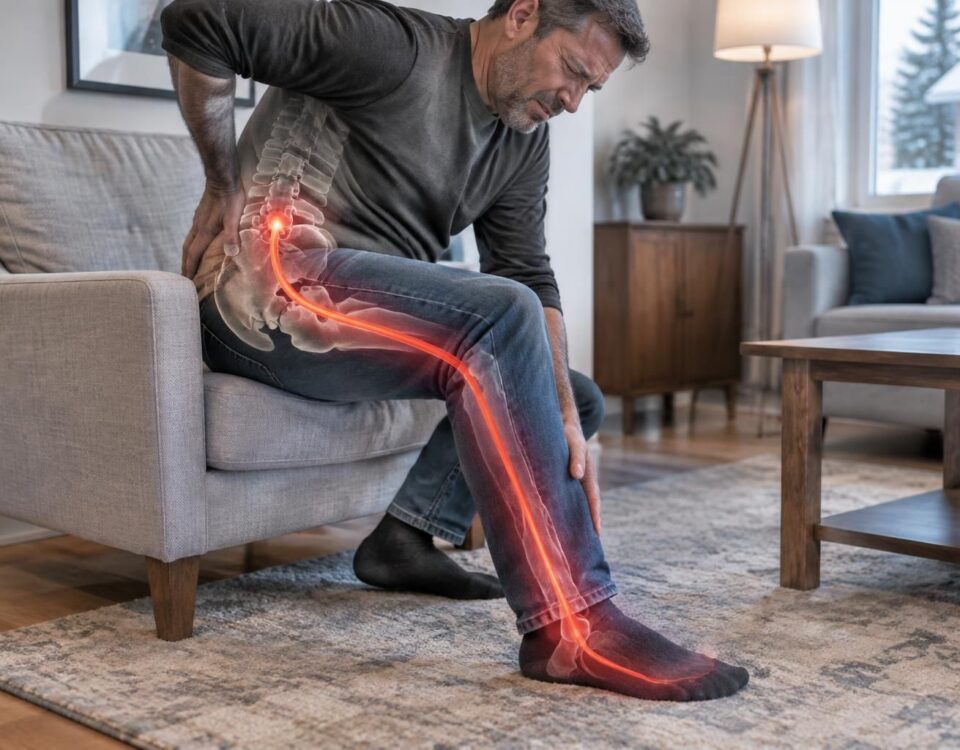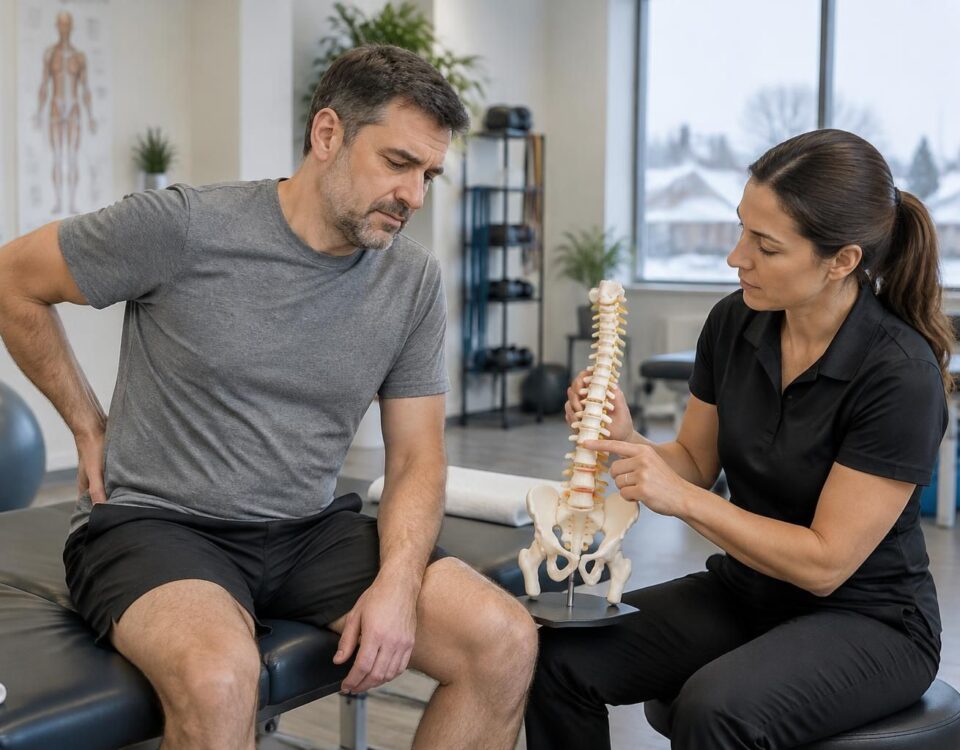



Sciatica in Montreal: L4-L5 disc, L5-S1 disc, and leg pain
16/10/2026
Sciatica and difficulty finding a comfortable position
16/10/2026
IN BRIEF Sciatica is pain that travels down the leg when a nerve root is irritated. An injury to the L4-L5 disc often affects the L5 root; an L5-S1 injury affects the S1 root. The path of the pain and the examination of strength, sensitivity, and reflexes help guide the assessment, although imaging alone is not sufficient to make a diagnosis. In Terrebonne, an evaluation helps link symptoms to function and determine appropriate next steps. Progressive weakness, foot drop, or urinary or bowel problems require urgent assessment. |
Sciatica in Terrebonne: L4-L5 and L5-S1 Discs
Pain that travels down the leg may be related to nerve irritation near the L4-L5 or L5-S1 discs. An L4-L5 injury can irritate the L5 root, causing symptoms towards the top of the foot or the big toe. An L5-S1 injury may concern the S1 root, with pain sometimes felt in the back of the leg or along the outer edge of the foot. These pathways guide the assessment but are not sufficient on their own to establish a diagnosis.
To consider management in Terrebonne, the decision must take into account symptoms, strength, sensitivity, reflexes, and function, as well as imaging when it is useful. Progressive weakness, foot drop, numbness in the saddle area, or urinary or bowel issues require urgent assessment.
Pain that starts from the lower back or buttock and travels down the leg may be compatible with sciatica. The L4-L5 and L5-S1 discs are often mentioned in imaging reports, but the described level alone does not explain the symptoms. The assessment should also consider the pain pathway, strength, sensitivity, reflexes, and affected activities. In Terrebonne, an evaluation clarifies questions to check and determines whether medical referral is necessary. The lumbar spine consists of five vertebrae, from L1 to L5. The sacrum is located below the last lumbar vertebra. The L4-L5 disc is located between the L4 and L5 vertebrae. The L5-S1 disc is situated between L5 and the sacrum. These two levels may exhibit changes related to wear, such as reduced disc height or protrusion. A disc herniation can also irritate or compress a nerve root. However, a visible abnormality on imaging is not automatically the cause of the pain: some changes also appear in individuals without symptoms. The name of the disc indicates where the anatomical change is located. The name of the root describes the nerve that may be irritated. In a common configuration, a posterior or posterolateral herniation at L4-L5 may affect the L5 root, while a herniation at L5-S1 may affect the S1 root. However, the position of the herniation and the anatomy of the person can alter this pattern. This distinction explains why an MRI report alone cannot determine the cause of the symptoms. Imaging findings must be compared to the examination and reported difficulties. Irritation of the L5 root can cause pain in the buttock, on the side of the leg, and on the top of the foot. Some people also experience tingling or numbness near the big toe. Difficulty lifting the foot or big toe can also guide the examination. Irritation of the S1 root can lead to pain in the buttock and at the back of the thigh or calf, sometimes down to the heel and along the outer edge of the foot. The examination can check calf strength and the Achilles reflex. However, pain or unusual sensations cannot confirm which root is affected without examination. To better understand certain symptoms, consult resources on pain on the top of the foot and the L5 root, numbness of the big toe associated with low back pain, and nocturnal leg pain. The assessment begins with questions about the onset of symptoms, their duration, pathway, and progression. The professional also inquires about positions or activities that worsen or relieve the pain, treatments already tried, and recent changes in walking or daily activities. The examination may compare both sides and check mobility, strength, sensitivity, reflexes, and some functions like walking on heels or toes. These observations help determine if symptoms correspond to nerve injury and whether further medical evaluation is indicated. An X-ray or MRI is not necessary in every situation. Imaging becomes more relevant when it can change management, for example, in the presence of neurological deficits, warning signs, or before a targeted procedure. The result must be interpreted together with symptoms and clinical examination, not in isolation. Pain in the leg does not prove that the disc is the sole cause. Other issues may produce similar symptoms. If the presentation is unusual, persistent, or changes rapidly, the professional may recommend reevaluation or medical consultation. Management depends on the probable cause, the intensity of symptoms, function, and the stability of neurological signs. When the situation is stable and without warning signs, the plan may aim to maintain tolerated activities and monitor pain, walking, sleep, and daily capabilities. There is no single intervention suitable for everyone. At the TAGMED Clinic, in Terrebonne or Montreal, services may include an assessment and, depending on the clinical profile, approaches such as specific osteopathy or motorized neurovertebral decompression. These options are not suitable for all cases and do not replace a medical diagnosis or urgent evaluation. The relevance of an approach should be discussed based on symptoms, examination, and functional goals. A resource on pain while seated with tingling in the foot can help prepare questions to ask during an assessment. An emerging weakness or reduced confidence in walking deserves special attention; also consult information on leg weakness and walking. Monitoring should not be limited to a pain score. It can include the trajectory of symptoms, strength, sensitivity, sleep quality, walking tolerance, and the ability to perform important activities. A fluctuation in pain from day to day does not necessarily mean that the disc has changed. Before starting an approach, ask what objective will be monitored, when the plan will be reassessed, and what changes would require a different direction. A temporary improvement in pain does not confirm the cause alone. Conversely, new or progressive weakness should be reported, even if the pain decreases. Consult a medical service without delay in case of loss of control of the bladder or bowels, numbness in the saddle area, significant or progressive weakness, foot drop, or symptoms affecting both legs. These signs require urgent evaluation. A fever, recent trauma, severe pain, or rapid worsening also warrant prompt medical attention. No. The indicated level alone does not determine severity. The assessment takes into account the size and position of the herniation, symptoms, strength, and neurological progression. No. This trajectory may guide the examination towards the L5 root, but it does not confirm the diagnosis. The professional must also check strength, sensitivity, reflexes, and other possible causes. No. An MRI is useful when its result can change the management or when a particular situation justifies it. The need for imaging depends on the symptoms, examination, and their evolution. No. This approach is not indicated for every person and does not replace screening for alert signs. A prior evaluation is necessary to discuss its relevance and limitations. Sylvain Desforges, B.Sc., D.O., N.D., osteopath and naturopath, is the founding president of TAGMED and the ACMA association. His practice focuses on chronic pain of the spine, lower back pain, and pain compatible with sciatica. Through SOS Sciatique, he publishes educational content on sciatica symptoms, possible causes, and non-surgical approaches that can be considered based on evaluation. To learn about available services, visit the TAGMED Clinic or information on the treatment of sciatica in Terrebonne. Medical disclaimer: The information and advice provided on this site do not replace the opinion, diagnosis, or treatment of a health professional. Please note that Sylvain Desforges, B.Sc., D.O., N.D., Doctor of Osteopathy, is neither a medical doctor nor a physician, and is not a specialist in a medical specialty as defined by the Collège des médecins du Québec. Manual medicine, functional medicine, and sports medicine as described on this site exclude any medical treatment or diagnosis made by a doctor or medical specialist. Always consult your physician for any medical questions. For more details, please read our Complete Legal Notice.What do L4-L5 and L5-S1 mean?
The disc level and the nerve root are not the same thing
What symptoms may accompany irritation of L5 or S1?
How to assess sciatic-type pain in Terrebonne?
Linking imaging to symptoms
What can be done when pain travels down the leg?
How to monitor the progression of symptoms?
When to seek urgent evaluation?
Frequently asked questions about L4-L5, L5-S1, and sciatica
Is an L5-S1 herniation more serious than an L4-L5 herniation?
Does pain on the top of the foot always indicate an L5 issue?
Is an MRI always necessary?
Is neurovertebral decompression suitable for all sciatic cases?
About the author
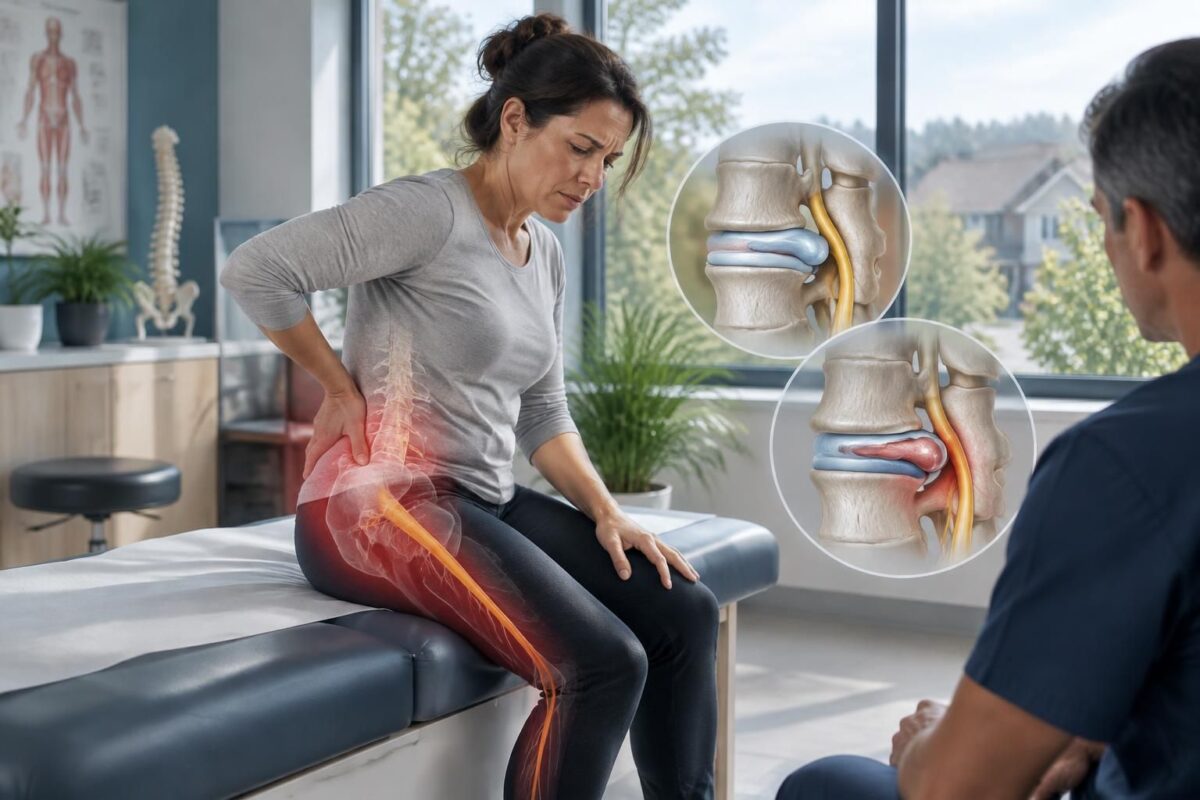
Sciatica in Terrebonne: disc protrusion or disc herniation?
IN BRIEF A disc bulge is a swelling of the disc, while a herniated disc involves a more pronounced protrusion of its contents; both can irritate a nerve root and cause sciatica. Symptoms alone do not always allow for distinction…

Sciatica disc in Terrebonne: why the pain travels down the leg
IN SHORT The disc-related sciatica occurs when a lumbar disc irritates a nerve root, which can cause pain to radiate down the buttock and leg. In Terrebonne, an assessment helps to better understand the cause of the symptoms and consider…
Sciatica in Terrebonne: Guidelines by Disc Level
L4-L5 Disc
- Can irritate the L5 root.
- Pain sometimes towards the side of the leg and the top of the foot.
- A difficulty in lifting the foot may guide the examination.
L5-S1 Disc
- Can irritate the S1 root.
- Pain sometimes behind the leg, down to the heel or edge of the foot.
- A difficulty in standing on tiptoes may guide the examination.
In Terrebonne, the level indicated on imaging is not sufficient to explain the pain: its distribution, strength, sensitivity, and reflexes must also be evaluated. Progressive weakness, numbness in the saddle area, or urinary or bowel disturbances require a urgent evaluation.

In Terrebonne, pain that radiates down the leg can sometimes be related to nerve irritation near the lumbar discs L4-L5 or L5-S1. However, the level observed on imaging is not enough to identify the cause or severity: the pain trajectory, strength, sensitivity, reflexes, and affected activities must also be evaluated. Here are some guidelines to prepare for a cautious and measurable approach.

L4-L5 disc herniation and sciatica in Terrebonne: pain towards the foot
IN BRIEF A L4-L5 disc herniation can irritate a nerve root and cause sciatica, with pain that radiates from the buttock down to the leg or foot. In Terrebonne, an evaluation helps better understand the origin of the symptoms and…

Lumbar disc herniation L5-S1 and sciatica in Terrebonne: common symptoms
IN BRIEF A L5-S1 disc herniation can irritate a nerve root and cause sciatica: lower back pain radiating to the buttock or leg, tingling, numbness, or weakness. In Terrebonne, an assessment helps to better understand the symptoms and guide management…
Understanding L4-L5 and L5-S1 Levels
The discs located between the last lumbar vertebrae and the sacrum bear significant loads and are often subject to age-related changes. A herniation or another modification at these levels can irritate a nerve root, but some changes on imaging are also present in individuals who do not experience pain. Therefore, a report alone does not constitute a diagnosis.
Possible Pathways, Without Automatic Certainty
Affecting the L4-L5 disc can notably irritate the L5 root. The pain can then travel through the buttock and the side of the leg to the top of the foot or the big toe. An L5-S1 issue may involve the S1 root, with pain sometimes following the back of the leg towards the heel or the outer edge of the foot.
These pathways vary from person to person and can overlap. A difficulty in lifting the foot or walking on the heels, or a difficulty in standing on tiptoes, are useful elements to check. They do not, alone, confirm the affected root.
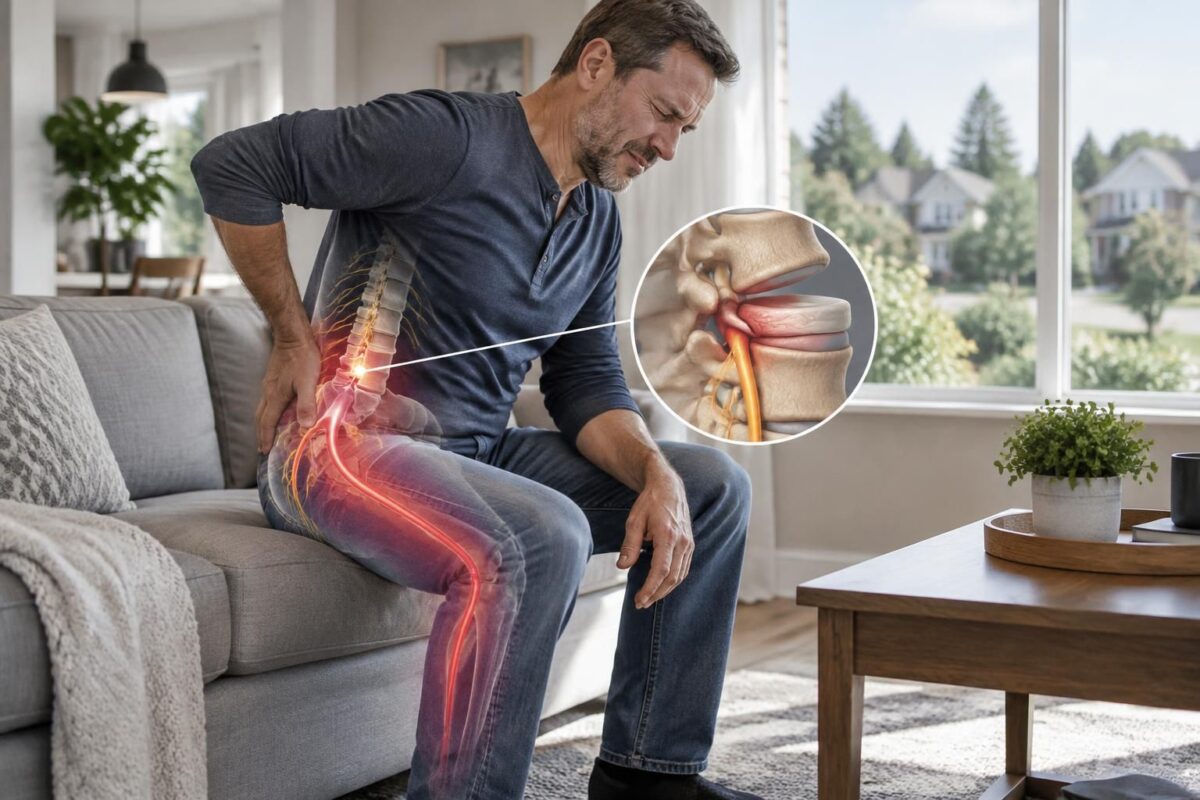
Sciatica and herniated disc in Terrebonne: understanding the link
IN BRIEF Sciatica refers to pain that follows the path of the nerve in the buttock and leg; a herniated disc can irritate it, but an anomaly on the MRI is not sufficient to establish the cause. In Terrebonne, the…

Sciatica in Terrebonne: lumbar roots and the choice of a cautious treatment
IN BRIEF Sciatica is pain related to the irritation or compression of a lumbar nerve root, which can radiate from the lower back to the buttock and leg. In Terrebonne, an evaluation allows for cautious treatment tailored to the cause…
What to do when pain radiates down the leg?
Start by noting when the symptoms began, their location, what aggravates or relieves them, and the activities that have become difficult. Also indicate changes in strength or sensitivity, sleep disturbances, and any treatments already tried. This information will help the professional establish a starting assessment and monitor the evolution.
When the symptoms are stable and no alarming signs are present, maintaining tolerated activities, such as short periods of walking, can be discussed with a professional. Adapt movements and loads that clearly exacerbate the pain. Avoid staying in a position that increases symptoms for long periods, but do not push through weakness or neurological worsening.
An evaluation based on multiple elements
In Terrebonne, a consultation should connect your history, your function, and an appropriate examination of mobility, strength, sensitivity, and reflexes. Imaging is not systematic: it is more relevant when it can change management, in the presence of concerning signs or before certain procedures. Care options, including osteopathy or motorized neurovertebral decompression, should be discussed according to your situation, their limits, and their risks. No treatment is suitable for everyone.
Plan for follow-up and emergency signs
Before any care plan, set a concrete goal, such as walking longer or resuming an important activity. Agree on a time for reevaluation and criteria for continuing, modifying, or stopping the approach. Follow-up should consider pain, but also strength, sensitivity, sleep, and daily participation. A decrease in pain does not necessarily mean that nerve function is restored.
Consult a medical service quickly in case of significant or progressive weakness, foot drop, symptoms in both legs, numbness in the saddle area, or urinary or intestinal issues. These signs require urgent evaluation.
About the author
Sylvain Desforges, B.Sc., D.O., N.D., is an osteopath and naturopath. The information presented is educational and does not replace a consultation, diagnosis, or treatment by an authorized healthcare professional.
| Disc | Pain and possible signs in the leg |
|---|---|
| L4-L5 | May irritate the L5 root: pain towards the side of the leg and the top of the foot; raising the foot or the big toe may be difficult. |
| L5-S1 | May irritate the S1 root: pain towards the back of the leg, the heel, or the outer edge of the foot; standing on tiptoes may be difficult. |
| To be verified | The path of the pain is not enough to establish the diagnosis: the examination must also assess strength, sensitivity, and reflexes. |
| Urgent evaluation | Progressive weakness, foot drop, numbness of the saddle area, or urinary or intestinal issues: consult without delay. |
Illustrative testimonies on sciatica in Terrebonne: L4-L5, L5-S1 and leg pain
Note: the narratives below are fictional examples, written for educational purposes. They do not represent testimonials from actual patients and guarantee no results. Leg pain requires an assessment suited to each person.
“My report mentioned an L4-L5 discopathy and I felt pain that radiated from my lower back down to my buttock and the side of my leg. I wanted to understand if the imaging really explained my symptoms. During my evaluation in Terrebonne, I was explained that the level indicated on the imaging is not sufficient, on its own, to determine the cause of the pain: it is also necessary to consider the path of the symptoms, strength, sensitivity, and function.”
“I was told there was a problem at the L5-S1 level. The pain extended to the back of my leg and the edge of my foot, and I was concerned about the difference from an L4-L5 issue. I understood that these indicators can guide the examination, but cannot diagnose without verifying the symptoms and neurological signs.”
“What worried me most was the pain in my leg, especially when I walked or sat for long periods. I was looking for an approach in Terrebonne that starts by clarifying the situation rather than promising a result. Discussing my activities, the distribution of the pain, and the criteria for reevaluation helped me better understand the possible next steps.”
Disc issues L4-L5 and L5-S1 are common, but an observation on imaging alone does not measure the pain or disability. An L4-L5 injury may sometimes be associated with irritation of the L5 root, while an L5-S1 injury may sometimes relate to the S1 root. Only a clinical examination taking into account the distribution of symptoms, strength, sensitivity, reflexes, and function can help assess this correspondence.
During an evaluation related to sciatica in Terrebonne, it is helpful to specify how long the pain has been present, where it radiates, what aggravates or relieves it, and which activities have become difficult. The goal is to establish a measurable starting point and to anticipate when the plan will be reevaluated or modified.
Leg pain accompanied by significant or progressive weakness, foot drop, numbness in the saddle area, urinary or intestinal issues, or symptoms affecting both legs demands a medical evaluation urgently.
Sciatica in Terrebonne: understanding L4-L5 and L5-S1 discs and leg pain
Sylvain Desforges, B.Sc., D.O., N.D., Doctor of Osteopathy and naturopath, is the founding president of TAGMED clinics and the ACMA association. He is particularly interested in chronic spinal pain, lower back pain, and symptoms compatible with sciatica. His approach aims to examine each person’s symptoms and function before considering support options. Available care at the TAGMED Clinic may include, depending on the evaluation and situation, specific osteopathy, motorized neurovertebral decompression, or a precision tool.
In Terrebonne, lower back pain radiating down to the buttock and leg may be related to irritation of a nerve root, but this path alone is not enough to establish a diagnosis. Disc changes at L4-L5 and L5-S1 are frequently observed. They may sometimes contribute to symptoms when they correspond with history, clinical examination, and, if indicated, imaging. An MRI result, on its own, does not necessarily reveal the cause of the pain and does not measure its severity.
The level of the disc and the name of the affected nerve root are two different concepts. An L4-L5 disc injury may irritate the L5 root; an L5-S1 injury may relate to the S1 root. These associations are common but not automatic. The affected side, the distribution of the pain, muscle strength, sensitivity, and reflexes must be considered together. Injuries at multiple levels can also produce overlapping signs.
Irritation of L5 can particularly be accompanied by pain that goes through the buttock and the side of the leg up to the top of the foot or the big toe. Difficulty in lifting the foot or walking on the heels may guide the examination. For S1, the pain may follow the back of the leg and reach the heel or the outer edge of the foot; difficulty in standing on tiptoes or a change in the Achilles reflex may also be looked for. None of these signs, taken in isolation, confirms the affected root.
The evaluation generally begins with questions about the onset and progression of symptoms, their location, activities that aggravate or relieve them, as well as treatments already attempted. The examination can compare mobility, walking, strength, sensitivity, and reflexes. Sleep, work, tolerance to walking, and activities important to the person are also useful to establish a measurable starting point.
Imaging is not necessary in all situations. It may be considered when it answers a clinical question likely to change management, notably if symptoms persist, if neurological deficits appear or worsen, or if a targeted procedure is contemplated. A reasonable plan specifies the functional goals, outcomes to be monitored, and when management will be re-evaluated. Care options have different goals, limitations, and risks; their relevance depends on the person’s profile.
A foot drop, progressive weakness, loss of sensation in the saddle region, urinary or bowel disturbances, or symptoms affecting both legs require a urgent medical evaluation. A decrease in pain is not enough to rule out a neurological problem if strength or sensitivity deteriorates.
The information presented here is educational and does not replace consultation, diagnosis, or follow-up with a doctor or other authorized healthcare professional. Sylvain Desforges is neither a physician nor a specialist in a medical specialty recognized by the Collège des médecins du Québec. Osteopathy and functional support approaches do not replace necessary medical care.
In Terrebonne, pain that radiates down the leg may be compatible with sciatica, but the level indicated on imaging is not sufficient to determine the cause or severity. A disc involvement L4-L5 can particularly irritate the L5 root, while an involvement L5-S1 may involve the S1 root. To guide the evaluation, the symptom pathways, strength, sensitivity, reflexes, and activities that have become difficult must be correlated.
What the L4-L5 and L5-S1 levels may indicate
The L4-L5 and L5-S1 discs are located in the lower back and are often affected by degenerative changes. However, seeing an anomaly on an X-ray or MRI does not prove that it explains the pain: such observations may also be present in people who have no symptoms. The image must therefore be interpreted alongside the history and clinical examination, and not in isolation.
In a herniation located between L4 and L5, the L5 root is often affected; a herniation between L5 and S1 may rather irritate the S1 root. The relationship between the disc and the root, however, depends on the exact location of the involvement. Additional explanations about sciatica associated with a disc herniation, lombosciatica and lumbar radiculopathy, or the levels L4, L5, and S1 can help clarify these terms, without replacing a personalized assessment.
The pathway of pain and function also matter
Irritation of the L5 root can be accompanied by pain that travels through the buttock and the side of the leg, sometimes all the way up to the top of the foot or the big toe. An S1 involvement may rather produce pain towards the back of the thigh and calf, the heel, or the outer edge of the foot. These pathways are guidelines, not diagnostic proofs: symptoms can overlap or vary from person to person.
The examination can also check the ability to lift the foot and big toe, to walk on the heels, or to stand on tiptoes, as well as sensitivity and certain reflexes. Pain in the calf, tingling, burning, or numbness may justify further checks. To deepen these manifestations, consult resources on burning in the foot, numbness in the leg, and pain accompanied by tingling or burning.
An evaluation that links symptoms, examination, and imaging
Pain may change direction or manifest mainly in the leg, even when the lower back is minimally painful. These variations alone do not allow for identifying the affected disc or root. The evaluation takes into account the onset of symptoms, their progression, positions or activities that modify them, walking, sleep, and neurological signs. Information on pain that changes trajectory or calf pain without significant low back pain can prepare the questions to ask a professional.
Imaging is not necessarily needed right away. It may be considered when symptoms persist, a neurological deficit appears or worsens, or when a result is likely to alter management. The choice of care depends on the clinical picture and functional goals; it should not rest solely on the mention “L4-L5” or “L5-S1” in a report. For an overview of the elements to discuss, you can consult this guide on sciatica L4-L5 and L5-S1 in Terrebonne and the guide dedicated to sciatica and disc herniation.
Follow-up and signs requiring prompt attention
To monitor progress, note the distribution of pain, walking tolerance, important activities, sleep, as well as any changes in strength or sensitivity. A care plan should include a concrete goal and a reevaluation time to determine whether to continue, modify, or seek further advice. A temporary decrease in pain does not always suffice to conclude that nerve function is restored.
Significant or progressive weakness, foot drop, increasing difficulty walking, numbness in the saddle area, loss of urinary or bowel control, or symptoms affecting both legs require urgent medical evaluation. In the presence of these signs, do not delay evaluation to complete a care program.

Sciatica in Terrebonne: how to interpret pain according to the leg path
IN BRIEF Sciatica is a pain that can start from the lower back or the buttock and travel down the leg to the foot. Its path, along with any tingling or weakness, helps guide the assessment but is not sufficient…

Sciatica in Terrebonne: L5-S1, canal, foramen and nerve compression
IN BRIEF The sciatica L5-S1 corresponds to irritation or compression of a nerve root, sometimes related to a disc herniation or narrowing of the lumbar canal or the foramen. The pain may radiate from the lower back to the buttock,…

Sylvain Desforges, B.Sc., D.O., N.D., docteur en ostéopathie
Dr Sylvain Desforges, B.Sc., D.O., N.D., osteopath, is the founding president of TAGMED and of the ACMA association. He dedicates his practice to chronic spinal pain, low back pain and symptoms compatible with sciatica, particularly when pain radiates toward the buttock, leg, calf, foot or toes.
Through SOS Sciatique, he publishes educational content on sciatica symptoms, possible causes such as disc herniation, disc narrowing, foraminal stenosis or irritation of a lumbar nerve root, as well as non-surgical approaches that may be considered according to the evaluation. At Clinique TAGMED, care may include, depending on the case, motorized neurovertebral decompression, specific osteopathic care or precision percussion.
For an evaluation related to sciatica treatment in Montreal / Mount Royal or sciatica treatment in Terrebonne, please consult the services available at Clinique TAGMED.
Medical disclaimer
The information published on SOS Sciatique is provided for educational purposes only and does not replace a consultation, diagnosis, opinion or treatment provided by a physician or another authorized healthcare professional. The author of this article is neither a medical doctor nor a specialist in a medical specialty recognized by the Collège des médecins du Québec. The osteopathic, manual medicine or functional support approaches described on this site do not constitute medical acts and are not intended to replace medical follow-up.
Consult a physician or emergency service in cases of loss of bladder or bowel control, anesthesia in the saddle area, significant or progressive weakness in the leg or foot, fever, recent trauma, severe pain or rapid worsening of symptoms. For more details, please read our Legal Notice.