Sciatica in Montreal: pain and numbness after walking
14/09/2026
Sciatica and difficulty going down stairs
14/09/2026
IN BRIEF
| In brief, sciatica in Terrebonne is pain and numbness that follow the path of the sciatic nerve after walking, which may affect the buttock, the back of the thigh, the calf, and the foot. This condition is mainly managed without surgery thanks to a personalized approach focused on movement. Key benefits: reduction of nerve irritation, gradual improvement of mobility, safe return to activities and walking, and prevention of recurrence. How does it work? A precise local assessment, targeted exercises, neural mobilization techniques, and postural advice, with appropriate follow-up to progress gently. In Terrebonne, the TAGMED Clinic offers this conservative and personalized pathway to help you resume your activities without surgical intervention. |
Sciatica in Terrebonne manifests as a pain and numbness that appear after walking and follow the path of the sciatic nerve, towards the buttock, the back of the thigh, the calf, and the foot. It can be accompanied by paresthesia and muscle weakness. Treatment favors non-surgical and personalized approaches (targeted exercises, neural mobility, manual therapy) to reduce irritation and promote a gradual return to activities. Warning signs requiring quick consultation: loss of bladder control, significant weakness, or pain that progresses rapidly.
This article provides a clear explanation of sciatica appearing after walking in Terrebonne, possible causes, the evaluation process, and non-surgical management options offered by the TAGMED Clinic. It aims to help you recognize the signs, understand the symptom path, and quickly guide towards an appropriate and safe approach.
Understanding Sciatica and Its Link to Walking
Sciatica refers to pain related to irritation or compression of one of the roots of the sciatic nerve, which is the largest and longest nerve in the body. The lumbar roots L5 and sacral S1 play a key role in the usual pathway of this pain. Walking can aggravate or trigger these symptoms when the nerve root is irritated by a disc protrusion, foraminal stenosis, or other lumbar disorders.
Signs After Walking and Location
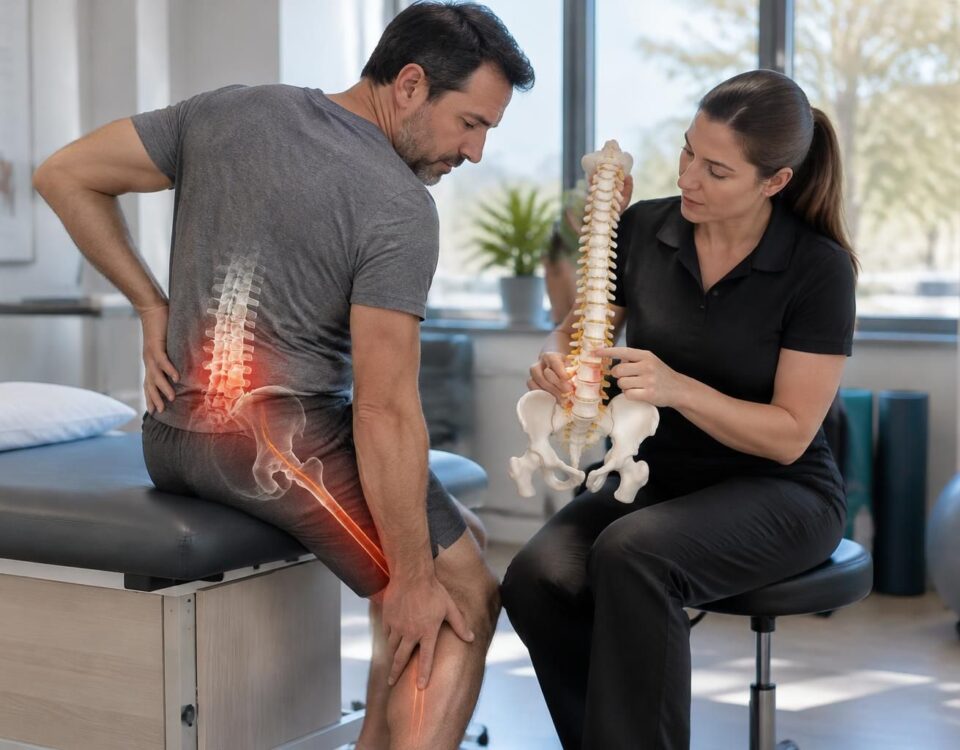
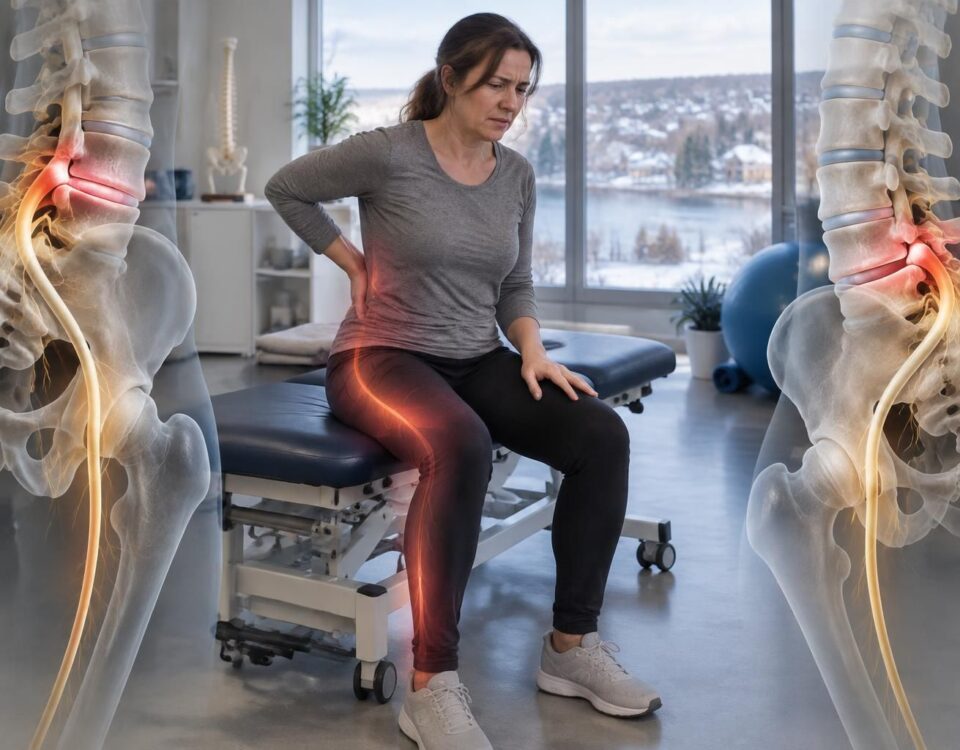
After a period of walking, pain may emerge in the buttock region and along the posterior thigh, then descend into the calf and foot. Sensations of tingling, burning, or numbness may accompany the pain. In some cases, muscle weakness or difficulties in walking may appear, especially when the S1 root is involved.
Possible Causes Related to Walking
Several mechanisms can explain the onset after walking. Classic lumbar causes, such as a disc herniation or foraminal stenosis, can be distinguished from non-lumbar factors that may provoke irritation of the sciatic nerve, such as muscle chains or tensions in the pelvic region. General signs or nocturnal pain may also direct the evaluation towards specific pathologies requiring tailored management.
Diagnosis and Evaluation in Terrebonne
During the consultation, the doctor or osteopath examines the symptom path, muscle strength, sensitivity, and reflexes. The Lasegue maneuver may help assess the intensity and location of the pain. Additional examinations are only considered if necessary to confirm the diagnosis or rule out an emergency. In Terrebonne, a structured evaluation helps distinguish lumbar radiculopathy and clarify possible causes.
Non-Surgical Treatment Options at the TAGMED Clinic
The TAGMED Clinic offers a patient-centered approach for sciatica pain after walking. The plan may include osteopathic techniques, neural mobilizations, and motorized neurovertebral decompression when relevant, combined with postural advice and regular follow-up. The goal is to reduce nerve irritation, improve mobility, and facilitate a gradual return to tolerated activities without resorting to surgery.
In the presence of persistent painful signs, the TAGMED Clinic can also discuss complementary treatments and lifestyle adjustments to prevent recurrences. For more information about the options offered in Terrebonne, refer to the Treatment of sciatica in Terrebonne.
Preventing and Supporting the Return to Activity
The return to activity should be gradual and tailored to your tolerance. Advice on workplace postures, active breaks, and pain management can help limit nerve irritation and improve mobility. Overall management also includes the relationship between the painful path and daily activities to consider a safe return to professional and personal activities.
To enrich your understanding and access complementary resources, you can check these relevant references:
Numbness and pain along the path of the sciatic nerve: Numbness in the sciatic leg – what to do.
Sciatica in Terrebonne and persistent heel pain: Persistent pain in the heel.
Sciatica and foot pain while walking: Sciatica and foot pain while walking.
For a specific evaluation in Terrebonne, you can also refer to the dedicated content: Nocturnal pain in the leg, Pain towards the little toe and root S1.
For a general framework of reference and associated approaches, you can consult TAGMED’s resources and the information available on Treatment of sciatica in Terrebonne.
Medical warning: All articles must include the medical disclaimer below.
Medical disclaimer: The information and advice provided on this site do not replace the opinion, diagnosis, or treatment of a healthcare professional. Please note that Dr. Sylvain Desforges, osteopath, is neither a medical doctor nor a physician, and is not a specialist in a medical specialty as defined by the College of Physicians of Quebec. Manual medicine, functional medicine, and sports medicine as described on this site exclude any treatment or medical diagnosis made by a physician or specialist. Always consult your doctor for any medical questions. For more details, please read our complete Legal Notice.
For those seeking information on neurovertebral decompression approaches and non-surgical treatments, the resources below remain relevant and suitable for your journey in Terrebonne:
Neurovertebral decompression and Herniated disc and non-surgical options. For specific information and non-surgical choices compatible with TAGMED, prioritize the resources available on sossciatique.com and cliniquetagmed.com.
Sciatica in Terrebonne: pain and numbness after walking — practical and quick focus.
- Pain after walking: sciatic nerve path often starting from the lower back or buttock and descending into the thigh, calf, then foot.
- Numbness or paresthesia along the path: sign of nerve involvement.
- Location according to the root: possible involvement of L5 or S1, which may affect the buttock, back of the thigh, calf, and foot.
- Proposed approach in Terrebonne: personalized conservative plan focused on movement (targeted exercises, neural mobility, and manual therapy) without surgery when possible.
- Practical advice: stay active, take active breaks, adopt an appropriate posture, and avoid movements that worsen the back.
- Red flags: loss of bladder or bowel control, marked or rapid weakness, pain that worsens or fever; consult quickly.

This article provides practical recommendations for sciatica after walking in Terrebonne, characterized by pain and sometimes numbness along the path of the sciatic nerve after effort or walking. It outlines the signs to watch for, possible causes, and a non-surgical plan focused on targeted exercises, neural mobility, postural advice, and a gradual return to activity. It emphasizes a local and personalized assessment to avoid repetitive pain and promote a comfortable return to walking.
Symptoms and sciatic nerve path
Pain may start from the lower back and radiate to the buttock, then down into the back of the thigh, calf to the foot. Numbness or tingling often accompanies this discomfort, and some patients describe a burning sensation or electric shock along the path. The main sign is the radiation that follows the path of the sciatic nerve, generally from low back pain to the heel or to one of the toes depending on the affected root (e.g. L5 or S1). In some cases, the pain can be truncated and involve only a part of the path.
Causes and triggers after walking
Several mechanisms may be involved after prolonged walking or standing: irritation of a nerve root due to a mild herniated disc, foraminal stenosis, or wear of the posterior joints (facet). A contracted piriformis muscle can also compress the trunk of the sciatic nerve. Factors that promote pain after effort include inappropriate posture while walking, insufficient core muscle strength, and lifestyle habits that are unfavorable to the spine.
Evaluation and red flags
A local assessment allows for precise mapping of symptom pathways, evaluation of strength, sensitivity, and reflexes, and identification of neurological signs that point to lumbar radiculopathy. Red flag signs requiring quick consultation include loss of bladder or bowel control, significant or rapid weakness of a leg, pain that worsens quickly or persists despite well-conducted treatment, fever, or recent trauma.
Non-surgical management plan
Management prioritizes movement and conservative measures. Adopt a suitable and regular activity, continue targeted exercises to stretch tight muscles and strengthen the core, and incorporate guided neural mobility to promote nerve glide without excessive pain. Manual therapy and mobilization techniques can complement the program, while a lumbar belt may be considered temporarily and under supervision.
Examples of exercises and practical advice
Incorporate simple core strengthening and lower back stretching exercises, with progression suited to your pain tolerance. Work on neural mobility through gentle and progressive mechanisms, and prioritize postures that maintain the natural curvature of the back. To pick up an object, bend your knees and keep your back straight rather than bending forward.
Daily advice and gradual return
Break activities into segments: alternate walking periods, active breaks, and recovery. Maintain hydration and a balanced diet to support disc health. If symptoms reappear, reassess the intensity and adapt the program with the help of a professional in Terrebonne to avoid flare-ups and promote a safe return.
When to consult quickly
Quickly consult if you observe a loss of urinary or bowel control, marked weakness, or pain that progresses rapidly, or any signs of recent infection or trauma. A specialized assessment can determine if further actions or adjustments to the plan are needed to allow for more comfortable and sustainable walking.
| Items to check | Concise observations |
|---|---|
| Path of symptoms | Do they follow the path of the sciatic nerve (buttock → leg → foot)? |
| Main location | Buttock and back of the thigh, sometimes calf or foot. |
| Trigger by walking | Walking can worsen or reveal the pain. |
| Quality of pain | Burning, electric shock, or tingling. |
| Numbness | Presence of numbness or paresthesias along the path. |
| Neurological signs | Weakness in the leg, loss of sensitivity, altered reflexes. |
| Functional impact | Difficulties walking, standing, and sleeping. |
| Signs of emergency | Loss of urinary/bowel control, rapid pain, fever. |
| Non-surgical approaches | Targeted exercises, neural mobility, manual therapy. |
| Practical tips | Adjusted activity, active breaks, and daily postures. |
Testimonials on Sciatica in Terrebonne: pain and numbness after walking
Before my first visit, the sciatic pain and numbness after walking forced me to stop after a few minutes. At the TAGMED Clinic in Terrebonne, the assessment traced the path of the nerve and the proposed plan focused on targeted exercises and neural mobilization. Since then, I can walk much farther without the pain settling in.
After a few weeks, the sciatic pain and numbness returned as soon as I increased the distance. The staff in Terrebonne adjusted my posture and strengthened my core, which reduced irritation and improved my mobility.
During a long walk, I felt a sciatic pain and numbness descending into the calf. The team precisely traced the path and proposed a personalized plan including simple exercises and neural mobilization. In a few weeks, my sensations evolved towards less discomfort and more comfort while walking.
Since the beginning of treatment, the sciatic pain after walking has become less severe, and the signs of numbness are rarer. The personalized plan and regular follow-ups have allowed me to resume my daily activities with confidence thanks to adapted exercises and good posture.
Today, I notice a significant improvement: the sciatic pain and numbness after walking no longer bother me. The TAGMED Clinic provided gradual and safe support, focused on my activity resumption and my safety.
Dr. Sylvain Desforges, an expert in osteopathy, manual medicine, and naturopathy, is the founding president of the TAGMED clinics and the ACMA association. With a career dedicated to innovation in healthcare, his work focuses particularly on the management of chronic pain of the spine and radicular disorders, with a marked attention to the mechanisms that manifest during walking and standing. His approach is based on rigorous assessment and personalized therapeutic planning, tailored to each pain journey.
In Terrebonne, his practice highlights sciatica as a complex symptom resulting from irritation, compression, or inflammatory disruption of the roots of the sciatic nerve. When a patient experiences pain and numbness after walking, the TAGMED team proposes an individualized approach: retracing the path of sensations, understanding their correlation with movements and daily activities, and establishing a rehabilitation plan that prioritizes movement rather than prolonged rest. This approach aims to enable a gradual resumption of activities while reducing nerve irritations and enhancing postural stability.
The diagnostic process favors a multidisciplinary and structured approach: clinical interviews, neurological examination, and functional evaluations guide reasoning, complemented when necessary by correlation with existing imaging. In the presence of worrying signs, the team knows how to quickly refer to the appropriate services. For classic cases of lumbosciatica, the objective is to identify the involved nerve (for example, L4-L5 or S1), understand the role of lumbar structures, and propose effective non-surgical solutions centered on movement and patient autonomy.
On the therapeutic front, Dr. Desforges relies on a conservative and active approach that combines targeted exercises, postural advice, and techniques of manual therapy and neural mobilization. When necessary, complementary interventions are considered within a personalized care plan to optimize nerve tolerance and promote smoother and less painful walking. The plan may include, depending on the assessment, methods such as motorized neurovertebral decompression, laser therapy, or shockwave stimulation, used appropriately and supervised for each patient.
In the context of managing sciatica in Terrebonne, Dr. Desforges emphasizes the importance of patient education and preventing relapses. Sustainable growth in mobility and function goes through healthy lifestyle habits, regular physical activity, and continuous attention to posture during daily and professional activities. The goal is clear: reduce nerve irritation, improve lumbar and lower limb mobility, and enable an active and safe resumption of activities after walking, without systematically resorting to surgery.
For those seeking expert and personalized care for sciatica in the region, the TAGMED team in Terrebonne offers a thorough assessment and a clear action plan focused on movement, understanding symptoms, and optimizing quality of life. Dr. Sylvain Desforges is guided by a philosophy based on evidence and continuous improvement of his patients’ well-being, placing each pain journey at the center of a sustainable and human approach.
This text provides a concise and practical overview of sciatica in Terrebonne, centered on symptoms of pain and numbness after walking, possible mechanisms, recommended evaluation, and non-surgical management options tailored to your profile. It offers clear resources to delve deeper into the topic and promote a gradual return to activities without invasive intervention.
Signs and Typical Journey After Walking
Sciatica may manifest as tingling, burning sensations, or numbness that follows the path of the sciatic nerve, starting from the lower back to the buttock, then down the back of the thigh, the calf, and the foot. After walking, these signs may appear after a few minutes and worsen if the walk is prolonged or repetitive. In some cases, pain may be limited to a portion of the journey or accompanied by targeted weakness, paresthesia, or nighttime awakening. For concrete examples and similar descriptions, you can consult resources such as hip pain or nerve radiation and pain that returns after walking.
Irritation may also be associated with a sensation of numbness progressing towards the foot, which may reflect lumbar sacral radiculopathy (L4-L5-S1). Supplementary resources explore how these pains may appear after a long journey or after a few minutes of walking and how they present differently among individuals: foraminal stenosis and radiating pain, appearance after a few minutes of walking, numbness progressing towards the foot.
For a complementary view on areas of numbness and zones affected by sciatica, you can also consult resources like numbness and affected areas.
Assessment and Diagnosis
In the context of a post-walking episode, the medical evaluation aims to outline the precise path of symptoms, examine muscle strength, sensitivity, and reflexes, and assess the impact on activity and sleep. The doctor may use a Lasegue maneuver or other clinical tests to determine if the signs indicate lumbar sacral radiculopathy and to distinguish a mechanical cause (herniated disc, foraminal stenosis, facet joint osteoarthritis) from other origins. Imaging exams (MRI or X-rays) are only considered if they influence the treatment plan or if symptoms evolve in a concerning manner. For the Terrebonne area, the available resources and types of evaluations are described in dedicated guides and articles, including those that explain the mechanisms and nerve pathways such as Ameli – consultation and treatment and tingling, burning, or numbness.
Non-Surgical Management and Practical Tips in Terrebonne
A conservative approach is favored to reduce nerve irritation and promote a return to movement. This may include targeted exercises, gentle mobilizations, and adapted manual therapy, along with postural advice and neural mobility programs. In some cases, specific techniques like motorized neurovertebral decompression may be discussed after evaluation, to support a gradual return to activity and walking without pain.
Beyond exercise, it is important to stay active and avoid prolonged rest. Simple measures like alternating sitting and standing positions, incorporating active breaks, and favoring tolerated activities (light walking, gentle stretching) can make a big difference. For specific cases, resources like heavy or painful leg and pain trailing after a long journey provide helpful insights on symptoms and non-surgical action plans.
To support your efforts, you can consult additional resources on the mechanisms and available options: numbness progressing towards the foot, pain returning after walking, and hip pain or nerve radiation.
Resources and Useful Readings
CONTENT END
To delve deeper, you can consult external and local resources that describe the mechanisms of sciatica, nerve pathways, and situations requiring quick assessment: hip pain or nerve radiation, pain that returns after walking, onset after a few minutes of walking, numbness progressing to the foot, tingling, burning, or numbness, Ameli – consultation and treatment, heavy or painful leg, train of pain after a long trip, radiating pain.

Sciatica L5-S1 in Terrebonne: why the pain can radiate down to the foot
IN BRIEF L5-S1 sciatica refers to pain related to irritation of a lumbar nerve root, which may start from the lower back and radiate into the buttock, leg, and down to the foot. The pathway varies: the top of the…

Sciatica in Terrebonne: painful journey according to roots L4, L5, and S1
IN BRIEF Sciatica in Terrebonne can cause pain, tingling, or weakness in the leg. The roots L4, L5, and S1 can guide the evaluation based on symptoms and changes in strength, sensitivity, or reflexes; their territories do overlap, however. Comparing…

Sciatica in Terrebonne: what does irritation of the S1 root mean?
IN BRIEF An irritation of the S1 root can cause pain of a sciatica type in the buttock, the back of the leg, and the outer edge of the foot. Tingling, numbness, or difficulty walking on tiptoes may also occur.…

Sciatica in Terrebonne: what does irritation of the L5 root mean?
IN BRIEF L5 sciatica corresponds to irritation of the L5 nerve root, often felt from the lower back and buttock down the side of the leg, to above the foot and the big toe. It can cause pain, tingling, or…

Sciatica in Terrebonne: difference between L4-L5 and L5-S1
IN BRIEF The difference between L4-L5 and L5-S1 concerns the level of the lumbar discs and the sometimes irritated nerve roots: an L4-L5 injury often affects L5, while an L5-S1 injury often affects S1. The sensory pathways overlap; thus, an…

Sciatica S1 in Terrebonne: pain towards the calf and the outer edge of the foot
IN BRIEF S1 sciatica is pain related to irritation of a lumbar nerve root, which may radiate down to the buttock, back of the calf, and the outer edge of the foot. Tingling or weakness may also occur. In Terrebonne,…

Sciatica L5 in Terrebonne: pain towards the big toe
IN SHORT L5 sciatica can cause pain or numbness that radiates to the big toe, sometimes with difficulty lifting the foot. This pathway is a clue, not a diagnosis: the examination compares strength, sensitivity, and gait, as the nerve territories…

Sciatica L5-S1 in Terrebonne: pain radiating to the heel or foot
IN BRIEF A L5-S1 sciatica often corresponds to irritation of the S1 root, which can cause pain that radiates from the buttock down to the calf, heel, or outer edge of the foot. Identifying the pathway of symptoms and changes…

Dr Sylvain Desforges, B.Sc., D.O., N.D., osteopath, is the founding president of TAGMED and of the ACMA association. He dedicates his practice to chronic spinal pain, low back pain and symptoms compatible with sciatica, particularly when pain radiates toward the buttock, leg, calf, foot or toes.
Through SOS Sciatique, he publishes educational content on sciatica symptoms, possible causes such as disc herniation, disc narrowing, foraminal stenosis or irritation of a lumbar nerve root, as well as non-surgical approaches that may be considered according to the evaluation. At Clinique TAGMED, care may include, depending on the case, motorized neurovertebral decompression, specific osteopathic care or precision percussion.
For an evaluation related to sciatica treatment in Montreal / Mount Royal or sciatica treatment in Terrebonne, please consult the services available at Clinique TAGMED.
Medical disclaimer
The information published on SOS Sciatique is provided for educational purposes only and does not replace a consultation, diagnosis, opinion or treatment provided by a physician or another authorized healthcare professional. The author of this article is neither a medical doctor nor a specialist in a medical specialty recognized by the Collège des médecins du Québec. The osteopathic, manual medicine or functional support approaches described on this site do not constitute medical acts and are not intended to replace medical follow-up.
Consult a physician or emergency service in cases of loss of bladder or bowel control, anesthesia in the saddle area, significant or progressive weakness in the leg or foot, fever, recent trauma, severe pain or rapid worsening of symptoms. For more details, please read our Legal Notice.