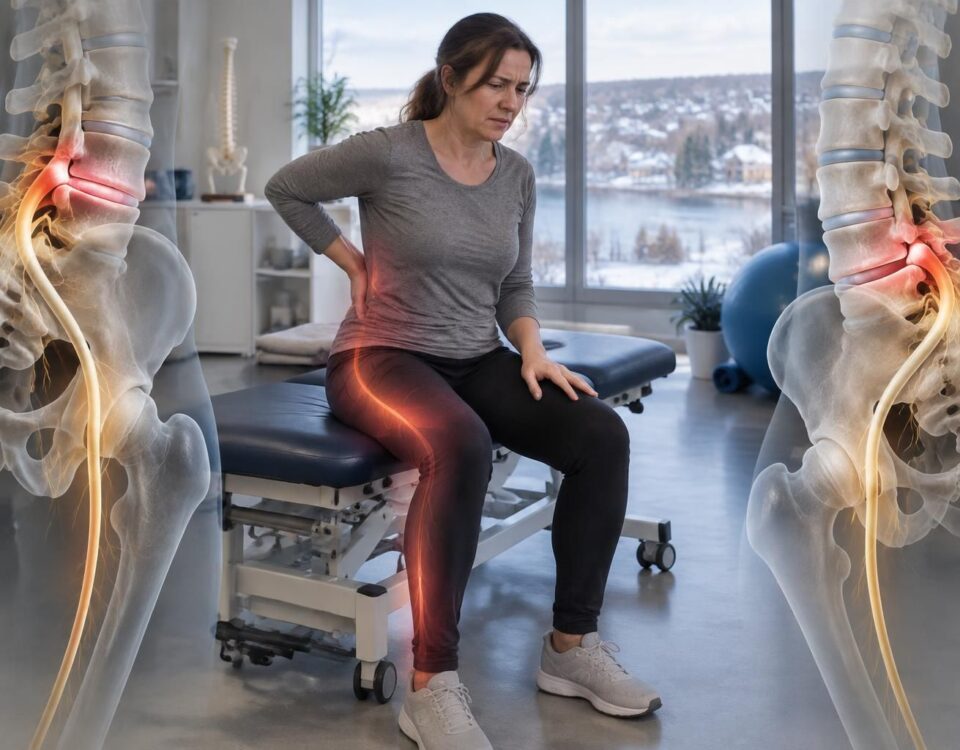
Sciatica in Montreal: pain towards the top of the foot and L5 root
04/09/2026
Sciatica and loss of strength: a sign not to be taken lightly
04/09/2026
IN SHORT The Sciatica in Terrebonne with pain radiating to the top of the foot and probable involvement of the L5 root describes a radicular injury manifested by pain following the nerve path, sometimes accompanied by numbness or weakness. The assessment focuses on the trajectory of the symptoms, strength, reflexes, and gait to distinguish stable radicular irritation from progressive deficit. The benefits of the local approach include a graduated, non-surgical conservative plan focused on improving function and sleep while monitoring motor function and signs of urgency. In Terrebonne, this framework prioritizes clear clinical evaluation and regular reassessment to tailor care and optimize outcomes without systematically resorting to surgery. |
Sciatica in Terrebonne — pain that starts from the lower back and can rise to the top of the foot, typically associated with an injury to the L5 root.
- Symptoms: pain radiating to the top of the foot, sometimes numbness or tingling on the dorsum, with possible weakness in dorsiflexion and difficulty lifting the big toe.
- Assessment: analysis of symptom trajectory, comparison of strength, sensitivity, and reflexes between both sides, heel walking test.
- Management: initial conservative plan tailored (graded activity, targeted exercises, and specific osteopathy). Imaging is considered only if it can influence clinical management.
- Red flags: marked progressive weakness, urinary or bowel issues, saddle anesthesia, fever or major trauma requiring prompt consultation.
- Objective: improve function (walking, sleeping, working) while ensuring a stable neurological trajectory, with reassessment at the right time.
For an assessment tailored to your situation in Terrebonne, consult an osteopathy professional or a specialized local clinic.
Quick summary: this article explains how an L5 root injury can cause pain radiating to the top of the foot, describes the simple clinical assessment and non-surgical treatment options available in Terrebonne through the TAGMED Clinic, and specifies the criteria for safely monitoring progression.
Initial assessment and identification of L5 signs
The goal is to confirm that a nerve root is likely involved and to ensure that neurological function remains stable. The painful trajectory, numbness, and sensations based on positions help, but they must be compared to muscle strength, reflexes, sensitivity, hip mobility, and gait. The assessment links symptom trajectories to neurofunction.
Key indicators
For L5, we look at the strength of dorsiflexion of the foot, the ability to lift the big toe, and heel walking. We assess the sensitivity on the top of the foot and the back of the leg. We check the reflexes and observe heel and toe walking. The objective is to compare both sides and detect any weakness or progressive numbness.
Important findings
Pain associated with numbness or tingling following the trajectory from the buttock to the foot may indicate L5 radiculopathy. The assessment must also check for new weakness or foot drop, which alters the urgency and care plan.
For more details on symptoms and typical trajectories, you can consult dedicated resources on sciatica in Terrebonne – progressive numbness to the foot and other specialized pages on sciatica and cold sensation in the foot.

Sciatica L5-S1 in Terrebonne: why the pain can radiate down to the foot
IN BRIEF L5-S1 sciatica refers to pain related to irritation of a lumbar nerve root, which may start from the lower back and radiate into the buttock, leg, and down to the foot. The pathway varies: the top of the…

Sciatica in Terrebonne: painful journey according to roots L4, L5, and S1
IN BRIEF Sciatica in Terrebonne can cause pain, tingling, or weakness in the leg. The roots L4, L5, and S1 can guide the evaluation based on symptoms and changes in strength, sensitivity, or reflexes; their territories do overlap, however. Comparing…
When to suspect L5 radiculopathy and what emergencies to consider
A clear differential diagnosis can rely on the pain/sensitivity association and the reflexes response during examination. A pain without material deficit can be monitored closely with a conservative plan, while an objective weakness, a foot drop, saddle anesthesia, or urinary or bowel changes require prompt or urgent medical evaluation.
Additional warning signs require accelerated evaluation, including sudden changes in gait, pain that worsens rapidly, or any progressive neurological symptom. Dedicated pages explain these aspects and actions to prioritize in emergencies.
For further information related to the clinical pathway and regional benchmarks, see related resources for Terrebonne on difficulty walking on heels or toes and progressive numbness to the foot.

Sciatica in Terrebonne: what does irritation of the S1 root mean?
IN BRIEF An irritation of the S1 root can cause pain of a sciatica type in the buttock, the back of the leg, and the outer edge of the foot. Tingling, numbness, or difficulty walking on tiptoes may also occur.…

Sciatica in Terrebonne: what does irritation of the L5 root mean?
IN BRIEF L5 sciatica corresponds to irritation of the L5 nerve root, often felt from the lower back and buttock down the side of the leg, to above the foot and the big toe. It can cause pain, tingling, or…
Trajectory, differential diagnosis and L5 localization
The painful trajectory and localization on the top of the foot point towards L5, but it must be confirmed with strength, sensation, and reflexes, and by comparing both sides. Imaging may be useful when the result can change management, not just to confirm an anomaly.
The diagnosis does not rely on a single image. It is based on history, examination, and, if necessary, targeted imaging. Ergonomics and daily activities matter to assess the functional impact and set treatment goals.
To enhance your understanding of the nerve trajectory and L5 territories, consult specialized resources on Sciatica assessment – Terrebonne and other internal resources available through sossciatique.com.

Sciatica in Terrebonne: difference between L4-L5 and L5-S1
IN BRIEF The difference between L4-L5 and L5-S1 concerns the level of the lumbar discs and the sometimes irritated nerve roots: an L4-L5 injury often affects L5, while an L5-S1 injury often affects S1. The sensory pathways overlap; thus, an…

Sciatica S1 in Terrebonne: pain towards the calf and the outer edge of the foot
IN BRIEF S1 sciatica is pain related to irritation of a lumbar nerve root, which may radiate down to the buttock, back of the calf, and the outer edge of the foot. Tingling or weakness may also occur. In Terrebonne,…
Imaging and decision-making
Imaging is used when the result may modify therapeutic management. An isolated image alone is not sufficient for diagnosis. Interpretation combines history, neurologic examination, and imaging results.
In practice in Terrebonne, the initial plan prioritizes conservative approaches when neurological function remains stable and the immediate risk is low. In case of progression, lack of progress, or atypical signs, a targeted reevaluation is necessary and may lead to advanced options considered by the TAGMED Clinic.
To understand the scenarios and decision criteria, you can look at specialized resources on treatment and evaluation via cold in the foot and radiculopathy and progressive numbness towards the foot.
Management Options in Terrebonne
After triage, stabilized cases can benefit from a graduated conservative plan, combining precise evaluation and tailored manual interventions. In atypical, progressive, or refractory cases, targeted imaging or a rapid medical opinion may be necessary. Planning should remain adjustable and focused on measurable outcomes.
At the TAGMED Clinic, care may include specific osteopathic approaches or motorized neurovertebral decompression techniques when deemed appropriate after evaluation. Depending on the diagnosis, other non-surgical options may be considered, while physical therapy alone may be less suitable for certain cases; it may, however, be regarded from a comparative perspective when necessary.
To access TAGMED services in Terrebonne or Montreal, visit TAGMED Clinic. For additional information on related conditions, you will find relevant resources on S.O.S Sciatique, particularly those dedicated to sciatica and neurovertebral decompression.
Useful links to complement your information: pain in the buttocks after prolonged sitting, pain in the foot that increases while sitting, and burning in the calf.
To learn more about options and alternatives, consult specialized pages on authorized sites and discuss your choices during your consultation in Terrebonne.
The osteopathy training institutions mentioned in this context include NUMSS, NAO, National University of Medical Sciences, and National Academy of Osteopathy. Relevant professional associations include ACMA (Canadian Alliance of Alternative Medicine) and the College of Canadian Osteopaths.
Additional resources on radiculopathies and nerve territories are accessible via the authorized domains listed in this text.
For information on evaluation and radicular territories, see The Spine Page – Sciatica Evaluation.
Note: for any medical question, consult your healthcare provider or a specialist. Prolonged bed rest is generally not recommended; prioritize suitable and progressive activity according to your tolerance and the evolution of symptoms.
Medical Disclaimer: The information and advice provided on this site do not replace the opinion, diagnosis, or treatment of a healthcare professional. Please note that Dr Sylvain Desforges, osteopath, is neither a doctor of medicine nor a physician, and is not specialized in any medical specialty as defined by the Collège des médecins du Québec. Manual medicine, functional medicine, and sports medicine as described on this site exclude any treatment or diagnosis performed by a physician or specialist. Always consult your doctor for any medical questions. For more details, please read our full Legal Disclaimer.
.two-col { display: flex; gap: 28px; }
.col { flex: 1; }
ul { list-style: none; padding: 0; margin: 0; }
li { margin-bottom: 8px; }
- Pathway: buttock pain → top of the foot
- Territory L5: evaluate dorsiflexion and big toe
- Strength: dorsiflexion and extension of the big toe
- Sensitivity: numbness on the top of the foot
- Walking: test on heels and toes
- Local context: Terrebonne — identical clinical criteria
- Action plan: non-surgical management if stable
- Imaging: targeted if it can modify management
- Objectives: improve walking, improve sleeping, resume activity
- Reevaluation: regular follow-up and adjustment of the plan
- Signs of urgency: progressive weakness, urinary issues, fever

Quick Overview
This article provides practical recommendations for Sciatica in Terrebonne with pain towards the top of the foot and suspicion of L5 root. It describes a targeted evaluation of the L5 territory, the clinical indicators to monitor, the situations requiring imaging or rapid medical advice, and a measurable treatment plan focused on returning to walking and daily activities, while remaining vigilant for alert signs.
Understanding the L5 Territory and Its Implications
The L5 root may influence the top of the foot and the big toe. A pain that progresses to the top of the foot may reflect L5 radicular irritation, but it is essential to distinguish stable irritation from deteriorating neurological deficit. The goal is to associate the symptom pathway with nerve function, rather than relying on a single observation. In Terrebonne, as elsewhere, the working diagnosis and functional objectives guide treatment choices more than any isolated imaging value.
Clinical Evaluation and Key Points
To assess a suspicion of L5, we examine:
The strength particularly of the foot during dorsiflexion and extension of the big toe, the sensation on the top of the foot, the reflexes (patellar and Achilles), and gait (ability to walk on heels and toes). The aim is to compare both sides and relate the painful pathway to neurological function. The Lasègue test can help as an indicator, but it is not sufficient alone and should be integrated into the overall clinical examination. A new weakness or progressive loss of sensation immediately changes the priority of assessment and may require quick referral.
When imaging and quick medical advice are needed
Imaging is considered when the treatment approach could be altered by the result (for example, in the presence of marked motor deficit, warning signs, or persistent symptoms despite a conservative plan). A contraindication or suspicion of another cause (hip, peripheral nerve, vascular pathology) may also justify a more targeted approach. A neurological worsening or the emergence of atypical signs requires rapid evaluation rather than the automatic repetition of the same treatment.
Management options in Terrebonne
After triaging, stable cases can benefit from a graduated conservative plan including targeted exercises, appropriate manual techniques, and a gradual return to activities. The plan should be reviewable and adapted to tolerance and evolution. If the territory or strength changes, a targeted re-evaluation is indicated and the diagnosis or treatment options may be adjusted. The goal is to promote functional improvement (walking, sleeping, working, driving) while maintaining a safe neurological trajectory.
Building a measurable plan
Establish clear measures from the beginning: walking distance, ability to walk on heels and toes, dorsiflexion and plantar flexion strength, and a chosen functional activity. Set a reassessment date and specify the criteria indicating progress or the need to adjust the plan. The comparison between pain and function is essential: a reduction in pain is not sufficient if walking or key activities remain limited.
Monitoring and warning signs
Monitor for any new weakness, numbness spreading, change in gait, or new urinary or bowel impairment. In the presence of such signs, or in the presence of fever, major trauma, or suspicion of infection, consult quickly. Follow-up is done using functional measures and not solely by pain intensity.
| Axis | Key Elements |
|---|---|
| Preliminary Diagnosis | L5 radiculopathy suspected when pain targets the top of the foot and weakness of dorsiflexion is possible; neurological assessment needed. |
| Symptomatic Pathway | Pathway buttock → top of the foot with paresthesias; note precise location. |
| Motor Signs | Measure and compare Dorsiflexion and Plantar flexion bilaterally. |
| Sensory Signs | Evaluate sensitivity of the top of the foot and the big toe. |
| Reflexes and Tests | Check reflexes and motor function of the involved segments to guide the nerve level. |
| Imaging | Targeted imaging if it can modify treatment approach or if there is progressive deficit. |
| Treatment Plan | Conservative plan with graduated exercises and manual care; promote adapted activity. |
| Warning Signs | Monitor for new weakness, saddle anesthesia, urinary or bowel issues; act urgently. |
| Functional Objectives | Improve walking, sleeping and return to activities without compromising safety. |
| Follow-up and Revision | Set a review date and escalation criteria; adjust if progression or stagnation. |
Patient Testimonials on Sciatica in Terrebonne — pain towards the top of the foot and L5 root
For several weeks, my sciatic pain traveled from my lower back to the top of my foot, with a pulling sensation along the L5 root. In Terrebonne, the assessment allowed mapping the symptom pathway and starting a personalized and progressive plan. After a few weeks, my walking is more stable and my sleep has improved.
I was constantly troubled by pain that radiated towards the top of my foot and prevented me from wearing my shoes. The Terrebonne team explained the source of the pain and offered non-surgical solutions suited to my L5 root. Today, I have returned to my daily activities and sleep better than before.
Initially, the pain mainly suggested irritation around the L5 root and the nerve pathway to the top of the foot. The comprehensive assessment in Terrebonne clarified the diagnosis and established a measurable plan. In about six weeks, strength and sensitivity improved and I can resume my long outings.
My return to Terrebonne came after a period when the pain radiated from the buttock to the top of the foot, with a nerve shortcut related to the L5 root. The plan was adjusted over the course of my progress and prioritized specific exercises and techniques. I feel less pulling and can walk longer without pain.
Another testimonial describes gradual improvement thanks to regular monitoring and clear objectives. The sciatic pain remained present but progress became measurable, with a decrease in symptoms at the top of the foot and better foot stability. Terrebonne provided a structured framework to recover my usual activities and protect my L5 root.
Professional Biography: Sciatica in Terrebonne — Pain towards the top of the foot and L5 root
Dr Sylvain Desforges, a recognized osteopath and expert in manual medicine, has established himself as a leader in the management of sciatica in Terrebonne. His approach combines osteopathy, naturopathy, and manual therapies to provide comprehensive care for lower back and radicular pain. At the helm of TAGMED Clinic and a major player in the ACMA association, he places safety and efficacy at the heart of every consultation, emphasizing evidence-based care tailored to the daily lives of patients.
In cases of sciatica where the pain radiates to the top of the foot and toes, especially when L5 radiculopathy is suspected, Dr. Desforges’ approach begins with a thorough assessment. He seeks to confirm the involvement of a nerve root while ensuring that neurological function remains stable. The pain trajectory, numbness, and sensitivity are scrutinized, but they are systematically related to muscle strength, reflexes, skin sensitivity, and gait to establish the link between symptoms and neurology.
The location in Terrebonne does not alter the clinical principles: the goal is to distinguish stable radicular irritation from a more progressive deficit. The patient is guided in a precise mapping of the pain trajectory, with particular attention to dorsiflexion and the function of the big toe, key elements for identifying L5 in relation to S1. The doctor adapts examinations and functional tests (walking on heels and toes, hip evaluations, and reflex tests) to build a reliable and actionable neurofunctional profile.
The therapeutic decision in Terrebonne is based on a complete clinical evaluation rather than just imaging. Imaging is considered when its results could alter the treatment plan or when neurological signs evolve or persist despite conservative measures. Dr. Desforges then favors a graduated and revisable approach, ready to adjust according to evolution, in order to prevent any unnecessary escalation and maximize recovery chances.
The preferred treatment options remain mostly non-surgical and personalized. The program may include targeted exercises, manual treatments, and, when relevant, technologies designed to optimize spinal function and mobility. The goal is clear: to achieve measurable results that matter to the patient, such as improvements in walking, sleep, the ability to work, and resuming daily activities, while ensuring that the neurological trajectory remains safe.
At the core of Dr. Desforges’ approach, each patient benefits from a concrete plan, with a re-evaluation date and clearly defined stop or escalate criteria. Follow-up is not limited to pain reduction; it aims for an overall improvement in function and quality of life. Collaboration and shared information enable the patient to understand warning signs and know when to request a quick re-evaluation or a specialized referral, thus guaranteeing proactive and tailored management of sciatica related to L5 radiculopathy in Terrebonne.
Quick summary: This article summarizes the key points of sciatica in Terrebonne, particularly when the pain rises to the top of the foot and the L5 root may be involved. It emphasizes that a rigorous evaluation connects the trajectory of symptoms to neurological function, and that the choice of treatments prioritizes a non-surgical and measurable approach, tailored to the patient and their local context, with resources and useful links to guide care.
In cases of sciatica in Terrebonne with pain above the foot and possible involvement of the L5 root, the assessment begins by mapping the painful trajectory and testing strength, sensitivity, reflexes, gait, and the ability to lift the big toe, in order to compare both sides and identify L5 radiculopathy.
The care plan prioritizes a conservative and measurable approach, combining targeted exercises, manual techniques, and functional advice. Imaging is considered only if it can modify the clinical course, and not simply to confirm an anomaly. For the treatment of sciatica in Terrebonne, you can consult the sciatica treatment Terrebonne and, locally, access dedicated resources like the one on Sciatica above the foot L5.
In daily practice, diagnosis and therapeutic choices remain guided by history, examination, and the patient’s functional goals. If warning signs appear (new weakness, progressive loss of sensation, walking difficulties, urinary or intestinal origins), rapid medical re-evaluation is recommended and may require a specialized referral. For further exploration of radicular territories and associated approaches, see dedicated local guides and external resources like The Spine Page and pages on health and symptom longevity.
To enrich your understanding and guide local efforts, several useful resources can be consulted: the in-depth article on The Spine Page – Sciatica L4-L5 and L5-S1 in Terrebonne, the dedicated pages of Clinique TAGMED, and general informative resources like Santé Nouvelle. You can also explore specific elements related to Terrebonne on the following pages: sciatica pain in Terrebonne, tingling in the heel – S1 root, and warm sensation in the leg.

Sciatica L5 in Terrebonne: pain towards the big toe
IN SHORT L5 sciatica can cause pain or numbness that radiates to the big toe, sometimes with difficulty lifting the foot. This pathway is a clue, not a diagnosis: the examination compares strength, sensitivity, and gait, as the nerve territories…

Sciatica L5-S1 in Terrebonne: pain radiating to the heel or foot
IN BRIEF A L5-S1 sciatica often corresponds to irritation of the S1 root, which can cause pain that radiates from the buttock down to the calf, heel, or outer edge of the foot. Identifying the pathway of symptoms and changes…

Dr Sylvain Desforges, B.Sc., D.O., N.D., osteopath, is the founding president of TAGMED and of the ACMA association. He dedicates his practice to chronic spinal pain, low back pain and symptoms compatible with sciatica, particularly when pain radiates toward the buttock, leg, calf, foot or toes.
Through SOS Sciatique, he publishes educational content on sciatica symptoms, possible causes such as disc herniation, disc narrowing, foraminal stenosis or irritation of a lumbar nerve root, as well as non-surgical approaches that may be considered according to the evaluation. At Clinique TAGMED, care may include, depending on the case, motorized neurovertebral decompression, specific osteopathic care or precision percussion.
For an evaluation related to sciatica treatment in Montreal / Mount Royal or sciatica treatment in Terrebonne, please consult the services available at Clinique TAGMED.
Medical disclaimer
The information published on SOS Sciatique is provided for educational purposes only and does not replace a consultation, diagnosis, opinion or treatment provided by a physician or another authorized healthcare professional. The author of this article is neither a medical doctor nor a specialist in a medical specialty recognized by the Collège des médecins du Québec. The osteopathic, manual medicine or functional support approaches described on this site do not constitute medical acts and are not intended to replace medical follow-up.
Consult a physician or emergency service in cases of loss of bladder or bowel control, anesthesia in the saddle area, significant or progressive weakness in the leg or foot, fever, recent trauma, severe pain or rapid worsening of symptoms. For more details, please read our Legal Notice.