


Sciatica in Montreal: pain in the big toe, L5 root or another cause?
18/10/2026
Sciatica and pain when turning in bed
18/10/2026
IN BRIEF Pain in the big toe accompanied by pain in the buttock or leg may be compatible with irritation of the L5 root, but other causes are possible. In Terrebonne, the evaluation notably compares strength, sensitivity, and gait to guide management and determine if further tests are useful. The path of the pain alone is not enough to confirm the diagnosis. |
In Terrebonne, pain or numbness in the big toe may be compatible with irritation of the L5 root, especially if the symptoms descend from the buttock to the side of the leg and the top of the foot. However, this path varies and overlaps with other nerve territories; a local cause in the foot or another nerve injury is also possible. The evaluation takes into account strength, sensitivity, gait, and the full range of symptoms: an MRI image alone does not confirm the cause.
Consult quickly if weakness appears or progresses, if the foot becomes difficult to lift, or in case of urinary or intestinal disturbances or numbness in the saddle region.
Pain that descends towards the big toe may be compatible with irritation of the L5 nerve root, but this sign alone is not enough to establish a diagnosis. In Terrebonne, the evaluation must also check the strength of the foot, sensitivity, gait, and possible local causes. The pathway of symptoms, their evolution, and examination results help choose the appropriate approach. The L5 root participates in the sensitivity of the top of the foot and the big toe area. It also contributes to certain movements, such as lifting the foot or the big toe. Therefore, lumbar irritation can cause pain, tingling, or numbness that descends towards this area. Pain may start in the lower back or buttock, then follow the thigh and leg. It may also be felt primarily in the leg or foot. Pain that increases while sitting may accompany some cases of sciatica, but it does not alone confirm L5 involvement. Also, consult our page on foot pain that increases when sitting. The territories of L5 and S1 overlap. Symptoms vary from person to person and do not always correspond perfectly to anatomical patterns. Pain in the big toe may steer the examination towards L5, but the professional must compare this sign with other results. The L5 root is often associated with the top of the foot and the big toe. The S1 root may rather affect the heel, the sole, or the outer edge of the foot. These markers provide clues, but they do not replace examination. To better understand the differences between these roots, consult the guide on pain paths according to L4, L5, and S1 roots and the one on the difference between L4-L5 and L5-S1. Pain limited to the big toe may stem from a problem in the foot or joint. Local irritation, an injury, a shoe that compresses, or another nerve injury can also cause symptoms. The presence of lower back or buttock pain and the evolution of the pathway can help distinguish these possibilities, but they are not sufficient for a distant diagnosis. Persistent pain in the heel does not prove sciatica either. It can be related to different causes. The page dedicated to persistent pain in the heel presents elements to consider. To further explore the link between the sciatic nerve and the foot, you can also read these resources on the path of the sciatic nerve, the L5 pathway and pain, the course of the sciatic nerve and sciatica and its possible effects in the foot. The evaluation begins with the history of symptoms: their onset, pathway, positions that alter them, and their evolution. The professional can then compare both sides and examine strength, sensitivity, reflexes, and gait. They may notably check the ability to lift the foot and the big toe, as well as to walk on heels and toes. The visible disc level on imaging alone does not determine which root is affected. A herniation located between L4 and L5 often affects the L5 root, while a herniation between L5 and S1 often affects S1. However, the concordance must be verified with the symptoms and examination. For lower back pain that descends into the leg, also consult our page on lower back pain with shooting into the leg. Imaging is not necessary in all cases. A doctor may request it when symptoms persist, when the examination reveals a deficit, or when the result could change management. A local evaluation in Terrebonne can be explored via this resource on sciatica evaluation in Terrebonne. New or progressive weakness, a foot drop, or deteriorating gait requires prompt medical evaluation. You should also consult urgently in case of loss of bowel or bladder control, numbness in the saddle region, fever, or significant trauma. Report also any numbness that spreads or a decrease in strength, even if the pain diminishes. Neurological evolution and the ability to walk matter as much as the intensity of pain. Management depends on the probable cause, the intensity of symptoms, the examination, and their evolution. A doctor can discuss medications, additional tests, or a specialized referral depending on the situation. Non-surgical treatments should be reassessed if function does not improve or if neurological signs appear. At the TAGMED Clinic, an evaluation can determine if approaches such as specific osteopathy, precision percussion therapy, or motorized neurovertebral decompression are appropriate. These options are not suitable for everyone and do not replace a medical diagnosis. A serious plan outlines the objectives pursued, the re-evaluation date, and the signs that require modifying the approach. Consult the services of the TAGMED Clinic or the information on sciatica treatment in Terrebonne. No. It may guide the assessment towards L5, but other causes are possible. The professional must examine the pathway of the pain, sensitivity, strength, and walking. No. A herniation at this level often affects the L5 root, but imaging must be correlated with symptoms and examination. An image alone is not sufficient to establish the cause of the pain. A new or progressive weakness, a foot drop, a loss of sensitivity that spreads, or a deteriorating walk require prompt evaluation. New urinary or intestinal disorders and saddle anesthesia require urgent care. Sylvain Desforges, B.Sc., D.O., N.D., osteopath and naturopath, is the founding president of TAGMED and the ACMA association. He dedicates his practice to chronic pain of the spine, low back pain, and pain consistent with sciatica, particularly when the pain radiates down to the buttock, leg, calf, foot, or toes. Through SOS Sciatique, he publishes educational content on the symptoms of sciatica, possible causes such as disc herniation, disc pinching, foraminal stenosis, or irritation of a lumbar nerve root, as well as on non-surgical approaches that may be considered based on the assessment. At the Clinique TAGMED, care may include, depending on the case, motorized neurovertebral decompression, specific osteopathy, or precision percussion. For an evaluation related to sciatica treatment in Montreal / Mont-Royal or sciatica treatment in Terrebonne, consult the services available at the Clinique TAGMED. Medical disclaimer: The information and advice provided on this site do not replace the opinion, diagnosis, or treatment of a health professional. Please note that Sylvain Desforges, B.Sc., D.O., N.D., Doctor of Osteopathy, is neither a medical doctor nor a physician, and is not a specialist in a medical specialty as defined by the Collège des médecins du Québec. Manual therapy, functional medicine, and sports medicine as described on this site exclude any medical treatment or diagnosis made by a physician or specialist. Always consult your doctor for any medical questions. For more details, please read our Complete Legal Notice. The information published on SOS Sciatique is provided for educational purposes and does not replace a consultation, diagnosis, opinion, or treatment by a physician or another authorized health professional. The author of this article is neither a physician nor a specialist in a medical specialty recognized by the Collège des médecins du Québec. The approaches of osteopathy, manual therapy, or functional support described on this site do not constitute medical acts and are not intended to replace medical follow-up. Consult a physician or emergency service in case of loss of bladder or bowel control, anesthesia in the saddle area, significant or progressive weakness of the leg or foot, fever, recent trauma, severe pain, or rapid deterioration. For more details, please read our Legal Notice.Big Toe Pain: What Link with the L5 Root?
The Pain Pathway Does Not Always Follow an Exact Map
Pain in the Big Toe Is Not Always Sciatica
How Evaluation Distinguishes L5 from Another Cause
When Should You Seek Evaluation Quickly?
What Options Can Be Considered in Terrebonne?
Frequently Asked Questions About Big Toe Pain
Does pain in the big toe confirm L5 involvement?
Does an L4-L5 herniation always mean that L5 is affected?
What changes should be reported quickly?
About the author
Medical disclaimer
When to think about L5?
- Pain or numbness on the top of the foot, sometimes down to the big toe.
- Possible weakness in lifting the foot or big toe.
- The pathway alone does not confirm an L5 root involvement.
Other causes and checks
- Local irritation of the foot or another nerve root may produce similar symptoms.
- The examination compares strength, sensitivity, reflexes, and walking; MRI is indicated only if it can guide the management.
- In Terrebonne as elsewhere, a new or progressive weakness requires prompt assessment.

In Terrebonne, pain that radiates down to the big toe may be compatible with irritation of the L5 nerve root, but this sign alone is not sufficient to confirm sciatica. The location of the pain, foot strength, sensitivity, walking, and other symptoms must be assessed together to distinguish a lumbar origin from a local foot problem or another cause.
Big toe pain: the possible role of L5
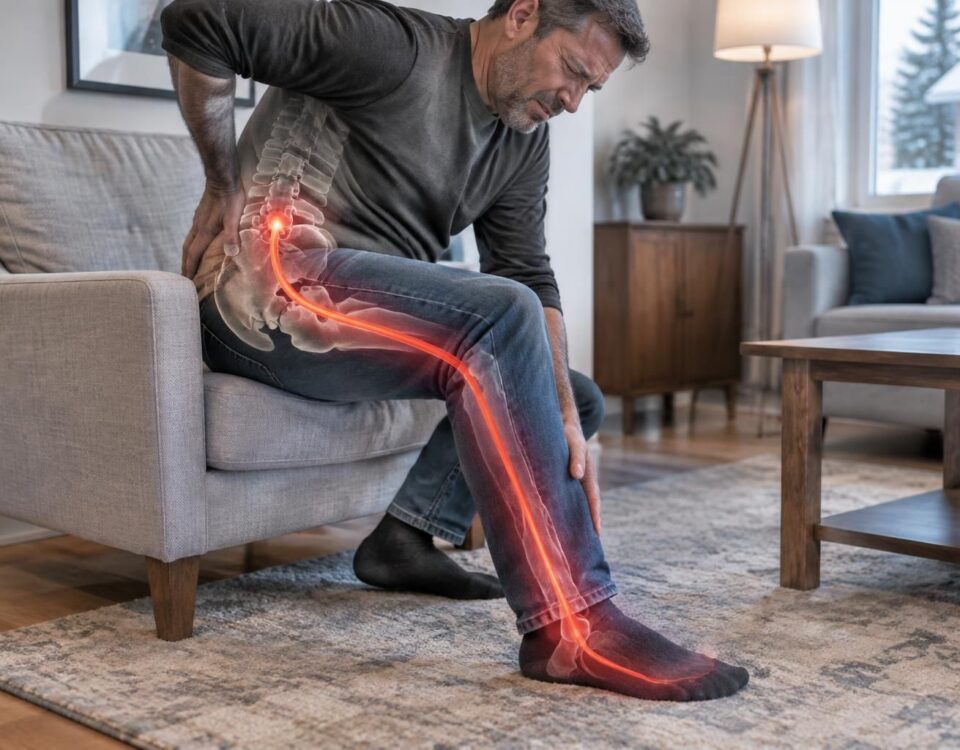
The L5 root is involved in the sensitivity of the top of the foot and the big toe, as well as in certain movements that lift the foot and toe. Irritation can cause pain radiating from the lower back or buttock down to the side of the leg to the top of the foot. Tingling or numbness may also be present.
However, isolated pain in the big toe, without pain in the leg or lumbar symptoms, does not necessarily correspond to sciatica. The nerve territories overlap and vary from person to person. Furthermore, the disc level visible on imaging alone does not allow for certain identification of the affected root: findings must be correlated with symptoms and clinical examination.
Sciatica in Terrebonne: disc protrusion or disc herniation?
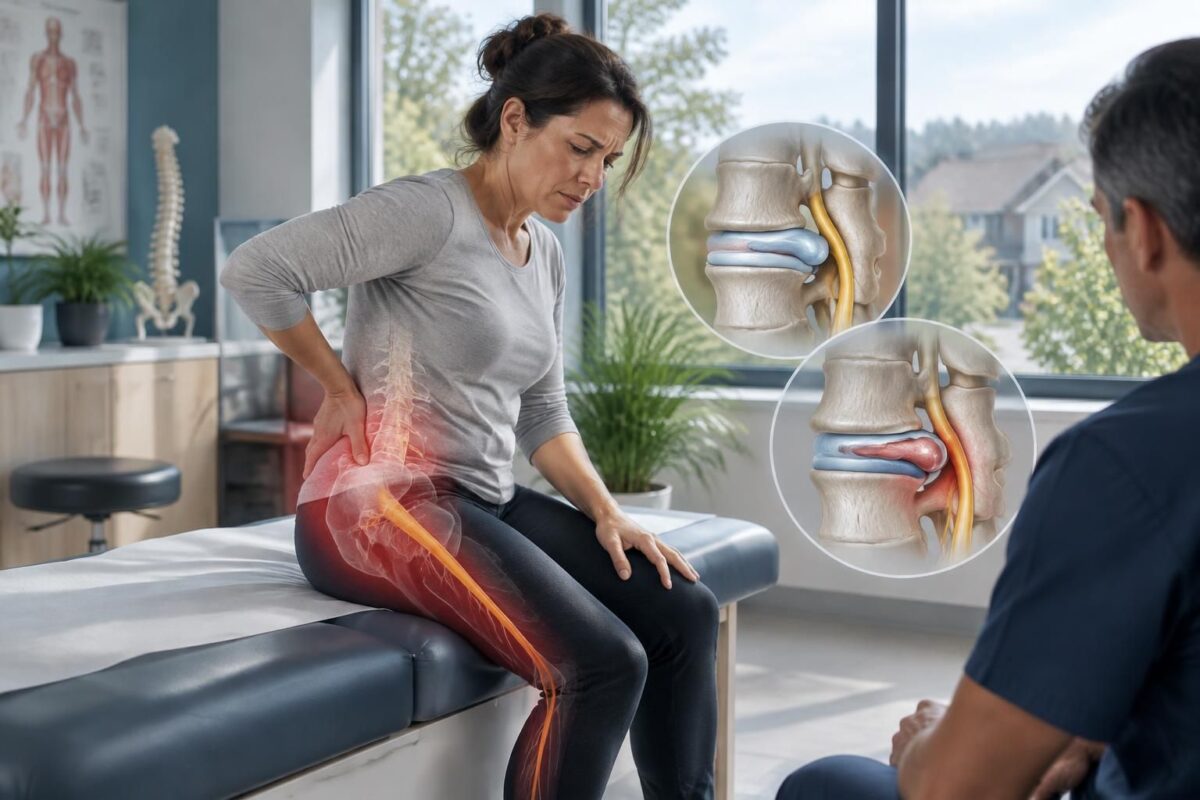
IN BRIEF A disc bulge is a swelling of the disc, while a herniated disc involves a more pronounced protrusion of its contents; both can irritate a nerve root and cause sciatica. Symptoms alone do not always allow for distinction…

Sciatica disc in Terrebonne: why the pain travels down the leg
IN SHORT The disc-related sciatica occurs when a lumbar disc irritates a nerve root, which can cause pain to radiate down the buttock and leg. In Terrebonne, an assessment helps to better understand the cause of the symptoms and consider…

L4-L5 disc herniation and sciatica in Terrebonne: pain towards the foot
IN BRIEF A L4-L5 disc herniation can irritate a nerve root and cause sciatica, with pain that radiates from the buttock down to the leg or foot. In Terrebonne, an evaluation helps better understand the origin of the symptoms and…
What other causes to consider?
Localized pain at the big toe joint may stem from a joint issue, inflammation, tendon irritation, or compression of a foot nerve. A shoe that is too tight, an injury, or a change in activity may also contribute to the pain. If symptoms affect both feet or are accompanied by other general signs, a different cause, such as peripheral nerve damage, may require evaluation.
Clues to note before a consultation
Note the pathway of the pain, its onset, positions that worsen or relieve it, and the presence of numbness. Also, observe if you have difficulty lifting the big toe or foot, walking on your heels, or if your gait changes. These observations help the professional compare symptoms on both sides and decide if further examinations are relevant.

Lumbar disc herniation L5-S1 and sciatica in Terrebonne: common symptoms
IN BRIEF A L5-S1 disc herniation can irritate a nerve root and cause sciatica: lower back pain radiating to the buttock or leg, tingling, numbness, or weakness. In Terrebonne, an assessment helps to better understand the symptoms and guide management…
Sciatica and herniated disc in Terrebonne: understanding the link
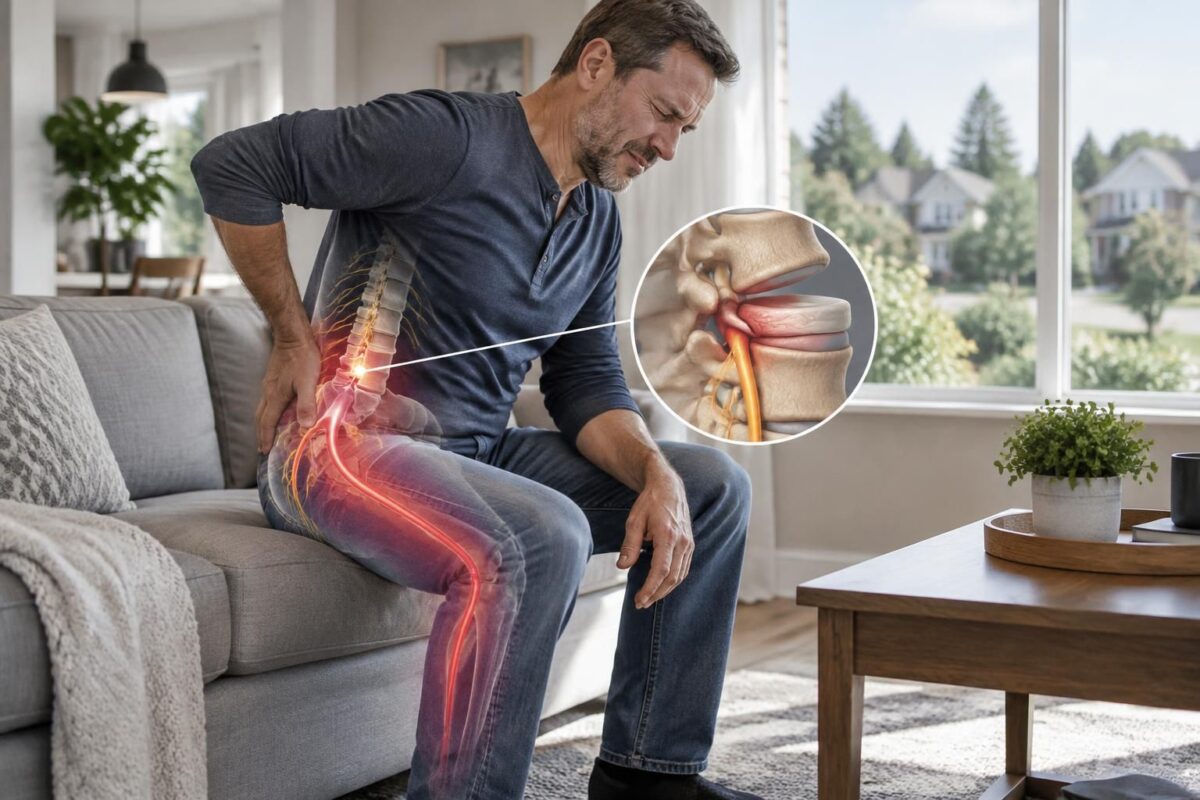
IN BRIEF Sciatica refers to pain that follows the path of the nerve in the buttock and leg; a herniated disc can irritate it, but an anomaly on the MRI is not sufficient to establish the cause. In Terrebonne, the…

Sciatica in Terrebonne: lumbar roots and the choice of a cautious treatment
IN BRIEF Sciatica is pain related to the irritation or compression of a lumbar nerve root, which can radiate from the lower back to the buttock and leg. In Terrebonne, an evaluation allows for cautious treatment tailored to the cause…
Recommendations for evaluation in Terrebonne
In consultation, the evaluation may include foot and leg strength, sensitivity, reflexes, walking, and certain back movements. Imaging is not always necessary initially. It may be considered when symptoms persist, a neurological deficit is observed, or its result could change the management plan. Request an explanation of the working diagnosis, other possibilities, and the criteria expected for reassessing the situation.
If your condition is stable, temporarily adjust activities that significantly increase symptoms, without remaining bedbound for prolonged periods. Gradually resume tolerated movements and avoid forcing a stretch that causes pain radiating further into the leg or foot. The choice of care must take into account the examination, your tolerance, and the measurable evolution of walking, strength, and daily activities.
When to seek medical help quickly
Consult quickly if new or progressive weakness appears, if the foot drops, or if walking deteriorates. Loss of bowel or bladder control, numbness in the saddle area, fever, recent trauma, or rapid aggravation requires urgent medical evaluation. Do not delay this evaluation to continue an already commenced care program.
About the author
Sylvain Desforges, B.Sc., D.O., N.D., osteopath and naturopath, is the founding president of TAGMED and the ACMA association. His practice focuses notably on chronic spinal pain and pain compatible with sciatica.
Medical disclaimer
This content is provided for educational purposes and does not replace a consultation, diagnosis, or treatment with a licensed health professional. The author is neither a physician nor a specialist in a medical specialty recognized by the Collège des médecins du Québec. Osteopathy and manual medicine approaches do not replace medical follow-up.
| Index in Terrebonne | What it may suggest |
|---|---|
| Pain to the big toe | May correspond to irritation of the root L5. |
| Pain in the heel or the outer edge of the foot | May suggest S1, without confirming it alone. |
| Tingling or numbness | The territory and examination help clarify the origin. |
| Weakness in lifting the foot or the big toe | A motor impairment of type L5 should be evaluated. |
| Symptoms without clear lumbar or gluteal pattern | Another local or nerve-related cause is possible. |
| Clinical examination | Compares strength, sensitivity, reflexes, and walking on both sides. |
| Lumbar MRI | To consider if the result could change the management. |
| New or progressive weakness | Consult a health professional quickly. |
| Bowel or bladder dysfunction, saddle anesthesia | Request urgent evaluation. |
Important: the testimonials below are fictional examples, written for educational purposes. They do not describe real patients and do not allow for a diagnosis. Pain in the big toe may sometimes accompany irritation of the root L5, but it can also have other origins.
“The pain started from the buttock and went down to the big toe”
“I had pain in my lower back and buttock, then a burning sensation that ran down the side of my leg to the top of my foot. My big toe was sometimes numb.”
This pathway may be compatible with irritation of the root L5, especially when symptoms start from the back or buttock and follow the leg. However, the pathway shape alone is not enough to confirm which root is affected: the examination must also compare strength, sensitivity, reflexes, and walking.
“My big toe was weak, even when the pain varied”
“I noticed that lifting my big toe was harder on one side. Some days, the pain was less intense, but my foot didn’t feel as stable.”
A new difficulty in lifting the big toe may be part of the signs sought during the evaluation of a possible involvement of L5. It must be interpreted with the other elements of the examination. A weakness that appears or progresses deserves rapid medical evaluation, even if the pain fluctuates.
“I had pain in my big toe, but no pain in my back”
“The discomfort was concentrated around my big toe and the top of my foot. I didn’t really feel pain in my buttock or leg.”
Isolated pain in the big toe does not automatically indicate sciatica or an involvement of L5. A joint, tendon, local irritation, or a peripheral nerve may also be the cause. The location, circumstances of occurrence, and associated signs help distinguish these possibilities.
“My foot was numb, but the pathway did not clearly match”
“The numbness affected a part of my foot, but it changed from day to day. I didn’t know if it came from my back, from my leg, or from my foot itself.”
The sensory territories of nerve roots overlap and vary from person to person. Thus, numbness in the foot must be evaluated alongside strength, reflexes, walking, and the evolution of symptoms, rather than relying on a map or a single painful point.
The MRI mentioned a disc, but I wanted to understand the link with my symptoms
“My imaging report mentioned a lumbar anomaly. I wanted to know if it really explained my pain down to the foot.”
An MRI result alone is not sufficient to establish the cause of symptoms. The health professional checks if the side, painful pathway, and examination results are consistent with the image. For example, a disc anomaly at the level of L4-L5 may involve L5, but this association is not automatic.
What may be checked during an evaluation in Terrebonne
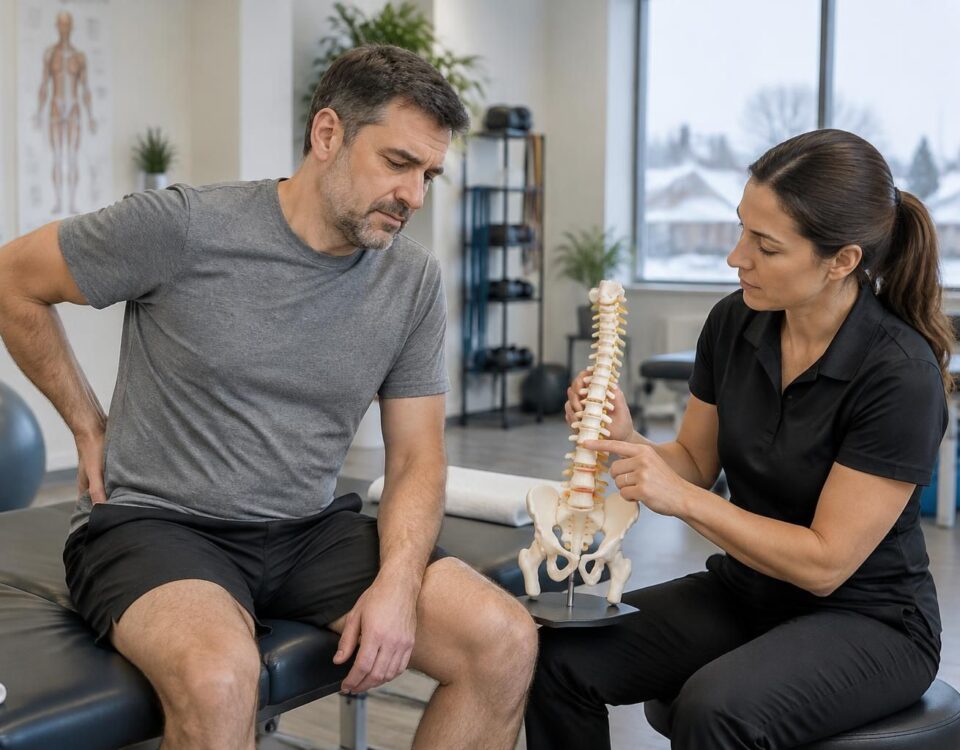
The examination may include a comparison of strength on both sides, especially for lifting the foot and the big toe, as well as sensitivity, reflexes, and walking on heels and toes. The professional is also interested in the timeline of symptoms, the positions that affect them, and their impact on daily activities.
According to the table and its evolution, the doctor can decide whether imaging or other tests are useful. Care should be chosen based on the assessment, neurological stability, functional goals, and the person’s preferences. A cautious plan includes a re-evaluation and clear criteria for modification if strength or walking deteriorates.
When to request a rapid evaluation
New or progressive weakness, a foot drop, numbness that spreads, or deteriorating walking require a rapid medical evaluation. New urinary or intestinal issues, a loss of sensation in the saddle area, fever, or significant trauma justify an urgent consultation.
About the author
Sylvain Desforges, B.Sc., D.O., N.D., osteopath and naturopath, is the founding president of TAGMED and the ACMA association. His practice particularly focuses on chronic spinal pain, lower back pain, and symptoms compatible with sciatica, including pain that may radiate to the buttock, leg, calf, foot, or toes.
Through SOS Sciatique, he publishes educational content on sciatica symptoms, possible causes, and non-surgical approaches that may be considered according to the assessment. At the TAGMED Clinic, care may include, depending on the situation, motorized neurovertebral decompression, specific osteopathy, or precision impactor.
Medical warning
This information is provided for educational purposes and does not replace a consultation, diagnosis, opinion, or treatment by a physician or other authorized health professional. The author is neither a physician nor a specialist in a medical specialty recognized by the Collège des médecins du Québec. Osteopathy, manual medicine, or functional support approaches do not constitute medical acts and do not replace medical follow-up.
Sylvain Desforges, B.Sc., D.O., N.D., osteopath and naturopath, is the founding president of TAGMED clinics and the ACMA association. His practice focuses particularly on chronic spinal pain, lower back pain, and symptoms compatible with sciatica. He is also interested in the evolution of care approaches and the integration of technologies, such as neurovertebral decompression, when these can be considered based on the person’s assessment.
In Terrebonne, pain radiating from the buttock down to the big toe may suggest irritation of the L5 nerve root. However, this distribution remains an indication, not a diagnostic proof. Nerve pathways vary and overlap; thus, the location of pain alone does not confirm which root is affected or identify the cause.
Irritation of L5 may be accompanied by pain or tingling on the side of the leg and the top of the foot, sometimes down to the big toe. Weakness in lifting the foot or big toe may also be sought during the examination. Involvement of S1 is more commonly observed at the back of the leg, the heel, or the outer edge of the foot, but the signs do not always follow a precise map. It is also important to distinguish the disc level — for example, L4-L5 — from the affected nerve root: one does not automatically lead to the deduction of the other.
Several causes can produce pain resembling sciatica. A herniated disc is a common possibility, but narrowing around a nerve root, changes related to arthritis, or other lumbar irritation can also be considered. Additionally, pain in the big toe may arise from a local problem in the foot, a joint, or a peripheral nerve. The examination should therefore compare the pathway of symptoms to force, sensitivity, reflexes, and walking results, rather than relying solely on an image or the painful area.
A structured evaluation checks the capacity to walk on heels and toes, to lift the big toe, as well as differences in strength and sensitivity between both sides. The professional also takes into account the chronology, positions that modify the symptoms, affected activities, and treatments already tried. Imaging, such as an MRI, is not necessary in all cases; it is relevant when its results may influence management, particularly in the presence of neurological signs or persistent symptoms.
Management depends on the working diagnosis, evolution, and functional goals. Depending on the situation, options may include activity advice, gradual exercises, physiotherapy, manual therapy, or a medical evaluation to discuss other interventions. At the TAGMED Clinic, approaches such as specific osteopathy or motorized neurovertebral decompression may be considered after assessment, without replacing medical follow-up when necessary. A serious plan includes observable criteria — walking, strength, sleep, or tolerance of sitting — as well as a time for re-evaluation.
New or progressive weakness, a foot drop, deteriorating walking, or numbness that spreads justify a rapid medical evaluation. New urinary or intestinal issues and anesthesia in the saddle area require an urgent consultation. The information presented is educational and does not replace a diagnosis or opinion from an authorized health professional.
In Terrebonne, pain radiating down to the big toe may be compatible with irritation of the L5 nerve root, but its location alone is not enough to confirm sciatica or determine its cause. The examination must also consider foot strength, sensitivity, walking, symptom evolution, and other possible explanations, in order to choose appropriate management and identify signs requiring rapid evaluation.
Pain in the big toe: a possible indicator, not a diagnosis
The L5 root may be irritated when symptoms follow a path from the lower back or buttock to the side of the leg, the top of the foot, and sometimes the big toe. Weakness in lifting the foot or big toe may also be sought during the examination. However, nerve territories overlap and vary from person to person: pain in the big toe, by itself, does not allow us to assert that L5 is involved.
The level of a disc and the affected nerve root are not the same. A disc involvement at L4-L5 may irritate L5, while an involvement at L5-S1 often concerns S1, without this association being systematic. To better understand these distinctions, please consult the guide on sciatica L4-L5 and L5-S1 in Terrebonne.
Examining other causes and all symptoms
Pain in the foot can have a nerve origin, but it can also be related to a local problem in the foot, in a joint, a tendon, or another condition. An evaluation takes into account the complete pathway of the pain, its onset, and the movements or positions that modify it. Lower back pain that radiates down to the calf, for example, should be interpreted alongside other symptoms rather than from a single painful point: also see the references on low back pain radiating to the calf.
Pain in the buttock after sitting for a long period, pain that appears after prolonged standing, or pain felt in the hip can provide useful information without establishing a diagnosis on their own. To compare these presentations, refer to the pages dedicated to buttock pain after prolonged sitting, leg pain after prolonged standing, and the difference between hip pain and nerve radiation.
A sensation of a numb foot or tingling can accompany nerve irritation, but it should be evaluated in its context. To learn more about this symptom, you can refer to information on numb foot and sciatica, as well as resources on nerve symptoms not to overlook. General presentations of sciatica and its causes are also provided by this resource on symptoms and treatments, this guide to recognize and relieve neuralgia, and this page dedicated to sciatica.
Assessment, Follow-up, and Safety
A healthcare professional can compare the strength of both legs, sensitivity, reflexes, and gait, including the ability to walk on heels or on tiptoes. They also consider the evolution of symptoms and their effect on sleep, mobility, work, and daily activities. Imaging is not automatically necessary: it is considered when its results may contribute to changing the management, particularly in the presence of persistent symptoms or neurological deficit.
Follow-up should be based on concrete objectives: ability to lift the foot, walking distance, tolerance to sitting, and evolution of the numb area, for example. If symptoms change, extend, or do not progress as expected, the plan should be re-evaluated rather than automatically continued. Possible approaches depend on the diagnosis, risks, and preferences; no temporary improvement alone is sufficient to confirm the cause of the problem.
Consult a doctor or emergency service promptly in case of new or progressive weakness, foot drop, deteriorating gait, numbness in the saddle area, or recent changes in urinary or intestinal control. These signs require priority evaluation, even if the pain varies or seems to temporarily decrease.

Sciatica in Terrebonne: how to interpret pain according to the leg path
IN BRIEF Sciatica is a pain that can start from the lower back or the buttock and travel down the leg to the foot. Its path, along with any tingling or weakness, helps guide the assessment but is not sufficient…

Sciatica in Terrebonne: L5-S1, canal, foramen and nerve compression
IN BRIEF The sciatica L5-S1 corresponds to irritation or compression of a nerve root, sometimes related to a disc herniation or narrowing of the lumbar canal or the foramen. The pain may radiate from the lower back to the buttock,…

Sylvain Desforges, B.Sc., D.O., N.D., docteur en ostéopathie
Dr Sylvain Desforges, B.Sc., D.O., N.D., osteopath, is the founding president of TAGMED and of the ACMA association. He dedicates his practice to chronic spinal pain, low back pain and symptoms compatible with sciatica, particularly when pain radiates toward the buttock, leg, calf, foot or toes.
Through SOS Sciatique, he publishes educational content on sciatica symptoms, possible causes such as disc herniation, disc narrowing, foraminal stenosis or irritation of a lumbar nerve root, as well as non-surgical approaches that may be considered according to the evaluation. At Clinique TAGMED, care may include, depending on the case, motorized neurovertebral decompression, specific osteopathic care or precision percussion.
For an evaluation related to sciatica treatment in Montreal / Mount Royal or sciatica treatment in Terrebonne, please consult the services available at Clinique TAGMED.
Medical disclaimer
The information published on SOS Sciatique is provided for educational purposes only and does not replace a consultation, diagnosis, opinion or treatment provided by a physician or another authorized healthcare professional. The author of this article is neither a medical doctor nor a specialist in a medical specialty recognized by the Collège des médecins du Québec. The osteopathic, manual medicine or functional support approaches described on this site do not constitute medical acts and are not intended to replace medical follow-up.
Consult a physician or emergency service in cases of loss of bladder or bowel control, anesthesia in the saddle area, significant or progressive weakness in the leg or foot, fever, recent trauma, severe pain or rapid worsening of symptoms. For more details, please read our Legal Notice.