Sciatica in Montreal: pain in the buttock without back pain
27/09/2026
Herniated disc and sciatica: significant pain despite small protrusion
27/09/2026
IN BRIEF Sciatica is pain that follows the path of the sciatic nerve and can manifest as pain in the buttock without back pain. In Terrebonne, it offers clear benefits: rapid relief, improved mobility, and non-surgical management. How does it work? A local assessment in Terrebonne identifies the painful pathway and the affected root, then a personalized plan combines manual therapy, active rehabilitation, and ergonomic advice to promote a return to activity. |
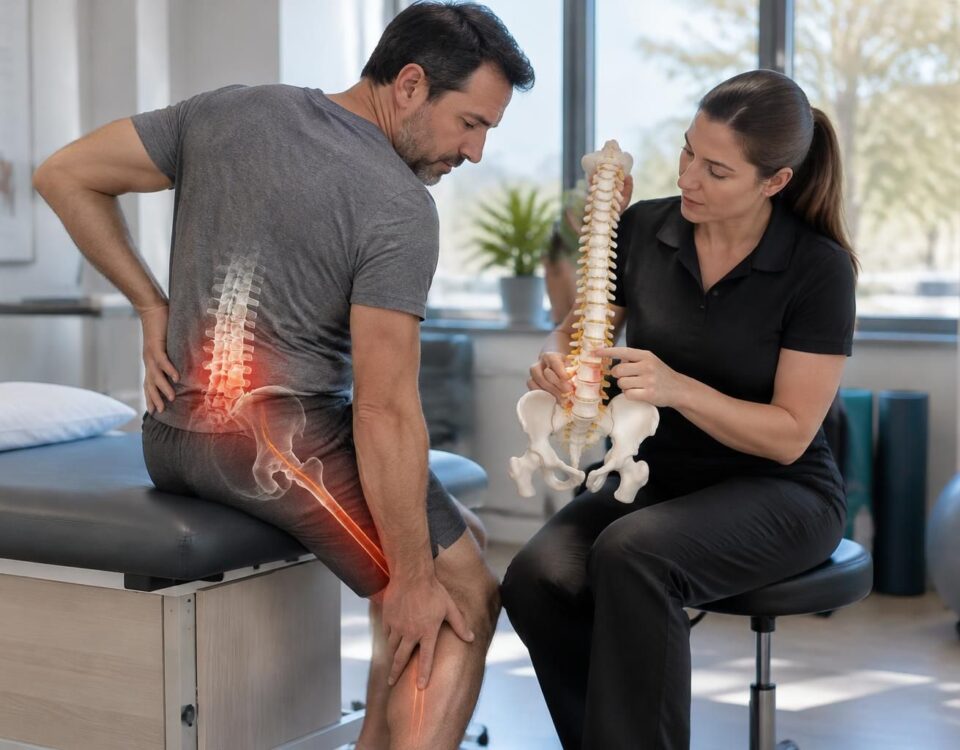
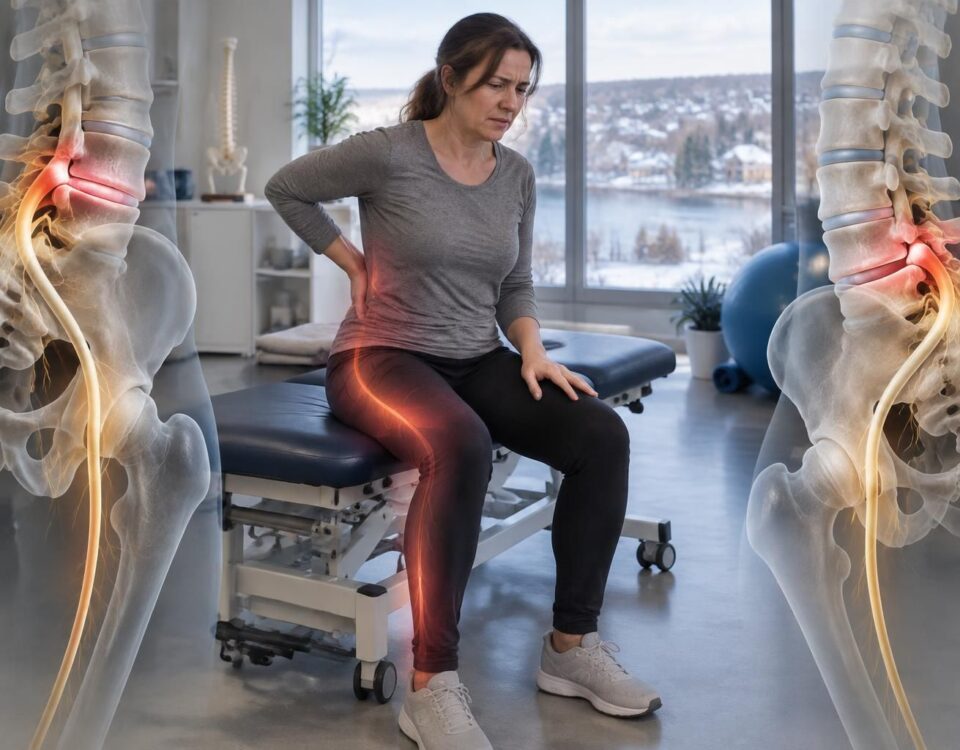
In Terrebonne, sciatica may manifest as pain in the buttock without noticeable back pain. This pain follows the path of the sciatic nerve and can radiate down the leg.
- Possible causes: irritation or compression of a lumbar root (L5/S1), herniated disc, lumbar canal stenosis, or piriformis syndrome.
- Key difference: if the pain is primarily at the front of the thigh, it may be femoral neuralgia and not sciatica.
- Quick diagnosis: trace the painful path and assess mobility to guide treatment.
- Management: physiotherapy/osteopathy assessment, targeted exercises, and ergonomic advice tailored for Terrebonne.
Would you like to know more or schedule a personalized assessment in Terrebonne? Contact us to set up an appointment.
This article, written by an expert health professional, explains why pain in the buttock may indicate sciatica in Terrebonne even in the absence of back pain. You will discover what sciatica is, how it manifests, its typical causes, warning signs, and what to expect during a consultation at TAGMED Clinic. Everything is presented simply and directly to facilitate understanding and access to appropriate management.
What is sciatica and its mechanism
Sciatica is pain that follows the path of the sciatic nerve. This nerve is one of the longest in the body and originates from the lumbar roots, then travels down to the buttock and the back of the leg. In most cases, pain in the buttock and leg reflects irritation or compression of a lumbar nerve root, such as L5 or S1, at the exit of the spine. The pain is of neuropathic origin, which explains its electrical, burning, or abnormal character rather than muscular.
Pain pathway and typical signs
Depending on the affected root, the painful path varies. If the L5 root is involved, the pain may follow the outside of the leg and reach the top of the foot. If it is the S1 root, it can travel from the buttock to the heel and sometimes to the sole of the foot or the toes. Just because the back is not very painful does not mean sciatica isn’t present: the pain follows the path of a nerve.
Common causes and local context
The most common cause is compression of a lumbar nerve root, often due to a herniated disc, especially around the L4-L5 and L5-S1 levels. With age, osteoarthritis and narrowing of the lumbar canal can also cause pain that radiates to the buttock and leg. Other mechanisms exist, such as piriformis syndrome or local inflammatory processes. Risk factors such as sedentary lifestyle, repeated heavy lifting, or prolonged sitting posture can promote the onset of these symptoms.
Warning signs and when to consult
Certain signs require rapid medical evaluation. Significant weakness in the leg, major sensory disturbances, pain that worsens quickly despite treatment, or urinary or bowel issues are significant alarms. If you observe these elements, do not wait to seek consultation.
Management at TAGMED Clinic
At TAGMED, assessment begins with a precise evaluation of the painful pathway, mobility, and leg strength, and what relieves or aggravates the pain. The management framework prioritizes an appropriate manual approach and patient education, with progressive rehabilitation focused on maintaining activity and correcting factors that promote pain. Everything is done in a multidisciplinary and personalized manner, notably through TAGMED Clinic. To learn more about the options offered in Terrebonne, you can consult the associated resources and information on available non-surgical approaches.
What to avoid and what to do
Avoid prolonged strict rest; it is better to stay active within limits that suit your pain. Keep in mind simple advice: walk regularly on flat ground, avoid sitting in one position for too long, and adapt daily movements (bend knees to pick up an object, keep your back straight). Ergonomic measures and posture advice can help reduce pain and promote recovery as part of a plan supervised by a professional at TAGMED Clinic. For more information, associated resources can be consulted on domain sites, including Sciatica in Terrebonne – calf pain and pain when sitting.
Your questions, your fears: what our team often hears
People often wonder if physiotherapy can worsen symptoms. In a first appointment, the assessment helps avoid overly strong mobilizations and tailor treatment to your tolerance. Treatment duration varies according to the cause and the progression. A comprehensive plan may include activity advice and support measures for daily living, consistent with practices recommended by TAGMED.
For further information, you can also consult relevant resources on signs and symptoms, the nature of the pain, and treatment options through dedicated pages on partner sites like Sciatica in Terrebonne and associated resources.
Important note: treatments in physiotherapy or kinesitherapy are only offered in a comparison context in efficacy tables. For complementary treatments, your team at the TAGMED clinic can direct you to the available options in our network.
Useful links and additional resources:
To understand the symptoms and typical duration of sciatica, consult Sciatica – symptoms and duration.
For general information on sciatica and diagnosis, visit MSD Manuals – Sciatica.
Medical disclaimer: The information and advice provided on this site do not replace the opinion, diagnosis, or treatment of a healthcare professional. Please note that Dr. Sylvain Desforges, osteopath, is neither a doctor of medicine nor a physician, and is not specialized in a medical specialty as defined by the Collège des médecins du Québec. Manual medicine, functional medicine, and sports medicine as described on this site exclude any medical treatment or diagnosis made by a physician or specialist. Always consult your doctor for any medical questions. For more details, please read our complete Legal Notice.
- Quick diagnosis: initial kinesiology assessment to trace the path and target the origin without confusing it with a cruralgia.
- Common origin: lumbar compression of a root (L5/S1) causing pain radiating to the buttock and leg.
- Typical symptoms: pain radiating from the buttock to the thigh and/or leg, sometimes without lumbar pain.
- Non-surgical approach: adapted management without surgery, focused on movement and rehabilitation.
- Terrebonne: local and personalized care, without traveling far.
- 3-phase plan: kinesiology diagnosis, cautious manual therapy, active rehabilitation, and postural advice.
- Targeted exercises: adapted stretching and strengthening to limit pain and enhance lumbar support.
- Gentle techniques: progressive and neurodynamic mobilizations to release the nerve without aggravation.
- Rapid pain reduction: concrete goals and gradual return to daily activity.
- Personalized follow-up: reassessment and adjustment of session frequency based on your progress.
- Practical advice: desk posture, sleep ergonomics, and everyday gestures to adopt.

This recommendation is addressed to individuals suffering from localized sciatica in the buttock, without apparent back pain, in Terrebonne. It provides clear guidelines to understand possible causes, recognize warning signals, and adopt an adapted and gradual management approach with your local kinesiotherapist or osteopath. The goal is to promote simple gestures, adapted activities, and targeted strengthening to limit recurrence and improve daily comfort.
What is sciatica targeting the buttock in Terrebonne?
Sciatica is pain that follows the path of the sciatic nerve, often starting from the buttock and descending into the thigh. When pain primarily manifests in the buttock without marked lumbar pain, it may be a piriformis syndrome or lumbar irritation/radiculopathy of the L5 or S1 roots without strong back pain. The verdict relies on the analysis of the painful path and clinical examination, to identify whether the pain is of nerve origin and which root is involved.
Possible causes when there is no back pain
Common causes
The most common causes of buttock pain without major lumbar pain include piriformis syndrome, local compression of the nerve in the buttock region, and other pathologies associated with the buttock or hip that mimic sciatica. A blocked sacroiliac joint or muscle tensions on the gluteal muscle can also cause pain radiating into the leg without associated back pain.
Warning signs and when to seek emergency care
Signs to watch for
If the pain is accompanied by notable loss of strength, significant numbness, or urinary or sphincter disorders, immediate consultation is required. Localized numbness in the saddle area, marked weakness while walking, or pain that rapidly worsens necessitates quick medical evaluation in Terrebonne.
Recommended management in Terrebonne
Evaluation and treatment plan
In Terrebonne, management begins with a kinesiology or osteopathy assessment to precisely trace the painful path and evaluate mobility, strength, and joint protections. Treatment prioritizes a progressive approach, centered on gentle mobility, targeted strengthening, and adapted manual techniques. The work may combine cautious mobilizations, targeted stretches, and neurodynamic exercises to improve nerve gliding and reduce pain.
What to avoid and what to do
Good practices
Maintain an adapted physical activity—the sedentary lifestyle aggravates pain. Favor regular walking, pelvic stability work, and deep core strengthening, and prioritize positions that relieve pain. Perform gentle stretches of the piriformis and hip mobility exercises. Adopt an ergonomic posture at work and avoid heavy loads during painful episodes.
Frequently asked questions
Quick answers
Sciatica can sometimes improve with adapted activity and a well-led exercise program. Strict rest is rarely helpful; guided movement is preferred. If the pain persists beyond a few weeks or is accompanied by warning signs, a specialized consultation in Terrebonne is recommended. Imaging or surgery is only considered after medical evaluation and based on progression.
To benefit from an assessment and a personalized plan tailored to your situation in Terrebonne, make an appointment with our team of physiotherapists and osteopaths. Our approach aims to get you back in action quickly while protecting your spine and hips.
| Element | Brief indication |
|---|---|
| Location | Pain in the buttock and along the leg, without marked low back pain |
| Path | Follows the sciatic nerve: buttock → thigh → leg; usually unilateral |
| Probable causes | L5-S1 disc herniation or narrow lumbar canal; possible inflammation |
| Associated signs | Tingling or electric shocks; pain sometimes without back pain at rest |
| Differentiation | Differs from cruralgia: anterior thigh pain; physiotherapy assessment differentiates |
| Warning signs | Marked weakness, sphincter disturbances, saddle anesthesia: medical emergency |
| Diagnosis and follow-up | Physiotherapy assessment: trace the path, evaluate mobility and strength, personalized plan |
| Treatment and activity | Adapted activity and progressive exercises; controlled movements; avoid prolonged rest |
| When to consult | Rapid developments or warning signs require a quick consultation |
Testimonials about Sciatica in Terrebonne: pain in the buttock without back pain
Marie D., real estate agent in Terrebonne, recounts: “I had a pain in the buttock that went down my leg and I had no apparent back pain. The physiotherapy assessment traced the exact path of the pain and the treatment plan allowed me to regain my mobility. After a few weeks, I could walk again and resume my activities without that constant discomfort.”
Marc L., technician in Terrebonne, remembers: “The pain in my buttock was amplified with movement and prevented me from working normally. The staff suggested gentle mobilizations and a targeted exercise program. Today the pain has significantly decreased and I fully enjoy my days without fear of symptom recurrence.”
Émilie T., teacher in Terrebonne, testifies: “I felt a pain in my right buttock that sometimes radiated down to my foot, without low back pain. The follow-up was personalized and educational: I returned to school activities with adapted movements and exercises to do at home. My comfort has improved and my hours in class no longer fatigue me as much.”
Lucas B., driver in Terrebonne, shares: “The onset of the pain was sudden and the buttock pain led me to avoid certain routes. After the assessment and management, I regained a smooth gait and better tolerance for walking. The program was gradual and respectful of my body; I regained confidence in my movements.”
Claire S., retiree in Terrebonne, writes: “My days were weighed down by a pain in the buttock that remained stable, without radiating into my back. Thanks to the exercise plan and ergonomic advice, I gradually gained stability and energy. I recommend this tailored and gentle approach, which spared me from invasive treatments.”
Théo C., developer in Terrebonne, concludes: “I was afraid that a sciatica would prevent me from working in front of my computer for a long time, especially without low back pain. The precise diagnosis and targeted exercises reduced the inflammation and improved my posture. I continue the exercises at home and I feel much better during my workdays.”
Biography of Dr Sylvain Desforges and his approach to Sciatica in Terrebonne
Dr Sylvain Desforges, expert in osteopathy, naturopathy and manual medicine, is the founding president of the TAGMED clinics and the ACMA grouping. Throughout a career dedicated to innovation in healthcare, he has specialized in managing chronic pain of the spinal column and in integrating advanced technologies that modernize the therapeutic approach, especially when symptoms present as stubborn or unexpected sciatica.
Rooted in the community of Terrebonne and its surroundings, his journey is guided by a holistic vision of health. He prioritizes personalized care, combining proven manual approaches with cutting-edge technological tools. His goal is to provide evidence-based care to optimize the health and well-being of each patient while remaining attentive to individual life context and personal goals.
His practice is based on a logic of reducing pain and functional limitations without systematically resorting to surgery. For individuals suffering from a pain in the buttock without back pain, as sometimes observed with a sciatica, he emphasizes the precise identification of the painful path and understanding of the affected root (L5 or S1), in order to propose non-surgical options and appropriate rehabilitation. This approach improves mobility, restores walking, and prevents recurrences when coupled with an active program.
In his intervention framework in Terrebonne, Dr Desforges integrates various technologies to complement manual care. He may use techniques such as motorized neurovertebral decompression, laser, and shockwave therapy, depending on the personalized assessment. These tools support the phases of stabilization and rehabilitation while remaining focused on the patient and on protocols based on current clinical data.
The therapeutic approach relies on careful evaluation, patient education, and multidisciplinary collaboration. Dr Desforges is committed to clearly explaining the mechanisms of sciatic pain and the movements to prioritize or avoid, in order to empower his patients in their healing journey. He prioritizes targeted exercises, progressive mobilizations, and active rehabilitation that strengthen stabilizing muscles, improve flexibility, and promote proper posture in daily and professional activities.
In parallel, his action extends to educational communication and guiding patients towards a better quality of life, integrating the principles of naturopathy when appropriate and adapting nutritional advice, sleep, and stress management to each individual’s reality. His approach is resolutely evidence-based and aims to offer sustainable solutions for people living with sciatica in Terrebonne, particularly those who have pain focused in the buttock without apparent main lumbar pain.
To learn more about his approach and the services available at the TAGMED Clinic, contact his team to evaluate together the most suitable options for your situation and lifestyle.
This article presents the issues of sciatica in Terrebonne, characterized by pain felt in the buttock without obvious lumbar pain, the possible mechanisms, and the appropriate management strategies by local physiotherapists. You will find possible causes (herniated disc, lumbar stenosis, piriformis syndrome), typical pain pathways, and practical advice for assessing and relieving pain in daily life.
Quick summary and local implications
Pain that starts in the buttock and sometimes radiates up the leg may correspond to local sciatica in Terrebonne. The most common profile combines irritation or compression of a lumbar nerve root (L5 or S1) and pain that follows the nerve pathway. For residents of Terrebonne, it is useful to distinguish Sciatica from other pains at the back of the thigh and leg, particularly cruralgia, which affects the front of the thigh. To guide you, you can consult specific resources like Sciatica in Terrebonne and guides on the factors influencing evolution.
Diagnosis and possible causes
The most common causes of buttock pain without major low back pain include a lumbar herniated disc compressing a nerve root, lumbar stenosis, or piriformis syndrome. Depending on the exact pathway of the pain (L5 or S1), the location may extend differently along the leg and foot. To shed light on these mechanisms, you can explore resources such as the factors influencing the evolution of herniated disc and sciatica.
The diagnosis is based on the interview and clinical examination conducted by a physiotherapist, who clearly differentiates sciatica from cruralgia to guide appropriate management. For additional insights on symptoms and associated inflammatory mechanisms, you can refer to Passport Health.
Management and local care
In Terrebonne, a structured approach begins with a thorough physiotherapy assessment to trace the painful pathway and evaluate mobility, strength, and sensitivity. Manual therapy techniques and gentle mobilizations may be used to reduce pain and restore mobility. The next phase focuses on active rehabilitation centered on core stabilization, hip mobility, and realigning movement patterns in daily life.
To enhance your understanding and access practical resources, consult the approaches offered by Body House Kiné and guides dedicated to recognizing and relieving sciatic neuralgia: Sciatica: recognize and relieve neuralgia. Additional information on triggers and practical advice tailored to Terrebonne can be found in local resources on the ground or guides dedicated to walking and activity in urban and rural settings, such as walking on uneven terrain.
Warning signs and when to consult
Some signs require prompt evaluation, particularly significant loss of strength in the leg, widespread sensory disturbances, or urinary/sphincter disturbances, which may indicate serious nerve compression. If these symptoms occur or worsen rapidly, it is essential to consult without delay to evaluate management options, including imaging or a specialized consultation. For references on alert states and guidelines to follow, refer to reliable resources like the symptoms that should alert.
Practical advice and prevention in Terrebonne
To limit recurrences and promote sustainable recovery, prioritize suitable physical activity and avoid prolonged bed rest. Simple habits like regular walking, alternating between sitting posture and mobility, and a routine of targeted stretches can make a significant difference. Complementary resources address the exercises and movements to prioritize or avoid, particularly programs and guides on exercises for sciatica. For example, you can check the Terrebonne advice and specialized guides on exercises and stretching.
To schedule an appointment and benefit from a personalized physiotherapy assessment in Terrebonne, our team can assist you in understanding the painful pathway, establishing a rehabilitation program, and monitoring your progress. Discover also complementary resources on the topic, such as Sciatica – causes and symptoms and in Montreal, to deepen your understanding and guide your choices.

Sciatica L5-S1 in Terrebonne: why the pain can radiate down to the foot
IN BRIEF L5-S1 sciatica refers to pain related to irritation of a lumbar nerve root, which may start from the lower back and radiate into the buttock, leg, and down to the foot. The pathway varies: the top of the…

Sciatica in Terrebonne: painful journey according to roots L4, L5, and S1
IN BRIEF Sciatica in Terrebonne can cause pain, tingling, or weakness in the leg. The roots L4, L5, and S1 can guide the evaluation based on symptoms and changes in strength, sensitivity, or reflexes; their territories do overlap, however. Comparing…

Sciatica in Terrebonne: what does irritation of the S1 root mean?
IN BRIEF An irritation of the S1 root can cause pain of a sciatica type in the buttock, the back of the leg, and the outer edge of the foot. Tingling, numbness, or difficulty walking on tiptoes may also occur.…

Sciatica in Terrebonne: what does irritation of the L5 root mean?
IN BRIEF L5 sciatica corresponds to irritation of the L5 nerve root, often felt from the lower back and buttock down the side of the leg, to above the foot and the big toe. It can cause pain, tingling, or…

Sciatica in Terrebonne: difference between L4-L5 and L5-S1
IN BRIEF The difference between L4-L5 and L5-S1 concerns the level of the lumbar discs and the sometimes irritated nerve roots: an L4-L5 injury often affects L5, while an L5-S1 injury often affects S1. The sensory pathways overlap; thus, an…

Sciatica S1 in Terrebonne: pain towards the calf and the outer edge of the foot
IN BRIEF S1 sciatica is pain related to irritation of a lumbar nerve root, which may radiate down to the buttock, back of the calf, and the outer edge of the foot. Tingling or weakness may also occur. In Terrebonne,…

Sciatica L5 in Terrebonne: pain towards the big toe
IN SHORT L5 sciatica can cause pain or numbness that radiates to the big toe, sometimes with difficulty lifting the foot. This pathway is a clue, not a diagnosis: the examination compares strength, sensitivity, and gait, as the nerve territories…

Sciatica L5-S1 in Terrebonne: pain radiating to the heel or foot
IN BRIEF A L5-S1 sciatica often corresponds to irritation of the S1 root, which can cause pain that radiates from the buttock down to the calf, heel, or outer edge of the foot. Identifying the pathway of symptoms and changes…

Dr Sylvain Desforges, B.Sc., D.O., N.D., osteopath, is the founding president of TAGMED and of the ACMA association. He dedicates his practice to chronic spinal pain, low back pain and symptoms compatible with sciatica, particularly when pain radiates toward the buttock, leg, calf, foot or toes.
Through SOS Sciatique, he publishes educational content on sciatica symptoms, possible causes such as disc herniation, disc narrowing, foraminal stenosis or irritation of a lumbar nerve root, as well as non-surgical approaches that may be considered according to the evaluation. At Clinique TAGMED, care may include, depending on the case, motorized neurovertebral decompression, specific osteopathic care or precision percussion.
For an evaluation related to sciatica treatment in Montreal / Mount Royal or sciatica treatment in Terrebonne, please consult the services available at Clinique TAGMED.
Medical disclaimer
The information published on SOS Sciatique is provided for educational purposes only and does not replace a consultation, diagnosis, opinion or treatment provided by a physician or another authorized healthcare professional. The author of this article is neither a medical doctor nor a specialist in a medical specialty recognized by the Collège des médecins du Québec. The osteopathic, manual medicine or functional support approaches described on this site do not constitute medical acts and are not intended to replace medical follow-up.
Consult a physician or emergency service in cases of loss of bladder or bowel control, anesthesia in the saddle area, significant or progressive weakness in the leg or foot, fever, recent trauma, severe pain or rapid worsening of symptoms. For more details, please read our Legal Notice.