Sciatica in Montreal: hip pain or true nerve radiation?
07/09/2026
Sciatica and difficulty walking on tiptoes: possible S1 root
07/09/2026
IN BRIEF Sciatica is a pain that follows the path of the sciatic nerve, from the lower back to the foot. In Terrebonne, it can manifest as pain in the hip or as true nerve irradiation. Key benefits: pain reduction, improved mobility, and prevention of recurrences, through a personalized plan. This plan combines physical therapy and local osteopathy, without surgery. How it works: the clinical evaluation leads to a personalized plan focused on movement and posture. Targeted exercises, trunk strengthening, and local osteopathic treatments facilitate a return to activity and quality of life. |
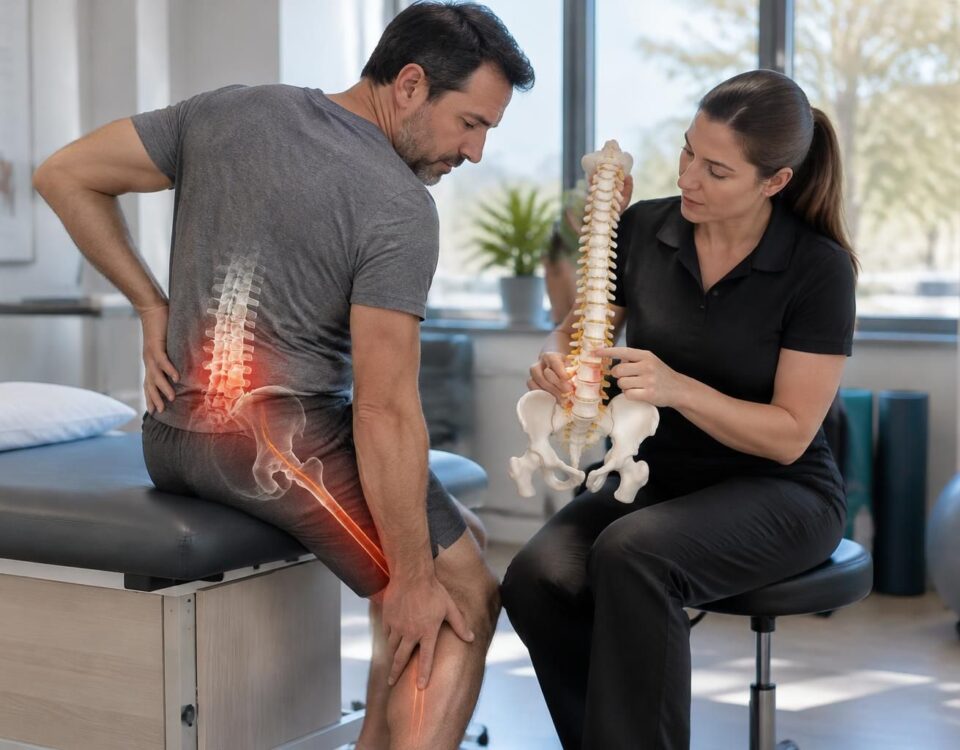
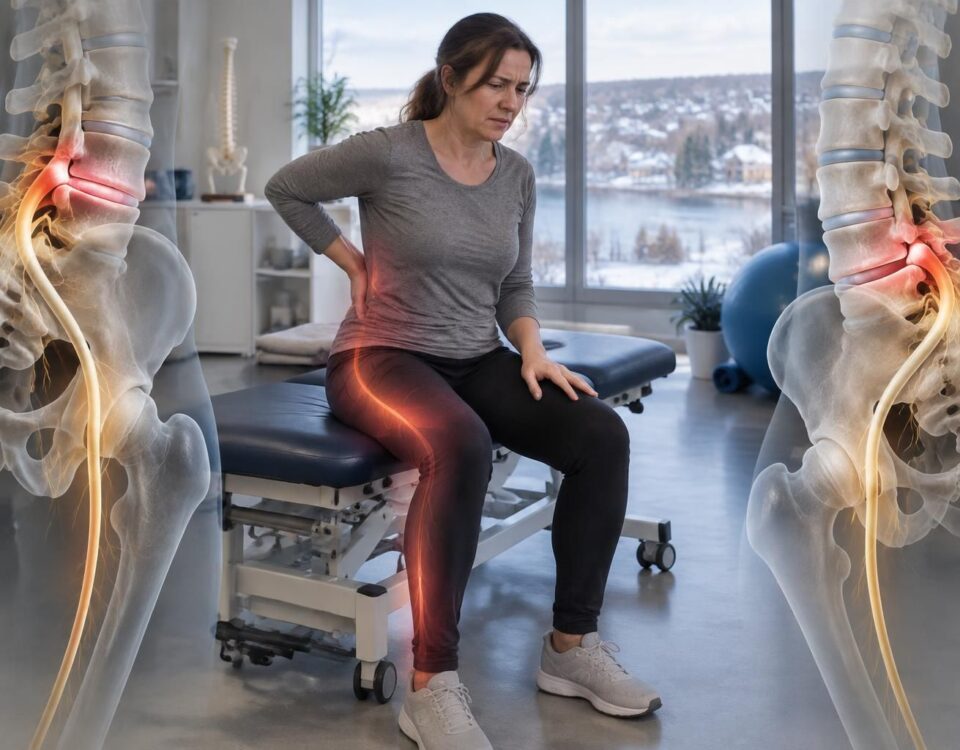
In Terrebonne, sciatic pain can result in discomfort near the hip or true nerve irradiation following the path of the sciatic nerve: lower back → buttock → thigh → calf → foot.
The distinction is essential: pain localized in the hip may be of local origin, while nerve irradiation spreads along the nerve path and may be accompanied by paresthesias or weakness. A clinical evaluation clarifies the mechanism and guides towards appropriate non-surgical approaches.
Treatment focused on movement and function, such as physical therapy and osteopathy, trunk strengthening, and posture improvement, can reduce pain, enhance mobility, and prevent recurrences without resorting to surgery.
This article, written by a healthcare professional specializing in spinal pain, clarifies how to differentiate between pain targeting the hip and true nerve irradiation related to the sciatic nerve. It describes the mechanisms, clinical signs, evaluation, and non-surgical options available at the TAGMED Clinic in Terrebonne. You will learn how to act quickly and without surgery when possible.
Understanding the Path of the Sciatic Nerve
The sciatic nerve is the longest in the body. It originates from the lumbar and sacral roots, then traverses the pelvis and passes behind the buttock. It then descends along the back of the thigh and down to the foot. This nerve pathway explains why pain felt in the lumbar region or hip may irradiate down to the foot. The pain may be described as an electrical shock or burning sensation, often felt on one side.
Hip Pain vs True Nerve Irradiation
Hip joint-centered pain may seem local, but nerve irradiation follows the path of the sciatic nerve. Key points to distinguish between the two: specific location, extension of the pain along the thigh or calf, and possible presence of paresthesias or weakness. When the pain follows the nerve path, it may appear far from the painful area and change with movement or position.
Evaluation and Diagnosis in Terrebonne
The evaluation starts with a clinical examination focused on the painful path and associated signs. Simple tests help identify root irritation. Imaging is considered if symptoms persist, worsen, or present red flags. The diagnosis primarily relies on the clinical examination, supplemented by additional tests when necessary. In Terrebonne, a local team can offer an appropriate non-surgical management after this evaluation.
Non-Surgical Approaches to Prefer in Terrebonne and TAGMED
For effective management without surgery, the offerings at TAGMED prioritize movement- and function-focused approaches. Osteopathy and targeted manual therapies play a key role. Non-invasive technological solutions may be considered based on the evaluation. The goal is to reduce pain, improve mobility, and facilitate a return to daily activities without immediately resorting to surgery.
The motorized neurovertebral decompression may be discussed as an option depending on the case, without prescription of generalized exercises or stretches in this article. The choice of interventions is made after a precise evaluation of the nerve pathway and the structures around the spinal column. To explore these approaches and their specifics, you can consult specialized resources on the areas mentioned below.
Prevention, Practical Tips, and Lifestyle
Adopt an aligned posture and prioritize regular movements. Maintain an activity level suitable for your condition and avoid sudden movements that stress the sciatic nerve. Integrate active breaks if you sit for long periods and ensure an ergonomic environment at work and home. Simple measures can help prevent flare-ups and maintain mobility.
Useful Resources and Practical Links
For more information, check the following resources that fall within the allowed areas:
General information and specific cases about Terrebonne and the path of the sciatic nerve: Sciatica in Terrebonne – understanding the path of pain before acting
Elements on causes and possible manifestations: pain radiating to the outer edge of the foot
Aspects of non-surgical treatment and associated resources: sciatica and pain trajectory after a long journey
Testimonials and local clinical context: Terrebonne – understanding the path of pain
To complete your information, also consult the following resources: neurovertebral decompression, herniated disc and sciatica, protrusion and bulging disc, carpal tunnel syndrome and associated pain, TAGMED Clinic.
Medical disclaimer: The information and advice provided on this site do not replace the opinion, diagnosis, or treatment of a healthcare professional. Please note that Dr. Sylvain Desforges, osteopath, is neither a medical doctor nor a physician, and is not specialized in a medical specialty as defined by the Collège des médecins du Québec. Manual medicine, functional medicine, and sports medicine as described on this site exclude any treatment or medical diagnosis made by a physician or medical specialist. Always consult your doctor for any medical questions. For more details, please read our full Legal Notice.
- Location: pain centered on the hip or buttock, rarely clear nerve route.
- Propagation: no noticeable irradiation; in radicular irradiation, pain follows the course of the sciatic nerve (lower back → buttock → thigh → calf → foot).
- Quality: painful movement at the hip vs electric shock/burning when the pain is radicular.
- Associated signs: paresthesias or weakness especially in irradiation; typically absent in pure hip pain.
- Clinical tests: a positive Lasègue suggests nerve irradiation.
- Risk factors: repetitive movements, sedentariness, diabetes, aging.
- Diagnosis: distinction between hip vs nerve through examination; imaging indicated if persistence or red flags.
- Non-surgical approaches: physiotherapy, osteopathy, trunk strengthening, posture improvement.
- Assessment: personalized plan and local follow-up in Terrebonne based on the assessment.
- Terrebonne Plan: assessment and non-invasive care focused on movement (TAGMED Clinic).
- Targeted options: neurovertebral decompression, manual techniques, nerve pathway-oriented rehabilitation.
- Prevention: regular mobility, core stability, posture at work and home.
- Emergencies: loss of bladder control/major discomfort, progressive weakness, fever.

This guide helps you distinguish between hip pain and true nerve irradiation in the context of sciatica in Terrebonne, and shows how understanding the course of the sciatic nerve can guide effective non-surgical approaches. You will learn how to spot the signs of irradiation, treatment options focused on movement and posture, and practical tips to regain mobility and comfort without immediately resorting to invasive intervention.
Understanding the difference between hip pain and nerve irradiation
Localized hip pain tends to be at the level of the joint or surrounding tissues (muscles, bursae, capsules) and does not necessarily follow the path of a nerve. On the other hand, nerve irradiation related to sciatica follows the path of the sciatic nerve, from the lower back to the foot, and may appear as an electric shock or burning sensation, often on one side. Understanding this path is key to targeting the assessment and guiding towards non-surgical treatments focused on movement, trunk strengthening, and targeted osteopathic treatments.
Evaluation and diagnosis in Terrebonne
The evaluation is based on a careful clinical examination of signs along the sciatic pathway, particularly the location of pain, paresthesias, and muscle strength. Simple tests can identify radicular irritation; imaging is retained if symptoms persist, worsen, or present red flags. The diagnosis primarily relies on the clinical assessment, supplemented if necessary by additional examinations. In Terrebonne, personalized management can be considered quickly to determine whether the pain arises from a disc herniation, deep gluteal syndrome, or other mechanisms, and guide towards suitable conservative solutions.
Non-surgical options and action plan
Physiotherapy and osteopathy
The majority of sciatica cases benefit from a non-invasive program focused on movement and function. The plan may combine local physiotherapy and osteopathy, with exercises dedicated to trunk strengthening and postural correction. These approaches aim to reduce pain, increase movement tolerance, and prevent recurrences, without resorting to surgery. The work is progressive, tailored to your pace and daily activities.
Other non-invasive interventions
Depending on the assessment, complementary options such as motorized neurovertebral decompression or other targeted manual techniques may be considered to reduce pressure on nerve structures and promote a return to activity. The goal is to restore function and mobility while limiting local inflammation and nerve pathway sensitivity.
Practical tips and prevention
Adopt an aligned posture at work and home, prioritize regular and suitable physical activities (walking, swimming), and incorporate core stability and gentle stretching exercises to support the lumbar spine. Reduce prolonged sitting positions and favor ergonomic environments with lumbar supports. These measures, combined with your rehabilitation program, help decrease tensions along the pathway and prevent flare-ups.
Warning signs and when to seek emergency care
Quickly consult if you observe a loss of urinary or bowel control, marked or progressive weakness of a limb, fever, recent trauma, or severe pain that worsens rapidly. In these cases, urgent medical evaluation is necessary.
| Nature of the symptom | Two possibilities: local pain in the hip or true irradiation along the sciatic pathway; in the latter case, it is referred to as sciatica. |
| Probable origin | Probable root origin when the pain follows the path and extends far from the source; otherwise, musculoskeletal origin. |
| Pain pathway | Irradiation following the path of the sciatic nerve: hip → buttock → thigh → calf → foot. |
| Preferred location | Frequent onset at the hip, unilateral projection toward the leg and foot. |
| Typical signs | Electric shock or burning sensation, paresthesia, and weakness along the leg. |
| Aggravating factors | Prolonged sitting, tension on the nerve pathway; stretching of the nerve may worsen. |
| Useful tests | Lasègue test is useful; imaging considered in case of persistence or red flags. |
| Non-surgical approaches | Physical therapy, osteopathy, and core strengthening, multimodal approach without surgery. |
| Emergencies to monitor | Loss of urinary/bowel control, marked weakness, fever; consult quickly. |
“I thought it was my hip that hurt. In Terrebonne, the evaluation revealed a true nerve irradiation following the path of the sciatic nerve, not a local hip issue. Thanks to an approach focused on the sciatic nerve path, I began mobility exercises and core strengthening, and the pain decreased.”
“I initially thought the pain came from my hip, especially during long sitting periods. The team identified a true nerve irradiation that went down the leg. By prioritizing non-surgical methods focused on movement and core strengthening, I gradually regained my mobility and less pain.”
“I was afraid of surgery after experiencing pain in the hip area. The clear explanation around the sciatic nerve pathway and sciatica reassured me. The program in Terrebonne, focused on physical therapy and local osteopathy, allowed me to resume my activities without invasive intervention.”
“At first, I thought I had pain in my hip, but the evaluation highlighted a sensation of nerve irradiation following the path of the sciatic nerve. I was offered a non-surgical plan with manual techniques and targeted exercises to improve mobility and prevent relapses in Terrebonne.”
“The real turning point was learning to distinguish localized pain in the hip from irradiation that travels up or down the path of the sciatic nerve. In Terrebonne, the program was clear: functional evaluation, strengthening, and gradual movement to resume activities without pain and without surgery.”
Dr. Sylvain Desforges, an expert in osteopathy, naturopathy, and manual medicine, is the founding president of the TAGMED clinics and the ACMA association. With a career dedicated to innovation in healthcare, he specializes in the management of chronic pain and the integration of advanced technologies. His approach is based on evidence-based services and a clear ambition: to optimize the health and well-being of everyone. In Terrebonne, he offers a focus on sciatica and sustainable mobility, without resorting to heavy or early invasive solutions.
The key question when discussing Sciatica in Terrebonne is often whether the pain actually originates from the hip or if it is a nerve irradiation that follows the path of the sciatic nerve. The sciatic nerve, the longest in the body, can project pain from the lower back or buttock to the foot, making the local origin ambiguous. This distinction is essential: understanding the neuro-kinetic pathway allows for prioritizing non-surgical management focusing on movement, core strengthening, and targeted osteopathic treatments.
In Dr. Desforges’ practice in Terrebonne, the initial evaluation is functional and personalized. It examines the painful pathway, associated signs, and movement limitations to differentiate possible causes: lumbar disc herniation, deep gluteal syndrome, foraminal stenosis, or myofascial tensions. This approach allows for developing a gradual rehabilitation plan that prioritizes movement and stabilization rather than immediate surgical intervention. The program may include a combination of physical therapy and local osteopathy, tailored to the individual patient’s needs and lifestyle.
At the core of the approach, core strengthening and targeted exercises for the pelvic floor and lower back muscles play a central role. Ergonomic advice and adapted activities (walking, swimming) complement the treatment to restore mobility, reduce pain, and prevent relapses. This philosophy aligns with a multidisciplinary approach: each patient benefits from tailored support intended to preserve function and autonomy in daily life while avoiding surgical interventions when possible and safe.
For more complex patients or when symptoms persist, complementary and non-invasive solutions may be considered. Dr. Desforges integrates technological options, such as targeted therapies and advanced manual approaches, to improve inflammation, vascularization, and tolerance to movement. Each therapeutic choice is discussed during a rigorous evaluation, with measurable objectives and a plan regularly re-evaluated, to ensure progress toward returning to activity and daily well-being.
Ultimately, in Terrebonne, Dr. Desforges’ approach allows for a clear response to the initial question: focused pain in the hip or true nerve irradiation? By restoring the functional pathway of the sciatic nerve as an axis of action, he offers a pragmatic and effective approach centered on movement, prevention, and sustainable recovery, without relying on premature surgical intervention.
This text clarifies the distinction between localized hip pain and true nerve irradiation related to sciatica in Terrebonne. It highlights the mechanisms, distinguishing signs, and non-surgical options focused on movement and posture to guide towards effective and sustainable rehabilitation without unnecessary recourse to surgery.
Hip pain can be of local mechanical origin or result from a sciatic nerve irritation that follows the nerve pathway down to the foot. Understanding the path of the sciatic nerve is therefore essential to differentiate pain in the hip from true nerve irradiation and to quickly target the appropriate interventions in Terrebonne.
In cases of nerve irradiation, the pain often describes a long, unilateral path: it can begin in the lumbar or gluteal area and radiate down the thigh, calf, and into the toes. This “projected” pain may be accompanied by paresthesia, muscle weakness, and worsens with effort or during prolonged sitting. Recognizing these signs is key to directing the evaluation and avoiding unnecessary early surgery.
A complete clinical evaluation is central. The use of simple tests is useful to accurately map the painful path and identify any root irritation. Imaging (lumbar MRI or CT scan) may be considered if symptoms persist, evolve, or present red flags. In Terrebonne, the goal is to prioritize non-surgical, personalized approaches centered on movement, strengthening, and function before considering more invasive interventions.
Practically, a localized and multidisciplinary approach may include physiotherapy, osteopathy, and posture advice, with additional solutions such as targeted manual techniques or non-invasive technologies based on the evaluation. This approach aims to quickly improve mobility, reduce pain, and prevent recurrences by strengthening stabilizing muscles and correcting movement patterns.
To act effectively, focus on simple and progressive measures: improving posture at work and home, regular trunk mobility and strengthening, and engaging in activities that do not irritate the nerve pathway. The goal is to restore function and allow for a sustainable return to physical activity while avoiding invasive treatments when unnecessary.
To explore the mechanisms, causes, and non-surgical management options further, you can consult dedicated resources such as guides on better understanding sciatic nerve pain, or specific resources for Terrebonne and Montreal on sciatica, including the pages of TAGMED Clinic and SOS Sciatica. These resources provide additional explanations on the pathway, causes, and non-surgical approaches suitable for Terrebonne and Montreal. Among other useful references, here are some practical links:
- Sciatica in Terrebonne: pain radiating to the outside of the foot
- Sciatica in Montreal: lumbar pain with shooting pain in the leg
- Sciatica and hip: link, explanation, and advice
- Difficulty walking on heels (L5 root) and sciatica
- Hip pain or sciatica: diagnosis
- Distinguishing lumbar pain and nerve pain – Terrebonne

Sciatica L5-S1 in Terrebonne: why the pain can radiate down to the foot
IN BRIEF L5-S1 sciatica refers to pain related to irritation of a lumbar nerve root, which may start from the lower back and radiate into the buttock, leg, and down to the foot. The pathway varies: the top of the…

Sciatica in Terrebonne: painful journey according to roots L4, L5, and S1
IN BRIEF Sciatica in Terrebonne can cause pain, tingling, or weakness in the leg. The roots L4, L5, and S1 can guide the evaluation based on symptoms and changes in strength, sensitivity, or reflexes; their territories do overlap, however. Comparing…

Sciatica in Terrebonne: what does irritation of the S1 root mean?
IN BRIEF An irritation of the S1 root can cause pain of a sciatica type in the buttock, the back of the leg, and the outer edge of the foot. Tingling, numbness, or difficulty walking on tiptoes may also occur.…

Sciatica in Terrebonne: what does irritation of the L5 root mean?
IN BRIEF L5 sciatica corresponds to irritation of the L5 nerve root, often felt from the lower back and buttock down the side of the leg, to above the foot and the big toe. It can cause pain, tingling, or…

Sciatica in Terrebonne: difference between L4-L5 and L5-S1
IN BRIEF The difference between L4-L5 and L5-S1 concerns the level of the lumbar discs and the sometimes irritated nerve roots: an L4-L5 injury often affects L5, while an L5-S1 injury often affects S1. The sensory pathways overlap; thus, an…

Sciatica S1 in Terrebonne: pain towards the calf and the outer edge of the foot
IN BRIEF S1 sciatica is pain related to irritation of a lumbar nerve root, which may radiate down to the buttock, back of the calf, and the outer edge of the foot. Tingling or weakness may also occur. In Terrebonne,…

Sciatica L5 in Terrebonne: pain towards the big toe
IN SHORT L5 sciatica can cause pain or numbness that radiates to the big toe, sometimes with difficulty lifting the foot. This pathway is a clue, not a diagnosis: the examination compares strength, sensitivity, and gait, as the nerve territories…

Sciatica L5-S1 in Terrebonne: pain radiating to the heel or foot
IN BRIEF A L5-S1 sciatica often corresponds to irritation of the S1 root, which can cause pain that radiates from the buttock down to the calf, heel, or outer edge of the foot. Identifying the pathway of symptoms and changes…

Dr Sylvain Desforges, B.Sc., D.O., N.D., osteopath, is the founding president of TAGMED and of the ACMA association. He dedicates his practice to chronic spinal pain, low back pain and symptoms compatible with sciatica, particularly when pain radiates toward the buttock, leg, calf, foot or toes.
Through SOS Sciatique, he publishes educational content on sciatica symptoms, possible causes such as disc herniation, disc narrowing, foraminal stenosis or irritation of a lumbar nerve root, as well as non-surgical approaches that may be considered according to the evaluation. At Clinique TAGMED, care may include, depending on the case, motorized neurovertebral decompression, specific osteopathic care or precision percussion.
For an evaluation related to sciatica treatment in Montreal / Mount Royal or sciatica treatment in Terrebonne, please consult the services available at Clinique TAGMED.
Medical disclaimer
The information published on SOS Sciatique is provided for educational purposes only and does not replace a consultation, diagnosis, opinion or treatment provided by a physician or another authorized healthcare professional. The author of this article is neither a medical doctor nor a specialist in a medical specialty recognized by the Collège des médecins du Québec. The osteopathic, manual medicine or functional support approaches described on this site do not constitute medical acts and are not intended to replace medical follow-up.
Consult a physician or emergency service in cases of loss of bladder or bowel control, anesthesia in the saddle area, significant or progressive weakness in the leg or foot, fever, recent trauma, severe pain or rapid worsening of symptoms. For more details, please read our Legal Notice.