Sciatica in Montreal: pain that worsens during sitting-standing transitions
01/10/2026
Sciatica and pain after moving
01/10/2026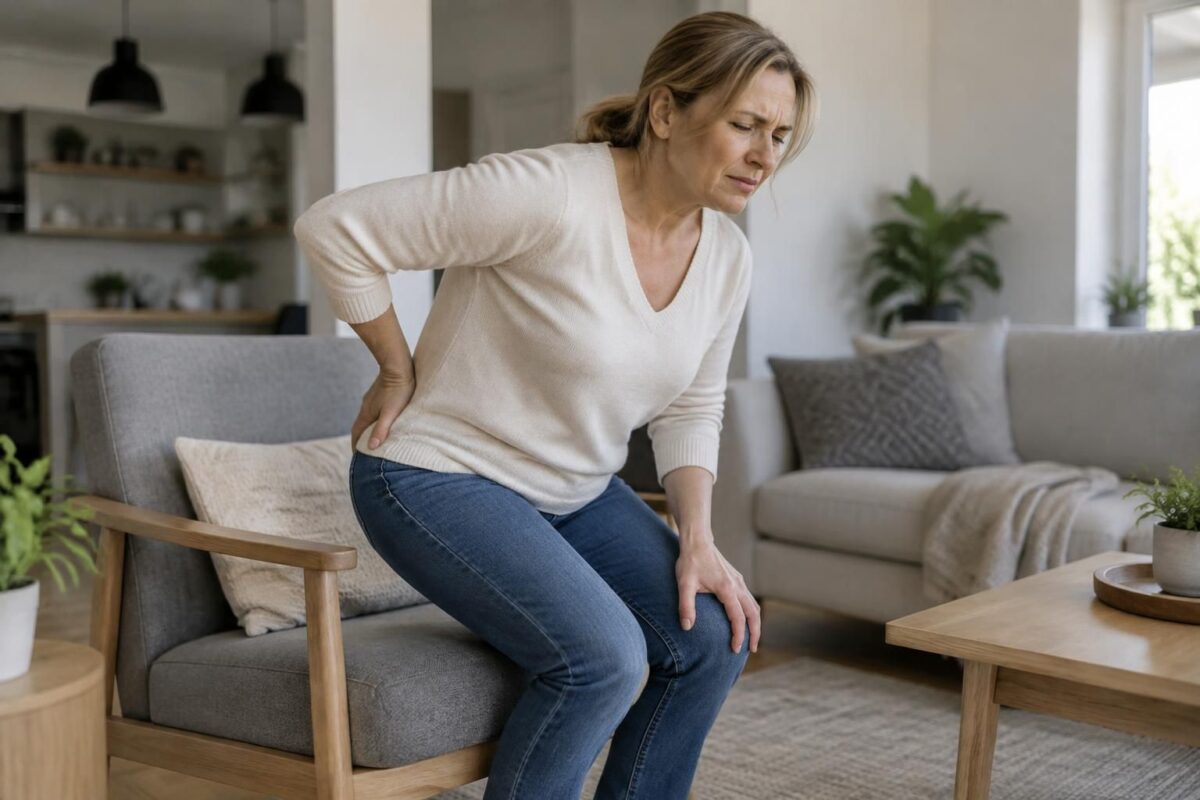
IN BRIEF
| Sciatica can cause pain that increases when moving from sitting to standing, although this sign alone is not sufficient to determine the cause. In Terrebonne, assessing when the pain appears, its path through the leg, and its evolution helps guide adaptations and care. Varying positions and rising gradually may improve comfort; new or progressive weakness requires prompt medical evaluation. |
Sciatica in Terrebonne: Pain When Transitioning from Sitting to Standing
Pain that increases when getting up from a chair may accompany sciatica, but this sign does not allow for determining the cause on its own. The duration of sitting, movements of the back and hip, and the path of symptoms down the leg should be considered. Gently varying positions and noting what triggers or relieves the pain can help better describe the issue during an evaluation.
If the pain persists or limits activities, consult a healthcare professional to guide management. A new or progressive weakness, numbness in the saddle area, or urinary or intestinal issues require urgent medical evaluation.
A sciatic pain that increases when getting up or sitting down may be related to the time spent in one position, the way the body moves, or the sensitivity of the lumbar and hip structures. In Terrebonne, an evaluation can help clarify the factors associated with the symptoms. Adjustments to the workstation and more gradual transitions may improve comfort, but they do not replace a diagnosis or appropriate management. Sciatica refers to pain that sometimes follows the path of a lumbar nerve root down to the buttock and leg. It may be accompanied by tingling, numbness, or weakness. Pain felt upon rising can also have another origin: the hip, muscles, joints, or other structures of the lower back may produce similar symptoms. Therefore, the fact that the pain appears during a transition is not enough to identify its cause. The path, evolution, positions that alter it, and the presence of neurological signs should be considered. To better understand the symptoms after a long sitting period, consult our page on pain in the buttock after a long sitting position in Terrebonne. When a person stands up, the pelvis, hips, and lower back change position. Movement can alter the stress on already sensitive tissues. The pain may also be related to a prolonged posture, sitting that limits position changes, or a quick transition. The sitting position does not produce the same effect for everyone. Some people experience more symptoms after extended sitting, while others tolerate standing poorly. Pain radiating from the lower back to the calf may require particular attention to the path and evolution of symptoms. You can read our page on pain from the lower back to the calf. Before a consultation, note when the pain begins and how long it lasts. Indicate if it occurs after a few minutes of sitting, when getting up, or after standing. Also, note if it radiates down the leg, to the foot or toes, and if it is accompanied by a loss of sensitivity or strength. Observe what happens after the transition. Does the pain decrease after a few steps, remain stable, or extend lower down the leg? The tingling in the toes and nerve pathway can provide important clues, but they do not alone allow for a diagnosis. Pain associated with nerve irritation does not always follow a complete path down to the foot. Its intensity and distribution vary from person to person. Pain limited to the buttock or thigh also warrants evaluation if it persists, worsens, or limits activities. To learn more, consult our article on incomplete path of sciatic pain in Terrebonne. To stand up, move close to the edge of the chair and use the armrests if it helps. Stand up in a controlled manner, avoiding sudden movements. Adjust your position before beginning to walk. If a step significantly increases the pain, avoid forcing it and seek advice from a healthcare professional. Alternating positions can limit long periods of immobility, but there is no universal duration suitable for everyone. A sit-stand desk can help facilitate this variation. However, it does not address the cause of the sciatica, and standing may worsen certain symptoms. Start with short periods and return to a more tolerable position if the pain increases. When seated, ensure your feet rest on the ground and the backrest supports the lower back. Place the keyboard and screen to avoid constantly leaning forward. When standing, keep your shoulders relaxed and avoid staying still if this posture increases discomfort. These adjustments should remain flexible: the best posture is generally one you can vary without exacerbating your symptoms. For additional advice on pain related to sitting, consult the page from Clinique TAGMED on sciatica in the sitting position. Those who experience more marked pain in the leg can also read our article on possible reasons for stronger sciatica pain in the leg. Consult a healthcare professional if the pain persists, recurs regularly, or limits your ability to sit, stand, walk, or work. The evaluation takes into account the history of symptoms and may include an examination of strength, sensitivity, walking, hip, and lower back movements. The plan depends on the results of the evaluation and the evolution of symptoms. Imaging is not always necessary; it is considered when it may change the course of action. At TAGMED Clinic, the options offered may include, depending on the evaluation and needs, specific osteopathy or motorized neurovertebral decompression. These approaches do not replace medical advice and are not suitable for all situations. Please refer to the information on sciatica treatment in Terrebonne. Seek a medical evaluation promptly if you notice new or progressive weakness in the leg or foot, numbness that spreads, or deteriorating walking. Inability to control the pedals while driving is also a reason to stop driving and consult quickly. A loss of urinary or intestinal control, numbness in the saddle area, significant weakness, fever, recent trauma, or rapid worsening require urgent medical evaluation. Dr. Sylvain Desforges, B.Sc., D.O., N.D., osteopath, is the founding president of TAGMED and the ACMA association. He dedicates his practice to chronic pain of the spine, lower back pain, and pain associated with sciatica, particularly when the pain radiates down to the buttock, leg, calf, foot, or toes. Through SOS Sciatique, he publishes educational content on sciatica symptoms, possible causes such as disc herniation, disc pinching, foraminal stenosis, or irritation of a lumbar nerve root, as well as non-surgical approaches that may be considered based on the evaluation. At TAGMED Clinic, care may include, depending on the case, motorized neurovertebral decompression, specific osteopathy, or precision percussion. For an evaluation related to sciatica treatment in Montreal / Mont-Royal or sciatica treatment in Terrebonne, consult the services available at TAGMED Clinic. The information published on SOS Sciatique is provided for educational purposes and does not replace a consultation, diagnosis, opinion, or treatment performed by a doctor or other authorized health professional. The author of this article is neither a physician nor a specialist in a medical specialty recognized by the Collège des médecins du Québec. The approaches of osteopathy, manual medicine, or functional support described on this site do not constitute medical acts and are not intended to replace medical follow-up. Consult a doctor or emergency service in case of loss of urinary or intestinal control, numbness in the saddle area, significant or progressive weakness in the leg or foot, fever, recent trauma, severe pain, or rapid worsening. For more details, please read our Legal Notice. Medical disclaimer: The information and advice provided on this site do not replace the opinion, diagnosis, or treatment of a health professional. Please note that Dr. Sylvain Desforges, osteopath, is neither a medical doctor nor a physician, and is not a specialist in a medical specialty as defined by the Collège des médecins du Québec. Manual medicine, functional medicine, and sports medicine as described on this site exclude any medical treatment or diagnosis made by a physician or medical specialist. Always consult your physician for any medical questions. For more details, please read our complete Legal Notice.Why can the transition from sitting to standing trigger pain?
Useful Information to Observe
Is pain that does not radiate to the foot concerning?
Adapting Transitions and the Workstation
When to Seek Evaluation in Terrebonne
Signs that require immediate attention
About the Author
Medical Disclaimer
To Observe
- Note if the pain increases when standing up or sitting down.
- Identify if it radiates down to the buttock or leg.
- Monitor any numbness or change in strength.
To Try
- Stand up gradually, using support if needed.
- Alternate positions and take short walking breaks.
- If symptoms persist or worsen, request a evaluation in Terrebonne.
Consult quickly in case of new or progressive weakness, numbness in the saddle area, or urinary or intestinal issues.

In Terrebonne, sciatica-like pain that increases when transitioning from sitting to standing should be observed rather than forced. Better-planned breaks, gradual movements, and an adjusted workstation can limit certain provocations, but the choice of measures depends on your symptoms and neurological function.

Sciatica L5-S1 in Terrebonne: why the pain can radiate down to the foot
IN BRIEF L5-S1 sciatica refers to pain related to irritation of a lumbar nerve root, which may start from the lower back and radiate into the buttock, leg, and down to the foot. The pathway varies: the top of the…

Sciatica in Terrebonne: painful journey according to roots L4, L5, and S1
IN BRIEF Sciatica in Terrebonne can cause pain, tingling, or weakness in the leg. The roots L4, L5, and S1 can guide the evaluation based on symptoms and changes in strength, sensitivity, or reflexes; their territories do overlap, however. Comparing…

Sciatica in Terrebonne: what does irritation of the S1 root mean?
IN BRIEF An irritation of the S1 root can cause pain of a sciatica type in the buttock, the back of the leg, and the outer edge of the foot. Tingling, numbness, or difficulty walking on tiptoes may also occur.…
Why can transitioning from sitting to standing cause pain?
Standing up rapidly changes the position of the pelvis and lower back. If sitting for a long time or leaning forward irritates symptoms, standing can temporarily exacerbate pain in the buttock or leg. Prolonged standing may also be poorly tolerated by some individuals. The response varies depending on the possible cause, which may include irritation of a nerve root, a disc herniation, or stenosis.
Pain alone does not allow for a diagnosis. Note if it radiates lower down the leg, if it is accompanied by tingling or numbness, how long you can remain seated, and how long it takes for you to recover after standing up.

Sciatica in Terrebonne: what does irritation of the L5 root mean?
IN BRIEF L5 sciatica corresponds to irritation of the L5 nerve root, often felt from the lower back and buttock down the side of the leg, to above the foot and the big toe. It can cause pain, tingling, or…

Sciatica in Terrebonne: difference between L4-L5 and L5-S1
IN BRIEF The difference between L4-L5 and L5-S1 concerns the level of the lumbar discs and the sometimes irritated nerve roots: an L4-L5 injury often affects L5, while an L5-S1 injury often affects S1. The sensory pathways overlap; thus, an…

Sciatica S1 in Terrebonne: pain towards the calf and the outer edge of the foot
IN BRIEF S1 sciatica is pain related to irritation of a lumbar nerve root, which may radiate down to the buttock, back of the calf, and the outer edge of the foot. Tingling or weakness may also occur. In Terrebonne,…
Recommendations for standing up more gradually
Prepare the movement
Before standing up, bring your feet closer to the chair and slightly lean forward towards the edge. Bend from the hips, without jerking, then gently push on the armrests or thighs. Once standing, take a few seconds to find a comfortable position before walking.
Alternate positions without imposing
Avoid remaining seated or standing still for long periods. Try to change positions before the pain significantly increases. You can start with short standing periods and then adjust based on your tolerance. If standing intensifies symptoms significantly or causes them to radiate further down the leg, return to a better-tolerated position and seek advice from a health professional.
Adjust Your Workspace
When sitting, choose a stable seat with comfortable lower back support. Keep your feet flat and avoid crossing your legs if it increases pain. When standing, adjust the work surface so your shoulders remain relaxed and your forearms are close to horizontal. Alternate weight between your feet and avoid excessively arching your lower back. A sit-stand desk can facilitate position changes but does not address the underlying cause of sciatica and is not suitable for everyone.
Track Your Progress and Get Evaluated
In Terrebonne and elsewhere, an evaluation can help clarify tolerated movements and assess strength, sensitivity, walking, and the path of pain. Before a consultation, note what triggers symptoms, what relieves them, activities that have become difficult, and treatments already attempted. The plan should be revised if your function does not improve or if symptoms change.
Consult quickly if new or progressive weakness occurs, if you experience drop foot, if numbness spreads, or if you have difficulty walking. Loss of bladder or bowel control, or numbness in the saddle area, requires urgent evaluation.
About the Author
Dr. Sylvain Desforges, B.Sc., D.O., N.D., osteopath, is the founding president of TAGMED and the ACMA association. His practice focuses on chronic spinal pain, low back pain, and symptoms consistent with sciatica. Care provided at the TAGMED Clinic may include, based on the evaluation, specific osteopathy, motorized neurovertebral decompression, or precision percussion therapy.
Medical Disclaimer
This information is educational and does not replace a consultation, diagnosis, or treatment by a licensed healthcare professional. The author is neither a physician nor a specialist in a medical specialty recognized by the Collège des médecins du Québec. Osteopathy and manual medicine approaches do not replace medical follow-up.
| What you observe | Useful marker |
|---|---|
| Pain during sit-stand transitions | Note if it decreases after a few steps or persists. |
| Pain that goes lower down the leg | Stop the movement and monitor the evolution of symptoms. |
| Symptoms triggered after a long period of sitting | Try regular breaks and position changes. |
| Pain exacerbated when bending | Avoid harsh bends and prefer gradual transitions. |
| New or progressive weakness in the leg or foot | Consult a healthcare professional promptly. |
| Loss of bladder or bowel control, or numbness in the saddle area | Consult an emergency service immediately. |
Illustrative Testimonials on Sciatica in Terrebonne: Pain During Sit-Stand Transitions
Note: The stories below are fictional examples created for educational purposes. They do not correspond to verified patient testimonials and do not guarantee any results.
“The pain increased when I stood up from my chair”
“After several hours at my desk, I felt pain in my lower back that radiated into my buttock. The sit-stand transition was particularly difficult: the first steps were uncomfortable. I started keeping track of how long I could remain seated and if the pain changed after a short walk. These observations helped me describe my symptoms more accurately during my evaluation in Terrebonne.”
“Alternating positions helped me better identify what worked for me”
“I thought a sit-stand desk would solve the problem. In reality, standing too long also increased my pain. So I tried shorter periods, alternating with a few minutes of movement. I learned that there is no ideal posture for everyone and that the response of my symptoms should guide the adjustments.”
“The moment I stood up was more painful than sitting”
“My pain seemed to awaken when I transitioned from the chair to standing. Over time, I noticed that repeated transitions and long periods of being stationary were not well tolerated. I began to stand up more gradually and walk a little, without forcing it if the pain radiated further down my leg.”
“I realized that the pain going down my leg warranted an evaluation”
“At first, I thought it was just stiffness after sitting for a while. As the pain sometimes radiated to my leg, I sought an evaluation instead of randomly changing my workspace. Knowing whether bending, standing, or other movements influenced my symptoms helped me better understand the possible next steps.”
Tolerance to sitting and transitions varies among individuals and the underlying cause of symptoms. Pain that increases when standing does not, by itself, determine whether it is a disc herniation, stenosis, or another issue. An evaluation can consider the path of pain, strength, sensitivity, walking, and movements that worsen or alleviate symptoms.
Consult promptly if new or progressive weakness appears, if numbness spreads, or if walking deteriorates. Urinary or bowel issues, loss of sensation in the saddle area, or significant weakness require urgent medical evaluation.
Medical Disclaimer: This information is educational and does not replace a consultation, diagnosis, or treatment by a licensed healthcare professional. Osteopathy or manual medicine approaches do not replace medical follow-up.
Pain that intensifies when getting up from a chair can be destabilizing, especially when it originates from the lower back or buttock and radiates down the leg. In Terrebonne, as elsewhere, this type of discomfort deserves careful observation: it may be consistent with sciatica but is not sufficient to establish the cause. Irritation of a lumbar nerve root, a disc herniation, stenosis, or a hip issue can produce similar symptoms.
The transition from sitting to standing engages multiple structures simultaneously. The trunk typically leans forward, the hips straighten, and the muscles of the back and legs contract to support the body. If certain lumbar or hip movements irritate sensitive tissues, pain may manifest when standing up, then diminish or persist during walking. The response varies from person to person: sitting does not produce the same symptoms for everyone, and a single posture is not necessarily the root of the problem.
To better understand the chart, note when the pain starts, its path, and the time needed to recover after the movement. Is it limited to the back or buttock, or does it travel down below the knee to the calf or foot? Any tingling, loss of sensitivity, or weakness may also be important to report. It is helpful to specify if the pain increases after a long period of sitting, during trunk flexion, or when standing. These observations assist the professional in guiding their assessment without replacing a clinical examination.
While waiting for an assessment, you can try to stand up without sudden movements: move close to the edge of the chair, place your feet under your knees and gently push on the armrests or thighs. Alternate positions and take short movement breaks rather than staying still for long periods. Adapt these gestures to your tolerance; if a movement causes the pain to travel further down the leg, stop. The goal is to maintain manageable activities without imposing an exercise or posture that worsens symptoms.
An assessment may compare strength, sensitivity, walking, and responses to movements of the back and hip. Imaging is not automatically necessary: it is considered when results may change management, based on symptoms and examination. A care plan should specify functional objectives, planned follow-ups, and criteria that would lead to revising the approach. At TAGMED Clinic, options may include, depending on the assessment, specific osteopathy, motorized neurovertebral decompression, or precision thrusting tools. These approaches do not replace a medical evaluation when indicated.
Consult quickly in case of new or progressive weakness of the leg or foot, numbing that spreads, or deteriorating walking. Loss of urinary or intestinal control, numbness in the saddle area, fever, recent trauma, or rapid worsening necessitates urgent medical evaluation. If you are driving and your strength or pedal control is diminished, stop driving and seek advice promptly.
About the author
Dr. Sylvain Desforges, B.Sc., D.O., N.D., osteopath, is the founding president of TAGMED and the ACMA association. His practice focuses particularly on chronic spinal pain, lower back pain, and symptoms consistent with sciatica. He is interested in health innovation and the integration of approaches tailored to the assessment and functional goals of each individual.
Medical disclaimer
This content is provided for educational purposes and does not replace a consultation, diagnosis, or treatment by a licensed healthcare professional. The author is neither a physician nor a specialist in a medical specialty recognized by the Collège des médecins du Québec. Osteopathy and manual medicine approaches do not constitute medical acts.
In Terrebonne, pain that increases when moving from a sitting to a standing position deserves careful observation, without concluding solely that it indicates sciatica or a herniated disc. The time spent sitting, how you get up, the path of the pain, and the evolution of strength or sensitivity help determine the next steps.
Interpreting pain during position changes
Shifting from sitting to standing engages several structures in the lower back and pelvis. Local pain or radiation towards the buttock and leg may be influenced by lumbar flexion, hip position, or the time spent without moving. Responses vary among individuals: some tolerate a slightly flexed posture better, while others feel more comfortable after straightening up. Therefore, there is no one ideal posture that applies to everyone.
Note if the pain appears after several minutes of sitting, if it travels further down the leg when you stand up, and how long it takes to subside after taking a few steps. The affected area may also vary: pain in the calf, heel, outer edge of the foot, or big toe should be described precisely to the consulted professional. To better understand these manifestations, consult the pages on pain that travels down then back up to the buttock, calf pain without significant lower back pain, and pain in the calf, heel, or outer edge of the foot.
Adapting transitions without imposing a single posture
If the symptoms remain stable and no concerning neurological signs appear, you can try to regularly vary positions and plan short pauses before the pain intensifies. To stand up, bring your feet close to the chair, slightly lean your torso from the hips, and push on your legs or armrests, avoiding sudden movements. After standing, walk for a moment if it does not increase the radiation. If the pain becomes more intense or travels further down the leg, return to a more tolerable position and reassess the strategy.
Advice on sitting position in case of sciatica and on how to sit can complement this approach. However, they do not replace a personalized assessment: response to sitting or standing is not sufficient to determine the cause. General information is also available from the MSD Manual and this resource on sciatica.
Choosing next steps based on symptoms and function
An assessment can compare the path of the pain, strength, sensitivity, walking, and responses to movements. It helps determine if activity recommendations, workstation adjustments, or professional care are relevant. In Terrebonne, you can consult information on the treatment of sciatica at TAGMED Clinic. The goal is to choose a proportional approach and monitor concrete changes, such as improved tolerance to transitions, walking, or daily activities.
Consult a professional promptly if the pain progressively worsens, if numbness spreads, or if weakness appears. Significant or progressive weakness, a foot drop, numbness in the saddle area, or changes in urinary or intestinal control necessitates urgent medical evaluation. The presence of such signs should take precedence over any attempt to adapt posture or continue a care program.

Sciatica L5 in Terrebonne: pain towards the big toe
IN SHORT L5 sciatica can cause pain or numbness that radiates to the big toe, sometimes with difficulty lifting the foot. This pathway is a clue, not a diagnosis: the examination compares strength, sensitivity, and gait, as the nerve territories…

Sciatica L5-S1 in Terrebonne: pain radiating to the heel or foot
IN BRIEF A L5-S1 sciatica often corresponds to irritation of the S1 root, which can cause pain that radiates from the buttock down to the calf, heel, or outer edge of the foot. Identifying the pathway of symptoms and changes…

Dr Sylvain Desforges, B.Sc., D.O., N.D., osteopath, is the founding president of TAGMED and of the ACMA association. He dedicates his practice to chronic spinal pain, low back pain and symptoms compatible with sciatica, particularly when pain radiates toward the buttock, leg, calf, foot or toes.
Through SOS Sciatique, he publishes educational content on sciatica symptoms, possible causes such as disc herniation, disc narrowing, foraminal stenosis or irritation of a lumbar nerve root, as well as non-surgical approaches that may be considered according to the evaluation. At Clinique TAGMED, care may include, depending on the case, motorized neurovertebral decompression, specific osteopathic care or precision percussion.
For an evaluation related to sciatica treatment in Montreal / Mount Royal or sciatica treatment in Terrebonne, please consult the services available at Clinique TAGMED.
Medical disclaimer
The information published on SOS Sciatique is provided for educational purposes only and does not replace a consultation, diagnosis, opinion or treatment provided by a physician or another authorized healthcare professional. The author of this article is neither a medical doctor nor a specialist in a medical specialty recognized by the Collège des médecins du Québec. The osteopathic, manual medicine or functional support approaches described on this site do not constitute medical acts and are not intended to replace medical follow-up.
Consult a physician or emergency service in cases of loss of bladder or bowel control, anesthesia in the saddle area, significant or progressive weakness in the leg or foot, fever, recent trauma, severe pain or rapid worsening of symptoms. For more details, please read our Legal Notice.