Sciatica in Montreal: pain towards the little toe and S1 root
05/09/2026
Sciatica and difficulty lifting the foot: emergency or quick consultation?
05/09/2026
IN BRIEF
| In brief, sciatica associated with pain towards the little toe and the S1 root is a neuropathic pain that follows the path of the sciatic nerve and often results from compression or irritation of the affected lumbar root. This condition is efficiently diagnosed through a physiotherapy assessment and is primarily treated with a non-surgical approach that includes targeted exercises, postural rehabilitation, and activity advice, leading to significant improvements in mobility and pain. In Terrebonne, our local approach emphasizes rapid assessment, a personalized plan, and progressive support to regain daily autonomy, with simple actions to do at home and ergonomic recommendations. |
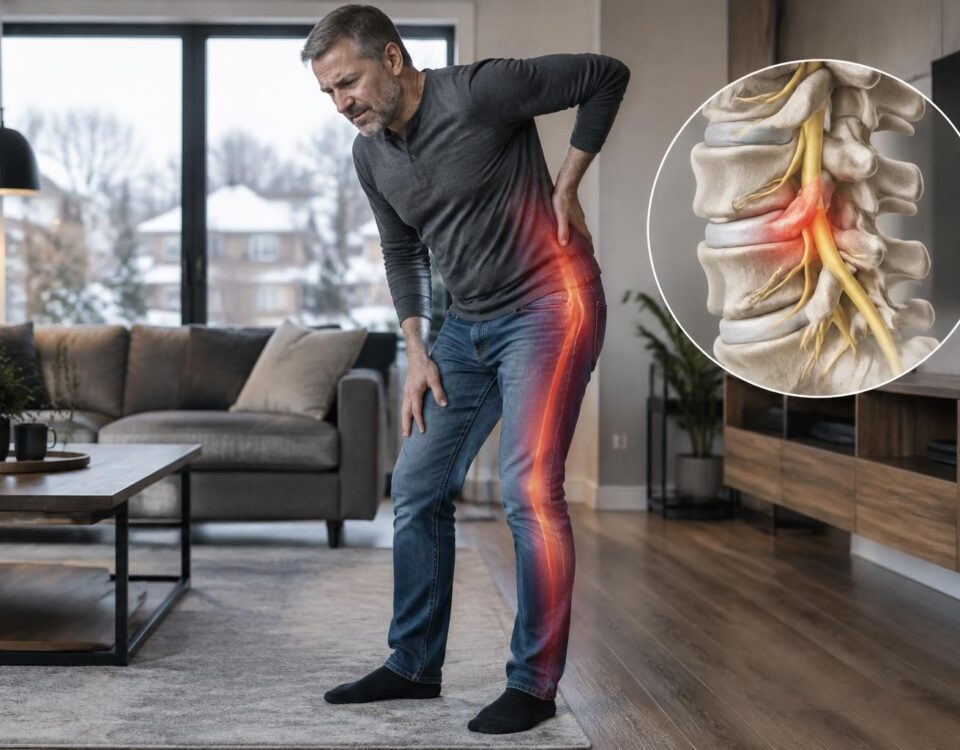
In Terrebonne, sciatica that radiates towards the little toe is typically linked to irritation or compression of the S1 root of the sciatic nerve. The painful pathway often starts at the buttock, follows the back of the leg, and can reach the heel, the sole of the foot, and the little toe.
The most common causes include a lumbar disc herniation or narrowing of the lumbar canal. A physiotherapy assessment in Terrebonne allows for precise identification of the affected root and an appropriate treatment plan, generally without surgery.
For a clear diagnosis and a personalized action plan, our team in Terrebonne offers a quick assessment and targeted exercises to provide rapid relief and prevent recurrences. Schedule an appointment now.
This article, written by an expert health professional, clearly outlines sciatica in Terrebonne with radiating pain towards the little toe and probable involvement of the S1 root. It describes the painful pathway, possible causes, warning signs, diagnosis, and management options at the TAGMED Clinic in Terrebonne or Montreal. The text emphasizes practical information and accessible clinical advice, avoiding specific exercises or stretches in the cases discussed.
Sciatica is pain that follows the path of the sciatic nerve. When the S1 root is affected, the pain may extend to the heel and involve the little toe. This pain is often described as burning, electric, or shooting. The diagnosis relies on clinical examination and the identification of the painful pathway.
Understanding Sciatica and the S1 Root
Sciatica is a neuropathic pain that can result from irritation or compression of a lumbar root, most often the S1 root for this profile. The sciatic nerve originates from several lumbar and sacral roots and runs through the buttock, back of the thigh, and calf, dividing near the knee. S1 involvement typically manifests as pain that follows the posterior path of the leg to the heel and sometimes to the sole of the foot and the last toes. To better understand the pathways, you can consult reliable resources related to radicular pathology and its assessment.
Pain Pathway and Little Toe
With S1 involvement, the pain follows the back of the thigh, descends into the calf, and may reach the heel and the outer edge of the foot, including the little toe. Motor signs may appear, such as difficulty standing on tiptoes or maintaining a normal gait. The precise tracing of the pain helps confirm the involvement of the S1 root and guides management.
Common Causes Related to S1
The most frequent cause is compression of the S1 root at the lumbar level, often due to a disc herniation at L5-S1 or degenerative mechanisms. Other factors may include a narrow lumbar canal, spondylolisthesis, or muscular conditions around the buttock such as piriformis syndrome. Rare causes exist but should be considered in atypical presentations.
Warning Signs and When to Consult Quickly
Urgent signs require quick consultation: significant weakness in the foot or ankle, urinary or bowel dysfunction, saddle anesthesia (loss of sensitivity around the anus and genitals), pain that rapidly worsens, or associated fever. These elements may indicate a syndrome requiring immediate neurosurgical evaluation.
Diagnosis and Assessment at TAGMED
The diagnosis is primarily clinical. The assessment may include measuring muscle strength, sensitivity, and the Achilles reflex, as well as evaluating the painful pathway. If in doubt, additional tests such as MRI or electromyography may be requested to specify the radicular origin and eliminate other causes. For more information on radicular pathways, see Sciatica – radicular pathways.
Management at TAGMED and Terrebonne
The management at TAGMED Clinic aims for a non-surgical approach whenever possible. The process starts with a thorough assessment, followed by adapted manual therapy and education on posture and ergonomics. Practical advice helps limit the risks of recurrence and improve daily comfort. Complementary technologies may be considered depending on the case, and options are discussed with you to favor an approach respectful of your physiology. For more information, check the dedicated resources and reviews on treatments at TAGMED Clinic and associated resources on Sciatica and S1 Root in Terrebonne.
What to Avoid and What to Do
Avoid prolonged bed rest and prioritize activity suited to your tolerance. Maintaining gentle movements and correct posture can facilitate recovery without forcing the pain. Avoid heavy loads and movements that worsen the pain. Practically, prioritize light and regular walking, ergonomic adjustments at work and sleep, and relief measures recommended by your healthcare professional. For a comparative overview of therapeutic options, you can consult specialized resources and TAGMED fact sheets.
Useful Resources and Links
To deepen your understanding, consult relevant sources of information on the pathways and clinical manifestations, as well as care options in Terrebonne and Montreal. Access specialized pages on nerve roots and the pathways of the sciatic nerve, as well as resources dedicated to driving and ergonomics related to sciatica:
– Sciatica – radicular pathways
– Sciatica and public transport – prolonged sitting
– Sciatica and S1 root in Terrebonne
– Sciatica and professional driving – signs not to trivialize
– Legal notice
– Sciatica and travel – recognize a worsening.
Medical disclaimer: The information and advice provided on this site do not replace the opinion, diagnosis, or treatment of a healthcare professional. Please note that Dr. Sylvain Desforges, osteopath, is neither a medical doctor nor a physician and is not a specialist in a medical specialty as defined by the Collège des médecins du Québec. Manual medicine, functional medicine, and sports medicine as described on this site exclude any medical treatment or diagnosis made by a physician or specialist. Always consult your doctor for any medical questions. For more details, please read our complete Legal Notice.
This article is informative and does not replace medical consultation. Only a healthcare professional can establish a diagnosis and a care plan suited to your situation. Sciatica is a pain that can be associated with a variety of causes, and individual assessment is necessary to determine the most appropriate treatment.
Medical disclaimer: The information and advice provided on this site do not replace the opinion, diagnosis, or treatment of a healthcare professional. Please note that Dr. Sylvain Desforges, osteopath, is neither a medical doctor nor a physician and is not a specialist in a medical specialty as defined by the Collège des médecins du Québec. Manual medicine, functional medicine, and sports medicine as described on this site exclude any medical treatment or diagnosis made by a physician or specialist. Always consult your doctor for any medical questions. For more details, please read our complete Legal Notice.
- Analytical axis Painful pathway and S1 root (Terrebonne): diagnostic orientation and local management.
- Typical S1 signs Posterior buttock pain → leg → heel and little toe; possible weakness when standing on tiptoes.
- Probable causes L5-S1 disc herniation and/or lumbar canal stenosis.
- Differentiation Cruralgia (L3-L4) identified by the physiotherapy assessment.
- Warning signs Loss of strength, sphincter disturbances, increasing pain, fever.
- Management Physiotherapy assessment, appropriate manual therapy, active rehabilitation.
- Practical advice Regular walking, avoid twisting and prolonged positions, sleep on your side.
- Care plan Initial session, reassessment, and adjusted progression.

This recommendation summarizes practical advice for localized sciatica in Terrebonne when pain follows the pathway of the sciatic nerve to the little toe and involves the S1 root. It recalls the possible mechanisms, the signals to monitor, the local management options, and the daily habits to prioritize in order to quickly improve comfort and mobility while avoiding complications.
Understanding sciatica and the S1 root
Sciatica is pain that follows the pathway of the sciatic nerve. When associated with the S1 root, the pain can extend from the lower back to the calf, heel, and sole of the foot, sometimes including the little toe. This pain is often described as burning, electric, or stabbing and can be accompanied by paresthesias or slight sensory deficits. The typical motor sign of S1 is difficulty standing on tiptoes and reduced foot extension, with a possibly slowed or diminished Achilles reflex.

Sciatica S1 in Terrebonne: pain towards the calf and the outer edge of the foot
IN BRIEF S1 sciatica is pain related to irritation of a lumbar nerve root, which may radiate down to the buttock, back of the calf, and the outer edge of the foot. Tingling or weakness may also occur. In Terrebonne,…
Painful pathway and localization to the little toe
To identify S1 involvement, it is useful to trace the path of pain from the lower back to the little toe. If the pain follows the posterior surface of the leg to the heel and the sole of the foot, with possible radiation to the little toe, this suggests S1 radiculopathy. This precise localization guides the assessment and treatment plan and helps differentiate S1 involvement from possible other nerves, such as L5, whose painful areas may be more lateral or on the dorsum of the foot.

Sciatica L5 in Terrebonne: pain towards the big toe
IN SHORT L5 sciatica can cause pain or numbness that radiates to the big toe, sometimes with difficulty lifting the foot. This pathway is a clue, not a diagnosis: the examination compares strength, sensitivity, and gait, as the nerve territories…
Common causes in Terrebonne
The most common causes associated with S1 pain include a lumbar disc herniation compressing the S1 root at L5-S1, or lumbar canal narrowing. Other mechanisms, such as postural rebalancing disorders, piriformis syndrome, or local irritations, may also be involved. In all cases, a specific assessment confirms the affected root and adjusts local management accordingly.

Sciatica L5-S1 in Terrebonne: pain radiating to the heel or foot
IN BRIEF A L5-S1 sciatica often corresponds to irritation of the S1 root, which can cause pain that radiates from the buttock down to the calf, heel, or outer edge of the foot. Identifying the pathway of symptoms and changes…
Warning signs and when to consult
Emergencies and red flags
Certain situations require prompt consultation: marked loss of strength in the leg, urinary or sphincter disturbances, anesthesia of the perineum, rapidly worsening pain, or fever associated with severe low back pain. These signs may indicate a neurological emergency and require immediate management.
Sciatica L4-L5 in Terrebonne: understand the possible symptoms
IN BRIEF The L4-L5 sciatica often corresponds to irritation of the L5 nerve root, sometimes related to a disc herniation. It can cause pain from the lower back to the buttock, the side of the leg, and the top of…
Local management in Terrebonne: what to do
Assessment and treatment plan
In Terrebonne, an initial physiotherapy or movement medicine consultation allows for determining the exact path of the pain, assessing spinal mobility and leg strength, and identifying positions that relieve or worsen symptoms. Treatment usually combines gentle manual therapy techniques, targeted exercises to strengthen the abdominal core and deep back muscles, and active rehabilitation focused on hip and pelvis mobility. Ergonomic advice and home exercises complete the care.

Sciatica in Terrebonne: how to describe your symptoms during a consultation
IN BRIEF Sciatica is pain or a tingling sensation that descends from the lower back or buttock down the leg. In Terrebonne, describing its path, duration, triggers, and effects on walking helps the professional assess the symptoms and guide the…
What to do and avoid
Stay active within the limits of your pain and favor moderate activities like walking on flat surfaces. Avoid prolonged sitting and adopt regular active breaks. Encourage controlled movements, good posture, and strengthening of deep muscles. Avoid significant twisting efforts and harsh manipulation of the spine. The goal is progressive recovery that restores function without worsening nerve irritation.

Sciatica in Terrebonne: nerve symptoms not to be taken lightly
IN BRIEF Sciatica is pain that can radiate from the lower back or buttock down to the leg, sometimes accompanied by tingling, numbness, or weakness. In Terrebonne, an assessment helps to examine the pathway of symptoms, function, and possible lumbar…
Frequently asked questions and practical advice
Most sciatica related to S1 improves with conservative management and appropriate rehabilitation over a few weeks. If pain persists beyond 6 to 8 weeks or if warning signs appear, a medical reevaluation is indicated to adjust treatment and consider other options if necessary.
| Item | Regarding Sciatica S1 in Terrebonne |
|---|---|
| Pain path | S1 involved: pain radiates from the buttock along the calf to the heel and the little toe. |
| Affected root | S1 compressed, typically by a L5-S1 herniation or foraminal stenosis, pain in the S1 territory. |
| Typical symptoms | Radicular pain with paresthesias; posterior irradiation of the thigh and calf. |
| Clinical signs S1 | Pain/limited mobility of the calf; difficulty standing on tiptoes; diminished Achilles reflex. |
| Key diagnosis | MRI of the lumbar spine showing compression of S1; clinical assessment. |
| Probable causes | L5-S1 herniation or narrow lumbar canal; aggravating factors such as age and inactivity. |
| Physiotherapy management | Assessment + gentle manual therapy; active rehabilitation; postural advice; targeted complementary options. |
| Warning signs | Marked loss of strength, sphincter dysfunction, rapidly worsening pain; cauda equina is an emergency. |
| Recovery time | Notable improvement in 4–6 weeks with conservative management and appropriate activity. |

Sciatica in Terrebonne: pain that descends into the leg upon waking
IN SHORT Sciatica is pain that starts from the lower back or buttock and radiates down the leg; it may be more pronounced upon waking. A herniated disc is a possible cause, but only a professional can assess the origin…
Testimonials of Sciatica in Terrebonne: pain toward the little toe and S1 root
Testimonial 1 – In Terrebonne, sciatica with pain starting from the buttock and descending to the little toe, mainly related to the S1 root. Camille, 38 years old, described a burning sensation and tingling that prevented her from walking for long. Her pain path closely followed the nerve’s course, allowing our team to target the areas to treat without wasting time.
After a detailed evaluation, the personalized program combined progressive exercises, physiotherapy techniques, and daily advice tailored to her life in Terrebonne. She now reports a significant decrease in pain and better tolerance for walking and daily activities, with a significant reduction in irradiation to the little toe.
Testimonial 2 – In Terrebonne, sciatica referenced by Marc, 52 years old, manual worker. His pain followed the path of the sciatic nerve and sometimes radiated up to the lower back, with sensations reaching the heel and little toe, indicating an affected S1 root. The assessment highlighted a clearly localized radicular involvement and a measured nerve responsiveness.
His treatment favored functional progression and gentle mobility techniques, coupled with stabilization and neurodynamics exercises. After a few weeks, Marc reported a noticeable improvement in pain, a smoother recovery of walking, and a better ability to perform his professional tasks without excessive tension on the affected leg.
Testimonial 3 – Isabelle, 47 years old, resident of Terrebonne. She suffered from pain radiating along the back of her thigh to the little toe, associated with paresthesias and occasional weakness in her back. The diagnosis aligned with an irritated S1 root, and the team worked on a progressive approach rather than abrupt mobilizations.
She describes a progression where targeted exercises, radicular-focused physiotherapy, and ergonomic advice helped restore a normal walking pattern and regain activities she had temporarily set aside. Isabelle emphasizes the importance of personalized support adapted to Terrebonne, taking her daily life and pace into account.
Testimonial 4 – Jonathan, 64 years old, living in Terrebonne. His sciatica exhibited irradiation toward the little toe and some weakness of the foot, a possible sign of the affected S1 root. He highlights the importance of a clear diagnosis and a treatment plan that respects the physiology of recovery, without rush or universal protocols.
With a combination of active rehabilitation, core stability exercises, and targeted mobility, followed by a gradual return to daily activities, Jonathan regained better stability and a durable reduction in pain. He concludes that the personalized approach and tailored support in Terrebonne were pivotal in his recovery and his ability to resume his movements without fear.
Dr. Sylvain Desforges, osteopath, naturopath, and specialist in manual medicine, is known for his integrated approach and commitment to patients suffering from sciatica in Terrebonne. Former founding president of the TAGMED clinics and the ACMA association, he has been working for years to improve the management of lumbar pain and radicular sciatica. His practice combines clinical experience, scientific rigor, and the use of advanced technologies to provide care that blends efficacy and safety for his patients, particularly when pain radiates to the little toe and follows the S1 root.
His approach begins with a thorough assessment of the painful path and the patient’s posture, in order to confirm the painful territory associated with the S1 root. This process allows for the distinction of sciatica from other lumbar pains and specifies the best therapeutic levers. Treatment is considered as a continuum, prioritizing first a precise diagnosis, then gentle and progressive manual techniques that respect the physiology of the spine and the functional limits of the patient. The objective is to restore mobility, reduce nerve irritation, and prevent recurrences through appropriate rehabilitation.
In his practice in Terrebonne, Dr. Desforges emphasizes the typical manifestations related to S1 reduction, where pain can extend from the buttock, along the posterior side of the leg down to the heel and sometimes to the toes. He supports patients who present with paresthesias, motor difficulties, or sensory disorders in the perineum, elements that point to a specific nerve injury and require appropriate management. Each session is personalized, with a clear explanation of the stages of progression and daily actions that will facilitate a return to activity.
To optimize results, his practice incorporates relevant technologies when indicated. Motorized spinal decompression may be recommended to relieve pressure on the lumbar nerve roots, while interventions such as laser and shockwave therapy can complement manual techniques and active rehabilitation. The overall aim is to address the cause, reduce inflammation around the root, and accelerate functional recovery, without sacrificing the patient’s safety or tolerance.
The central message of his work is clear: a evidence-based approach tailored to each individual can transform a painful episode into lasting rehabilitation and effective relapse prevention. His team firmly believes that patient education — about the actions to adopt, poor postures to correct, and exercises to develop — is as crucial as the techniques employed. Thanks to this approach, patients in Terrebonne benefit from a clear path to active and lasting recovery, with attentive support at every stage.
If you are suffering from sciatica with pain radiating down to the little toe and suspect involvement of the S1 root, a personalized assessment can help you regain mobility and quality of life. Schedule an appointment to discuss your painful journey and the therapeutic options that suit you best, within the framework of a coordinated and progressive rehabilitation plan.
This article summarizes the key aspects of sciatica in Terrebonne when pain radiates to the little toe and is associated with a S1 root involvement: typical origin, painful path, possible mechanisms, and management options tailored to your local context. You will find practical guidelines to understand your pain and act quickly with an effective conservative approach.
S1 Root and Pain Path: when radiculopathy affects S1, pain generally follows the posterior path of the leg down to the heel and can extend to the little toe. This pain is often described as sharp, burning, or felt like an electric shock, and may be accompanied by weakness at the toe or a diminished Achilles reflex. In some cases, the pain also ascends to the buttock and the posterior thigh, with increased sensitivity along the nerve path.
To distinguish an S1 involvement from other radiculopathies, it is useful to assess the exact path of pain and associated motor signs (for example, difficulty standing on tiptoes). The initial physiotherapy assessment allows confirming the affected root and adapting management without delay. In case of doubt, further examinations may be considered based on clinical evaluation.
Causes and Context in Terrebonne: an S1 root can be compressed by a lumbar disc herniation or, in some individuals, by spinal canal stenosis or other degenerative factors. Age, lifestyle habits, and repetitive efforts play a role. In all cases, a conservative and progressive approach is preferred at first, with adaptations to daily actions and targeted exercises to free the root and restore mobility.
Diagnosis and Differentiation: the diagnosis relies on the interview and physical examination, often supplemented if necessary by MRI imaging or other explorations to specify the level of compression and guide management. The assessment helps avoid confusion with other pathologies and plan rehabilitation adapted to Terrebonne.
Conservative Management in Terrebonne: the approach is structured in three phases. First, a physiotherapy assessment to trace the pain path and evaluate mobility, strength, and sensitivity. Then, manual therapy and neurodynamic techniques to reduce pain and restore mobility. Finally, an active rehabilitation focused on core stabilization, hip and pelvic mobility, gradual load progression, and the adoption of daily back-protective actions. Ergonomic advice and exercises to perform at home complete the program.
To deepen the options and results observed in similar cases, you can consult additional resources such as Hernie discale et sciatique chronique, Évaluation sciatique Terrebonne or Fourmillements et trajet nerveux. These resources will provide you with additional perspectives on mechanisms and therapeutic options.
What to Do and Avoid to limit recurrences and promote recovery: prioritize adapted physical activity over total rest, walk regularly on flat ground, avoid prolonged sitting positions, and adopt movements that protect the back daily. At the same time, paying particular attention to posture, strengthening deep muscles, and maintaining hip and pelvic mobility can reduce recurrent episodes and sustainably improve quality of life.
To enrich your understanding and guide your journey in Terrebonne, also discover these useful resources: Tingling and nerve path, Sciatica Evaluation Terrebonne, Burning in the toes, and Tingling root L5 possible.
To quickly initiate a personalized and adapted care approach for your situation in Terrebonne, make an appointment with our team of physiotherapists to conduct a complete initial assessment and set the most effective action plan for your specific case.

Sciatica in Terrebonne: pain that increases during sitting-standing transitions
IN BRIEF Sciatica can cause pain that increases when moving from sitting to standing, although this sign alone is not sufficient to determine the cause. In Terrebonne, assessing when the pain appears, its path through the leg, and its evolution…

Dr Sylvain Desforges, B.Sc., D.O., N.D., osteopath, is the founding president of TAGMED and of the ACMA association. He dedicates his practice to chronic spinal pain, low back pain and symptoms compatible with sciatica, particularly when pain radiates toward the buttock, leg, calf, foot or toes.
Through SOS Sciatique, he publishes educational content on sciatica symptoms, possible causes such as disc herniation, disc narrowing, foraminal stenosis or irritation of a lumbar nerve root, as well as non-surgical approaches that may be considered according to the evaluation. At Clinique TAGMED, care may include, depending on the case, motorized neurovertebral decompression, specific osteopathic care or precision percussion.
For an evaluation related to sciatica treatment in Montreal / Mount Royal or sciatica treatment in Terrebonne, please consult the services available at Clinique TAGMED.
Medical disclaimer
The information published on SOS Sciatique is provided for educational purposes only and does not replace a consultation, diagnosis, opinion or treatment provided by a physician or another authorized healthcare professional. The author of this article is neither a medical doctor nor a specialist in a medical specialty recognized by the Collège des médecins du Québec. The osteopathic, manual medicine or functional support approaches described on this site do not constitute medical acts and are not intended to replace medical follow-up.
Consult a physician or emergency service in cases of loss of bladder or bowel control, anesthesia in the saddle area, significant or progressive weakness in the leg or foot, fever, recent trauma, severe pain or rapid worsening of symptoms. For more details, please read our Legal Notice.