Sciatica in Montreal: painful journey according to the roots L4, L5, and S1
12/10/2026
Sciatica and pain in lying position
12/10/2026
IN BRIEF
| Sciatica in Terrebonne can cause pain, tingling, or weakness in the leg. The roots L4, L5, and S1 can guide the evaluation based on symptoms and changes in strength, sensitivity, or reflexes; their territories do overlap, however. Comparing them helps to guide management and follow-up without making a diagnosis solely based on the painful path. |
Sciatica in Terrebonne: Possible Paths According to L4, L5, and S1
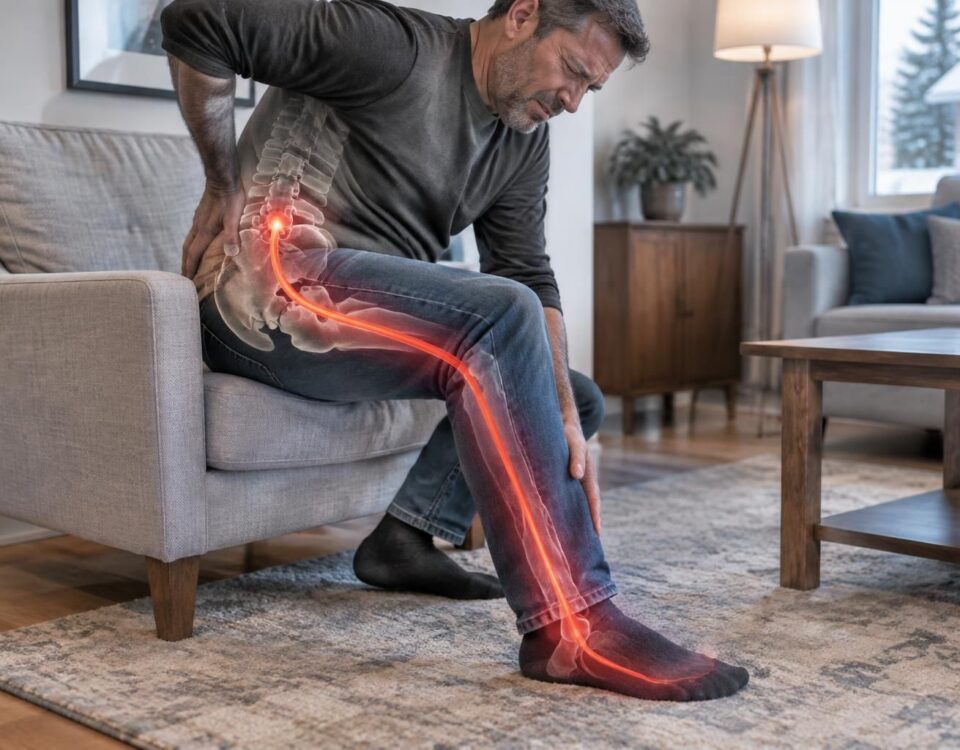
Pain related to nerve irritation can extend down the leg through various areas. L4 can affect the front of the thigh or the inner side of the leg; L5, the side of the leg, the top of the foot, or the big toe; S1, the back of the calf, the heel, or the outer edge of the foot.
These paths overlap and vary from person to person. Therefore, the disc level visible on imaging is not sufficient to identify the affected root: the evaluation also considers strength, sensitivity, reflexes, and gait.
A new or progressive weakness, a foot that drops, numbness in the saddle area, or urinary or bowel changes require prompt or urgent medical evaluation.
In Terrebonne, pain that radiates into the buttock and leg may correspond to irritation of a lumbar nerve root. Its path can provide clues about the L4, L5, or S1 roots, but the symptoms overlap and do not allow for a diagnosis by themselves. The evaluation compares pain, sensitivity, strength, reflexes, and gait, then determines whether imaging or a medical referral could alter the course of action.
The term sciatica often describes pain that starts from the lower back or buttock and radiates down the leg. Nerve irritation can also cause tingling, numbness, or weakness. Radicular pain can exist without measurable loss of strength. The term radiculopathy refers to damage to a nerve root that can alter strength, sensitivity, or reflexes.
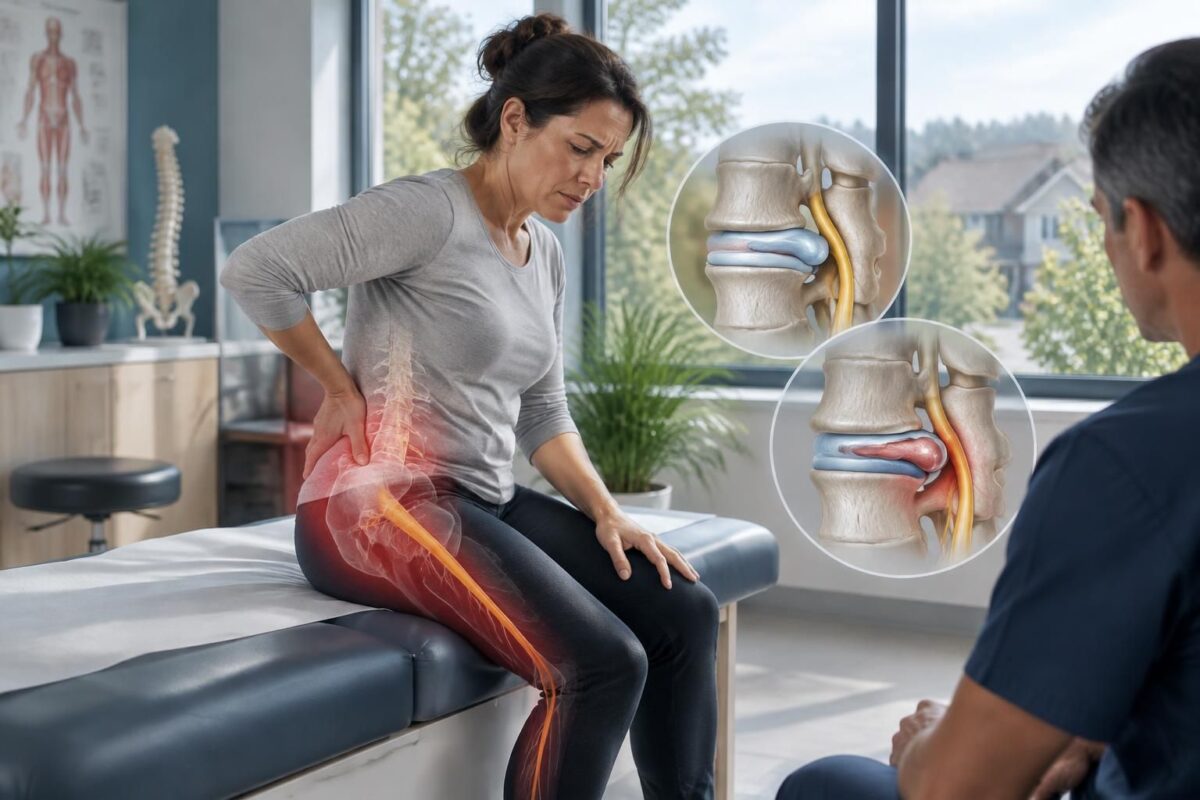
The levels L4-L5 and L5-S1 refer to spaces between the vertebrae. The roots L4, L5, and S1 are nerves that contribute to sensations and movements of the leg and foot. Therefore, a disc level does not automatically correspond to a single affected root. To better understand this distinction, consult the guide on sciatica L4-L5 and L5-S1 in Terrebonne and the one on lumbar radiculopathy L4, L5, and S1.
Sciatica in Terrebonne: disc protrusion or disc herniation?
IN BRIEF A disc bulge is a swelling of the disc, while a herniated disc involves a more pronounced protrusion of its contents; both can irritate a nerve root and cause sciatica. Symptoms alone do not always allow for distinction…

Sciatica disc in Terrebonne: why the pain travels down the leg
IN SHORT The disc-related sciatica occurs when a lumbar disc irritates a nerve root, which can cause pain to radiate down the buttock and leg. In Terrebonne, an assessment helps to better understand the cause of the symptoms and consider…
What Paths Might Indicate L4, L5, or S1?
The paths below are guides, not exact maps. Sensory territories overlap, and the path varies from person to person. The practitioner therefore compares multiple signs instead of relying solely on the painful area.
Root L4: Front of the Thigh and Inner Side of the Leg
Irritation of L4 may be accompanied by pain in the front of the thigh, near the knee, or on the inner side of the leg. The examination may check knee strength and the patellar reflex. However, pain in the knee alone is not sufficient to confirm an L4 involvement: the hip, knee, and other structures may also be implicated.
Root L5: Top of the Foot and Big Toe
An involvement of L5 may produce symptoms on the side of the leg, the top of the foot, or near the big toe. The examination particularly compares the ability to lift the foot and the big toe. A new difficulty in lifting the front of the foot, sometimes referred to as foot drop, requires prompt medical evaluation. To learn more about this root, check the guide dedicated to irritation of root L5 in Terrebonne.
Root S1: Back of the Calf and Outer Edge of the Foot
An involvement of S1 may result in pain in the back of the thigh or calf, at the heel, or on the outer edge of the foot. The practitioner may check strength during plantar flexion of the foot and compare the Achilles reflex. A burning type pain in the back of the thigh can have various causes; it must be interpreted along with other symptoms and examination results. Also consult our page on burning pain in the back of the thigh in Terrebonne.

L4-L5 disc herniation and sciatica in Terrebonne: pain towards the foot
IN BRIEF A L4-L5 disc herniation can irritate a nerve root and cause sciatica, with pain that radiates from the buttock down to the leg or foot. In Terrebonne, an evaluation helps better understand the origin of the symptoms and…

Lumbar disc herniation L5-S1 and sciatica in Terrebonne: common symptoms
IN BRIEF A L5-S1 disc herniation can irritate a nerve root and cause sciatica: lower back pain radiating to the buttock or leg, tingling, numbness, or weakness. In Terrebonne, an assessment helps to better understand the symptoms and guide management…
Why the Disc Level Is Not Sufficient to Locate the Root
A herniation located between L4 and L5 often affects the L5 root when it extends backwards and to the side. If the problem is in the foramen, the root that exits at that level, often L4, may be involved. An L5-S1 herniation often affects S1, but its position and anatomical variations can alter this relationship.
The MRI report describes structures. It does not prove by itself that these cause the symptoms. The practitioner compares the image with the painful side, the symptom path, and the examination results. For a general presentation of sciatica, check the MSD Manual on sciatica. You can also read this resource on lumbar disc herniation L4-L5.
Sciatica and herniated disc in Terrebonne: understanding the link
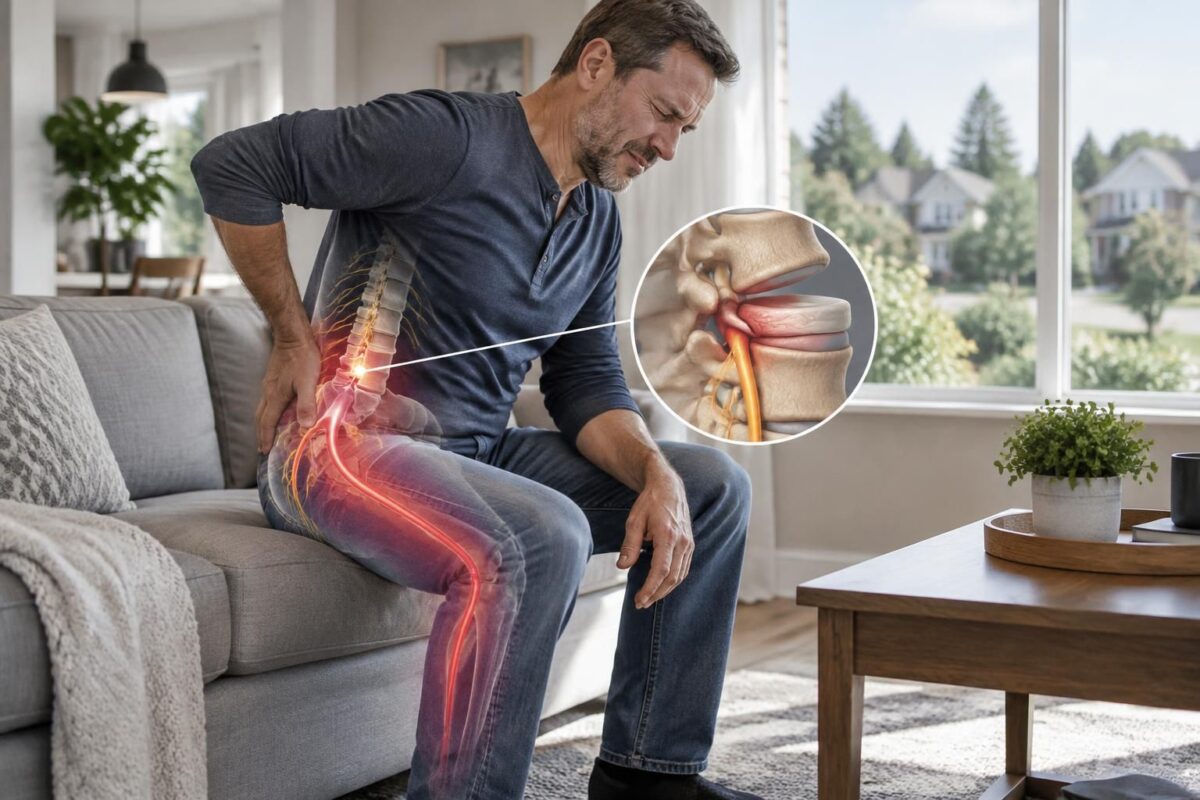
IN BRIEF Sciatica refers to pain that follows the path of the nerve in the buttock and leg; a herniated disc can irritate it, but an anomaly on the MRI is not sufficient to establish the cause. In Terrebonne, the…

Sciatica in Terrebonne: lumbar roots and the choice of a cautious treatment
IN BRIEF Sciatica is pain related to the irritation or compression of a lumbar nerve root, which can radiate from the lower back to the buttock and leg. In Terrebonne, an evaluation allows for cautious treatment tailored to the cause…
How Does the Evaluation in Terrebonne Proceed?
The evaluation begins with the timeline of symptoms, their path, and the actions or positions that modify them. The practitioner may ask whether the pain increases when sitting, walking, or during certain movements. Pain in the foot that changes when the person sits does not automatically localize a root, but this information contributes to the overall picture. Also consult the pages on pain in a sitting position with tingling in the foot, foot pain that increases when sitting, and pain that prevents sitting.
The examination may compare the strength of both legs, sensitivity, reflexes, and gait. It may include observing gait on heels and toes, as well as the ability to lift the big toe. The practitioner also considers other possible causes, such as an issue with the hip or a peripheral nerve.
An MRI is not always necessary before starting care. It may be considered if a warning sign appears, if a neurological deficit progresses, if symptoms persist, or if its result could change decisions. Educational information on lumbosciatica is also available in this resource on lumbosciatica and lumbar disc herniation.
Choosing Appropriate and Measurable Care
Care depends on the likely cause, neurological status, risks, and goals of the individual. When neurological function remains stable, non-surgical options may be discussed. Manual therapy, technologies, medications, injections, and surgery serve different indications. No treatment is suitable for all situations.
At TAGMED Clinic, services may include, depending on the assessment, motorized neurovertebral decompression, specific osteopathy, or a precision impactor. These approaches do not replace a medical diagnosis. The plan should include re-evaluation and be modified if strength, sensitivity, or walking deteriorates.
Before starting care, it is helpful to clarify the working diagnosis, the signs supporting it, and the expected outcome. Measures may include foot strength, walking distance, time spent sitting, sleep, and the ability to resume important activities. A temporary decrease in pain does not, by itself, confirm the cause or a recovery of nerve function.
Questions to Ask Before Starting
What elements of the examination support the working diagnosis?
What function will be monitored: strength, walking, sensitivity, sleep, or daily activity?
When will the plan be re-evaluated?
What changes would warrant stopping, modifying, or escalating care?
What other causes or options should be considered?
When to Seek Medical Evaluation Quickly
A new or progressive weakness, a drop foot, or a worsening gait requires prompt medical evaluation. New urinary or bowel issues, loss of sensation in the saddle area, significant or rapidly progressive weakness, fever, or major trauma justify urgent evaluation. One should not continue a scheduled program while waiting for these signs to resolve.
Frequently Asked Questions About L4, L5, and S1 Roots
What is the difference between L4-L5 and L5-S1?
These are two distinct disc levels. Depending on the position of a herniation or stenosis, one or more nerve roots may be affected.
Which root can cause symptoms in the big toe?
The L5 root is often associated with symptoms on the top of the foot and near the big toe. The pathway alone is not enough to establish a diagnosis.
Which root can influence the Achilles reflex?
The Achilles reflex is often associated with S1. The professional interprets it with strength, sensitivity, and other signs.
Does sciatica always mean there is a disc herniation?
No. A disc herniation is a possible cause, but stenosis, foraminal irritation, or another condition can produce similar symptoms.
Is an MRI always necessary?
No. Imaging is primarily useful when its result can change the course of action, particularly in the presence of warning signs, a progressing deficit, or persistent symptoms.
Can symptoms improve without surgery?
Yes, some situations improve without surgery. The decision depends on the progression, likely cause, and neurological status. Significant or progressive weakness requires medical evaluation.
What to bring to an appointment?
Bring a timeline of symptoms, a list of care and medications already tried, available imaging reports, and your priority questions.
Local Resources and Additional Information
To continue your reading, check the guides from SOS Sciatique on symptoms, warning signs, and management options. To know the services available in Terrebonne or Montreal, consult the TAGMED Clinic. This clinical resource is presented separately from educational information so that you can distinguish between the two.
About the Author
Sylvain Desforges, B.Sc., D.O., N.D., Doctor of Osteopathy, is the founding president of TAGMED and the ACMA association. He dedicates his practice to chronic pain of the spine, low back pain, and pain associated with sciatica, particularly when pain radiates to the buttock, leg, calf, foot, or toes.
Through SOS Sciatique, he publishes educational content on sciatica symptoms, possible causes such as disc herniation, disc pinching, foraminal stenosis, or irritation of a lumbar nerve root, as well as non-surgical approaches that can be considered based on the assessment. At TAGMED Clinic, care may include, depending on the case, motorized neurovertebral decompression, specific osteopathy, or a precision impactor.
For an evaluation related to sciatica treatment in Montreal / Mont-Royal or sciatica treatment in Terrebonne, consult the services available at the TAGMED Clinic.
Medical Disclaimer
The information published on SOS Sciatique is provided for educational purposes and does not replace a consultation, diagnosis, opinion, or treatment performed by a physician or another licensed health professional. The author of this article is neither a physician nor a specialist in a medical specialty recognized by the Collège des médecins du Québec. The osteopathy, manual medicine, or functional support approaches described on this site do not constitute medical acts and are not intended to replace medical follow-up.
The information and advice provided on this site do not replace the opinion, diagnosis, or treatment of a health professional. Please note that Sylvain Desforges, B.Sc., D.O., N.D., Doctor of Osteopathy, is neither a doctor of medicine nor a physician and is not specialized in a medical specialty as defined by the Collège des médecins du Québec. Manual medicine, functional medicine, and sports medicine as described on this site exclude any treatment or medical diagnosis done by a doctor or medical specialist. Always consult your physician for any medical questions. In case of loss of bowel or bladder control, anesthesia in the saddle area, significant or progressive weakness, fever, recent trauma, severe pain, or rapid deterioration, consult a physician or an emergency service. For more details, please read our complete legal notice.
Sciatica in Terrebonne: indicators based on the L4, L5, and S1 roots
- L4 — Possible pain in the front of the thigh or the knee; knee weakness and patellar reflex to check.
- L5 — Symptoms sometimes on the top of the foot or towards the big toe; raising the foot may be difficult.
- S1 — Possible pain behind the calf, at the heel, or on the outer edge of the foot; standing on tiptoes may be difficult.
- To remember — The pathways overlap. Strength, sensitivity, reflexes, and gait should be assessed together.
Consult quickly in case of new or progressive weakness, foot drop, saddle numbness, or urinary or bowel disturbances.

In Terrebonne, pain that radiates down the leg may suggest nerve irritation, but its pathway alone is not enough to determine which root is involved. The indicators associated with L4, L5, and S1 help guide the evaluation; however, they overlap. An assessment of strength, sensitivity, reflexes, and gait allows for selecting an appropriate approach and tracking progress without solely relying on pain or MRI results.
Recognizing possible pathways
Sciatica can cause pain, tingling, or numbness in the buttock and leg. The territory felt varies from person to person: nerve maps are indicators, not absolute rules. Moreover, an MRI image showing a disc at a given level does not confirm by itself that the neighboring root explains the symptoms.
Indicators associated with L4
An injury to L4 may be accompanied by pain towards the front of the thigh, the knee, or the inner side of the leg. The evaluation particularly checks the strength of the knee and the patellar reflex. Other causes, such as a hip problem, may produce neighboring signs.
Indicators associated with L5
Symptoms compatible with L5 may radiate down the side of the leg to the top of the foot or to the big toe. The ability to raise the foot or the big toe is a useful indicator. A new difficulty in raising the front of the foot, sometimes called foot drop, requires prompt medical evaluation.
Indicators associated with S1
A pathway associated with S1 may affect the back of the calf, the heel, or the outer edge of the foot. The push of the foot downward, as when walking on tiptoes, and the Achilles reflex can be examined. None of these signs alone localizes the cause with certainty.
Choosing an appropriate approach in Terrebonne
The consultation should compare the two sides and take into account strength, sensitivity, reflexes, gait, and back movements. The professional may also check whether the hip or a peripheral nerve contributes to the symptoms. An L4-L5 herniation often affects the L5 root, while an L5-S1 herniation often affects S1, but the precise location and anatomical variations may change this pattern.
When symptoms are stable and there is no significant deficit, non-surgical options can be considered based on evaluation, tolerance, and goals: adjusted activity, graded exercises, education, and, in some cases, manual therapy or other interventions. Imaging is not always necessary right away; it is primarily relevant if its result can change the course of action, especially in the presence of warning signs or persistent symptoms.
Tracking progress and knowing when to reevaluate
Before starting, define concrete indicators: walking distance, time spent sitting, sleep, foot strength, and important activities. Plan a reevaluation date. If the pain decreases but gait or strength does not improve, the plan deserves reconsideration. Conversely, a more painful day does not necessarily indicate deterioration; the overall trend and neurological state should be considered.
Consult quickly in case of new or progressive weakness, extending numbness, or deteriorating gait. New urinary or bowel disorders, loss of sensation in the saddle area, or significant weakness require urgent evaluation. Do not delay this evaluation to complete a pre-scheduled care program.
About the author
Sylvain Desforges, B.Sc., D.O., N.D., Doctor of Osteopathy, is the founding president of TAGMED and the ACMA association. His practice particularly focuses on chronic spinal pain, lower back pain, and symptoms compatible with sciatica. He publishes educational content on possible causes and non-surgical approaches that can be considered based on evaluation.
Medical disclaimer
This information is educational and does not replace a consultation, diagnosis, or treatment by a licensed healthcare professional. The author is not a doctor nor a specialist in a medical specialty recognized by the Collège des médecins du Québec. Osteopathy and manual therapy approaches do not replace medical follow-up.
| Root | Pain Pathway and Possible Indicators |
|---|---|
| L4 | Front of the thigh, knee, or inner side of the leg; sometimes knee weakness. |
| L5 | Side of the leg, top of the foot, or big toe; sometimes difficulty raising the foot. |
| S1 | Back of the calf, heel, or outer edge of the foot; sometimes weakness on the toes. |
| To remember | The pathways overlap: assessment of strength, sensitivity, and reflexes helps to distinguish them. |
Sciatica in Terrebonne: Illustrative Testimonials Based on L4, L5, and S1 Roots
Note: The narratives below are fictional examples, written for educational purposes. They do not come from identifiable patients and do not allow for diagnosis. Symptoms may vary from person to person, and nerve territories overlap.
A Pathway Compatible with L4
“The pain started in the lower back and went down to the front of the thigh and the knee. I also had an unusual sensation on the inner side of the leg.”
This type of pathway can guide the evaluation towards several possibilities, including irritation of the L4 root. A professional can compare sensitivity, knee strength, and patellar reflex while checking other possible causes. The location of the pain alone is not enough to confirm the concerned root.
A Pain That Goes Down to the Top of the Foot: L5 Pathway
“In Terrebonne, I noticed that the pain ran along the side of the leg and reached the top of the foot, sometimes all the way to the big toe. Raising the front of my foot felt less easy on some days.”
An impairment of the L5 root may be considered when symptoms affect the top of the foot or the big toe. The examination can compare ankle and big toe strength, sensitivity, and walking on heels. A new or increasing difficulty in raising the foot warrants a rapid medical evaluation.
A Pain Behind the Leg: S1 Pathway
“The pain followed the back of the calf and reached the heel or the outer edge of the foot. Walking on my toes had become more difficult than before.”
This picture may lead to checking the S1 root, among other things, by evaluating plantar flexion, the Achilles reflex, foot sensitivity, and the ability to walk on toes. These clues must be interpreted together: no pathway is perfectly identical for everyone.
Why MRI Is Not Sufficient to Locate the Root
“My imaging report mentioned L4-L5, and I thought that automatically indicated the responsible root. The examination helped me understand that my symptoms and strength also needed to be taken into account.”
L4-L5 and L5-S1 denote disc levels, while L4, L5, and S1 refer to nerve roots. A herniation located at L4-L5 often affects the L5 root, while a foraminal impairment at the same level may concern L4. Therefore, the exact location of the anomaly and the examination results are as important as the name of the level displayed in the image.
A Follow-Up Focused on Function
“We noted what limited my walking, my sleep, and my activities, then compared these elements to the re-evaluation. This allowed us not to judge progress solely based on pain intensity.”
A follow-up can document the pathway of symptoms, strength, sensitivity, reflexes, walking, and activities important to the person. The plan depends on the working diagnosis, evolution, and individual preferences. If symptoms extend, strength changes, or walking worsens, the plan should be reassessed rather than repeated automatically.
Consult a healthcare professional quickly in case of new or progressive weakness, foot drop, or spreading numbness. Loss of urinary or bowel control, numbness in the saddle area, or significant weakness require urgent medical evaluation.
Sciatica in Terrebonne: Understanding the Pain Pathway of L4, L5, and S1 Roots
A pain that starts from the lower back and descends into the buttock or leg may be compatible with sciatica, but its pathway alone does not determine which nerve root is involved. In Terrebonne and elsewhere, the evaluation considers the history of symptoms, strength, sensitivity, reflexes, and walking patterns. This information helps establish a working diagnosis and decide if imaging or a medical opinion might alter the management.
The levels L4-L5 and L5-S1 describe spaces between vertebrae, while L4, L5, and S1 refer to nerve roots. Therefore, one should not automatically associate the level indicated on an MRI with the root responsible for the symptoms. A herniation located between L4 and L5 often affects the L5 root when it is paracentral. If it rather narrows the nerve exit passage, it may concern L4. The direction and position of the anomaly matter.
Irritation of the L4 root may be associated with pain or numbness at the front of the thigh, around the knee, or on the inner part of the leg. The examiner may compare quadriceps strength, particularly when straightening the knee, and check the patellar reflex. These signs are indicators: their presence or absence does not always confirm or exclude an impairment of L4.
The L5 root may be associated with sensations on the side of the leg, on the top of the foot, or near the big toe. The ability to raise the foot and the big toe, as well as to walk on heels, can be assessed. A new difficulty in raising the front of the foot, sometimes called foot drop, deserves prompt attention, as it may indicate loss of strength. Other causes, including the impairment of a peripheral nerve, can nonetheless produce similar signs.
An impairment of S1 can cause pain at the back of the calf, the heel, or the outer edge of the foot. The examination can compare plantar flexion, for instance, the ability to rise on toes, as well as the Achilles reflex. The sensory pathways of L5 and S1 overlap: the big toe, the outer edge of the foot, or the location of the numbness provide clues but do not constitute an infallible diagnostic map.
To clarify the situation, the evaluation can compare both sides of the body, observe gait, test ankle and knee movements, and examine the response to lumbar movements. The hip, peripheral nerves, and other structures may also be considered, as they can sometimes mimic radicular pain. An MRI is not systematic: it is mainly relevant when its result could influence decisions, particularly in the presence of neurological deficits, persistent symptoms, or warning signs.
When neurological function is stable, non-surgical measures can be considered based on the likely cause, objectives, and the person’s tolerance. The plan may include education, a gradual return to activities, exercises, or appropriate care after evaluation. It should specify what will be monitored and when it will be reviewed. Gait, sleep, strength, sensitivity, and the ability to work or perform an important activity provide more comprehensive benchmarks than pain intensity alone.
A temporary improvement does not necessarily confirm the suspected cause, and isolated painful fluctuations do not always indicate worsening. Conversely, new or progressive weakness, a foot drop, numbness that spreads, or deteriorating gait should lead to rapid reassessment. New urinary or bowel issues, loss of sensation in the saddle area, or significant weakness require urgent medical evaluation. One should not wait until the end of a care program if these signs appear.
Before starting management, it is helpful to ask what the working diagnosis is, what exam results support it, which function will be measured, and when the plan will be revised. Bringing the timeline of symptoms, treatments already tried, a list of medications, and imaging reports can facilitate communication. A credible plan also outlines the criteria that would justify an alternative approach or medical advice.
About the author
Sylvain Desforges, B.Sc., D.O., N.D., Doctor of Osteopathy, is the founding president of TAGMED and the ACMA association. His practice focuses on chronic spinal pain, low back pain, and symptoms consistent with sciatica. Depending on the evaluation, the proposed care may include specific osteopathy, motorized neurovertebral decompression, or precision impactor.
Medical disclaimer
This content is provided for educational purposes and does not replace a consultation, diagnosis, or treatment from a licensed healthcare professional. The author is neither a physician nor a specialist in a medical specialty recognized by the Collège des médecins du Québec. Osteopathy and manual medicine approaches do not constitute medical acts and do not replace medical follow-up.
In Terrebonne, pain that radiates down the leg may follow a path consistent with irritation of the nerve roots L4, L5, or S1, but its location alone does not identify the affected root. The examination compares the symptom path to strength, sensitivity, reflexes, and gait; the level observed in the MRI must also be interpreted according to anatomy and clinical signs.
Guidelines for interpreting roots L4, L5, and S1
Affecting L4 may be accompanied by symptoms towards the front of the thigh, the knee, or the inner side of the leg, sometimes with decreased strength of the quadriceps or the patellar reflex. Irritation of L5 may pertain to the side of the leg, the top of the foot, or the big toe and may sometimes make it more difficult to lift the front of the foot. S1 may be associated with pain towards the back of the calf, the heel, or the outer edge of the foot, as well as difficulty pushing off the toes or a change in the Achilles reflex. These paths are guidelines, not exact maps: sensory territories overlap and vary from person to person. To visualize the sciatic nerve pathway or consult other explanations about the sciatic nerve pathway and its role, these resources can complement general information.
It is important to distinguish disc levels from nerve roots. A herniation located between L4 and L5 often affects the L5 root when it is paracentral, while foraminal narrowing at the same level may concern the L4 root, which exits at that point. Similarly, a lesion between L5 and S1 can often irritate S1, although this correlation is not automatic. The position of the anomaly, the affected side, and the findings of the examination are therefore just as important as the name of the disc described in an imaging report. Additional information on nerve roots and sciatica can help clarify this distinction.
Calf pain is not necessarily accompanied by significant low back pain, and pain felt as a cramp is not enough to localize a root. Likewise, an incomplete or intermittent pathway does not exclude nerve irritation. To better understand these presentations, consult the resources on root S1, calf pain without significant low back pain, calf pain resembling a cramp, sciatica with an incomplete pathway, and intermittent or constant pain. However, these descriptions do not replace an evaluation, as other causes may produce comparable symptoms.
The clinical evaluation relates the history of symptoms to functional measures: comparison of strength on both sides, sensitivity, reflexes, heel-to-toe walking, ability to raise the big toe, and evolution of numbness. The hip, peripheral nerves, and other structures may also need to be examined. An MRI is not always necessary initially; it is mainly relevant when its result could change the management, particularly in the presence of neurological deficits, warning signs, or persistent symptoms for which intervention is considered.
When neurological function is stable, options may include education, a suitable and graduated activity, exercises, or other care chosen according to the assessment, preferences, and tolerance of the individual. The plan should specify what will be measured — for example, walking, strength, sleep, or work capacity — as well as the timing for reevaluation. If symptoms worsen, strength decreases, or expected functional progress is not evident, the plan should be reviewed rather than automatically repeated. In Terrebonne, as elsewhere, it is the clinical picture, neurological safety, and functional goals that guide decisions, not just geographical location or an isolated image.
A new or progressive weakness, a drop foot, increasing difficulty walking, an expanding loss of sensation, numbness in the saddle area, or a recent change in urinary or bowel control requires prompt or urgent medical evaluation. In the presence of significant or quickly worsening symptoms, do not delay this evaluation to continue with a planned care program.
About the author
Sylvain Desforges, B.Sc., D.O., N.D., Doctor of Osteopathy, is the founding president of TAGMED and the ACMA association. His practice is focused on chronic spinal pain, lower back pain, and pain associated with sciatica, particularly when the pain radiates to the buttock, leg, calf, foot, or toes. Through SOS Sciatique, he publishes educational content on symptoms, possible causes, and non-surgical approaches that may be considered based on the assessment. At Clinique TAGMED, care may include, as appropriate, motorized neurovertebral decompression, specific osteopathy, or precision percussion.
Medical disclaimer
The information published on SOS Sciatique is provided for educational purposes and does not replace a consultation, diagnosis, advice, or treatment performed by a physician or other licensed healthcare professional. The author of this article is neither a physician nor a specialist in a medical specialty recognized by the Collège des médecins du Québec. The osteopathic approaches, manual medicine, or functional support described on this site do not constitute medical acts and are not intended to replace medical follow-up. Consult a physician or emergency service in the presence of warning signs. For more details, please read our Legal Notice.

Sciatica in Terrebonne: how to interpret pain according to the leg path
IN BRIEF Sciatica is a pain that can start from the lower back or the buttock and travel down the leg to the foot. Its path, along with any tingling or weakness, helps guide the assessment but is not sufficient…

Sciatica in Terrebonne: L5-S1, canal, foramen and nerve compression
IN BRIEF The sciatica L5-S1 corresponds to irritation or compression of a nerve root, sometimes related to a disc herniation or narrowing of the lumbar canal or the foramen. The pain may radiate from the lower back to the buttock,…

Sylvain Desforges, B.Sc., D.O., N.D., docteur en ostéopathie
Dr Sylvain Desforges, B.Sc., D.O., N.D., osteopath, is the founding president of TAGMED and of the ACMA association. He dedicates his practice to chronic spinal pain, low back pain and symptoms compatible with sciatica, particularly when pain radiates toward the buttock, leg, calf, foot or toes.
Through SOS Sciatique, he publishes educational content on sciatica symptoms, possible causes such as disc herniation, disc narrowing, foraminal stenosis or irritation of a lumbar nerve root, as well as non-surgical approaches that may be considered according to the evaluation. At Clinique TAGMED, care may include, depending on the case, motorized neurovertebral decompression, specific osteopathic care or precision percussion.
For an evaluation related to sciatica treatment in Montreal / Mount Royal or sciatica treatment in Terrebonne, please consult the services available at Clinique TAGMED.
Medical disclaimer
The information published on SOS Sciatique is provided for educational purposes only and does not replace a consultation, diagnosis, opinion or treatment provided by a physician or another authorized healthcare professional. The author of this article is neither a medical doctor nor a specialist in a medical specialty recognized by the Collège des médecins du Québec. The osteopathic, manual medicine or functional support approaches described on this site do not constitute medical acts and are not intended to replace medical follow-up.
Consult a physician or emergency service in cases of loss of bladder or bowel control, anesthesia in the saddle area, significant or progressive weakness in the leg or foot, fever, recent trauma, severe pain or rapid worsening of symptoms. For more details, please read our Legal Notice.