Sciatica in Montreal: radiation in the leg after physical effort
30/09/2026
Sciatica and pain after shoveling
30/09/2026
IN BRIEF
| The sciatica in Terrebonne refers to pain that can start in the lower back and radiate down the leg, sometimes after physical effort. A descending pain does not always indicate an injury to the sciatic nerve: an evaluation helps better understand the symptoms and adjust daily movements. |
Sciatica in Terrebonne: leg pain after effort
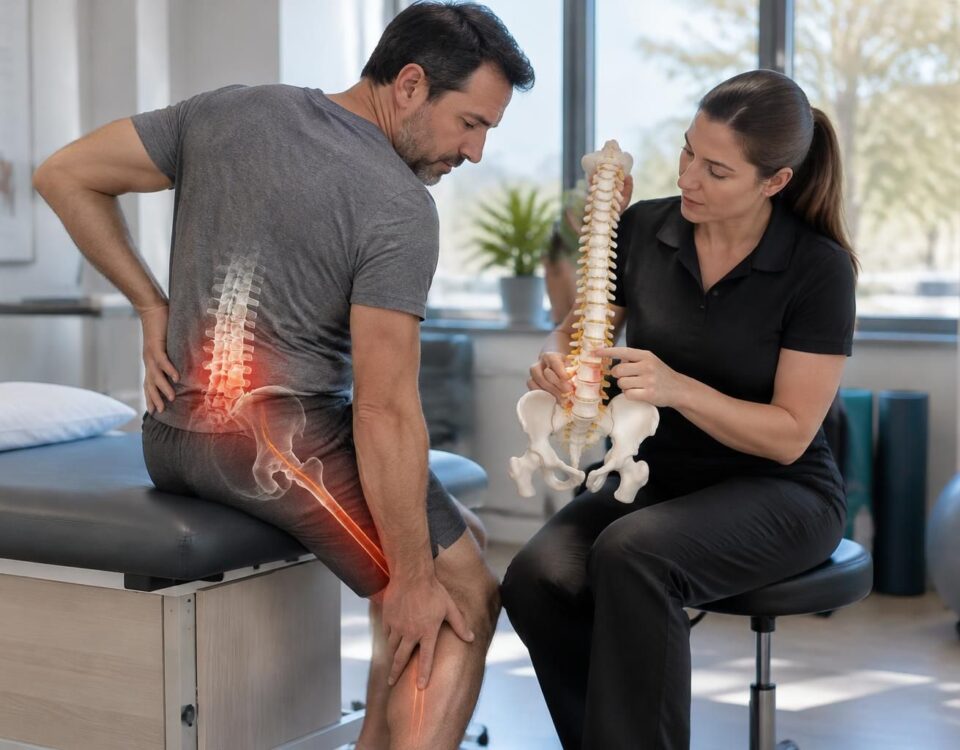
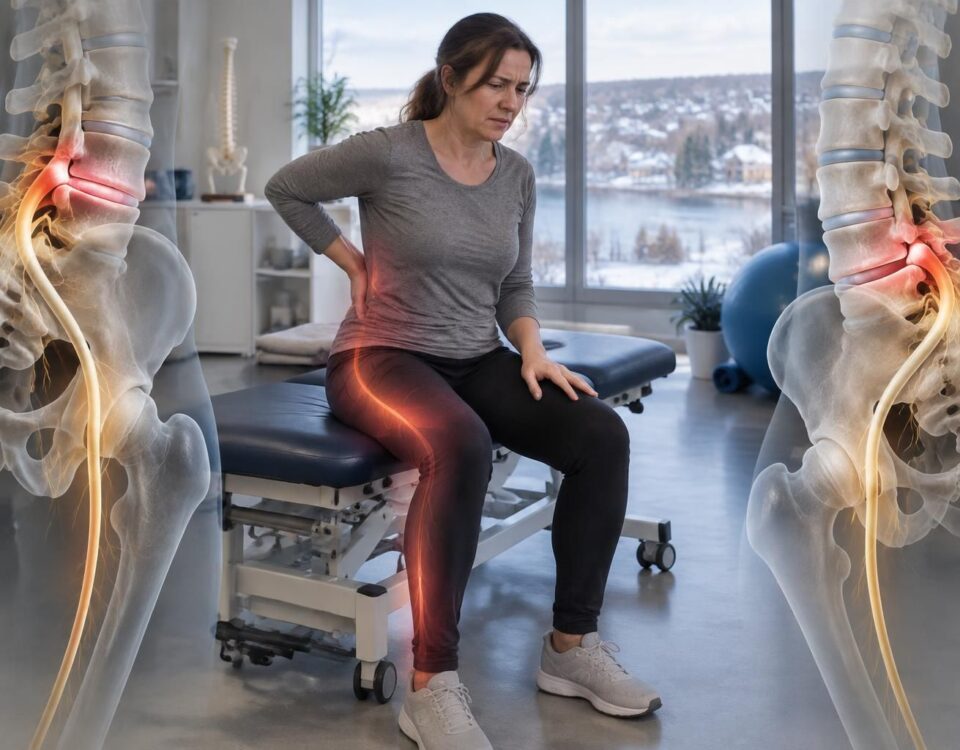
After physical effort, pain that starts in the lower back or buttock and radiates down the leg may suggest sciatica. However, not all radiating pain is necessarily caused by irritation of the sciatic nerve. An evaluation allows for a better understanding of the symptoms and consideration of suitable treatment approaches, particularly non-surgical methods depending on the case. Consult a healthcare professional promptly if you notice significant or progressive weakness, or loss of bladder or bowel control.
After physical effort, pain may start in the lower back or buttock and radiate down the leg. This radiation does not always mean that it is sciatica or that a nerve is compressed. In Terrebonne, an evaluation helps to better understand the signs, identify situations that require medical advice, and examine suitable support options.
An effort such as lifting a load, staying in one position for a long time, or resuming an activity can precede the onset of lower back pain or leg pain. The effort can reveal or aggravate symptoms, but it does not suffice to determine their cause. Pain radiating down the leg can originate from nerve irritation, but also from muscles or other tissues in the back and hip.
The term “sciatica” is often used to describe any pain that radiates into a leg. In the strict sense, it refers to pain associated with irritation of a lumbar nerve root or the sciatic nerve. The pain may then follow a path into the buttock and leg, sometimes down to the foot. Tingling, numbness, or a sensation of electric shock may also occur.
A sciatalgia describes pain that resembles sciatica, without solely confirming nerve injury. Other radiating pains may move through the leg without following a precise nerve pathway. Distinguishing these descriptions helps better communicate symptoms, but does not replace a medical diagnosis.
Why might pain appear after exertion?
A herniated disc, changes related to arthritis, or narrowing around a nerve root may contribute to radiating pain. Pain may also be associated with muscular or joint structures, without direct compression of the sciatic nerve. Only a healthcare professional can evaluate the symptoms and determine if further examinations are necessary.
Effort can also temporarily modify the way of moving. Pain may increase when walking, bending, or changing position, then vary throughout the day. A radiation that changes course does not alone allow for a conclusion about a precise injury. To better understand this fluctuation, refer to this article on sciatic pain that changes course over the days in Terrebonne.

Sciatica L5-S1 in Terrebonne: why the pain can radiate down to the foot
IN BRIEF L5-S1 sciatica refers to pain related to irritation of a lumbar nerve root, which may start from the lower back and radiate into the buttock, leg, and down to the foot. The pathway varies: the top of the…
Signs to observe after exertion
Note where the pain starts, how far it radiates down, and what seems to modify it. Specify whether it affects one leg or both, if it occurs after walking, and whether you also experience tingling, loss of sensitivity, or weakness. This information can help the consulted professional better understand your situation.
Pain may only radiate down into the buttock or thigh, without reaching the foot. An incomplete pathway neither confirms nor excludes sciatica. You can read information about sciatic pain in Terrebonne with an incomplete pathway, as well as pain that starts in the lower back and radiates to the leg.
An electric sensation, numbness after walking, or pain with a varying pathway deserves attention tailored to the context. These signs do not allow for a remote diagnosis. For more information, check the pages on pain and numbness after walking and sensation of electric shock in the leg.
When to seek medical help quickly?
Consult a doctor or an emergency service quickly if you observe a loss of bladder or bowel control, numbness in the saddle region, or significant or progressive weakness in the leg or foot. A fever, recent trauma, severe pain, or rapid deterioration also justify a medical evaluation.

Sciatica in Terrebonne: painful journey according to roots L4, L5, and S1
IN BRIEF Sciatica in Terrebonne can cause pain, tingling, or weakness in the leg. The roots L4, L5, and S1 can guide the evaluation based on symptoms and changes in strength, sensitivity, or reflexes; their territories do overlap, however. Comparing…
Evaluation and support options in Terrebonne
A healthcare professional can examine your symptoms, mobility, and strength, then refer you to a doctor if the situation requires it. Based on the signs and their evolution, a doctor may decide if imaging or other examinations are indicated. An evaluation in osteopathy does not replace this medical examination and does not allow, on its own, to confirm a herniated disc or nerve compression.
At the TAGMED Clinic, the evaluation aims to understand limitations and discuss possible support options based on each situation. Care may include specific osteopathy, motorized neurovertebral decompression, or precision percussion, when the professional deems these approaches appropriate. These services do not guarantee results and do not replace medical follow-up.
To learn about the services offered, consult the page of the TAGMED Clinic in Terrebonne or the information on sciatica treatment in Terrebonne. Additional information on possible signs is available in these articles dedicated to recognizing signs of sciatica and when to consult, as well as the difference between sciatica, sciatalgia, and radiating pain.
Resuming activities without rushing
The reaction to effort varies from person to person and depends on the cause of the symptoms. Avoid drawing conclusions based on a single sensation or movement. If an activity significantly increases pain, consult a healthcare professional before modifying your routine or resuming strenuous activities. The priority is to clarify the symptoms and choose an approach appropriate to your situation.
For general information on the links between leg pain, mobility, and daily activities, you can check this resource: sciatica, leg pain, and mobility.
About the author
Dr. Sylvain Desforges, B.Sc., D.O., N.D., osteopath, is the founding president of TAGMED and the ACMA association. He dedicates his practice to chronic pain of the spine, lower back pain, and pain associated with sciatica, particularly when the pain radiates down to the buttock, leg, calf, foot, or toes.
Through SOS Sciatique, he publishes educational content on the symptoms of sciatica, possible causes such as disc herniation, disc compression, foraminal stenosis, or irritation of a lumbar nerve root, as well as on non-surgical approaches that may be considered based on evaluation. At TAGMED Clinic, care may include, depending on the case, motorized neurovertebral decompression, specific osteopathy, or precision adjustment.
For an assessment related to the sciatica treatment in Montreal / Mont-Royal or the sciatica treatment in Terrebonne, consult the services available at TAGMED Clinic.
Medical disclaimer
The information published on SOS Sciatique is provided for educational purposes and does not replace a consultation, diagnosis, advice, or treatment performed by a doctor or another licensed healthcare professional. The author of this article is neither a doctor nor a specialist in a medical specialty recognized by the Collège des médecins du Québec. The approaches in osteopathy, manual medicine, or functional support described on this site do not constitute medical acts and are not intended to replace medical follow-up.
Consult a doctor or emergency service in case of loss of bowel or bladder control, anesthesia in the saddle area, significant or progressive weakness of the leg or foot, fever, recent trauma, severe pain, or rapid worsening. For more details, please read our Legal Notice.
Medical disclaimer: The information and advice provided on this site do not replace the opinion, diagnosis, or treatment of a healthcare professional. Please note that Dr. Sylvain Desforges, osteopath, is neither a medical doctor nor a physician and is not a specialist in a medical field as defined by the Collège des médecins du Québec. Manual medicine, functional medicine, and sports medicine as described on this site exclude any treatment or medical diagnosis conducted by a doctor or specialist. Always consult your physician for any medical questions. For more details, please read our complete Legal Notice.

Sciatica in Terrebonne: what does irritation of the S1 root mean?
IN BRIEF An irritation of the S1 root can cause pain of a sciatica type in the buttock, the back of the leg, and the outer edge of the foot. Tingling, numbness, or difficulty walking on tiptoes may also occur.…
Sciatica in Terrebonne: leg pain after exertion
What radiation may indicate
- A pain that radiates from the buttock down to the leg may be consistent with sciatica.
- Radiating pain after exertion does not always indicate nerve damage.
- Tingling, numbness, or weakness deserves evaluation.
Good reflexes
- Temporarily adapt movements that worsen the pain and gradually resume movement.
- An evaluation can help clarify possible causes and management options in Terrebonne.
- Consult promptly in case of significant or progressive weakness, or loss of bowel or bladder control.

After physical exertion, a pain that starts from the lower back or buttock and radiates down the leg may indicate sciatica, but not all radiation is necessarily due to nerve damage. In Terrebonne, it is useful to observe the evolution of symptoms, temporarily adjust activities, and seek evaluation if the pain persists, intensifies, or is accompanied by unusual signs.

Sciatica in Terrebonne: what does irritation of the L5 root mean?
IN BRIEF L5 sciatica corresponds to irritation of the L5 nerve root, often felt from the lower back and buttock down the side of the leg, to above the foot and the big toe. It can cause pain, tingling, or…
After exertion: spotting symptoms without jumping to conclusions
Pain may arise after lifting a load, returning to sports, or performing an unusual movement. Irritation of a lumbar nerve root, sometimes associated with a disc herniation or narrowing of the spinal spaces, can cause pain that radiates into the buttock and leg. Tingling, an electric sensation, or numbness may also be present.
However, radiating pain can also come from muscles or joints and may not follow the exact path of the sciatic nerve. Therefore, the term “sciatica” alone is not sufficient to establish the cause. A healthcare professional can take into account the location of the pain, its evolution, the strength and sensitivity of the leg, as well as the effect of movements.

Sciatica in Terrebonne: difference between L4-L5 and L5-S1
IN BRIEF The difference between L4-L5 and L5-S1 concerns the level of the lumbar discs and the sometimes irritated nerve roots: an L4-L5 injury often affects L5, while an L5-S1 injury often affects S1. The sensory pathways overlap; thus, an…
What to do in the first few days?
Adapt activity rather than remain still
If pain allows, maintain gentle movements and light activities, breaking tasks into smaller parts. Temporarily avoid movements that significantly worsen symptoms, particularly heavy lifting, repeated twisting, or sudden efforts. Prolonged complete rest can promote stiffness and loss of physical condition: gradually resume, without trying to “tough it out” through increasing pain.
Choose simple and cautious measures
A comfortable position, a short walk, or the application of cold or heat can provide relief for some people. Choose what suits you and stop if it worsens the pain or sensations in the leg. Before taking any medication, consult a doctor or pharmacist, especially if you have other health issues or are already taking medications.

Sciatica S1 in Terrebonne: pain towards the calf and the outer edge of the foot
IN BRIEF S1 sciatica is pain related to irritation of a lumbar nerve root, which may radiate down to the buttock, back of the calf, and the outer edge of the foot. Tingling or weakness may also occur. In Terrebonne,…
When to Seek an Evaluation in Terrebonne?
Consult a professional if the pain does not improve, occurs frequently, limits walking or sleeping, or if numbness or weakness appears. An evaluation will help determine the next steps and check if medical follow-up or examinations are indicated. Depending on the situation, a non-surgical approach focused on mobility and function may be considered. At the TAGMED Clinic, an evaluation in Terrebonne can guide the proposed care according to needs and clinical findings; no technique is suitable for everyone.
Recognizing Emergency Signs
A loss of control of the bladder or bowels, anesthesia in the saddle area, or significant or rapidly progressive weakness of the leg or foot requires immediate medical attention. Also seek medical advice quickly in case of fever, recent trauma, severe pain, or rapid worsening.

Sciatica L5 in Terrebonne: pain towards the big toe
IN SHORT L5 sciatica can cause pain or numbness that radiates to the big toe, sometimes with difficulty lifting the foot. This pathway is a clue, not a diagnosis: the examination compares strength, sensitivity, and gait, as the nerve territories…
Gradually Resuming Activity
As symptoms decrease, gradually increase the duration and intensity of activities. To lift an object, bring it close to your body, bend at the hips and knees, and avoid twisting while carrying the load. If a movement strongly reproduces the pain in your leg, reduce the effort and seek advice rather than multiplying stretches or exercises without evaluation.
Medical Warning: this content is educational and does not replace a consultation, diagnosis, or treatment by a licensed healthcare professional. Osteopathy and manual approaches do not replace medical follow-up.
About the Author: Dr. Sylvain Desforges, B.Sc., D.O., N.D., is an osteopath and the founding president of TAGMED and the ACMA association. His practice notably focuses on chronic spinal pain and lower back pain.
| After Physical Effort | Useful Reference |
|---|---|
| Pain in the buttock and leg | A radiation can have multiple causes; it does not confirm sciatica on its own. |
| Tingling or numbness | Note their location and progression, then report them to a healthcare professional. |
| Pain increased by certain movements | Temporarily reduce movements that intensify it, without seeking prolonged rest. |
| Fluctuating symptoms | Adapt activity to your tolerance and gradually resume it. |
| Persistent or recurring pain | An evaluation can help guide management. |
| Significant or progressive weakness | Consult a healthcare professional quickly. |
| Loss of bladder or bowel control | Go immediately to an emergency department. |

Sciatica L5-S1 in Terrebonne: pain radiating to the heel or foot
IN BRIEF A L5-S1 sciatica often corresponds to irritation of the S1 root, which can cause pain that radiates from the buttock down to the calf, heel, or outer edge of the foot. Identifying the pathway of symptoms and changes…
Illustrative Testimonials: Pain radiating in the leg after effort in Terrebonne
Transparency Note: the following stories are fictional examples, composed from frequently described situations. They do not correspond to verified patient testimonials and do not predict the outcomes of a consultation or treatment.
“The pain started after moving boxes”
After a day of organizing, I felt pain in my lower back that radiated into my buttock and the back of my thigh. The next day, some movements were more uncomfortable. I initially thought it was definitely sciatica, but then I realized that a radiating pain alone does not establish the cause. I decided to seek advice before resuming my usual efforts.
“A hike awakened a pain down to the calf”
The discomfort started after a walk that was longer than usual. It originated from the lumbar area and extended down into the leg. It varied depending on my posture and the intensity of the activity. Since radiating pains can have different origins, I noted their path and the movements that changed them to discuss with a healthcare professional.
“I overexerted gardening, then my leg became sensitive”
After working several hours in the garden, pain appeared in my buttock and spread to my thigh. I feared I had a pinched nerve. I was reminded that it is essential to distinguish sciatica from other radiating pains, and that an examination is necessary to understand what is happening. While waiting for appropriate advice, I avoided repeating the movements that clearly worsened my symptoms.
A pain that radiates down the leg after exertion can be related to different mechanisms. The path of the pain, its duration, associated sensations, and its progression help the consulted professional guide the evaluation; they do not, alone, allow for a diagnosis. If the symptoms persist, intensify, or limit your activities, seek advice from a doctor or a licensed healthcare professional.
Seek medical attention quickly in case of loss of bladder or bowel control, numbness in the saddle area, significant or progressive weakness of the leg or foot, fever, recent trauma, or rapid worsening.
About the Author
Dr. Sylvain Desforges, B.Sc., D.O., N.D., Osteopath, is the founding president of TAGMED and the ACMA association. His practice is dedicated to chronic spinal pain, lower back pain, and pain compatible with sciatica. The care proposed at the TAGMED Clinic may include, depending on the evaluation, motorized neurovertebral decompression, specific osteopathy, or precision impact therapy.
Medical Disclaimer
This information is provided for educational purposes and does not replace a consultation, diagnosis, or treatment by a physician or another licensed healthcare professional. The author is neither a doctor nor a specialist in a medical specialty recognized by the Collège des médecins du Québec. Osteopathy, manual medicine, or functional support approaches do not constitute medical acts and do not replace medical follow-up.
Sciatica in Terrebonne: radiation in the leg after physical effort
After lifting a load, gardening, running, or resuming physical activity, pain may appear in the lower back and radiate to the buttock, thigh, or calf. This radiation often causes concern and is sometimes referred to as “sciatica.” However, pain that spreads down the leg does not automatically mean that the sciatic nerve is compressed. The intensity or path of the symptoms alone is not sufficient to establish a diagnosis.
Sciatica generally corresponds to pain associated with irritation of a lumbar nerve root or the sciatic nerve. It often manifests on one side, from the lower back or buttock down the leg, sometimes all the way to the foot. Symptoms like tingling, electric sensations, numbness, or weakness may also be present. A herniated disc, foraminal narrowing, or other changes in the spine can contribute to the symptoms, but their presence and significance must be assessed by a healthcare professional.
After exertion, however, the radiation may have other explanations. Sensitive muscle or joint structures, unusual overload, or stiffness can cause pain projected into the buttock or thigh without direct nerve involvement. The term sciatalgia is sometimes used to describe pain resembling sciatica, without confirming nerve compression. The evolution of the symptoms, the movements that alter them, and associated signs help determine whether a medical evaluation is warranted.
In Terrebonne, an appropriate approach begins with listening to the pain history: what effort triggered it, where it radiates, if it increases with coughing or moving, and if sensitivity or strength has changed. A qualified professional can also assess mobility and function. Depending on the clinical picture, medical consultation or additional examinations may be necessary. Imaging is not routine, and its usefulness depends particularly on the examination and duration of symptoms.
When the situation allows, support aims to gradually regain more comfortable movements and improve tolerance for daily activities. It may include advice on temporary effort management, maintaining appropriate activity, and graduated exercises, without trying to force marked pain. Depending on the assessment, non-surgical approaches may be considered, including specific osteopathy or motorized neurovertebral decompression. The choice of care must take into account symptoms, history, and the individual’s progression.
Dr. Sylvain Desforges, B.Sc., D.O., N.D., osteopath, is the founding president of TAGMED and the ACMA association. His practice focuses notably on chronic spinal pain, low back pain, and symptoms compatible with sciatica. His approach is concerned with functional assessment and non-surgical options that may be considered based on each situation. At TAGMED Clinic, the proposed care may include, when appropriate, motorized neurovertebral decompression, specific osteopathy, or precision percussion.
Quickly consult a doctor or emergency service in case of loss of urinary or bowel control, numbness in the saddle area, significant or progressive weakness in the leg or foot, fever, recent trauma, or rapid worsening. This information is educational and does not replace a consultation, diagnosis, or medical follow-up.
After physical exertion, pain originating from the lower back or buttock and radiating into the leg may suggest sciatica, but not all radiation necessarily indicates that a nerve is compressed. In Terrebonne, it is useful to consider the type of pain, its path, the circumstances that aggravate it, and the possible presence of tingling, numbness, or weakness to determine whether a professional assessment is warranted.
Sciatica in Terrebonne: Radiation in the Leg After Physical Exertion
An unusual effort, a twisting movement, lifting a load, or prolonged activity can trigger or exacerbate low back pain. When it radiates to the buttock and back of the leg, it may be compatible with irritation of a lumbar nerve root. A herniated disc or narrowing of spaces around the nerves are among the possible causes, but an examination is necessary to clarify the situation. To better understand the symptoms and possible causes, consult this guide on sciatica, its symptoms, and relief.
The pain may manifest as a burning sensation, electric shock, shooting, or pulling feeling. It may be more pronounced after exertion, in prolonged sitting, or during certain movements. Pain in the buttock after sitting for a long time, for example, deserves interpretation based on all symptoms: see also the information on buttock pain after prolonged sitting. Exertion may also make the symptoms more noticeable, without enabling identification of their origin; this article discusses sciatica pain associated with exertion.
The path of the radiation and accompanying signs can provide clues, but they do not replace an evaluation. A burning sensation in the foot, a shooting towards the outer edge of the foot, or a numbness that progresses towards the foot are elements to describe to the consulting professional. A new difficulty walking on the heels or the toes is also important to report; you can read more about the difficulty walking on the heels or the toes.
While awaiting evaluation, it is generally preferable to adapt activities rather than force through increasing pain. Gentle, frequent movements may be better tolerated than prolonged rest, but exercises and stretches should be adjusted according to the body’s responses. If you are wondering whether to stop running, this article addresses the issue of running with sciatica. General comfort tips are also presented in this content on sciatica pain in the leg. However, these resources do not allow for diagnoses or replace clinical advice.
A healthcare professional will be able to examine strength, sensitivity, reflexes, and movements, then determine if additional examinations are relevant. Possible causes and evaluation methods are described in the MSD Manual file on sciatica. Quickly consult a doctor or emergency service in case of significant or progressive weakness, loss of bladder or bowel control, numbness in the saddle area, fever, recent trauma, or rapid worsening of symptoms.

Dr Sylvain Desforges, B.Sc., D.O., N.D., osteopath, is the founding president of TAGMED and of the ACMA association. He dedicates his practice to chronic spinal pain, low back pain and symptoms compatible with sciatica, particularly when pain radiates toward the buttock, leg, calf, foot or toes.
Through SOS Sciatique, he publishes educational content on sciatica symptoms, possible causes such as disc herniation, disc narrowing, foraminal stenosis or irritation of a lumbar nerve root, as well as non-surgical approaches that may be considered according to the evaluation. At Clinique TAGMED, care may include, depending on the case, motorized neurovertebral decompression, specific osteopathic care or precision percussion.
For an evaluation related to sciatica treatment in Montreal / Mount Royal or sciatica treatment in Terrebonne, please consult the services available at Clinique TAGMED.
Medical disclaimer
The information published on SOS Sciatique is provided for educational purposes only and does not replace a consultation, diagnosis, opinion or treatment provided by a physician or another authorized healthcare professional. The author of this article is neither a medical doctor nor a specialist in a medical specialty recognized by the Collège des médecins du Québec. The osteopathic, manual medicine or functional support approaches described on this site do not constitute medical acts and are not intended to replace medical follow-up.
Consult a physician or emergency service in cases of loss of bladder or bowel control, anesthesia in the saddle area, significant or progressive weakness in the leg or foot, fever, recent trauma, severe pain or rapid worsening of symptoms. For more details, please read our Legal Notice.