


Sciatica in Montreal: what does irritation of the S1 root mean?
11/10/2026
Sciatica and pain during sleep
11/10/2026
IN BRIEF
| An irritation of the S1 root can cause pain of a sciatica type in the buttock, the back of the leg, and the outer edge of the foot. Tingling, numbness, or difficulty walking on tiptoes may also occur. In Terrebonne, a comparative evaluation of strength, sensitivity, and walking helps guide management; symptoms alone are not sufficient to confirm the affected root. A new or progressive weakness or urinary or intestinal issues require prompt medical evaluation. |
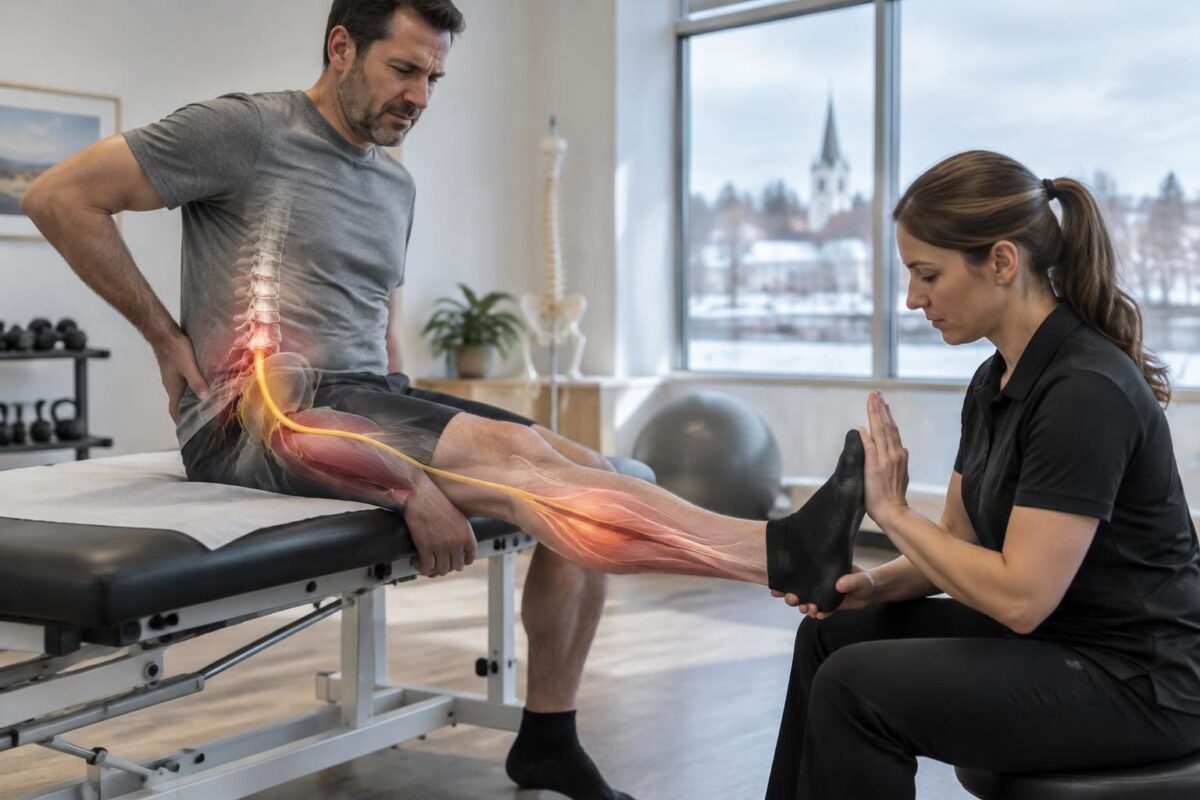
In Terrebonne, irritation of the S1 nerve root can cause pain that starts in the lower back or buttock and travels down the back of the thigh to the calf, heel, or outer edge of the foot. Tingling, numbness, or difficulty standing on tiptoes may also appear.
These signs alone are not enough to confirm S1 involvement: nerve territories overlap and the examination must compare strength, sensitivity, reflexes, and walking. A problem at the L5-S1 disc level can sometimes irritate this root, but imaging alone does not always determine the cause of the symptoms.
A new or progressive weakness, a dropped foot, a loss of sensation in the saddle region, or urinary or intestinal issues require a prompt or urgent medical evaluation.
An irritation of the S1 root can cause pain that starts in the lower back or buttock and travels down the leg to the heel or outer edge of the foot. It may also cause tingling, decreased sensitivity, or weakness. These signs guide the evaluation but are not sufficient to confirm the cause or the affected root.
The Role of the S1 Root
The S1 root is a nerve that exits the lower part of the spine. It contributes to the sensitivity of certain areas of the leg and foot, as well as movements like pushing the foot down. It also participates in the Achilles reflex, checked during a neurological examination.
A nerve root can be irritated or compressed by various causes. A disc herniation at the L5-S1 level can particularly contribute to S1 irritation, but symptoms alone do not determine the source.
What Symptoms May Correspond to S1?
Pain associated with S1 often follows the back of the thigh and calf. It can reach the heel or the outer edge of the foot. Some people experience burning, electric shocks, tingling, or numbness instead. Walking on tiptoes may also become difficult if the strength of certain muscles decreases.
Each nerve pathway varies from person to person. The sensory territories of S1 and adjacent roots overlap. Therefore, pain in the heel or outer edge of the foot does not alone confirm S1 involvement. To learn more about these signs, consult the pages on pain in the heel and the possible S1 root and pain on the outer edge of the foot associated with S1.
Difficulty Walking on Tiptoes
Weakness when pushing the foot can make walking on tiptoes more difficult. A comparison between both sides helps identify a difference. However, pain, balance, and other issues can also influence this movement. A new or progressive weakness justifies a prompt medical evaluation. You can read more about difficulty walking on tiptoes and possible S1 involvement.
How to Distinguish an S1 Involvement from an L5 Involvement?
The L5 root may be associated with symptoms on the top of the foot and difficulty lifting the big toe or foot. S1 may instead affect sensitivity in the heel or outer edge of the foot, as well as the ability to push the foot down. These markers remain indicative: nerve territories overlap and the examination must compare several signs.
It is also essential to distinguish the disc level from the nerve root. A visible abnormality between L5 and S1 does not automatically prove that the S1 root is involved. The side, the symptom pathway, and the neurological examination must correspond. To better understand the signs associated with L5, consult the resources on pain on the top of the foot and the L5 root and the possible meaning of irritation of L5.

Lumbar disc herniation L5-S1 and sciatica in Terrebonne: common symptoms
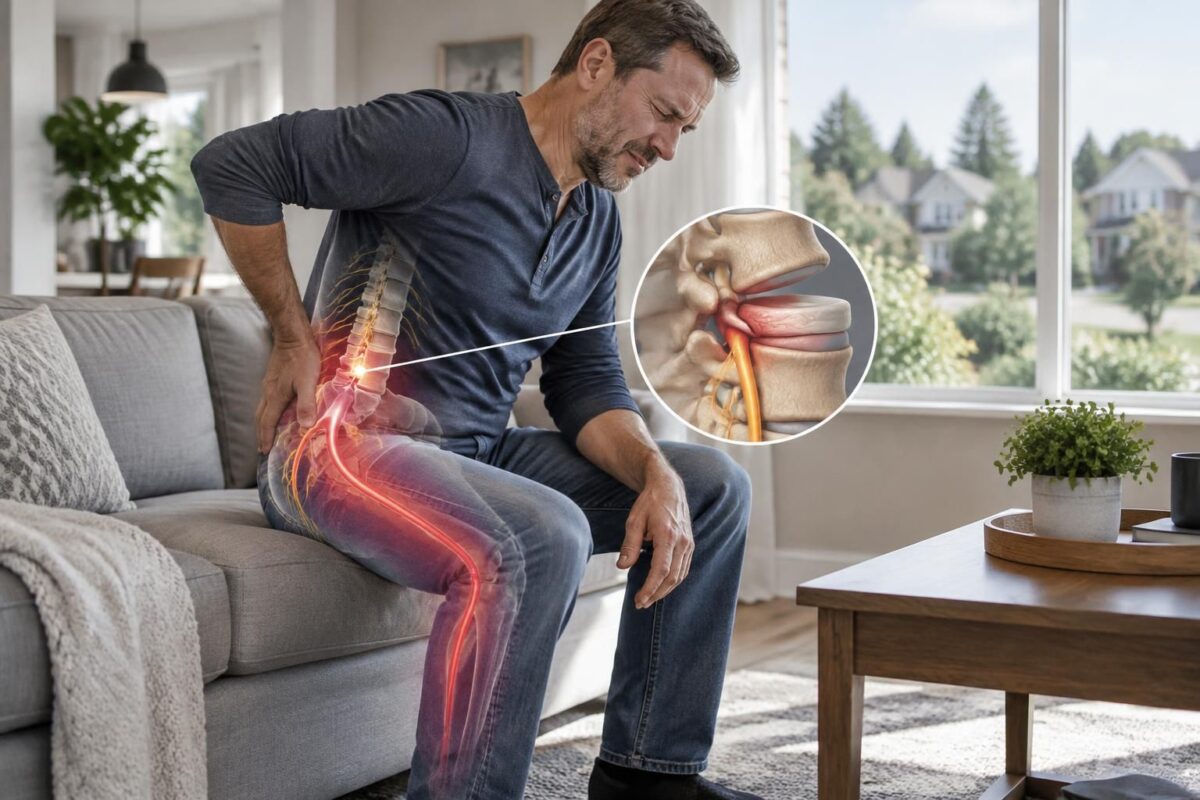
IN BRIEF A L5-S1 disc herniation can irritate a nerve root and cause sciatica: lower back pain radiating to the buttock or leg, tingling, numbness, or weakness. In Terrebonne, an assessment helps to better understand the symptoms and guide management…
Sciatica and herniated disc in Terrebonne: understanding the link
IN BRIEF Sciatica refers to pain that follows the path of the nerve in the buttock and leg; a herniated disc can irritate it, but an anomaly on the MRI is not sufficient to establish the cause. In Terrebonne, the…

Sciatica in Terrebonne: lumbar roots and the choice of a cautious treatment
IN BRIEF Sciatica is pain related to the irritation or compression of a lumbar nerve root, which can radiate from the lower back to the buttock and leg. In Terrebonne, an evaluation allows for cautious treatment tailored to the cause…
How to Evaluate an S1 Root Irritation in Terrebonne?
The evaluation starts with the history of symptoms, their pathway, and the activities that aggravate or relieve them. The professional then examines walking, strength, sensitivity, and certain reflexes. They can compare the ability to walk on heels and toes, as well as the strength of both legs.
Imaging, such as an MRI, is not always necessary right away. It may be considered if its result is likely to change management, for example, in the presence of a neurological deficit or persistent symptoms. An image must always be interpreted with the symptoms and examination: it is not sufficient to establish a diagnosis.
The evaluation also seeks other possible causes, such as a hip problem, a peripheral nerve involvement, or another source of pain. A comparative approach helps avoid automatically attributing every leg pain to sciatica.

Sciatica in Terrebonne: how to interpret pain according to the leg path
IN BRIEF Sciatica is a pain that can start from the lower back or the buttock and travel down the leg to the foot. Its path, along with any tingling or weakness, helps guide the assessment but is not sufficient…

Sciatica in Terrebonne: L5-S1, canal, foramen and nerve compression
IN BRIEF The sciatica L5-S1 corresponds to irritation or compression of a nerve root, sometimes related to a disc herniation or narrowing of the lumbar canal or the foramen. The pain may radiate from the lower back to the buttock,…
Sciatica in Terrebonne: why an MRI must be correlated with symptoms
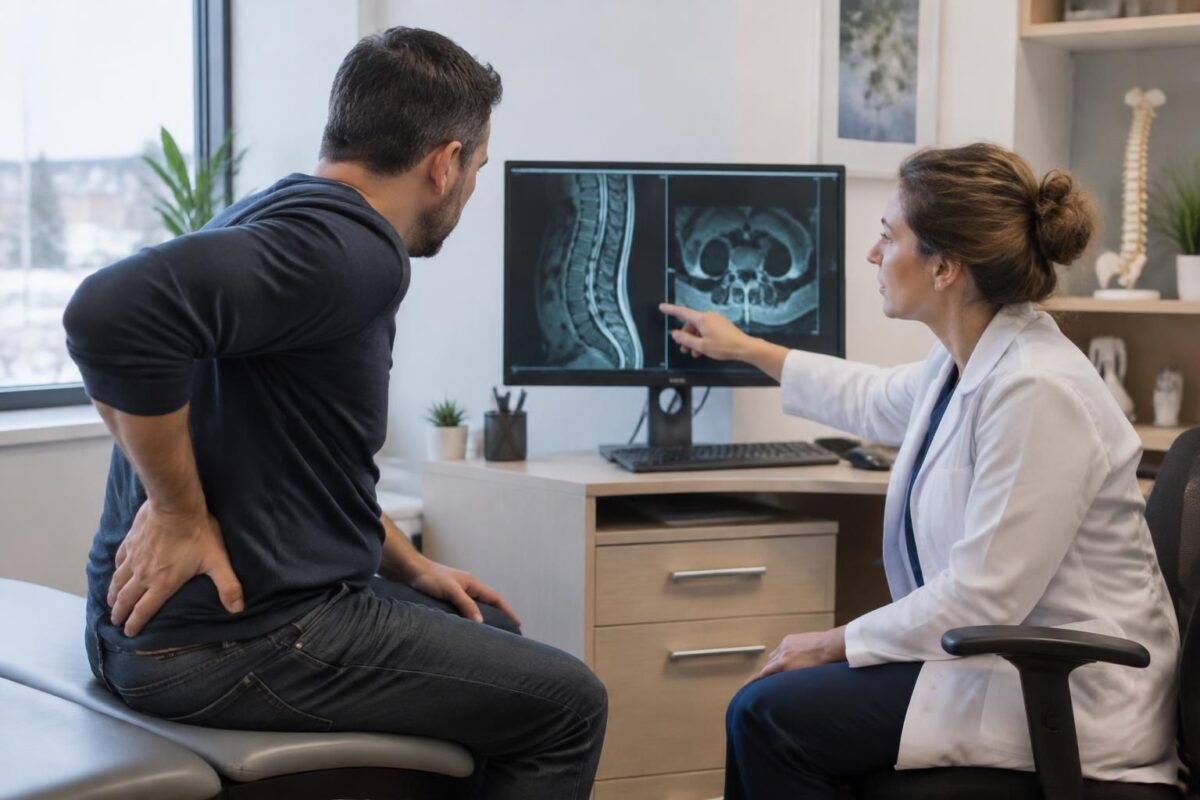
IN BRIEF Sciatica is a pain that often radiates from the lower back to the buttock and leg. A lumbar MRI shows the structures of the spine, but its results must correspond to the symptoms and clinical examination: a visible…
What Management Options Can Be Considered?
The choice depends on the probable cause, strength, sensitivity, the evolution of symptoms, and their effect on walking, sleep, or work. When the neurological state is stable, the professional can discuss a conservative approach and plan follow-up with measurable objectives.
At the TAGMED Clinic, options may include an assessment and, depending on the situation, specific osteopathy care, a precision punch, or a motorized neurovertebral decompression. These approaches are not suitable for everyone and do not guarantee a result. The choice of care must take into account the examination, risks, the person’s preferences, and relevant medical recommendations. The difference between nerve compression and chemical irritation may also be part of the discussions during the assessment.
A follow-up plan should specify what will be measured: foot strength, walking, numbness area, sleep, or significant activity. If function does not improve, if symptoms spread, or if weakness appears, the professional should reassess the situation rather than automatically repeat the same approach.
To know the available services, check the page on sciatica treatment in Terrebonne or contact the TAGMED Clinic.
When should you consult quickly?
A new weakness, a progressing weakness, a dropped foot, or worsening walking requires prompt medical evaluation. Consult immediately in the event of loss of bladder or bowel control, numbness in the saddle area, significant weakness, fever, recent trauma, or rapid deterioration.
A decrease in pain does not always mean that strength or nerve function has returned. Report any changes in sensitivity, strength, or walking, even if discomfort varies.
About the author
Sylvain Desforges, B.Sc., D.O., N.D., Doctor of Osteopathy, is the founding president of TAGMED and the ACMA association. His practice focuses on chronic pain of the spine, lower back pain, and pain related to sciatica, especially when it radiates to the hip, leg, calf, foot, or toes.
Through SOS Sciatique, he publishes educational content on the symptoms of sciatica, its possible causes, and non-surgical approaches that can be considered based on the assessment. Care provided at the TAGMED Clinic may include, as needed, motorized neurovertebral decompression, specific osteopathy, or precision punching.
For an assessment, refer to the services for sciatica treatment in Montreal and Mont-Royal or sciatica treatment in Terrebonne at the TAGMED Clinic.
Medical Disclaimer
Medical Disclaimer: The information and advice provided on this site do not replace the opinion, diagnosis, or treatment of a health professional. Please note that Sylvain Desforges, B.Sc., D.O., N.D., Doctor of Osteopathy, is neither a doctor of medicine nor a physician, and is not a specialist in a medical specialty as defined by the Quebec College of Physicians. Manual medicine, functional medicine, and sports medicine as described on this site exclude any treatment or medical diagnosis made by a physician or specialist. Always consult your doctor for any medical questions. For more details, please read our complete Legal Notice.
What irritation of S1 may indicate
- Pain in the buttock, behind the thigh, and the calf.
- Tingling or numbness sometimes in the heel or the outer edge of the foot.
- Possible weakness in going on tiptoes.
- A disc herniation L5-S1 may involve S1, without confirming it alone.
Assessment and next steps in Terrebonne
- Compare on both sides the strength, sensitivity, reflexes, and walking.
- Choose care based on the examination, symptoms, and their evolution; plan for a measurable reassessment.
- Consult quickly if weakness appears or progresses.
- Emergency in cases of urinary or intestinal disturbances, saddle numbness, or significant weakness.
Educational information: it does not replace evaluation by a health professional.

Irritation of the S1 nerve root can cause pain that starts from the lower back or buttock and radiates behind the thigh down to the calf, heel, or outer edge of the foot. Tingling, numbness, or weakness may also occur. However, these signs are not sufficient to confirm that S1 is involved: in Terrebonne and elsewhere, the assessment must compare your symptoms, strength, sensitivity, and walking.
Understanding the role of the S1 root
A nerve root, not a diagnosis on its own
The nerve roots located in the lower back contribute to forming the sciatic nerve. The S1 root is particularly involved in the sensitivity of certain areas of the foot and movements such as pushing off the forefoot. When irritated or compressed, pain may follow a pathway consistent with sciatica. However, it is not always identical from one person to another: the territories of S1 and L5 overlap.
An S1 impairment may be associated with a disc herniation, often at L5-S1, but this association is not automatic. An MRI showing an anomaly does not alone establish the cause of the symptoms. It is necessary to check if the side, the painful pathway, and the examination results match. Other problems related to the hip, muscles, or a peripheral nerve can sometimes produce similar symptoms.
What signs to observe?
Note if the pain descends behind the leg, if the heel or outer edge of the foot is numb, and if you have more difficulty walking on your toes. A professional can compare the strength of both legs, sensitivity, reflexes, and gait. These elements help build a working diagnosis, but no isolated sign allows for certain localization of a nerve root.
What steps to prioritize in Terrebonne?
Start with an evaluation and a revisable plan
If symptoms are stable, non-surgical management may be considered depending on the situation. It may include advice to temporarily adjust activities, graded movements, and exercises chosen based on your tolerance. Avoid prolonged bed rest, but do not force a stretch or an exercise that significantly increases pain or symptoms in the leg. Heat or cold can provide temporary relief: choose what helps you the most.
Before starting care, ask which outcomes will be monitored and when the plan will be reassessed. Walking, sleeping, foot strength, and the ability to work or drive are useful benchmarks, in addition to pain intensity. If the painful area changes, if numbness spreads, or if function does not improve, a new assessment may be necessary. An MRI is not systematic: it is particularly relevant when its results can change management.
Recognize signs that require quick attention
Consult a healthcare professional quickly if a new or progressive weakness, a dropped foot, or deteriorating gait occurs. New urinary or bowel problems, loss of sensation in the saddle area, or significant weakness require urgent medical evaluation. In these situations, do not delay consultation to continue an exercise program or wait for a care appointment.
| Clinical benchmark | What it may suggest |
|---|---|
| Pain in the buttock and back of the leg | Pathway sometimes compatible with irritation of S1. |
| Numbness in the heel or outer edge of the foot | Possible hint, but the territory varies and overlaps with that of other roots. |
| Difficulty walking on toes | May warrant checking the strength of the leg and foot. |
| Decreased Achilles reflex | An element to compare on both sides during the examination. |
| L5-S1 disc herniation on imaging | May concern S1, without confirming the cause of the symptoms alone. |
| Pain alone, without progressive weakness | A graded management approach may be considered with reassessment. |
| New weakness, dropped foot, or urinary problems | Consult a healthcare professional or emergency service quickly. |
Illustrative testimonies: in Terrebonne, what does irritation of the S1 root mean?
The testimonies below are fictional and serve only to illustrate possible situations. They do not come from real patients and do not allow for a diagnosis. Pain in the leg can have several causes: the evaluation must consider symptoms, strength, sensitivity, reflexes, and gait.
“The pain went down to the outer edge of the foot”
In this example, a person from Terrebonne describes pain starting from the buttock and descending behind the thigh to the calf and the outer edge of the foot. This pathway may be compatible with irritation of the S1 root, but it is not sufficient to confirm it. Other structures may produce similar symptoms.
“I noticed weakness when I stood on my toes”
A new difficulty pushing with the foot or walking on the tips of the toes may warrant an examination of strength, particularly of plantar flexion. The professional may also compare the reflexes and sensitivity on both sides. If weakness appears or worsens, it is important to seek medical evaluation quickly.
“My report mentioned L5-S1, but I didn’t know if that explained my symptoms”
A disc level like L5-S1 is not the same as a nerve root like S1. An abnormality observed on imaging does not prove, by itself, that it is the cause of pain. The affected side, the pathway of symptoms, and examination results must be interpreted together.
What can irritation of the S1 root mean? It can lead to pain in the buttock and back of the leg, sometimes down to the heel or the outer edge of the foot. Tingling, numbness, or decreased strength may also be present. However, nerve territories overlap, and symptoms vary from person to person.
In Terrebonne as elsewhere, a management plan should be tailored to the situation and revised based on evolution. When neurological signs are stable, conservative measures may be considered based on the evaluation: maintaining tolerated activity, graded exercises, mobility, or manual care. Progress can be monitored by concrete benchmarks, such as walking, foot strength, sleep, and resuming activities.
Consult quickly if you notice new or progressive weakness, a dropped foot, deteriorating gait, or spreading numbness. New urinary or bowel problems, loss of sensation in the saddle area, or significant weakness require urgent medical evaluation. These examples do not replace a consultation, diagnosis, or advice from a qualified healthcare professional.
Sciatica in Terrebonne: what does irritation of the S1 root mean?
An irritation of the S1 nerve root means that one of the roots that contribute to forming the sciatic nerve is sensitized or compressed near the lumbar spine. This root exits from the area located between the fifth lumbar vertebra and the first sacral vertebra, called the L5-S1 level. Irritation at this location can cause pain that descends from the lower back or buttock to the back of the thigh, the calf, and then the heel or the outer edge of the foot. However, the pathway varies from person to person.
The sciatic nerve exists on both sides of the body, but symptoms often affect only one leg. The pain may be described as burning, electric shock-like, or pulling. Tingling, numbness, or weakness may also occur. When S1 is involved, difficulty pushing on the forefoot or standing on tiptoes can be an indication. The Achilles reflex and sensitivity of the foot are also part of the assessed elements. However, none of these signs, taken in isolation, is sufficient to establish a diagnosis.
It is important not to automatically confuse the level of a visible anomaly on imaging with the affected nerve root. A change in the disc at L5-S1 may sometimes irritate S1, but anatomical variations and overlapping nerve territories make interpretation more complex. The clinical examination particularly compares strength, sensitivity, reflexes, gait, and response to movement. Imaging may be considered when its result is likely to change the management; it is not necessary in all situations.
In Terrebonne, as elsewhere, the choice of care depends on the evolution of symptoms, neurological function, and activities that have become difficult. When the situation is stable, a conservative approach may include advice to remain active without overexerting, graduated exercises, adapted movements, and, depending on the assessment, manual therapy. The objective is to encourage a gradual return to walking, work, sleep, or daily activities. A serious plan also includes follow-up measures and a reassessment date, rather than promising a fixed number of sessions in advance.
Avoid prolonged bed rest in general. Relative rest may be useful, temporarily reducing movements that significantly aggravate pain while maintaining light and tolerated movements. Heat or cold can provide temporary relief; choose what works best for you and stop if discomfort increases. Stretching and mobility exercises are not universal: a beneficial movement for one person may exacerbate symptoms in another. Have them adapted to your situation if the pain radiates further down the leg or if numbness appears.
Consult a healthcare professional quickly if weakness sets in or progresses, if the foot becomes difficult to lift, or if gait deteriorates. New urinary or bowel dysfunctions, loss of sensitivity in the saddle region, fever, or significant trauma require urgent medical evaluation. These signs should not wait for the end of a care program.
About the author
Sylvain Desforges, B.Sc., D.O., N.D., Doctor of Osteopathy, is the founding president of TAGMED and the ACMA association. His practice focuses particularly on chronic spinal pain, low back pain, and symptoms consistent with sciatica. At the TAGMED Clinic, options may include, depending on the assessment, specific osteopathy, motorized neurovertebral decompression, or precision impact therapy.
Medical Warning
This content is educational and does not replace a consultation, diagnosis, or treatment by a licensed healthcare professional. The author is neither a doctor nor a specialist in a medical specialty recognized by the Collège des médecins du Québec. The approaches of osteopathy and manual therapy described do not replace medical follow-up. Consult a doctor or an emergency service in the presence of warning signs.
In Terrebonne, speaking of an irritation of the S1 root means that a nerve originating from the lower part of the lumbar spine may be sensitized or compressed. This can cause pain radiating into the buttock and the back of the leg down to the heel or the outer edge of the foot. The path of the symptoms provides clues, but it is not sufficient on its own to establish a diagnosis or choose a treatment.
What does irritation of the S1 root mean?
The nerve root S1 contributes to sensitivity and muscle function of the leg and foot. When irritated, some people experience pain, tingling, numbness, or a shock-like sensation that travels down the back of the thigh and calf. Symptoms may reach the heel or the outer edge of the foot, but their distribution varies and overlaps with that of other nerves.
An issue near the L5-S1 disc may sometimes affect the S1 root, but the level visible on imaging alone does not confirm which root is involved. A disc herniation, foraminal irritation, or another condition can contribute to similar symptoms. To better understand the possible manifestations, consult our page on sciatic pain and this resource dedicated to sciatica.
Pain in the heel does not automatically indicate S1 involvement. It may also have a local origin or be related to another structure. The location must therefore be interpreted alongside the evolution of symptoms and the results of the examination; our guide on heel pain and possible causes presents these distinctions. You can also read information on L5-S1 sciatica in Terrebonne.
Why isn’t the examination limited to the pain pathway?
The sensory territories of the L5 and S1 roots overlap. A symptom in the foot may guide the evaluation, without definitively indicating a specific root. The professional may compare sensitivity on both sides, strength, reflexes, and gait. They may particularly observe the ability to walk on heels or toes, as well as the movement of the big toe. These signs must be considered together, not as isolated tests.
The distinction between the levels L4-L5 and L5-S1 is also important: these are disc levels, while L5 and S1 refer to nerve roots. An anomaly on imaging must be correlated with the affected side, the path of the symptoms, and the clinical examination. For further details, consult the resources on the difference between L4-L5 and L5-S1 and on the comparison of the L4, L5, and S1 roots in Terrebonne.
An evaluation can also check if another musculoskeletal or nerve cause better explains the symptoms. The principles of lumbosciatica and radiculalgia are presented in this resource from physiotherapy on lumbosciatica related to a lumbar disc herniation. For information on possible involvement of L5, also consult the guide on the irritation of the L5 root in Terrebonne.
What factors guide the choice of care in Terrebonne?
The choice of management depends on the suspected cause, the intensity of the symptoms, their evolution, and their impact on walking, sleeping, working, or daily activities. When neurological function is stable, non-surgical measures may be considered, with progression adapted to tolerance: maintaining modified activity, exercises selected according to symptoms, and monitoring mobility and strength. No exercise or treatment is automatically suitable for all individuals.
A useful plan specifies the changes one wishes to measure and the time it will be reassessed. This can include, for example, walking distance, the ability to stand on tiptoe, numbness, or the return to a significant activity. A temporary improvement in pain does not alone confirm the origin of symptoms; function and neurological status must also be monitored. To know the available services, please visit the TAGMED Clinic page dedicated to S1 sciatica.
New or progressive weakness, a foot that starts to drop, deteriorating walking ability, or spreading numbness warrant prompt medical evaluation. New urinary or bowel issues or a loss of sensation in the saddle region require urgent attention. Imaging or a specialist referral is discussed according to the present signs, their evolution, and the possibility that the results may change the course of action.

Sciatica in Terrebonne: reflexes, strength, and sensitivity in evaluation
IN BRIEF In Terrebonne, the assessment of sciatica checks the reflexes, strength, and sensitivity of the legs to identify possible nerve damage. These observations, combined with the pain’s pathway and its evolution, help to guide the next steps and recognize…
Sciatica in Terrebonne: muscle weakness according to the irritated nerve root
IN BRIEF Sciatica with muscle weakness can occur when a lumbar nerve root is irritated; affected movements, such as raising the foot or walking on tiptoes, provide clues but are not sufficient for a diagnosis. In Terrebonne, an evaluation can…

Sylvain Desforges, B.Sc., D.O., N.D., docteur en ostéopathie
Dr Sylvain Desforges, B.Sc., D.O., N.D., osteopath, is the founding president of TAGMED and of the ACMA association. He dedicates his practice to chronic spinal pain, low back pain and symptoms compatible with sciatica, particularly when pain radiates toward the buttock, leg, calf, foot or toes.
Through SOS Sciatique, he publishes educational content on sciatica symptoms, possible causes such as disc herniation, disc narrowing, foraminal stenosis or irritation of a lumbar nerve root, as well as non-surgical approaches that may be considered according to the evaluation. At Clinique TAGMED, care may include, depending on the case, motorized neurovertebral decompression, specific osteopathic care or precision percussion.
For an evaluation related to sciatica treatment in Montreal / Mount Royal or sciatica treatment in Terrebonne, please consult the services available at Clinique TAGMED.
Medical disclaimer
The information published on SOS Sciatique is provided for educational purposes only and does not replace a consultation, diagnosis, opinion or treatment provided by a physician or another authorized healthcare professional. The author of this article is neither a medical doctor nor a specialist in a medical specialty recognized by the Collège des médecins du Québec. The osteopathic, manual medicine or functional support approaches described on this site do not constitute medical acts and are not intended to replace medical follow-up.
Consult a physician or emergency service in cases of loss of bladder or bowel control, anesthesia in the saddle area, significant or progressive weakness in the leg or foot, fever, recent trauma, severe pain or rapid worsening of symptoms. For more details, please read our Legal Notice.