Sciatica in Montreal: why L5-S1 is often involved
24/10/2026
Sciatica and pain relieved while seated: consider stenosis?
24/10/2026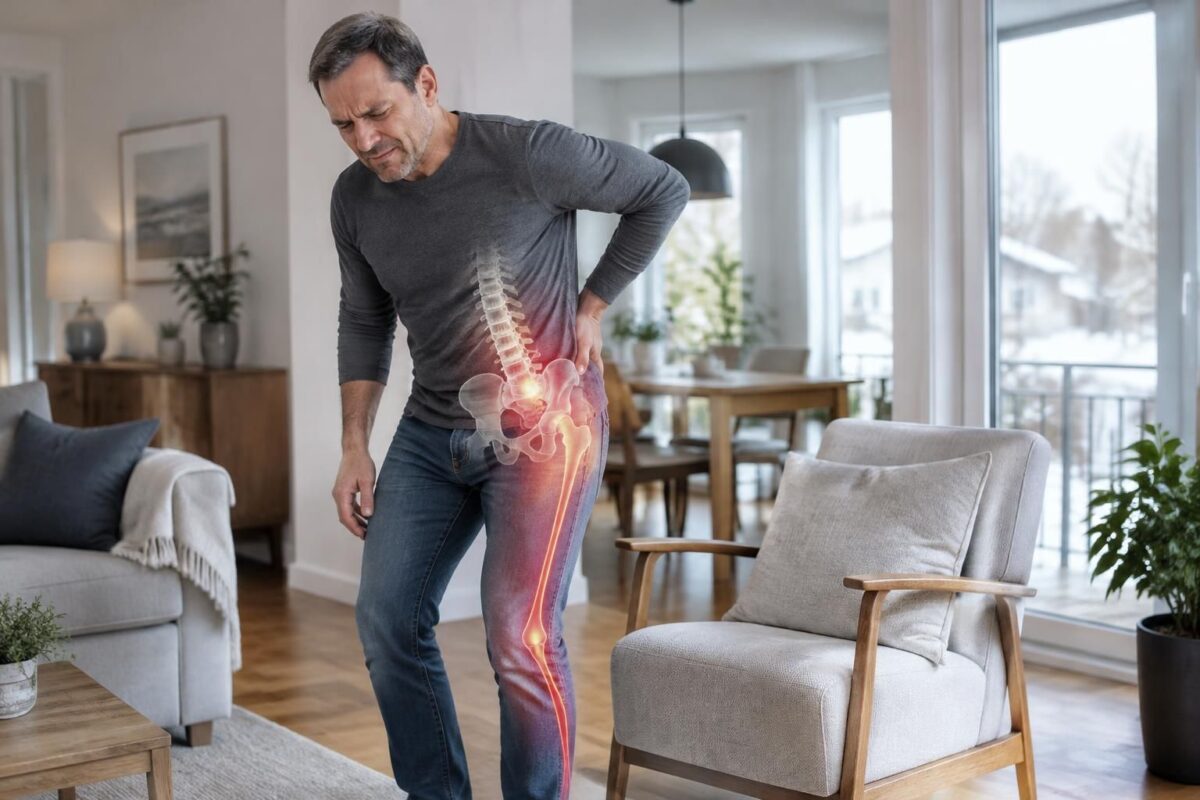
IN BRIEF Sciatica corresponds to pain related to the irritation of a nerve root, which can extend from the buttock down to the leg. The L5-S1 level is often involved, as a disc herniation or irritation at this location can affect the nerves responsible for the symptoms. In Terrebonne, understanding this implication helps to better guide the evaluation and choose an appropriate management plan. |
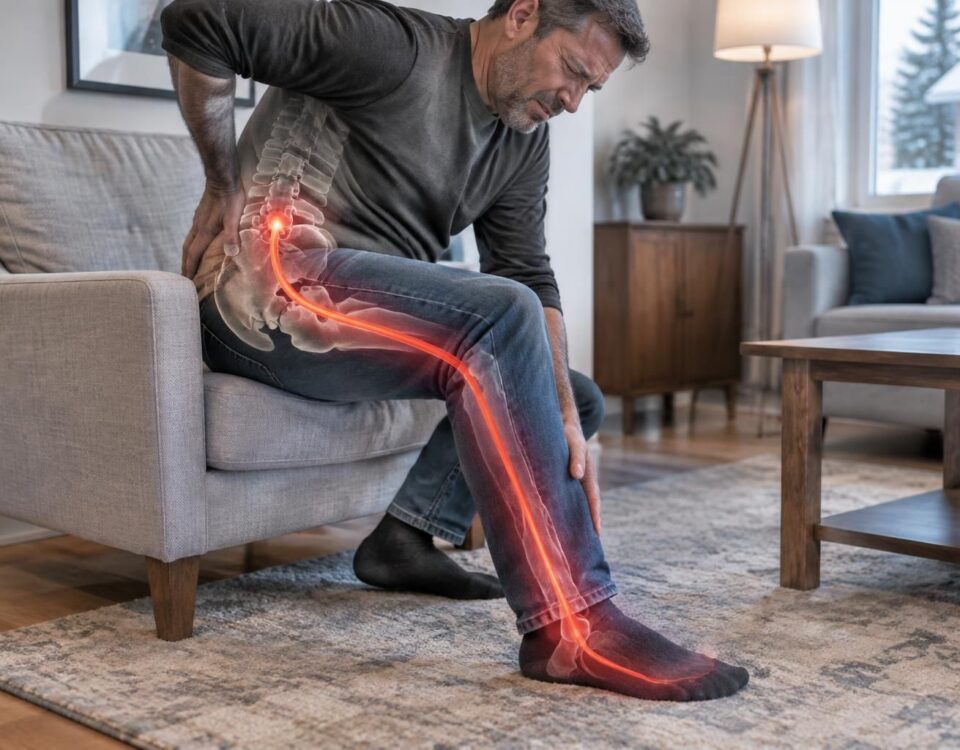
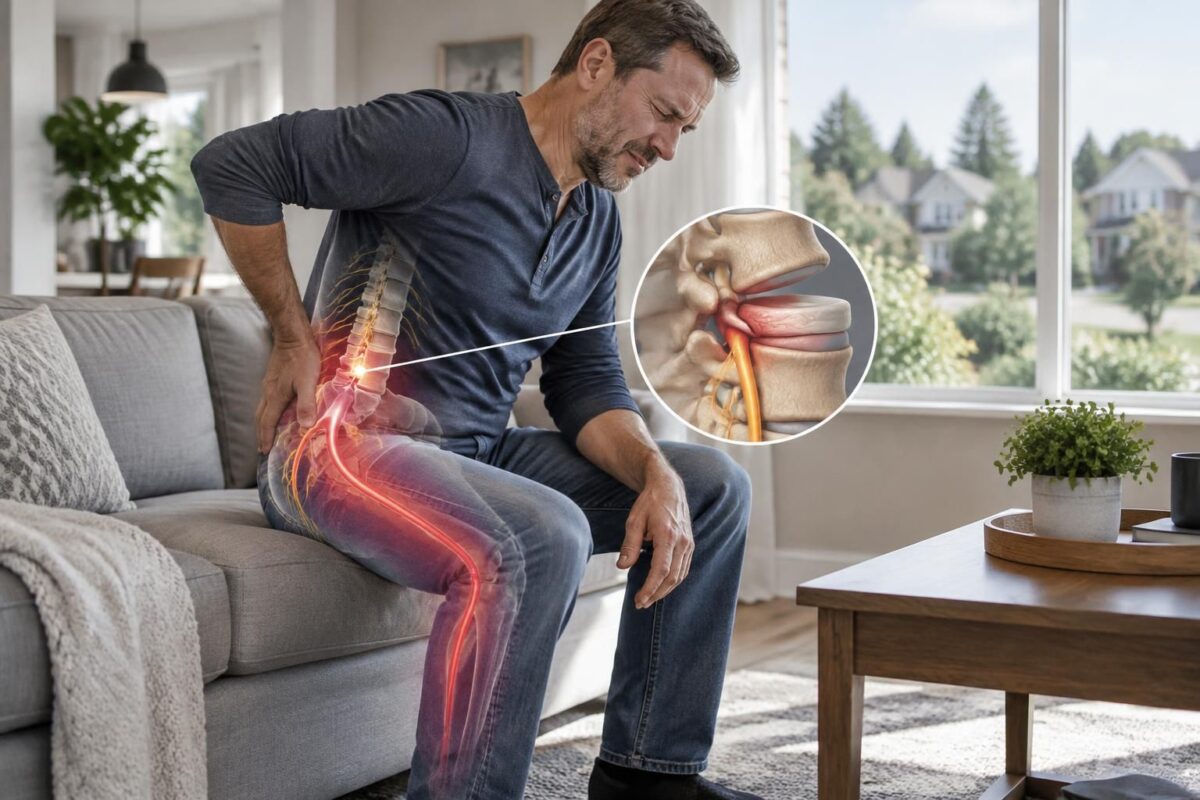
In Terrebonne, pain resembling sciatica may sometimes be related to the L5-S1 segment, located at the junction between the lumbar vertebrae and the sacrum. This region bears significant stress; a disc irritation can particularly affect the S1 nerve root, causing pain that descends from the buttock to the back of the leg, sometimes down to the foot. However, there are several possible causes, and symptoms alone do not allow for a diagnosis: a professional evaluation helps determine the origin of the pain and the appropriate options.
In Terrebonne, pain that starts from the lower back and descends into the buttock or leg may be consistent with sciatica. The L5-S1 level, located between the last lumbar vertebra and the sacrum, is often involved because it bears significant stress and is near the nerve roots contributing to the sciatic nerve. However, the location of the pain alone does not confirm an injury at this level: symptoms, clinical examination, and if necessary, imaging need to be interpreted together. The lumbar spine consists of five vertebrae, designated as L1 to L5. The L5-S1 segment corresponds to the junction between the fifth lumbar vertebra and the first sacral vertebra. A disc is located between these two bones. Nerves exit the spinal canal through openings called foramina. Irritation or compression near these nerves can produce pain that follows a pathway into the buttock and leg. This pain may be accompanied by tingling, numbness, or sometimes a decrease in strength. To better understand reading levels on an MRI, refer to this article on visible lumbar levels on MRI. The lower spine transmits the weight of the upper body to the pelvis. The L5-S1 segment also participates in trunk movements. These stresses can promote changes to the disc over time. A disc herniation, disc bulging, or foraminal narrowing can then irritate a nerve root. This does not mean that these changes occur in everyone with back pain, nor that a visible abnormality on imaging always explains the symptoms. Possible causes of sciatica vary depending on the individual and the context. A general overview of possible causes of sciatica can help identify often-mentioned factors. For an explanation focused on lumbosciatica associated with a disc herniation, you can also consult this resource on radiculopathy from lumbar disc herniation. A disc herniation at L5-S1 can irritate the S1 nerve root. This irritation can cause pain that descends behind the thigh and calf, sometimes to the outer edge of the foot. Damage to the L5 root may instead result in symptoms towards the side of the leg and the top of the foot. These pathways are guidelines, not absolute rules: symptoms vary and may overlap. The disk level and the affected nerve root are not always identical in common language. Some foraminal injuries may affect the root exiting at this level, while a herniation located elsewhere may affect a root descending within the canal. This page provides guidelines on sciatica at the L4-L5 and L5-S1 levels. However, a healthcare professional should interpret this information based on the individual’s examination. Pain that travels below the knee, electric shocks, or numbness may suggest nerve irritation. However, these signs alone do not confirm a herniation at L5-S1. Similarly, an MRI image showing a damaged disc does not automatically prove that this disc is the source of the pain. The evaluation takes into account the history of symptoms, their progression, and the results of the clinical examination. Sensations vary from person to person. Some individuals describe a electric sensation in the calf. Others experience pain that worsens when sitting or prevents them from sitting for long periods. This discomfort is described on the page about pain that prevents sitting. Pain that occurs at night can have several explanations. It deserves particular attention if it is intense, persistent, worsens, or is accompanied by other symptoms. Consult information on night pain in the leg and pain that wakes at night. A reference document on sciatica is also available in this folder dedicated to sciatica. An evaluation starts with questions about the onset of pain, its path, associated sensations, and factors that modify it. The professional can then assess mobility, sensitivity, and strength, depending on their area of practice. These elements help determine if the symptoms are consistent with nerve damage and whether a medical consultation or imaging should be considered. An MRI is not necessary in all cases. A doctor may request it based on the duration of symptoms, the results of the examination, and the present signs. Imaging allows visualization of structures but does not replace clinical evaluation. Therefore, details about causes and mechanisms should be considered as general information, not a personal diagnosis. The options depend on the evaluation and the evolution of the symptoms. At the TAGMED Clinic, a consultation can discuss the proposed approaches, including specific osteopathy or, when warranted, motorized neurovertebral decompression. The choice of an approach cannot be made solely based on the L5-S1 level mentioned in an MRI report. The expected benefits, limitations, and precautions must be explained before any treatment. For an assessment in Terrebonne, check the information on the sciatica treatment in Terrebonne. The consultation aims to examine the situation and determine if further medical evaluation is necessary. No treatment guarantees the disappearance of symptoms. Significant or progressive weakness of the leg or foot requires quick medical evaluation. Immediate consultation is also necessary in case of loss of control of the bladder or bowels, numbness in the saddle area, fever, recent trauma, severe pain, or rapid deterioration. These signs should not be automatically attributed to ordinary sciatica. Sylvain Desforges, B.Sc., D.O., N.D., osteopath and naturopath, is the founding president of TAGMED and the ACMA association. His practice focuses on chronic pain of the spine, back pain, and pain compatible with sciatica, particularly when it radiates to the buttock, leg, calf, foot, or toes. Through SOS Sciatique, he publishes educational content on the symptoms of sciatica, its possible causes, and the non-surgical approaches that can be discussed after an evaluation. The content presenting the writing and verification methods may describe the editorial work of authors and scientific managers, including consultation of primary sources and review of evidence levels. This editorial information does not replace individual medical evaluation. For an assessment in Montreal or Mont-Royal, check the page on the sciatica treatment in Montreal / Mont-Royal. The services offered are presented by the TAGMED Clinic. The information published on SOS Sciatique is provided for educational purposes. It does not replace a consultation, diagnosis, advice, or treatment carried out by a physician or another licensed healthcare professional. The author of this article is neither a doctor nor a specialist in a medical specialty recognized by the Collège des médecins du Québec. The osteopathy, manual medicine, or functional support approaches described on this site do not constitute medical acts and are not intended to replace medical follow-up. Consult a physician or an emergency service in case of loss of bladder or bowel control, anesthesia in the saddle area, significant or progressive weakness of the leg or foot, fever, recent trauma, severe pain, or rapid deterioration. For more details, please read our Legal notice. Medical disclaimer: The information and advice provided on this site do not replace the advice, diagnosis, or treatment of a healthcare professional. Please note that Sylvain Desforges, B.Sc., D.O., N.D., Doctor of Osteopathy, is neither a doctor of medicine nor a physician and is not a specialist in a medical specialty as defined by the Collège des médecins du Québec. Manual medicine, functional medicine, and sports medicine as described on this site exclude any treatment or medical diagnosis made by a physician or specialist. Always consult your doctor for any medical questions. For more details, please read our complete Legal Notice.What does the L5-S1 level mean?
Why is this junction often involved?
Which nerve roots can be affected?
Symptoms alone are not sufficient to locate the cause
How evaluation can clarify the situation in Terrebonne
What non-surgical options can be discussed?
When to seek medical advice promptly
About the author and content verification
Medical disclaimer
Why this area is concerned
- L5-S1 is the last lumbar level, heavily stressed during movements and lifting loads.
- An irritated disk or a herniated disk can sometimes affect a neighboring nerve root.
- The pain can then descend from the buttock to the leg, sometimes down to the foot.
Key points to remember
- A pain of sciatica type does not necessarily mean that L5-S1 is involved.
- The symptoms, their evolution, and the clinical examination help guide the evaluation.
- Significant or progressive weakness, or urinary or bowel disorders, requires urgent medical evaluation.

In Terrebonne, pain that starts from the lower back and descends to the buttock or leg may suggest sciatica, without confirming the cause alone. The L5-S1 level, located at the junction between the last lumbar vertebra and the sacrum, is often affected because it undergoes significant stress and is close to nerve roots that may contribute to the sciatic nerve. An evaluation helps clarify the origin of the symptoms and choose appropriate measures.
Why is the L5-S1 region often involved?
The L5-S1 segment connects the mobile part of the lumbar spine to the pelvis. It participates in load transmission when walking, bending, lifting an object, or sitting for long periods. This function exposes the disk and neighboring joints to repeated stresses, which can contribute to disc changes over time.
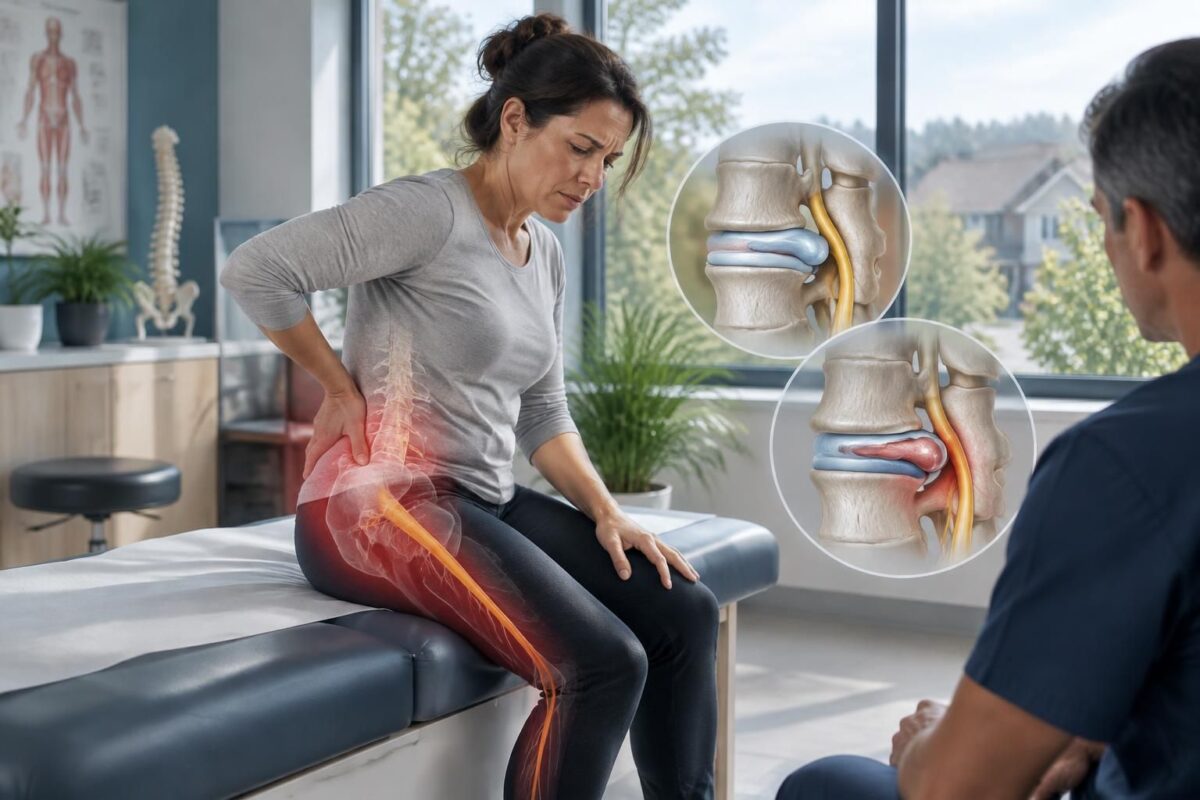
A herniated disk at this level can irritate or compress a nerve root, particularly the S1 root or, depending on its position, the L5 root. Irritation can also be associated with a narrowing of the nerve exit space, known as foraminal stenosis. However, an abnormality observed on imaging does not automatically prove that it explains the pain: symptoms and clinical examination must be considered together.
What symptoms may appear?
Pain compatible with affectation of L5-S1 may manifest in the lower back, buttock, back of the thigh, and sometimes in the calf or foot. Tingling, numbness, or a feeling of weakness may also be present. The pathway varies from person to person; the intensity of pain alone cannot precisely determine the structure involved.
Sciatica in Terrebonne: disc protrusion or disc herniation?
IN BRIEF A disc bulge is a swelling of the disc, while a herniated disc involves a more pronounced protrusion of its contents; both can irritate a nerve root and cause sciatica. Symptoms alone do not always allow for distinction…

Sciatica disc in Terrebonne: why the pain travels down the leg
IN SHORT The disc-related sciatica occurs when a lumbar disc irritates a nerve root, which can cause pain to radiate down the buttock and leg. In Terrebonne, an assessment helps to better understand the cause of the symptoms and consider…

L4-L5 disc herniation and sciatica in Terrebonne: pain towards the foot
IN BRIEF A L4-L5 disc herniation can irritate a nerve root and cause sciatica, with pain that radiates from the buttock down to the leg or foot. In Terrebonne, an evaluation helps better understand the origin of the symptoms and…

Lumbar disc herniation L5-S1 and sciatica in Terrebonne: common symptoms
IN BRIEF A L5-S1 disc herniation can irritate a nerve root and cause sciatica: lower back pain radiating to the buttock or leg, tingling, numbness, or weakness. In Terrebonne, an assessment helps to better understand the symptoms and guide management…
Initial recommendations in case of sciatica pain
If the symptoms are recent and no warning signs are present, prioritize appropriate activity rather than prolonged bed rest. Short walks and frequent position changes may be better tolerated than immobility, provided they do not cause marked aggravation. Temporarily reduce movements that clearly trigger pain, then gradually resume them according to your tolerance.
Avoid multiplying exercises or intense stretches without knowing if they suit you. Note the activities that worsen or relieve symptoms, their progression, and any presence of numbness or weakness. This information can facilitate a consultation with a healthcare professional. In Terrebonne, an assessment allows for discussion of non-surgical options tailored to your situation; no approach can guarantee an identical result for everyone.
When to seek medical help quickly?
Consult a doctor or emergency service promptly in case of loss of urinary or bowel control, numbness in the saddle area, significant or progressive weakness in the leg or foot, fever, recent trauma, or severe pain that worsens rapidly. These signs require medical evaluation and should not be addressed solely by manual therapy.
How our content is prepared
Health information must be presented clearly and cautiously. The editorial approach described for this content emphasizes readability, examination of possible biases, and verification of methodological rigor based on relevant sources and their level of evidence. This article is informational: it does not replace a diagnosis or personalized advice from a licensed professional.
About the author
Sylvain Desforges, B.Sc., D.O., N.D., osteopath and naturopath, is the founding president of TAGMED and the ACMA association. His practice particularly focuses on chronic spinal pain and low back pain compatible with sciatica. Proposed interventions may vary according to the assessment and do not replace medical follow-up.
Medical disclaimer: consult a doctor or licensed healthcare professional for advice tailored to your situation.
| Factor | Why L5-S1 is often involved |
|---|---|
| Mechanical load | This junction bears a significant share of the lower back’s stress. |
| Mobility and constraints | It connects a mobile lumbar region to the more stable sacrum. |
| Intervertebral disc | The L5-S1 disc may undergo changes or a herniation. |
| Nerve root | Nerve irritation can cause pain radiating into the leg. |
| Possible symptoms | Pain may extend to the buttock, calf, or foot. |
| In Terrebonne | The place of residence does not determine the cause; the clinical assessment guides the evaluation. |
| Confirmation | Symptoms alone do not allow asserting that L5-S1 is involved. |
Illustrative testimonials in Terrebonne: why L5-S1 is often involved in sciatica
Transparency note: the testimonials below are fictional examples intended to illustrate possible situations. They do not correspond to identifiable patients nor to opinions collected in Terrebonne.
“The pain started in my lower back and went down my leg” — In this scenario, a person describes lower back pain radiating to the buttock and back of the leg. This pathway may be consistent with nerve irritation, but it cannot alone determine which structure is involved. An evaluation considers the history of symptoms, examination, and, when indicated, imaging results.
Why L5-S1 often comes up: this segment is located at the junction between the last lumbar vertebra, L5, and the sacrum. It participates in movement and load transfer between the trunk and the pelvis. This area may therefore be stressed during repeated actions, exertions, or certain postures. A disc, joint, or opening through which a nerve root passes may contribute to the symptoms, but this possibility must be assessed on a case-by-case basis.
“I was told about the L5-S1 disc, but the imaging didn’t tell the whole story” — In this example, a person learns that imaging shows a change at L5-S1. This is useful information, but an imaging result does not automatically prove that it explains the pain. Disc changes can be present without symptoms; conversely, pain may require assessment even if imaging does not show an obvious cause.
“The pain went down to my foot, and I needed to understand my options” — Pain that radiates down the leg may sometimes be related to nerve root irritation, particularly in the lumbar region. However, symptoms vary from person to person and cannot confirm an L5-S1 involvement on their own. The healthcare professional checks strength, sensitivity, reflexes, and pain progression to guide the way forward.
In Terrebonne, as elsewhere, a consultation can help clarify symptoms and discuss options suitable for the situation. Depending on the assessment, non-surgical support may be considered; however, it does not replace a medical diagnosis when needed. Rigorous information must distinguish possible mechanisms from what is actually established in an individual.
Consult a doctor or emergency service quickly in case of loss of urinary or bowel control, numbness in the saddle area, significant or worsening weakness in a leg or foot, fever, recent trauma, or rapid aggravation of symptoms. This content is provided for educational purposes and does not replace a consultation, diagnosis, or treatment by a licensed healthcare professional.
In Terrebonne, pain that starts in the lower back and radiates to the buttock or leg may suggest sciatica. This term generally describes pain associated with the irritation or compression of a lumbar nerve root, and not a single disease. Among the frequently affected areas is L5-S1, the junction between the fifth lumbar vertebra and the sacrum. Its role in movements and body support helps understand why this area may be vulnerable.
The L5-S1 junction is located at the bottom of the spine, where mechanical stresses are significant during walking, lifting a load, or changing posture. The disc located between these vertebrae helps to distribute these forces and allows movement. Over time, or after certain stresses, it may undergo changes such as dehydration, protrusion, or a herniated disc. If these changes irritate a neighboring nerve root, pain may radiate into the buttock, thigh, calf, or down to the foot.
L5-S1 is often mentioned, but the location of symptoms alone cannot determine the structure involved. Pain radiating down the leg may also be associated with nerve irritation from another lumbar level, narrowing of the nerve exit space — called foraminal stenosis — or other musculoskeletal factors. The sensation can vary: burning, electric shock, numbness, tingling, or pain worsened by certain positions. Clinical examination and, when indicated, imaging help clarify the situation.
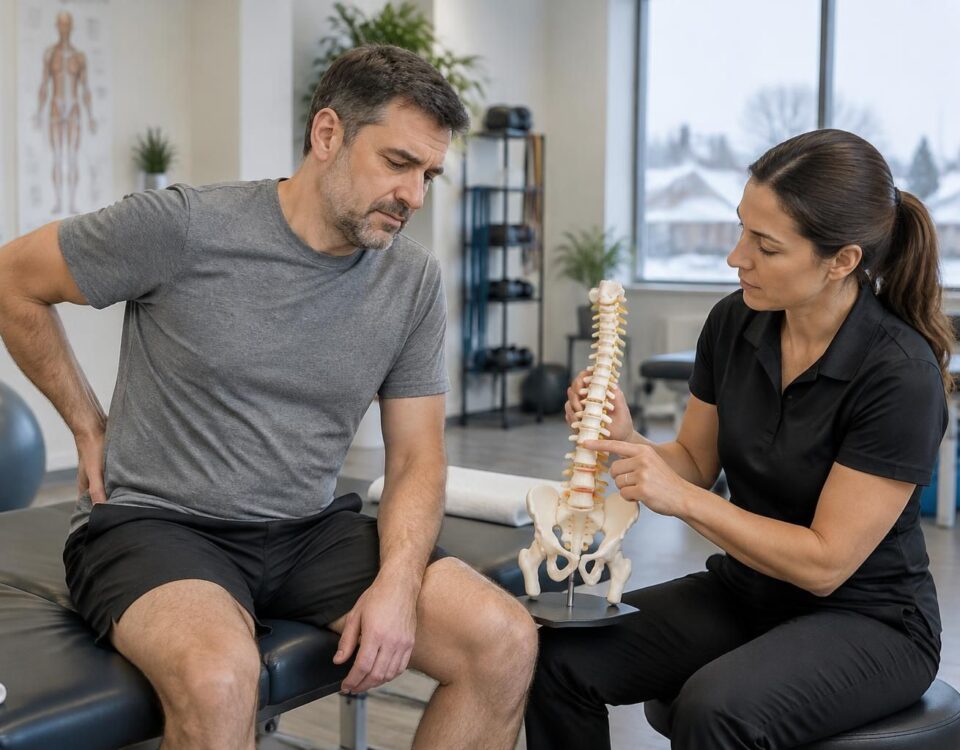
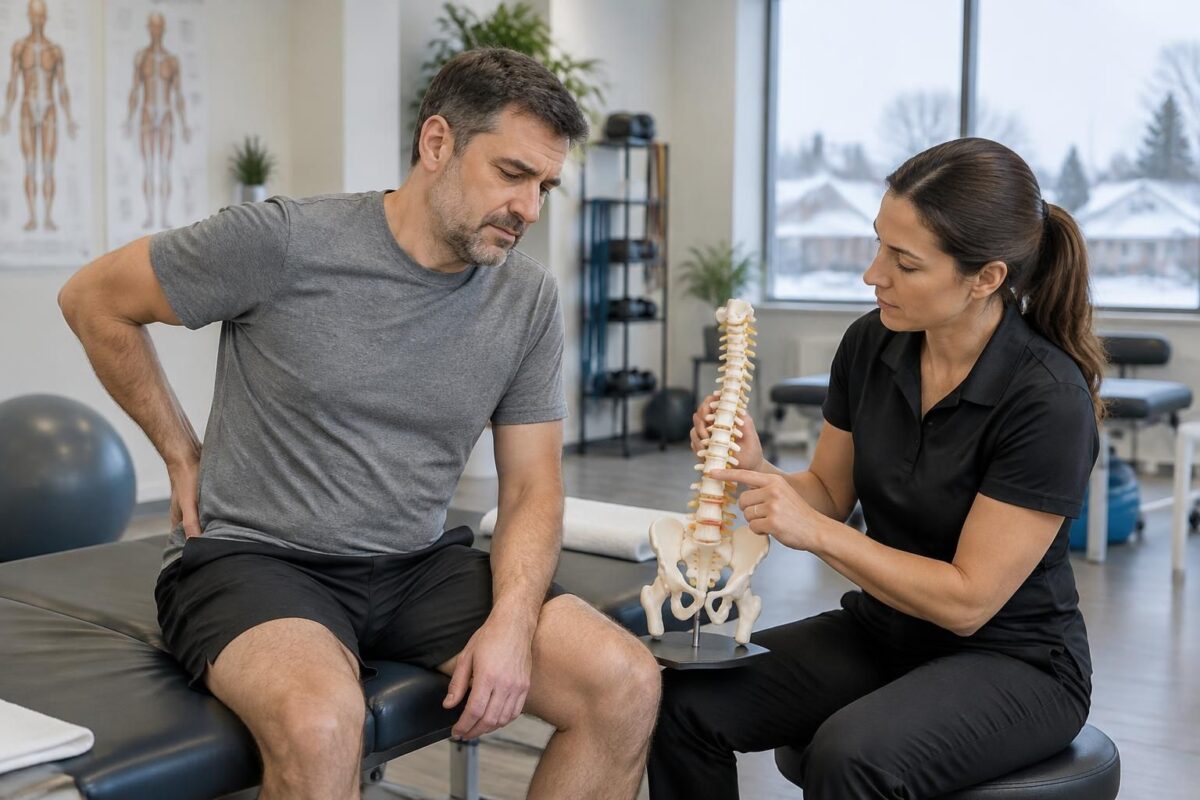
For individuals seeking an assessment in Terrebonne, the goal is first to understand the evolution of symptoms, the activities that trigger them, and the signs that require medical attention. An individualized approach can then be considered. Depending on the assessment and needs, care offered at TAGMED Clinic may include specific osteopathy or neurovertebral decompression. These interventions are not suitable for everyone and do not replace a medical diagnosis or treatments prescribed by a licensed professional.
Sylvain Desforges, B.Sc., D.O. and N.D., is an osteopath and naturopath, as well as the founding president of TAGMED and the ACMA association. His work focuses notably on chronic spinal pain, lower back pain, and symptoms compatible with sciatica. He is interested in the thoughtful integration of technologies and non-surgical approaches, depending on the evaluation of each individual. The materials he publishes have an educational purpose and aim to help readers better understand their options and ask informed questions during a consultation.
Significant or progressive weakness in the leg or foot, loss of bladder or bowel control, anesthesia in the saddle area, fever, recent trauma, or rapid deterioration warrant urgent medical consultation. These signs should not be evaluated solely based on online informational content.
Medical warning: this information does not replace a consultation, a diagnosis, or a treatment performed by a physician or another authorized healthcare professional. Sylvain Desforges is neither a physician nor a specialist in a medical specialty recognized by the Collège des médecins du Québec. Osteopathy and functional support approaches do not constitute medical acts.
In Terrebonne, sciatica can cause lower back pain that radiates to the buttock and leg, sometimes accompanied by tingling, numbness, or a feeling of heaviness. The L5-S1 level is often involved, as this segment is at the junction between the lower back and the sacrum and undergoes significant stress. However, symptoms alone do not confirm the origin or level of nerve irritation.
Why the L5-S1 segment is often involved
The L5-S1 disc separates the last lumbar vertebra from the sacrum. This region contributes to trunk mobility while transmitting part of the loads between the upper body and the pelvis. A herniated disc, local irritation, or other changes can sometimes contribute to irritating a neighboring nerve root and causing pain radiating down the leg. The term lumbosciatica refers to lower back pain associated with radiation into the lower limb, but it does not specify, on its own, the exact cause.
When the S1 root is irritated, pain may extend to the back of the leg and the calf. Manifestations such as calf pain associated with L5-S1 sciatica may guide the assessment, but do not constitute sufficient proof to identify the affected disc. Other levels, particularly L4-L5, may also produce similar symptoms; painful areas overlap and vary from person to person.
Symptoms vary from person to person
Sciatica does not always present as intense pain. Some people rather describe tingling, burning, or numbness. Others feel a heavy or painful leg, or notice that symptoms appear or worsen after walking, as in the case of pain and numbness after exertion.
The location of sensations can provide useful elements for evaluation. For example, numbness of the big toe accompanied by lower back pain may correspond to different nerve injuries; it does not conclusively indicate L5-S1 without examination. To better understand the differences between L4-L5 and L5-S1 levels, consult this resource on L4-L5 and L5-S1 sciatica.
Why symptoms alone are not sufficient for diagnosis
Pain and unusual sensations must be related to health history, physical examination, and, when indicated, imaging results. A visible abnormality on imaging does not automatically explain the symptoms: it must be verified if it corresponds to their side, distribution, and clinical findings. Available recommendations for the management of sciatica can help situate general options, but they do not replace a personalized assessment.
Depending on the situation, non-surgical management may be considered after evaluation. For more information on neurovertebral decompression in the context of an L5-S1 herniation and sciatic symptoms, consult the TAGMED Clinic information. The choice of an approach depends notably on the symptoms, their evolution, medical history, and examination results; no method is automatically suitable for everyone.
Significant or progressive weakness in the leg or foot, loss of bladder or bowel control, or numbness in the saddle area requires urgent medical evaluation. In the presence of less urgent but persistent or recurring symptoms, a healthcare professional can help determine the next steps and check if a nerve injury is involved.
Sciatica and herniated disc in Terrebonne: understanding the link
IN BRIEF Sciatica refers to pain that follows the path of the nerve in the buttock and leg; a herniated disc can irritate it, but an anomaly on the MRI is not sufficient to establish the cause. In Terrebonne, the…
Sciatica in Terrebonne: lumbar roots and the choice of a cautious treatment
IN BRIEF Sciatica is pain related to the irritation or compression of a lumbar nerve root, which can radiate from the lower back to the buttock and leg. In Terrebonne, an evaluation allows for cautious treatment tailored to the cause…

Sciatica in Terrebonne: how to interpret pain according to the leg path
IN BRIEF Sciatica is a pain that can start from the lower back or the buttock and travel down the leg to the foot. Its path, along with any tingling or weakness, helps guide the assessment but is not sufficient…

Sciatica in Terrebonne: L5-S1, canal, foramen and nerve compression
IN BRIEF The sciatica L5-S1 corresponds to irritation or compression of a nerve root, sometimes related to a disc herniation or narrowing of the lumbar canal or the foramen. The pain may radiate from the lower back to the buttock,…

Sylvain Desforges, B.Sc., D.O., N.D., docteur en ostéopathie
Dr Sylvain Desforges, B.Sc., D.O., N.D., osteopath, is the founding president of TAGMED and of the ACMA association. He dedicates his practice to chronic spinal pain, low back pain and symptoms compatible with sciatica, particularly when pain radiates toward the buttock, leg, calf, foot or toes.
Through SOS Sciatique, he publishes educational content on sciatica symptoms, possible causes such as disc herniation, disc narrowing, foraminal stenosis or irritation of a lumbar nerve root, as well as non-surgical approaches that may be considered according to the evaluation. At Clinique TAGMED, care may include, depending on the case, motorized neurovertebral decompression, specific osteopathic care or precision percussion.
For an evaluation related to sciatica treatment in Montreal / Mount Royal or sciatica treatment in Terrebonne, please consult the services available at Clinique TAGMED.
Medical disclaimer
The information published on SOS Sciatique is provided for educational purposes only and does not replace a consultation, diagnosis, opinion or treatment provided by a physician or another authorized healthcare professional. The author of this article is neither a medical doctor nor a specialist in a medical specialty recognized by the Collège des médecins du Québec. The osteopathic, manual medicine or functional support approaches described on this site do not constitute medical acts and are not intended to replace medical follow-up.
Consult a physician or emergency service in cases of loss of bladder or bowel control, anesthesia in the saddle area, significant or progressive weakness in the leg or foot, fever, recent trauma, severe pain or rapid worsening of symptoms. For more details, please read our Legal Notice.