



Disc protrusion and pain that increases when sitting
13/10/2026
Sciatica L4-L5 in Terrebonne: possible pain, numbness, and weakness
14/10/2026
IN BRIEF The L4-L5 sciatica refers to irritation of a lumbar nerve root that can cause pain radiating down the leg, tingling, or weakness. In Montreal, an evaluation allows for examining the symptoms and guiding the treatment based on their cause, in order to support mobility and a gradual return to activities. |
L4-L5 Sciatica in Montreal
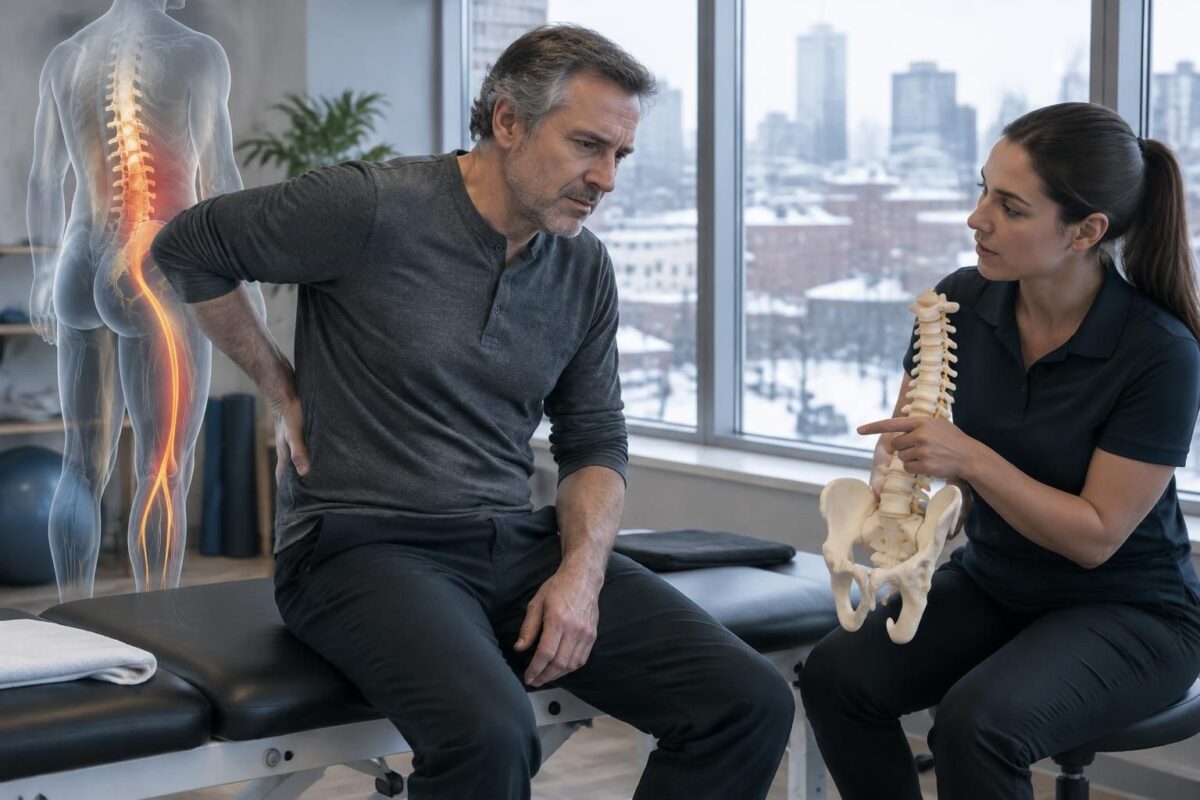
Irritation of a nerve root at L4-L5 can cause pain in the lower back or buttocks, often radiating to the side of the leg down to above the foot. Tingling, numbness, or weakness may also occur. Symptoms vary from person to person; a professional evaluation in Montreal can help determine the cause and guide treatment. In cases of significant or worsening weakness, consult a healthcare professional quickly.
Pain starting in the lower back and radiating down the leg may be linked to irritation of a nerve root near the L4-L5 vertebrae. It may be accompanied by tingling, numbness, or weakness in the foot. These symptoms alone do not confirm the cause: an evaluation helps distinguish nerve damage from other issues and choose the appropriate next steps.

Sciatica and disc bulge in Montreal: possible cause of nerve irritation
IN BRIEF A disc bulge can sometimes irritate a nerve root and contribute to sciatica, with pain in the buttock or leg. Evaluation helps to identify the cause of the symptoms and guide appropriate care; in Montreal, a consultation can…

Sciatica in Montreal: disc protrusion or herniated disc?
IN BRIEF Sciatica in Montreal may be related to a disc protrusion or a herniated disc, but these terms describe different changes in the disc and are not sufficient on their own to explain the pain. An assessment helps to…
What does L4-L5 sciatica mean?
Sciatica, also called sciatica pain, describes pain associated with irritation of a nerve root or the sciatic nerve. It does not necessarily mean that a nerve is “pinched.” The tissues around the nerve may be irritated or sensitive, leading to symptoms along its path.
The sciatic nerve is formed from lumbar and sacral nerve roots. At the L4-L5 region, a herniated disc located centrally or to the side may affect the L5 root. A lesion closer to the nerve exit may instead involve the L4 root. Therefore, the level visible on an image is not sufficient to determine the affected root: symptoms and clinical examination also matter.
To better understand pain related to the sciatic nerve, consult this sciatic pain guide and this general explanation of sciatica.

Sciatica disc in Montreal: why the pain travels down the leg
IN BRIEF Disc herniated sciatica occurs when a lumbar disc irritates or compresses a nerve root, which can cause pain to radiate down to the buttock and leg. In Montreal, an evaluation helps understand the cause of the symptoms and…

L4-L5 disc herniation and sciatica in Montreal: pain towards the foot
IN BRIEF An L4-L5 disc herniation can irritate the L5 nerve root and cause sciatica that radiates down to the top of the foot or the big toe. Burning sensations, tingling, and pain when walking may occur. In Montreal, a…
Where can pain and numbness manifest?
Irritation of the L5 root can cause pain in the buttock, the side of the leg, or the top of the foot. Tingling or loss of sensation can affect the top of the foot or the big toe. The distribution varies from person to person and does not confirm a specific lesion on its own.
Pain radiating to the outer edge of the foot may also present with certain lumbar issues. This sign should be interpreted alongside other symptoms and evaluation results. To learn more, see articles on big toe numbness and lumbar pain in Montreal, pain towards the big toe in L5 sciatica in Montreal, and sciatic pain radiating towards the outer edge of the foot in Terrebonne.
Pain can be sharp, burning, or felt like an electric shock. It may increase in a seated position or during certain movements. Some people also experience stiffness or decreased endurance in the leg.

Herniated Disc L5-S1 and Sciatica in Montreal: Common Symptoms
IN BRIEF A L5-S1 disc herniation is a displacement of the disc located between the last two lumbar vertebrae and the sacrum; if it irritates a nerve root, it can cause sciatica. The pain often radiates from the buttock down…

Sciatica and disc herniation in Montreal: understanding the link
IN BRIEF Sciatica is a pain that radiates down the leg when a nerve root is irritated; a lumbar herniated disc can be the cause, but is not always responsible. In Montreal, an assessment helps to better understand the symptoms,…
What are the possible causes of L4-L5 pain?
Herniation or bulging disc
A spinal disc can deform and irritate a nearby nerve root. An L4-L5 herniated disc can therefore cause pain radiating down the leg. However, a visible abnormality on imaging does not always explain the symptoms. The healthcare professional compares images with the patient’s history and examination. This article explains what MRI can show in cases of disc herniation and sciatica.
Changes related to osteoarthritis or foraminal narrowing
Age-related joint changes can reduce the space through which a nerve root exits the spine. This is referred to as foraminal narrowing. This change can contribute to nerve irritation, but it must be evaluated in the context of the symptoms. The Merck Manual on sciatica presents the causes and associated signs.
Other possible factors
Deep muscular structures in the buttock can sometimes contribute to pain resembling sciatica. The pain may also be associated with other lumbar issues. An evaluation helps look for signs that point to a discal, joint, muscular, or other origin.
Sciatica in Montreal: lumbar roots and choice of a cautious treatment
IN BRIEF Sciatica is pain radiating from the buttock down the leg, often related to irritation of a lumbar root. In Montreal, a careful assessment helps to connect symptoms to function and to choose appropriate management: modified activity, rehabilitation, or…

Sciatica in Montreal: how to interpret pain according to the leg path
IN BRIEF Sciatica refers to pain that can follow a nerve root from the lower back to the buttock and the leg. Its path, along with tingling, numbness, or weakness, helps guide the evaluation but is not sufficient to make…
How to recognize concerning weakness?
Severe pain may make movement difficult without actual loss of strength. Nerve weakness may instead manifest as new difficulty in lifting the front of the foot, walking on the heels, or controlling the leg. Only an examination can help clarify what is happening.
Seek medical advice quickly if weakness appears suddenly, progresses, or significantly hinders walking. Go to an emergency room immediately if there is loss of bladder or bowel control, numbness in the saddle area, or significant weakness in one or both legs. Fever, recent trauma, severe pain, or rapid worsening also require prompt evaluation.
When to consult in Montreal for L4-L5 sciatica?
Consult a doctor or other healthcare professional if the pain is severe, persists, recurs frequently, or is accompanied by numbness and weakness. A doctor can assess the necessity of exams or medical treatment. Imaging is not necessary in all cases; the decision depends on the signs observed and the progression.
In Montreal, an evaluation at the TAGMED Clinic can help examine symptoms and discuss appropriate non-surgical options for the situation. Depending on the assessment, care may include specific osteopathy or motorized neurovertebral decompression. These approaches do not replace a medical diagnosis and are not suitable for everyone.
Vibrations during a trip can modify symptoms in some people without revealing the cause alone. Discover possible factors in this article on sciatica and road vibrations. You can also read this resource on sciatic pain, its symptoms, and when to consult.
For a presentation of symptoms and evaluation options in osteopathy, also consult this page on sciatic pain.
About the Author
Sylvain Desforges, B.Sc., D.O., N.D., Doctor of Osteopathy, is the founding president of TAGMED and the ACMA association. He dedicates his practice to chronic pain of the spine, lower back pain, and pain associated with sciatica, particularly when the pain radiates to the buttock, leg, calf, foot, or toes.
Through SOS Sciatique, he publishes educational content on the symptoms of sciatica, possible causes such as herniated discs, disc pinching, foraminal stenosis, or irritation of a lumbar nerve root, as well as on non-surgical approaches that may be considered based on the evaluation. At TAGMED Clinic, care may include, depending on the case, motorized neurovertebral decompression, specific osteopathy, or the precision impactor.
For an evaluation related to sciatica treatment in Montreal / Mont-Royal or sciatica treatment in Terrebonne, check the services available at the TAGMED Clinic.
Medical Disclaimer
The information published on SOS Sciatique is provided for educational purposes only and does not replace a consultation, diagnosis, opinion, or treatment performed by a physician or another licensed healthcare professional. The author of this article is neither a doctor nor a specialist in a medical specialty recognized by the Collège des médecins du Québec. The osteopathy, manual medicine, or functional support approaches described on this site do not constitute medical acts and are not intended to replace medical follow-up.
Consult a physician or emergency service in case of loss of bowel or bladder control, numbness in the saddle region, significant or progressive weakness of the leg or foot, fever, recent trauma, severe pain, or rapid worsening. For more details, please read our Legal Notice.
Medical Disclaimer: The information and advice provided on this site do not replace the opinion, diagnosis, or treatment of a healthcare professional. Please note that Sylvain Desforges, B.Sc., D.O., N.D., Doctor of Osteopathy, is neither a medical doctor nor a physician, and is not a specialist in a medical specialty as defined by the Collège des médecins du Québec. Manual medicine, functional medicine, and sports medicine as described on this site exclude any medical treatment or diagnosis made by a physician or specialist. Always consult your doctor for any medical questions. For more details, please read our complete Legal Notice.
Sciatica L4-L5: Possible Signs
- Pain from the lower back to the buttock and leg.
- Numbness sometimes on the side of the leg or the top of the foot.
- Weakness possible in lifting the foot or big toe.
- The symptoms vary depending on the affected nerve root.
In Montreal: When to Seek Help
- Consult a professional if the pain persists or limits your activities.
- An evaluation helps clarify the cause and suitable options.
- Emergency in case of progressive weakness, loss of bowel or bladder control, or numbness in the saddle region.

A sciatica associated with the L4-L5 level can cause pain in the lower back or buttock that radiates down the leg, as well as tingling, numbness, or weakness. In Montreal, as elsewhere, these symptoms warrant an evaluation to investigate the cause: the level observed in imaging is not sufficient alone to confirm the origin of the pain or determine the appropriate treatment.
Understanding L4-L5 Sciatic Pain
Between the L4 and L5 vertebrae lies a disc that can, among other things, protrude and irritate a nerve root. Joint changes or narrowing of the space through which the nerve passes can also contribute to symptoms. The term “pinched nerve” is common, but the pain often indicates nerve irritation or sensitization. The path and intensity vary from person to person.
Pain, Numbness, and Weakness
Pain can radiate from the lower back to the buttock, then down the thigh and leg, sometimes to the foot. An L5 root involvement may particularly be accompanied by unusual sensations on the side of the leg or the top of the foot. However, these markers cannot diagnose at a distance. Weakness, such as a new difficulty lifting the foot, should be promptly reported to a healthcare professional.
What to Do Daily in Montreal?
If sitting increases your symptoms, regularly interrupt it by standing up and walking gently. When you must remain seated, support your back, keep your feet on the ground, and avoid positions that trigger or worsen the pain. Vary your postures at work and adjust your setup to avoid leaning forward for long periods.
As long as it does not cause marked aggravation, prioritize light activity such as short walks. Prolonged complete rest may make resuming movement more difficult. However, avoid stretches or exercises that increase pain in the leg, numbness, or weakness. A program tailored to your condition is preferable to a series of exercises chosen without evaluation.
When to seek an assessment?
Consult a doctor or healthcare professional if the pain persists, frequently returns, or limits your activities, or if numbness or weakness appears. The assessment can help distinguish lower back pain from other causes and decide if further exams or medical follow-up are necessary. In Montreal, a non-surgical approach may be discussed depending on your situation and the evaluation results; manual therapies do not replace a medical diagnosis.
Emergency signs
Go to the emergency room promptly in case of loss of bladder or bowel control, numbness around the genitals or perineum, or significant weakness that progresses rapidly. Fever, recent trauma, or rapid worsening also warrants immediate medical advice.
About the author: Sylvain Desforges, B.Sc., D.O., N.D., is an osteopath and founding president of TAGMED and the ACMA association. His educational content focuses on lower back pain and symptoms consistent with sciatica.
Medical disclaimer: This information is educational and does not replace a consultation, diagnosis, or treatment by a licensed healthcare professional. The author is neither a physician nor a specialist in a medical specialty recognized by the Collège des médecins du Québec.
| Marker | Sciatica L4-L5 in Montreal |
|---|---|
| Pain | May radiate from the lower back or buttock down the leg. |
| Area sometimes affected | The side of the leg and the top of the foot, depending on the sensitized nerve root. |
| Numbness | Tingling or reduced sensitivity may appear in the leg or foot. |
| Possible weakness | Difficulties raising the foot or big toe may occur. |
| Aggravating factors | Prolonged sitting or certain movements may worsen symptoms. |
| To be evaluated | A healthcare professional can clarify the cause and guide management. |
| Urgency | Consult immediately in cases of progressive weakness or loss of bladder or bowel control. |
Illustrative testimonials on sciatica L4-L5 in Montreal
Important note: the stories below are fictional examples, written to illustrate possible experiences. They do not correspond to real patient testimonials and do not allow for a diagnosis. Pain attributed to L4-L5 can vary from person to person; symptoms alone do not confirm the cause.
“The pain went down my leg”
In Montreal, after several days of lower back pain, a person notices that the discomfort extends towards the buttock and the side of the leg. Sitting for long periods seems to exacerbate the pain. They consult a healthcare professional to evaluate their symptoms rather than concluding on an L4-L5 issue themselves.
“I had tingling on the top of my foot”
In this fictional example, a person experiences tingling and a numb area in the leg and foot, in addition to lower back pain. Since the location of sensations can have multiple explanations, they seek an evaluation to determine the next steps appropriate to their situation.
“My leg felt weaker”
Another possible scenario is one where a person notices weakness in the leg or new difficulty in raising the foot. This type of change warrants a prompt evaluation, especially if it worsens or disrupts walking. Weakness should not be interpreted solely based on a testimony or an online description.
“I didn’t know if it was sciatica”
A person from the Montreal area feels pain that starts from the lower back and radiates down the leg, sometimes with shocks or numbness. They learn that the term “sciatica” describes a set of symptoms but does not specify which structure is involved. A professional evaluation helps guide management.
Lower back pain accompanied by symptoms in the leg may relate to nerve irritation, but other causes are possible. Consult a healthcare professional for an individualized evaluation. In case of significant or progressive weakness, loss of bladder or bowel control, or numbness in the perineal area, seek emergency medical care.
About the author
Sylvain Desforges, B.Sc., D.O., N.D., Doctor of Osteopathy, is the founding president of TAGMED and the ACMA association. He devotes his practice to chronic spinal pain, lower back pain, and pain consistent with sciatica, including when the pain radiates towards the buttock, leg, calf, foot, or toes.
Through SOS Sciatique, he publishes educational content on sciatica symptoms, its possible causes — such as herniated disc, disc pinching, foraminal stenosis, or irritation of a lumbar nerve root — as well as on non-surgical approaches that may be considered based on the evaluation. At TAGMED Clinic, care may include, depending on the case, motorized neurovertebral decompression, specific osteopathy, or precision percussion.
For an assessment related to sciatica treatment in Montreal / Mont-Royal or sciatica treatment in Terrebonne, consult the services available at TAGMED Clinic.
Medical disclaimer
The information published on SOS Sciatique is provided for educational purposes and does not replace a consultation, diagnosis, opinion, or treatment by a physician or another licensed healthcare professional. The author of this article is neither a physician nor a specialist in a medical specialty recognized by the Collège des médecins du Québec. The approaches of osteopathy, manual medicine, or functional support described on this site do not constitute medical acts and are not intended to replace medical follow-up.
Consult a physician or an emergency service in case of loss of urinary or bowel control, anesthesia in the saddle area, significant or progressive weakness of the leg or foot, fever, recent trauma, severe pain, or rapid worsening. For more details, please read our Legal Notice.
Pain that starts from the lower back and descends into the buttock or leg may be compatible with sciatica. When a nerve root at the L4-L5 level is irritated or sensitized, symptoms may manifest along its territory, but their location varies from person to person. The term “pinched nerve” is often used; this expression does not always accurately describe the mechanism. Inflammation or irritation of the nerve root may also contribute to pain.
The L4-L5 junction is located in the lower part of the lumbar spine. A herniated disc, wear-related changes, or narrowing of the space through which the nerve root passes may sometimes contribute to the symptoms. However, pain alone does not allow for establishing the cause or confirming that a specific root is affected. A healthcare professional must consider the history of symptoms and conduct an appropriate evaluation.
Pain may be felt in the lower back, the buttock, and the side of the leg, sometimes extending to the top of the foot. Some people describe a burning sensation, sharp pains, or an electric shock feeling. Tingling or numbness may also appear in the leg or foot. A decrease in strength or endurance is possible, for example, when lifting the front of the foot, but it must be assessed, especially if it worsens.
Symptoms may increase after prolonged sitting, during certain movements, or while exerting effort. However, their intensity and trajectory are not the same for everyone. Pain in the front of the thigh, for example, may suggest another nerve involvement than sciatica; evaluation helps distinguish these possibilities and determine whether medical advice or additional examinations are necessary.
In Montreal, a cautious approach begins by checking the symptoms, their evolution, and their impacts on daily activities. The support plan depends on this evaluation. It may aim to better manage pain, maintain tolerable mobility, and gradually resume activities. Advice on positions, appropriate exercises, or manual therapy may be considered depending on the situation, without guaranteeing results and without replacing a medical diagnosis. Avoid continuing an exercise that significantly increases pain, numbness, or weakness.
Seek immediate medical attention if you notice significant or progressive weakness. Loss of bladder or bowel control, numbness in the saddle area, fever, recent trauma, or rapid worsening justify urgent evaluation. In the absence of these signs, a healthcare professional can help you choose the appropriate action and determine if osteopathy or physiotherapy is suitable for your situation.
About the author
Sylvain Desforges, B.Sc., D.O., N.D., Doctor of Osteopathy, is the founding president of TAGMED and the ACMA association. His practice particularly focuses on chronic spinal pain, lower back pain, and symptoms compatible with sciatica. He is interested in innovation in functional support and non-surgical approaches that may be considered after assessment, including motorized neurovertebral decompression, specific osteopathy, and precision impact therapy.
Medical Warning: This content is provided for educational purposes and does not replace a consultation, diagnosis, or treatment by a licensed healthcare professional. The author is neither a physician nor a specialist in a medical specialty recognized by the Collège des médecins du Québec. The approaches of osteopathy and manual medicine do not constitute medical acts and do not replace medical follow-up.
Sciatica associated with the L4-L5 region can cause pain that starts from the lower back or buttock and travels down the leg, sometimes to the top of the foot. Tingling, numbness, or weakness may also occur. However, the location of the symptoms alone is not sufficient to confirm which nerve root is involved: an appropriate evaluation is necessary.
When a nerve root is irritated near the lumbar vertebrae, the pain may follow a path into the buttock, thigh, and side of the leg. Depending on the affected root, it may also reach the top of the foot. The presentation varies from person to person: some mainly feel pain, while others notice more tingling, loss of sensitivity, or difficulty in lifting the foot or toes. Consult this guide on the possible differences between L4-L5 and L5-S1 sciatica.
A herniated disc may contribute to irritating a nerve root, but it is not the only possible explanation. Degenerative changes or narrowing of the space through which the nerve passes may also be involved. The presence of symptoms alone does not determine their origin; a healthcare professional can assess strength, sensitivity, reflexes, and movements, and then decide if further examinations are indicated. For more information on this mechanism, consult the guide on sciatica related to a herniated disc and the information from the MSD Manual on sciatica.
Pain may be more pronounced after a prolonged sitting period, during certain movements, or while walking. Persistent numbness or weakness warrants particular attention, especially if these symptoms intensify. Resources specifically address the possible meaning of L5 root irritation and situations where difficulty walking on the heels may require evaluation.
In Montreal, if these symptoms disrupt your activities or persist, request an evaluation from a licensed healthcare professional. Care and exercises should be chosen according to your situation and tolerated without significant aggravation. Avoid concluding on a specific condition based solely on the path of the pain; pain towards the foot, for example, can have various causes. You can also refer to this page dedicated to sciatica accompanied by numbness or weakness in Montreal.
Quickly consult a doctor or an emergency service in case of significant or progressive weakness, loss of control of the bladder or bowels, or numbness in the saddle area. Rapid worsening, severe pain, fever, or recent trauma also warrant medical evaluation. This information is educational and does not replace an examination or professional advice.

Sylvain Desforges, B.Sc., D.O., N.D., docteur en ostéopathie
Dr Sylvain Desforges, B.Sc., D.O., N.D., osteopath, is the founding president of TAGMED and of the ACMA association. He dedicates his practice to chronic spinal pain, low back pain and symptoms compatible with sciatica, particularly when pain radiates toward the buttock, leg, calf, foot or toes.
Through SOS Sciatique, he publishes educational content on sciatica symptoms, possible causes such as disc herniation, disc narrowing, foraminal stenosis or irritation of a lumbar nerve root, as well as non-surgical approaches that may be considered according to the evaluation. At Clinique TAGMED, care may include, depending on the case, motorized neurovertebral decompression, specific osteopathic care or precision percussion.
For an evaluation related to sciatica treatment in Montreal / Mount Royal or sciatica treatment in Terrebonne, please consult the services available at Clinique TAGMED.
Medical disclaimer
The information published on SOS Sciatique is provided for educational purposes only and does not replace a consultation, diagnosis, opinion or treatment provided by a physician or another authorized healthcare professional. The author of this article is neither a medical doctor nor a specialist in a medical specialty recognized by the Collège des médecins du Québec. The osteopathic, manual medicine or functional support approaches described on this site do not constitute medical acts and are not intended to replace medical follow-up.
Consult a physician or emergency service in cases of loss of bladder or bowel control, anesthesia in the saddle area, significant or progressive weakness in the leg or foot, fever, recent trauma, severe pain or rapid worsening of symptoms. For more details, please read our Legal Notice.


