Sciatica L4-L5 in Montreal: understanding possible symptoms
05/10/2026
Sciatica and pain after weight training
05/10/2026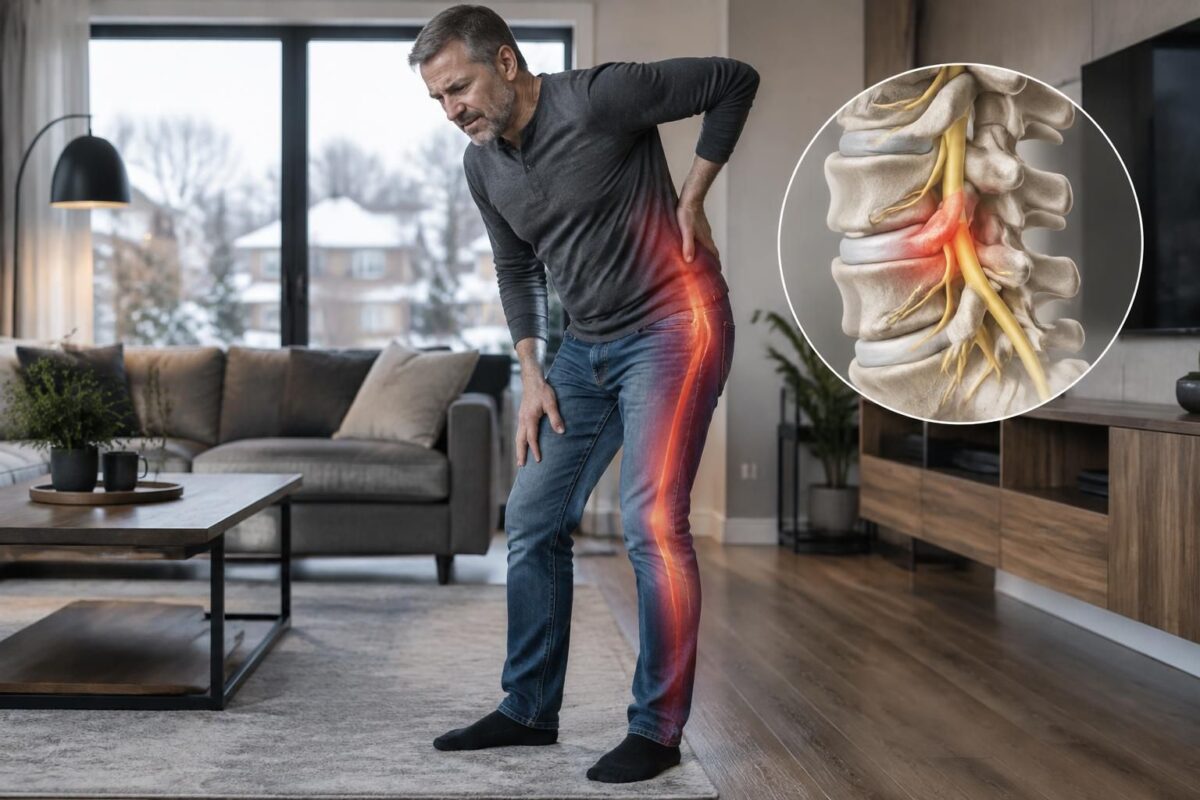
IN BRIEF
| The L4-L5 sciatica often corresponds to irritation of the L5 nerve root, sometimes related to a disc herniation. It can cause pain from the lower back to the buttock, the side of the leg, and the top of the foot, with tingling or difficulty lifting the foot. In Terrebonne, an evaluation helps to better understand these symptoms and guide the next steps according to the situation. |
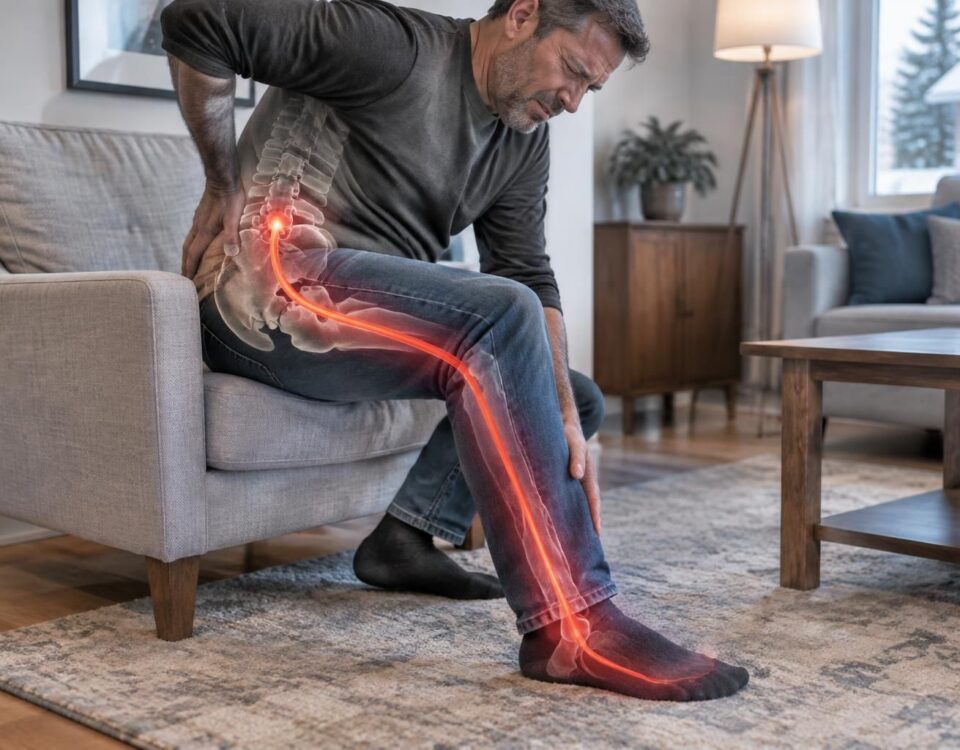
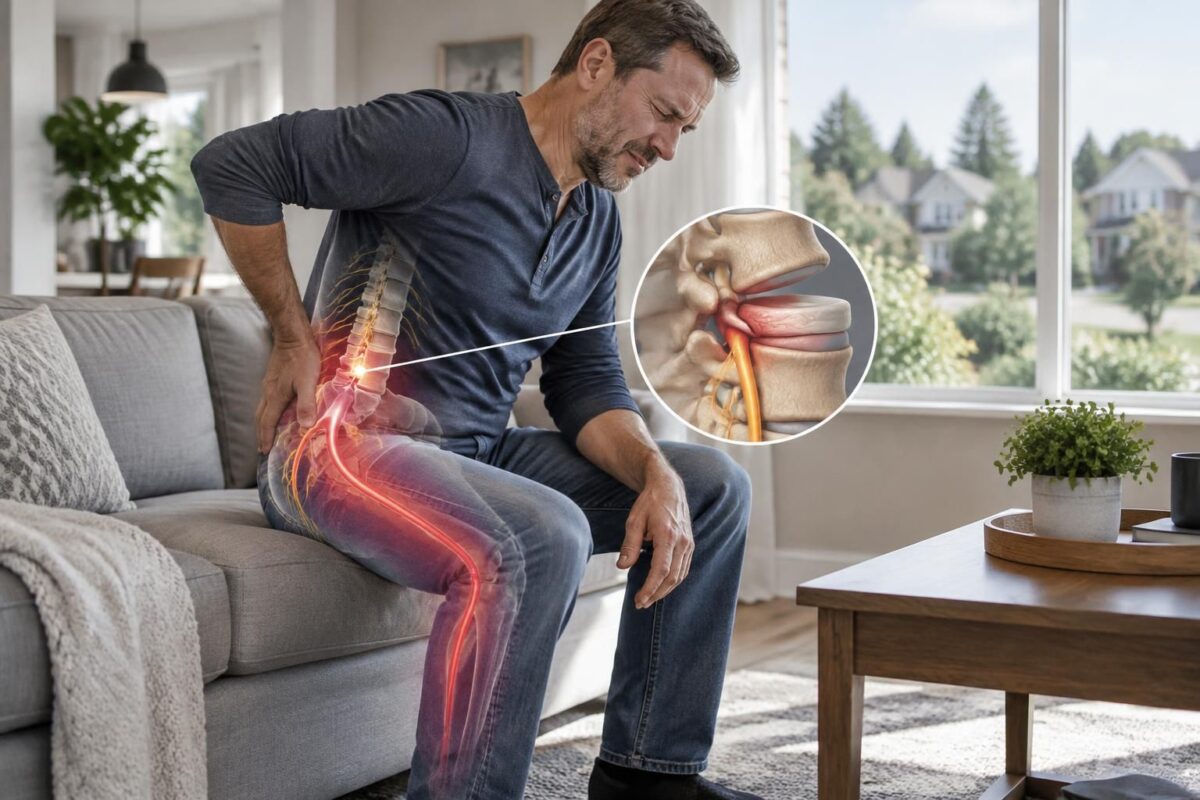
Irritation of the L5 nerve root, sometimes associated with a disc herniation between L4 and L5, can cause pain that starts from the lower back or buttock and travels down the side of the leg to the top of the foot or the big toe. Tingling, numbness, or weakness when lifting the foot may also occur. Symptoms vary from person to person: evaluation by a healthcare professional is necessary to determine the cause.
Consult quickly in cases of significant or progressive weakness, loss of bladder or bowel control, or numbness in the saddle area. This information is educational and does not replace medical advice.
Irritation of the L5 nerve root near the L4-L5 disc can cause pain that starts from the lower back, passes through the buttock, and travels down the leg to the top of the foot or the big toe. Symptoms vary according to the cause and the person. This article explains possible signs, situations requiring prompt attention, and options to discuss with a healthcare professional in Terrebonne. Sciatica, also called sciatalgia, refers to pain related to irritation or compression of a nerve root contributing to the sciatic nerve. The sciatic nerve transmits sensory and motor information between the lower back and part of the leg and foot. When a problem affects the disc located between the L4 and L5 vertebrae, the L5 root may be irritated. An L4-L5 disc herniation is a possible cause, but it does not explain all leg pain. Stenosis around the nerve or other lumbar issues can also produce similar symptoms. The level of the spine and the affected nerve root are not always the same. An L4-L5 herniation often affects the L5 root, but the specific location of the herniation can change the affected root. Clinical examination helps interpret the pain pathway and other signs. For an overview of symptoms associated with lumbar levels, consult this article on L4-L5 and L5-S1 sciatica in Terrebonne. Pain may start in the lower back or buttock, then follow the back or side of the thigh and the outer part of the leg. It may reach the top of the foot and the big toe. Some people experience sharp pain, burning, or an electrical shock sensation. Others describe tingling or unusual sensitivity. Pain or tingling on the top of the foot may be consistent with irritation of the L5 root. Discomfort in the big toe may also occur. However, these signs alone are not sufficient to confirm sciatica: a professional must consider all symptoms and the examination. To learn more, read the pages on pain on the top of the foot and the L5 root and on big toe pain possibly related to L5. Nerve involvement can reduce sensitivity in a part of the leg or foot. Some people also notice weakness when lifting the foot or big toe. It can then become difficult to walk on the heels. A foot that drags on the ground or drops while walking requires prompt medical evaluation. Weakness in the thigh or leg can have multiple causes. It does not alone confirm L5 compression. Consult the information on thigh weakness that could be related to the lower back and seek evaluation if the weakness is new or worsens. Pain may remain in the buttock or thigh, or travel down to the foot. It may also be accompanied by low back pain and a feeling of stiffness. Prolonged sitting may aggravate symptoms in some people, while others notice them more while walking, bending, or changing positions. Vibrations and jolts during a vehicle ride can make the pain more sensitive in some people. This factor alone does not identify the cause. You can consult this article on the possible influence of road vibrations on symptoms. Pain in the buttock after sitting for a long time may also have different explanations; see the page on pain in the buttock after prolonged sitting. A doctor or another authorized healthcare professional may ask questions about the onset of pain, its pathway, intensity, and activities that modify it. The examination may include checking strength, sensitivity, and reflexes. Certain maneuvers may also help see if a movement reproduces the pain in the leg. Imaging such as MRI is not necessary in all cases. The professional may request it if symptoms persist, if the examination raises concern, or if the results can guide management. An image must be interpreted alongside the symptoms: the presence of a disc abnormality does not automatically prove it causes the pain. The spine surgery page on lumbar L4-L5 disc herniation provides additional information on this level of the spine. For a general explanation of sciatica, you can also consult the resources from Doctissimo, TousOrtho, and recommendations on sciatica. Seek urgent medical help in the case of loss of bladder or bowel control, new difficulty urinating, numbness in the area between the legs, or significant or progressive weakness in the leg or foot. Rapidly worsening pain, accompanied by fever or occurring after trauma, also requires immediate evaluation. Consult a professional if the pain persists, limits your activities, or recurs regularly. An evaluation allows for checking nerve signs, ruling out other causes, and determining if further examination or medical advice is needed. Care depends on the cause, the intensity of symptoms, and the results of the assessment. The healthcare professional can discuss pain management, medical follow-up, and options suited to your situation. Do not start or modify a medication treatment without consulting an authorized professional. At the TAGMED Clinic, an evaluation can help determine if the services offered, such as specific osteopathy or motorized neurovertebral decompression, are right for you. These approaches do not replace a medical diagnosis and are not suitable for everyone. The decision should consider your symptoms and health history. To get information about the sciatica treatment in Terrebonne, check the available services and request an evaluation. Sylvain Desforges, B.Sc., D.O., N.D., Doctor of Osteopathy, is the founding president of TAGMED and the ACMA association. He dedicates his practice to chronic pain of the spine, lower back pain, and pain compatible with sciatica, particularly when the pain radiates to the buttock, leg, calf, foot, or toes. Through SOS Sciatica, he publishes educational content on the symptoms of sciatica, possible causes such as herniated discs, disc compression, foraminal stenosis, or irritation of a lumbar nerve root, as well as non-surgical approaches that may be considered based on the assessment. At TAGMED Clinic, care may include, depending on the case, motorized neurovertebral decompression, specific osteopathy, or precision tapping. For an evaluation related to sciatica treatment in Montreal / Mont-Royal or sciatica treatment in Terrebonne, check the available services at the TAGMED Clinic. The information published on SOS Sciatique is provided for educational purposes and does not replace a consultation, diagnosis, opinion, or treatment performed by a doctor or another authorized healthcare professional. The author of this article is neither a doctor nor a specialist in a medical specialty recognized by the Collège des médecins du Québec. The approaches of osteopathy, manual medicine, or functional support described on this site do not constitute medical acts and are not intended to replace medical follow-up. Consult a doctor or emergency service in case of loss of bowel or bladder control, numbness in the saddle area, significant or progressive weakness in the leg or foot, fever, recent trauma, severe pain, or rapid deterioration. For more details, please read our Legal notice. Medical disclaimer: The information and advice provided on this site do not replace the advice, diagnosis, or treatment of a healthcare professional. Please note that Sylvain Desforges, B.Sc., D.O., N.D., Doctor of Osteopathy, is neither a doctor of medicine nor a physician, and is not a specialist in a medical specialty as defined by the Collège des médecins du Québec. Manual medicine, functional medicine, and sports medicine as described on this site exclude any treatment or medical diagnosis made by a physician or specialist. Always consult your doctor for any medical questions. For more details, please read our complete Legal Notice.L4-L5 Sciatica: what does this term mean?
What symptoms can appear with L5 involvement?
Pain on the top of the foot or the big toe
Tingling, numbness, or weakness
Why can symptoms vary?
How is the origin of the pain assessed?
When should you seek urgent care?
What management options can be discussed in Terrebonne?
About the author
Medical disclaimer
Sciatica L4-L5 in Terrebonne: possible symptoms
A L4-L5 disc injury may irritate the L5 nerve root. The signs vary from person to person and should be assessed by a healthcare professional.
Pain and sensations
- Lower back pain radiating to the buttock.
- Pain in the side or back of the thigh and the side of the calf.
- Sharpness or shocks all the way to the top of the foot or the big toe.
- Tingling, numbness, or decreased sensitivity.
Strength and signs to watch
- Possible difficulty lifting the foot or big toe.
- Walking on the heels may sometimes be more difficult.
- Symptoms may be limited to part of the pathway.
- Consult urgently in case of progressive weakness, loss of bowel or bladder control, or numbness in the saddle area.

Pain that starts from the lower back and radiates down into the buttock or leg may suggest sciatica. When a disc between the L4 and L5 vertebrae irritates a nerve root, the symptoms may follow the territory of the L5 root, but their pathway and intensity vary from person to person. In Terrebonne, a professional evaluation can help clarify the cause of the pain and determine the appropriate next steps for your situation.
Sciatica in Terrebonne: disc protrusion or disc herniation?
IN BRIEF A disc bulge is a swelling of the disc, while a herniated disc involves a more pronounced protrusion of its contents; both can irritate a nerve root and cause sciatica. Symptoms alone do not always allow for distinction…
What does L4-L5 related sciatica mean?
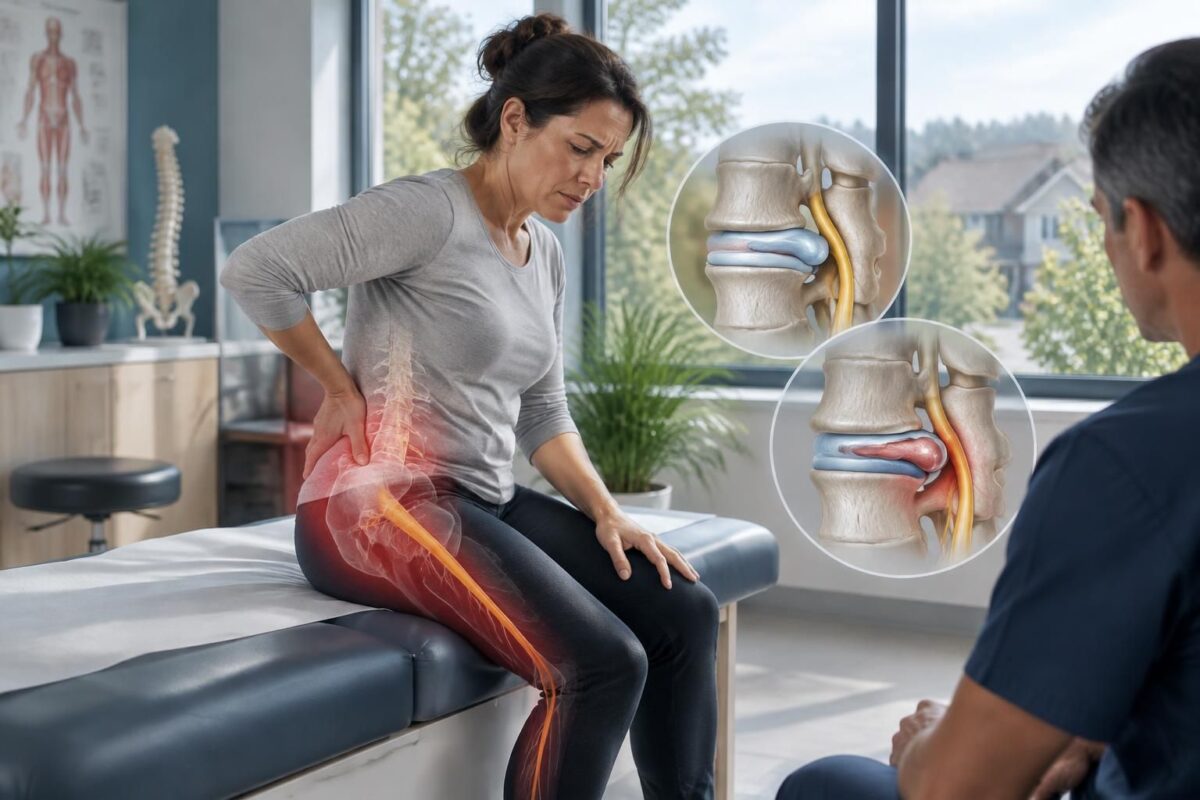
Sciatica refers to pain associated with the irritation or compression of a nerve root contributing to the sciatic nerve. A herniated disc at the L4-L5 level can particularly irritate the L5 root. However, an MRI image or the location of pain alone is not sufficient to establish a diagnosis: the assessment takes into account the symptoms, their progression, and the clinical examination.

Sciatica disc in Terrebonne: why the pain travels down the leg
IN SHORT The disc-related sciatica occurs when a lumbar disc irritates a nerve root, which can cause pain to radiate down the buttock and leg. In Terrebonne, an assessment helps to better understand the cause of the symptoms and consider…
What symptoms can appear?
Pain radiating in the leg
Pain may start in the lower back or buttock, then radiate down the back or side of the thigh and calf. In the case of irritation of the L5 root, it may extend to the top of the foot and the big toe. Some people describe a burning sensation, sharpness, or electric shocks. Others feel pain limited to part of the nerve pathway, without complete radiation.
Tingling, numbness, or weakness
Tingling, decreased sensitivity, or numbness may accompany the pain. More marked involvement may also lead to weakness, such as difficulty lifting the foot or big toe. These symptoms deserve particular attention, especially if they appear recently, worsen, or disrupt walking.

L4-L5 disc herniation and sciatica in Terrebonne: pain towards the foot
IN BRIEF A L4-L5 disc herniation can irritate a nerve root and cause sciatica, with pain that radiates from the buttock down to the leg or foot. In Terrebonne, an evaluation helps better understand the origin of the symptoms and…
How to react and obtain an evaluation in Terrebonne?
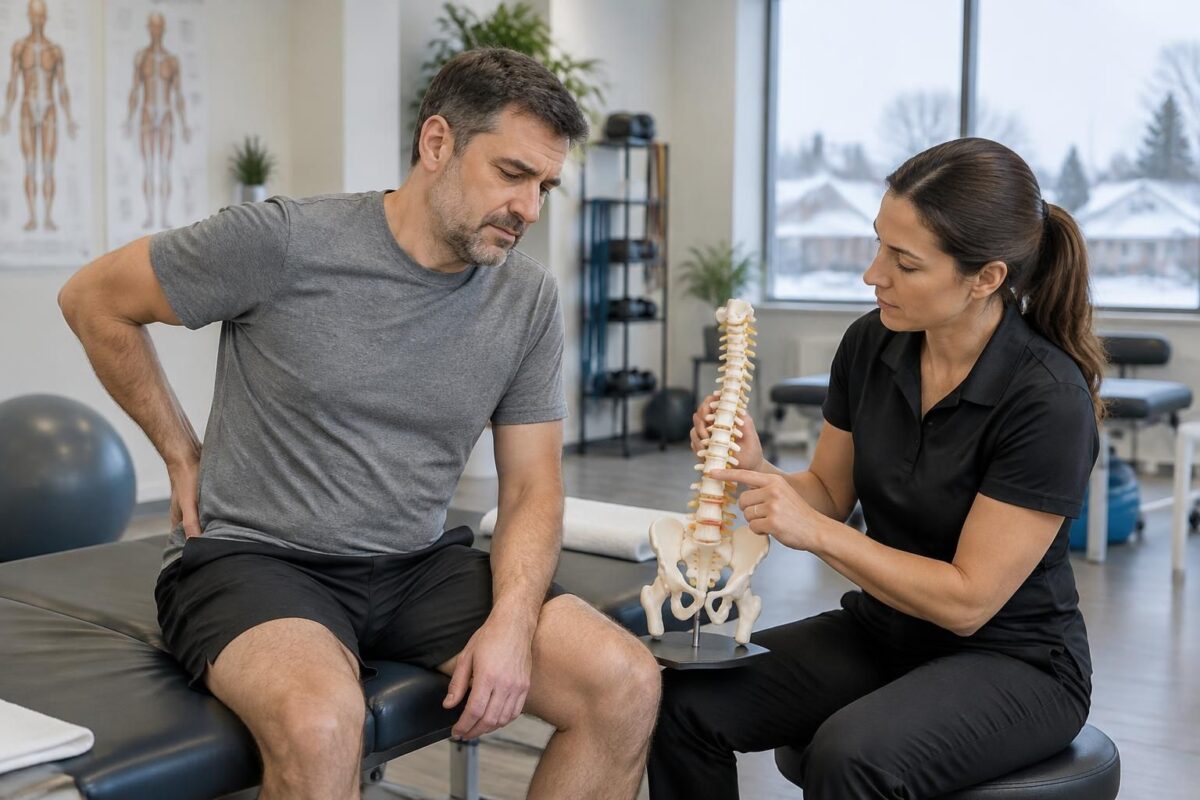
If pain persists, recurs frequently, or limits your activities, make an appointment with a healthcare professional to discuss it. The doctor can assess strength, sensitivity, and reflexes, then determine if tests, like imaging, are useful. An osteopathy consultation can also help examine movement and functional factors, without replacing a medical diagnosis or the care indicated by a doctor.
While waiting for an opinion, avoid staying in bed for long if it’s not necessary. Gradually resume tolerated movements, like short walks, and vary positions while sitting. Avoid forcing a stretch or exercise that significantly increases pain. Possible approaches depend on the evaluation and your health status. At TAGMED Clinic in Terrebonne, an assessment can allow discussion of available support options based on your situation.

Lumbar disc herniation L5-S1 and sciatica in Terrebonne: common symptoms
IN BRIEF A L5-S1 disc herniation can irritate a nerve root and cause sciatica: lower back pain radiating to the buttock or leg, tingling, numbness, or weakness. In Terrebonne, an assessment helps to better understand the symptoms and guide management…
When to seek urgent care?
Consult immediately if you have a loss of bladder or bowel control, new difficulty urinating, numbness in the saddle area, or significant or progressive weakness in the leg or foot. Pain that rapidly intensifies, fever, or pain after a trauma also requires prompt medical advice.
Sciatica and herniated disc in Terrebonne: understanding the link
IN BRIEF Sciatica refers to pain that follows the path of the nerve in the buttock and leg; a herniated disc can irritate it, but an anomaly on the MRI is not sufficient to establish the cause. In Terrebonne, the…
About the author
Sylvain Desforges, B.Sc., D.O., N.D., Doctor of Osteopathy, is the founding president of TAGMED and the ACMA association. His practice focuses on chronic spinal pain, lower back pain, and pain compatible with sciatica. The content published by SOS Sciatique is educational and does not replace a consultation or medical diagnosis.
Medical Warning: the author is neither a physician nor a specialist in a medical specialty recognized by the Collège des médecins du Québec. Osteopathy and functional support approaches do not replace medical follow-up. In the presence of emergency signs, consult a doctor or an emergency service.
| Possible Sign | Concise Manifestation |
|---|---|
| Pain Pathway | From the lower back to the buttock, then the back-external side of the thigh and calf. |
| Foot and Toes | Pain or tingling may reach the top of the foot and the big toe. |
| Sensitivity | Numbness or decreased sensitivity along the pathway associated with the L5 root. |
| Foot Strength | Possible difficulty lifting the foot or walking on the heels. |
| Walking | A foot that catches or drops can alter the gait and increase the risk of falling. |
| Lower Back Pain | Pain in the lower back may accompany radiation into the leg. |
| Variation of Symptoms | Pain may be intermittent, persistent, or limited to a part of the nerve pathway. |
| Emergency Signs | Progressive weakness, loss of bladder or bowel control, or numbness in the saddle area: consult without delay. |
Sciatica in Terrebonne: lumbar roots and the choice of a cautious treatment
IN BRIEF Sciatica is pain related to the irritation or compression of a lumbar nerve root, which can radiate from the lower back to the buttock and leg. In Terrebonne, an evaluation allows for cautious treatment tailored to the cause…
L4-L5 Sciatica in Terrebonne: Illustrative Testimonials to Understand Possible Symptoms
The narratives below are composite examples for educational purposes. They do not come from identifiable patients and do not constitute verified testimonials from TAGMED Clinic. Pain that follows the pathway of the sciatic nerve may have various causes: only a healthcare professional can evaluate the situation.
“The pain started from the lower back and went down the leg”
In this example, the person describes lower back pain that radiates into the buttock, then to the side or back of the thigh and the outer side of the leg. An injury to the disc between L4 and L5 can irritate the L5 nerve root, but the trajectory of the pain is not enough to confirm the level involved.
“I had tingling on the top of my foot”
Another illustrative story mentions tingling or decreased sensitivity on the top of the foot, sometimes extending to the big toe. These sensations may accompany nerve irritation; they warrant evaluation, especially if they persist, extend, or intensify.
“Lifting my foot became more difficult”
In some situations, an injury to the L5 root may be accompanied by weakness in lifting the foot or toes. A new difficulty walking on the heels or a foot that trips on the ground should be taken seriously and evaluated promptly by a healthcare professional.
“The pain did not extend to the foot”
Symptoms do not always follow a complete pathway. Pain related to sciatica may be limited to the buttock, thigh, or calf. Low back pain may also be present, with stiffness hindering certain movements. Thus, the absence of pain down to the toes does not exclude nerve irritation.
“I didn’t know if it was sciatica or something else”
This is common: several issues can cause pain in the lower back, buttock, or leg. The healthcare professional takes into account the history of symptoms and the clinical examination. Imaging tests may be considered based on the duration, progression of symptoms, and observed signs; they are not necessary in all situations.
In Terrebonne, an evaluation can help better understand the symptoms and determine appropriate next steps. At TAGMED Clinic, the proposed approaches depend on the evaluation and do not replace a diagnosis or medical follow-up. Care may include, as applicable, specific osteopathy, motorized neurovertebral decompression, or precision percussion.
Consult a doctor or an emergency service quickly in case of loss of bladder or bowel control, numbness in the saddle area, significant or progressive weakness in the leg or foot, fever, recent trauma, or rapid worsening of pain.
About the author
Sylvain Desforges, B.Sc., D.O., N.D., Doctor of Osteopathy, is the founding president of TAGMED and the ACMA association. His practice is dedicated especially to chronic spinal pain, lower back pain, and pain compatible with sciatica.
Through SOS Sciatique, he publishes educational content on sciatica symptoms, their possible causes — including disc herniation, disc pinching, foraminal stenosis, or irritation of a lumbar nerve root — as well as non-surgical approaches that may be considered based on the evaluation.
Medical Warning
The information presented is provided for educational purposes. It does not replace a consultation, diagnosis, advice, or treatment by a doctor or another licensed healthcare professional. The author is neither a physician nor a specialist in a medical specialty recognized by the Collège des médecins du Québec. Approaches involving osteopathy, manual medicine, or functional support do not constitute medical acts and are not intended to replace medical follow-up.
The L4-L5 sciatica refers to nerve pain that can occur when a structure in the lumbar region irritates or compresses a nerve root. A disc herniation between the L4 and L5 vertebrae can particularly affect the L5 root, but other causes are possible. The level and exact origin of the symptoms cannot be determined from the pain alone: an assessment by a healthcare professional is necessary.
The sciatic nerve originates from nerve roots in the lower back and descends to the buttock, leg, and foot. When the L5 root is irritated, the pain can start from the lower back, cross the buttock, and then follow the side or back of the thigh and leg. It may also be felt on the top of the foot or near the big toe. Some people feel pain in only a part of this path, without it reaching the foot.
The sensations described vary: sharp pain, burning, stabbing, or a feeling of electric shock. Pins and needles, numbness, or decreased sensitivity may accompany the pain. In some cases, a person notices weakness when lifting the foot or big toe, or has difficulty walking on their heels. These manifestations are not identical in everyone and cannot, by themselves, confirm an L4-L5 herniation.
Symptoms may be influenced by movements, prolonged positions, or exertion, but their triggers differ from person to person. Lower back pain may also be present: when back pain is accompanied by pain radiating into the leg, it is often referred to as lumbosciatica. However, pain resembling sciatica may have other origins; clinical examination helps guide the assessment and determine if further tests are relevant.
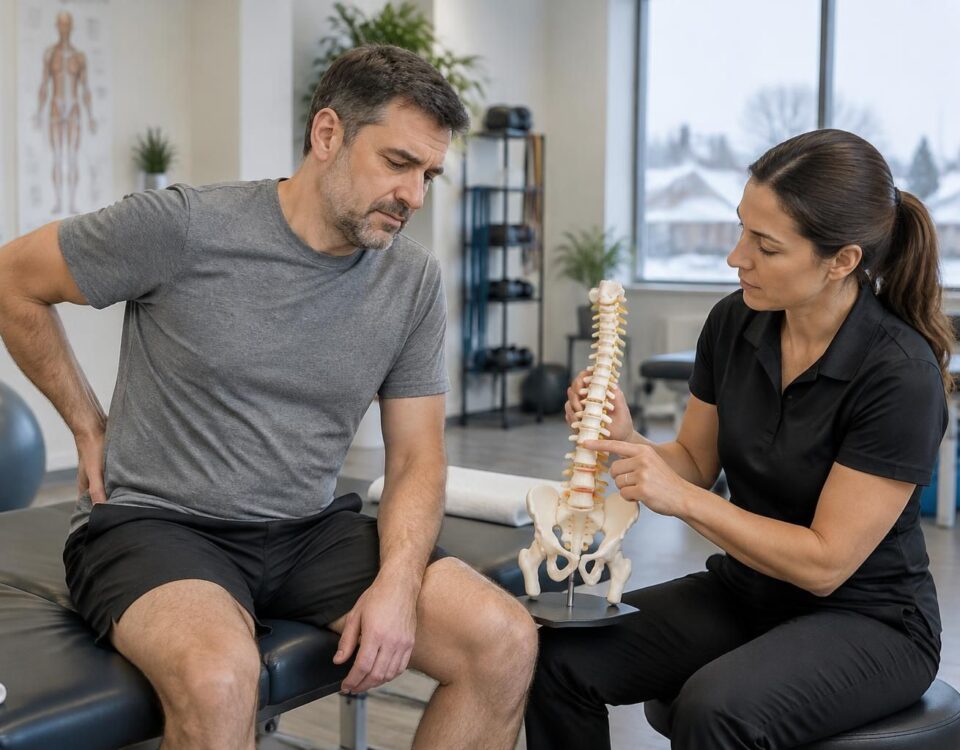
In Terrebonne, a cautious approach involves having persistent, recurrent, or activity-limiting pain assessed by a doctor or a licensed healthcare professional. Depending on the observed signs, the evaluation may include questions about the pain pathway, sensitivity, and strength of the leg. Imaging, such as an MRI, is not necessary in every situation; its indication notably depends on the progression and clinical signs.
Sylvain Desforges, B.Sc., D.O., N.D., is an osteopath and founding president of TAGMED and the ACMA association. His practice focuses particularly on chronic spinal pain, lower back pain, and symptoms compatible with sciatica. At the TAGMED Clinic, support options may include, depending on the assessment and situation, specific osteopathy, motorized neurovertebral decompression, or precision percussion. These approaches do not replace a medical diagnosis and are not necessarily suitable for all causes of pain.
Consult a doctor or emergency service without delay in cases of loss of bladder or bowel control, numbness in the saddle area, significant or progressive weakness in the leg or foot, fever, recent trauma, or rapid deterioration. These signs require priority evaluation.
Medical Warning: this information is educational and does not replace consultation, diagnosis, or treatment by a licensed healthcare professional. The author is neither a physician nor a specialist in a medical specialty recognized by the Collège des médecins du Québec. Osteopathy care and manual approaches do not constitute medical acts.
A sciatica associated with an L4-L5 disc herniation can irritate the L5 nerve root and cause pain that starts from the lower back or buttock, then often descends on the side of the leg to the top of the foot or the big toe. In Terrebonne, an evaluation by a healthcare professional helps clarify the cause of the symptoms and determine appropriate next steps, without presuming that a herniation is necessarily responsible.

Sciatica in Terrebonne: how to interpret pain according to the leg path
IN BRIEF Sciatica is a pain that can start from the lower back or the buttock and travel down the leg to the foot. Its path, along with any tingling or weakness, helps guide the assessment but is not sufficient…
L4-L5 Sciatica in Terrebonne: Symptoms Overview
At the L4-L5 level, a disc injury can affect the L5 root. Possible manifestations include pain in the buttock and on the side or back of the thigh, sometimes extending to the side of the leg and the top of the foot. Pins and needles, numbness, or unusual sensitivity may also occur. However, the pathway varies from person to person and does not alone confirm the level reached.
Pain radiating below the knee, symptoms mainly on one side, or unusual sensations in the toes can help describe the problem during a consultation. To better understand these manifestations, consult our pages on pain radiating below the knee in Terrebonne, sciatica felt on one side, and pins and needles in the toes and the nerve pathway.
Weakness deserves special attention. New difficulty in lifting the foot or walking on the heels may be a sign of motor impairment; weakness in the calf or difficulties in rising on the toes should also be reported. To learn more, consult the information on calf weakness and sciatica symptoms to monitor.

Sciatica in Terrebonne: L5-S1, canal, foramen and nerve compression
IN BRIEF The sciatica L5-S1 corresponds to irritation or compression of a nerve root, sometimes related to a disc herniation or narrowing of the lumbar canal or the foramen. The pain may radiate from the lower back to the buttock,…
Evaluation and Options to Discuss
Pain may be related to a disc herniation, but other lumbar factors may also be at play. A clinical evaluation allows for clarification of the pain pathway, sensitivity, and strength, and then determines if additional tests are relevant. The relationship between nerve roots and sciatica symptoms can help understand why manifestations differ depending on the affected area. For more details, also see information on central disc herniation and sciatica pain and L4-L5 lumbar discopathy.
Care depends on the intensity of symptoms, their progression, and the results of the evaluation. Depending on the situation, a professional may discuss measures aimed at maintaining tolerable activity, adapted exercises, or other care options. Manual approaches do not replace a medical diagnosis and may not be suitable for all causes of pain. General resources are also available on sciatica treatment in Terrebonne and in this overview of sciatica.
Quickly consult a doctor or an emergency service in case of significant or progressive weakness, loss of urinary or bowel control, numbness in the saddle area, fever, recent trauma, or rapid aggravation. An urgent evaluation is also indicated if the pain becomes severe or if new symptoms appear.
About the author
Sylvain Desforges, B.Sc., D.O., N.D., Doctor of Osteopathy, is the founding president of TAGMED and the ACMA association. He dedicates his practice to chronic spinal pain, lower back pain, and pain compatible with sciatica, particularly when the pain radiates down to the buttock, leg, calf, foot, or toes.
Through SOS Sciatique, he publishes educational content on sciatica symptoms, possible causes—including disc herniation, disc pinching, foraminal stenosis, or irritation of a lumbar nerve root—and non-surgical approaches that may be considered based on the evaluation. At TAGMED Clinic, care may include, depending on the case, motorized neurovertebral decompression, specific osteopathy, or precision impactor.
For an evaluation related to sciatica treatment in Montreal / Mont-Royal or sciatica treatment in Terrebonne, consult the services available at TAGMED Clinic.
Medical disclaimer
The information published on SOS Sciatique is provided for educational purposes and does not replace a consultation, diagnosis, opinion, or treatment performed by a physician or another authorized health professional. The author of this article is neither a physician nor a specialist in a medical specialty recognized by the Collège des médecins du Québec. The osteopathy, manual medicine, or functional support approaches described on this site do not constitute medical acts and are not intended to replace medical follow-up.
Consult a doctor or an emergency service in case of loss of urinary or bowel control, anesthesia in the saddle area, significant or progressive weakness of the leg or foot, fever, recent trauma, severe pain, or rapid aggravation. For more details, please read our Legal Notice.

Sylvain Desforges, B.Sc., D.O., N.D., docteur en ostéopathie
Dr Sylvain Desforges, B.Sc., D.O., N.D., osteopath, is the founding president of TAGMED and of the ACMA association. He dedicates his practice to chronic spinal pain, low back pain and symptoms compatible with sciatica, particularly when pain radiates toward the buttock, leg, calf, foot or toes.
Through SOS Sciatique, he publishes educational content on sciatica symptoms, possible causes such as disc herniation, disc narrowing, foraminal stenosis or irritation of a lumbar nerve root, as well as non-surgical approaches that may be considered according to the evaluation. At Clinique TAGMED, care may include, depending on the case, motorized neurovertebral decompression, specific osteopathic care or precision percussion.
For an evaluation related to sciatica treatment in Montreal / Mount Royal or sciatica treatment in Terrebonne, please consult the services available at Clinique TAGMED.
Medical disclaimer
The information published on SOS Sciatique is provided for educational purposes only and does not replace a consultation, diagnosis, opinion or treatment provided by a physician or another authorized healthcare professional. The author of this article is neither a medical doctor nor a specialist in a medical specialty recognized by the Collège des médecins du Québec. The osteopathic, manual medicine or functional support approaches described on this site do not constitute medical acts and are not intended to replace medical follow-up.
Consult a physician or emergency service in cases of loss of bladder or bowel control, anesthesia in the saddle area, significant or progressive weakness in the leg or foot, fever, recent trauma, severe pain or rapid worsening of symptoms. For more details, please read our Legal Notice.