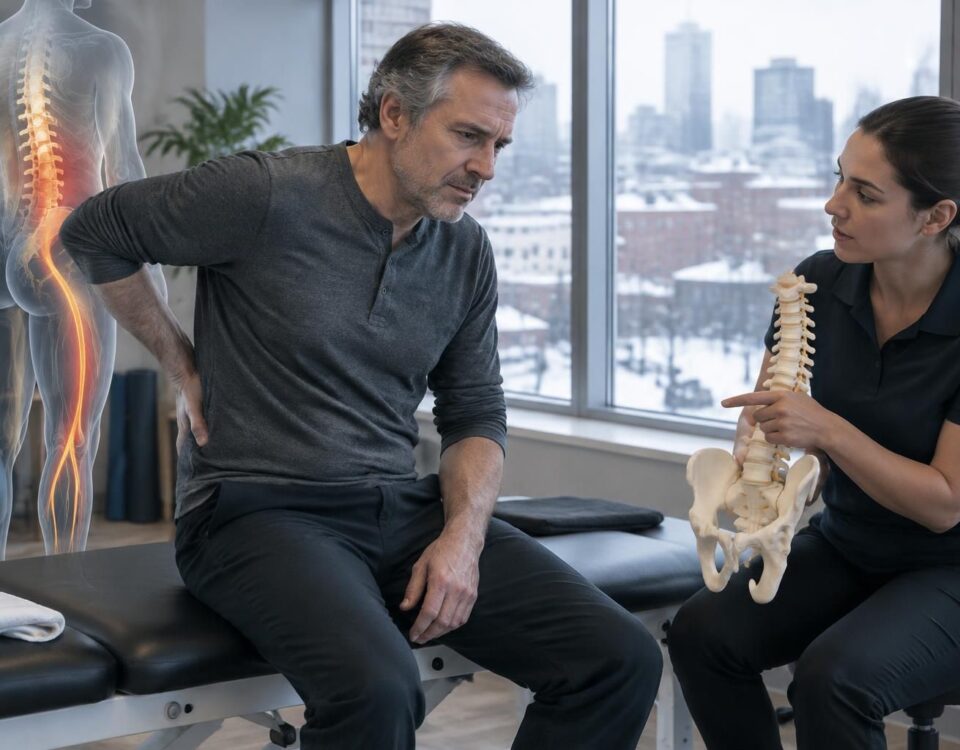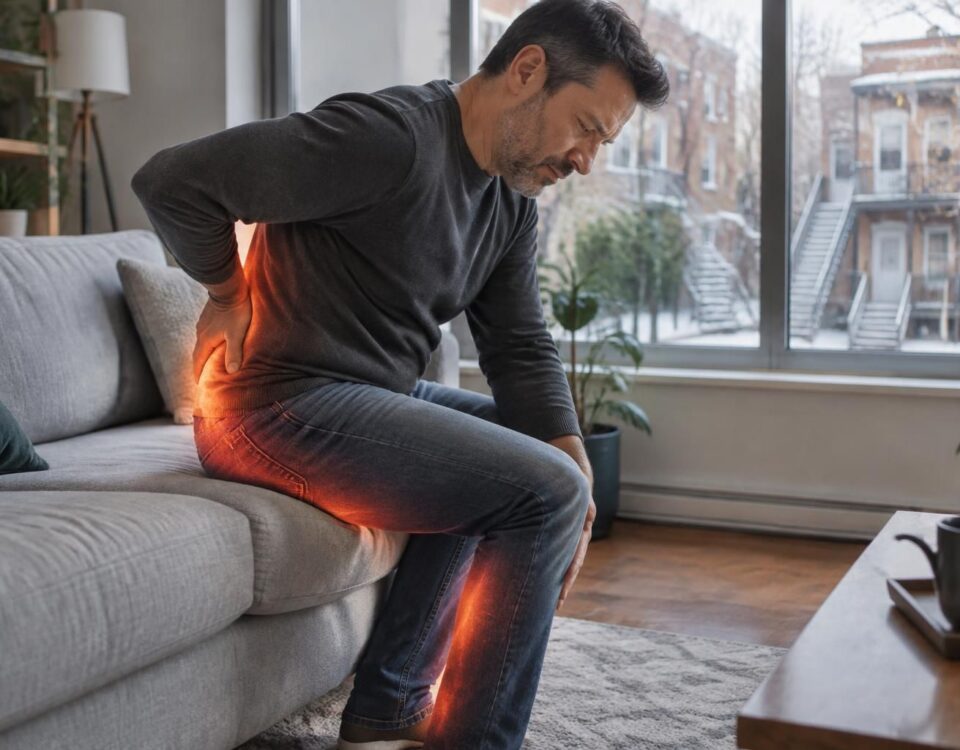


Sciatica and stationary bike: useful or aggravating depending on the case
12/10/2026
Sciatica L5-S1 in Terrebonne: why the pain can radiate down to the foot
13/10/2026
IN BRIEF
| The L5-S1 sciatica refers to pain related to the irritation of a lumbar nerve root, which can start from the lower back and descend into the buttock, leg, and down to the foot. An L5 involvement may affect the top of the foot, while an S1 involvement may radiate to the calf, heel, or outer edge of the foot. Identifying this pathway helps guide assessment and appropriate care. In Montreal, consult a healthcare professional to determine the cause of your symptoms. |
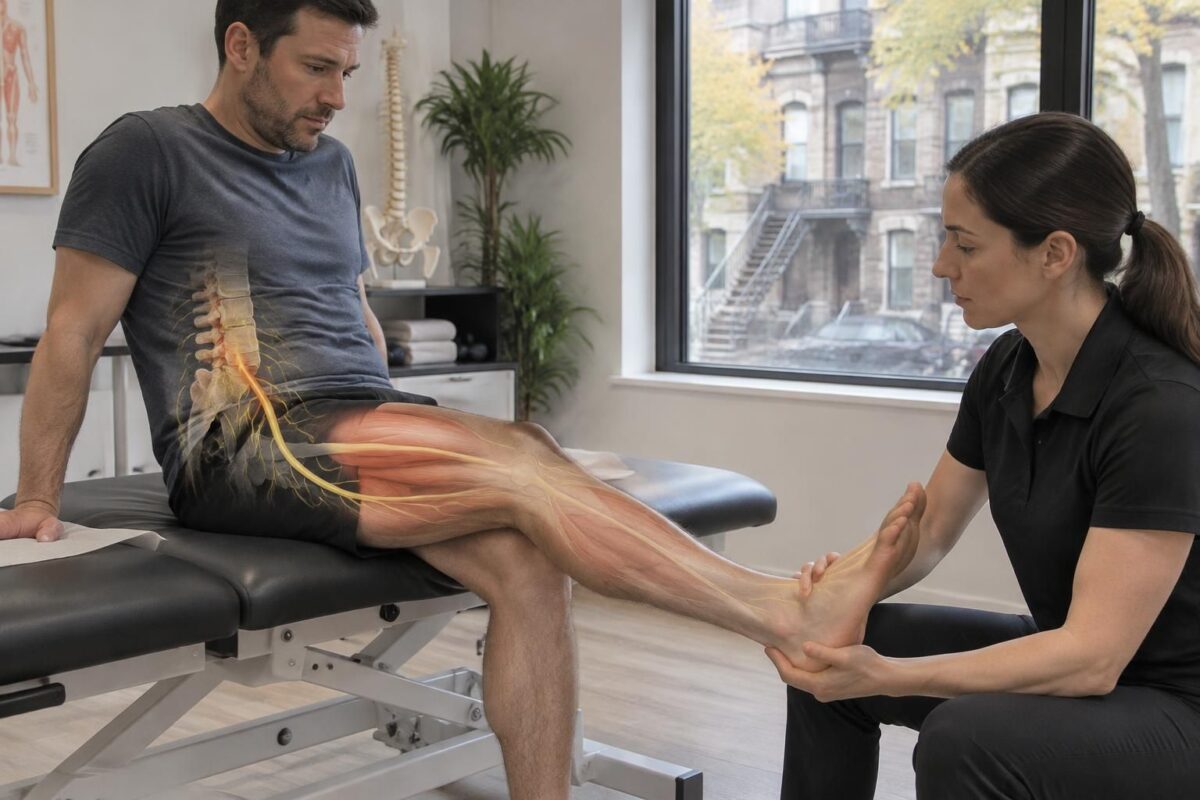
A L5-S1 sciatica can cause pain to extend down to the foot because the nerve roots in the lower back contribute to the path of the sciatic nerve. When a root is irritated or compressed, the pain can radiate into the buttock and leg: an L5 involvement is often felt on the top of the foot, while an S1 involvement may reach the heel or the outer edge of the foot. A healthcare professional in Montreal can evaluate your symptoms. Consult quickly if you notice progressive weakness or urinary or intestinal issues.
A pain that starts from the lower back, passes through the buttock, and descends down to the foot can follow the path of an irritated nerve root in the lumbar region. In Montreal, a pain called L5-S1 may also be accompanied by burning, tingling, or numbness in the leg and foot. The pathway of symptoms provides clues, but only a healthcare professional can determine their cause.
The term sciatica describes pain that follows the path of the sciatic nerve. This large nerve is formed from nerve roots located in the lower back, crosses the buttock, and descends into the leg. Irritation or compression near the spine can therefore cause sensations further down, sometimes even in the foot or toes.
The mention of L5-S1 refers to the area between the fifth lumbar vertebra and the first sacral vertebra. Irritation of the nerve roots at this level can produce radiating pain. However, symptoms alone do not confirm which structure is involved. A clinical evaluation can help clarify the situation and determine if further examinations are needed.
How does lumbar pain reach the foot?
The lumbar and sacral nerve roots contribute to the formation of the sciatic nerve. If a root is irritated, the pain can follow a part of its territory in the buttock, thigh, calf, or foot. Thus, pain felt in the foot does not always mean the problem is located in the foot.
To better visualize this pathway, consult this page on sciatica pathways and symptoms. The path varies depending on the affected root and from person to person.
What symptoms can accompany L5-S1 sciatica?
The pain can be dull, burning, sharp, or similar to an electric shock. Some people also experience tingling, a less sensitive area, or a feeling of heaviness in the leg. Symptoms often affect one side only, but their location and intensity can vary.
When the L5 root is irritated
An involvement of the L5 root can cause pain that goes through the buttock and the outer side of the thigh, then descends towards the shin and the top of the foot. Unusual sensations may also affect the big toe. This pathway constitutes a clue to communicate during an evaluation but is not sufficient to establish a diagnosis.
When the S1 root is irritated
An involvement of the S1 root may be accompanied by pain in the buttock and the back of the thigh or calf. It can extend to the heel or the outer edge of the foot. To learn more about this situation, consult the information regarding L5-S1 foraminal stenosis and sciatica.
Weakness or loss of sensation
New or progressive weakness in the leg or foot deserves prompt medical attention. The same goes if the foot catches on the ground or if walking becomes difficult. To learn about the signs to watch for in the calf, consult this article on calf weakness associated with sciatica. A loss of sensation in the toes is also a symptom that should be reported: see information on toe sensitivity.

Herniated Disc L5-S1 and Sciatica in Montreal: Common Symptoms
IN BRIEF A L5-S1 disc herniation is a displacement of the disc located between the last two lumbar vertebrae and the sacrum; if it irritates a nerve root, it can cause sciatica. The pain often radiates from the buttock down…
What causes can irritate an L5 or S1 nerve root?
Several causes can produce sciatica-like pain. A herniated disc can irritate a nerve root. A narrowing of a passage where the nerve travels, such as foraminal stenosis, can also contribute to symptoms. Joint changes related to wear or other spinal issues may also be considered during evaluation.
Symptoms do not always allow for the exact cause to be identified. Depending on the examination and their duration, a healthcare professional may recommend imaging or other tests. The results must be interpreted alongside the symptoms and clinical examination, as a visible abnormality does not always prove it explains the pain.

Sciatica and disc herniation in Montreal: understanding the link
IN BRIEF Sciatica is a pain that radiates down the leg when a nerve root is irritated; a lumbar herniated disc can be the cause, but is not always responsible. In Montreal, an assessment helps to better understand the symptoms,…
Why do certain positions worsen the pain?
Prolonged sitting, driving, standing, or certain movements can increase discomfort in some individuals. A posture maintained for a long time may make the lumbar region more sensitive, while others may notice worsening when walking or climbing stairs. It is helpful to note activities that change the symptoms and describe them during a consultation.
If pain arises after a long period of sitting, consult this information on pain in the buttock after prolonged sitting. You can also read about pain after prolonged standing and symptoms that appear in the stairs.

Sciatica in Montreal: lumbar roots and choice of a cautious treatment
IN BRIEF Sciatica is pain radiating from the buttock down the leg, often related to irritation of a lumbar root. In Montreal, a careful assessment helps to connect symptoms to function and to choose appropriate management: modified activity, rehabilitation, or…
How is the evaluation of sciatica conducted in Montreal?
The evaluation begins with a discussion about pain: its onset, its path, the positions that modify it, and associated symptoms. The professional can then assess mobility, sensitivity, strength, and some reflexes. These elements help choose the next steps; they do not replace a medical diagnosis when one is necessary.
If the pain persists, worsens, or is accompanied by weakness, a medical evaluation may be indicated. Depending on the context, a doctor may request imaging or nerve and muscle tests. To consult a resource dedicated to the evaluation of sciatica in Montreal, visit the TAGMED Clinic page.

Sciatica in Montreal: how to interpret pain according to the leg path
IN BRIEF Sciatica refers to pain that can follow a nerve root from the lower back to the buttock and the leg. Its path, along with tingling, numbness, or weakness, helps guide the evaluation but is not sufficient to make…
What support options can be considered?
The management depends on the cause, the intensity of symptoms, and the results of the evaluation. It may include medical follow-up and measures tailored to the situation. A manual approach may be considered in some cases after verifying that it is appropriate. It does not replace a diagnosis or medical treatment and is not suitable for everyone.
At TAGMED Clinic, options may include, depending on the evaluation, specific osteopathy or motorized neurovertebral decompression. The choice of an approach must consider symptoms, history, and contraindications. No results or number of sessions can be guaranteed in advance.

Sciatica in Montreal: L5-S1, canal, foramen, and nerve compression
IN BRIEF Sciatica related to L5-S1 can occur when a nerve root is irritated or compressed, particularly due to narrowing of the spinal canal or the foramen, the opening through which the nerve exits the spine. It can cause pain,…
When should you consult quickly?
Consult a doctor or an emergency service immediately in case of loss of bladder or bowel control, numbness in the saddle area, significant or progressive weakness of the leg or foot, fever, recent trauma, severe pain, or rapid worsening. Pain affecting both legs with neurological signs also requires urgent evaluation.
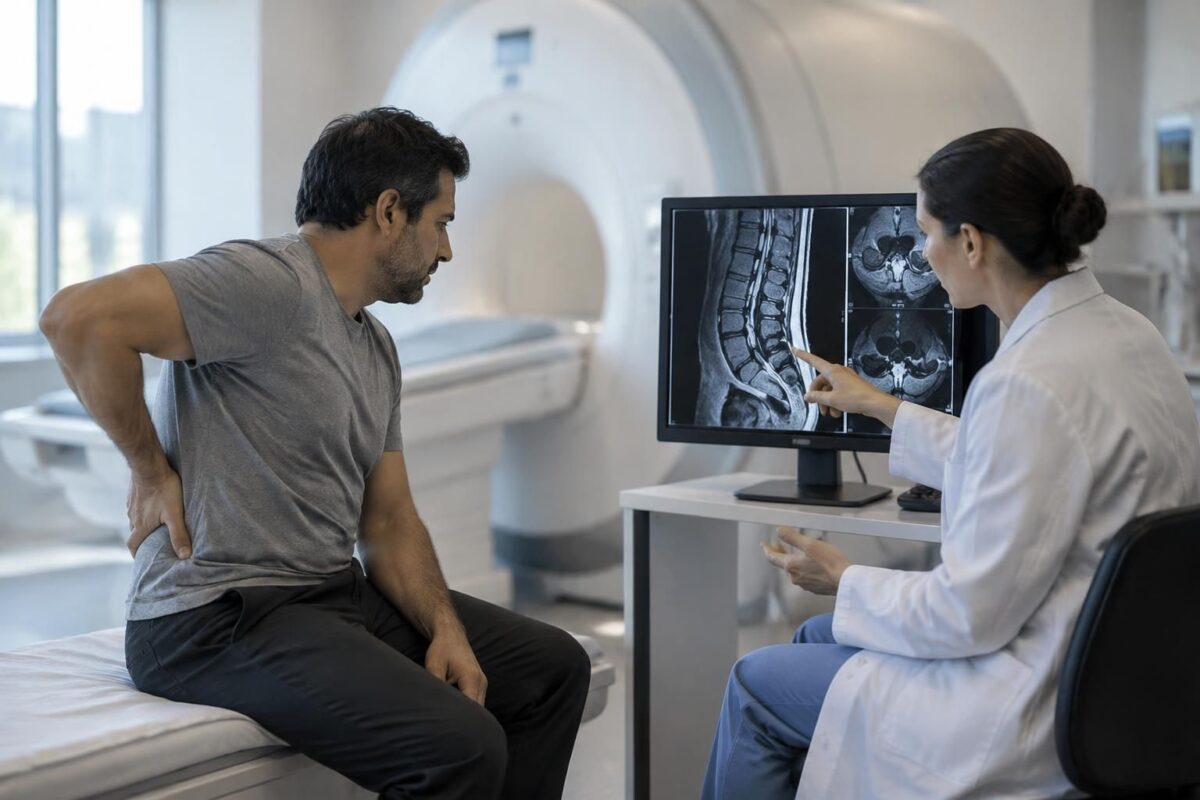
Sciatica in Montreal: why an MRI must be correlated with symptoms
IN BRIEF An MRI for sciatica shows structures in the lower back, but an anomaly alone does not prove the cause of the pain. It must be compared with the symptom pathway, the affected side, and the neurological examination. This…
About the author
Sylvain Desforges, B.Sc., D.O., N.D., Doctor of Osteopathy, is the founding president of TAGMED and the ACMA association. He dedicates his practice to chronic pain of the spine, lower back pain, and pain compatible with sciatica, particularly when the pain radiates down to the buttock, leg, calf, foot, or toes.
Through SOS Sciatique, he publishes educational content on the symptoms of sciatica, its possible causes, such as disc herniation, disc pinching, foraminal stenosis, or irritation of a lumbar nerve root, as well as on non-surgical approaches that may be considered based on the evaluation. At TAGMED Clinic, care may include, depending on the case, motorized neurovertebral decompression, specific osteopathy, or a precision impactor.
For an evaluation related to sciatica treatment in Montreal / Mont-Royal or sciatica treatment in Terrebonne, consult the services available at the TAGMED Clinic.
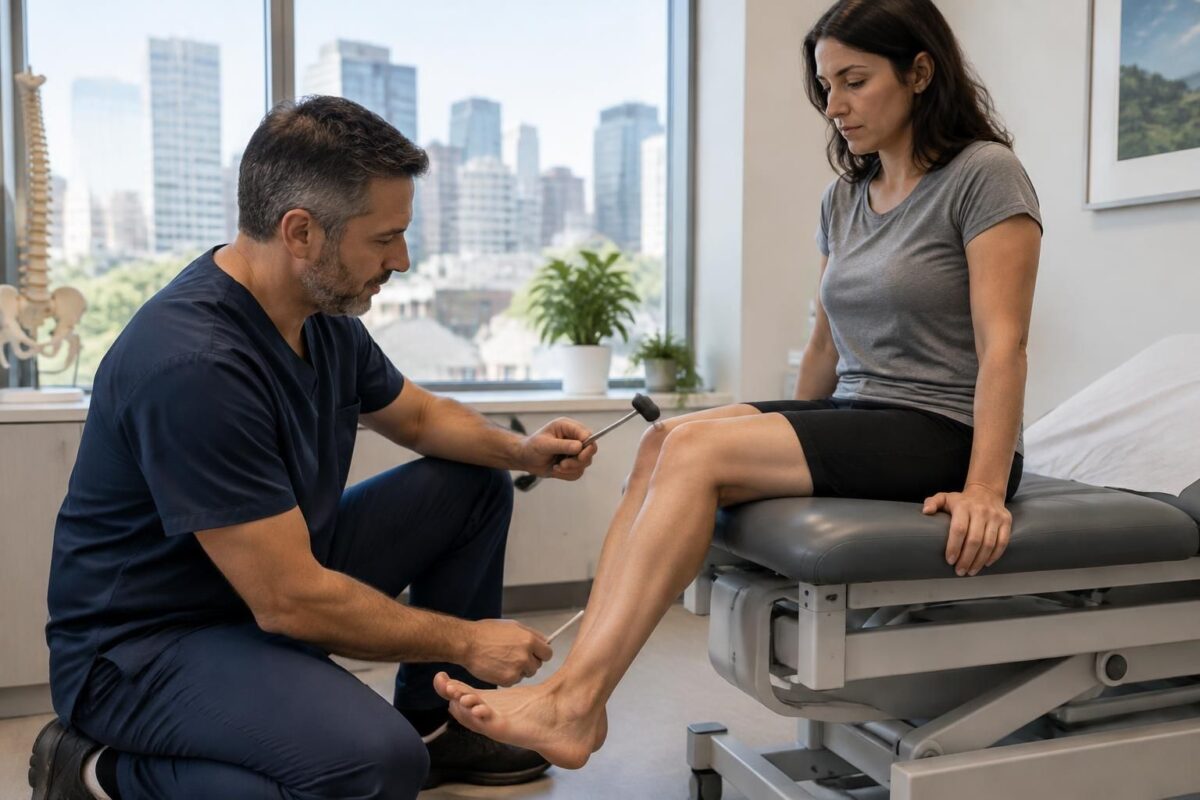
Sciatica in Montreal: reflexes, strength, and sensitivity in evaluation
IN BRIEF The evaluation of sciatica involves examining reflexes, muscle strength, and sensitivity, in addition to the pathway and evolution of pain. In Montreal, these observations help the healthcare professional identify potential neurological signs and guide the next steps. No…
Medical Disclaimer
The information published on SOS Sciatique is provided for educational purposes and does not replace a consultation, diagnosis, advice, or treatment provided by a physician or other licensed healthcare professional. The author of this article is neither a doctor nor a specialist in a medical specialty recognized by the Collège des médecins du Québec. The approaches of osteopathy, manual medicine, or functional support described on this site are not considered medical acts and are not intended to replace medical follow-up.
“Medical Disclaimer: The information and advice provided on this site do not replace the opinion, diagnosis, or treatment of a healthcare professional. Please note that Sylvain Desforges, B.Sc., D.O., N.D., Doctor of Osteopathy, is neither a medical doctor nor a physician, and is not a specialist in a medical specialty as defined by the Collège des médecins du Québec. Manual medicine, functional medicine, and sports medicine as described on this site exclude any treatment or medical diagnosis made by a physician or specialist doctor. Always consult your physician for any medical questions. For more details, please read our complete Legal Notice.”
For more details, please read our Legal Notice.
Injury to the L5 root
- Pain from the lower back to the buttock, the outer side of the leg, and the top of the foot.
- Tingling may affect the big toe.
Injury to the S1 root
- Pain from the buttock to the back of the thigh and calf, down to the heel or outer edge of the foot.
- Nerve irritation may cause burning, numbness, or weakness.
At the level of L5-S1, an irritated or compressed nerve root can transmit pain along its path, causing it to radiate down to the foot. Seek prompt consultation in case of significant or progressive weakness, numbness in the saddle area, or urinary or bowel issues.

A pain that starts from the lower back, crosses the buttock, and descends to the foot may correspond to irritation of a lumbar nerve root, particularly L5 or S1. In Montreal, some cautious measures can help better manage symptoms, but their choice depends on their cause, intensity, and your health status. Progressive weakness or urinary issues require rapid medical evaluation.
Sciatica in Montreal: Muscle Weakness Based on the Irritated Root
IN BRIEF Sciatica can cause muscle weakness when lumbar nerve roots are irritated. Depending on the affected root, it may become difficult to lift the foot or stand on tiptoes. In Montreal, an assessment of strength, sensation, and pain pathway…
Why can L5-S1 pain reach the foot?
The nerve roots that exit the lower spine converge to form the sciatic nerve. This passes through the buttock and then descends down the leg to the foot. If a root is irritated or compressed, the pain can follow part of this path: it is felt at a distance from its origin, sometimes down to the toes. This does not necessarily mean that the nerve is compressed along its entire length.
An injury to the disc located between the L5 and S1 vertebrae can particularly irritate the S1 root. The pain often radiates down the back of the thigh and calf, towards the heel or the outer edge of the foot. An injury to the L5 root may instead affect the outer side of the leg and the top of the foot, sometimes reaching the big toe. These paths vary from person to person and are not sufficient on their own to establish a diagnosis.
What to do when the pain radiates down the leg?
Stay active without overexerting
If your symptoms allow it, prioritize short movements and regular position changes rather than prolonged bed rest. Slow walking may be suitable, but reduce activity if it significantly increases pain, numbness, or weakness. Temporarily avoid movements that trigger symptoms, such as lifting a load while bending or sitting for long periods without a break.
Adapt positions and daily movements
At the office or in the car, change positions frequently and support your back comfortably. To pick up an object, move closer, bend at the hips and knees, and avoid twisting the trunk while lifting. You can try a resting position that reduces your symptoms, for example, lying on your side with a cushion between your knees. Stop any stretching or exercise that worsens the pain radiating down the leg.
When to seek an evaluation in Montreal?
A consultation with a healthcare professional can help assess strength, sensitivity, and reflexes, clarify symptoms, and determine if further tests are relevant. Imaging is not necessarily required from the start: its indication notably depends on the examination and evolution. Manual therapy or adapted exercises may be considered after evaluation, without replacing a diagnosis or medical follow-up.
Consult a medical service immediately in case of difficulty controlling the bladder or intestines, numbness in the pelvic region, significant or progressive weakness, or symptoms affecting both legs. Also seek advice quickly if the pain is severe, worsens suddenly, occurs after trauma, or is accompanied by fever. The information presented here is educational and does not replace a consultation or personalized medical advice.
| L5 Injury | S1 Injury | |
|---|---|---|
| Common Path | Buttock, outer side of the thigh, shin | Buttock, back of the thigh, calf |
| Foot Area | Top of the foot, often towards the big toe | Heel or outer edge of the foot, sometimes the little toes |
| Why the pain radiates | An irritated nerve root can project pain along its path | An irritated nerve root can project pain along its path |
| In Montreal | The location of symptoms helps guide the evaluation, but is not sufficient to confirm the cause | |
Illustrative testimonials on L5-S1 sciatica in Montreal: why the pain radiates to the foot
The testimonials below are fictitious and presented for educational purposes. They illustrate possible experiences of lower back pain radiating into the leg. They do not describe real patients and do not allow for a diagnosis.
“The pain started from my lower back and went down to my heel”
Marc, 46 years old, works seated in Montreal. After several hours in front of his screen, he feels pain in his lower back, then in his buttock and the back of his leg. Some days, a burning sensation reaches his calf and heel.
This pathway may be compatible with irritation of the S1 nerve root, located near the disc between the L5 and S1 vertebrae. When this root is irritated or compressed, the pain can follow the path associated with the sciatic nerve and be felt much lower than its origin. However, the distance the pain travels does not, by itself, mean that the foot is injured.
“I primarily had tingling on the top of my foot”
Sophie, 39 years old, describes pain radiating from her buttock to the outer side of her leg. She also notices tingling on the top of her foot and near her big toe, especially after a long time in the car.
Irritation of the L5 root can sometimes produce symptoms in these areas. The pathways are not always perfectly typical: sensations can vary from person to person and may be limited to the buttock or thigh. A healthcare professional evaluates strength, sensitivity, and reflexes before determining if further tests are relevant.
“I didn’t understand why my foot was affected”
André, 58 years old, thought his problem was from his foot because the pain and numbness were primarily felt underneath it. The evaluation instead raised the possibility of nerve irritation coming from the lower back.
The nerves responsible for some of the sensitivity and movements of the foot originate in the lumbar and sacral regions. A herniated disc, changes related to osteoarthritis, or a narrowing of the canal can irritate a nerve root. The pain signal can then be felt along its path, reaching the calf or foot, even if the problem is located higher up.
Why can L5-S1 pain radiate down to the foot?
The sciatic nerve is formed from several nerve roots from the lower back. Irritation near the spine can cause what is known as radiating pain, sometimes accompanied by burning, tingling, numbness, or a feeling of weakness. The path depends on the affected root: S1 injury may manifest at the back of the leg and towards the heel or outer edge of the foot, while L5 injury can affect the outer side of the leg and the top of the foot.
These indicators are not sufficient to confirm L5-S1 sciatica. Other conditions can cause pain in the foot or leg, and symptoms do not always follow a precise pattern. If the pain persists, recurs frequently, or limits walking and activities, an appropriate evaluation can help better understand the situation and discuss management options.
While waiting for advice, avoid staying still for too long if it increases stiffness. Gentle movements may be suitable for some, but it is wise to stop a movement that significantly intensifies symptoms. Exercises should be tailored to the individual rather than chosen solely based on a testimony.
Quickly consult a doctor or an emergency service in case of loss of control of the bladder or bowels, numbness in the saddle area, significant or worsening weakness in the leg or foot, or severe and rapidly progressive symptoms.
About the author
Sylvain Desforges, B.Sc., D.O., N.D., Doctor of Osteopathy, is the founding president of TAGMED and the ACMA association. He dedicates his practice to chronic spinal pain, lower back pain, and pain compatible with sciatica. His content is educational and presents non-surgical approaches that may be considered based on each individual’s assessment.
Medical warning: this information does not replace consultation, diagnosis, or treatment by a doctor or another licensed health professional. The author is neither a doctor nor a specialist in a medical specialty recognized by the Collège des médecins du Québec. Osteopathy, manual therapy, and functional support do not constitute medical acts and do not replace medical follow-up.
L5-S1 Sciatica in Montreal: why can pain travel down to the foot?
A pain that starts in the lower back, crosses the buttock, and extends down the back of the leg to the foot may correspond to sciatica. The term describes pain related to irritation or compression of a lumbar or sacral nerve root, and not necessarily damage to the nerve along its entire length. In Montreal, as elsewhere, long periods of sitting, driving, and certain physical activities can make these symptoms particularly bothersome in daily life.
The L5 and S1 roots contribute to the formation of the sciatic nerve. They emerge in the lower spine, and their fibers come together to form a nerve that passes through the pelvis and buttock before descending into the leg. As this nerve network extends down to the foot, irritation near the spine can be felt far from its point of origin. The pain can take the form of burning, shooting, tingling, or numbness.
When the L5 root is irritated, discomfort may follow the buttock and the outer side of the leg, reaching the top of the foot or the big toe. A problem with S1 may instead manifest in the back of the thigh and calf, extending towards the heel or the outer edge of the foot. These pathways are general markers: symptoms vary from person to person and are not sufficient, on their own, to identify the cause.
Possible origins include a herniated disc, changes related to osteoarthritis, or narrowing of the space where a nerve root passes. Pain may be exacerbated by coughing, sneezing, certain movements, or prolonged sitting. Muscle weakness, a heavy leg sensation, or tingling may also accompany the pain. A clinical examination helps clarify the picture; imaging tests or other assessments may be considered depending on the symptoms and their progression.
Management depends on the cause, intensity of symptoms, and overall health status. A professional evaluation can guide appropriate measures, including temporary adaptation of activities and gradual resumption of movement. Osteopathy or manual therapy may be considered as complementary approaches when they are suited to the situation. At the TAGMED Clinic, available services may include neuro-vertebral decompression, laser, or shockwave therapy, depending on the assessment; these approaches may not be suitable for everyone and do not guarantee a determined outcome.
Sylvain Desforges, founder of TAGMED clinics and the ACMA association, dedicates his practice to the management of chronic pain and the integration of technologies to support care. His approach aims for individualized care based on available data, taking into account the symptoms, goals, and context of each person.
The information presented here is educational and does not replace a medical consultation or diagnosis. Quickly consult a doctor or an emergency service in case of loss of control of the bladder or bowels, numbness in the saddle area, significant or worsening weakness, or rapid worsening of symptoms.
An L5-S1 sciatica can cause pain that starts in the lower back, crosses the buttock, and descends into the leg down to the foot. This irradiation is explained by the pathway of the lumbar and sacral nerve roots: when a root is irritated or compressed, the symptoms may be felt far from their source. In Montreal, a professional evaluation helps clarify the cause and determine the appropriate measures for your situation.
Why does irritation in L5-S1 feel down to the foot?
The L5 and S1 nerve roots contribute to the formation of the sciatic nerve, which runs from the lower back to the buttock and then into the leg. Irritation near the spine can therefore produce pain, tingling, or numbness lower down this pathway. Pain felt in the foot does not necessarily mean the problem is in the foot: it may originate from a lumbar or sacral nerve root. The Merck Manual describes this mechanism and the possible symptoms of sciatica.
A problem with L5 can notably radiate to the outer side of the leg and the top of the foot, sometimes even to the big toe. With an injury to S1, the pain may follow the back of the thigh and calf, then reach the heel or the outer edge of the foot. These pathways are useful markers, but alone they do not allow for certain identification of the affected root. To better visualize the differences between the L4-L5 and L5-S1 levels, also check the information on L4-L5 and L5-S1 sciatica in Montreal.
What sensations may accompany the pain?
In addition to the pain that descends into the leg, some people experience burning, electric shocks, tingling, or decreased sensitivity. The pathway of symptoms varies depending on the affected root and from person to person. Pain towards the outer edge of the foot may be consistent with irritation of S1, while discomfort on the top of the foot may suggest L5, without constituting a diagnosis in itself. Resources detail the pain radiating to the outer edge of the foot and S1 sciatica with pain in the calf and the outer edge of the foot.
A persistent numbness in the toes or pain that occurs after walking should be described precisely during an evaluation. Note where the pain starts, how far it travels, what worsens it, and if you notice any weakness. You can consult additional information on numbness in the toes and pain or numbness after walking.
What causes may be involved?
A lumbar herniated disc can irritate or compress a nerve root and lead to pain radiating down to the foot. Other causes are possible, including spinal canal narrowing or changes associated with osteoarthritis. The path of the pain helps the professional direct their examination, but the assessment also takes into account strength, reflexes, sensation, and the evolution of symptoms. For more information, check the explanations on L5-S1 herniated disc and sciatica as well as lumbosciatica associated with a lumbar herniated disc.
The path of L5 sciatica can help understand why the pain manifests in different parts of the leg. However, only a healthcare professional can determine if the symptoms correspond to irritation of L5, S1, or another cause. Depending on the examination and the duration of symptoms, imaging tests or other assessments may sometimes be considered.
When to seek medical advice quickly?
Consult a doctor or emergency service without delay in cases of significant or progressive weakness of the leg or foot, loss of bladder or bowel control, or numbness in the saddle area. Severe pain, rapid worsening, fever, or symptoms after trauma also warrant a medical evaluation. These signs require special attention and should not be managed only with home remedies.
If the symptoms are stable and without urgent signs, a professional can help you understand the factors that influence them and consider appropriate management. Manual or functional approaches can be discussed based on the assessment, but they do not replace a medical diagnosis or care recommended by a doctor. The level of pain and its path to the foot, taken in isolation, do not allow for predicting the evolution or choosing a treatment without examination.
About the author
Sylvain Desforges, B.Sc., D.O., N.D., Doctor of Osteopathy, is the founding president of TAGMED and the ACMA association. He devotes his practice to chronic spinal pain, lower back pain, and pain compatible with sciatica, particularly when the pain descends to the buttock, leg, calf, foot, or toes.
Through SOS Sciatique, he publishes educational content on sciatica symptoms, possible causes such as herniated disc, disc pinching, foraminal stenosis, or irritation of a lumbar nerve root, as well as on non-surgical approaches that may be considered based on the evaluation. At TAGMED Clinic, care may include, depending on the case, motorized neurovertebral decompression, specific osteopathy, or precision impaction.
For an evaluation related to sciatica treatment in Montreal / Mount Royal or sciatica treatment in Terrebonne, consult the services available at TAGMED Clinic.
Medical Disclaimer
The information published on SOS Sciatique is provided for educational purposes and does not replace a consultation, diagnosis, advice, or treatment performed by a doctor or another licensed healthcare professional. The author of this article is neither a doctor nor a specialist in a medical specialty recognized by the Collège des médecins du Québec. The osteopathy, manual medicine, or functional support approaches described on this site do not constitute medical acts and are not intended to replace medical follow-up.
Consult a doctor or emergency service in cases of loss of bladder or bowel control, numbness in the saddle area, significant or progressive weakness of the leg or foot, fever, recent trauma, severe pain, or rapid worsening. For more details, please read our Legal Notice.

Sylvain Desforges, B.Sc., D.O., N.D., docteur en ostéopathie
Dr Sylvain Desforges, B.Sc., D.O., N.D., osteopath, is the founding president of TAGMED and of the ACMA association. He dedicates his practice to chronic spinal pain, low back pain and symptoms compatible with sciatica, particularly when pain radiates toward the buttock, leg, calf, foot or toes.
Through SOS Sciatique, he publishes educational content on sciatica symptoms, possible causes such as disc herniation, disc narrowing, foraminal stenosis or irritation of a lumbar nerve root, as well as non-surgical approaches that may be considered according to the evaluation. At Clinique TAGMED, care may include, depending on the case, motorized neurovertebral decompression, specific osteopathic care or precision percussion.
For an evaluation related to sciatica treatment in Montreal / Mount Royal or sciatica treatment in Terrebonne, please consult the services available at Clinique TAGMED.
Medical disclaimer
The information published on SOS Sciatique is provided for educational purposes only and does not replace a consultation, diagnosis, opinion or treatment provided by a physician or another authorized healthcare professional. The author of this article is neither a medical doctor nor a specialist in a medical specialty recognized by the Collège des médecins du Québec. The osteopathic, manual medicine or functional support approaches described on this site do not constitute medical acts and are not intended to replace medical follow-up.
Consult a physician or emergency service in cases of loss of bladder or bowel control, anesthesia in the saddle area, significant or progressive weakness in the leg or foot, fever, recent trauma, severe pain or rapid worsening of symptoms. For more details, please read our Legal Notice.