

Sciatica S1 in Montreal: pain towards the calf and the outer edge of the foot
08/10/2026
Sciatica and pain after a day of sitting at work
08/10/2026
IN BRIEF
| S1 sciatica is pain related to irritation of a lumbar nerve root, which may radiate down to the buttock, back of the calf, and the outer edge of the foot. Tingling or weakness may also occur. In Terrebonne, an assessment helps to better understand the symptoms and consider suitable management, often non-surgical depending on the case. In the event of significant or progressive loss of strength, urinary issues, or numbness in the saddle area, consult a medical service without delay. |
S1 sciatica can cause pain starting from the lower back or buttock, then radiating down the back of the thigh and calf to the outer edge of the foot. Tingling or numbness may also occur. In Terrebonne, a professional evaluation can help clarify the cause and management options. If weakness worsens, or if there are urinary or bowel problems, or numbness in the perineal region, seek medical attention immediately.
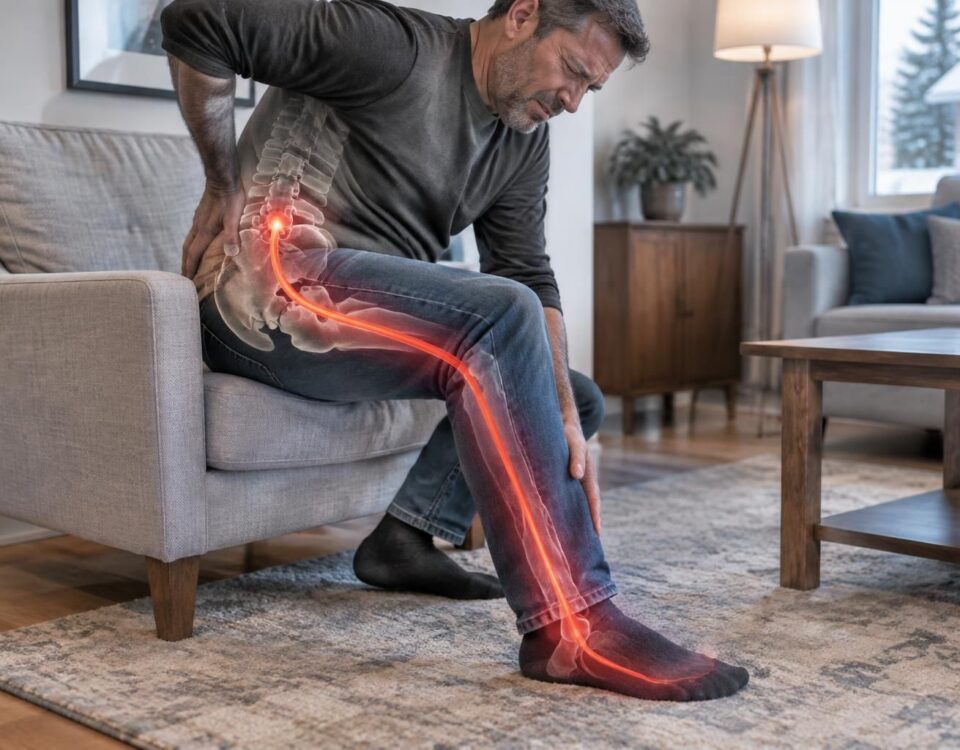
A pain that starts in the lower back or buttock, descends behind the thigh, and reaches the calf or the outer edge of the foot may correspond to irritation of the S1 nerve root. This pathway alone is not sufficient to confirm the diagnosis: a professional must evaluate your symptoms, strength, and sensitivity. In Terrebonne, an assessment helps to better understand the possible cause and discuss suitable management options. The S1 root contributes to the formation of the sciatic nerve. When it is irritated or compressed in the lower back, pain may follow a path from the buttock to the back of the thigh, then to the calf and foot. Some individuals may also experience symptoms near the heel, the sole of the foot, or the outer edge of the foot. Pain may manifest as a burning sensation, electric shock, or cramping. Tingling, numbness, or reduced sensitivity may also appear. Coughing, sneezing, or certain movements can sometimes exacerbate the pain. The path varies from person to person. Pain in the calf or the outer edge of the foot alone does not indicate which nerve root is affected. To better describe your symptoms before a consultation in Terrebonne, refer to this guide on describing symptoms. A possible S1 involvement may be accompanied by pain at the back of the calf or towards the outer edge of the foot. Tingling near the heel can also occur. These signs guide the evaluation but do not confirm S1 sciatica. Localized pain in the foot or calf may have other causes. To learn more about tingling in the heel, read our article on the possible irritation of the S1 root. You can also visit the TAGMED Clinic page dedicated to S1 sciatica. Sciatica refers to pain linked to irritation of a nerve root or the sciatic nerve. It is a symptom, not a cause in itself. A lumbar disc herniation can irritate the S1 root, often near the disc situated between the L5 and S1 vertebrae. Other changes in the spine, such as narrowing of the nerve exit space, can also contribute to symptoms. Pain may appear after exertion but can also develop without a specific event. An examination helps to determine if the signs are consistent with nerve irritation and whether further checks are needed. Numbness in the leg or foot warrants evaluation, especially if it persists, spreads, or is accompanied by weakness. To understand the possible link between disc herniation and numbness, refer to this article on leg numbness. During an evaluation, the professional will ask where the pain starts, how far it radiates, and what movements modify it. They may also assess the sensitivity of the leg and foot, muscle strength, and certain movements. This information helps to establish whether the symptoms may correspond to S1 or if they require another explanation. An imaging exam is not necessary for every sciatic pain case. A physician may prescribe it depending on the symptoms, their duration, and the examination results. An accurate diagnosis helps to choose appropriate management. To learn more, read this article on the importance of an accurate diagnosis. Management depends on the likely cause, the intensity of the pain, and its effect on your activities. A healthcare professional can advise on appropriate care and determine if medical consultation or imaging is indicated. Do not start any exercise or stretch without proper advice if you are experiencing pain radiating down the leg or numbness. At the TAGMED Clinic, options may include an evaluation, specific osteopathy, or, depending on the situation, motorized neurovertebral decompression. These approaches may not suit everyone and do not replace a medical diagnosis. Their relevance is determined after evaluation, considering your symptoms and health history. To find out about available services near you, check the page on treatment for sciatica in Terrebonne. An evaluation can help you understand the options without presuming the treatment you need. Consult a doctor or emergency service without delay if you have significant or progressive loss of strength in the leg or foot. New difficulty in raising the foot or walking on tiptoes also requires quick evaluation. Urinary or bowel issues, loss of sensation in the area between the legs, fever associated with severe low back pain, or rapid deterioration require urgent medical attention. These signs should not be managed only with manual care. Sylvain Desforges, B.Sc., D.O., N.D., Doctor of Osteopathy, is the founding president of TAGMED and the ACMA association. He dedicates his practice to chronic pain of the spine, lower back pain, and pain consistent with sciatica, particularly when the pain radiates towards the buttock, leg, calf, foot, or toes. Through SOS Sciatique, he publishes educational content on the symptoms of sciatica, its possible causes, and the non-surgical approaches that may be considered after evaluation. At TAGMED Clinic, care may include, depending on the case, neurovertebral decompression, specific osteopathy, or precision percussion. For an evaluation related to sciatica treatment in Montreal / Mont-Royal or sciatica treatment in Terrebonne, consult the available services at TAGMED Clinic. The information published on SOS Sciatique is provided for educational purposes and does not replace a consultation, diagnosis, opinion, or treatment by a doctor or another licensed healthcare professional. The author of this article is neither a doctor nor a specialist in a medical specialty recognized by the Collège des médecins du Québec. The approaches of osteopathy, manual therapy, or functional support described on this site do not constitute medical acts and are not intended to replace medical follow-up. Consult a doctor or an emergency service in case of loss of bladder or bowel control, anesthesia in the saddle area, significant or progressive weakness in the leg or foot, fever, recent trauma, severe pain, or rapid worsening. For more details, please read our Legal notice. Medical disclaimer: The information and advice provided on this site do not replace the opinion, diagnosis, or treatment of a healthcare professional. Please note that Sylvain Desforges, B.Sc., D.O., N.D., Doctor of Osteopathy, is neither a doctor of medicine nor a physician, and is not a specialist in a medical specialty as defined by the Collège des médecins du Québec. Manual therapy, functional medicine, and sports medicine as described on this site exclude any medical treatment or diagnosis made by a doctor or specialist. Always consult your physician for any medical questions. For more details, please read our Complete Legal Notice.How to recognize pain consistent with S1 sciatica
Pain in the calf and outer edge of the foot
What are the possible causes of S1 sciatica?
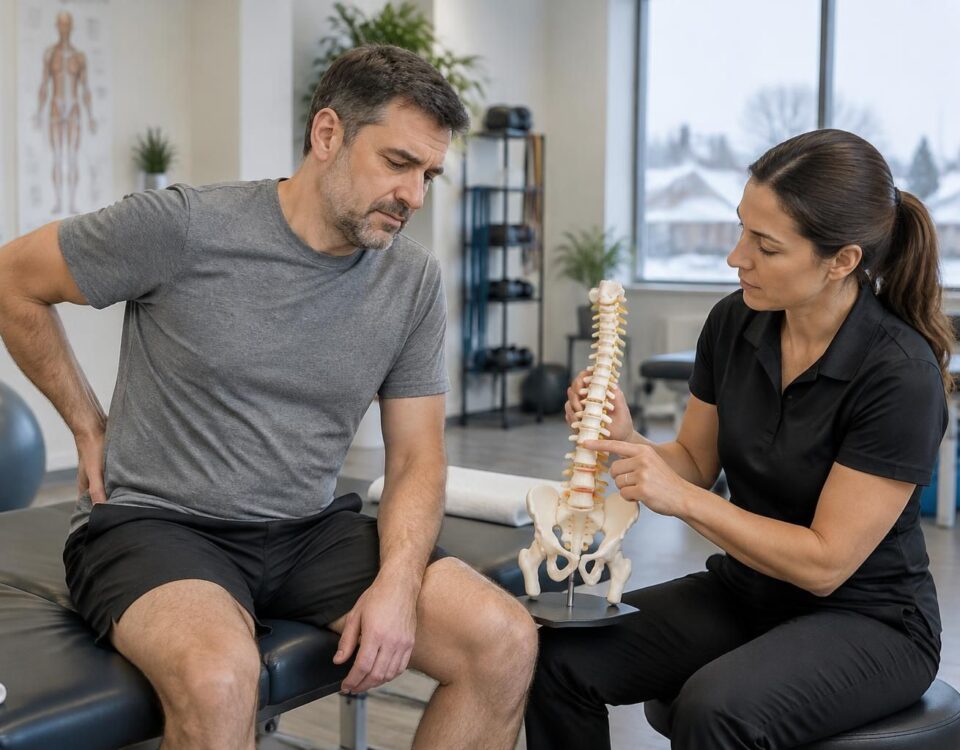
What does the evaluation in Terrebonne involve?
Non-surgical management options
When to seek immediate medical attention?
About the author
Medical Disclaimer
Indicators: sciatica S1
- Pain from the buttock down the back of the thigh and the calf.
- It may reach the outer edge of the foot and the little toes.
- Tingling or difficulty standing on tiptoes may sometimes be associated.
In Terrebonne: next steps
- Have the pain pathway and leg strength evaluated by a healthcare professional.
- Maintain gentle activity based on your tolerance; avoid prolonged strict bed rest.
- Emergency: progressive weakness, urinary problems, or loss of sensitivity in the perineum.

A pain that starts from the lower back or the buttock, descends behind the thigh, and reaches the calf or the outer edge of the foot may indicate irritation of the S1 nerve root. In Terrebonne, an evaluation allows to clarify the origin of the symptoms and determine appropriate measures. In the meantime, prioritize tolerated movements, avoid prolonged strict bed rest, and monitor any signs of weakness or worsening.
Recognizing pain consistent with S1 sciatica
The S1 root contributes to the sensitivity and motor function of the leg and foot. When it is irritated or compressed, the pain may follow a path from the buttock down the back of the thigh, then to the calf, heel, and sometimes to the outer edge of the foot or the last toes. Tingling, numbness, or a burning sensation may also be present.
This pathway may guide the evaluation, but is not sufficient to confirm a diagnosis. Pain in the calf or foot can have various causes. A healthcare professional can specifically check strength, sensitivity, reflexes, and movements that alter the symptoms.
Sciatica in Terrebonne: disc protrusion or disc herniation?
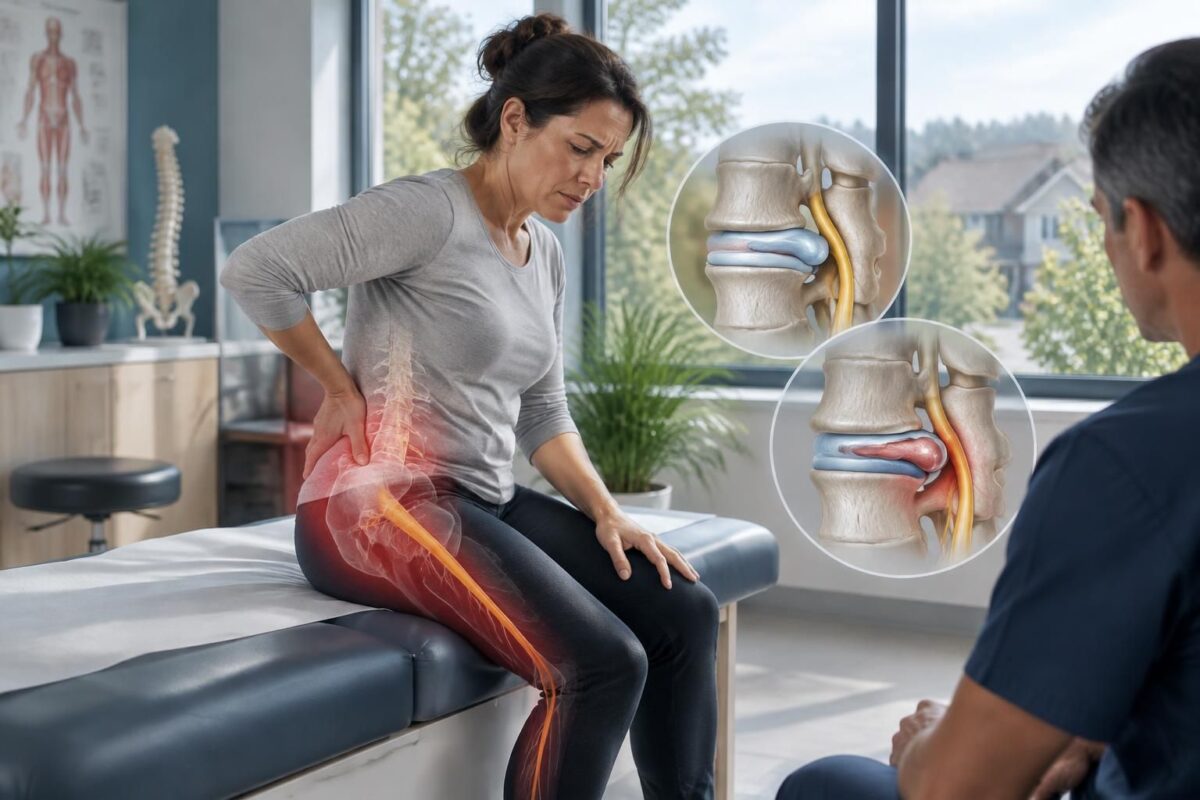
IN BRIEF A disc bulge is a swelling of the disc, while a herniated disc involves a more pronounced protrusion of its contents; both can irritate a nerve root and cause sciatica. Symptoms alone do not always allow for distinction…

Sciatica disc in Terrebonne: why the pain travels down the leg
IN SHORT The disc-related sciatica occurs when a lumbar disc irritates a nerve root, which can cause pain to radiate down the buttock and leg. In Terrebonne, an assessment helps to better understand the cause of the symptoms and consider…
What to do daily when the pain descends to the calf?
Stay active without straining
Prolonged bed rest is generally not recommended. Instead, try to maintain light activities, such as short walks on a flat surface, adjusting their duration according to your tolerance. If the pain significantly increases or extends further down the leg, reduce activity and seek advice. Alternate positions and get up regularly if you must sit for a long time.
Adapt movements and positions
During a painful period, temporarily limit lifting heavy objects, twisting the torso, and movements that clearly trigger irradiation. To pick up an object, get close to it and bend your knees instead of leaning forward while turning. For sleeping, try a comfortable position on your side with a pillow between your knees, or on your back with your legs slightly supported. However, there is no one-size-fits-all position.
Avoid trying to “free” the nerve with intense stretches or sudden manipulations. Exercises and manual treatments should be tailored to your symptoms and examination. At TAGMED Clinic, an evaluation can help discuss possible non-surgical options, including specific osteopathy or motorized neurovertebral decompression, depending on the situation. These approaches do not replace a medical evaluation when necessary.

L4-L5 disc herniation and sciatica in Terrebonne: pain towards the foot
IN BRIEF A L4-L5 disc herniation can irritate a nerve root and cause sciatica, with pain that radiates from the buttock down to the leg or foot. In Terrebonne, an evaluation helps better understand the origin of the symptoms and…

Lumbar disc herniation L5-S1 and sciatica in Terrebonne: common symptoms
IN BRIEF A L5-S1 disc herniation can irritate a nerve root and cause sciatica: lower back pain radiating to the buttock or leg, tingling, numbness, or weakness. In Terrebonne, an assessment helps to better understand the symptoms and guide management…
When to seek an evaluation in Terrebonne?
Consult a professional if the pain persists, frequently recurs, disrupts sleep, or limits your activities. An evaluation allows for a better understanding of possible factors—for example, irritation related to a lumbar disc or narrowing of the space around a nerve root—and to guide the next steps. Imaging tests are not systematic: their relevance depends on the clinical picture and evolution.
Recognize signs of emergency
Consult an emergency service immediately in case of loss of control of the bladder or bowels, numbness in the saddle area, significant or progressive weakness in the leg or foot, or rapid worsening. A fever associated with intense lower back pain, or pain that appeared after trauma, also requires prompt evaluation.
About the author
Sylvain Desforges, B.Sc., D.O., N.D., Doctor of Osteopathy is the founding president of TAGMED and the ACMA association. His practice focuses in particular on chronic spinal pain and low back pain that may radiate into the leg.
Medical Warning
These information are educational and do not replace a consultation, diagnosis, or treatment by a licensed healthcare professional. The author is neither a physician nor a specialist in a medical specialty recognized by the Collège des médecins du Québec. Osteopathy and manual therapy approaches do not replace medical follow-up.
| Marker | What to pay attention to |
|---|---|
| Possible route | Buttock, back of the thigh, calf, then outer edge of the foot. |
| Sensations | Burning pain, electric shock, tingling or numbness. |
| Sometimes difficult movements | Pushing up on the toes or pushing with the foot. |
| Possible aggravating factor | Coughing, sneezing, or certain movements of the back. |
| To know | This route may suggest involvement of the S1 root, but is not sufficient to confirm the cause. |
| Assessment in Terrebonne | A professional can evaluate the pain, strength, and sensitivity. |
| Emergency | Consult immediately in case of progressive weakness, urinary problems, or numbness between the legs. |
Sciatica and herniated disc in Terrebonne: understanding the link
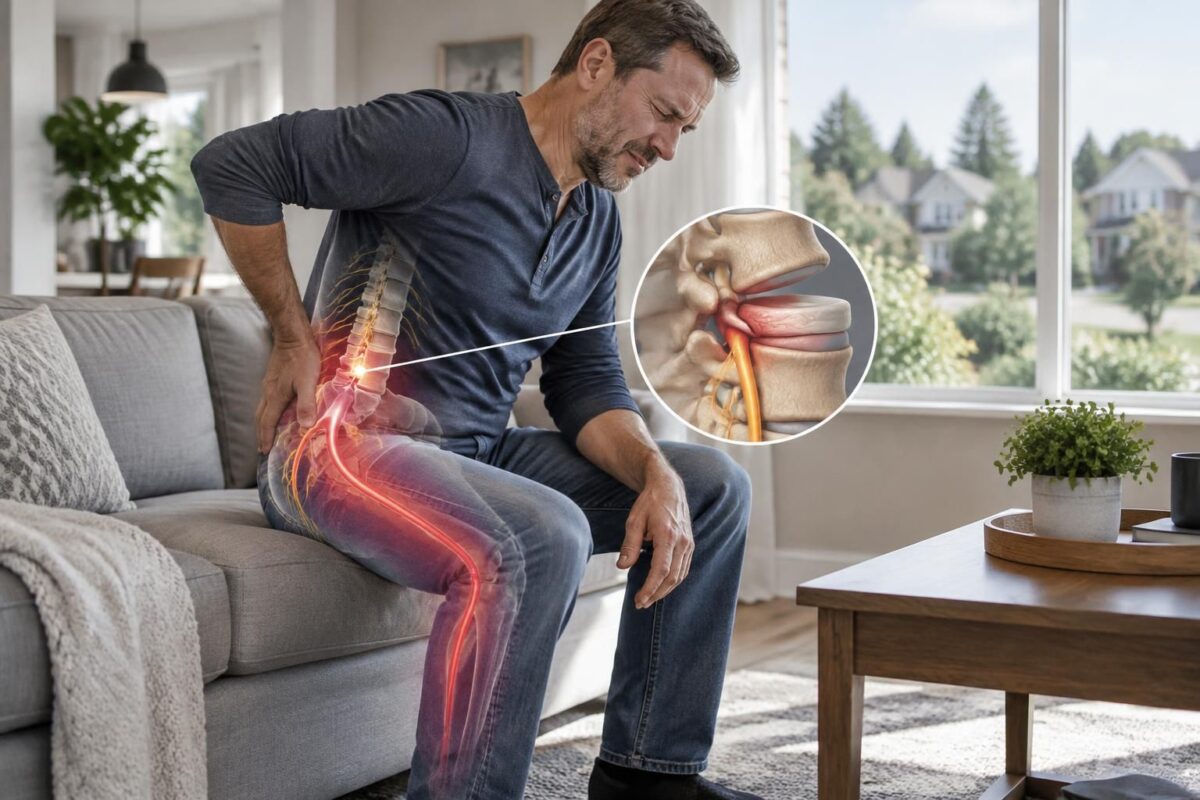
IN BRIEF Sciatica refers to pain that follows the path of the nerve in the buttock and leg; a herniated disc can irritate it, but an anomaly on the MRI is not sufficient to establish the cause. In Terrebonne, the…
Sciatica in Terrebonne: lumbar roots and the choice of a cautious treatment
IN BRIEF Sciatica is pain related to the irritation or compression of a lumbar nerve root, which can radiate from the lower back to the buttock and leg. In Terrebonne, an evaluation allows for cautious treatment tailored to the cause…
Illustrative Testimonials: S1 Sciatica in Terrebonne and Pain Towards the Calf and Outer Edge of the Foot
Note: the accounts below are composite examples written for informational purposes. They do not correspond to verified patient testimonials. Pain that radiates towards the calf or the outer edge of the foot may suggest irritation of the S1 root, but only a healthcare professional can assess your situation.
“The pain started in the buttock and radiated down the back of the leg.” In Terrebonne, a person describes low back pain that radiated into the buttock, the back of the thigh, then the calf to the outer edge of the foot. The episodes were more pronounced after a long period of sitting. The assessment helped clarify the route of the symptoms and discuss appropriate options without presuming their cause.
“I also had tingling in my foot.” In this example, the pain was accompanied by tingling near the little toe and the outer edge of the foot. These sensations may be associated with nerve irritation, but alone they are not sufficient to establish a diagnosis of S1 sciatica. An evaluation allows checking strength, sensitivity, and the progression of symptoms.
“Walking a little was easier than sitting for long periods.” Another illustrative situation refers to a person who felt pain in the calf and foot after sitting. Short periods of gentle walking were better tolerated, while certain movements increased discomfort. Activities should be adjusted according to the body’s response, without forcing through a clear aggravation.
“I wanted to know if an intervention was necessarily required.” In this composite account, the person feared needing surgery because of pain radiating down to the foot. The management of sciatica, however, depends on its cause, intensity, duration, and the presence of any neurological signs. A non-surgical approach may be considered based on the evaluation; no method guarantees the same outcome for everyone.
At the TAGMED Clinic in Terrebonne, an evaluation can help assess the route of the pain, limitations, and associated signs. Depending on the situation, treatments may include specific osteopathy or motorized neurovertebral decompression. These approaches do not replace a medical diagnosis and may not be suitable for everyone.
Consult urgently in case of loss of bladder or bowel control, numbness in the saddle area, significant or progressive weakness of the leg or foot, fever, recent trauma, severe pain, or rapid aggravation.
About the author
Sylvain Desforges, B.Sc., D.O., N.D., Doctor of Osteopathy is the founding president of TAGMED and the ACMA association. He dedicates his practice to chronic spinal pain, low back pain, and pain consistent with sciatica.
Medical Warning
These information are provided for educational purposes and do not replace a consultation, diagnosis, opinion, or treatment performed by a physician or other authorized healthcare professional. The author is neither a physician nor a specialist in a medical specialty recognized by the Collège des médecins du Québec. Osteopathy, manual medicine or functional support approaches do not constitute medical acts and are not intended to replace medical follow-up.

Sciatica in Terrebonne: how to interpret pain according to the leg path
IN BRIEF Sciatica is a pain that can start from the lower back or the buttock and travel down the leg to the foot. Its path, along with any tingling or weakness, helps guide the assessment but is not sufficient…

Sciatica in Terrebonne: L5-S1, canal, foramen and nerve compression
IN BRIEF The sciatica L5-S1 corresponds to irritation or compression of a nerve root, sometimes related to a disc herniation or narrowing of the lumbar canal or the foramen. The pain may radiate from the lower back to the buttock,…
S1 Sciatica in Terrebonne: Pain in the Calf and Outer Edge of the Foot
Pain that radiates from the buttock down the back of the thigh, calf, and the outer edge of the foot may correspond to a irritation of the S1 nerve root. This route is suggestive, but does not suffice to establish a diagnosis: other problems in the back, hip, or nearby tissues may produce similar symptoms. In Terrebonne, a proper evaluation can help clarify the situation and determine the next steps.
The S1 root participates in the formation of the sciatic nerve. When compressed or irritated near the lumbar spine, the pain can following the route from the buttock to the calf, sometimes towards the heel, sole, or outer edge of the foot. Some individuals describe a burning sensation, electric shock, stabbing pain, or tingling. Symptoms may be continuous or variable and influenced by certain postures or activities.
A lumbar herniated disc, particularly between the L5 and S1 vertebrae, may be involved, but it does not explain every sciatica-like pain. A narrowing of the spaces where nerves pass, changes related to arthritis, or other factors may also be considered by a professional. The examination takes into account the route of the pain, its evolution, sensitivity, and leg strength. Based on observed signs, a physician may recommend further examinations, such as imaging.
An S1 involvement may sometimes be accompanied by weakness in the calf or difficulty standing on tiptoes. Numbness or altered sensitivity may also occur. Note when the symptoms started, the movements that aggravate or alleviate them, and any difference in strength: this information can facilitate the evaluation. Avoid attempting to “unpinch” the nerve through jerky movements or unassessed manipulations.
The management depends on the cause, the intensity of symptoms, and their evolution. It may include recommendations to maintain tolerable activity, advice on temporarily adjusting certain movements, and, depending on the evaluation, manual or functional support. At TAGMED Clinic, the proposed options may include specific osteopathy or motorized neurovertebral decompression, when deemed relevant. They do not replace a medical diagnosis and may not be suitable for everyone.
If you are looking for an assessment for pain suggesting S1 sciatica, consult the information on sciatica treatment in Terrebonne. A consultation allows for discussion of your symptoms and options to consider based on your situation, without presuming their cause.
Consult a doctor or emergency service immediately in case of loss of urinary or bowel control, numbness in the saddle region, significant or progressive weakness of the leg or foot, fever, recent trauma, severe pain, or rapid deterioration. These signs require urgent medical evaluation.
About the author
Sylvain Desforges, B.Sc., D.O., N.D., Doctor of Osteopathy, is the founding president of TAGMED and the ACMA association. His practice particularly focuses on chronic spinal pain, lower back pain, and pain compatible with sciatica, including when radiating to the buttock, leg, calf, foot, or toes.
Through SOS Sciatique, he publishes educational content on sciatica symptoms, their possible causes — including disc herniation, disc pinching, foraminal stenosis, or irritation of a lumbar nerve root — and non-surgical approaches that can be considered after evaluation. The care offered at TAGMED Clinic may include, depending on the case, motorized neurovertebral decompression, specific osteopathy, or precision impactor. To learn about available services, consult the TAGMED Clinic.
Medical disclaimer
The information published on SOS Sciatique is provided for educational purposes and does not replace a consultation, diagnosis, advice, or treatment by a physician or other licensed healthcare professional. The author is neither a doctor nor a specialist in a medical specialty recognized by the Collège des médecins du Québec. The approaches of osteopathy, manual therapy, or functional support described on this site do not constitute medical acts and do not replace necessary medical follow-up. For more details, please read our Legal Disclaimer.
An S1 sciatica can cause pain that starts in the lower back or buttock, travels down the back of the thigh and calf, and reaches the heel or the outer edge of the foot. In Terrebonne, a professional assessment can help clarify the origin of the symptoms and determine the next steps, without presuming that pain along this pathway alone confirms involvement of the S1 root.
When the pain travels down to the calf and the outer edge of the foot, the pathway may suggest irritation of the S1 nerve root, sometimes associated with a lumbar disc herniation. Tingling, numbness, or burning sensations may also be present. To better understand the possible variations of this picture, consult our page on S1 sciatica and pain towards the calf and outer edge of the foot, as well as the information on the role of levels L4-L5 and L5-S1.
The location of the pain provides a useful clue, but it is not sufficient to establish a diagnosis. The evaluation considers all symptoms, their evolution, the strength of the leg and foot, sensitivity, and activities that worsen or relieve the pain. Calf pain can have various causes: you can refer to this resource on sciatica pain in the calf to learn more.
In Terrebonne, an assessment at the TAGMED Clinic can allow for discussion of options suitable for your situation. Depending on the evaluation, the support may include non-surgical approaches such as specific osteopathy or motorized neurovertebral decompression. These interventions are not suitable for everyone and do not replace a medical diagnosis or necessary medical care.
As long as symptoms permit, maintaining gentle and appropriate activity is generally preferable to prolonged strict rest. However, resumption should be gradual: if walking or exercising significantly increases pain in the leg, adjust the effort and consult a healthcare professional. For guidance on a cautious progression, refer to our article on resuming activity with sciatica.
Consult urgently in case of significant or worsening loss of strength, marked difficulty in raising the foot or walking, loss of sensitivity in the saddle region, or new urinary or bowel issues. A rapid medical evaluation is also necessary if pain worsens quickly or is accompanied by fever. These signs should not solely be addressed through manual care.
Medical disclaimer: this information is educational and does not replace a consultation, diagnosis, or treatment by a licensed healthcare professional. The author is neither a doctor nor a specialist in a medical specialty recognized by the Collège des médecins du Québec. The approaches of osteopathy, manual therapy, or functional support do not constitute medical acts. For more details, please read our Legal Disclaimer.

Sylvain Desforges, B.Sc., D.O., N.D., docteur en ostéopathie
Dr Sylvain Desforges, B.Sc., D.O., N.D., osteopath, is the founding president of TAGMED and of the ACMA association. He dedicates his practice to chronic spinal pain, low back pain and symptoms compatible with sciatica, particularly when pain radiates toward the buttock, leg, calf, foot or toes.
Through SOS Sciatique, he publishes educational content on sciatica symptoms, possible causes such as disc herniation, disc narrowing, foraminal stenosis or irritation of a lumbar nerve root, as well as non-surgical approaches that may be considered according to the evaluation. At Clinique TAGMED, care may include, depending on the case, motorized neurovertebral decompression, specific osteopathic care or precision percussion.
For an evaluation related to sciatica treatment in Montreal / Mount Royal or sciatica treatment in Terrebonne, please consult the services available at Clinique TAGMED.
Medical disclaimer
The information published on SOS Sciatique is provided for educational purposes only and does not replace a consultation, diagnosis, opinion or treatment provided by a physician or another authorized healthcare professional. The author of this article is neither a medical doctor nor a specialist in a medical specialty recognized by the Collège des médecins du Québec. The osteopathic, manual medicine or functional support approaches described on this site do not constitute medical acts and are not intended to replace medical follow-up.
Consult a physician or emergency service in cases of loss of bladder or bowel control, anesthesia in the saddle area, significant or progressive weakness in the leg or foot, fever, recent trauma, severe pain or rapid worsening of symptoms. For more details, please read our Legal Notice.