Sciatica treatment Montreal: questions to ask before starting care
12/07/2026
Sciatica pain that radiates down to the foot: understanding the pathway
12/07/2026
IN BRIEF
| The Sciatica Treatment in Terrebonne is a non-surgical therapeutic approach aimed at relieving radiating pain along the sciatic nerve and restoring mobility. Its goal is to identify and treat the causes (for example, herniated discs or foraminal stenosis) without resorting to surgery. The main benefits include rapid pain relief, improved function and mobility, and reduced risk of surgery through techniques like neurovertebral decompression. Before starting, you will benefit from a personalized assessment and an individualized treatment plan, with progressive sessions and clear follow-up. In Terrebonne and nearby, this treatment is an effective option for individuals suffering from back pain radiating to the leg who wish to quickly regain their quality of life without persistent pain. |
Sciatica Treatment Terrebonne: Questions to Ask Before Starting Care
- Diagnosis and Causes: What are the possible causes of your sciatic pain and how will the diagnosis be confirmed (e.g., imaging, clinical examination)?
- Treatment Goals: What results would you aim for and what reasonable timeline can be expected for improvement?
- Proposed Approaches: What recommended treatment options are there (osteopathy, neurovertebral decompression, exercises, associated therapies) and why are they suitable for your case?
- Care Plan: How many sessions are planned, at what frequency, and how will the program be adjusted based on your progress?
- Safety and Risks: Are there any contraindications, possible side effects, or precautions to take during treatment?
- Assessments and Follow-Up: What exams are necessary before and during treatment (MRI, X-ray) and how will your condition be monitored?
- Daily Activities and Ergonomics: What adaptations or exercises should you do or avoid to support recovery in daily life?
- Cost and Coverage: What are the rates, what is included in each session, and are there any possibilities for insurance reimbursement?
By asking these questions, you obtain a personalized and transparent plan for your sciatica treatment in Terrebonne.
This guide presents essential questions to ask before starting care for sciatica in Terrebonne. It aims to help you understand the available options, evaluate possible causes, and prepare a clear discussion with your healthcare professional. The goal is to choose a safe and effective approach, prioritizing non-surgical treatments when appropriate.
Understanding the Origin and Evaluation
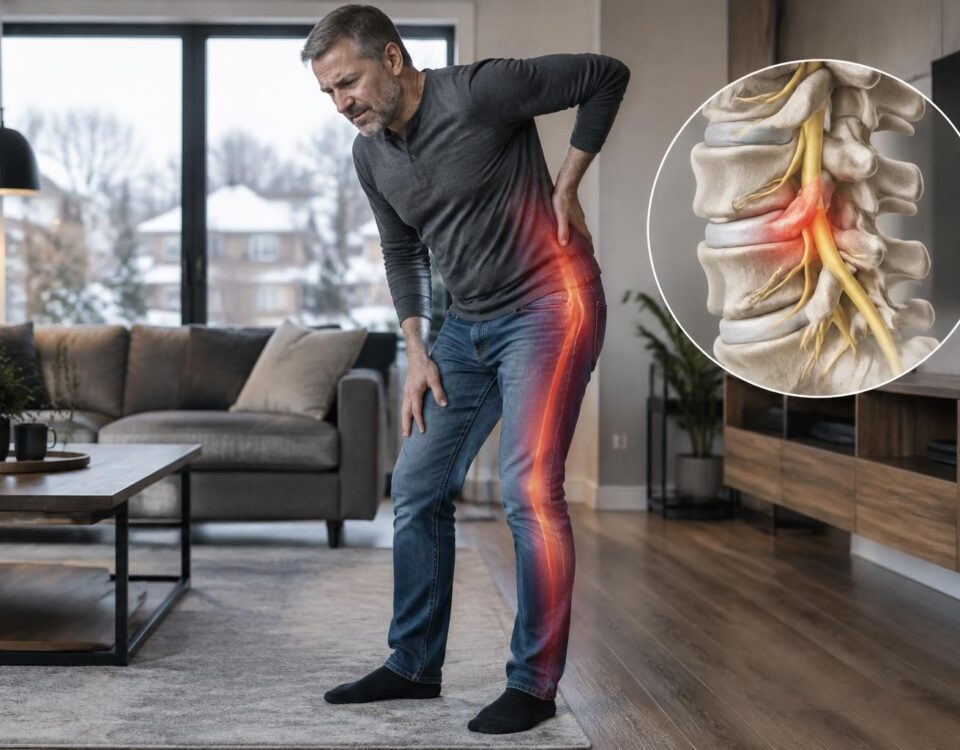
Sciatica can result from compression or irritation of the sciatic nerve. Common causes include a herniated disc, foraminal pinching, or other mechanical mechanisms of the spine. Ask how your pain is assessed and which clinical signs guide the initial diagnosis. For further information, consult specialized resources on the assessment and diagnosis of sciatica.
Treatment Options and the Role of Neurovertebral Decompression
Several approaches may be proposed. At the TAGMED Clinic, neurovertebral decompression is a non-invasive option that can be considered after assessment. Other osteopathic and manual techniques may be used as appropriate. To learn about the available services, see Sciatica at the TAGMED Clinic, and explore associated resources on partner sites Sciatica Treatment in Montreal and Self Terrebonne — cautious approach. Note that the approaches associated with decompression are chosen based on the assessment and relief objectives.
Practical Questions to Ask During the Consultation
What are the treatment goals and expected outcomes?
How long does treatment typically last and how will my progress be monitored?
What are the alternatives if neurovertebral decompression is not suitable for me?
What tests or exams will be necessary before starting treatment?
How do the services in Terrebonne integrate with other available services in the region? For more information, consult the relevant resources at Sciatica Terrebonne – cautious approach and Sciatica Evaluation Montreal.
What to Avoid Asking or Doing
Avoid promises of quick healing without a clear diagnosis. Be wary of solutions that do not rely on a thorough assessment and follow-up plans. Prefer a structured approach, with measurable goals and points for regular reevaluation.
First Consultation and Plan Development
During the first visit, the team gathers your history and symptoms, then discusses a suitable treatment plan. A written plan details the steps, criteria for progress, and any conditions for adjusting the treatment if necessary. For additional information, see Pain in the Buttock and Sciatica and Possible Mechanical Causes.
Resources and Useful Links
To deepen the information on support options and non-surgical approaches, please refer to the following resources: General information on sciatica, Sciatica Terrebonne — cautious approach, and Treatment of sciatica in Montreal. For information on initial assessment and management options, also refer to specialized resources and the About TAGMED page.
Resources on non-invasive options and available osteopathic approaches: Ameli – consultation and treatment, Pain in the buttock and sciatica. For more technical information and educational resources, refer to TAGMED’s pages.
Medical disclaimer: The information and advice provided on this site do not replace the opinion, diagnosis, or treatment of a healthcare professional. Please note that Dr. Sylvain Desforges, osteopath, is neither a physician nor a doctor, and is not a specialist in a medical specialty as defined by the Collège des médecins du Québec. Manual medicine, functional medicine, and sports medicine as described on this site exclude any treatment or medical diagnosis made by a physician or specialist. Always consult your physician for any medical questions. For more details, please read our full Legal Notice.
- Diagnosis — Is the diagnosis clearly established and what evidence supports the sciatica?
- Eligibility — Are there any contraindications to decompression and what safety guarantees are there for the patient?
- Goals — What results are you aiming for and what is a realistic timeframe?
- Protocol — How many sessions and what frequency is recommended?
- Main therapy — Is neurovertebral decompression the main approach and why?
- Self-management — What exercises and advice should be carried out at home?
- Equipment — What equipment will be used and what accessibility is there in Terrebonne?
- Costs — Cost of sessions and reimbursement or insurance options?
- Progress — What signs of improvement to expect and how to measure progress?
- Follow-up — What follow-up plan and what criteria trigger adjustments?
- Safety — What potential risks exist and how are they managed?
- Decision — What non-surgical alternatives exist and what criteria lead to possible surgery?

This guide helps you effectively prepare for your management of sciatica in Terrebonne. You will find the essential questions to ask before starting care to understand the proposed approach, the course of sessions, practical aspects, and warning signs to watch for.
Assessment and treatment goals
Before starting care, ask how the pain starts and spreads, and what information helps establish the diagnosis. Inquire whether additional examinations may be necessary and what results would be expected for considering a change in care. Clarify the main goals of treatment, specifically slowing down the pain, improving mobility, and reducing the risk of recurrence. Ask how progress will be measured over the weeks and how the plan will be adjusted based on your progression.
Questions about the approach and qualifications
What training and specific experience related to sciatica do you have? Which technique(s) do you prioritize and why in your approach for Terrebonne? How do you evaluate the potential contraindications of this method for you and your personal situation? How do you collaborate with general practitioners or surgeons if necessary?

Sciatica L5 in Terrebonne: pain towards the big toe
IN SHORT L5 sciatica can cause pain or numbness that radiates to the big toe, sometimes with difficulty lifting the foot. This pathway is a clue, not a diagnosis: the examination compares strength, sensitivity, and gait, as the nerve territories…

Sciatica L5-S1 in Terrebonne: pain radiating to the heel or foot
IN BRIEF A L5-S1 sciatica often corresponds to irritation of the S1 root, which can cause pain that radiates from the buttock down to the calf, heel, or outer edge of the foot. Identifying the pathway of symptoms and changes…
Practical progress of the treatment
Inquire about the general structure of the path: expected number of sessions, duration of each session, and recommended frequency. Ask how a first consultation takes place, what will be assessed, and what the initial steps of treatment will be. Inquire about the methods that will be used and whether home exercises will be prescribed to support the process of pain reduction and functional improvement.
What to expect from the results
Request a realistic estimate of the time needed to observe a notable improvement, as well as the mid and long-term results that can be expected. Ask about possible factors that influence success, such as adherence to the protocol, general condition, and maintaining appropriate activity. Request examples of protocols used and indicators that allow for deciding on an adjustment or a change in strategy.
Sciatica L4-L5 in Terrebonne: understand the possible symptoms
IN BRIEF The L4-L5 sciatica often corresponds to irritation of the L5 nerve root, sometimes related to a disc herniation. It can cause pain from the lower back to the buttock, the side of the leg, and the top of…

Sciatica in Terrebonne: how to describe your symptoms during a consultation
IN BRIEF Sciatica is pain or a tingling sensation that descends from the lower back or buttock down the leg. In Terrebonne, describing its path, duration, triggers, and effects on walking helps the professional assess the symptoms and guide the…
Preparation and safety
Prepare what you need to bring to the first visit (medical history, imaging if available, list of current treatments, medications). Ask if dietary adjustments, activity restrictions, or specific precautions are recommended before or during treatment. Check the safety and hygiene measures in place during care and the patient’s tolerance for each technique.
Practical and logistical aspects
Address questions about cost and coverage, payment methods, and potential reimbursements through insurance. Inquire about practical availability for scheduling sessions and the cancellation or rescheduling policy. Ask what will be required of you between visits and the level of commitment needed to achieve the best results.

Sciatica in Terrebonne: nerve symptoms not to be taken lightly
IN BRIEF Sciatica is pain that can radiate from the lower back or buttock down to the leg, sometimes accompanied by tingling, numbness, or weakness. In Terrebonne, an assessment helps to examine the pathway of symptoms, function, and possible lumbar…

Sciatica in Terrebonne: pain that descends into the leg upon waking
IN SHORT Sciatica is pain that starts from the lower back or buttock and radiates down the leg; it may be more pronounced upon waking. A herniated disc is a possible cause, but only a professional can assess the origin…
Warning signs and medical coordination
Find out about the signs that should lead to an emergency consultation or a treatment reassessment, such as loss of urinary control, significant weakness, or a rapid worsening of pain. Ask how to quickly report any changes and how coordination with your primary doctor or a spine specialist can be organized to ensure maximum safety and continuity of care.

Sciatica in Terrebonne: pain that increases during sitting-standing transitions
IN BRIEF Sciatica can cause pain that increases when moving from sitting to standing, although this sign alone is not sufficient to determine the cause. In Terrebonne, assessing when the pain appears, its path through the leg, and its evolution…

Sciatica in Terrebonne: radiating pain in the leg after physical exertion
IN BRIEF The sciatica in Terrebonne refers to pain that can start in the lower back and radiate down the leg, sometimes after physical effort. A descending pain does not always indicate an injury to the sciatic nerve: an evaluation…
| Questions to ask | Concise answer |
|---|---|
| Treatment goal | Clarify that the goal is to reduce pain and improve mobility through a tailored approach in Terrebonne. |
| Location and accessibility | Check that the center is close to your home in Terrebonne and know the available time slots. |
| Eligibility and safety | Identify contraindications and confirm that the treatment is appropriate for your profile. |
| Type of treatment proposed | Mainly neurovertebral decompression with possible supplements; know the expected benefits. |
| Session proceedings | Total number of sessions, frequency, and duration; adjustments based on progress. |
| Equipment and comfort | Explain the devices used and ensure a non-invasive and comfortable treatment. |
| Initial assessment | Preliminary evaluation, imaging if necessary, and establishment of a personalized plan. |
| Cost and coverage | Cost per session and coverage options; plan the total budget. |
| Risk and safety | Indicate low risks and signs that require reassessment or interruption. |
Testimonials and questions to ask before Sciatica Treatment in Terrebonne
Testimonial 1 : Since my first visit for sciatica treatment in Terrebonne, I have been listened to carefully and guided step by step. The proposed protocol has brought me lasting relief and a gradual return to daily activities.
Testimonial 2 : The clear explanations and questions to ask from the start allowed me to understand the possible causes and the care plan. This transparency strengthened my confidence in the process.
Testimonial 3 : The sessions have been personalized and the frequency adapted to my pace. I have regained mobility and comfort without feelings of discomfort after each session.
Testimonial 4 : I appreciate the non-invasive nature of the treatment and the support throughout the journey. I felt a real progression and a noticeable improvement in my quality of life.
Key questions to ask before starting care
Question 1: What are the treatment goals and how will progress be measured?
Question 2: What are the probable causes of your sciatica and what recommended diagnostic tests will be considered?
Question 3: How do the sessions proceed (frequency, duration, techniques used) and what will the personalized treatment plan be?
Question 4: What are the risks, potential side effects, and situations in which care should be interrupted?
Question 5: What is the cost of the sessions and what is covered by insurance or mutual insurance?
Question 6: What recommendations for home (exercises, posture, activities) and what are realistic long-term expectations?
Sciatica treatment in Terrebonne: questions to ask before starting care
Dr. Sylvain Desforges, expert in osteopathy, naturopathy, and manual medicine, is the founding president of the TAGMED clinics and the ACMA association. His career is marked by innovation in healthcare and a specialization in chronic pain management, particularly in the spine, and in the integration of advanced technologies such as vertebral decompression, laser, and shockwave therapy. His mission is to provide evidence-based care to optimize health and well-being for his patients, with particular attention to treating sciatica pain affecting the Terrebonne region and its surroundings.
In his practice, the emphasis is on an integrative and personalized approach. Osteopathy and manual medicine serve as the foundation, complemented by non-invasive technological tools such as neurovertebral decompression and modern physical therapies. Dr. Desforges prioritizes a thorough evaluation that combines clinical examination, history, and, when necessary, imaging elements in order to propose a progressive treatment plan verifiable by measurable progress. His work aims to limit pain radiating from the sciatic nerve and to restore mobility, so that patients can return to their daily activities more quickly and with less fear.
For individuals considering sciatica treatment in Terrebonne, Dr. Desforges is committed to informing and guiding. He explains the possible mechanisms of sciatica, such as compression or irritation of the sciatic nerve from various causes, and details non-surgical options that have proven effective when the diagnosis is accurate. The approach sometimes combines neurovertebral decompression, targeted exercises, and postural advice; it may also integrate complementary modalities like laser or shockwaves when appropriate.
Questions to ask before starting treatment. Dr. Desforges advises addressing the first consultation with a clear list of questions in order to establish a true therapeutic partnership and obtain transparent answers on the path to relief: what is the likely cause of sciatica and how will it be confirmed? What treatments do you propose and on what scientific basis? What is the personalized treatment plan and the estimated duration of the sessions? What are the risks or potential side effects of the approaches used? How will progress be measured and what is the role of the patient at home? The practitioner can also specify the criteria for stopping treatment and the coordination with the referring doctor. By adopting this approach, patients obtain clear answers and a precise view of the path to a better quality of life.
This article presents sciatica and key elements to discuss before starting treatment in Terrebonne, emphasizing the importance of clinical evaluation, available options, and resources to guide your decision. It also highlights non-invasive approaches and criteria to consider in choosing the right path for care.
Questions to ask before starting treatment
How will the initial clinical evaluation be organized and how will the treatment plan be tailored to my personal case? (useful reference on why evaluation precedes treatment: Why clinical evaluation always precedes treatment)
What are the possible mechanical causes of my pain (e.g. herniated disc, stenosis, nerve irritation) and how will they guide the therapeutic choice? See the basics explained here: Mechanical causes of sciatica.
What treatment options are considered in Terrebonne and which are most suitable for my profile (pain, mobility, history)? For a specific framework, see the dedicated page: Treatment of sciatica in Terrebonne.
What is the philosophy of caution adopted to avoid ill-suited treatments and what non-invasive alternatives should be prioritized? Associated page: Cautious approach in Terrebonne.
What results to expect, over what duration, and how will my progress be measured? Clear indicators and realistic goals allow for the effectiveness of treatment to be assessed.
What will be the potential impacts on daily life (activities, work, sports) and what tools or advice will help cope during the treatment period? For practical advice, you can also consult general resources on how to act in case of sciatica pain: What to do and when to consult.
What is the role of prior evaluation in the therapeutic process and how does it condition the choice of primary care? To understand the order of the steps, refer to the evaluation that precedes treatment.
What are the specific conditions that might require a targeted approach or even a referral to other specialists? For signs indicating a targeted treatment is necessary, consult: signs of targeted treatment in Montreal.
How is follow-up organized and what is the role of collaboration between the patient and practitioner in the success of the plan? The framework may include early detection of signs of ineffectiveness and adjustments to the protocol.
Understanding the treatment framework and associated resources
The treatment of sciatica in Terrebonne can include non-surgical approaches such as neurospinal decompression, based on a diagnosis supported by the clinical evaluation and necessary examinations. For more information on the basis of decompression and indications, see: Treatment of sciatica in Terrebonne.
To understand the mechanisms and stakes of this condition, it is useful to consult specialized resources like the possible mechanical causes and cautious approaches to avoid inappropriate treatments: Cautious approach in Terrebonne.
If you have doubts about the need for treatment or an overall plan, you can refer to reliable and up-to-date resources such as ameli.fr – what to do and when to consult.
To complete your information, the TAGMED Clinic page may offer perspectives and options related to sciatica and neurospinal decompression: The Sciatica Solution.
Finally, when considering the overall treatment framework, it is important to examine the elements that foster or hinder the success of treatment. The above resources allow you to evaluate different dimensions, from the nature of pain to planning follow-up and therapeutic choice.

Dr Sylvain Desforges, B.Sc., D.O., N.D., osteopath, is the founding president of TAGMED and of the ACMA association. He dedicates his practice to chronic spinal pain, low back pain and symptoms compatible with sciatica, particularly when pain radiates toward the buttock, leg, calf, foot or toes.
Through SOS Sciatique, he publishes educational content on sciatica symptoms, possible causes such as disc herniation, disc narrowing, foraminal stenosis or irritation of a lumbar nerve root, as well as non-surgical approaches that may be considered according to the evaluation. At Clinique TAGMED, care may include, depending on the case, motorized neurovertebral decompression, specific osteopathic care or precision percussion.
For an evaluation related to sciatica treatment in Montreal / Mount Royal or sciatica treatment in Terrebonne, please consult the services available at Clinique TAGMED.
Medical disclaimer
The information published on SOS Sciatique is provided for educational purposes only and does not replace a consultation, diagnosis, opinion or treatment provided by a physician or another authorized healthcare professional. The author of this article is neither a medical doctor nor a specialist in a medical specialty recognized by the Collège des médecins du Québec. The osteopathic, manual medicine or functional support approaches described on this site do not constitute medical acts and are not intended to replace medical follow-up.
Consult a physician or emergency service in cases of loss of bladder or bowel control, anesthesia in the saddle area, significant or progressive weakness in the leg or foot, fever, recent trauma, severe pain or rapid worsening of symptoms. For more details, please read our Legal Notice.