Sciatica in Terrebonne: why the clinical evaluation always precedes the treatment
03/07/2026
Sciatica: when the lumbar disc irritates the nerve
03/07/2026
In short
The sciatica with shock is a sign ofnervous irritation sciatic nerve, often of mechanical origin (herniated disc, lumbar osteoarthritis). |
The sciatica is a pain that follows the path of the sciatic nerve. when it is manifested by a shock or a burning sensation along the leg, this indicates a nervous irritation of the nerve.
- Typical signs : Pain radiating from the buttocks to the foot, accompanied by paresthesias and sometimes muscle weakness.
- Common causes : herniated disc, lumbar stenosis, osteoarthritis, or other radicular irritations.
- Diagnosis : clinical examination; MRI can be considered if the pain persists or is accompanied by neurological signs.
- Treatment : progressive approach with adapted activity, analgesics/anti-inflammatory and physiotherapy; Infiltrations or surgery in the event of major resistance or neurological deficiency.
- When to consult urgently : marked weakness, sphincter disorders, rapidly aggravated pain or suspected ponytail syndrome.
This article, written by a health professional specializing in spinal disorders, explores sciatica with electric shock as a potential sign of nervous irritation. It describes possible causes, associated signs, diagnostic pathway and management options within a non-surgical clinical approach when appropriate. The objective is to offer clear and practical information to better understand this symptom and guide decisions in consultation.
What is electric shock and why it appears?
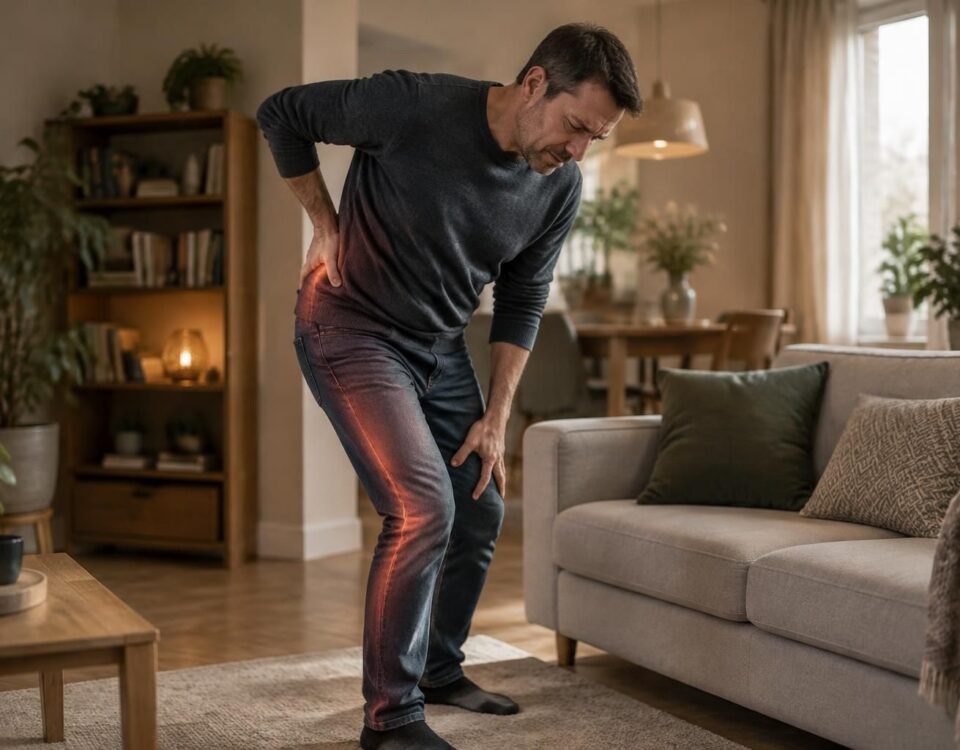
The electrical discharge felt along the path of the sciatic nerve reflects irritation or compression of a lumbar nerve root. This feeling can unfold from the lower back to the buttocks, then descend into the leg and sometimes to the foot. It is often described as a discharge, burn or acute electrical sensation that follows the path of the sciatic nerve.
The sciatic nerve is the longest in the body and can be affected by mechanical mechanisms at the lumbar level. The precise location of the irritation can direct towards L5 or S1 roots, with different pain and weakness profiles depending on the affected root. To better understand these reliefs, you can consult dedicated resources on sciatica and prolonged sitting positions.
Associated signs and alarm signals
In addition to irradiated pain, other symptoms may accompany electric shock. You can perceive paresthesias (tingling), tingling or numbness along the leg. Muscle weakness may appear, especially in the ability to raise the foot (walking on the heels) or to put on tiptoe (Achilles reflex possibly decreased or absent).
Signs indicating an emergency or a quick consultation include pain that has become paralyzing, hyperalgic pain that does not breathe at rest, or detected sphincter disorders (or loss of sensitivity in the saddle). Ponytail syndrome is a neurosurgical emergency and requires immediate management.
Electrical discharge may be a sign of nerve irritation related to causes such as herniated disc, foraminal stenosis or other lumbar damage. Further information on these mechanisms can be found in assessment guides and specialized resources.
Diagnosis and evaluation
The diagnosis is based first on the interrogation and the clinical examination. The doctor seeks the precise location of the pain, its nature and its impact on daily activities. Neurological tests make it possible to assess the strength, reflexes and sensitivity of the lower limbs.
Imaging examinations are not systematically necessary during acute sciatic pain without a deficit sign. However, if the pain persists beyond several weeks, or if motor or neurological signs appear, a radiological assessment (MRI or CT scan) can be considered to specify the etiology and guide the treatment.
Processing options and support
Initial management aims to relieve pain and reduce nerve irritation. Non-surgical options include osteopathy and neurovertebral decompressions when indicated, as well as pharmacological measures such as non-steroidal anti-inflammatory drugs and severity. Infiltrations can be offered in case of stubborn pain, under radiological control.
As part of a care program, the TagMed clinic offers adapted solutions in Montreal or Terrebonne when clinical criteria allow it. For patients looking for additional information, resources on non-surgical mechanisms and options are accessible via sites dedicated to sciatica.
It is important to rely on a professional assessment and avoid self-diagnosis. In the event of intense electrical discharge associated with neurological signs, rapid medical advice is recommended to exclude a serious complication.
Prevent and live with this symptom
Maintaining a suitable activity and avoiding positions that aggravate pain can contribute to recovery. Overall lifestyle management, including regular physical activity and a general anti-inflammatory approach, can help prevent repeated episodes. For affected patients, specific advice on sitting positions and nerve irritation mechanisms are available via specialized resources.
Resources and deepening on the subject, including explanations on sitting influences and treatment options, can be viewed on dedicated sites. Additional information is also available in specialized guides on spinal lesions and pain in the lower limb.
To learn more about non-surgical mechanisms and approaches, check out the following resources:
- Sciatica and sitting position
- Prolonged sitting and pain
- Non-surgical treatment in Montreal
- Neurovertebral decompression and sciatic pain
- herniated disc and symptoms
- Bread Radiating and Nerve Irritation
- Tagmed Clinic
Training reference and practical supervision: Osteopathy professionals can come from recognized training such as NUMSS, NAO, National University of Medical Sciences or National Academy of osteopathy. Relevant professional associations include ACMA (Canadian Alliance of Alternative Medicine), the College of Canadian Osteopaths and the College of Canadian Osteopaths.
Medical Disclaimer: The information and advice provided on this site does not replace the health professional’s diagnosis or treatment. Please note that Sylvain Desforges osteopath is neither a doctor of medicine nor a doctor, and is not a specialist in a medical specialty as defined by the Collège des Médecins du Québec. Manual medicine, functional medicine and sports medicine as described on this site exclude any medical treatment or diagnosis made by a doctor or specialist doctor. Always consult your doctor for any medical questions. For more details, please read our full legal notice.
Medical Disclaimer: The information and advice provided on this site does not replace the health professional’s diagnosis or treatment. Please note that Sylvain Desforges osteopath is neither a doctor of medicine nor a doctor, and is not a specialist in a medical specialty as defined by the Collège des Médecins du Québec. Manual medicine, functional medicine and sports medicine as described on this site exclude any medical treatment or diagnosis made by a doctor or specialist doctor. Always consult your doctor for any medical questions. For more details, please read our full legal notice.
- key symptom: Electrical discharge or burning along the sciatic nerve.
- Location: unilateral pain starting from the buttock and descending behind the leg.
- Path: can reach the posterior surface of the thigh and the leg to the foot.
- associated sensations: paresthesias and numbness.
- aggravating factors: prolonged sitting, coughing, intense efforts.
- Possible weakness: Difficulty lifting the foot or getting on the tip of the feet (depending on the root).
- Practical answers: Stay active with adapted activities; Avoid complete rest.
- Therapeutic plan: physiotherapy and osteopathy in addition; targeted exercises.
- Drug treatment: AINS and analgesics according to prescription; muscle relaxants if necessary.
- Advanced approaches: epidural infiltrations or surgery as a last resort if persistence or motor deficit.
- Emergency signs: sphincter disorders, rapid force loss, bilateral pain; fever; In case of ponytail syndrome, call 15.

An electrical discharge felt in the leg during sciatic pain can be a clear sign of irritation or compression of a nerve root. This article helps you understand why these sensations occur, how to distinguish them from ordinary lower back pain, when to consult, and what steps to take to sustainably relieve while preserving your daily activity.
The meaning of an electric shock in sciatica
The feeling of shock Typically follows the path of the sciatic nerve and shows root irritation. It can accompany pain that starts from the lower back, radiates towards the buttocks and descends along the posterior or lateral side of the leg, sometimes even at the foot. This pain is often described as raw, burning or as a current that passes through the limb.
Electric shocks essentially indicate a nervous irritation rather than just muscle pain. They are more common when the L5 or S1 root is involved and may be associated with paresthesias, muscle weakness, or mild to moderate loss of sensation in the foot or toes. Understanding this mechanism helps guide diagnosis and therapeutic options.

Disabling sciatica: what to do when the leg limits activities?
IN BRIEF A debilitating sciatica causes pain that travels down the leg and can limit walking, sleeping, or daily activities. If your leg is holding you back, have the cause evaluated and adjust your activities without straining: non-surgical approaches may…

Moderate sciatica: when to consult?
IN BRIEF A moderate sciatica is pain that starts from the lower back and radiates down into the buttock or leg, sometimes accompanied by tingling. If it limits your activities, persists, or worsens, consult a healthcare professional to assess the…
Warning signs and when to consult urgently
Signs that require quick consultation
Some situations must attract emergency care. In case of Rapid engine deficit, urinary or fecal control relief, rapidly evolving bilateral pain, or major feeling of weakness In both legs, one should consult without delay or dial 15. These signs can signal a complication that requires urgent neurosurgical evaluation.
Also note that if the pain becomes hyperalgic (Intense despite the usual treatments) or if the pain expands abruptly for no obvious reason, a medical assessment is essential to exclude another serious cause.

Mild sciatica: should we still keep an eye on it?
IN BRIEF A mild sciatica causes moderate pain that can radiate from the lower back to the buttock and leg. While it often improves over time, monitor its progress, avoid prolonged rest, and maintain gentle activity according to your tolerance.…

Severe sciatica: what signs warrant an evaluation?
IN BRIEF A severe sciatica is pain that radiates from the lower back or buttock down the leg and may be accompanied by nerve signs. A significant or progressive weakness, difficulties urinating or controlling bowel movements, or numbness in the…
Assessment and therapeutic approach
Remote vs face-to-face evaluation
teleconsultation can allow Accurate pain characterization, antecedents and initial tips. However, complete neurological examination and reflex tests most often require face-to-face evaluation to check muscle strength, sensitivity and mobility of the lower limbs.
In case of persistent pain or deficient neurological signs, the doctor may recommend imaging examinations (lumbar MRI) or additional tests. The objective is to identify a possible herniated disc, canal narrowing or other causes and to adapt the treatment.

Recurrent sciatica: symptoms that often come back
IN BRIEF Recurrent sciatica refers to the return of pain that starts from the lower back or buttock and radiates down one leg, sometimes all the way to the foot. Tingling or numbness may also reappear. A herniated disc or…

Chronic sciatica: symptoms to watch for
IN BRIEF Chronic sciatica is a persistent pain that starts from the lower back or buttock and radiates down the leg, sometimes to the foot. Burning, tingling, numbness, or weakness may also occur. Identifying these symptoms helps obtain an evaluation…
Practical recommendations and daily advice
Immediate management and preferred activities
Stay active within the reasonable extent and avoid movements that increase pain. of gentle stretching exercises And activities like walking, swimming or cycling can promote space around the nerve roots and decrease the sensitivity of electric shocks. Alternately apply cold in the acute phase and then heat to relax the muscles and reduce inflammation.
Adopt an appropriate hydration and an anti-inflammatory diet (fatty fish, fruits and vegetables rich in antioxidants, anti-inflammatory spices). A Adapted ergonomics At work and correct handling techniques reduce the constraints on the column.
If the pain persists for more than a few weeks, or if warning signs appear, check quickly to re-evaluate the diagnosis and explore options such as physiotherapy, osteopathy or, if necessary, targeted treatments (infiltrations or others as appropriate).
| Analysis axis | Concise description |
|---|---|
| Definition | shock Along the way from sciatic nerve; Sign of root irritation. |
| Location | buttocks and leg, posterior or lateral path of the lower limb. |
| nature of pain | Electric breath/electric arm with paresthesias or numbness. |
| triggers | Stress, cough, sneezing and prolonged sitting can accentuate it. |
| Associated signs | Paresthesias, possible weakness of the foot or toes. |
| Roots involved | L5 → external pain and major toe; S1 → Posterior pain and small toes. |
| Differential diagnosis | commonly associated with low back pain; Distinguish by clinical examination and painful journey. |
| Additional examinations | lumbar MRI in case of persistence or deficit; EMG/Scanner depending on context. |
| Initial support | NSAIDs and analgesics, physiotherapy/osteopathy; adapted activity and maintenance of movement. |
| Emergency signs | Significant loss of strength, sphincter disorders or bilateral pain → call the emergency services. |

Subacute sciatica: persistent symptoms
IN SHORT Subacute sciatica refers to pain that follows the path of the sciatic nerve and persists for several weeks, often between 4 and 12 weeks. It may be accompanied by tingling, numbness, or pain in the buttock and leg.…

Acute sciatica: typical symptoms to recognize
IN BRIEF Acute sciatica is pain related to the irritation of a nerve root, often starting from the lower back and extending into one buttock and then one leg. It may be accompanied by burning, electric shocks, tingling, numbness or…
Sciatica and electric shocks: a sign of nervous irritation?
Testimony 1 — Mathilde, 44 years old : For three weeks, each movement triggers an electric shock which starts from the buttock and follows the path from the nerve to the foot. This feeling prevented me from sleeping and working, and I had the impression that nothing could soothe him.
Testimony 2 — Pierre, 54 years old : The electric shock occurs at the slightest sneeze or when I sit for too long. We are talking aboutnervous irritation And, even if it was impressive at first, the evaluation allowed for appropriate and effective care.
Testimony 3 — Sophie, 33 years old : My doctor explained to me that these discharges are a key sign ofSciatic nerve root irritation. With targeted exercises and manual therapies, I was able to reduce these discharges and resume my activities.
Testimony 4 — Lucas, 40 years old : I thought it was just lumbar pain until an electric shock crosses my leg. The diagnosis confirmed thenervous irritation And I was guided to effective solutions.
Testimony 5 — Emilie, 48 years old : After a combination of physiotherapy and osteopathy, discharges gradually decreased. Today, the pain is much better controlled and I live again.
Sylvain Desforges, an experienced osteopath, has established itself as a reference in the integrated approach to musculoskeletal pain and spinal syndromes. at the head of tagmed and co-founder of theacma, it combines knowledge in osteopathy, manual medicine and Naturopathy to offer appropriate, evidence-based solutions. His journey is guided by a constant quest for innovation in the service of chronic pain and from the Functional reinstallation patients.
The phenomenon of electric shocks in sciatica is not an isolated pathology but a signal ofnervous irritation sciatic nerve. It is often a Root compression at the lumbar level, linked to a slipped disc or to a Foraminal stenosis, which triggers burning or electrical pain along the path of the nerve, from the buttocks to the foot. This type of symptoms can be persistent or occurring by seizures, and it requires accurate assessment to distinguish nerve irritation from other lumbar origins.
For Dr. Desforges, the diagnosis begins with a in-depth anamnesis and one Targeted neurological examination. It endeavors to specify the path of the pain, the intensity, the triggering factors and the associative signs (weakness, paresthesia, loss of strength). The objective is to detect if the pain follows a precise nerve root (L5 or S1) and to assess the risks of root complications. If necessary, additional explorations will be used judiciously, while avoiding unnecessary imaging.
therapeutically, The conservative approach occupies a central place. Techniques osteopathic and protocols of physiotherapy Aim to release the injured root, improve mobility and strengthen the trunk muscles to support the spine. The objective is to reduce irritation and avoid invasive treatments, while favoring active and progressive measures. Everything is in line with a logic evidence-based and adapted to each patient.
When the pain persists despite the conservative measures, the practitioner can offer complementary non-surgical therapeutic options, including advanced therapeutic techniques such as neurovertebral decompression motorized, the laser and shockwave therapies. These approaches aim to reduce local inflammation, improve circulation and promote faster functional recovery, while remaining consistent with the initial assessment and individual needs of the patient.
Beyond treatments, Dr. Desforges emphasizes lifestyle habits and maintaining a suitable activity. specific exercises, appropriate posture at work and a Anti-inflammatory diet May reduce inflammation and prevent recurrences. Therapeutic education and a proactive approach make it possible to optimize recovery and sustainably improve the quality of life of people suffering from electric shock sciatica.
To discover the approach and services offered, contact the TagMed clinic and discuss with a professional who can personalize the care pathway based on your symptoms and lifestyle.
This text explores in detail the sign shock in the sciatica, sign ofnervous irritation potential, and presents the key elements to understand its origin, diagnosis and support options. It highlights why this symptom may require full medical assessment and how to distinguish benign situations from emergencies, while proposing pragmatic ways to relieve pain and preserve quality of life.
The sciatica with shock Generally reflects irritation or compression of the sciatic nerve, the longest nerve in the body. This sensation, described as an electric shock or a burn, typically follows the course of the nerve from the lower back to the leg and can be accompanied by paresthesia or muscle weakness. The use of diagnosis is based first on the clinical examination and the interpretation of symptoms, in particular the painful journey and the associated signs. The attacks of the L5 and S1 roots are distinguished by specific layouts and deficits, which guides the therapeutic choice and possible additional examinations.
The treatment is most often progressive and oriented towards maintaining activity and reducing inflammation. Conservative measures include recommendations for appropriate physical activity, physiotherapy sessions and, where appropriate, drug treatments suitable for pain and inflammation. Osteopathy or manual therapies can provide relief when the pain is of mechanical origin, while infiltrations or, exceptionally, surgery can be considered when the symptoms persist or worsen despite appropriate care. For some patients, new therapeutic approaches and personalized medicine strategies are emerging, promising more targeted and less invasive treatments.
As part of a Early assessment, it is essential to distinguish situations that can be managed quickly by conservative measures from signs that require specialized care or emergency consultation. In case of Significant motor deficit, of Major pain that gets worse, or Signs of sphincter deficit, an urgent consultation should be considered. For less serious cases, an approach that favors education, posture, movement and rehabilitation can allow a significant improvement in symptoms and functioning on a daily basis.
To deepen the issues related to the sciatica And at its events, you can consult specialized resources personally adapted to your situation: Sciatic nerve neuropathy, The clinical assessment that precedes treatment, Cautious approach in Montreal, symptoms, Foot or toe and sciatica pain, Understanding pain before treatment.
To go further, additional useful resources include information on nerve mechanisms and management options, including practical advice and emergency criteria. You can also explore pages like Electricity shot in the leg To better understand the manifestations and the associated alarm signals.

Sylvain Desforges, B.Sc., D.O., N.D., docteur en ostéopathie
Dr Sylvain Desforges, B.Sc., D.O., N.D., osteopath, is the founding president of TAGMED and of the ACMA association. He dedicates his practice to chronic spinal pain, low back pain and symptoms compatible with sciatica, particularly when pain radiates toward the buttock, leg, calf, foot or toes.
Through SOS Sciatique, he publishes educational content on sciatica symptoms, possible causes such as disc herniation, disc narrowing, foraminal stenosis or irritation of a lumbar nerve root, as well as non-surgical approaches that may be considered according to the evaluation. At Clinique TAGMED, care may include, depending on the case, motorized neurovertebral decompression, specific osteopathic care or precision percussion.
For an evaluation related to sciatica treatment in Montreal / Mount Royal or sciatica treatment in Terrebonne, please consult the services available at Clinique TAGMED.
Medical disclaimer
The information published on SOS Sciatique is provided for educational purposes only and does not replace a consultation, diagnosis, opinion or treatment provided by a physician or another authorized healthcare professional. The author of this article is neither a medical doctor nor a specialist in a medical specialty recognized by the Collège des médecins du Québec. The osteopathic, manual medicine or functional support approaches described on this site do not constitute medical acts and are not intended to replace medical follow-up.
Consult a physician or emergency service in cases of loss of bladder or bowel control, anesthesia in the saddle area, significant or progressive weakness in the leg or foot, fever, recent trauma, severe pain or rapid worsening of symptoms. For more details, please read our Legal Notice.