




Epidural Injection for Sciatica: When Should You Consider It?
An epidural injection may be discussed when significant pain associated with nerve root irritation persists despite appropriate initial management. Its primary goal is to temporarily reduce inflammation and pain to facilitate movement, sleep, or rehabilitation.
It does not automatically repair a herniated disc, does not guarantee avoiding surgery, and is not suitable for all lower back pain. The decision lies with a qualified physician, after comparing the symptom pathway, examination, any imaging, risks, and the expected functional benefit.
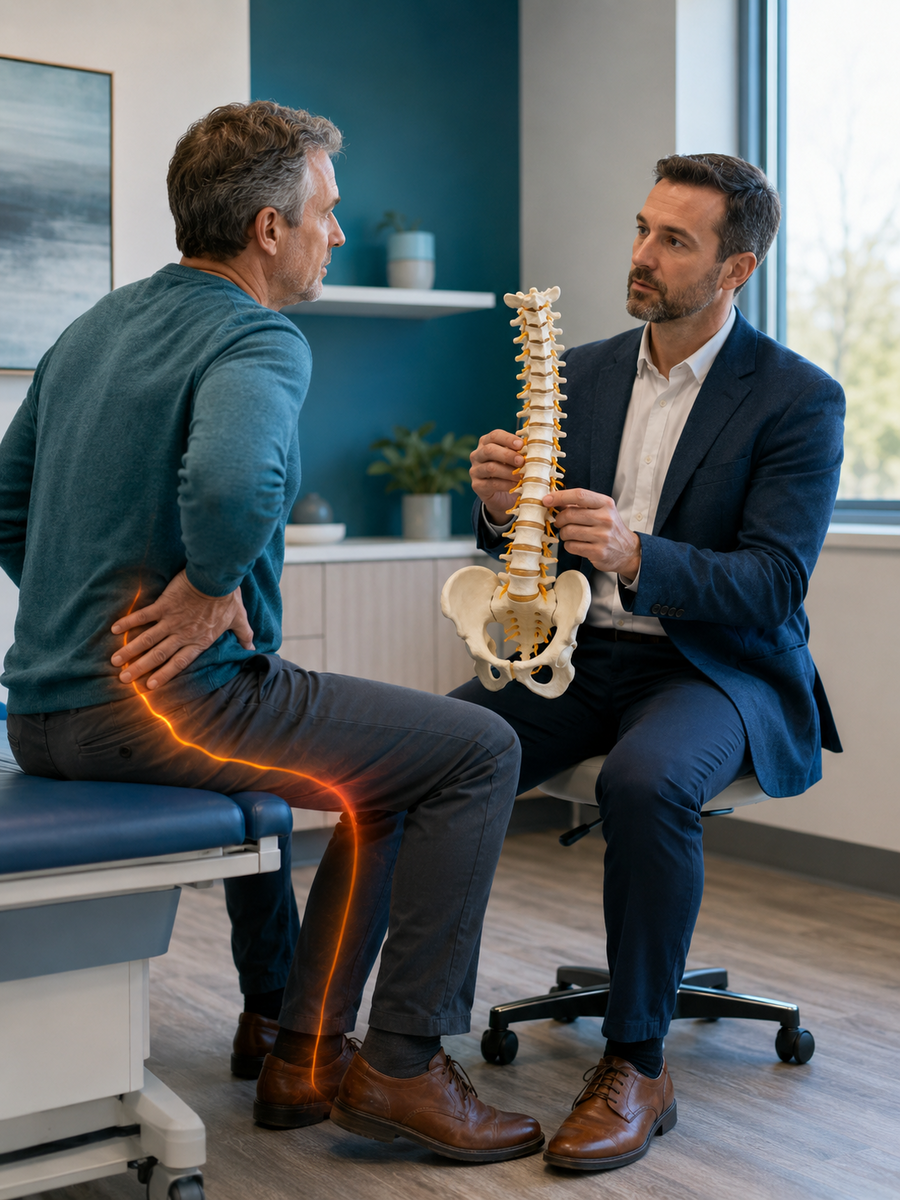
What is an epidural infiltration?
In common language, “infiltration for sciatica” often refers to an injection of a corticosteroid, usually combined with a local anesthetic, into the epidural space of the lumbar spine. The medication aims to modulate inflammation around an irritated nerve root. It is typically not injected directly into the sciatic nerve of the leg.
Depending on the target and anatomy, the doctor may choose a transforaminal, interlaminar, or caudal approach. These terms describe the pathway used to reach the epidural space. The choice depends on the suspected level, surgical history, imaging, risks, and the specialist’s experience.
Transforaminal Approach
The injection is directed towards the exit area of a targeted nerve root under imaging guidance.
Interlaminar Approach
Access is made between two posterior structures of the spine to reach the epidural space.
Caudal Approach
Access is via the lower part of the sacral canal to allow diffusion to the lumbar region.
In what situations might one consider this?
NICE suggests considering an epidural injection of local anesthetic and corticosteroid for individuals presenting with acute and severe sciatica. This recommendation does not imply that all intense sciatica must be infiltrated. The decision depends on the duration, progression, examination, treatments already attempted, and individual risks.
Significant radicular pain
Pain in the leg compatible with a root, severely limiting sleep, walking, or active care.
Clinical concordance
Course, sensitivity, strength, and possible imaging support a precise target like a herniation or foraminal stenosis.
Insufficient initial measures
The situation does not improve sufficiently despite a cautious plan, or the pain prevents its implementation.
Defined functional objective
Create a window allowing for sleep, walking, working, or participating in a graded rehabilitation.
Non-urgent surgery
A temporary option may be discussed when medical advice does not conclude with urgent surgical decompression.
Shared decision
The patient understands the expected benefit, alternatives, risks, and the possibility of no response.
When is the infiltration less convincing?
| Presentation | Why caution increases | Priority question |
|---|---|---|
| Isolated low back pain | The epidural infiltration mainly targets radicular pain, not mechanical low back pain without a clear nerve root. | What structure or mechanism truly explains the pain? |
| MRI without concordance | An anomaly on the wrong side or at the wrong level presents a less convincing target. | Does the image correspond to the course, strength, and sensitivity? |
| Mild symptoms improving | The risks and constraints may outweigh the expected additional benefit. | Is graduated activity monitoring sufficient? |
| Progressive weakness | An evolving neurological compression may require urgent referral rather than waiting. | Is a quick surgical or hospital opinion needed? |
| Claudication due to central stenosis | NICE recommends not using epidurals for neurogenic claudication associated with central canal stenosis. | Is walking pain related to central stenosis? |
| Repeated injections with no benefit | Automatically repeating an ineffective intervention exposes to risks without demonstrated objectives. | Should the diagnosis or plan be reviewed? |
What relief can one realistically expect?
The systematic review published by the American Academy of Neurology in 2025 concludes that for radiculopathy, corticosteroid epidural injections may modestly reduce pain and disability for up to around three months in some individuals. Functional benefits may persist longer in some patients, but results remain variable.
The Cochrane review from 2020 arrives at a more reserved conclusion: compared to a placebo, injections probably slightly reduce pain in the leg and short-term disability, but the average effect is weak and may not be clinically significant. Thus, neither review warrants a promise of relief nor an automatic series of injections.
Possible benefit
Temporary reduction of radicular pain sometimes allowing for better function.
Unpredictable Response
Some patients respond clearly, others partially, and some not at all.
Non-structural Effect
A decrease in pain does not indicate that a hernia or stenosis has resolved.
Is an MRI necessary before the injection?
Imaging is not necessary for all uncomplicated recent sciatica. However, when a targeted intervention is considered, an MRI or other imaging may be requested to confirm the level, exclude certain causes, and plan the procedure. The decision lies with the doctor or specialist.
- The side of the anomaly must correspond to the side of the symptoms.
- The level must be compatible with the course and any potential deficit.
- A visible hernia without clinical correlation may be incidental.
- An old MRI may no longer answer the question if the symptoms have changed.
- Imaging never replaces the examination of strength, sensation, and reflexes.

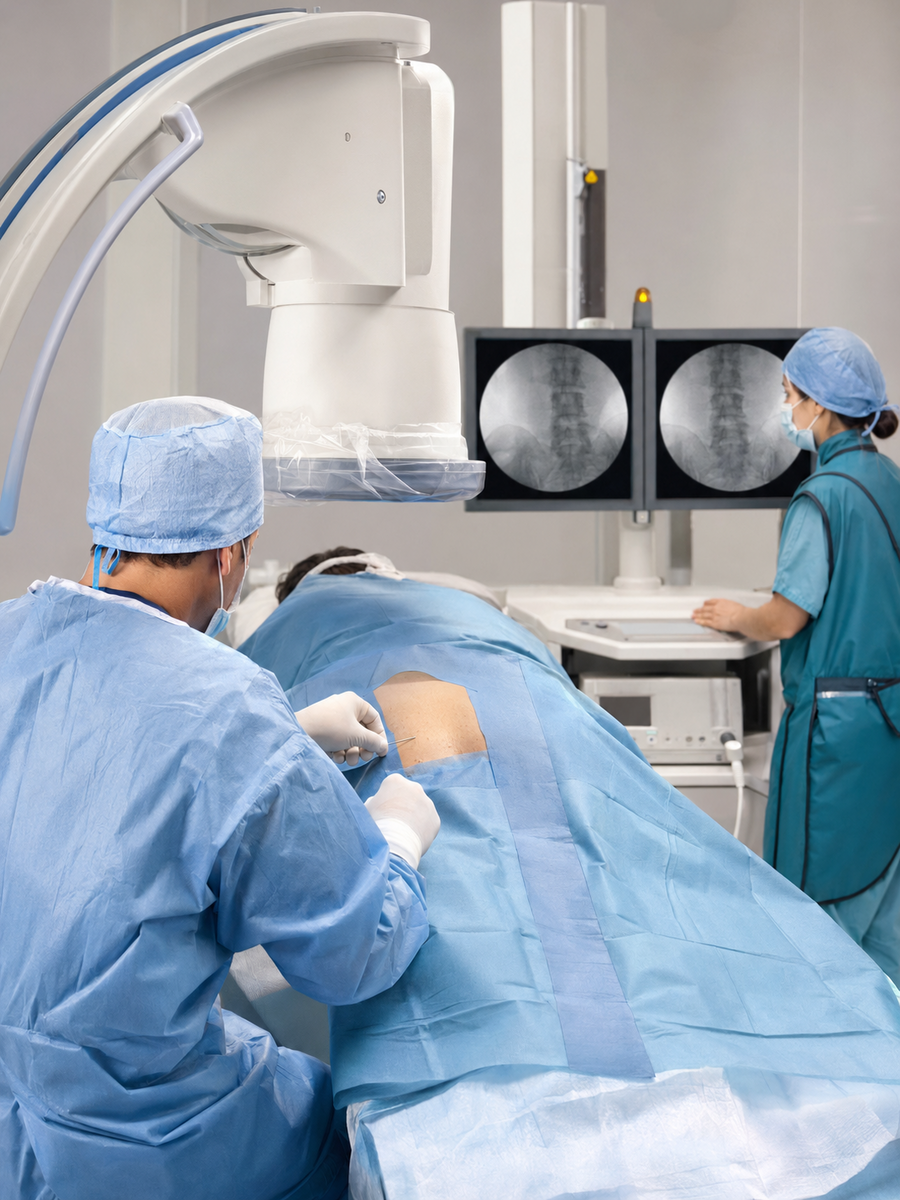
How does the intervention generally proceed?
Protocols vary depending on the center, the chosen route, and the health status. The person is usually positioned on a table, the skin is cleaned, and local anesthesia may be used. Fluoroscopic guidance or another imaging technique helps the doctor position the needle. A contrast agent may be used to check the spread before the medication is injected.
- Verification. Identity, level, side, allergies, medications, and consent.
- Installation. Appropriate positioning, monitoring, and sterile preparation.
- Guidance. Positioning of the needle with imaging control according to the technique.
- Injection. Careful administration of the product as planned by the doctor.
- Observation. Brief monitoring and instructions for returning home.
What needs to be reported before an infiltration?
The center performing the procedure must provide its own instructions. Provide a complete list of medications, natural products, and allergies. Never stop an anticoagulant or antiplatelet on your own initiative.
Medications that affect bleeding
Anticoagulants, antiplatelet agents, anti-inflammatories, and certain supplements can modify the preparation.
Diabetes
A corticosteroid may temporarily increase blood sugar; a monitoring plan may be necessary.
Infection or fever
A recent infection, antibiotics, or a wound near the site must be reported.
Allergies
Medications, anesthetics, antiseptics, and contrast agents must be mentioned.
Possible pregnancy
Inform the team before a procedure using X-rays or certain medications.
Previous interventions
Surgery, previous infiltration, undesirable reactions, and benefits obtained guide the decision.
Questions to ask the doctor
- Which root and level do you think you will target, and why?
- What realistic benefit do you expect in my case and for how long?
- What medications will be used and which route will be chosen?
- What specific risks arise from my diabetes, my medications, or my history?
- What should I stop, continue, or modify before the procedure?
- What symptoms after the infiltration require a call or emergency assistance?
- What plan will follow if the infiltration works, or if it does not work?
What are the side effects and risks?
The possible effects depend on the product, the route, the dose, and the health status. Temporary increase in pain, facial redness, variation in blood sugar, vagal discomfort, or headache may occur. Dural puncture, bleeding, infection, allergic reaction, or nerve damage are also possible.
The U.S. FDA warns that serious but rare neurological complications have been reported after epidural corticosteroid injections, including vision loss, stroke, paralysis, and death. It also states that corticosteroids are not approved by the FDA for this epidural use. Regulatory status and practices must be verified in the jurisdiction where the procedure is performed.
Possible transient effects
Pain at the site, brief boost, temporary numbness, redness, insomnia, or increased blood sugar.
Complications requiring advice
Fever, increasing redness, discharge, severe headache, unusual pain, or persistent symptoms.
Emergency after injection
New weakness, loss of bowel control, visual disturbance, seizure, confusion, or signs of stroke.
What to do if the injection relieves the pain?
A reduction in pain can provide an opportunity to gradually resume limited activities. It is generally more beneficial to use this window to restore walking, sleep, sitting tolerance, and a rehabilitation program than to immediately test maximum loads.
- Follow the immediate instructions given by the center.
- Note the onset time and the extent of relief.
- Compare the same functional measures as before the injection.
- Gradually resume permitted activities, work, and exercises.
- Avoid concluding that a temporary disappearance of pain means the structure is healed.
- Plan a re-evaluation with the doctor who recommended the procedure.

Infiltration and evaluation at Clinique TAGMED
The TAGMED Clinic does not perform infiltrations. It can offer an osteopathic assessment of pain consistent with sciatica before or after a medical intervention, within the limits of its practice scope. An imaging report or infiltration can help understand the targeted level, the response obtained, and the signs that require a new medical referral.
Depending on the context, a non-surgical approach like specific osteopathy or a cautious trial of neurovertebral decompression may be discussed. These approaches do not replace prescribed infiltration, do not guarantee to avoid surgery, and should not delay urgent medical advice. NICE also recommends not offering traction routinely for low back pain with or without sciatica.
TAGMED Clinic Terrebonne
1150 Lévis Street, Suite 200
Terrebonne, QC, J6W 5S6
Phone: 450-704-4447
Days: Monday, Wednesday, and Friday
TAGMED Clinic Montreal / Mount Royal
1140 Beaumont Avenue
Mont-Royal, QC, H3P 3E5
Phone: 1-877-672-9060
Days: Tuesday and Thursday
Frequently Asked Questions about Sciatica Injections
Can an injection cure sciatica?
It can temporarily reduce inflammation and pain in some people, but it does not automatically repair a herniated disc or the structural cause. Healing cannot be guaranteed.
How long does it take to feel an effect?
The local anesthetic can produce a rapid and temporary effect, while the effect of corticosteroids may take longer. The center should explain the expected delay based on the products used.
How long can relief last?
The duration is variable. Recent syntheses mainly describe a modest short-term benefit in some individuals, often lasting up to about three months, with no individual guarantee.
How many injections can one receive?
There is no universal number that fits everyone. The doctor must consider previous benefits, cumulative dosage, risks, other illnesses, and applicable recommendations.
Is an MRI mandatory before the procedure?
Not in all contexts, but imaging is often helpful when a targeted injection is planned. It should correspond to the path and examination and not be interpreted alone.
Is the injection painful?
A pressure or discomfort may be felt. Local anesthesia is often used. The doctor should explain the procedure and comfort options before consent.
Can one drive after the injection?
The instructions vary depending on the medication, potential sedation, and the center. It may be necessary to be accompanied and not to drive on the day of the procedure.
Does the injection prevent surgery?
Not necessarily. It may offer temporary relief, but the data do not guarantee that it will avoid surgery when it becomes indicated.
Can we perform neurovertebral decompression after an injection?
The schedule should be discussed with the doctor performing the injection and the professional evaluating the decompression. Consideration must be given to the response, restrictions, and neurological signs; no automatic resumption is recommended.
What symptoms after the injection require urgent attention?
New weakness, loss of bladder or bowel control, visual disturbances, seizures, signs of a stroke, significant fever, or a severe allergic reaction require immediate attention.
Sources and References
- NICE NG59 — Low back pain and sciatica: assessment and management.
- American Academy of Neurology — Epidural Steroids for Cervical and Lumbar Radicular Pain and Spinal Stenosis, 2025.
- Cochrane — Corticosteroid Injections for the Treatment of Sciatica, 2020.
- FDA — Rare but serious neurologic problems after epidural corticosteroid injections.
Are you undecided between infiltration and a non-surgical approach?
An evaluation can help document the pathway, function, and signs that require medical guidance. The TAGMED Clinic does not perform infiltrations but can discuss its non-surgical intervention scope when appropriate.
Sylvain Desforges, B.Sc., D.O., N.D., Doctor of Osteopathy
Editorial information, sources and limitations
This content is intended to inform patients about sciatica, possible causes, warning signs, and care options. It does not replace an individualized assessment.
Reference sources
References are selected according to the subject of the page: guidelines, systematic reviews, then institutional resources.
- NICE NG59 – Low back pain and sciatica in over 16s — National guideline
- HAS – Management of patients with common low back pain — French national guideline
- Cochrane – Corticosteroid injections for treatment of sciatica — Systematic review
- NCBI Bookshelf – Sciatica — Clinical institutional resource
Complementary resources from the TAGMED network
These internal resources complement the clinical information and thematic linking. They do not replace national guidelines or systematic reviews.
Editorial note on decompression
Clinical resource from the TAGMED network; it does not replace national guidelines. Some guidelines use the term “traction” and recommend caution for low back pain with or without sciatica. Any decompression option should therefore be presented as an individualized clinical approach, with limitations, indications, and contraindications clearly explained.
Limitations of this information
The information on this page is general. It does not constitute a diagnosis, prescription, or guarantee of results. Pain radiating into the leg may have several causes; assessment should consider clinical history, examination findings, symptom progression, and, when appropriate, complementary tests.
When to seek urgent medical care
Seek urgent medical care if you experience loss of bladder or bowel control, saddle anesthesia, major or progressive leg weakness, unexplained fever, pain after significant trauma, or severe pain that rapidly worsens.
