


Causes of Sciatica: Understanding the Possible Origin of Pain
Sciatic pain can be linked to several different mechanisms: irritation of a nerve root, herniated disc, disc bulge, foraminal stenosis, osteoarthritis, local inflammation or projected pain from another structure.
This page helps you understand the most common causes of sciatica compatible pain, the limitations of self-interpretation, the role of clinical evaluation, and the importance of not assigning leg pain to a single structure too quickly.
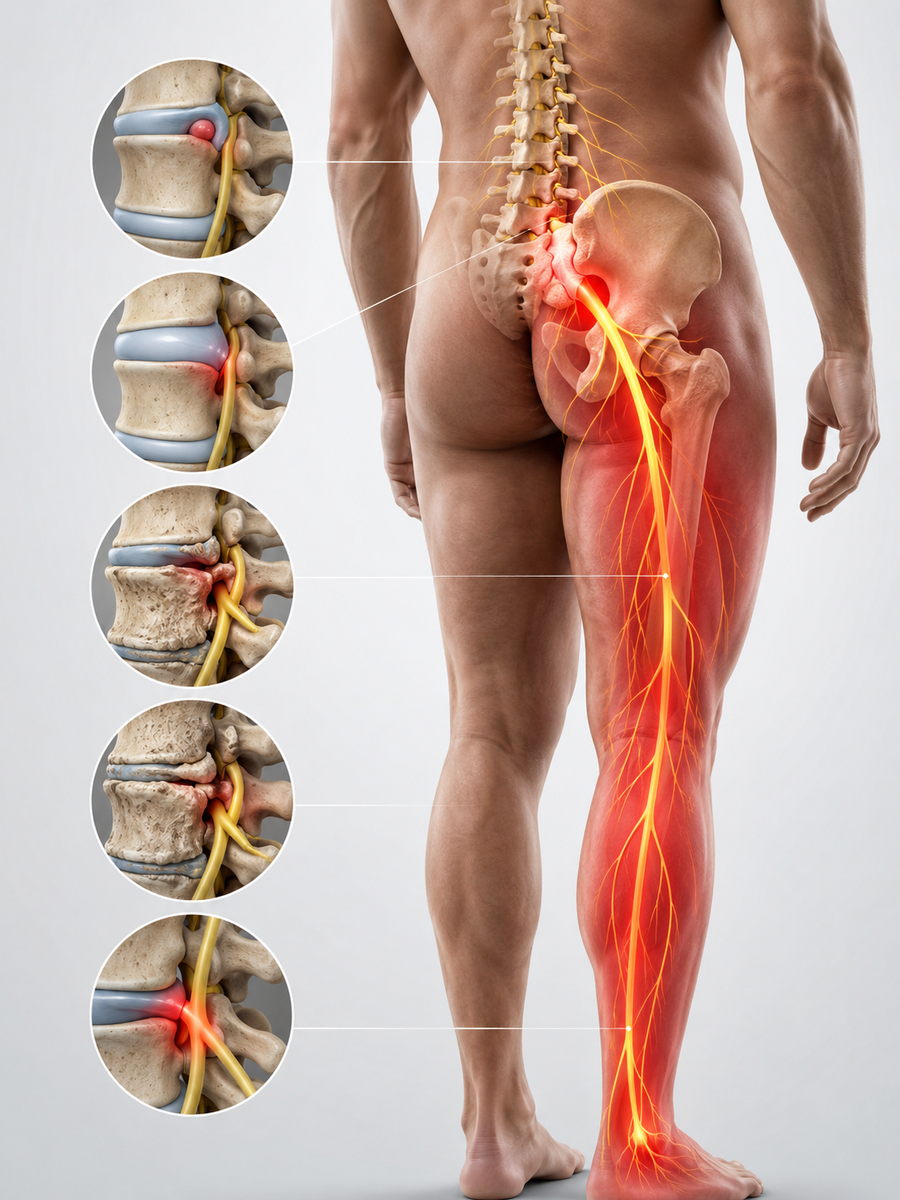
Why sciatica can have multiple causes
The sciatic nerve is formed from nerve roots that emerge from the lumbar and sacral spine. When one of these roots is irritated, compressed or inflamed, the pain can be felt far from the spine, for example in the buttocks, back of the thigh, calf, heel, foot or certain toes.
It is this particularity that makes sciatica sometimes difficult to interpret. The patient may have a very pain in the leg, while the main mechanical problem is higher, in the lumbar region. Conversely, some pain in the buttocks or legs do not come directly from a nerve root, but from a joint, tendon, muscle, hip or projected pain.
The frequent error is to want to name a single cause too quickly. A serious assessment should rather answer several questions: where does the pain begin, how far it goes, what movements make it worse, is there numbness, loss of sensitivity or weakness, and the symptoms agree with the available examinations?
Disc cause
A hernia, protrusion, or bulge disc can irritate a nerve root, especially when the pain drops below the knee.
foraminal cause
A narrowing of the foramen can limit the space available for a nerve root and cause irradiated pain.
joint or projected cause
The facets, the sacroiliac, the hip or certain muscle structures can sometimes mimic sciatic pain.

1. Herniated disc: a common cause, but not automatic
Herniated disc is one of the best known causes of sciatica pain. It occurs when part of the intervertebral disc protrudes backwards or sides and may come into contact with a nerve root. This contact can lead to local inflammation, irradiated pain, tingling, numbness or sometimes weakness.
However, the presence of a hernia on an MRI is not enough to automatically explain all the symptoms. Some hernias are not very symptomatic, while small protrusions can be very irritating if they precisely affect a sensitive nerve root. The concordance between the image, the path of pain and the clinical signs is therefore essential.
Pain that follows a specific journey, for example to the big toe or outer edge of the foot, can point to a particular root. However, the assessment should always remain cautious, as the symptoms do not always follow the perfect patterns of anatomy textbooks.
2. Bushing Discal and Protrusion: When the disc overflows without real voluminous hernia
A disc bulge corresponds to a wider overflow of the disc, often associated with wear, disc dehydration or repeated stresses. A protrusion is generally more localized, but it can also help reduce the available space around a nerve root.
These abnormalities are common on imaging tests, especially with age. Their importance depends on the context: a light disc bulge in a person without pain does not have the same meaning as a protrusion that agrees with irradiated pain, numbness or significant functional limitation.
The objective is therefore not to process an image, but to understand if the image really explains the symptoms. This is why a mechanical, clinical and functional reading is often more useful than a simple list of radiological terms.
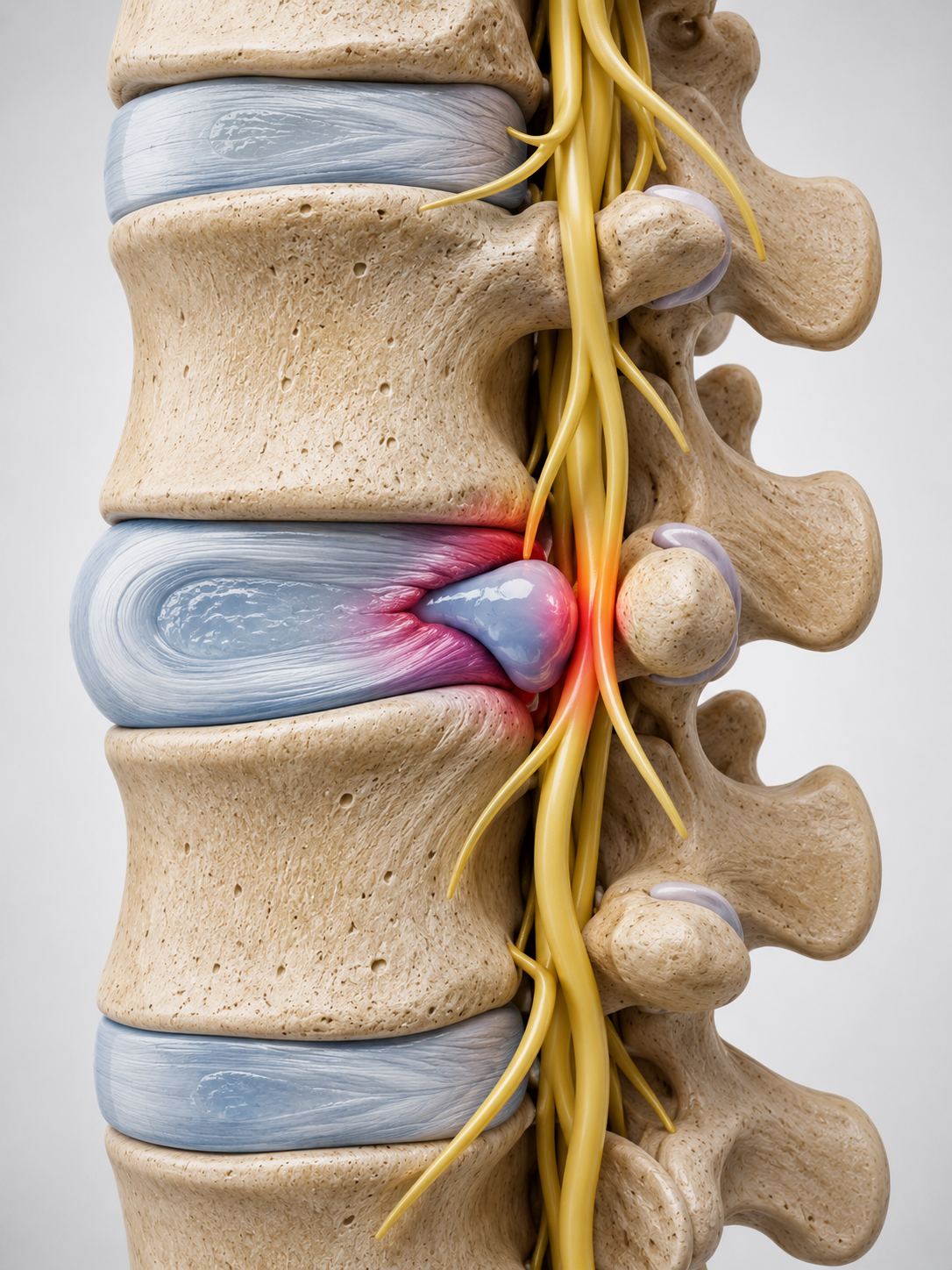
3. Foraminal stenosis and lumbar stenosis: when available space decreases
Foraminal stenosis refers to a narrowing of the opening through which the nerve root comes out of the column. This narrowing can be related to osteoarthritis, loss of disc height, osteophytes, ligament thickening or a combination of degenerative factors.
The central lumbar stenosis affects the spinal canal instead. It can cause lower back pain, leg pain, heaviness, numbness or difficulty walking for a long time. Some people describe an improvement when they sit or lean forward slightly, as this position may temporarily increase the available space.
Stenosis is particularly important to consider when leg pain is triggered by prolonged walking or standing, especially in an older person or with advanced lumbar osteoarthritis.
| Condition | Possible mechanism | Common symptoms |
|---|---|---|
| Foraminal stenosis | Nerve root passage narrowing | Irradiated pain, numbness, burning, often unilateral symptoms |
| Central lumbar stenosis | Spinal canal narrowing | Pain or heaviness in the legs when walking, possible sitting improvement |
| Mixed degenerative stenosis | Disc, osteoarthritis, osteophytes and ligaments combination | Variable, sometimes bilateral or fluctuating symptoms |

4. Facet osteoarthritis, osteophytes and disco-osteophytic complex
Over time, the facet joints can become osteoarthritis. They can thicken, become inflammatory and help reduce space around nerve structures. Osteophytes, sometimes called bone beaks, can also form in a degenerative context.
The term disco-osteophytic complex often describes a combination of disc overflow and degenerative bone formation. This type of change can be very relevant when it affects a narrow area such as the lateral recession or the foramen.
These terms may seem worrying, but their importance always depends on their location, severity and concordance with the symptoms. Visible osteoarthritis in imaging is not always painful, but when it reduces the space of a nerve root, it can participate in sciatic pain.
5. Piriform Syndrome: An Explanation Often Overused
Piriformis syndrome is often mentioned when a person feels pain in the buttocks or behind the thigh. However, this is a much less frequent cause than disc, foraminal, osteoarthritic or radicular explanations. The problem is that this label is sometimes used without a solid objective test, simply because the pain is felt in the buttock.
This caution is important. Buttock pain may come from a lumbar nerve root, disc herniation, foraminal stenosis, facet osteoarthritis, sacroiliac joint, hip problem or of a projected pain. Attributing pain to the piriform too quickly can delay a better understanding of the problem.
The piriform can be contracted or sensitive in several lumbar conditions, without being the main cause. Its tension can be a consequence of protection, compensation or nervous irritation, rather than the origin of the problem.
6. Projected pain: hip, sacroiliac and muscles
Not all pains that descend into the leg do not necessarily come from a nerve root. The hip, sacroiliac joint, gluteal muscles, some tendons and ligament structures can create projected pain that partially resembles sciatica.
The difference is often found in the details. Non-radicular projected pain rarely descends along a clear neurological path to the foot or toes. It is often more diffuse, more mechanical, more localized around the buttocks, hips or thighs, and less associated with precise numbness.
However, there are gray areas. A person may have both lumbar pain, nervous irritation and hip or pelvis compensation. Assessment must therefore look for the dominant causes rather than stopping in a single term.

How the evaluation helps guide the likely cause
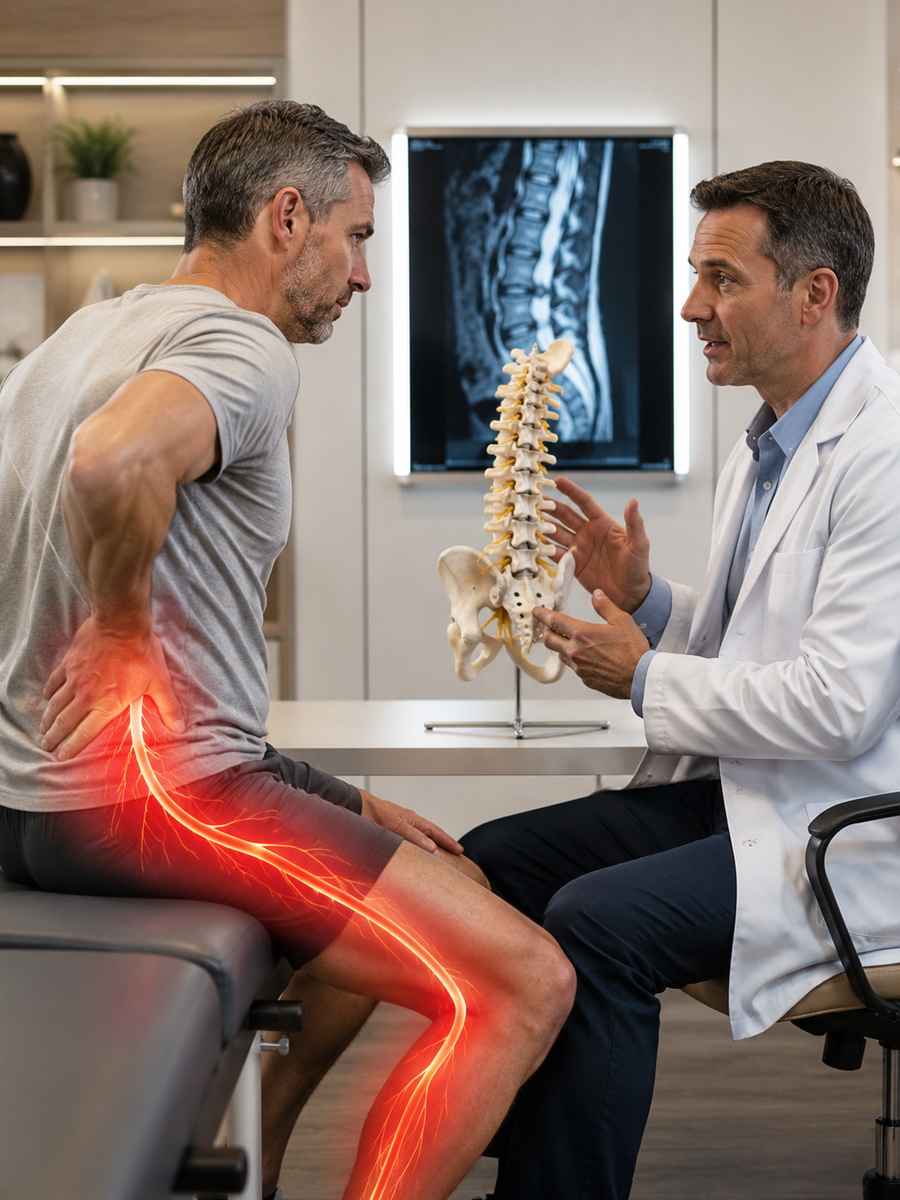
A structured assessment is not based on a single element. It combines the history of pain, its path, aggravating factors, neurological signs, functional limitations and available examinations. This combination makes it possible to orient the most probable cause and to choose a cautious strategy.
1. History of symptoms
Sudden or progressive onset, fall, effort, recurrence, recent or chronic pain.
2. Pain path
Butt, thigh, calf, heel, foot, big toe or outer edge of the foot.
3. Neurological signs
Numbness, tingling, loss of sensitivity, weakness or difficulty walking.
4. Imaging
MRI, scanner or X-rays already available when their analysis is relevant.

The role of imaging: useful, but never alone
MRI can be very useful when suspecting a herniated disc, stenosis, root compression or a more complex condition. It allows you to visualize disks, nerve roots, lumbar canal and degenerative structures.
But imaging can also show abnormalities that do not cause the current pain. Many adults show signs of disc degeneration, osteoarthritis or bulge without significant pain. This is why it is necessary to avoid processing only an image.
A good clinical interpretation seeks a concordance: the side of the pain, its path, the sensory or motor signs and the location of imaging anomalies must form a coherent whole. When there is discrepancy, the analysis must be broadened.
Signs that deserve special attention
Some symptoms may indicate greater nervous irritation or a situation that requires priority medical care. These signs should not be ignored.
to be assessed quickly
- pain that descends lower and lower in the leg;
- increasing numbness;
- persistent pain despite adaptation of activities;
- difficulty walking for a long time;
- Light but new weakness.
medical emergency
- loss of urinary or intestinal control;
- anesthesia in the stool area;
- Severe weakness or foot drop;
- fever or suspected infection;
- pain after significant trauma.
Common causes: practical summary
| possible cause | Frequent index | point of caution |
|---|---|---|
| Slipped disc | Pain radiated under the knee, sometimes numbness or weakness | The image should match the path and side of symptoms |
| bulge or protrusion | Mechanical or root pain depending on location | Very common in imaging, not always symptomatic |
| Foraminal stenosis | root pain, often aggravated by certain postures | May be related to osteoarthritis, disc, osteophytes or loss of disc height |
| Lumbar stenosis | Pain or heaviness in walking | often progressive and multifactorial |
| Facet osteoarthritis | Lumbar pain, sometimes projected pain | Can coexist with a disc or foraminal cause |
| Hip or sacroiliac | butt, groin, hip or thigh pain | Can mimic sciatica without real nervous irritation |
| piriform | Pain sometimes aggravated buttocks sitting | cause much less frequent than lumbar or foraminal explanations |
Non-surgical approach: when the cause seems mechanical
When the symptoms are compatible with a mechanical or disc cause, a non-surgical approach may be considered depending on the assessment, patient tolerance, chronicity, available imaging and contraindications.
At the Tagmed Clinic, options may include motorized neurovertebral decompression, specific osteopathy, laser medical, shock waves or precision striker when these approaches are appropriate to the patient’s profile.
The goal is not to promise a cure, but to propose a structured, prudent and personalized strategy to reduce constraints, calm irritation and improve function.
Please note that we do not offer physiotherapy, chiropractic, injection, naturopathic or functional medicine services at the TagMed Clinic.

Frequently asked questions about the causes of sciatica
What is the most common cause of true sciatica?
Real sciatic pain is often linked to irritation of a lumbar nerve root, for example in the presence of a herniated disc, disc protrusion, disc bulge or foraminal stenosis. However, the exact cause should always be interpreted depending on the path of pain, neurological signs, clinical examination and available imaging.
Does pain in the buttock mean it is piriform?
No. Piriformis syndrome is often mentioned too quickly. Pain in the buttocks may come from a lumbar nerve root, disc herniation, foraminal stenosis, facet osteoarthritis, sacroiliac joint, hip or pain projected. Piriformis should not be considered the main cause without serious assessment.
Is an MRI still necessary for sciatic pain?
No. MRI is not always necessary at the onset of sciatic pain. It becomes especially relevant when the pain persists, worsens, gradually descends into the leg, is accompanied by numbness or weakness, or when the results can influence the choice of treatment.
Why does my pain go down to the foot?
Pain that goes down to the foot may be compatible with irritation of a lumbar nerve root, especially L5 or S1. For example, pain or numbness towards the big toe may evoke L5, while pain towards the heel or the outer edge of the foot can evoke S1. However, the journey must be confirmed by all the clinical signs.
Does a herniated disc on MRI always explain sciatica?
No. A herniated disc on MRI does not automatically explain all symptoms. Some hernias are not very symptomatic, while some smaller protrusions can be very irritating if they come into contact with a sensitive nerve root. The concordance between the image, the side of the pain, the path and the neurological signs is essential.
What is the difference between a disc herniation, a disc bulge and a protrusion?
A disc bulge generally corresponds to a wider overflow of the disc. A protrusion is often more localized. A disc herniation involves a more marked protrusion of the disc, sometimes in contact with a nerve root. These terms should be interpreted according to their location, size, nerve effect and symptom concordance.
Can foraminal stenosis cause sciatic pain?
Yes I do. Foraminal stenosis corresponds to a narrowing of the space through which a nerve root comes out of the column. If this space becomes too narrow, the root can be irritated or compressed. This can cause pain that descends into the buttocks, thigh, calf or foot depending on the root involved.
Can the hip or sacroiliac joint mimic sciatica?
Yes I do. Some pain from the hip, sacroiliac joint, gluteal muscles or tendons can partially mimic sciatica. These pains are often more diffuse and less associated with a specific neurological path to the foot or toes. An assessment distinguishes between projected pain from true nervous irritation.
When does sciatic pain become worrying?
Sciatic pain becomes more worrying when accompanied by weakness, loss of sensitivity, progressive numbness, difficulty walking, falling the foot, loss of urinary or intestinal control, anesthesia in the stool, fever or rapid worsening. Some of these signs require urgent medical consultation.
Can sciatica be treated without surgery?
In several situations, a non-surgical approach can be considered, depending on the probable cause, severity of symptoms, neurological signs, contraindications and progression of pain. At the TagMed Clinic, the approach may include a personalized assessment and, where relevant, non-invasive care tailored to the patient’s profile.
Want to understand the probable cause of your pain?
An assessment can assist in linking your symptoms, pain path, limitations, and available exams to determine if a non-surgical approach is relevant.
Dr Sylvain Desforges, B.Sc., D.O., N.D., Osteopath
Editorial information, sources and limitations
This content is intended to inform patients about sciatica, possible causes, warning signs, and care options. It does not replace an individualized assessment.
Reference sources
References are selected according to the subject of the page: guidelines, systematic reviews, then institutional resources.
- NICE NG59 – Low back pain and sciatica in over 16s — National guideline
- HAS – Management of patients with common low back pain — French national guideline
- Cochrane – Corticosteroid injections for treatment of sciatica — Systematic review
- NCBI Bookshelf – Sciatica — Clinical institutional resource
Complementary resources from the TAGMED network
These internal resources complement the clinical information and thematic linking. They do not replace national guidelines or systematic reviews.
Editorial note on decompression
Clinical resource from the TAGMED network; it does not replace national guidelines. Some guidelines use the term “traction” and recommend caution for low back pain with or without sciatica. Any decompression option should therefore be presented as an individualized clinical approach, with limitations, indications, and contraindications clearly explained.
Editorial note on imaging
Imaging is mainly considered when the presentation is complicated, prolonged, or likely to change management. Routine imaging is generally not necessary for every simple and recent sciatica-like pain presentation.
Limitations of this information
The information on this page is general. It does not constitute a diagnosis, prescription, or guarantee of results. Pain radiating into the leg may have several causes; assessment should consider clinical history, examination findings, symptom progression, and, when appropriate, complementary tests.
When to seek urgent medical care
Seek urgent medical care if you experience loss of bladder or bowel control, saddle anesthesia, major or progressive leg weakness, unexplained fever, pain after significant trauma, or severe pain that rapidly worsens.