


Sciatica: when to consult urgently or quickly?
Sciatic pain can sometimes change favorably, but some signs should never be trivialized. Pain that descends into the leg, which is accompanied by numbness, weakness or urinary disorders, requires special attention.
The purpose of this page is to help you distinguish three situations: signs that justify urgent consultation, symptoms that deserve a quick assessment, and situations where careful monitoring can be considered. This distinction is important because sciatic pain may be related to nerve irritation, disc herniation, disc protrusion, foraminal stenosis, spinal stenosis or disc pinch.


Emergency, quick consultation or monitoring: how to tell the difference?
The first question to ask is not only: “Is the pain strong? Rather, you have to ask, “Does the pain change quickly?” Does it go lower? Does the force decrease? Does the sensitivity change? Are urinary or intestinal functions affected? »
Stable, recent sciatic pain with no neurological deficit can sometimes be monitored for a few days with caution. Conversely, pain that gets worse, which becomes more intense in the leg than in the back, which descends towards the foot or which is accompanied by progressive numbness must be assessed more quickly.
| Situation | Possible signs | prudent decision |
|---|---|---|
| Emergency | Urinary or intestinal disorders, stool anesthesia, significant weakness, extreme pain. | Consult immediately. |
| quick consultation | Progressive numbness, pain under the knee, pain going down to the foot. | Ask for an evaluation without waiting too long. |
| planned evaluation | Persistent, recurrent pain, limiting walking, sitting or sleeping. | clarify the probable cause. |
| Prudent monitoring | Mild to moderate pain, recent, stable, without weakness or neurological disorder. | Observe evolution and avoid aggravating movements. |
Signs that require urgent consultation
Some symptoms may indicate greater neurological damage or a medical situation that goes beyond mere mechanical pain. They should be taken seriously, even if the lower back pain itself seems bearable.
loss of urinary or intestinal control
New difficulties in urinating, urinary leakage, loss of intestinal control or a sudden change in sphincter control are major warning signs.
Anesthesia in the stool area
A loss of sensitivity in the area of the perineum, crotch or stool should be considered urgent, especially if it appears with sciatic pain.
significant or progressive weakness
Difficulty lifting the foot, climbing on tiptoe, walking normally or a loose leg can evoke a motor deficit.
Unrelieved extreme pain
Very intense, unusual, uncontrollable or unrelieved sciatica pain despite the usual measures should be assessed without delay.
General fever or malaise
Lumbar or sciatic pain associated with fever, chills or altered general condition may suggest another cause that requires a medical assessment.
recent trauma
A fall, accident, significant impact or pain that appears after trauma should be assessed quickly, especially in a fragile or older person.
When to consult quickly, even without obvious emergency?
Between urgency and simple monitoring, there is an important area: rapid consultation. This is the case when the pain does not present an immediate dramatic sign, but is moving in a worrying direction. Pain that gradually descends towards the foot, numbness that extends or a loss of walking tolerance should be assessed.
It is also necessary to consult quickly if pain limits essential activities: sleeping, walking, getting up, driving, working or remaining seated. Sciatic pain that persists, recurs or worsens despite the precautions deserves an assessment to avoid repeating ill-suited movements or exercises.
- The pain descends under the knee or towards the foot.
- The numbness increases or changes territory.
- The pain becomes stronger in the leg than in the lower back.
- Walking is getting harder and harder.
- Pain disrupts sleep significantly.
- Exercises or stretching aggravate the symptoms.
- The pain frequently returns despite the rest periods.
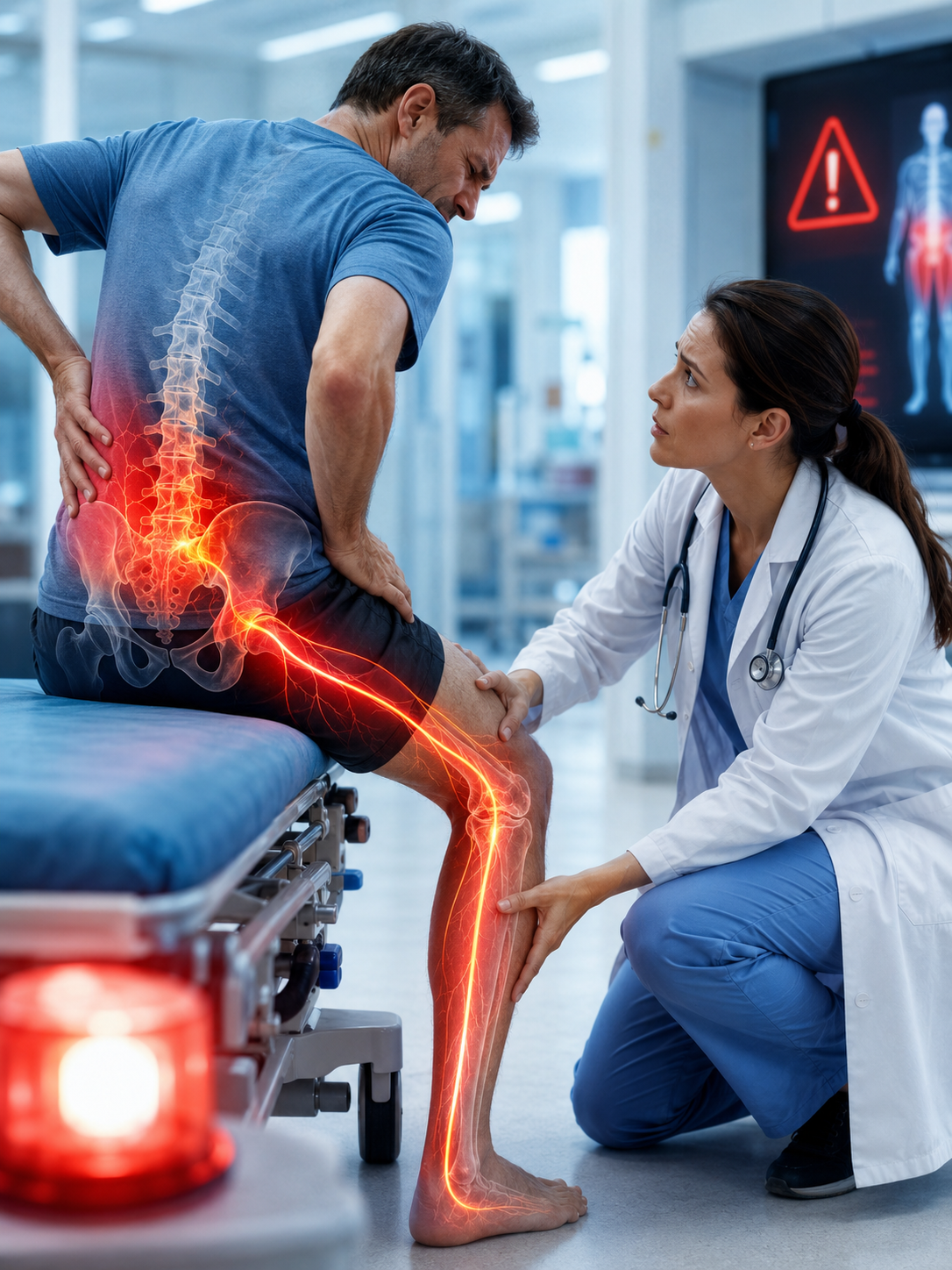
Practical table: what does your symptom mean?
The following table does not replace a clinical evaluation, but it helps to understand why some signs are more of a concern than others. The decision always depends on the intensity, progression and the medical context.
| Symptom | level of caution | Why is it important |
|---|---|---|
| Pain in the butt only | Variable | Can be mechanical, disc, joint or muscular. The journey and the evolution are essential. |
| Pain coming down behind the thigh | Moderate | May be compatible with irritation of a lumbar nerve root. |
| Pain in the calf or foot | Higher | More distal pain often suggests clearer nervous irritation. |
| Progressive numbness | High | May indicate a sensory attack that needs to be monitored closely. |
| Weakness of the foot or leg | Very high | May indicate a motor deficit requiring rapid assessment. |
| Urinary disorders or stool anesthesia | Emergency | may correspond to a serious neurological situation. |
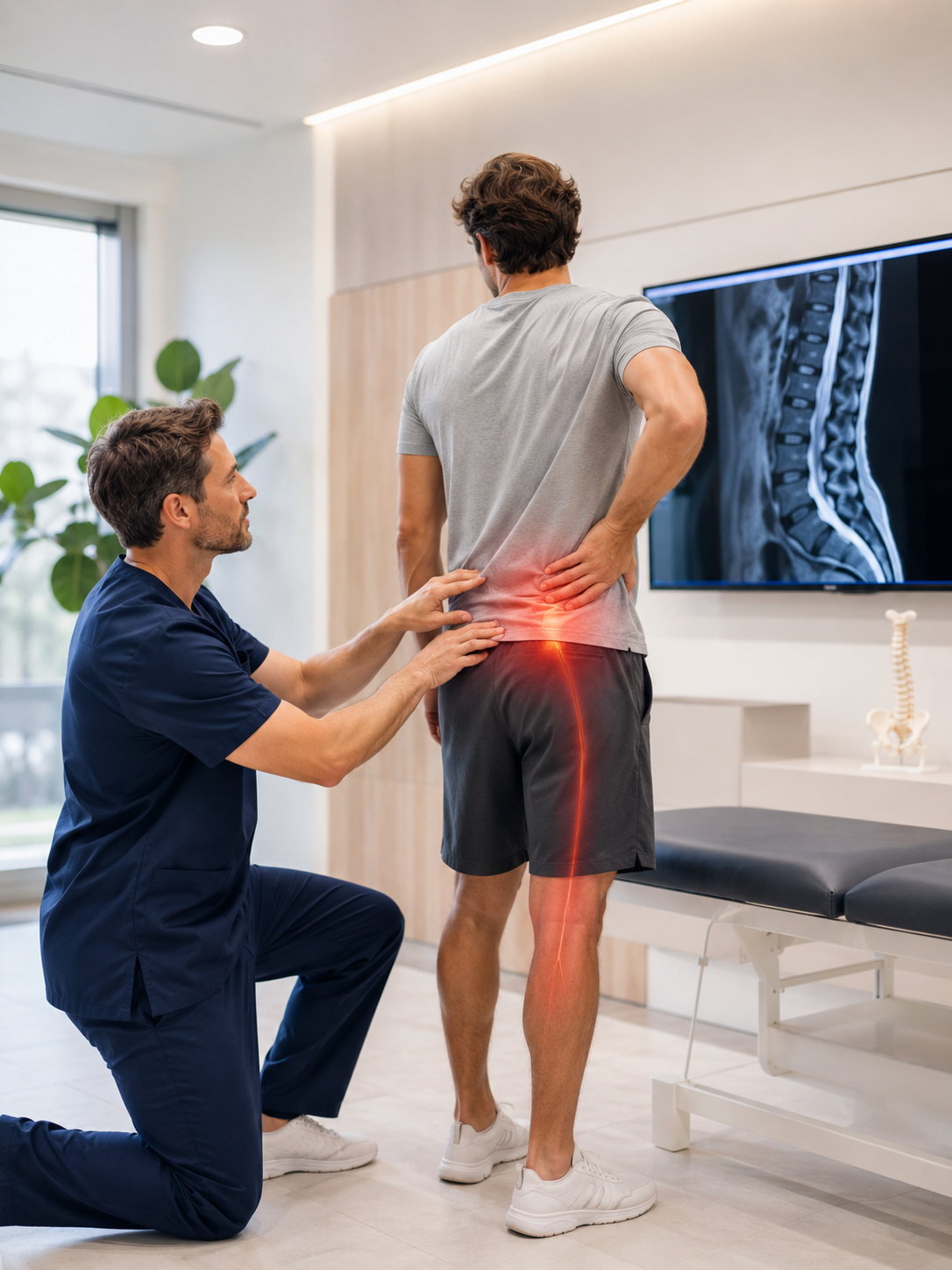
Do you need an MRI as soon as you have sciatica?
Not necessarily. Imaging can be useful in certain contexts, especially when there are neurological signs, persistent pain, aggravation, trauma, more serious suspicion of cause or a therapeutic decision to be specified. However, MRI should not replace clinical evaluation.
An imaging result should be related to the symptoms. Disc hernia, bulge, protrusion, foraminal stenosis or spinal stenosis may be present in imaging, but their importance depends on the path of pain, neurological examination, strength, sensitivity and reaction positions.
MRI sometimes useful
Persistent pain, weakness, progressive numbness, suspicion of significant compression or treatment decision.
MRI to interpret
One image alone is not enough. It should be compared to symptoms and clinical examination.
What can the TagMed clinic do in the face of sciatic pain?
At the TagMed clinic, pain compatible with sciatica is approached by a personalized evaluation. The goal is to understand the path of pain, aggravating positions, associated neurological signs, walking tolerance, seated position tolerance and elements compatible with a disc or foraminal cause.
Depending on the context, non-surgical and non-invasive approaches may include neurovertebral decompression motorized, specific osteopathy or the precision striker. The choice depends on the evaluation, the patient’s tolerance and the probable cause.
| Approach | Possible role | When to consider it |
|---|---|---|
| Motorized neurovertebral decompression | Reduce some mechanical stress on discs and nerve roots. | Pain compatible with a disc origin or mechanical compression. |
| osteopathy specific | Adapt interventions to mobility, compensation and patient tolerance. | Pain with stiffness, functional limitation or associated mechanical overload. |
| Precision striker | Instrument assisted intervention, targeted and low amplitude. | Accurate mechanical dysfunction depending on the assessment and tolerance. |
Consult for sciatica at the Tagmed clinic
The Tagmed Clinic is a specific osteopathy and advanced technology clinic. She offers non-surgical and non-invasive care for spinal pain, certain joint pain, muscle pain and sports injuries, depending on the assessment.
For pain compatible with sciatica, the goal is to identify signs that require urgent medical guidance, clarify symptoms compatible with nervous irritation and determine if a personalized approach may be relevant. The typical rate is $140 per consultation or treatment. The services are not covered by the RAMQ, but osteopathy receipts may be provided and are eligible for reimbursement by several private insurance plans according to your contract.
Please note that we do not offer physiotherapy, chiropractic, injection, naturopathic or functional medicine services at the TagMed Clinic.
Tagmed Terrebonne Clinic
1150 rue Lévis, Suite 200
Terrebonne, QC, J6W 5S6
Phone: 450-704-4447
Days: Monday, Wednesday and Friday
Clinic Tagmed Montreal / Mont-Royal
1140 Avenue Beaumont
Mount Royal, QC, H3P 3E5
Phone: 1-877-672-9060
Days: Tuesday and Thursday
Frequently asked questions: When to consult for sciatica?
When does sciatica become an emergency?
Sciatica becomes urgent in the presence of urinary or intestinal disorders, anesthesia in the stool area, significant or rapidly progressive weakness, unrelieved extreme pain, fever or recent trauma.
Is a foot weakness worrying?
Yes I do. Difficulty lifting the foot, walking on the heels, climbing on the tip of the feet or a loose leg can indicate a motor deficit. This sign should be assessed quickly.
Does a foot numbness require consultation?
A light and stable numbness must be monitored, but a numbness that increases, extends or is accompanied by weakness justifies a quick consultation.
Should we consult if the pain drops below the knee?
Yes, especially if the pain drops gradually, reaches the calf or foot, or is accompanied by tingling, numbness or weakness. This may suggest a clearer nervous irritation.
Can sciatic pain be monitored for a few days?
It can sometimes be monitored if it is recent, mild to moderate, stable, without weakness, without worrying loss of sensitivity and without urinary or intestinal disorder. Any aggravation must modify the conduct.
Should I stop the exercises if the pain increases?
Yes I do. Exercise that lowers the pain lower into the leg, increases numbness or causes weakness should be interrupted. Exercises should be adapted to the probable cause.
Is sciatic pain at night worrying?
Persistent, very intense nocturnal pain associated with fever, general malaise, unexplained weight loss or rapid worsening should be medically assessed.
When to ask for an MRI for sciatica?
MRI can be relevant in case of neurological signs, persistent pain, aggravation, more serious suspicion or when a therapeutic decision depends on imaging. It should be interpreted with symptoms and clinical examination.
Can the TagMed Clinic assess sciatic pain?
Yes I do. The TagMed Clinic can assess pain compatible with sciatica, identify signs requiring urgent medical guidance and determine whether a non-surgical and non-invasive approach is relevant depending on the context.
What treatments are possible at TagMed Clinic?
Depending on the assessment, possible approaches may include motorized neurovertebral decompression, specific osteopathy or the precision striker. Medical laser and shock waves are not used for the treatment of back pain or sciatica.
Your sciatica gets worse or goes down the foot?
An assessment can help clarify the level of caution, identify signs that require urgent guidance and determine whether a non-surgical approach like motorized neurovertebral decompression, specific osteopathy, or the precision striker may be relevant.
Dr Sylvain Desforges, B.Sc., D.O., N.D., Osteopath
Editorial information, sources and limitations
This content is intended to inform patients about sciatica, possible causes, warning signs, and care options. It does not replace an individualized assessment.
Reference sources
References are selected according to the subject of the page: guidelines, systematic reviews, then institutional resources.
- NICE NG59 – Low back pain and sciatica in over 16s — National guideline
- HAS – Management of patients with common low back pain — French national guideline
- Cochrane – Corticosteroid injections for treatment of sciatica — Systematic review
- NCBI Bookshelf – Sciatica — Clinical institutional resource
Complementary resources from the TAGMED network
These internal resources complement the clinical information and thematic linking. They do not replace national guidelines or systematic reviews.
Editorial note on decompression
Clinical resource from the TAGMED network; it does not replace national guidelines. Some guidelines use the term “traction” and recommend caution for low back pain with or without sciatica. Any decompression option should therefore be presented as an individualized clinical approach, with limitations, indications, and contraindications clearly explained.
Limitations of this information
The information on this page is general. It does not constitute a diagnosis, prescription, or guarantee of results. Pain radiating into the leg may have several causes; assessment should consider clinical history, examination findings, symptom progression, and, when appropriate, complementary tests.
When to seek urgent medical care
Seek urgent medical care if you experience loss of bladder or bowel control, saddle anesthesia, major or progressive leg weakness, unexplained fever, pain after significant trauma, or severe pain that rapidly worsens.
