


Exercises for sciatica: which to do with caution?
The sciatica exercises are highly sought after, but they are not all suitable for all people. Pain that goes down in the leg can have several causes, and sometimes poorly chosen movement can increase the irritation of a nerve root.
Before choosing an exercise, it is necessary to take into account the path of the pain, the presence of numbness, muscle weakness, tolerance to sitting position, walking, flexing the trunk and stretching. Sciatica related to a herniated disc does not always react as pain related to foraminal stenosis, spinal stenosis or disc pinching.
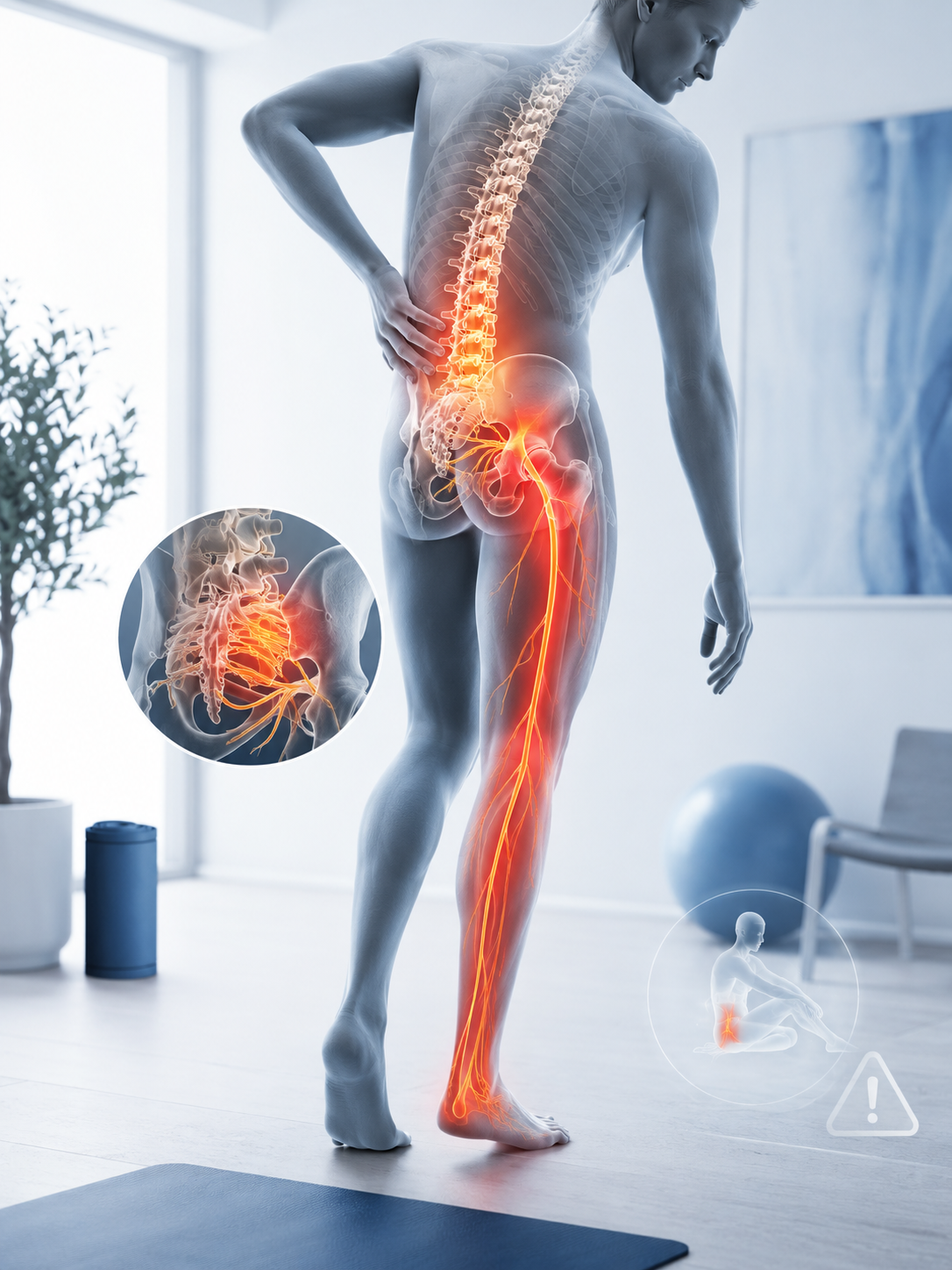

Before you start: questions to ask
Before doing exercises for sciatica, it is first necessary to observe how the pain reacts. Is the pain especially in the lower back, in the buttocks, behind the thigh, in the calf or in the foot? Is she worse while sitting? Is she worse walking? Is it aggravated by flexing the trunk, twisting or stretching?
These responses are important because they guide caution. Pain that remains localized and gradually decreases is generally less worrying than pain that descends lower and lower in the leg. Pain accompanied by loss of strength, progressive numbness or difficulty walking should be assessed more quickly.
| Question | Why is it important | prudent decision |
|---|---|---|
| Does the pain drop lower after exercise? | This may suggest increased nervous irritation. | Stop the exercise and re-evaluate. |
| Is there numbness or tingling? | Sensitive symptoms may indicate nerve damage. | Avoid aggressive movements. |
| Is there foot or leg weakness? | Weakness is a more worrying neurological sign. | consult quickly. |
| Does walking improve or worsen? | The reaction to walking may differ depending on the cause. | Adapt duration and monitor response. |
What types of exercises can sometimes be better tolerated?
There is no universal exercise that is suitable for all sciatica. The initial objective is not to force, to stretch aggressively or to unblock the sciatic nerve, but to find gentle movements that do not cause aggravation. Tolerance must guide progress.
Short and fractional walk
Walking can sometimes be better tolerated when it is short, slow and split. It should not be forced if it increases the pain in the leg, causes heaviness or causes numbness.
gentle pelvic movements
Some light movements of the pelvis, made without pain and without forced amplitude, can help to observe mechanical tolerance. They should remain comfortable and not cause descending pain.
Breathing and relaxation
When the pain is acute, breathing, relaxation and positioning exercises may be more relevant than a program of intensive stretching. The goal is to decrease muscle protection without attacking the nerve root.
Very progressive mobility
Progressive mobility can be considered when symptoms are stable. Movements should be slow, controlled and stopped as soon as they reproduce clear nerve pain.
adapted rest positions
Some positions can temporarily reduce the tension felt in the leg. The choice depends on the probable cause and the individual reaction, in particular in the presence of disc pain or stenosis.
gradual recovery
The resumption of activity should be done in small steps. A lasting improvement is measured by better tolerance on a daily basis, not by the ability to force painful exercise.
Stretching for sciatica: why you have to be careful
Stretching of piriformis, hamstrings or posterior chains are often offered to people who have sciatic pain. The problem is that these stretches do not always take into account the real cause of the pain. If a nerve root is irritated, too intense a stretch may increase mechanical tension on the nervous system.
The feeling of stretching is not always a good sign. Pain that resembles an electric shock, a descending burn or nervous tightness in the calf or foot should not be interpreted as a simple tense muscle. In this context, seeking to stretch more can make the situation worse.
- Stretching should not reproduce electrical pain in the leg.
- A stretch should not increase the numbness of the foot.
- A stretch should not lower the pain lower than before.
- A stretch should not be maintained with sharp pain.
- A stretch does not replace an assessment when symptoms progress.

Movements to avoid or interrupt in case of sciatica
Some movements are not necessarily bad for everyone, but they can become problematic when they reproduce sciatic symptoms precisely. The practical rule is simple: a movement that centralizes symptoms and improves tolerance can sometimes be acceptable, while a movement that lowers the pain lower into the leg should be avoided.
| Movement or situation | Why this can be a problem | What to watch out for |
|---|---|---|
| repeated flexion of the trunk | May increase some discus pain, especially if the sitting position is already aggravating. | Pain going down to the calf or foot. |
| Intense stretch behind the leg | May increase tension on a sensitive nerve root. | Electric shock, burn or numbness. |
| Forced lumbar twists | May irritate already sensitive lumbar structures. | sharp pain, blocking or immediate irradiation. |
| prolonged walking despite worsening | May be poorly tolerated in the presence of stenosis or nervous irritation. | Heaviness, weakness, progressive pain in the leg. |
| Generic exercises found online | They do not take into account the cause, the level reached or the neurological signs. | worsening during or after exercise. |
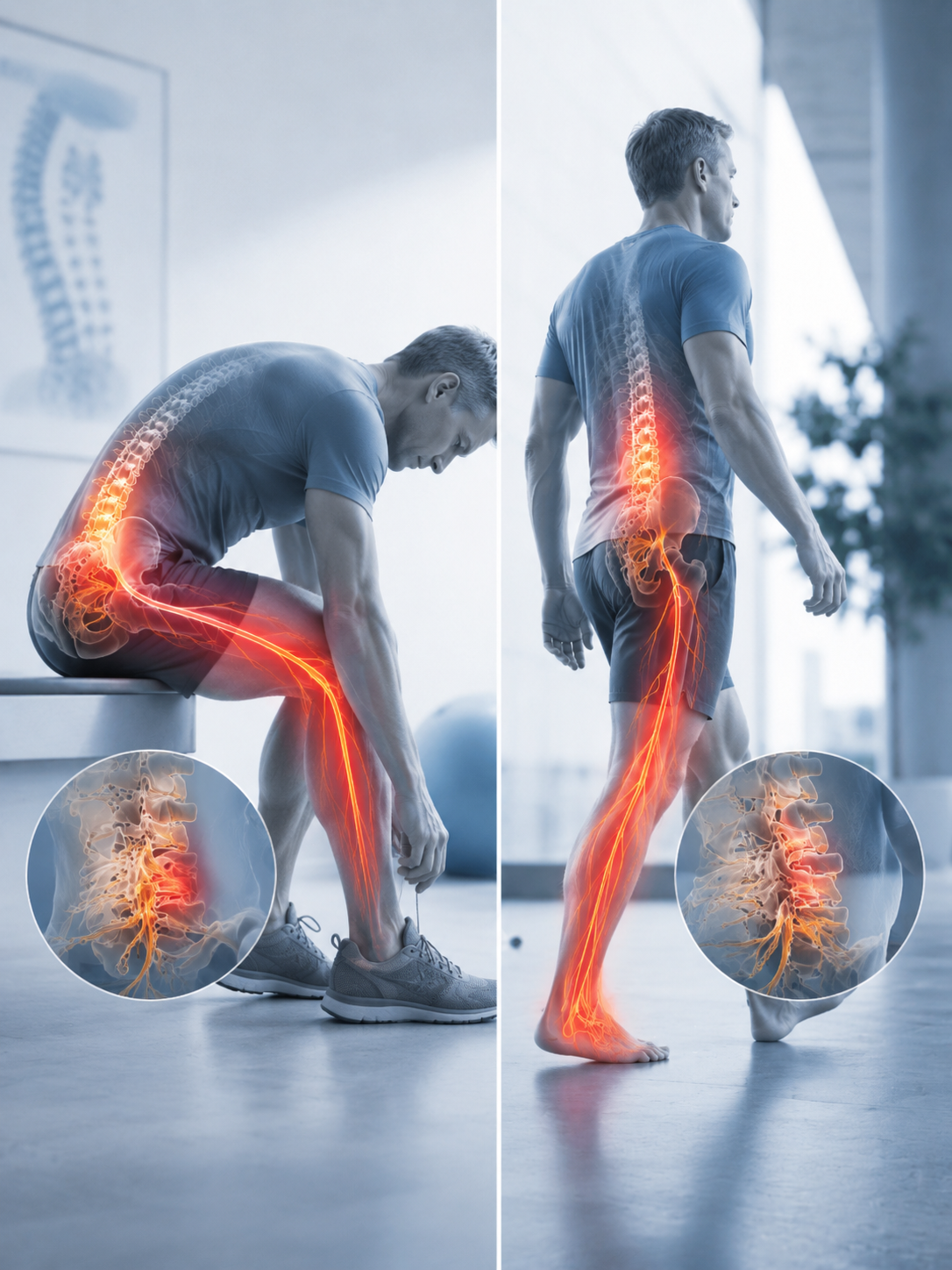
The probable cause changes the choice of exercises
Sciatica of disc origin may react differently from sciatica linked to stenosis. In some cases, sitting position, flexion and repeated efforts increase pain. In other cases, it is standing or prolonged walking that becomes more difficult. This is why the exercises must be adapted to the real profile of the pain.
A cautious approach is to observe the reactions rather than apply a single recipe. If a movement reduces the pain in the leg and brings it back to the back, it can sometimes be better tolerated. If a movement causes the pain to descend to the calf or foot, it should be interrupted.
Possible disc profile
Pain often aggravated by sitting, flexing, coughing, some stresses or prolonged positions.
Possible stenosis profile
Pain, heaviness or weakness sometimes aggravated by walking or prolonged standing.
When to immediately stop an exercise?
An exercise should not be continued simply because it is recommended in a popular video or article. In the context of sciatic pain, progression during and after exercise is essential. A clear worsening, especially when it descends into the leg, should be taken seriously.
Exercise should be stopped and asked for an assessment if symptoms change worryingly. Progression should never be made against sharp nervous pain, increasing numbness or new weakness.
| Sign during or after exercise | Prudent interpretation | Recommended action |
|---|---|---|
| pain going lower | Possibility of increased nervous irritation. | Stop and avoid repeating. |
| increasing numbness | Neurological symptom to monitor. | Request an evaluation. |
| Weakness of the foot or leg | more worrying neurological sign. | consult quickly. |
| loss of urinary or intestinal control | Medical red flag. | Consult urgently. |
| Anesthesia in the stool area | Medical red flag. | Consult urgently. |
Exercises, sciatic pain and Clinique Tagmed
At the TagMed clinic, pain compatible with sciatica is approached by a personalized evaluation. The goal is not to give a universal list of exercises, but to understand why the pain descends into the leg, what movements aggravate it, what neurological signs are present and what non-surgical approaches may be relevant depending on the context.
Depending on the evaluation, possible approaches may include neurovertebral decompression motorized, specific osteopathy or the precision striker. These approaches aim to take into account the probable cause, level of patient tolerance and the possible presence of mechanical irritation of a nerve root.
The laser Medical and shockwaves are not used at the TagMed Clinic for the treatment of back pain or sciatica. Please also note that we do not offer physiotherapy, chiropractic, injection, naturopathic or functional medicine services at the TAGMED Clinic.
Tagmed Terrebonne Clinic
1150 rue Lévis, Suite 200
Terrebonne, QC, J6W 5S6
Phone: 450-704-4447
Days: Monday, Wednesday and Friday
Clinic Tagmed Montreal / Mont-Royal
1140 Avenue Beaumont
Mount Royal, QC, H3P 3E5
Phone: 1-877-672-9060
Days: Tuesday and Thursday
Frequently asked questions about sciatica exercises
What is the best exercise for sciatica?
There is no better universal exercise. The choice depends on the probable cause, the path of the pain, the presence of numbness or weakness and the reaction to the movements. An exercise that relieves one person can aggravate another.
Is walking good for sciatica?
Walking can be useful if it is well tolerated. However, it can aggravate some sciatica, especially if the pain goes further into the leg, if heaviness appears or if walking causes progressive numbness.
Should the sciatic nerve be stretched?
You have to be very careful with this idea. Sciatic pain may involve an irritated nerve root. Aggressive stretching can increase tension on the nervous system and worsen symptoms.
Is a stretching that hurts effective?
No. In the context of sciatica, electrical pain, downward burning or numbness during stretching is not a therapeutic goal. Exercise should be discontinued if nervous symptoms increase.
Why is my sciatica worse after some exercises?
Some exercises can increase mechanical stress on the disc, reduce space around a nerve root, or increase tension on an irritated structure. This may explain stronger pain after exercise.
Should I continue the exercises if the pain goes down in the foot?
No. Pain that goes lower in the leg or in the foot after exercise is a sign of possible worsening. It is best to stop the exercise and ask for an evaluation.
Can exercises replace an assessment?
No. Exercises can sometimes be part of a global strategy, but they do not replace an assessment when the pain persists, progresses, goes down under the knee or is accompanied by numbness or weakness.
Are the exercises indicated in case of herniated disc?
Some movements may be useful depending on the stage and tolerance, but others can make the symptoms worse. In case of disc herniation with descending pain, exercises that increase irradiation, numbness or weakness should be avoided.
When should you consult instead of doing exercises?
It is necessary to consult quickly in case of weakness, progressive numbness, rapidly worsening pain, loss of urinary or intestinal control, anesthesia in the stool area, fever, trauma or persistent severe pain.
What treatments are possible at TagMed Clinic?
Depending on the assessment, possible approaches may include motorized neurovertebral decompression, specific osteopathy or the precision striker. The choice depends on the pain profile, probable cause and tolerance of the patient.
Are your exercises worsening your sciatica pain?
If the pain drops further into the leg, if the numbness increases or if you are not sure which movements to avoid, an assessment can clarify your pain profile and guide a more appropriate approach.
Dr Sylvain Desforges, B.Sc., D.O., N.D., Osteopath

Editorial information, sources and limitations
This content is intended to inform patients about sciatica, possible causes, warning signs, and care options. It does not replace an individualized assessment.
Reference sources
References are selected according to the subject of the page: guidelines, systematic reviews, then institutional resources.
- NICE NG59 – Low back pain and sciatica in over 16s — National guideline
- HAS – Management of patients with common low back pain — French national guideline
- Cochrane – Corticosteroid injections for treatment of sciatica — Systematic review
- NCBI Bookshelf – Sciatica — Clinical institutional resource
Complementary resources from the TAGMED network
These internal resources complement the clinical information and thematic linking. They do not replace national guidelines or systematic reviews.
Editorial note on decompression
Clinical resource from the TAGMED network; it does not replace national guidelines. Some guidelines use the term “traction” and recommend caution for low back pain with or without sciatica. Any decompression option should therefore be presented as an individualized clinical approach, with limitations, indications, and contraindications clearly explained.
Limitations of this information
The information on this page is general. It does not constitute a diagnosis, prescription, or guarantee of results. Pain radiating into the leg may have several causes; assessment should consider clinical history, examination findings, symptom progression, and, when appropriate, complementary tests.
When to seek urgent medical care
Seek urgent medical care if you experience loss of bladder or bowel control, saddle anesthesia, major or progressive leg weakness, unexplained fever, pain after significant trauma, or severe pain that rapidly worsens.
