


Sciatica or muscle pain: how to differentiate between a muscle and nerve pain?
Pain in the buttock, back of the thigh, calf, or leg can sometimes suggest sciatica. However, some pains originate more from a muscle, tendon, or local mechanical strain.
The difference is not always obvious. Muscle pain can be sharp, deep, or limiting, while sciatica may sometimes start as pain in the buttock or back of the thigh. The path of the pain, nerve sensations, numbness, tingling, and weakness help to distinguish the two situations.
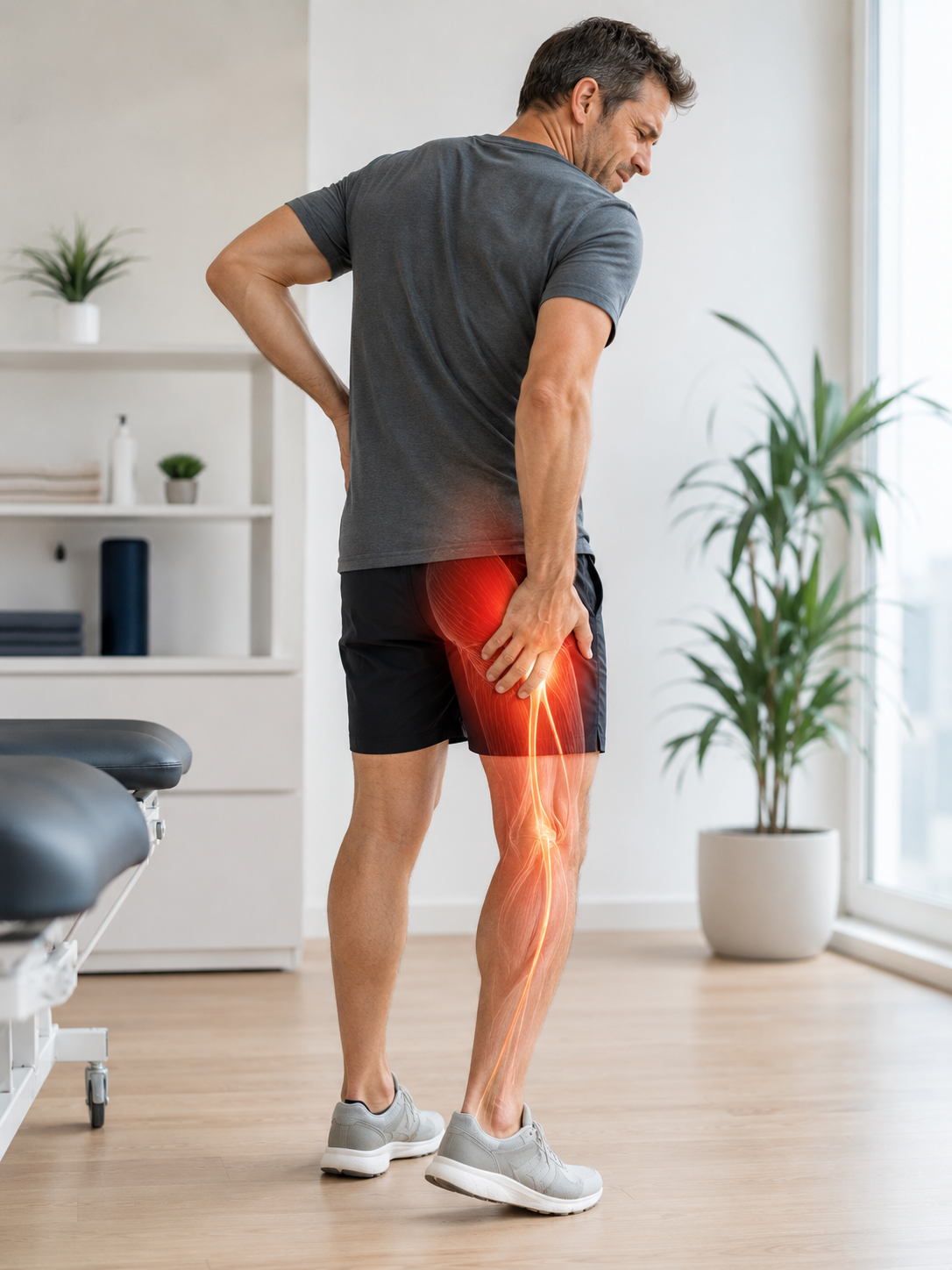
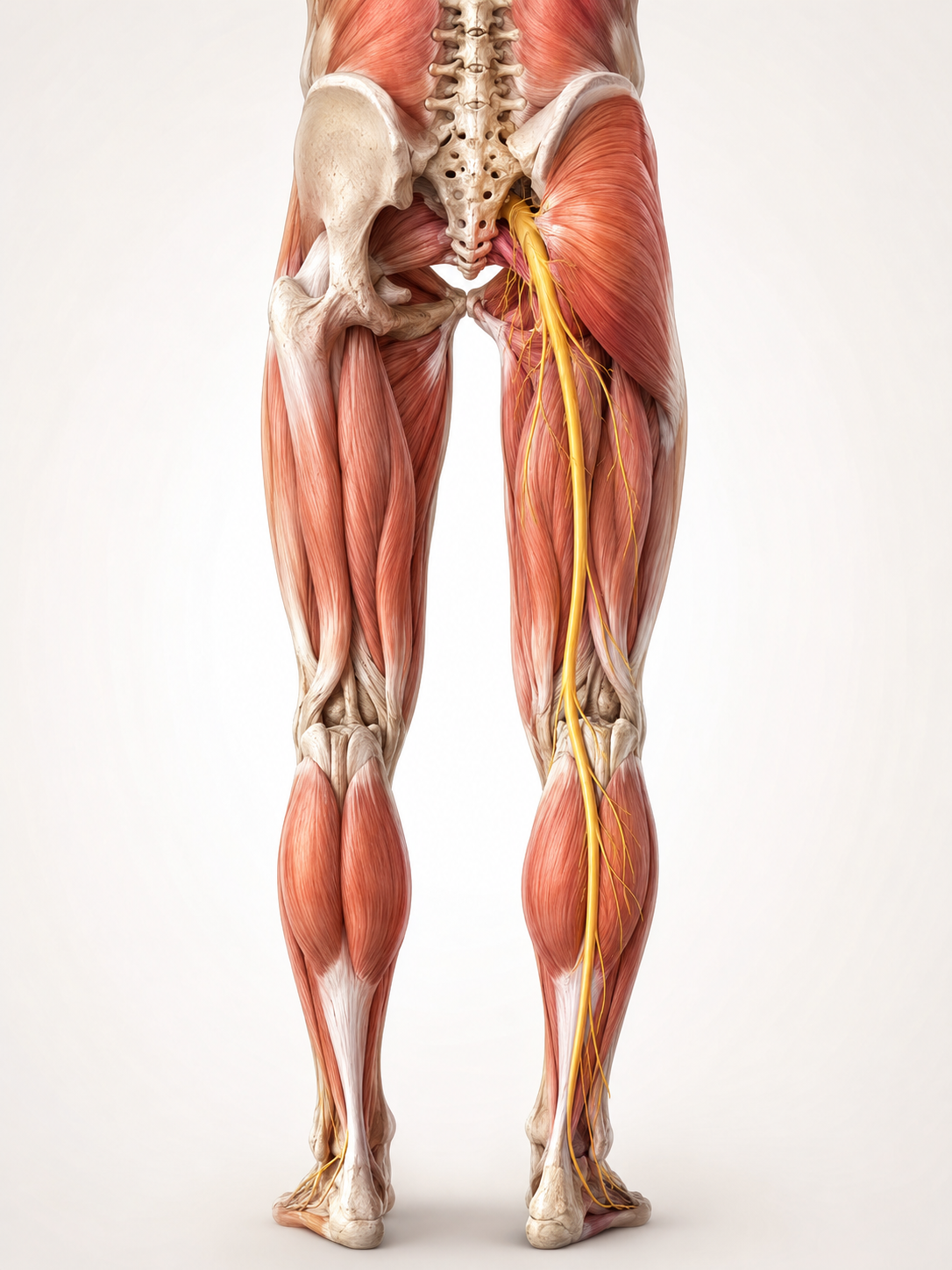
Muscle Pain: What Indicators to Look For?
Muscle pain is often related to an effort, an unusual activity, a contraction, a stretch, or a sensitive area when touched. It can be felt in the buttock, the back of the thigh, the calf, or around the hip.
Muscle pain can be intense, but it does not necessarily follow a precise nerve pathway. It is generally less associated with clear numbness, tingling in the toes, or actual weakness of the foot. These latter signs should raise considerations of a neural origin until proven otherwise.
| Compared Element | More Likely Muscle Pain | More Likely Sciatica |
|---|---|---|
| Trigger | Effort, sports, sudden movement, cramp, contraction, or stretch. | May be related to the back, sitting, bending, walking, or an irritated root. |
| Location | More specific area in the muscle, sometimes sensitive to touch. | Descending path from the buttock, thigh, calf, foot, or toes. |
| Pain below the knee | Possible if the calf is muscular, but less typical as a complete nerve pathway. | More suspicious if it descends from the buttock or thigh. |
| Tingling | Less typical for simple muscle pain. | More compatible with nerve irritation. |
| Weakness | Pain may limit effort, without real motor deficit. | More concerning if the foot catches or loses strength. |
Signs that point towards sciatica rather than muscle
A muscle pain can be sharp, but certain signs are more compatible with nerve irritation. The most important is to monitor if the pain follows a descending path and if it is accompanied by neurological symptoms.
Pain that descends below the knee
Pain that starts from the buttock or thigh and descends towards the calf or foot suggests sciatica.
Burning or electric shock
A sensation of current, burning, or shock in the leg may indicate a nerve component.
Tingling
Prickling sensations in the calf, foot, or toes should be interpreted with caution.
Specific numbness
Numbness on the top of the foot, the big toe, the heel, or the outer edge of the foot may indicate a nerve root issue.
Foot Weakness
A foot that catches, difficulty raising the toes or pushing on the tip of the foot should be assessed quickly.
Increased Pain in the Leg
When the leg becomes more painful than the local muscle area, a radicular component should be considered.
Buttock, Hamstrings, Calf: Which Path to Monitor?
Muscle pain in the buttock can be confused with piriformis pain or sciatica. Pain in the hamstrings can feel like pain behind the thigh. Calf pain may be confused with an S1 path. The context of onset and the reaction to movement become essential.
Sciatica is more suspected when the pain does not stay in a single muscle but follows a continuous or progressive path towards the calf, heel, foot, or toes. The exact territory can indicate L5 or S1, especially if numbness or weakness is present.
- Localized pain after exertion: possible muscular cause.
- Pain reproduced by contraction: possible muscular cause.
- Buttock + calf + foot pain: more suspect lumbar sciatica.
- Big toe pain: possible L5 irritation.
- Heel or outer edge of the foot pain: possible S1 irritation.
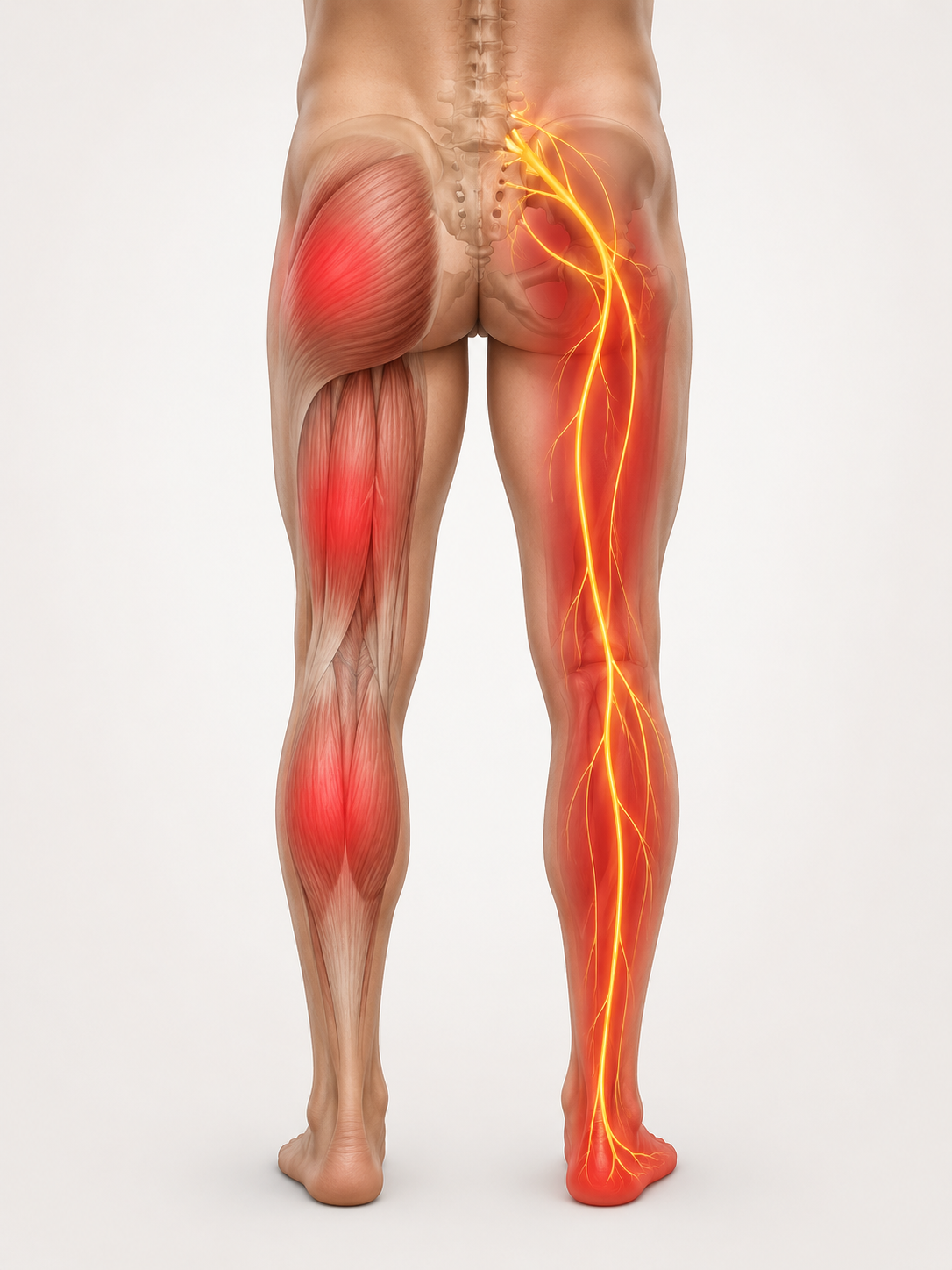
Muscle pains often confused with sciatica
Several muscle pains can initially resemble sciatica. The goal is to identify clues that indicate local pain or lumbar nerve irritation.
| Possible cause | Why it may resemble sciatica | What to check |
|---|---|---|
| Hamstring pain | May cause pain behind the thigh. | Recent effort, pain during contraction, stretching, or palpation. |
| Calf pain | May be confused with S1 pain. | Swelling, redness, warmth, cramp, effort pain, or pathway from the buttock. |
| Deep gluteal pain | May be confused with piriformis syndrome or sciatica. | Pain under the knee, numbness, or weakness. |
| Hip pain | May cause pain in the buttock, thigh, or groin. | Hip rotation, walking, stairs, and pain in the groin. |
| Lumbar disc herniation | May be mistakenly attributed to muscle pain at the start. | Nerve pathway, foot pain, numbness, weakness. |

Why personalized evaluation is essential
Pain in the leg is not enough to determine whether the cause is muscular or nervous. It is necessary to compare the trigger, location, pathway, response to contraction, stretching, walking, sitting, as well as the presence of numbness or weakness.
The evaluation aims to distinguish between local muscle pain, hip pain, sacroiliac pain, referred lumbar pain, irritation of a nerve root, or a combination of factors. This distinction is important because the precautions, exercises, and guidance are not the same.
Test the muscle
Check if the pain is reproduced by contraction, stretching, palpation, or local effort.
Check for nerve signs
Compare pain, sensitivity, strength, walking, numbness, and tingling.
What to do if you are unsure between sciatica and muscle pain?
The first step is to avoid jumping to conclusions too quickly. Pain felt in the buttock, thigh, or calf may come from a muscle, but it can also originate from the lumbar spine or an irritated nerve root.
Depending on the evaluation, non-surgical and non-invasive approaches may be discussed. If the picture suggests a lumbar or radicular origin, the approach should target the probable cause: disc, foramen, lumbar canal, disc compression, stenosis, or other mechanical factors. If the pain seems more muscular or joint-related, precautions and direction should be adapted to this reality.
| Pain Profile | Priority | Why |
|---|---|---|
| Pain after muscle exertion | Evaluate muscle, tendon, hip, and local mechanics. | This profile may be more compatible with a muscular origin. |
| Pain in buttock + calf or foot | Look for lumbar nerve irritation. | The descending trajectory increases the probability of sciatica. |
| Numbness or tingling | Identify the sensory territory. | These signs point more towards a neurological component. |
| Weakness or foot dragging | Quick assessment. | The loss of strength changes the level of safety. |
Muscle pain, sciatica, and clinical orientation
An educational page like this helps to better understand the possible differences, but it does not replace an evaluation. Muscle pain or sciatica must be interpreted according to its location, trajectory, duration, reaction to movements, neurological signs, and aggravating factors.
For a local appointment or a geolocated treatment page, the main conversion page should be hosted on the TAGMED Clinic’s site to avoid SEO cannibalization with the educational content of SOS Sciatique.
SOS Sciatique’s educational pages must explain the causes and guide the reader. Local treatment, appointment, and conversion pages should remain on TAGMED Clinic’s site.
Understanding the territory
Local pain in a muscle and pain that radiates down to the foot do not have the same meaning.
Avoid hasty conclusions
A muscle may be involved, but lumbar causes must be considered if there are neurological signs.
Frequently asked questions about sciatica and muscle pain
Can muscle pain mimic sciatica?
Yes. Pain in the gluteal muscles, hamstrings, or calf can sometimes resemble sciatic pain.
How to distinguish between sciatica and muscle pain?
Muscle pain is often localized and related to effort, contraction, or stretching. Sciatica often radiates below the knee and may be accompanied by nerve signs.
Is pain behind the thigh always sciatica?
No. It may originate from the hamstrings, hip, glute, or a lumbar nerve root. The pathway and associated signs are important.
Is calf pain muscular or sciatic?
It can be either. Localized pain after exertion may be muscular, but pain that radiates from the glute or is accompanied by numbness may be nerve-related.
What signs suggest true sciatica?
Pain below the knee, burning, electric shock sensations, numbness, tingling, foot pain, or weakness in the foot can indicate sciatica.
Can muscle pain cause tingling?
Tingling is less typical of simple muscle pain. It should raise suspicion of nerve irritation or another cause.
Do stretches help muscle pain or sciatica?
They may help with certain muscle pains, but they can worsen sciatica if the nerve or root is irritated. One should monitor the reaction.
When to consult quickly?
You should seek prompt consultation if the pain radiates down to the foot, if numbness increases, if weakness appears, if your gait changes or if symptoms progress rapidly.
Is neurovertebral decompression indicated for muscle pain?
It primarily targets certain lumbar or radicular profiles. If the pain is mainly muscular, the evaluation should determine if another approach is more appropriate.
Why is it important to avoid jumping to conclusions?
Because several pains can resemble each other in the buttock, thigh, or calf. A misinterpretation can delay the identification of a muscular, lumbar, neurological, or joint cause.
Does your pain come from a muscle or the sciatic nerve?
A personalized assessment can help distinguish local muscle pain from lumbar nerve irritation, especially if the pain radiates below the knee or reaches the foot.
Dr. Sylvain Desforges, B.Sc., D.O., N.D., osteopath

Editorial information, sources and limitations
This content is intended to inform patients about sciatica, possible causes, warning signs, and care options. It does not replace an individualized assessment.
Reference sources
References are selected according to the subject of the page: guidelines, systematic reviews, then institutional resources.
- NICE NG59 – Low back pain and sciatica in over 16s — National guideline
- HAS – Management of patients with common low back pain — French national guideline
- Cochrane – Corticosteroid injections for treatment of sciatica — Systematic review
- NCBI Bookshelf – Sciatica — Clinical institutional resource
Complementary resources from the TAGMED network
These internal resources complement the clinical information and thematic linking. They do not replace national guidelines or systematic reviews.
Editorial note on decompression
Clinical resource from the TAGMED network; it does not replace national guidelines. Some guidelines use the term “traction” and recommend caution for low back pain with or without sciatica. Any decompression option should therefore be presented as an individualized clinical approach, with limitations, indications, and contraindications clearly explained.
Limitations of this information
The information on this page is general. It does not constitute a diagnosis, prescription, or guarantee of results. Pain radiating into the leg may have several causes; assessment should consider clinical history, examination findings, symptom progression, and, when appropriate, complementary tests.
When to seek urgent medical care
Seek urgent medical care if you experience loss of bladder or bowel control, saddle anesthesia, major or progressive leg weakness, unexplained fever, pain after significant trauma, or severe pain that rapidly worsens.
