




Sciatica or cruralgia: differentiate the L3-L4 roots from L5-S1
Pain in front of the thigh does not point to the same roots as pain that travels through the buttock and down the back of the leg. Cruralgia more often concerns the upper lumbar roots L2 to L4, while sciatica mostly involves L5 or S1.
This page compares the pathways, sensitivity, strength, and reflexes that can help distinguish these two syndromes, while explaining why an assessment remains necessary before concluding.
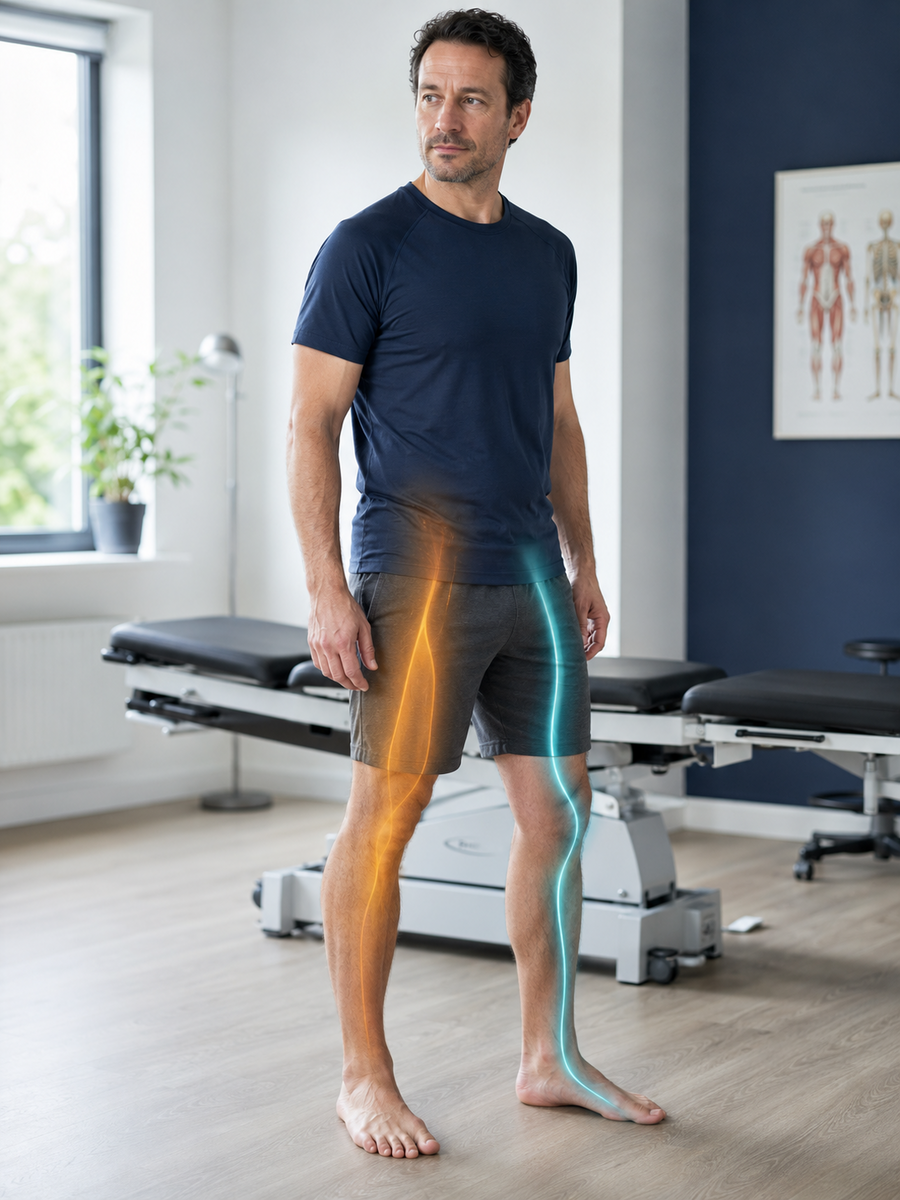
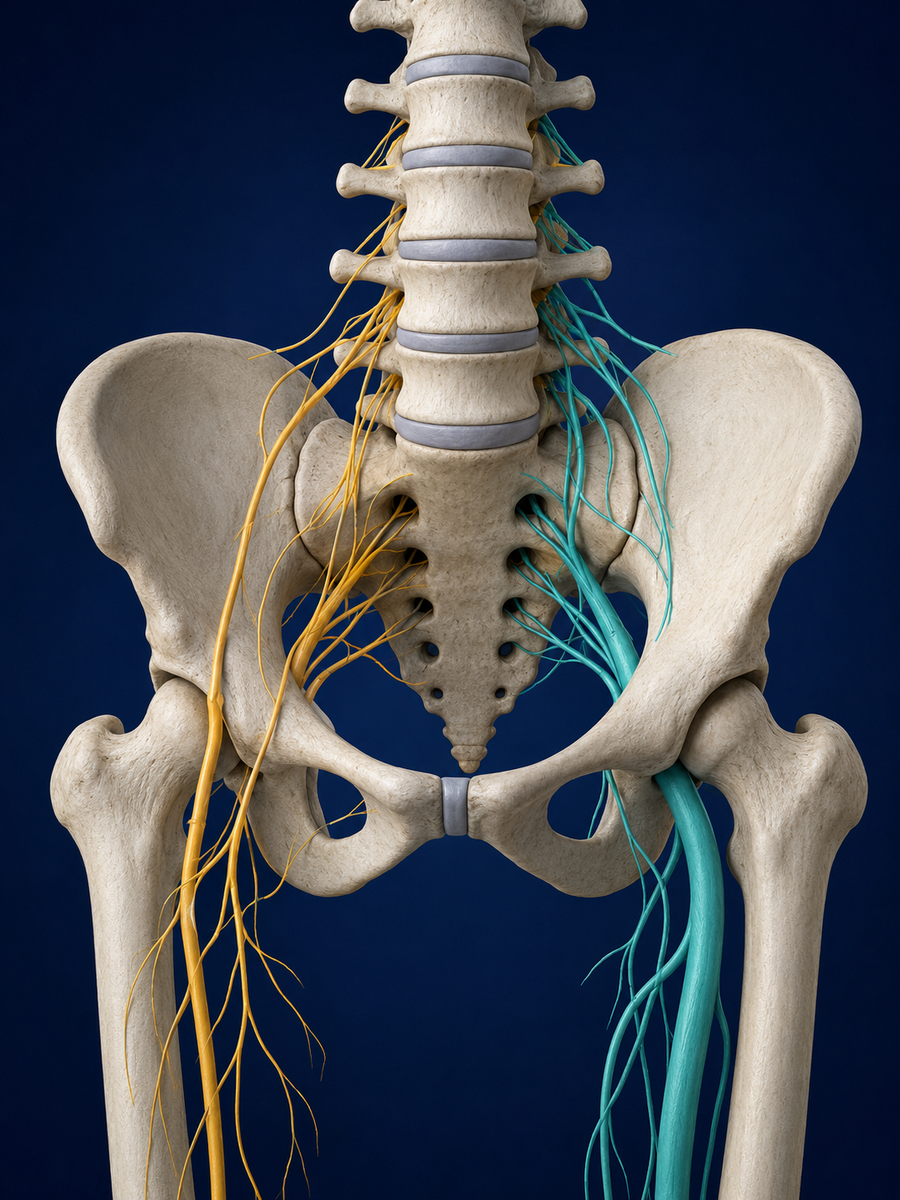
Femoral nerve and sciatic nerve: two different pathways
The femoral nerve forms from the lumbar plexus, mainly involving the roots L2, L3, and L4. It travels to the front of the thigh and is involved in hip flexion, knee extension, and sensitivity to the anterior surface of the thigh and the inner edge of the leg through its saphenous branch.
The sciatic nerve forms from the lumbosacral plexus, with contributions from L4 to S3. It passes through the buttock region and then behind the thigh before branching towards the leg and foot. The roots L5 and S1 are most frequently associated with disc-related sciatica.
| Element | Cruralgia | Sciatica |
|---|---|---|
| Common roots | L2, L3, or L4 | L5 or S1 |
| Associated peripheral nerve | Femoral nerve, formerly called crural nerve | Sciatic nerve and its branches |
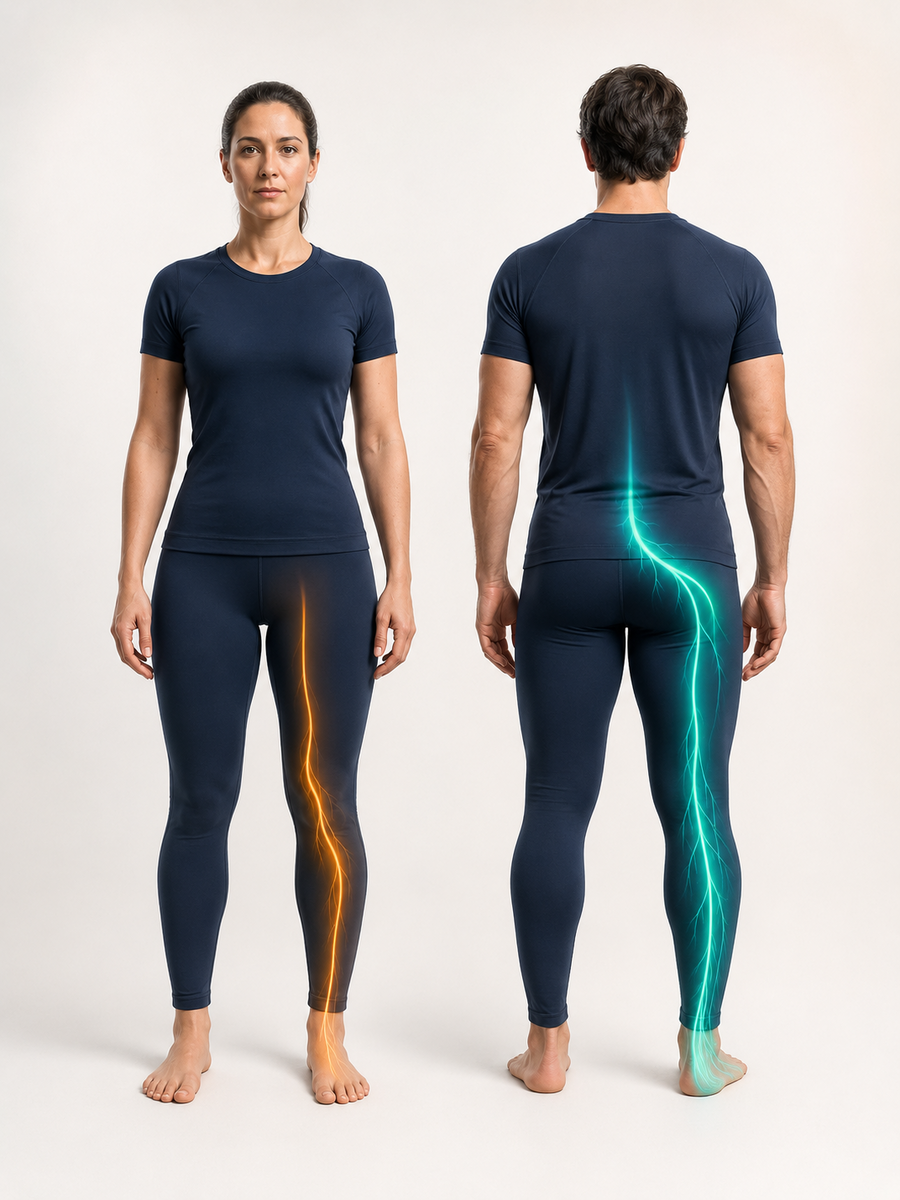
| Main area | Front of the thigh, knee, sometimes the inner edge of the leg | Buttock, back or side of the leg, foot, and toes |
| Reflex that may change | Patellar, especially L4 | Achilles, especially S1 |
What symptoms correspond to L3, L4, L5 or S1?
Sensitive areas overlap and vary from person to person. The table helps to understand classic profiles; it does not allow for self-diagnosis.
| Root | Possible pain or numbness | Possible weakness | Clinical index |
|---|---|---|---|
| L3 | Front and inner side of the thigh, towards the inner part of the knee. | Hip flexion or knee extension. | Possible difficulty climbing a step or stabilizing the knee. |
| L4 | Front of the thigh, knee, and inner edge of the leg. | Knee extension. | Knee reflex sometimes diminished; knee appears to give way. |
| L5 | Buttock, outer side of the leg, top of the foot, and big toe. | Foot or big toe lift. | Walking on heels more difficult; foot catches. |
| S1 | Buttock, back of the thigh and calf, outer edge or sole of the foot. | Push of the foot downward. | Walking on toes more difficult; Achilles reflex diminished. |
Cramplike pain: a pain rather in front of the thigh
Cramplike pain can start from the lower back, the groin, or the front region of the hip and descend towards the front of the thigh. Depending on the root, it may reach the knee or extend along the inner edge of the leg.
Pain can be described as a burning sensation, an electric shock, or a stabbing pain. Tingling, decreased sensitivity, weakness in the quadriceps, or a giving way knee may accompany the symptoms.
What may aggravate it
Standing position, hip extension, certain lumbar movements, coughing, or sneezing may alter the symptoms depending on the cause.
Sciatica: pain in the buttock and foot
Sciatica often starts in the lower back or buttock and radiates down the back or side of the thigh. An L5 involvement may affect the top of the foot and the big toe; an S1 involvement may reach the heel, outer edge, or sole of the foot.
Burning sensations, electric shocks, tingling, or numbness may occur. Weakness may hinder walking on the heels or the balls of the feet.
What may aggravate it
Sitting position, lumbar flexion, certain efforts, coughing, or sneezing may increase disc radicular pain in some individuals.
Why is location not enough for diagnosis?
Pain in the front of the thigh is not automatically a cruralgia. Pain in the hip, involvement of the femoral nerve, meralgia paresthetica, muscle pain, or vascular issues can produce similar symptoms.
Similarly, buttock or posterior pain is not always sciatica. The piriformis, joints, hamstring muscles, the hip, and certain peripheral disorders can mimic radicular pain.
- Cruralgia and sciatica can exceptionally coexist.
- A large hernia or stenosis may affect multiple roots.
- The pain is often more diffuse than the loss of sensation.
- A peripheral neuropathy does not always respect a dermatome.
- A visible anomaly on MRI may be unrelated to current symptoms.
What causes can produce cruralgia or sciatica?
A disc herniation is a possible cause, but the level, location, and context determine the affected root. Anterior and posterior pain do not always have a discal origin.
Disc herniation
A high lumbar hernia may irritate L2, L3, or L4; the L4-L5 and L5-S1 levels more often concern L5 or S1.
Foraminal stenosis
The exit passage of a root can become narrower due to disc, bone, or joint changes.
Canal stenosis
A reduction in space within the canal can affect multiple roots and produce variable or bilateral symptoms.
Femoral neuropathy
A compression of the femoral nerve after exiting the spinal column may resemble an L2-L4 radiculopathy.
Hip or pelvis
Pain in the hip, psoas, or other structures may be felt in the groin and front of the thigh.
Other causes
Diabetes, hematoma, infection, tumor, vascular problem, or other neurological disorder should sometimes be considered.
How does the evaluation differentiate between cruralgia and sciatica?
The evaluation looks for several consistent findings. No isolated test confirms any root or the exact cause of pain.
- Path of pain, tingling, and numbness.
- Strength of the hip, quadriceps, foot, and toes.
- Patellar and Achilles reflexes.
- Normal walking, on heels and on the tips of the toes when safe.
- Stretch test of the femoral nerve for medium lumbar roots.
- Elevation of the extended leg for possible lumbosacral irritation.
- Examination of the hip, pulses, sensitivity, and other possible diagnoses.
- Warning signs and evolution over time.
When to seek prompt or emergency care?
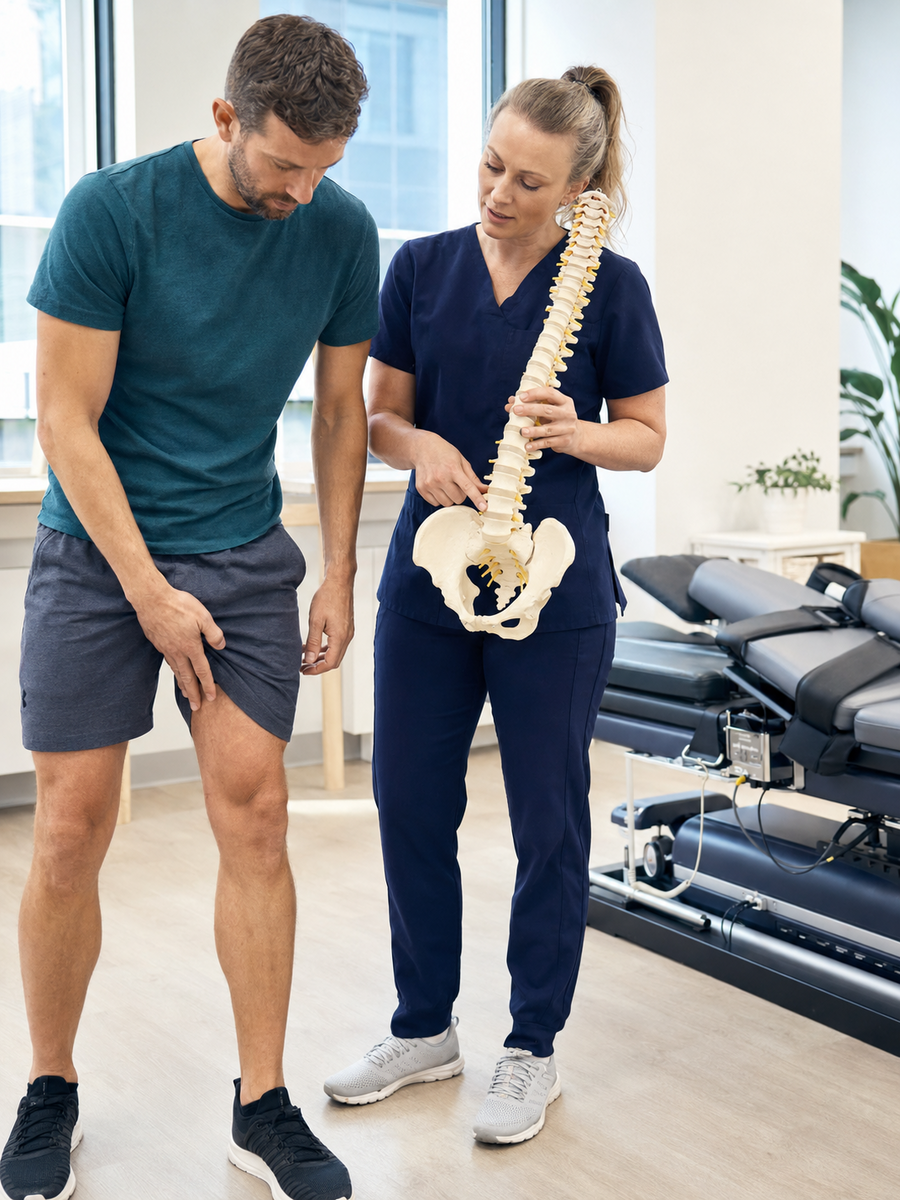
A cruralgia or sciatica can be very painful without being an emergency. However, the presence of a motor deficit, sphincter issues, or a concerning general context changes the priority level.
Cauda equina syndrome
New difficulty urinating, retention, incontinence, loss of bowel control, saddle anesthesia, or recent changes in sexual function.
Progressive weakness
Knee giving way more and more, difficulty lifting the foot, foot drop, inability to walk normally, or severe symptoms on both sides.
Possible serious cause
Fever, recent infection, trauma, known cancer, immunosuppression, unexplained weight loss, or unusual nighttime pain.
Is the management different?
The general principles may appear similar, but the exercises, positions, and interventions must be tailored to the likely root, mechanism, and function. Advice designed for L5-S1 sciatica may be poorly tolerated for anterior L2-L4 pain.
| Component | Objective | Precaution |
|---|---|---|
| Information and adapted activity | Maintain tolerated activities and reduce prolonged rest. | Reduce or modify what extends pain or increases neurological deficit. |
| Personalized exercises | Preserve mobility and gradually rebuild capacity. | A piriformis stretch is not a universal answer to leg pain. |
| Medical evaluation | Discuss medications, imaging, infiltration, or referral. | Essential if weakness progresses or another cause is suspected. |
| Physical or manual approaches | Facilitate movement in a broader plane. | Must not delay necessary medical examinations or care. |
| Surgery | Decompress a root in certain selected situations. | Discuss with a specialist based on deficit, cause, and progression. |
What is the role of neurovertebral decompression?
The neurovertebral decompression therapy is a form of controlled mechanical traction performed on a specialized table. At Clinique TAGMED, this can be discussed after an assessment when a discal or foraminal component seems plausible and no contraindications are identified.
It does not diagnose cruralgia or sciatica, does not automatically reposition a disc, and does not guarantee a result. The NICE recommendations discourage routine use of traction for low back pain with or without sciatica. The relevance of a trial must therefore be individualized, explained, and reevaluated.
Identify the area
Distinguish between anterior pain L2-L4 and posterior or lateral pain L5-S1.
Check the limits
Look for contraindications, deficits, and diagnoses that require referral.
Measure the response
Monitor gait, strength, tolerated positions, and function, without promising a uniform result.
Assessment of thigh or leg pain
The TAGMED Clinic offers osteopathic evaluation and non-surgical, non-invasive approaches for certain lower back pain and pain compatible with nerve root irritation. Depending on the situation, care that may be discussed includes motorized neurovertebral decompression, specific osteopathy, or precision percussion.
This evaluation does not replace a medical diagnosis, prescription, imaging, or a specialized consultation. Medical guidance is recommended when the situation exceeds the scope of osteopathy.
TAGMED Clinic Terrebonne
1150 Lévis Street, Suite 200
Terrebonne, QC, J6W 5S6
Phone: 450-704-4447
Days: Monday, Wednesday, and Friday
TAGMED Clinic Montreal / Mont-Royal
1140 Beaumont Avenue
Mont-Royal, QC, H3P 3E5
Phone: 1-877-672-9060
Days: Tuesday and Thursday
Frequently Asked Questions about Sciatica and Cruralgia
What is the main difference between sciatica and cruralgia?
Cruralgia generally affects the front of the thigh and primarily involves the L2 to L4 roots or the femoral nerve. Sciatica more often concerns the buttock, back, or side of the leg and primarily involves L5 or S1.
Can cruralgia extend below the knee?
Yes. An L4 lesion or saphenous nerve involvement can produce symptoms on the inner border of the leg. The pathway should be compared to strength, sensitivity, and the patellar reflex.
Can sciatica cause pain in the front of the thigh?
A typical L5 or S1 sciatica is rarely limited to the front of the thigh. Anterior pain suggests L2-L4, the hip, or another diagnosis, without allowing automatic conclusions.
Which root can cause the knee to buckle?
A weakness of the quadriceps may be associated with L3 or L4 and give the impression that the knee is buckling. A knee issue or femoral nerve problem can also cause this symptom.
Why do we test the patellar reflex?
The patellar reflex depends on the femoral nerve and mainly on the L2 to L4 roots. A decrease on one side may provide a clue when it aligns with other findings.
Is it always necessary to have an MRI?
No. Imaging depends on the duration, progression, neurological deficit, warning signs, and its possible influence on management.
Are the same exercises suitable for both pains?
Not necessarily. A movement or stretch may be well tolerated in one profile and worsen the other. The pattern and reaction of symptoms should guide adjustments.
Is decompression suitable for cruralgia?
It may be considered in certain disc or foraminal profiles after evaluation, but it is not indicated for everyone and is not guaranteed. The cause, level, contraindications, and other options should be considered.
Sources and References
- National Library of Medicine — Radicular Back Pain.
- National Library of Medicine — Femoral Nerve Anatomy.
- National Library of Medicine — Femoral Region Anatomy.
- NICE NG59 — Low back pain and sciatica: assessment and management.
- NHS — Sciatica and emergency symptoms.
TAGMED guides by city
Choose a condition and city to view the corresponding TAGMED treatment guide.
SOS Sciatique and TAGMED Clinic are part of the same website portfolio.
Is your pain in front of the thigh or does it go down behind the leg?
An evaluation can help compare the path, strength, sensitivity, reflexes, and available examinations before discussing an approach. No results can be guaranteed and medical guidance remains necessary when the situation demands it.
Sylvain Desforges, B.Sc., D.O., N.D., osteopath
Editorial information, sources and limitations
This content is intended to inform patients about sciatica, possible causes, warning signs, and care options. It does not replace an individualized assessment.
Reference sources
References are selected according to the subject of the page: guidelines, systematic reviews, then institutional resources.
- NICE NG59 – Low back pain and sciatica in over 16s — National guideline
- HAS – Management of patients with common low back pain — French national guideline
- Cochrane – Corticosteroid injections for treatment of sciatica — Systematic review
- NCBI Bookshelf – Sciatica — Clinical institutional resource
Complementary resources from the TAGMED network
These internal resources complement the clinical information and thematic linking. They do not replace national guidelines or systematic reviews.
Editorial note on decompression
Clinical resource from the TAGMED network; it does not replace national guidelines. Some guidelines use the term “traction” and recommend caution for low back pain with or without sciatica. Any decompression option should therefore be presented as an individualized clinical approach, with limitations, indications, and contraindications clearly explained.
Limitations of this information
The information on this page is general. It does not constitute a diagnosis, prescription, or guarantee of results. Pain radiating into the leg may have several causes; assessment should consider clinical history, examination findings, symptom progression, and, when appropriate, complementary tests.
When to seek urgent medical care
Seek urgent medical care if you experience loss of bladder or bowel control, saddle anesthesia, major or progressive leg weakness, unexplained fever, pain after significant trauma, or severe pain that rapidly worsens.
