




Position to sleep or sit with sciatica
There is no perfect position for all sciatica cases. One posture may relieve one person and worsen another depending on the underlying cause, the path of the pain, and the nerve’s reaction to bending, extending, or pressure.
The goal is to find a tolerable position, to support the body with pillows or an adjustable chair, and above all to avoid remaining still for too long. Pain that radiates further down the leg, increasing numbness, or weakness should alter the approach.
How to know if a position works for you?
A position can be considered temporarily better tolerated if it allows for relaxation, normal breathing, and changing positions without causing lasting aggravation. A slight local discomfort does not have the same significance as pain that radiates to the calf, foot, or toes.
Acceptable response
The pain remains stable or decreases, the leg does not become more numb, and the next movement remains possible.
Response to modify
The pain goes lower, tingling increases, or relief disappears as soon as you move.
Concerning response
New weakness, foot dragging, leg giving out, significant loss of sensation or sphincter dysfunction.
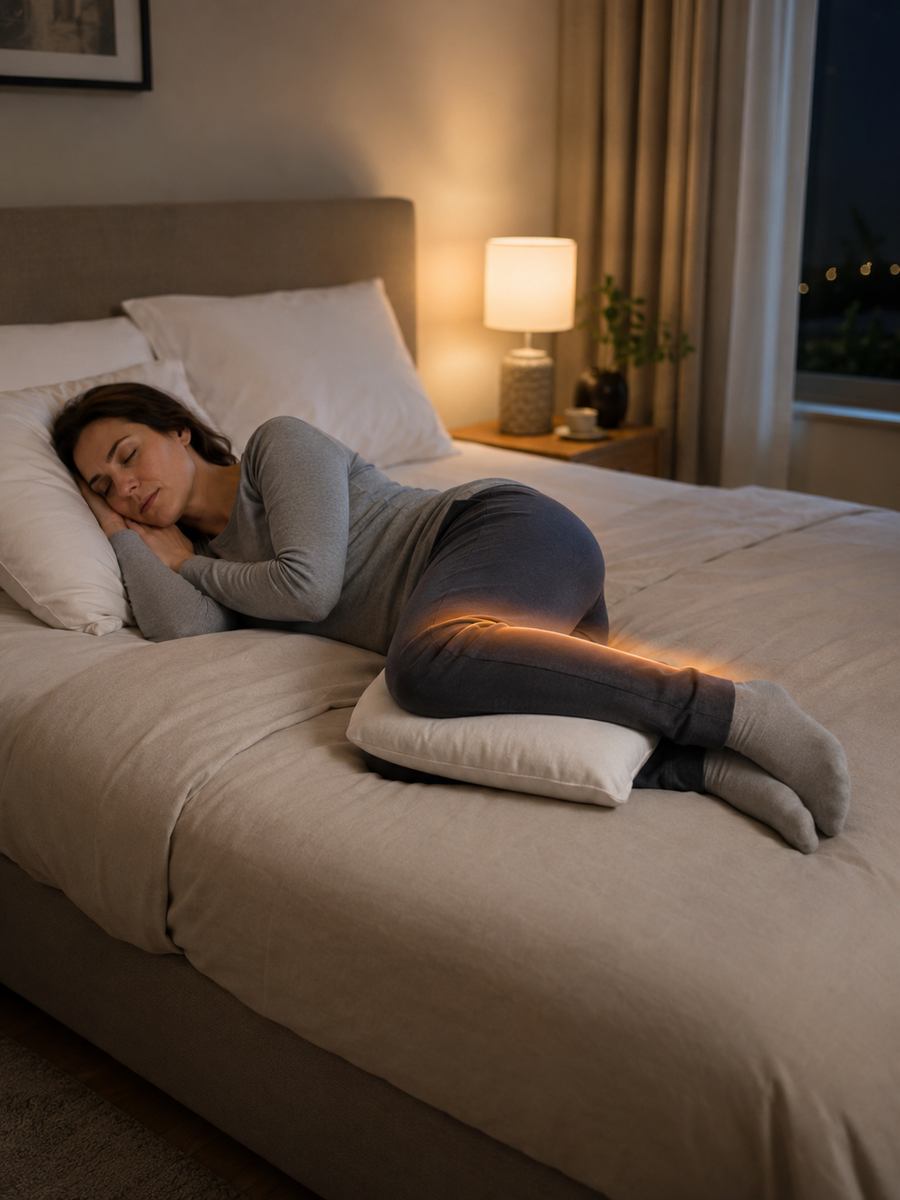
Sleeping on the side with sciatica
Sleeping on the side is often attempted because it allows for slight bending of the hips and knees. A pillow between the knees and, ideally, between the ankles can reduce pelvis rotation and prevent the upper leg from falling forward.
- Choose a pillow thick enough to fill the space between the legs without excessively spreading the hips.
- Keep the knees slightly bent rather than strongly pulled towards the chest.
- Use a head pillow that supports the neck comfortably, without tilting it too much.
- A cushion against the back or in front of the torso can facilitate changes in position.
- Test both sides: the painful side is not automatically prohibited.
Painful side below
This position may be comfortable for some individuals, but the pressure on the buttock or hip may cause discomfort for others.
Painful side above
It can reduce direct pressure, provided the leg is supported to avoid pelvic rotation.
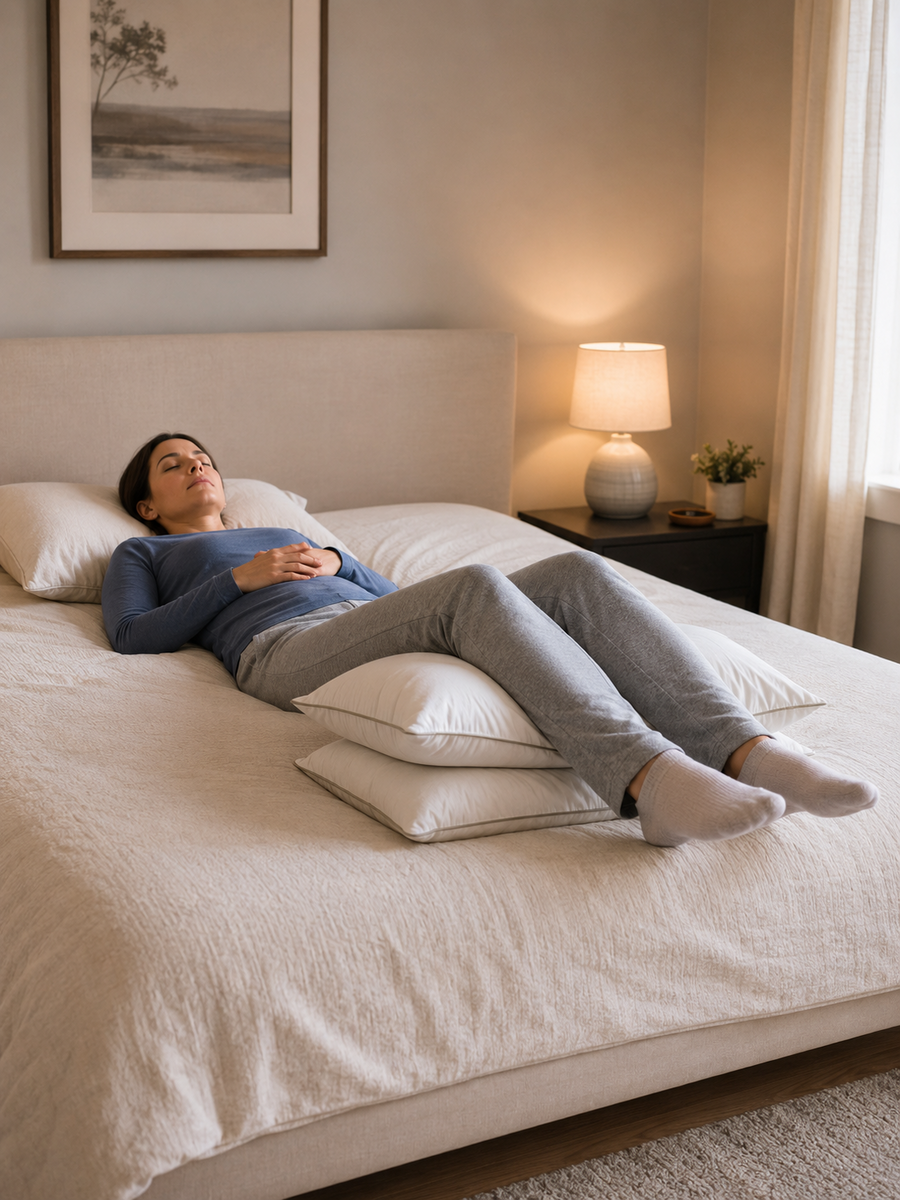
Sleeping on the back with sciatica
On the back, one or more pillows under the knees can reduce tension in the hips and allow the lower back to rest more comfortably. The height should remain tolerable: too many cushions can place the pelvis in excessive flexion.
- Support the knees and part of the calves rather than just the back of the knees.
- Keep your legs extended and avoid keeping them completely straight if it pulls behind your thigh.
- A small lumbar roll can be tried only if it provides immediate comfort.
- The head cushion should support the neck without forcing the chin heavily towards the chest.
And sleeping on your stomach?
Sleeping on your stomach is not universally forbidden. If it’s the only tolerable position, a thin cushion under the pelvis or lower abdomen can be tried. However, avoid forced neck rotation and abandon this position if the pain travels further down the leg.
Getting in bed, turning, and getting out
The transition between standing and lying down can be more challenging than the sleeping position itself. A simple strategy is to minimize sudden twists and move the trunk and pelvis together when pain is very irritating.
Sit on the edge
Back up to the bed and use your hands if necessary to control the descent.
Lowering to the side
Lean on your forearm while your legs come up onto the bed.
Rolling in a comfortable block
Turn your shoulders and pelvis together if isolated twisting increases the symptoms.
Inverting to get up
Get close to the edge, lower your legs, and push with your arms without holding your breath.
How to sit with sciatica?
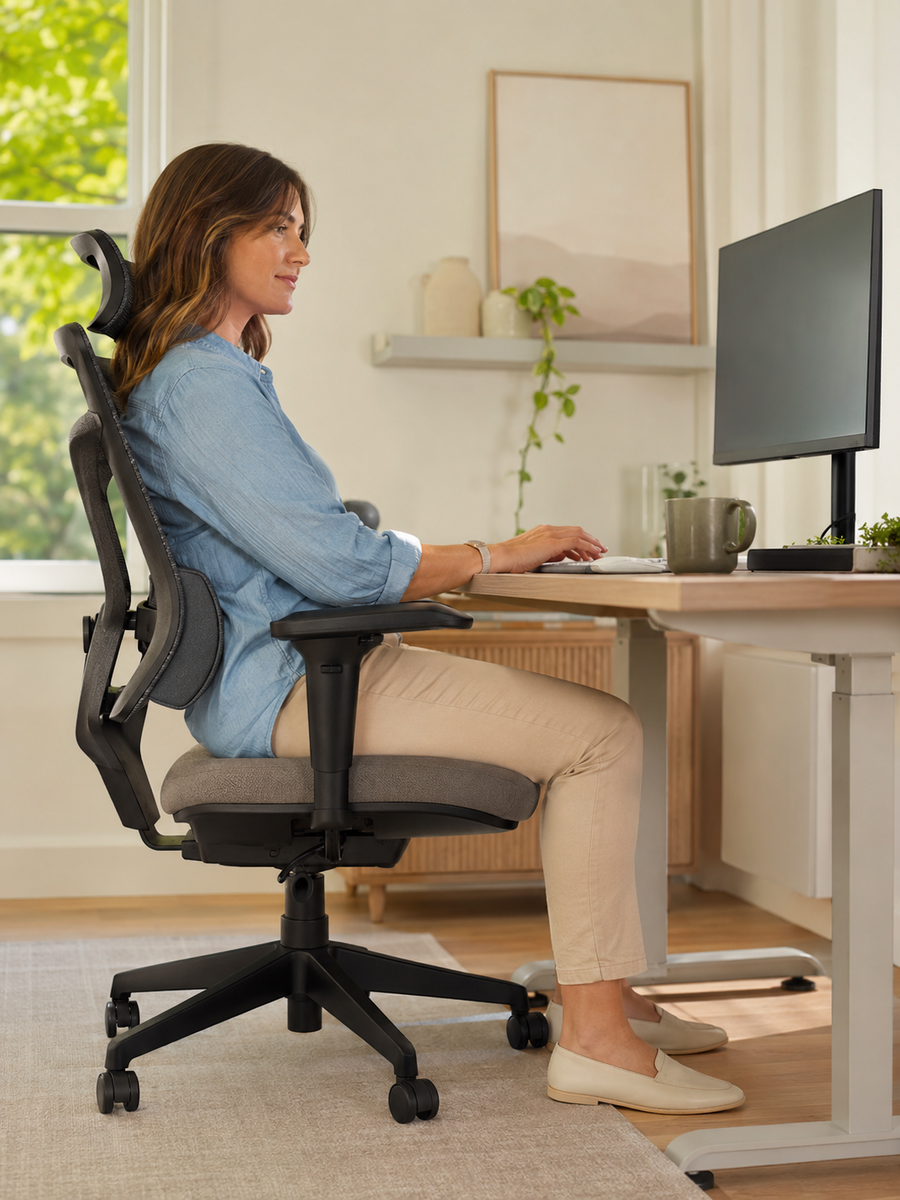
The Canadian Centre for Occupational Health and Safety reminds us that there is no single recommended sitting position for everyone. A reasonable starting configuration places the feet flat, the knees at hip height or slightly lower, and the pelvis against a backrest supporting the lumbar region.
- Adjust the height so that the feet rest on the ground or on a footrest.
- Keep the knees at hip height or slightly lower if that is better tolerated.
- Leave a small space between the edge of the seat and the back of the knees.
- Bend the work closer to avoid leaning forward.
- Use the armrests without raising the shoulders.
- Try a small lumbar support, then remove it if it increases pain in the leg.
A relaxed and supported posture is preferable to a military position maintained by constant effort. The adjustment should improve tolerance, not create new pain.
Office, car, and couch: useful adjustments
| Situation | Adjustment to try | What to watch for |
|---|---|---|
| Office | Adjustable chair, removable lumbar support, screen in front of you, keyboard close, and alternating sitting-standing-walking. | Time before symptoms and pain radiating below the knee. |
| Car | Bring the seat close enough, slightly recline the backrest, support the lower back, and take breaks before discomfort worsens. | Numbness, pain in the calf or foot, and difficulty controlling the pedals. |
| Soft couch | Add a firm cushion under or behind the pelvis, or temporarily choose a chair that is easier to get out of. | Very rounded back, pelvis sunk in, and pain when getting up. |
| Meal or meeting | Choose a seat with support, keep feet supported, and stand briefly at tolerable intervals. | Progressively increasing pain in the leg. |
| Bed with legs extended | Avoid working for long periods sitting in bed; support the back and slightly bend the knees if this position is necessary. | Pulling in the back, numbness, or prolonged lumbar flexion. |
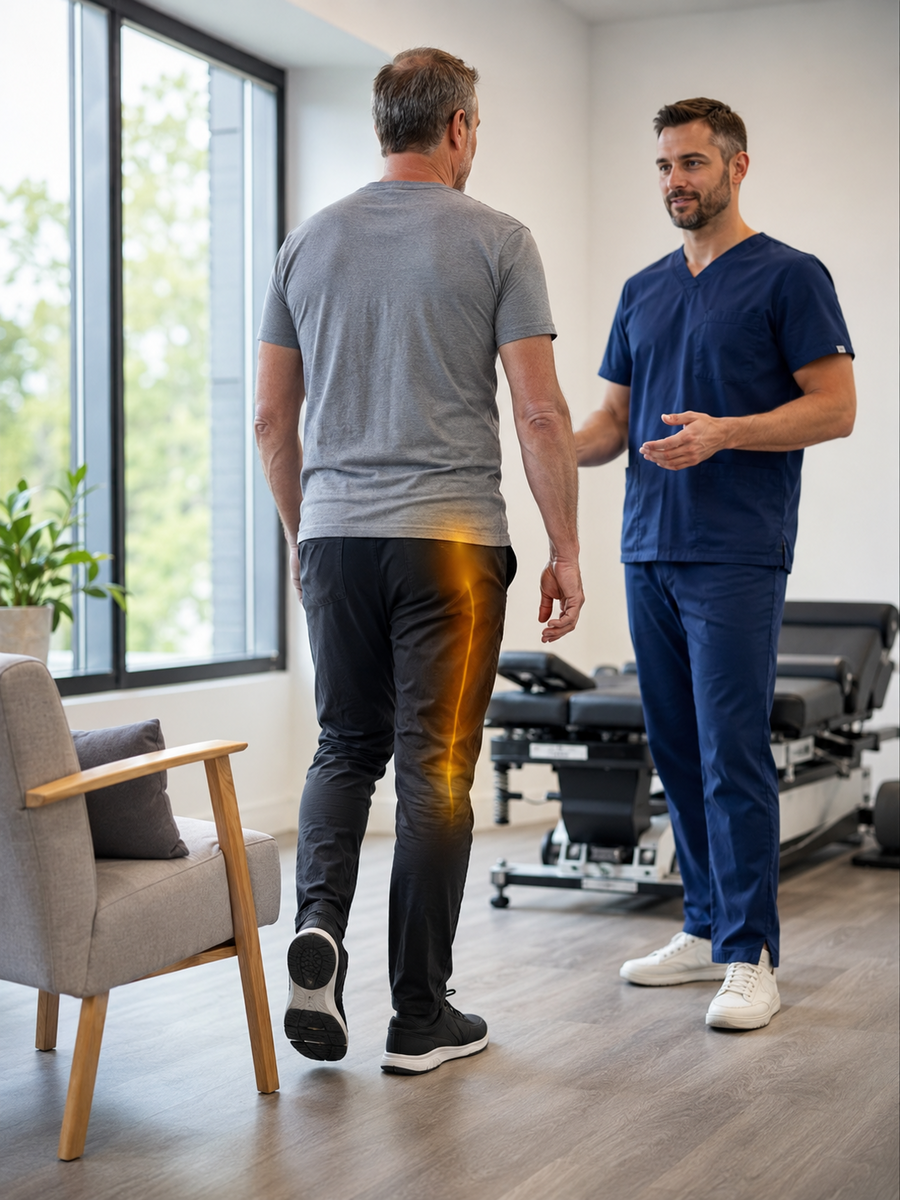
How often should you change position?
There is no universal interval. Various ergonomic resources suggest frequent changes, often around 20 to 40 minutes, but your threshold could be much shorter during a flare-up. The best guideline is to move before the pain becomes difficult to manage.
Determine your threshold
Note after how many minutes pain appears, then plan to take a break slightly before that moment.
Take a simple break
Getting up, walking for a moment, or changing tasks may be sufficient; a complex routine is not always necessary.
Gradually increase sitting time when the reaction remains stable. A whole day standing can also become irritating; the goal is alternation, not replacing one fixed posture with another.
Why are some sciatica pains worse sitting and others standing?
The response to positions can guide the assessment, but it cannot diagnose a structure solely on its own. Sitting flexed may irritate certain disc profiles, while a seated or forward-leaning position may relieve certain central stenoses. Foraminal stenoses, hip pain, and gluteal issues may behave differently.
Worse sitting
May indicate sensitivity to bending, pressure on the buttocks, or tension in the leg, without confirming a hernia.
Worse standing or walking
May be compatible with stenosis or sensitivity to extension, but a vascular cause must sometimes be excluded.
Worse in all positions
Constant pain or accompanied by general signs requires a broader evaluation than just postural advice.
What to do when sciatica prevents sleep?
Prepare the supports
Keep one or two pillows within reach to adjust support without having to get up multiple times.
Avoid forced immobility
Change sides or get up briefly if the pain increases instead of struggling to maintain a posture.
Review medications
Consult a doctor or pharmacist; do not combine, modify, or stop a prescribed treatment on your own.
Gentle heat can provide temporary comfort, but protect the skin and avoid heat on a numb area. Persistent nocturnal pain associated with fever, altered general condition, or unexplained weight loss merits medical evaluation.
When do positions no longer suffice?
Immediate urgency
New urinary or intestinal issues, anesthesia of the stool, severe or progressive weakness, or significant symptoms on both sides.
Quick Consultation
Foot drop, leg giving way, numbness extending, altered gait or pain that worsens despite adjustments.
Planned Evaluation
Regularly interrupted sleep, very reduced sitting tolerance, recurrences or persistent limitation of activities.
Evaluation of aggravated sciatica while in bed or sitting
The TAGMED Clinic offers osteopathic evaluation and non-surgical, non-invasive approaches for certain lumbar pain and pain compatible with sciatica. The evaluation compares the path, strength, sensitivity, gait, and reaction to positions to specify the profile and signs requiring medical guidance.
Depending on the situation, care that can be discussed includes motorized neurovertebral decompression, specific osteopathy, or precision impactor. No results can be guaranteed, and the relevance of an approach depends on the probable cause and contraindications.
TAGMED Clinic Terrebonne
1150 Lévis Street, Suite 200
Terrebonne, QC, J6W 5S6
Phone: 450-704-4447
Days: Monday, Wednesday, and Friday
TAGMED Clinic Montreal / Mont-Royal
1140 Beaumont Avenue
Mont-Royal, QC, H3P 3E5
Phone: 1-877-672-9060
Days: Tuesday and Thursday
Frequently Asked Questions about Positions and Sciatica
What is the best position to sleep with sciatica?
There is no universal best position. Sleeping on your side with a pillow between your legs or on your back with pillows under your knees are two common attempts.
Should you sleep on the opposite side of the sciatica?
Not automatically. Test both sides. The painful side may be aggravated by pressure, while the opposite side can strain the pelvis if the leg is unsupported.
Can you sleep on your stomach?
Yes, if this position is tolerable. A thin cushion under the pelvis or lower abdomen can be tried, but abandon the position if the pain increases further.
Is a firm mattress always preferable?
No. The hardest mattress is not automatically the best. Comfort, support, and the ability to change positions are more useful than a one-size-fits-all firmness rule.
What seat should be used with sciatica?
A supportive adjustable seat is a good starting point. Feet should be supported, the pelvis at the back of the seat, and lumbar support removed if it increases the pain.
Should you completely avoid sitting?
Not necessarily. It is generally preferable to break up sitting time, alternate positions, and gradually increase tolerance.
How often should you get up?
There is no fixed interval. Start getting up before your usual threshold of aggravation; for many people, this means changing position every 20 to 40 minutes.
Why does driving sometimes aggravate sciatica?
Driving combines sitting position, vibrations, hip flexion, and limited movement possibilities. Seat adjustments and breaks should be tailored to the symptom reactions.
Is a ring cushion recommended?
Not systematically. It can modify the pressures, but it does not address the cause and can be uncomfortable. A lumbar support or a simple firm cushion is often easier to test.
When does nighttime pain become concerning?
Nighttime pain associated with fever, unexplained weight loss, known cancer, progressive deficit, or altered general condition requires medical evaluation.
Sources and references
- NICE NG59 — Low back pain and sciatica: assessment and management.
- NHS 111 Wales — Sciatica.
- Cambridge University Hospitals — Seating and ergonomics.
- Canadian Centre for Occupational Health and Safety — sitting position.
- Mayo Clinic — Sleeping positions that reduce back pain.
Treatment pages by clinic
SOS Sciatique and TAGMED clinics are part of the same website portfolio.
Is your sciatica preventing you from sleeping or sitting comfortably?
An evaluation can help clarify the pathway, neurological function, aggravating positions, and the likely cause. Medical guidance remains a priority when concerning signs are present.
Sylvain Desforges, B.Sc., D.O., N.D., Doctor of Osteopathy
Editorial information, sources and limitations
This content is intended to inform patients about sciatica, possible causes, warning signs, and care options. It does not replace an individualized assessment.
Reference sources
References are selected according to the subject of the page: guidelines, systematic reviews, then institutional resources.
- NICE NG59 – Low back pain and sciatica in over 16s — National guideline
- HAS – Management of patients with common low back pain — French national guideline
- Cochrane – Corticosteroid injections for treatment of sciatica — Systematic review
- NCBI Bookshelf – Sciatica — Clinical institutional resource
Complementary resources from the TAGMED network
These internal resources complement the clinical information and thematic linking. They do not replace national guidelines or systematic reviews.
Editorial note on decompression
Clinical resource from the TAGMED network; it does not replace national guidelines. Some guidelines use the term “traction” and recommend caution for low back pain with or without sciatica. Any decompression option should therefore be presented as an individualized clinical approach, with limitations, indications, and contraindications clearly explained.
Limitations of this information
The information on this page is general. It does not constitute a diagnosis, prescription, or guarantee of results. Pain radiating into the leg may have several causes; assessment should consider clinical history, examination findings, symptom progression, and, when appropriate, complementary tests.
When to seek urgent medical care
Seek urgent medical care if you experience loss of bladder or bowel control, saddle anesthesia, major or progressive leg weakness, unexplained fever, pain after significant trauma, or severe pain that rapidly worsens.
