




Preventing sciatic relapse: movements, activities, and habits
After improving from sciatica, the fear of pain returning may lead to avoiding movement, work, sports, or travel. However, no perfect posture or single exercise can guarantee the absence of relapse.
A realistic strategy involves gradually rebuilding capacity, maintaining regular activity, managing loads, recognizing early signs, and knowing when to seek a new assessment. Prevention should be tailored to the probable cause, any neurological deficits, and activities that are important for each individual.

What is a recurrence of sciatica?
A recurrence corresponds to the return of pain compatible with a radicular pathway after a period of improvement. It may resemble the first episode or present a different pathway, intensity, and neurological signs. Isolated lower back discomfort after activity does not automatically indicate a new sciatica.
The return of symptoms alone does not prove that a herniated disc has worsened. A rapid increase in load, long periods of sitting, disturbed sleep, an intercurrent infection, decreased activity, or new mechanical irritation can contribute to a flare-up. Conversely, a new motor deficit should never be trivialized as a simple habitual recurrence.
| Situation | What it may mean | Prudent approach |
|---|---|---|
| Brief lower back stiffness | Reaction to an unusual load without obvious nerve involvement. | Adjust the day, move gently, and monitor the progression. |
| Pain in the buttock or thigh | Possible flare-up, referred pain, or initial irritation. | Compare to the previous pathway and temporarily reduce triggering activities. |
| Pain extending down to the foot | Clearer radicular irritation, especially with tingling. | Seek evaluation if it progresses, persists, or limits function. |
| New weakness | Possible motor impairment. | Obtain medical advice promptly, even if the pain remains tolerable. |
What factors may promote a new flare-up?
There is no single cause of relapse. The interaction between current capacity and physical demand is often more useful to examine than an isolated action. A movement that is generally tolerated can become problematic when repeated for a long time, performed under fatigue, or suddenly added to an already busy week.
Sudden spike in load
Moving, intensive gardening, rapid return to sports, or a long physical day without prior progression.
Prolonged inactivity
A long interruption can decrease endurance and make the usual return too demanding.
Fatigue and sleep
Insufficient sleep and accumulated fatigue can reduce recovery and tolerance.
Repeated exposure
Driving, bending, twisting, or prolonged handling without breaks or appropriate variation.
Condition not re-evaluated
A stenosis, hernia, weakness, or another cause may require a different plan if the profile changes.
Fear and avoidance
Avoiding all activities can maintain the loss of capacity and make each return more difficult.
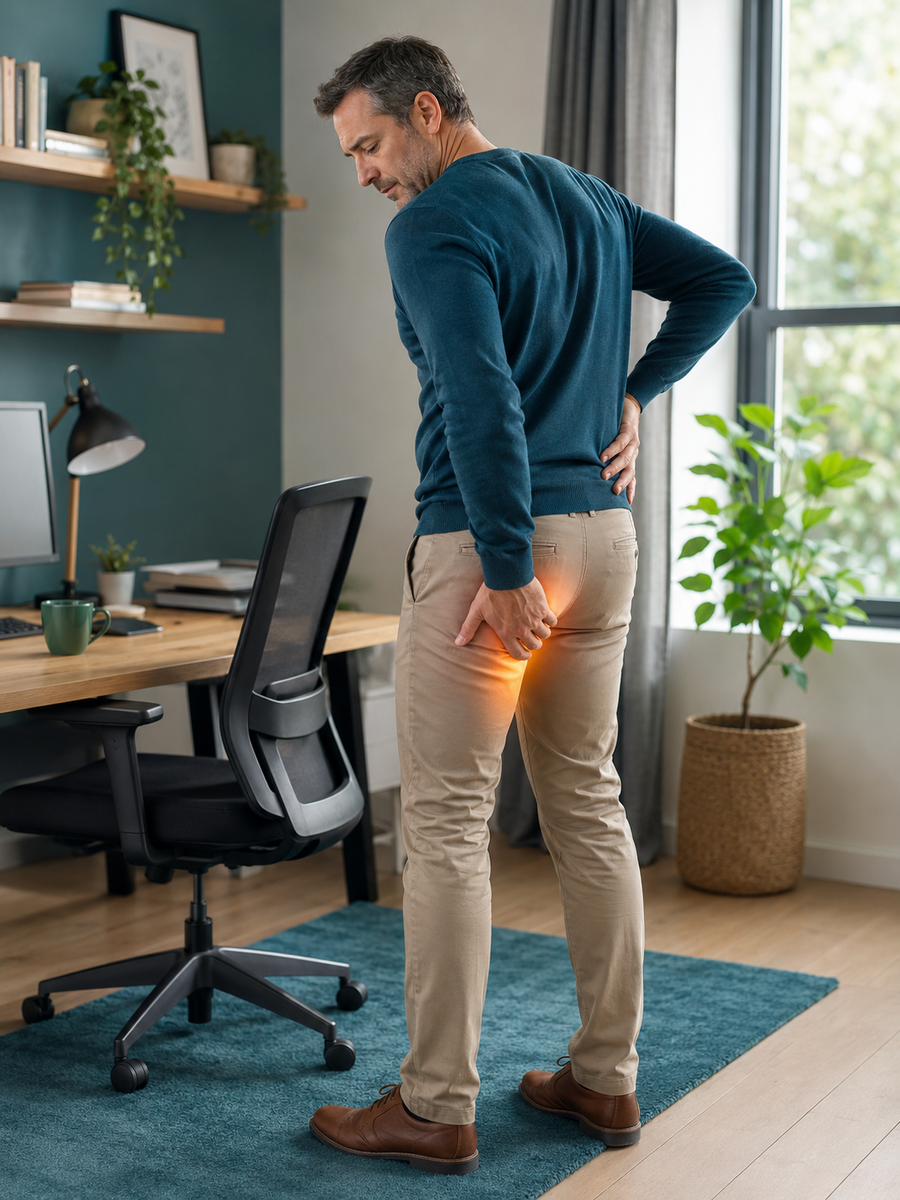
How to react to the first signs?
A timely and proportionate reaction can prevent the cycle of “doing everything” and “doing nothing.” The goal is to temporarily reduce what irritates, maintain what remains tolerable, and monitor neurological signs.
- Identify the change. Where does the pain start and how far does it go down?
- Check the function. Has walking, heel, toe, and foot strength changed?
- Reduce the peak. Temporarily decrease duration, load, or repetitions without imposing bed rest.
- Vary the positions. Alternate short walks, relative rest, and simple activities according to tolerance.
- Reassess within 24 to 72 hours. Look for a trend, not a perfect minute.
What might a weekly routine look like?
The best routine is one that can be maintained, adjusted, and related to the actual needs of the person. The general recommendations for physical activity for adults aim for at least 150 minutes of moderate activity per week and two days of strengthening, but this volume is a general health target, not an immediate prescription for someone recovering from sciatica.
Start from the current capacity. A person who can tolerate ten minutes of walking should not jump directly to five sessions of thirty minutes. The increase can be a few minutes, a repetition, a set, or a small load at a time.
| Component | Adaptable example | Progress indicator |
|---|---|---|
| Aerobic activity | Walking, stationary cycling, water, or other well-tolerated activities. | Increase duration before intensity if the pace remains stable. |
| Strengthening | Leg, hip, trunk movements, pulling and pushing adapted. | Add one variable at a time without loss of strength or increased irradiation. |
| Mobility | Comfortable hip, spine, and ankle movements based on the profile. | Seek useful range, never aggressive nerve stretching. |
| Exposure to tasks | Gradually simulate driving, stairs, gardening, or carrying loads. | Get closer to actual demands without significant delayed pushing. |
| Recovery | Sleep, lighter days, alternating loads and breaks. | Maintain the week without a progressive accumulation of symptoms. |

What do the data say about exercise and recurrences?
The data specifically dedicated to preventing another episode of sciatica is limited. A Cochrane review on low back pain recurrences found moderate quality evidence in favor of exercise programs conducted after treatment, but the programs varied widely and the review dates back to 2010. Therefore, this result cannot be translated into a single exercise or a guarantee against radicular pain.
NICE recommends self-management, continuing normal activities, and exercise programs tailored to the needs and capacities for low back pain with or without sciatica. The World Health Organization also supports a coordinated and individualized approach including education and exercise for chronic low back pain, a condition that differs from sciatica but is relevant to overall spinal health.
What is reasonable
Regularly maintain strength, endurance, and confidence in necessary activities.
What remains uncertain
The best type, dosage, and schedule to prevent any recurrence of sciatica.
What to avoid
Present an exercise, a posture, or a device as insurance against a new hernia.

How to resume load carrying without living in fear?
The back doesn’t need to be perfectly straight at all times. For a heavy, repeated, or unusual load, bringing the object closer, ensuring supports, avoiding sudden rotation under strain, and using the hips and knees can reduce immediate demand. These are practical options, not absolute rules.
- First, test a light load and a limited number of repetitions.
- Move your feet when the task requires significant rotation.
- Break a load into smaller parts or ask for help when the weight exceeds current capacity.
- Alternate handling and less demanding tasks during the first weeks.
- Evaluate your response during the task, in the evening, and the next day.
The right technique is the one that allows you to perform the task with control and without gradual worsening. A visually perfect technique does not compensate for excessive weight, frequency, or duration.
Work, driving, sleep: which habits are helpful?
Sitting work
Choose a supportive chair, vary the angle, and get up before exacerbation. An active break can be very short if it is regular.
Physical Work
Plan heavy tasks, alternate demands, and gradually resume volume, speed, and weight.
Driving
Adjust the seat distance, avoid back wallets, take breaks, and gradually test long trips.
Sleep
Use the most tolerated position with support as needed. No mattress or pillow alone prevents a recurrence.
Travel
Plan luggage, alternate positions, walk during stops, and avoid an excessively busy first day.
Sports and Leisure
Reintroduce duration and technique first, then intensity, direction changes, and maximum efforts.
Practical plan for the first 24 to 72 hours of an episode
This general plan is for a mild or moderate episode that resembles a previously assessed episode, without new weakness or signs of urgency. It does not replace a consultation.
First 24 hours
Reduce the most irritating tasks, maintain short tolerated activities, check the route and strength, and avoid repeatedly testing pain.
From 24 to 48 hours
If the signs decrease or remain stable, gently reintroduce simple activities. If the pain decreases further, seek advice.
From 48 to 72 hours
Gradually resume the routine if the trend is favorable. Consult if function continues to decline or if the flare-up differs from previous ones.
What should not become a permanent strategy
Preventive rest
Avoiding any activity out of fear can reduce capacity and complicate the next restart.
The perfect posture
Variation, comfort, and tolerance matter more than maintaining a rigid position all day.
The constant belt
NICE does not recommend belts or corsets for low back pain with or without sciatica.
Aggressive nerve stretches
A stretch that reproduces or distally affects symptoms is not a useful prevention.
Treatments without a goal
A repeated care indefinitely should be reevaluated if it does not support any measurable functional improvement.
The guarantee of a device
No device, insole, mattress, or table can guarantee that sciatica will never return.
When does a relapse merit a new evaluation?
Quickly
Pain that radiates lower, numbness that spreads, decreased strength, difficulty walking, or increasingly frequent urges.
Planned
Repeated recurrences that limit work, sleep, driving, or activity despite a careful and regular plan.
Emergency
Sphincter disorders, loss of bowel control, significant motor deficit, severe bilateral symptoms, fever, or trauma.
Prevention and evaluation at TAGMED Clinic
The TAGMED Clinic can provide osteopathic evaluation when lower back pain or a trajectory compatible with sciatica recurs. The goal is to compare the new episode with the previous one, verify signs that require medical referral, and discuss the relevance of a non-surgical approach within the practice field.
The neurovertebral decompression is not presented as a guaranteed method to prevent recurrences nor as a necessary maintenance treatment. NICE recommends not offering traction for low back pain with or without sciatica. Any potential trial should therefore be individualized, based on functional objectives and discontinued if it does not provide relevant benefits.
TAGMED Clinic Terrebonne
1150 Lévis Street, Suite 200
Terrebonne, QC, J6W 5S6
Phone: 450-704-4447
Days: Monday, Wednesday, and Friday
TAGMED Clinic Montreal / Mont-Royal
1140 Beaumont Avenue
Mont-Royal, QC, H3P 3E5
Phone: 1-877-672-9060
Days: Tuesday and Thursday
Frequently Asked Questions about Recurrence Prevention
Can you completely prevent sciatica from returning?
No. No program guarantees the absence of recurrence. Regular activity, gradual loading, and early response can, however, improve capacity and possibly reduce the risk or impact of flare-ups.
What is the best exercise to prevent a recurrence?
There is no universal exercise. The choice depends on the likely cause, strength, tolerance, necessary activities, and symptoms. A varied and sustainable routine is generally more helpful than a single movement.
How many times a week should one train?
The frequency should start from the current capacity. General recommendations aim for 150 minutes of moderate activity and two days of strengthening per week, but an individualized progression can begin well below that.
Should you keep your back straight forever?
No. The back is designed to move. For a heavy or repetitive task, keeping the load close to the body and using a controlled strategy can be helpful, but no single curvature is mandatory at all times.
Does an ergonomic chair prevent recurrences?
It may improve comfort but does not guarantee prevention. Varying positions, taking breaks, and maintaining overall capacity remain important.
Should you avoid lifting after a herniated disc?
Not necessarily forever. Lifting can be gradually resumed based on progression, strength, and needs, with professional advice if deficits persist or symptoms increase.
What to do if slight pain returns in the buttock?
Temporarily reduce the triggering load, maintain tolerated movements, and monitor the pathway and strength. Consult if the pain radiates down, progresses, or does not improve.
Should you repeat an MRI at every recurrence?
No. Imaging is most useful if it changes the management, if a deficit appears or progresses, if a serious cause is suspected, or if an intervention is being considered.
Are maintenance treatments mandatory?
No. Any repeated treatment should have a clear objective, a measurable benefit, and a review date. No passive treatment replaces self-management and gradual recovery of function.
When does a recurrence become urgent?
It is urgent in case of difficulty urinating, loss of sphincter control, bowel anesthesia, significant or progressive weakness, severe symptoms in both legs, fever, or trauma.
Sources and references
- NICE NG59 — Low back pain and sciatica: assessment and management.
- NICE QS155 — Self-management for low back pain with or without sciatica.
- Cochrane — Exercises for prevention of recurrences of low-back pain.
- World Health Organization — Guideline for non-surgical management of chronic primary low back pain, 2023.
- CDC — Adult physical activity guidelines.
Your sciatica keeps coming back despite your precautions?
A new evaluation can help compare the path, check the strength, identify modifiable factors, and determine whether a medical referral or a cautious non-surgical approach should be discussed.
Treatment pages by clinic
SOS Sciatique and Clinique TAGMED are part of the same portfolio. These links present the clinic’s services.
Sylvain Desforges, B.Sc., D.O., N.D., Doctor of Osteopathy
Editorial information, sources and limitations
This content is intended to inform patients about sciatica, possible causes, warning signs, and care options. It does not replace an individualized assessment.
Reference sources
References are selected according to the subject of the page: guidelines, systematic reviews, then institutional resources.
- NICE NG59 – Low back pain and sciatica in over 16s — National guideline
- HAS – Management of patients with common low back pain — French national guideline
- Cochrane – Corticosteroid injections for treatment of sciatica — Systematic review
- NCBI Bookshelf – Sciatica — Clinical institutional resource
Complementary resources from the TAGMED network
These internal resources complement the clinical information and thematic linking. They do not replace national guidelines or systematic reviews.
Editorial note on decompression
Clinical resource from the TAGMED network; it does not replace national guidelines. Some guidelines use the term “traction” and recommend caution for low back pain with or without sciatica. Any decompression option should therefore be presented as an individualized clinical approach, with limitations, indications, and contraindications clearly explained.
Limitations of this information
The information on this page is general. It does not constitute a diagnosis, prescription, or guarantee of results. Pain radiating into the leg may have several causes; assessment should consider clinical history, examination findings, symptom progression, and, when appropriate, complementary tests.
When to seek urgent medical care
Seek urgent medical care if you experience loss of bladder or bowel control, saddle anesthesia, major or progressive leg weakness, unexplained fever, pain after significant trauma, or severe pain that rapidly worsens.
