



Mild sciatica: should we still keep an eye on it?
10/11/2026
Sciatica and controlled movement: why adaptation matters
10/11/2026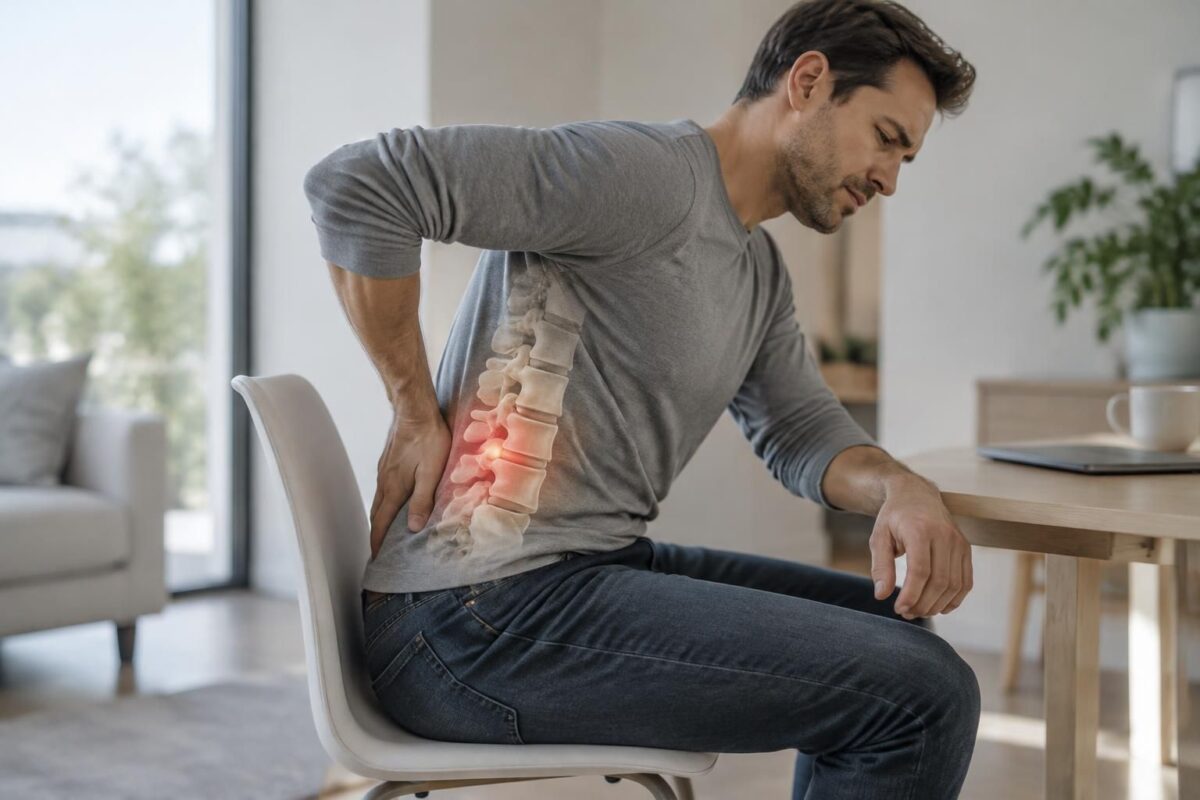
IN BRIEF
| A disk bulge is a protrusion of a disk between the vertebrae; it does not always cause symptoms. Prolonged sitting can accentuate lower back pain and sometimes pain that radiates into the buttock or leg. Varying positions, moving regularly, and getting a persistent pain evaluated helps guide management. In Montreal, a healthcare professional can examine your symptoms and determine the next appropriate steps. |
A disk bulge can sometimes contribute to lower back pain that worsens in a seated position, as this posture increases the stress on the disks in the lower back. However, a bulge observed in imaging does not always explain the symptoms: the pain may also be related to other factors.
Change positions regularly, get up to walk for a few minutes, and avoid prolonged sitting postures that exacerbate the pain. If the pain radiates into the buttock or leg, or is accompanied by tingling or numbness, seek an evaluation from a healthcare professional. Significant weakness, loss of bowel or bladder control, or numbness in the saddle area require urgent attention.
A disk bulge can be associated with lower back pain that increases in a seated position, but an abnormal image on an MRI alone does not prove that it causes symptoms. Posture, the duration spent sitting, and possible nerve irritation also count. This article explains the possible causes, signs to watch for, and options for getting your back evaluated. An intervertebral disk is located between two vertebrae. It cushions some of the stresses and allows the spine to move. A disk bulge describes a disk that protrudes more or less extensively from its usual boundary. This finding can appear on imaging, sometimes without causing pain. Pain may occur when the disk or surrounding tissues are irritated. It may also come from muscles, joints, or another condition. Therefore, it is important to relate imaging results to symptoms and clinical examination, rather than concluding from the term “bulge” alone. A prolonged seated position leaves little room for load changes. A slumped posture or a seat that is too low can also alter the position of the pelvis and increase discomfort for some individuals. The lower back muscles can tire when they support the trunk without a break. However, pain does not depend on just one posture. Some people feel worse sitting, while others experience more discomfort standing or walking. Thus, pain that arises while sitting does not confirm, by itself, a disk bulge. To learn more about posture-related factors, see this article on lower back pain after prolonged sitting. The L4-L5 and L5-S1 disks are often examined when lower back pain radiates into the buttock or leg. A bulge at these levels can sometimes contribute to irritation of a nerve root, but this is not systematic. The location of the pain and the results of the examination help interpret the MRI. You can read explanations about lumbar levels in this article on MRI and lumbar spine levels, as well as the possible links between L4-L5 or L5-S1 disks and pain in the leg. A disk bulge may cause no symptoms. When associated with pain, it may remain in the lower back or extend into the buttock. If a nerve root is irritated, the pain may radiate into the thigh, calf, or foot. Tingling, a burning sensation, or numbness may also occur in the leg. Weakness or difficulty performing certain movements requires evaluation, especially if it progresses. The presence of these signs does not allow for determining the exact cause alone. A bulge and a disk protrusion do not always refer to the same form of overflow. Their significance depends on the imaging report and their relationship to the symptoms. Check the explanations on disk protrusion and nerve root irritation and symptoms associated with a disk bulge. A healthcare professional typically begins by gathering information about the pain: its location, intensity, evolution, and activities that modify it. The examination may also assess mobility and look for signs of nerve damage. A doctor may request an MRI when it is relevant to clarify the condition of the disks and nerve roots. An image must always be interpreted with the symptoms and examination results. To better understand what the MRI can show, consult this guide on MRI and sciatica symptoms. Notify the professional if the pain increases after sitting for a period, if it radiates down the leg, or if it is accompanied by numbness. These details can help guide the evaluation, without replacing a medical diagnosis. Avoid staying in the same position for long periods. If your situation allows, alternate positions and get up regularly to walk for a few moments. Choose a stable seat, keep your feet supported, and bring frequently used items close to avoid leaning or twisting. There is no perfect posture that suits everyone. Comfort varies from person to person and can change throughout the day. If a position significantly increases pain or symptoms in the leg, modify it rather than forcing it. Avoid starting targeted exercises or stretches without professional advice when you have a diagnosed disk bulge and significant symptoms. Certain positions or movements can exacerbate symptoms in some individuals. A healthcare professional can guide you based on your situation. Management depends on the likely cause, the intensity of symptoms, and the results of the evaluation. It may include advice on daily activities or an appropriate manual approach. The motorized neurovertebral decompression may be considered in certain cases after evaluation, but it is not suitable for everyone and does not guarantee a result. At Clinique TAGMED, the team can assess your situation and discuss available options, including in Montreal or Terrebonne. The evaluation does not replace a medical diagnosis. For information on symptoms related to nerve irritation at L5, also refer to this article on disc protrusion and L5. Consult a doctor quickly if the pain is accompanied by a significant or progressive weakness in one leg, loss of sensation in the genital area or around the anus, or difficulty controlling the bladder or bowels. These signs require urgent evaluation. Seek medical advice as well in case of fever, recent trauma, severe pain, or rapid worsening. Persistent pain that disrupts your activities or does not improve also deserves professional evaluation. Sylvain Desforges, B.Sc., D.O., N.D., Doctor of Osteopathy and naturopath, is the founding president of TAGMED and the ACMA association. His practice focuses on chronic pain of the spine, lower back pain, and pain compatible with sciatica, especially when it radiates to the buttock, leg, calf, foot, or toes. Through SOS Sciatique, he publishes educational content on the symptoms of sciatica, possible causes such as disc herniation, disc compression, foraminal stenosis, or irritation of a lumbar nerve root, as well as non-surgical approaches that may be considered after evaluation. At Clinique TAGMED, care may include, depending on the case, motorized neurovertebral decompression, specific osteopathy, or precision impactor. For an evaluation related to sciatica treatment in Montreal or Mont-Royal, or to sciatica treatment in Terrebonne, check the services available at Clinique TAGMED. The information published on SOS Sciatique is provided for educational purposes and does not replace a consultation, diagnosis, opinion, or treatment performed by a physician or another authorized health professional. The author of this article is neither a physician nor a specialist in a medical specialty recognized by the Collège des médecins du Québec. The osteopathy, manual medicine, or functional support approaches described on this site do not constitute medical acts and are not intended to replace medical follow-up. Consult a physician or emergency service in case of loss of bowel or bladder control, anesthesia in the saddle area, significant or progressive weakness in the leg or foot, fever, recent trauma, severe pain, or rapid worsening. For more details, please read our Legal Notice. Medical disclaimer: The information and advice provided on this site do not replace the opinion, diagnosis, or treatment of a health professional. Please note that Sylvain Desforges, B.Sc., D.O., N.D., doctor of osteopathy, is neither a medical doctor nor a physician, and is not a specialist in a medical specialty as defined by the Collège des médecins du Québec. Manual medicine, functional medicine, and sports medicine as described on this site exclude any medical treatment or diagnosis made by a physician or specialist. Always consult your doctor for any medical questions. For more details, please read our complete Legal Notice.Why can sitting exacerbate pain?
Which lumbar levels may be affected?
Possible symptoms of a disk bulge
How to assess the cause of the pain?
What to do when pain increases in a seated position?
Support options and evaluation
When to consult quickly?
About the author
Medical disclaimer
Disc bulge and sitting position
- A disc bulge may be present without pain.
- Sitting for long periods can exacerbate lower back pain in some people.
- Pain that radiates into the buttock or leg may suggest nerve irritation.
Helpful tips
- Change positions and walk for a few minutes regularly.
- Adjust your seat to keep your feet planted and your back supported.
- Consult if the pain persists, worsens, or is accompanied by weakness.

A disc bulge can sometimes contribute to worsening lower back pain when seated, but it does not solely explain the symptoms. Prolonged sitting, a rounded back, or lack of movement can also increase discomfort. Here are recommendations for better managing your sitting position, spotting signs to watch for, and knowing when to seek professional evaluation.
Understanding seated pain and disc bulge
An imaging result to interpret with caution
A disc bulge corresponds to a protrusion of the contour of a disc between the vertebrae. It can be observed on imaging without causing pain. To determine if it is associated with your symptoms, a health professional must consider their location, evolution, and clinical examination. Therefore, lower back pain in a seated position does not automatically mean that a disc is compressing a nerve.
Why can sitting increase discomfort?
Sitting for long periods keeps the lower back and hips in a relatively static position. If the pelvis tilts backward and the back rounds, certain structures may be more stressed. The lumbar muscles can also tire from supporting the trunk without breaks. In a car or on a low, soft couch, lack of support and vibrations can exacerbate discomfort in some individuals.
Discomfort associated with nerve irritation may sometimes be accompanied by pain radiating into the buttock or leg, tingling, or numbness. These manifestations deserve evaluation, especially if they persist or intensify.

Disc bulge and narrowed foramen
IN BRIEF A disc bulge is a protrusion of the disc that can contribute to narrowing the foramen, the opening where a nerve root passes through. If this is irritated or compressed, pain, tingling, or weakness may occur, sometimes extending…

Disc bulge and loss of disc height
IN BRIEF A disc bulge is a protrusion of the disc between the vertebrae; a loss of disc height means that the disc has thinned. These changes may be related to wear and sometimes contribute to pain, stiffness, or nerve…

Disc bulging and disc degeneration
IN SHORT A disc bulge is a protrusion of the disc, sometimes associated with disc degeneration related to aging. These visible changes on imaging do not always cause symptoms. Their significance is determined by comparing the MRI to pain, strength,…

Herniated disc and recurring pain
IN BRIEF A disc bulge is a disc that protrudes without necessarily being ruptured; it does not always cause pain. When pain returns, it may be related to nerve irritation, but a professional must verify the link with the symptoms.…
Adjusting sitting position and moving regularly
Arranging your seat
If possible, choose a stable chair with a backrest that supports the lower back. Keep your feet flat on the ground or on a footrest, and adjust the height so that your shoulders remain relaxed. Position the screen in front of you to avoid leaning forward. A small cushion or rolled towel can offer point support, as long as it is comfortable and does not create additional pressure.
Avoid Prolonged Immobility
There is no perfect posture to maintain all day long. The most helpful thing is to change positions regularly. Get up frequently, walk for a few minutes, or alternate with standing periods if that suits you. When driving, plan for breaks during long trips. Gentle walking and pelvic movements can help reduce stiffness, as long as they do not worsen your symptoms.
Avoid forced stretches, sudden movements, and exercises that significantly increase pain or symptom spread in the leg. Gradually resume activity and adapt it to your tolerance. If the pain is significant, a professional can advise you on appropriate movements for your situation.
When to Seek Medical Evaluation
Consult a doctor if the pain persists, comes back frequently, limits your activities, or is accompanied by symptoms in the leg. A clinical examination helps guide management; imaging is not necessary in all cases and its indication depends on the evaluation.
Quickly consult a medical service in cases of significant or progressive weakness in the leg or foot, loss of bladder or bowel control, or numbness in the saddle region. A fever, recent trauma, or rapid worsening also justifies immediate evaluation.
Medical Warning: this information is educational and does not replace consultation, diagnosis, or treatment from a licensed health professional. Osteopathy and manual approaches do not replace medical follow-up.
| Indicator | To Know |
|---|---|
| Disc Bulge | The disc slightly protrudes beyond its contour; this finding on imaging does not always mean it causes pain. |
| Sitting Position | Prolonged sitting, especially with a rounded back, can increase discomfort in some people. |
| Localized Pain | Pain limited to the lower back can have several causes and does not confirm a symptomatic bulge. |
| Radiating Pain | Pain that descends into the buttock or leg may suggest nerve irritation and merits evaluation. |
| Variation of Symptoms | Changing positions and walking gently can improve comfort; avoid sitting too long without breaks. |
| Evaluation | A health professional examines the symptoms; imaging is considered based on the clinical context. |
| Seek Help Quickly | Seek urgent help in cases of progressive weakness, loss of bladder or bowel control, or numbness in the saddle region. |
Illustrative Testimonials: Disc Bulge and Pain in Sitting Position
Note: the accounts below are fictional and illustrative examples, not testimonials from real patients. A disc bulge observed on imaging does not necessarily mean it is the cause of pain; its interpretation depends on symptoms and clinical evaluation.
“After several hours at my desk, I felt a dull pain in my lower back. It decreased when I stood up and walked a bit. My doctor explained that a disc bulge visible on the MRI had to be related to my symptoms, rather than considered in isolation. I started alternating positions and taking short movement breaks.” — Illustrative Account
“In the car, the pain appeared faster than at home. I was sitting for long periods, with a rounded back, and the vibrations made the trip uncomfortable. Adjusting the seat and taking breaks to walk helped me manage the drives better, without immediately eliminating all the symptoms.” — Illustrative Account
“My pain didn’t always stay in the lower back: after a long sitting period, it could radiate down into my buttock and the back of my thigh, with tingling. Since these signs could suggest nerve irritation, I sought a medical evaluation instead of concluding on my own that the disc bulge was necessarily responsible.” — Illustrative Account
“I was afraid to move because some movements increased the discomfort. A health professional advised me to gradually resume tolerated activities and to avoid exercises that significantly increased the pain. The approach was tailored to my symptoms rather than a one-size-fits-all program.” — Illustrative Account
A persistent pain or pain radiating into the leg deserves evaluation by a health professional. Seek help quickly in cases of significant or progressive weakness, loss of bladder or bowel control, or numbness in the saddle region.
Disc Bulge and Pain in Sitting Position: Understanding Causes and Management Options
A disc bulge refers to a deformation of the intervertebral disc that slightly exceeds its usual contour. It can appear with the normal aging of the spine or be associated with repeated strains. This finding on imaging does not automatically mean it is responsible for pain: some individuals have a bulge without symptoms, while others experience significant discomfort. Thus, the interpretation depends on the symptoms, clinical examination, and the context of each person.
Prolonged sitting posture can exacerbate lower back pain in some individuals. When the back rounds or the pelvis tilts backward, the stresses on the lumbar structures change. The lower back muscles may also remain engaged for long periods while the hips stay flexed. Maintaining a fixed position, more than the existence of a “perfect” or “poor” posture, can contribute to stiffness and discomfort.
If a disc irritates a nerve root, the pain may extend beyond the lower back and radiate toward the buttock or leg. Tingling, a burning sensation, or numbness may also occur. Pain that increases in a seated position and decreases when walking may guide the evaluation, but it is not sufficient to confirm a disc bulge or herniation. Other causes, such as muscle tension or joint issues, can produce similar symptoms.
To limit discomfort, try to regularly vary positions: stand up, walk for a few minutes, and return to your activity according to your tolerance. At the office, adjust your chair so that your feet rest on the floor or on a footrest, and bring the screen closer to avoid leaning forward for too long. In the car, back support and breaks during long trips can improve comfort. These adaptations do not replace evaluation when pain persists or worsens.
Walking and gentle movements of the pelvis or trunk can help maintain comfortable mobility. Start gradually and stop a movement if it significantly increases pain, numbness, or symptoms in the leg. Repeated bends or forced stretches are not necessarily suitable for all situations. A healthcare professional can help determine the appropriate activities and distinguish symptoms that require further examination.
The assessment generally starts with questions about pain and an examination of mobility, strength, and sensitivity. Imaging, such as an MRI, is not routine: a doctor recommends it when the symptoms and examination findings justify it. Management may combine activity advice, suitable exercises, and, depending on the evaluation, manual or functional approaches. The goal is to support the individual without assuming that the disc image alone explains all the symptoms.
Quickly consult a doctor or emergency service if there is significant or progressive weakness in the leg or foot, loss of urinary or bowel control, or numbness in the saddle area. Fever, recent trauma, severe pain, or rapid deterioration also warrant evaluation. If symptoms persist, limit activities, or are accompanied by pain radiating into the leg, seek professional advice.
About the author: Sylvain Desforges, B.Sc., D.O., N.D., is a doctor of osteopathy and naturopath, founding president of TAGMED and the ACMA association. His practice focuses particularly on chronic spinal pain and lower back pain. At the TAGMED Clinic, the care provided may include, depending on the evaluation, motorized neurovertebral decompression, specific osteopathy, or precision percussion.
Medical disclaimer: this content is informative and does not replace a consultation, diagnosis, or treatment by a doctor or other licensed healthcare professional. The author is neither a physician nor a specialist in a medical specialty recognized by the Collège des médecins du Québec. Osteopathy and functional support approaches do not replace medical follow-up.
A disc bulge may be associated with lower back pain that increases when sitting, especially when this posture is maintained for a long time. However, imaging alone does not explain the symptoms: their evolution, location, and any signs in the leg must also be considered. Varying positions and regularly interrupting sitting periods can promote comfort, without substituting for a professional evaluation when pain persists or worsens.
Disc bulge and sitting position
In a sitting position, especially when the back rounds, the stress on the lumbar discs can increase. This can make the posture uncomfortable for some individuals, but a bulge observed in imaging is not necessarily the cause of the pain. To better understand this distinction, consult the explanations on disc bulge and the difference between bulge and disc protrusion.
If the pain radiates into the buttock or leg, or is accompanied by tingling, numbness, or weakness, nerve irritation may be considered among possible explanations. Sciatica associated with a lumbar disc herniation requires appropriate evaluation: symptoms and clinical examination must be correlated with imaging results.
Adjusting seating and knowing when to consult
To limit discomfort, try to keep your feet supported, support your lower back, and change positions regularly. Stand up to walk for a few minutes at regular intervals, and avoid staying slouched on a low couch or poorly fitted seat. Other practical guidelines are presented in this guide on sitting posture when you have a disc herniation.
Seek medical advice if the pain persists, worsens, or is accompanied by symptoms in a leg. Consult quickly in case of significant or progressive weakness, loss of urinary or bowel control, or numbness in the saddle area. This information is educational and does not substitute for an examination or personalized medical advice.

Disc bulge and pain after exertion
IN BRIEF A disc bulge is a disc that slightly protrudes between two vertebrae; after exertion, it may be associated with low back pain, sometimes radiating into the leg. An imaging result alone is not enough to explain the pain…

Disc bulge and tingling in the foot
IN SHORT A disc bulge refers to a disc that bulges beyond its boundary; if it irritates a nerve root, it can contribute to tingling in the foot, numbness, or pain in the leg. However, MRI alone is not sufficient…

Disc bulge and intermittent numbness
IN SHORT A bulging disc associated with intermittent numbness may sometimes indicate nerve irritation, but an MRI alone does not allow determining the cause. Connecting the symptoms’ path, sensitivity, and strength helps guide the evaluation and next steps. New or…
IN BRIEF A disc bulge is a diffuse protrusion of the disc and does not always cause symptoms. A buttock pain may sometimes be associated with nerve irritation, but the bulge visible on imaging is not enough to establish the…

Sylvain Desforges, B.Sc., D.O., N.D., docteur en ostéopathie
Dr Sylvain Desforges, B.Sc., D.O., N.D., osteopath, is the founding president of TAGMED and of the ACMA association. He dedicates his practice to chronic spinal pain, low back pain and symptoms compatible with sciatica, particularly when pain radiates toward the buttock, leg, calf, foot or toes.
Through SOS Sciatique, he publishes educational content on sciatica symptoms, possible causes such as disc herniation, disc narrowing, foraminal stenosis or irritation of a lumbar nerve root, as well as non-surgical approaches that may be considered according to the evaluation. At Clinique TAGMED, care may include, depending on the case, motorized neurovertebral decompression, specific osteopathic care or precision percussion.
For an evaluation related to sciatica treatment in Montreal / Mount Royal or sciatica treatment in Terrebonne, please consult the services available at Clinique TAGMED.
Medical disclaimer
The information published on SOS Sciatique is provided for educational purposes only and does not replace a consultation, diagnosis, opinion or treatment provided by a physician or another authorized healthcare professional. The author of this article is neither a medical doctor nor a specialist in a medical specialty recognized by the Collège des médecins du Québec. The osteopathic, manual medicine or functional support approaches described on this site do not constitute medical acts and are not intended to replace medical follow-up.
Consult a physician or emergency service in cases of loss of bladder or bowel control, anesthesia in the saddle area, significant or progressive weakness in the leg or foot, fever, recent trauma, severe pain or rapid worsening of symptoms. For more details, please read our Legal Notice.


