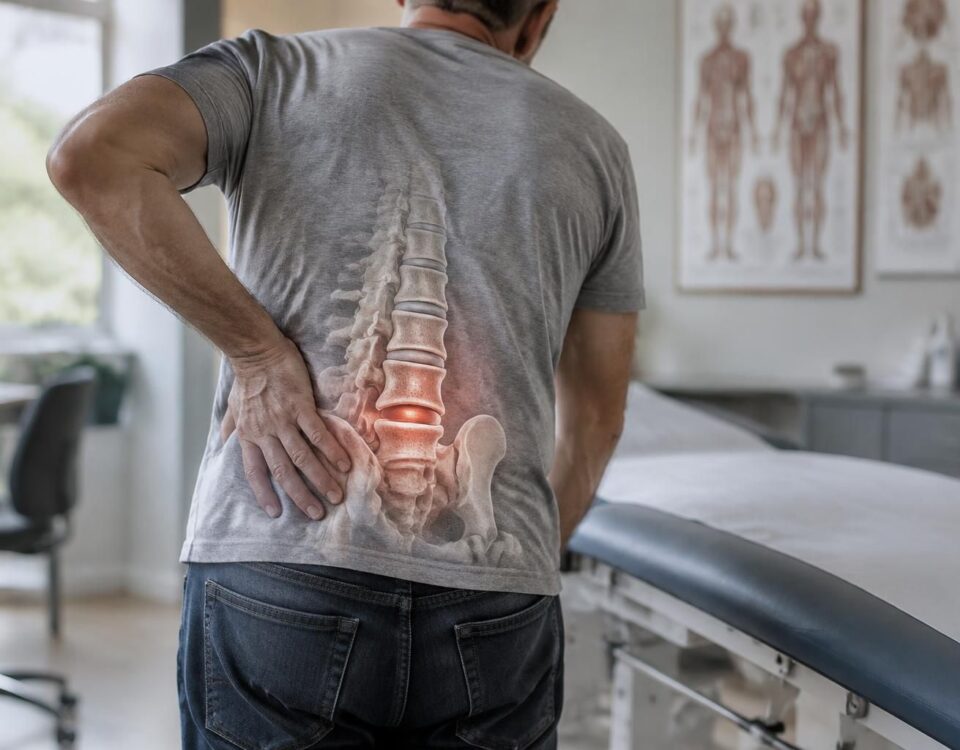
Sciatica and pain with progressive weakness
23/11/2026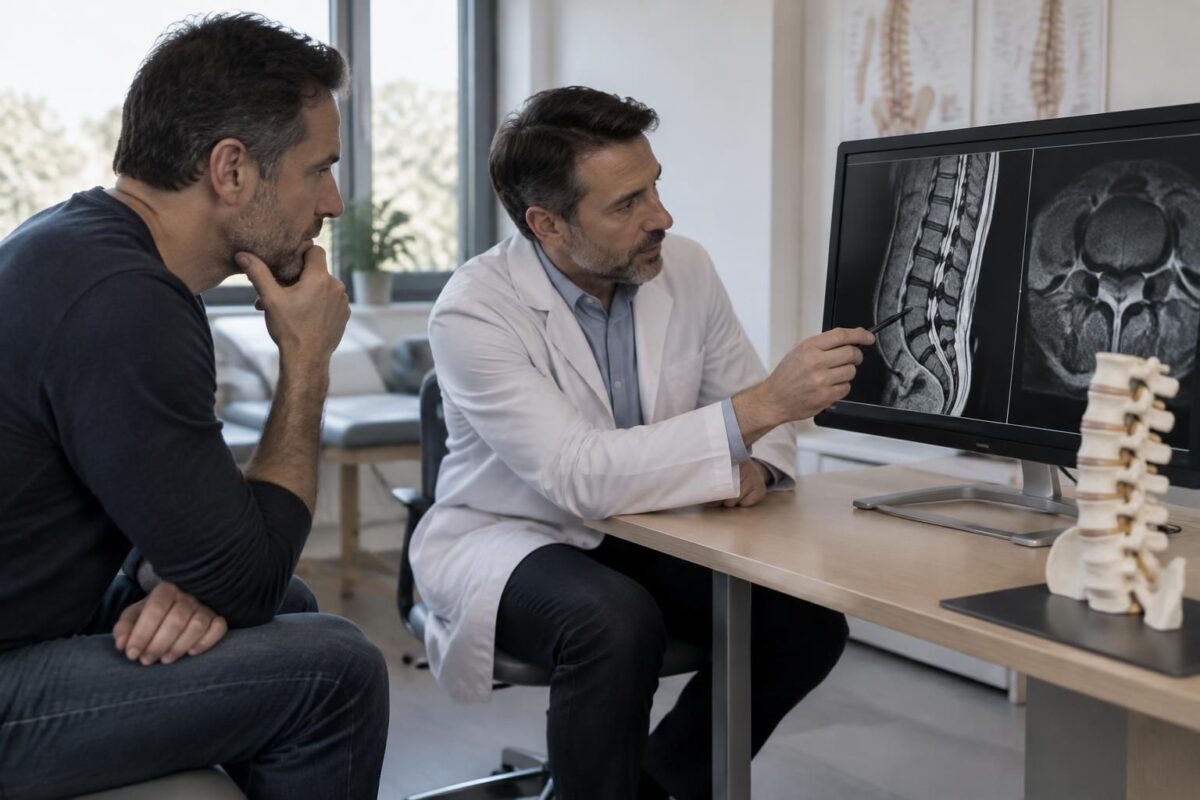
IN BRIEF A disc bulge is a protrusion of a disc visible on imaging; it is not sufficient on its own to explain pain or to make a diagnosis. Its interpretation must take into account symptoms, clinical examination, and context. This assessment helps to distinguish a finding without symptoms from nerve irritation and to guide care without prematurely concluding a herniated disc or sciatica. |
A disc bulge observed on imaging is not sufficient on its own to explain pain or to establish a diagnosis. Its significance must be related to symptoms, clinical examination, and other possible causes, such as a herniated disc or nerve root irritation. A professional assessment helps to guide care without jumping to conclusions.
A disc bulge describes a shape observed on imaging of the spine. This result is not sufficient on its own to explain pain or to establish a complete diagnosis. The healthcare professional must relate the images to symptoms, clinical examination, and the person’s progression. This distinction helps to avoid hasty conclusions and to choose appropriate care.
The discs are located between the vertebrae. They help distribute loads and allow movement of the spine. A disc bulge corresponds to a protrusion of the contour of the disc. It can be observed at various lumbar levels and does not automatically mean that a nerve is compressed.
An imaging report describes anatomical elements. It does not replace the evaluation of a professional. Some people have a disc bulge without pain. Conversely, a person may experience significant symptoms even if imaging shows only modest changes. Therefore, the result must be interpreted while considering the history of symptoms and clinical examination.
The disc bulge is not automatically the cause of pain
Lower back pain or pain that radiates into the buttock and leg can have several causes. The disc may be involved, but other structures may also contribute to the symptoms. The localization of the pain, sensations of tingling or numbness, as well as the presence of weakness, provide useful information. None of these signs should be interpreted in isolation.
Pain that follows the leg may sometimes correspond to irritation of a lumbar nerve root. However, its presence alone does not confirm compression caused by a bulge. The assessment must verify whether the level described on imaging corresponds to the side and area of symptoms.
What imaging can show, and what it cannot confirm
X-rays, computed tomography, or magnetic resonance imaging can help detect changes in the spine. These tests do not directly measure pain intensity and do not always determine which structure is responsible for the symptoms. The professional also considers the duration of the pain, its progression, and its effects on daily activities.
The terms bulge, protrusion, and herniated disc are not interchangeable. They describe different shapes or modifications of the disc. Their significance depends on the clinical context. To understand the possible link between a protrusion and nerve symptoms, consult the article on disc protrusion and nerve inflammation.
A bulge may also be present with signs of lumbar degeneration. These observations should be contextualized within the individual rather than considered as an automatic explanation for every pain. To learn more, read the article on disc protrusion and lumbar degeneration.
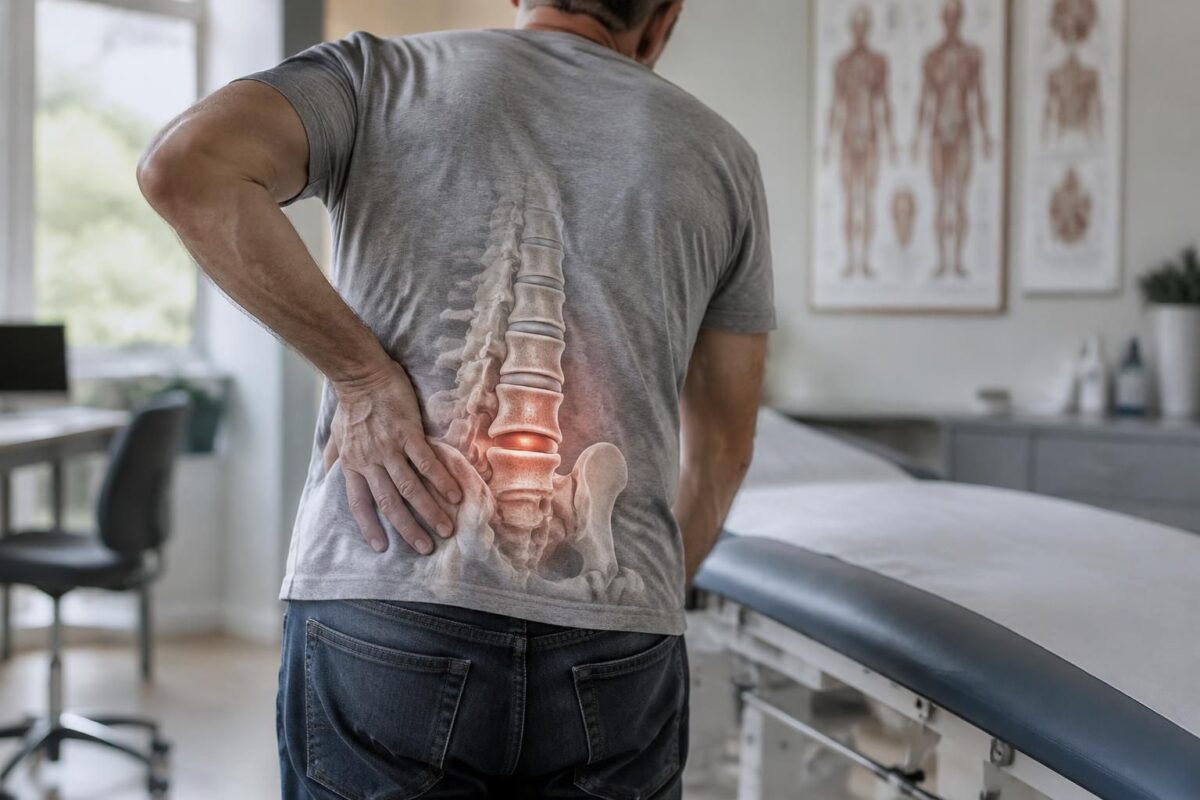
Disc bulge and lumbar osteoarthritis
IN BRIEF A disc bulge is a protrusion of the lumbar disc; wear can also contribute to lumbar osteoarthritis and lower back pain. Symptoms vary by individual and may sometimes radiate into the leg. Motion imaging may be considered by…
Why symptoms may return
Pain can fluctuate over time. A period of well-being does not always mean that all possible causes have disappeared. Similarly, the return of pain does not prove that a bulge has worsened. Activities, tolerance to loads, sleep, and other factors can influence symptoms.
When pain returns, a new assessment can help verify its evolution and determine whether the symptoms still correspond to the initial picture. The article on disc bulge and recurring pain explains why a recurrence does not alone allow for a conclusion about the condition of the disc.
The location of symptoms matters
A bulge at L4-L5 may be associated with pain in the leg in some cases, but the image alone is not sufficient to confirm this relationship. The professional compares the observed level with the painful area and other clinical signs. Consult the information on disc bulge L4-L5 and pain in the leg.
A bulge at L5-S1 may also be mentioned in a report when pain extends down to the foot. This association does not automatically confirm that the disc is responsible. The examination should evaluate the trajectory of the pain, sensations, and strength. To delve deeper into this topic, consult the article on disc bulge L5-S1 and pain towards the foot.

Disc bulge and narrowed foramen
IN BRIEF A disc bulge is a protrusion of the disc that can contribute to narrowing the foramen, the opening where a nerve root passes through. If this is irritated or compressed, pain, tingling, or weakness may occur, sometimes extending…
How a relevant evaluation is conducted
An evaluation begins with questions about symptoms: their onset date, location, intensity, and factors that modify them. The professional then examines movements and relevant functional signs, within the limits of their practice. They may also consider previously conducted examinations.
This approach helps to distinguish an imaging result from a clinical diagnosis. It also allows for identifying situations that require medical advice or additional examinations. If several explanations remain possible, the professional may recommend a medical consultation rather than jumping to a swift conclusion about a single cause.

Disc bulge and loss of disc height
IN BRIEF A disc bulge is a protrusion of the disc between the vertebrae; a loss of disc height means that the disc has thinned. These changes may be related to wear and sometimes contribute to pain, stiffness, or nerve…
What options may be discussed
The management depends on the assessment, symptoms, and needs of the individual. A professional can explain the different non-surgical options within their area of practice and discuss their limitations. At the TAGMED Clinic, care may include, depending on the assessment, motorized neurovertebral decompression, specific osteopathy, or a precision impactor. These approaches do not replace medical diagnosis and may not be suitable for every person.
For information about the services, you can consult the TAGMED Clinic, which sees patients in Montreal and Terrebonne. An assessment allows you to check if the services offered correspond to the situation and if a medical opinion is needed first.

Disc bulging and disc degeneration
IN SHORT A disc bulge is a protrusion of the disc, sometimes associated with disc degeneration related to aging. These visible changes on imaging do not always cause symptoms. Their significance is determined by comparing the MRI to pain, strength,…
When to quickly seek medical advice
Consult a doctor or emergency service in case of loss of bladder or bowel control, numbness in the saddle area, significant or progressive weakness in a leg or foot, fever, recent trauma, severe pain, or rapid deterioration. These signs require prompt assessment and should not be attributed without examination to a disc bulge.
About the author
Sylvain Desforges, B.Sc., D.O., N.D., Doctor of Osteopathy and naturopath, is the founding president of TAGMED and the ACMA association. He dedicates his practice to chronic spinal pain, low back pain, and pain associated with sciatica, especially when pain radiates down to the hip, leg, calf, foot, or toes.
Through SOS Sciatica, he publishes educational content on the symptoms of sciatica, possible causes such as disc herniation, disc pinching, foraminal stenosis, or irritation of a lumbar nerve root, as well as non-surgical approaches that may be considered depending on the assessment. At the TAGMED Clinic, care may include, depending on the case, motorized neurovertebral decompression, specific osteopathy, or a precision impactor.
For an evaluation related to the treatment of sciatica in Montreal / Mont-Royal or the treatment of sciatica in Terrebonne, check the available services at the TAGMED Clinic.
Medical Disclaimer
The information published on SOS Sciatica is provided for educational purposes and does not replace a consultation, diagnosis, opinion, or treatment by a doctor or another licensed health professional. The author of this article is neither a doctor nor a specialist in a medical specialty recognized by the Collège des médecins du Québec. The osteopathy, manual therapy, or functional support approaches described on this site do not constitute medical acts and are not intended to replace medical follow-up. Consult a doctor or emergency service in case of loss of bladder or bowel control, numbness in the saddle area, significant or progressive weakness in the leg or foot, fever, recent trauma, severe pain, or rapid deterioration. For more details, please read our Legal Notice.
Medical Non-Responsibility Notice: The information and advice provided on this site do not replace the advice, diagnosis, or treatment of a health professional. Please note that Sylvain Desforges, B.Sc., D.O., N.D., doctor of osteopathy, is neither a medical doctor nor a physician, and is not a specialist in a medical specialty as defined by the Collège des médecins du Québec. Manual therapy, functional medicine, and sports medicine as described on this site exclude any treatment or medical diagnosis performed by a physician or medical specialist. Always consult your doctor for any medical questions. For more details, please read our complete Legal Notice.
What a disc bulge may indicate
- A change in the disc, common and sometimes asymptomatic.
- Possible nerve irritation if the signs align, such as pain radiating down the leg.
- An imaging finding to be interpreted alongside clinical examination.
What to avoid concluding too quickly
- That the bulge is necessarily the cause of the pain.
- That it automatically indicates a herniated disc or sciatica.
- That precise treatment is necessary without evaluating the symptoms, their progression, and other possible causes.

A disc bulge describes a change in the shape of a disc between the vertebrae, but this finding is not enough to explain pain or to establish a complete diagnosis. A relevant assessment takes into account symptoms, clinical examination, and, when indicated, imaging. Here are recommendations for interpreting this result without jumping to conclusions and for choosing an appropriate approach.

Herniated disc and recurring pain
IN BRIEF A disc bulge is a disc that protrudes without necessarily being ruptured; it does not always cause pain. When pain returns, it may be related to nerve irritation, but a professional must verify the link with the symptoms.…
Understanding what a disc bulge means
Intervertebral discs contribute to mobility and shock absorption in the spine. A bulge corresponds to a protrusion of their contour; it does not automatically mean that there is a herniated disc, nerve compression, or an injury causing the symptoms. These terms describe different findings, the significance of which depends on their location and relationship to adjacent structures.
Disc bulges are sometimes observed in individuals who experience no pain. Conversely, low back pain or pain radiating down to the hip and leg may require assessment even if imaging does not show significant bulging. Therefore, it is best not to rely solely on the radiological report.

Disc bulge and pain after exertion
IN BRIEF A disc bulge is a disc that slightly protrudes between two vertebrae; after exertion, it may be associated with low back pain, sometimes radiating into the leg. An imaging result alone is not enough to explain the pain…
Avoiding shortcuts in diagnosis
Linking the image to the symptoms
The professional must check if the level and side of the bulge match the pain area, sensations of tingling or numbness, and any movement difficulties. Leg pain radiating may be compatible with nerve irritation, but other causes are possible. The term “sciatica” describes a set of symptoms; it does not, alone, specify their origin.
Consider the entire clinical picture
A serious approach takes into account the evolution of the pain, activities that trigger or relieve it, medical history, and the examination of sensitivity, strength, and movement. Imaging is not always necessary right away. A doctor may recommend it when symptoms persist, worsen, or raise a specific clinical question. An imaging result must always be interpreted in this context.

Disc bulge and tingling in the foot
IN SHORT A disc bulge refers to a disc that bulges beyond its boundary; if it irritates a nerve root, it can contribute to tingling in the foot, numbness, or pain in the leg. However, MRI alone is not sufficient…
Recommendations for the future
Ask the professional accompanying you to clearly explain the report: which disk is involved, what the term used means, and whether the findings correspond to your symptoms. Avoid self-diagnosing based solely on an image or an online article. If the pain disrupts your activities or persists, a personalized assessment may help determine the next steps.
Depending on the situation, care may include advice on activities, adapted exercises, and non-surgical support. At TAGMED Clinic, approaches such as specific osteopathy or motorized neurovertebral decompression may be considered after assessment when appropriate. No treatment is suitable for everyone: goals and limitations must be explained before starting.
Consult a doctor or emergency service quickly in case of loss of urinary or bowel control, numbness in the saddle region, significant or progressive weakness in the leg or foot, fever, or severe pain that worsens rapidly. These signs require immediate medical evaluation.

Disc bulge and intermittent numbness
IN SHORT A bulging disc associated with intermittent numbness may sometimes indicate nerve irritation, but an MRI alone does not allow determining the cause. Connecting the symptoms’ path, sensitivity, and strength helps guide the evaluation and next steps. New or…
About the author
Sylvain Desforges, B.Sc., D.O., N.D., Doctor of Osteopathy and Naturopath, is the founding president of TAGMED and the ACMA association. His practice focuses in particular on chronic spinal pain and pain compatible with sciatica.
Medical disclaimer: this information is educational and does not replace a consultation, diagnosis, or treatment by an authorized health professional. The author is neither a doctor nor a specialist in a medical field recognized by the Collège des médecins du Québec. The approaches described do not constitute medical acts nor a replacement for medical follow-up.
Disc bulge: what imaging alone cannot establish
| Element | To be interpreted with caution |
|---|---|
| Disc bulge on imaging | Does not prove, alone, the cause of the pain. |
| Presence of symptoms | A bulge can be observed without pain. |
| Pain radiating in the leg | Must be related to the clinical examination and imaging. |
| Location and level | A match with the symptoms is important. |
| Other possible causes | A hernia, stenosis, or nerve irritation may also be considered. |
| Treatment choice | It depends on the overall picture, not just a single radiological term. |
| Warning signs | Progressive weakness, saddle numbness, or urinary issues: consult quickly. |
Disc bulge: illustrative testimonies and a diagnosis not to be oversimplified
Important: the stories below are fictional examples created for educational purposes. They do not correspond to authentic patient testimonials and do not allow predicting the evolution of an individual situation.
“My imaging showed a disc bulge, but I didn’t know if it explained my pain.” This illustrative situation reminds us that a disc bulge observed in imaging alone is not sufficient to establish the cause of symptoms. The health professional also considers their location, evolution, clinical examination, and other elements of the case.
“I had pain in my buttock and leg, and I thought the report explained everything.” In this fictional example, the person discovers that pain radiating down the leg can have different causes. The interpretation of the bulge must be related to the trajectory of the pain, sensations, strength, and examination results.
“The term ‘disc bulge’ worried me, but I didn’t know what it meant for me.” An imaging report describes anatomical observations; it does not always, by itself, provide a complete diagnosis. Some disc anomalies may be present without directly explaining the symptoms. It is therefore best to ask a qualified professional to clarify their significance in the specific context of the individual.
“I understood that I should avoid drawing a conclusion from a single word.” This fictional example emphasizes that a diagnosis is not limited to the presence of a bulge. History, observed signs, symptom progression, and, when necessary, other examinations can contribute to the assessment. A cautious approach helps avoid hasty conclusions.
If you have received a result indicating a disc bulge, discuss it with a doctor or another authorized health professional who can interpret it according to your symptoms and situation. The information presented here is educational and does not replace a consultation or diagnosis. Consult a medical service quickly in case of loss of urinary or bowel control, numbness in the saddle region, significant or progressive weakness, or rapid worsening.
Sylvain Desforges: disc bulge and diagnosis not to be simplified
Sylvain Desforges, B.Sc., D.O., N.D., Doctor of Osteopathy and Naturopath, is the founding president of TAGMED clinics and the ACMA association. His career is dedicated to innovation in health and supporting individuals suffering from persistent pain, particularly in the spinal area. In his practice, he focuses on technologies and non-surgical approaches that may be considered based on the needs and assessment of each individual, such as neurovertebral decompression, laser, and shockwave therapy.
The disc bulge is a description observed in imaging: an intervertebral disc protrudes beyond its usual contour over a certain extent. This observation alone is not sufficient to determine the cause of pain or to establish a complete diagnosis. Bulges may be present in individuals who experience no symptoms. Conversely, significant pain can have multiple causes, with or without visible disc anomaly. The image must therefore be interpreted alongside the clinical picture, and not in isolation.
For Dr. Desforges, evaluating a spinal problem should not reduce the situation to a single radiological expression. The location of the bulge, its significance, the structures potentially involved, and the symptoms reported must be examined discerningly. For example, low back pain does not automatically mean that a disc is responsible. The evolution of symptoms, the activities that modify them, past medical history, and the results of the examination conducted by a qualified professional should also be considered.
When the pain radiates into the buttock or leg, nerve root irritation may be considered, but it is not confirmed by the mere presence of a disc bulge. Clinical examination and, when indicated, imaging studies help to clarify hypotheses and verify their consistency. Other possible causes, such as joint involvement, foraminal narrowing, or another condition, may require particular attention. The diagnosis thus depends on a set of clues, and not a simplified reading of a report.
His approach emphasizes individualized care based on available data. Manual interventions or technologies such as decompression, laser treatment, or shockwave therapy may not suit everyone and do not guarantee a specific outcome. Their relevance must be assessed according to the situation, goals, and precautions specific to each person. A medical consultation may be necessary to establish or confirm a diagnosis and determine the appropriate course of action.
The information presented here is educational and does not replace medical advice. Seek prompt medical attention or visit an emergency service in case of loss of bowel or bladder control, numbness in the saddle area, significant or progressive weakness in a leg or foot, fever, recent trauma, or rapid worsening of symptoms.
A disc bulge observed in imaging is not sufficient, on its own, to explain a pain or to establish a complete diagnosis. To understand its significance, symptoms, their evolution, the clinical examination, and imaging results must be correlated, and it must be verified whether other causes might contribute to the picture.
Understanding what the imaging shows
A disc bulge describes a change in the shape of a disc between two vertebrae. It can be present without causing symptoms. Conversely, when there is pain, one should not automatically conclude that the bulge is the cause: its location, significance, and its relationship with nearby structures must be interpreted in the context of each individual.
Thus, the diagnosis should not be reduced to a single image or label. It must take into account the pain trajectory, any numbness, the strength and sensitivity of the leg, the factors that aggravate or alleviate symptoms, and their duration. For example, pain in the buttock can have multiple origins; the link between a disc bulge and buttock pain should be evaluated cautiously.
Examining symptoms and other factors
When the space around a nerve root appears reduced, the location and actual effects of this reduction matter. A disc bulge associated with a narrowed foramen does not necessarily mean a nerve is symptomatically compressed. The examination must determine whether the reported signs correspond to the affected area and whether the progression justifies further investigation or management.
Symptoms may also vary depending on the activities. Pain that arises or worsens while walking should be described in detail: tolerable distance, posture, recovery time, and any presence of weakness or numbness. These elements help distinguish different possibilities, rather than attributing the difficulty to a single imaging finding. To learn more, refer to the article on disc bulge and pain while walking.
An intermittent numbness should also be interpreted according to its frequency, duration, location, and the circumstances under which it occurs. If the symptoms suggest nerve irritation, other factors—such as a disc herniation or foraminal narrowing—may also be taken into account. The context described in the article on sciatica and disc herniation in Terrebonne illustrates why the analysis cannot be limited to the name of a radiological abnormality.
Choosing an appropriate approach
An evaluation allows for discussions about options based on symptoms, capabilities, and the person’s goals. Depending on the case, a non-surgical approach may be considered; however, it must be individualized and does not replace a medical diagnosis when indicated. At TAGMED Clinic, services may include, based on the evaluation, motorized neurovertebral decompression, specific osteopathy, or precision impactor. To learn about services related to sciatica treatment in Montreal / Mont-Royal or sciatica treatment in Terrebonne, consult the TAGMED Clinic.
Significant or progressive weakness in a leg or foot, loss of bladder or bowel control, numbness in the saddle area, fever, recent trauma, severe pain, or rapid worsening requires urgent medical consultation. These signs should not be managed solely through a manual or functional approach.
About the author
Sylvain Desforges, B.Sc., D.O., N.D., Doctor of Osteopathy and Naturopath, is the founding president of TAGMED and the ACMA association. He dedicates his practice to chronic pain of the spine, low back pain, and pain compatible with sciatica, particularly when the pain radiates into the buttock, leg, calf, foot, or toes.
Through SOS Sciatique, he publishes educational content on the symptoms of sciatica, possible causes such as herniated disc, disc pinching, foraminal stenosis, or irritation of a lumbar nerve root, as well as on non-surgical approaches that may be considered based on evaluation. At TAGMED Clinic, care may include, depending on the case, motorized neurovertebral decompression, specific osteopathy, or precision percussion.
Medical Disclaimer
The information published on SOS Sciatique is provided for educational purposes and does not replace a consultation, diagnosis, opinion, or treatment performed by a physician or other licensed healthcare professional. The author of this article is neither a physician nor a specialist in a medical specialty recognized by the Collège des médecins du Québec. The approaches of osteopathy, manual medicine, or functional support described on this site do not constitute medical acts and are not intended to replace medical follow-up. For more details, please read our Legal Notice.

Sylvain Desforges, B.Sc., D.O., N.D., docteur en ostéopathie
Dr Sylvain Desforges, B.Sc., D.O., N.D., osteopath, is the founding president of TAGMED and of the ACMA association. He dedicates his practice to chronic spinal pain, low back pain and symptoms compatible with sciatica, particularly when pain radiates toward the buttock, leg, calf, foot or toes.
Through SOS Sciatique, he publishes educational content on sciatica symptoms, possible causes such as disc herniation, disc narrowing, foraminal stenosis or irritation of a lumbar nerve root, as well as non-surgical approaches that may be considered according to the evaluation. At Clinique TAGMED, care may include, depending on the case, motorized neurovertebral decompression, specific osteopathic care or precision percussion.
For an evaluation related to sciatica treatment in Montreal / Mount Royal or sciatica treatment in Terrebonne, please consult the services available at Clinique TAGMED.
Medical disclaimer
The information published on SOS Sciatique is provided for educational purposes only and does not replace a consultation, diagnosis, opinion or treatment provided by a physician or another authorized healthcare professional. The author of this article is neither a medical doctor nor a specialist in a medical specialty recognized by the Collège des médecins du Québec. The osteopathic, manual medicine or functional support approaches described on this site do not constitute medical acts and are not intended to replace medical follow-up.
Consult a physician or emergency service in cases of loss of bladder or bowel control, anesthesia in the saddle area, significant or progressive weakness in the leg or foot, fever, recent trauma, severe pain or rapid worsening of symptoms. For more details, please read our Legal Notice.